




Abstract
Antecedents
Writing on the occasion of the centennial birth of the State Agricultural Experiment Station (SAES) system, Administrator John Patrick Jordon credited it with fomenting “nothing less than a scientific revolution.” 1 The SAES system that he celebrated is a uniquely American research innovation. Much admired around the world, poorly understood at home, and still evolving, it sprang to life during the latter decades of the nineteenth century, a time of immense change in the United States. Farmers represented roughly 50% of the US labor force as late as 1880, yet their lives were barely touched by the scientific and technological advancements that had begun to bring about radical transformation in the country. The west was being settled, cities were beginning to urbanize, and the nation was undergoing a period of rapid industrialization. These dynamics kindled the political will to establish a research system that would bring scientific advances to bear on the needs of farmers. Momentum began building in the 1860s and 1870s and culminated with the passage of the Hatch Act. President Grover Cleveland signed it into law in the spring of 1887.
With a stroke of his pen, Cleveland created the foundation of today's SAES system. Federal funds—originally $15,000 per year—were to be appropriated annually to each state, provided that it established and maintained an “agricultural experiment station” for “scientific investigation and experiment respecting the principles and applications of agricultural science.” The states responded quickly, and the network soon appeared on the landscape, with each individual SAES most often on or adjacent to the campus of a land grant university. The Hatch Act assured that research in each state would remain under local control, yet mandated that a single system would be created and function under the auspices of what is now the US Department of Agriculture (USDA).
Today's SAES system stands as a novel, decentralized confederation between state and federal governments. On the one hand, each state is granted latitude in structuring its SAES, in setting its own priorities, and in specifying how research is to be conducted. On the other hand, the involvement of the USDA and the need to secure annual federal appropriations ensure a significant degree of coordination across the system. All of these activities are guided collectively by farmers and agricultural stakeholder groups, which have from the beginning insisted that agricultural research have one key attribute: utility. Investigations were and still are to be conducted not merely for the sake of discovery and the advancement of knowledge, but also for their practical usefulness to those in the business of producing food.
Although debate about how best to orient the SAES research portfolio to the needs of the US food production system is ongoing, responsiveness to stakeholders is deeply embedded in the culture of the system and remains as an overarching principle. Relevance matters, but we also must acknowledge that much has changed—politically, demographically, and technologically—during the more than 125-year interval between enactment of the Hatch legislation and the present. Although the fundamental relationship between the original players remains intact, the SAES system has been under virtually continuous challenge by a number of factors, among them the advent of biotechnology and its implications for agriculture and food production.
Along Comes Biotechnology
In celebrating the centenary of the SAES system, Administrator Jordan singled out biotechnology as a “fantastic tool,” predicting that it “will provide a key in unlocking the answers to challenges facing both society and agricultural research today as well as tomorrow.” 1 More accurately described as a box of tools rather than just one, biotechnology exploits a well-known collection of techniques that trace back to the late 1960s and early 1970s and that have been applied broadly to biological systems. Among them are genetic engineering, use of molecular markers, molecular diagnostics, tissue culture, and whole plant regeneration, as well as bioinformatics and the rapidly maturing approaches collectively identified as “omics.” 2 By exploiting these tools, agricultural biotechnology has indeed fulfilled many promises, just as foretold by Jordan and others. In a few short years it has become interwoven with a long, progressive series of efforts to improve both deliberately and systematically the plants, animals, and microorganisms that humans use for food and in the preparation of food. 3
Most of the technologies in today's biotechnology toolbox emerged from scientific fields other than agriculture. Adoption of these tools by agricultural scientists, including many in the SAES system, was nonetheless swift, and over the ensuing 40 years, these tools have enabled agricultural researchers to make progress that otherwise would have been inconceivable. 4 –6 In a few cases, the SAES system has even added items to the biotechnology toolbox, as for example with the invention of the gene gun, which allows biolistic delivery of nucleic acid-coated particles into living cells. 7 These contributions are significant, but they often obscure a parallel issue that is our focus here: How has the modern SAES system been shaped by agricultural biotechnology? And how will this research enterprise be further molded as these technologies become more numerous, powerful, and sophisticated?
Timing was important from a historical perspective. The first in a series of influential research reports advisory to the USDA was commissioned by the National Research Council and delivered in 1972, roughly coincident with the advent of biotechnology. 8 This document, as well as its 1989 and 2000 successors, called for major changes in agricultural research investment by the public sector, including that conducted by the SAES system. 9,10 The experts advised policymakers to infuse significantly more money into agricultural research and to revise the funding model so that a greater proportion of public resources would be awarded competitively to expand the core of knowledge relevant to agriculture. These recommendations, particularly the call for emphasis on basic investigations and core knowledge, anticipated the power of biotechnology and sought to validate the application of fundamental science to practical agricultural issues.
The proposed changes nevertheless challenged the traditional model, with its reliance on annual, formula-based appropriations to individual states (in contrast to competitive funding to individual investigators) and emphasis on applied research to address local problems (in contrast to more basic investigations with longer intervals between discovery and practical solutions). 11 The recommendations were never fully implemented, as confirmed by the appearance in 2012 of yet another report from the President's Council of Advisors on Science and Technology that called for the same suite of reforms. 12 Policy momentum was nonetheless created at precisely the time when new approaches first became available, and this primed the SAES system to embrace agricultural biotechnology.
Timing was important in another way, too. Agricultural biotechnology first took serious hold in the 1970s and early 1980s, just as a new generation of late baby boomer scientists entered the workplace. Many had been trained in biotechnological fields distant from agriculture, and although they often had little familiarity with practical agricultural problems of the sort that occupied the SAES system, they recognized the potential application of the new tools to solve problems of agriculture and food production. Eager to apply their skills to issues of relevance to society, they became available just as biotechnology began to make its first inroads into the SAES system. Simultaneously, a number of physiologists, biochemists, and geneticists who had been working in agriculture recognized the potential of biotechnology and retooled their research programs to take advantage of it.
The inability to pinpoint a start date for the adoption of agricultural biotechnology by the SAES system reflects both the decentralized nature of the system and the fact that change occurred gradually over the period of a decade or more. Several states nevertheless undertook formal initiatives in agricultural biotechnology, among them Illinois and Missouri. The Animal Science Department at the University of Illinois was an early innovator, hiring its first two biotechnologists in 1983–1984. This decision, which was not without controversy (Neal Merchen, personal communication), primed the Illinois SAES for a broader subsequent hiring initiative that coincided with the construction of a modern laboratory building to house the university's new biotechnology research programs.
The University of Missouri's Food for the 21st Century Program is another early initiative that was rooted not in an academic department but in the SAES itself. Beginning in 1984, Missouri began to invest in scientists, infrastructure, and targeted research projects with an explicit biotechnological orientation. The initial resources came from the university, but legislative funding eventually was secured. Early emphasis focused on the plant sciences and on animal reproductive biology. The Food for the 21st Century Program has evolved over the decades and is still in existence, 30 years after its inception.
Impacts on the Culture of the SAES System
The advent of agricultural biotechnology unleashed a series of transformational changes within and surrounding the SAES system during the last decades of the twentieth and the early years of the twenty-first century. 11,13,14 Some of these changes soon became apparent, but others revealed themselves more slowly. Some were subtle, and many could not have been anticipated. Biotechnology was by no means the only force impacting the SAES system during this period, but it was especially effective in heightening the competitiveness of agricultural research and removing barriers that had tended to isolate its agenda from that of the broader scientific community. 15 These dynamics played out during the early days of the competitive grants program within the USDA, when the availability of novel biotechnological approaches was invoked as justification for an infusion of congressionally appropriated funds. 1 The initial and successor competitive programs in the USDA solicited research proposals from non-SAES system and non-land grant university scientists and, from their inception, they funded significant amounts of basic biotechnological research, competitively and on the basis of merit.
As would be expected, the availability of new funding streams attracted the attention of SAES biotechnologists, many of whom responded by forging competitively funded collaborations with scientists outside of the SAES system. This process of reaching out was accelerated when the USDA entered into formal agreements with other federal agencies to underwrite large projects to sequence the genomes of agriculturally significant species such as maize and the cow. 16,17 SAES scientists often found themselves in the lead in forging complex consortia of researchers to undertake this work. In short, by exerting heavy influence on how public sector agricultural research is funded, biotechnology provided incentives for SAES scientists—and the SAES system itself—to be more innovative and interactive with other branches of the scientific community.
These were significant cultural changes, and from the very beginning they provoked deep introspection within the SAES system. 15,18 There is continuing debate, for example, about the competitive funding model and its possible negative impacts on traditional, formula-based SAES appropriations, which have become embedded in the base budgets of most land grant universities. There is anxiety that biotechnology may be inserting unintended bias into the SAES system, favoring larger institutions with the resources necessary to maintain needed but expensive research infrastructure. There is concern, too, that emphasis on biotechnology and related core science approaches is distancing the SAES research portfolio from its long-stated goal of meeting the practical needs of agricultural producers and other intended food system beneficiaries. These points of discussion were anticipated during the early age of agricultural biotechnology, and we can be sure that they will remain with us for the foreseeable future. 11,15
Impacts on Relationships with the Private Sector: Plant Breeding
The new tools of biotechnology have profoundly altered the way that the SAES system interacts with the private sector too, and no one area of agricultural research has been more influenced than that of plant genetics and breeding. 19,20 Biotechnology allows for the recombinant transfer of agriculturally desirable genes into crop species to generate genetically modified (GM) varieties. It also adds precision and efficiency to the breeding process, and it greatly shortens the breeding cycle. The marriage of biotechnology and plant breeding has consequently created major new markets for GM crop varieties with desired agronomic properties such as herbicide- and insect-resistance and other features.
Such varieties have been readily adopted by farmers, especially in the US and this in turn has created financial incentives for private sector research and development (R&D) investment. 21,22 The level of such investment in agricultural research first exceeded that of the public sector in the late 1970s, coincident with the advent of biotechnology. Except for a few small dips, it has consistently outstripped that of public sector investment in the intervening years (Figure 1).
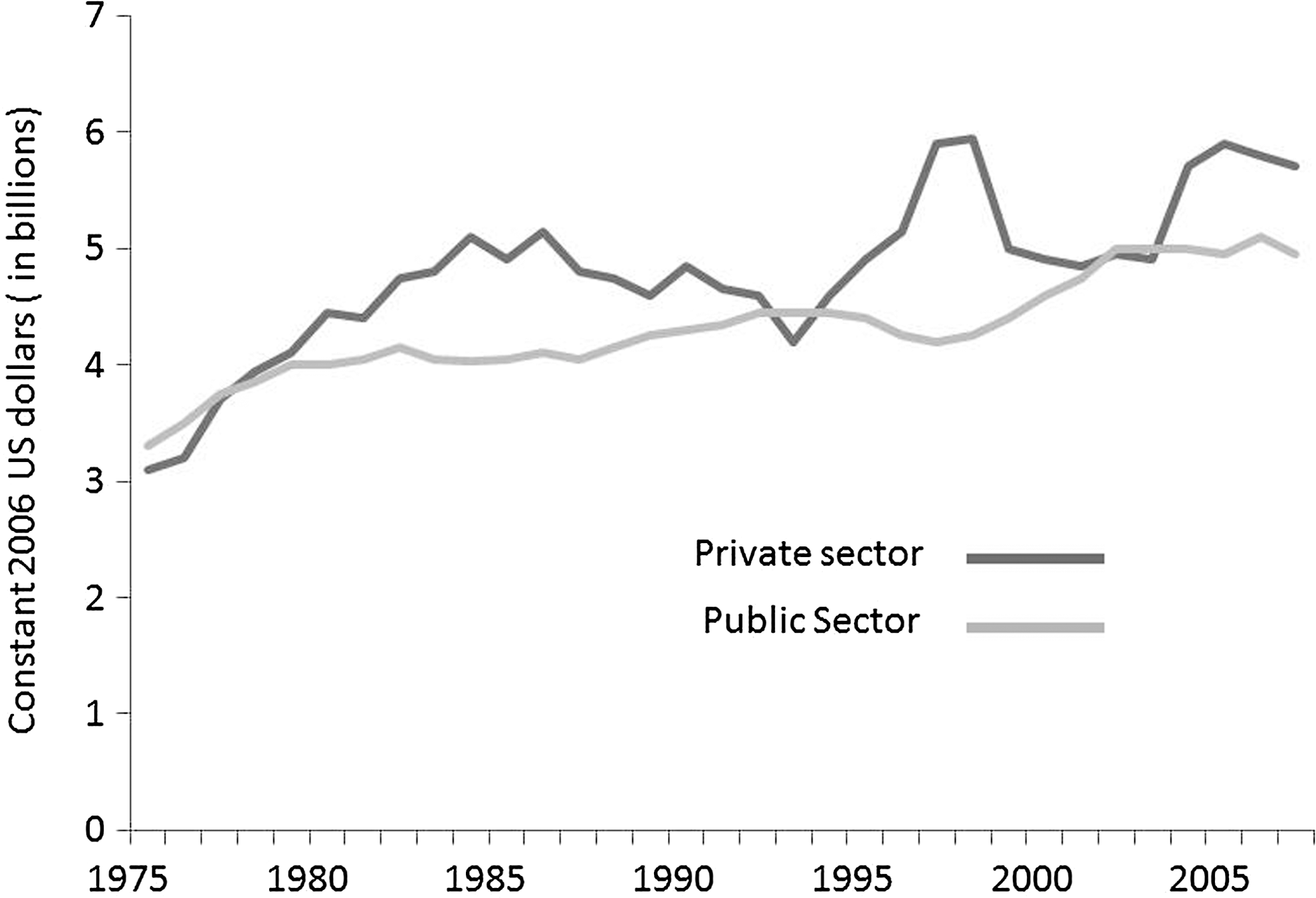
Recent US private and public sector R&D investment in food and agriculture. (Source: USDA Economic Research Service)
Efforts by the private sector to develop GM crops are market-oriented and thus distributed unevenly across species, with concentration on a few major high acreage crops, including maize, soybeans, canola, and cotton. 21 Analogous attempts to improve other crops have lagged, in part because of insufficient return to investors, but also because of regulatory impediments and issues of consumer acceptance. 23 Acting in concert, the above trends have refocused the SAES system's plant breeding portfolio away from release of varieties—especially in the major field crops, which are being dominated by GM varieties and for which private sector involvement is intense. 19
In short, biotechnology has altered the “who does what” equation in plant breeding, and these dynamics have played a major role in recalibrating the relationships between the SAES system and private sector firms. SAES plant breeders have not abandoned biotechnology, but they have been forced to shift emphasis to upstream elements of the R&D pathway, including basic discovery research, genetic investigations, and release of germplasm rather than varieties. Investments by firms in public sector genetics and plant breeding programs have become more important as research costs have risen, and this has highlighted the general issue of intellectual property rights. 23,24 Concurrently, the public and private sectors are working together to ensure that the future supply of plant breeders—the majority of whom are trained at land grant universities—is not choked off as biotechnology continues to shift the roles of the public and private sector. 19
Impacts in the Regulatory and Public Arenas
Commercialization of the products of agricultural biotechnology has drawn agricultural researchers out of the laboratory and thrust them into new territory as honest brokers at the intersection of science and public policy. In part this reflects respect for their technical expertise, but it also relates to the perceived objectivity of SAES scientists in addressing complex and sometimes contentious issues. The role of honest broker was at first unfamiliar, but with the passage of time, many SAES scientists have become adept at navigating the public policy arena. The SAES system as a whole has consequently assumed a position of influence, especially in the approval process for release of GM crops and in guiding public perception of these crops and the foods derived from them.
Regulatory approval by federal authorities is required for the registration and field testing of GM crops in the US, as well as for their consumption as food.
25
–28
These decisions are guided by science and based on a coordinated framework of legal authority granted by federal statute. Details of the approval process vary by agency, and because the underlying issues can be complex, agencies often call on public sector experts for advice. This is particularly true for the US Environmental Protection Agency (USEPA), which holds authority to register plant-incorporated protectants such as the widely used insecticidal Bacillus thuringiensis, or Bt toxins. USEPA routinely receives input from SAES system experts and also makes extensive use of Scientific Advisory Panels (
SAES scientists have also assumed important roles in what has become a never ending global controversy over GM foods. This debate has grown to encompass everything from possible environmental issues associated with planting GM crops, to the potential impacts of recombinant DNA on human nutrition and health, international marketing and trade, and proposals for mandatory labeling of GM foods. The dialogue has become highly polarized, pitting those who see agricultural biotechnology as an essential tool to combat hunger and improve nutrition against those who wish to ban the planting of GM crops. As public employees with technical expertise, SAES scientists are active in guiding the dialogue on GM foods, lending balance and objectivity to the discussion and ensuring that interpretations of what we know and do not know are sound and based on scientific evidence.
This discussion plays out in a myriad of ways that are often focused on specific issues of immediate local relevance. Workshops and panel discussions, published synopses and reviews, interactions with the press, and community discussions are often led in partnership with University Extension, the outreach-oriented counterpart of the SAES system. SAES scientists also are instrumental in facilitating ongoing high-level dialogue on GM foods via entities such as the North American Agricultural Biotechnology Council (
The decision to integrate biotechnology into the SAES research portfolio has enabled the system to draw broadly upon scientific advances, both in the public and private sector, for the improvement of agriculture. The process of becoming adept with the tools of biotechnology also has conferred an additional, unanticipated benefit on agricultural scientists: they have been challenged to confront societal concerns and help shape public policy. SAES investigators are becoming increasingly comfortable in these roles, which require the translation of scientific knowledge into a form that meets not only the needs of traditional agricultural stakeholders but also those of consumers and the regulatory agencies concerned with consumer well-being. These experiences have equipped agricultural scientists with the real world understanding necessary to guide the SAES system as it seeks to maximize the future contributions of biotechnology to agriculture. Information loops of this sort ensure that the tools of biotechnology—inconceivable at the time when President Cleveland took up his pen—remain an asset to the SAES system as it holds firm to the Hatch Act's original mandate for utility and relevance.