




Abstract

Introduction
There is a generalized perception of the emergence and expansion of the bioeconomy. An analysis including in-depth literature reviews, survey instruments, interviews, and a public-private workshop was undertaken to provide better quantification of this manifestation. The United States Department of Agriculture's (USDA's) BioPreferred® program presented and distributed the findings of this effort in October 2014 in a report titled, “Why Biobased? Opportunities in the Emerging Bioeconomy.”
1
The findings of this report included the following: • Government policies and industry business-to-business sustainability programs are driving the biobased economy • Across the globe, nations are investing in Public/Private Partnerships to expand their biobased economies for domestic and international consumers • In the US, the USDA BioPreferred program and federal funding continue to drive investment in research and development (R&D) and make available broader sets of biobased consumer products • Continued investments are needed to establish a biobased infrastructure while ensuring that the economics of biobased feedstocks are competitive with existing, petroleum-based feedstocks • An economic impact model is required to study the potential impacts of the bioeconomy and policies that can encourage investment. Such a model should include many of the factors identified in this report and it should predict changes to a wide range of outcomes, for example, impacts on jobs, job creation, gross domestic production (GDP), the environment, and national security
On October 7, 2014, USDA Secretary Tom Vilsack announced that his agency had just released this comprehensive report outlining the opportunities for the emerging bioeconomy. 1 As the authors of that report, we aim to provide a synthesis of our research and summarize why the analysis leads us to believe that various institutional drivers will lead to a further expansion of the industrial bioeconomy around the globe.
To frame the discussion, we define the bioeconomy as “the global industrial transition of sustainably utilizing renewable aquatic and terrestrial resources in energy, intermediate, and final products for economic, environmental, social, and national security benefits.” 1 The bioeconomy is characterized by a new generation of environmentally-friendly materials and products and economic opportunities for US-based agriculture, chemical, and manufacturing sectors and their value chains, with far-reaching potential impacts on socioeconomic development and the resurgence of production in the US. Because there has been extensive prior research on biofuels, our research excluded biobased fuels and energy sources and focused on understanding the emergence of biobased feedstocks for industrial and consumer goods. We based our findings on extensive literature reviews, interviews, a Duke Center for Sustainability & Commerce (DCSC) survey of industry as well as a joint DCSC and Yale Center for Green Chemistry & Green Engineering workshop held in Washington, DC.
Institutional Drivers
Public and private institutions play a critical role in the adoption and expansion of new technologies. We sought to understand what institutional drivers have been enacted specific to the utilization of biological feedstocks for industrial purposes. The analysis identified two specific entities that have a major influence in driving the future of the biobased economy: national governments and pre-competitive industrial associations.
In the United States, Section 9002 of the Farm Security and Rural Investment Act (FSRIA) of 2002, Public Law 107–171, authorizes the USDA to designate biobased products for federal preferred procurement. The US Farm Bill requires federal agencies to purchase biobased products designated for preferred procurement under the BioPreferred program, except as provided by Federal Acquisition Regulation (FAR) Part 23.404(b). In general, federal agencies are required to give preference to items with the highest percentage of biobased content when purchases exceed $10,000 per fiscal year, as prescribed by 7 CFR 3201.3. While this has stimulated federal acquisition of biobased products by the Federal government, consumer awareness has been heightened as a result of the Farm Bill authorizing USDA to implement a program to certify biobased products and creation of the “USDA Certified Biobased Product” label. The BioPreferred program was continued and strengthened under subsequent US Farm Bills in 2008 and 2014. While still in its early maturation, the recent 2014 US Farm Bill provides loan guarantees for biorefinery projects and funds for biomass research and development.
An additional element in how the government is promoting the biobased economy is the role of the executive branch. President Obama signed US Executive Order 13514 (October 5, 2009), making it a requirement under section 2h that federal agencies ensure that 95% of new contract actions, including tasks and delivery orders (excluding weapons), include biobased requirements. 2 This is in addition to the 2012 White House National Bioeconomy Blueprint to “strengthen bioscience research as a major driver of American innovation and economic growth” through five strategic imperatives including investments in R&D, transitioning bioinventions from lab to market, reforming regulations, working with academic institutions, and helping to support public-private partnerships.
Internationally, the Grenelle Law II in France has far reaching implications well beyond France or the European Union. The legislation, passed in 2012, requires companies to include information on their environmental and social performance, including all of the company's subsidiaries, in their annual report. Additionally and important to the future expansion of biobased products was the effort of the French Ministry for environment, energy, and sustainable development (MEDDE) in implementing a one-year national pilot on consumer product environmental information in 2011–2012. The trial covered the quantification of environmental impacts and the communication of the environmental footprint to the consumer of products via labeling. Currently, an evaluation report has been provided to the French Parliament and a stakeholder group has been formed to develop longer-term programs on communicating to consumers environmental impacts, including greenhouse gas emissions and resource utilization of consumer products.
Our interviews and surveys painted a rather clear and consistent insight from those involved in the purchasing and selling of consumer goods. There was consistency in the belief that stimulation of the bioeconomy is coming more from industry than government. In part, this movement is in response to industry perceptions of increased governmental pressures in the future, coupled with increasing consumer desire for more environmentally friendly products. Two of the most significant actions by industry have been the creation and launching of the Sustainable Apparel Coalition (SAC) and the Walmart led Sustainability Consortium (TSC), which now includes over 150 of the world's largest retailers, brands, and manufacturers from various sectors that are using the strength of their combined purchasing power to drive their vast global supply chain to improve the environmental performance of the consumer products that are manufactured and sold around the globe. Both the TSC and SAC utilize life cycle modeling or life cycle-inspired approaches to quantify the impacts of the resources and manufacturing practices used. Both of these efforts have resulted in various projects among suppliers to utilize biobased feedstocks in lieu of non-renewable resources for various products, such as those presented in Table 1.
Examples of Biobased Consumer Products 3
Individual firms such as Nike, Procter & Gamble, Coca-Cola, Heinz, and Ford, have also undertaken biobased product programs. This includes Coca-Cola's launch of the PET PlantBottle™ in 2009 containing biobased monoethylene glycol (MEG), which comprises approximately 30% of the bottle. 4 Ford has utilized soy-based material in its seats in over one million vehicles, which is estimated to have reduced carbon dioxide emissions by five million pounds annually. By 2010, over one million Ford vehicles contained soy foam products. 5 In addition, non-governmental organizations are also influencing how firms respond to environmental pressures and are investing in the industrial bioeconomy. In our research firms cited a successful campaign by Greenpeace called the “Detox Campaign,” in which they target global firms including Adidas, Nike, H&M, etc. to eliminate toxic chemical usage and wastewater discharges.
While not explicitly presented, it became clear in our research that a key driver for the expected expansion of the industrial bioeconomy will be firm and product transparency. As governments push for consumer sustainability labeling of products and for major multinational retailers and brands to require their supply chain to undertake life cycle assessment (LCA) or modified LCA of inputs for a product or good, in essence they are mandating increased transparency of the resources being used and the environmental impacts associated with their usage. These firms can and are using their purchasing strength to persuade suppliers to seek feedstocks and processes that have lower environmental impacts; biobased feedstock is perceived to provide that benefit and competitive advantage to suppliers as well as brands (Figure 1).
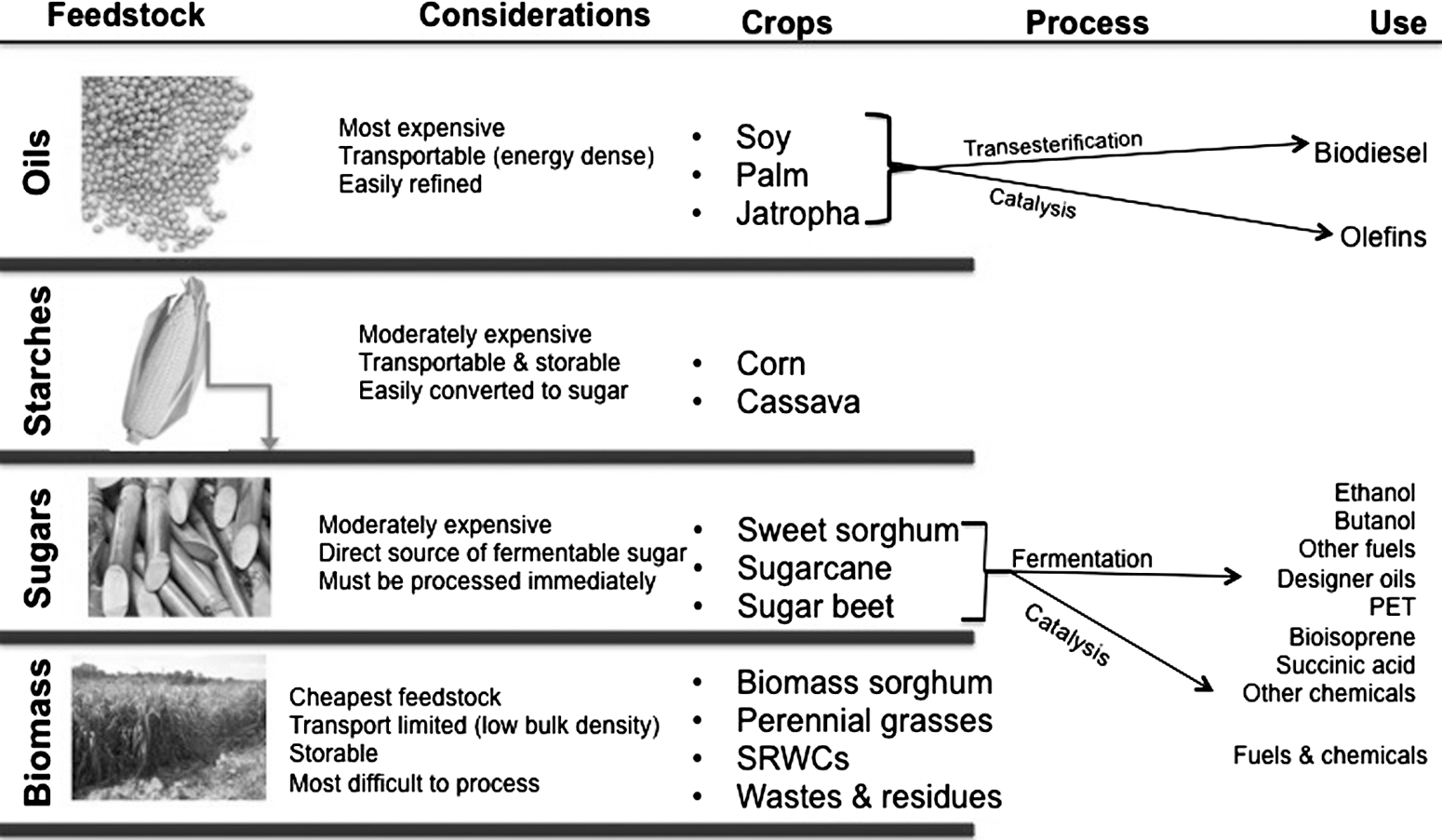
Considerations related to biobased feedstock: Golden & Handfield (2014) adapted from A. Rath (2012). 3
Forecasting the Opportunities
Around the world, over $400 billion worth of conventional manufacturing products are produced each year using biomass. In attempting to quantify more spatially specific data through existing literature, it became clear that the greatest amount of information available to date has been produced within the European Union. The EU estimates that the sectors that comprise the bioeconomy account for 22 million jobs, which is approximately 9% of the EU's workforce. 6 Aided by the stabilization in glycerin prices, the biobased chemical sector alone achieved a market value of $3.6B in 2011.
The literature indicated that biobased chemicals are expected to constitute the largest segment of potential growth for industrial biobased products. Projecting forward, it is estimated that by 2021, the global market for biobased chemicals will have increased to $12.2 billion, accounting for 25.4 billion pounds of biobased chemical production at the end of the decade. While this represents a significant increase, both Cargill and McKinsey & Company believe that there is potential to produce two-thirds of the total volume of chemicals from biobased material, representing over 50,000 products, a $1 trillion annual global market. 7
Most of the growth will occur in specialty chemicals and polymers. Specialty chemicals alone, such as adhesives, surfactants, and solvents, would constitute 60% of the total value of all the biotech-based chemical production in 2025. One specific biochemical sub-group that retailers and brands articulated as areas of increasing focus and opportunities was bioplastics. According to European Bioplastics (2013), global production of bioplastics is expected to increase by 500% by 2016. Commercialized polymers, such as polylactic acid (PLA) and polyhydroxyalkanoates (PHAs), have already established strongholds in the market, with a per annum growth in the range of 10–30%. 8 Additionally, the market for industrial enzymes also will experience strong growth beyond 2015, with 6.5% annual growth in the global enzyme market and global sales of $7.4 billion in 2015. 3
Within the United States, where 96% of all goods manufactured incorporate a chemical product and represent $3.6 trillion of the US GDP, there are great opportunities. 9 Shifting 20% of just the current plastics produced in the US into bioplastics could create about 104,000 jobs in the US alone. 10 The opportunities go beyond just the manufacturing centers across the US, which are typically located within urban regions. Rural areas can also realize economic growth and job creation with the expansion of the bioeconomy. The literature specifically calls out the conversion of lignocellulosic biomass as a mechanism to support rural economies. One recent study concluded that in a 98-county area in the mid-to-south Mississippi Delta region, lignocellulosic feedstock processing utilizing 10% of cropland, 25% of idle lands, 25% of conservation reserve program land, and 15% of pasture land would support a biomass industry worth over $8 billion annually and create 50,000 jobs by 2030 in the study area alone. 11
System Implications
While improved environmental performance of industrial and consumer goods was identified to be a significant driver of the bioeconomy, there does exist a known need for more effective quantification of how the expansion of the industrial bioeconomy may impact the environment including land use change, water quantity and quality, and energy inputs. This research need is amplified when considering mega-trends of global population increase from 6 billion to 9 billion, rapid urbanization and land use change, climate change including extreme weather events such as drought, and potential geopolitical instability in regions (Figure 2 ). These considerations need to be evaluated in conjunction with technological advancements in seeds, irrigation, fertilization, cultivation, and logistical infrastructure.
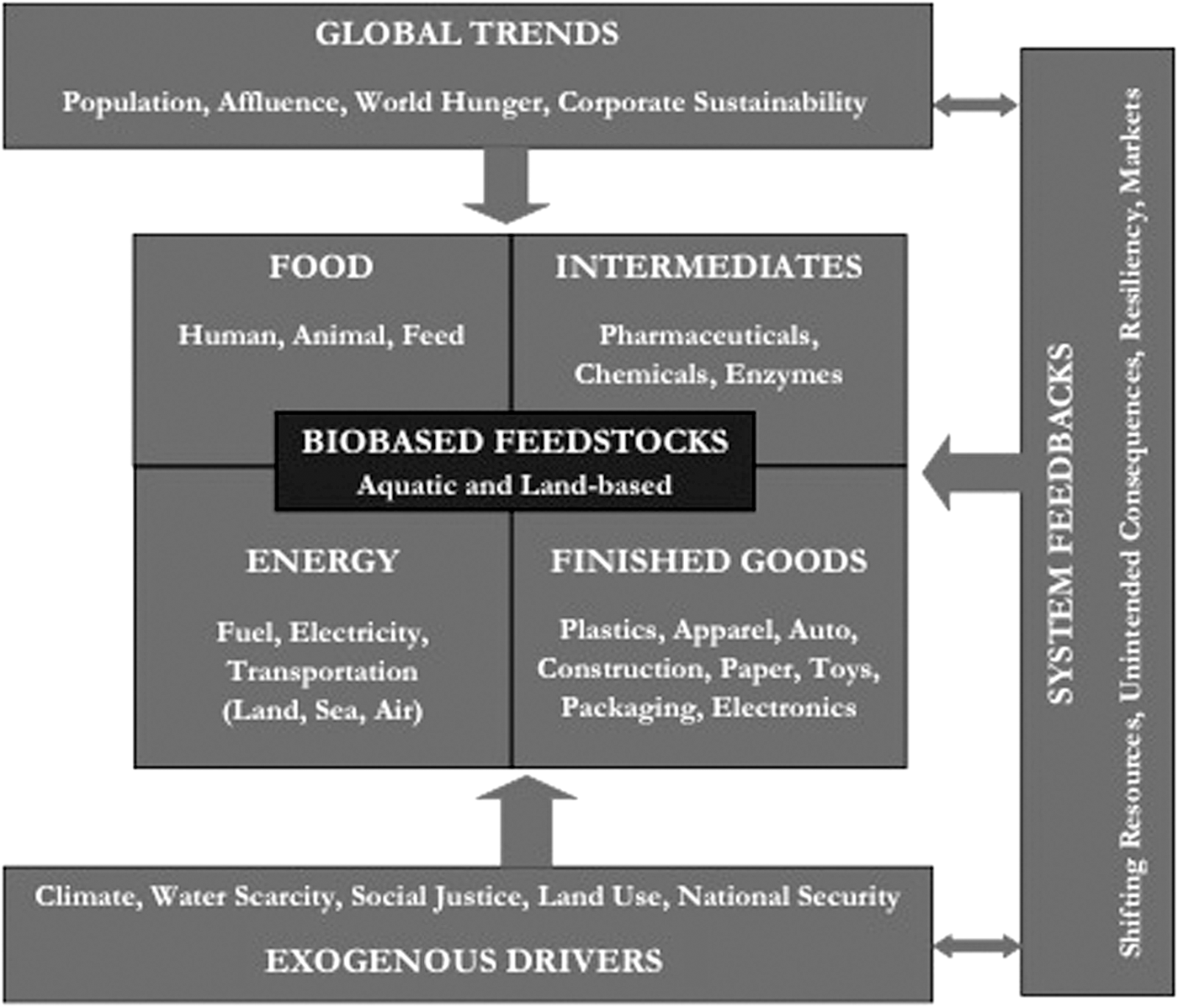
Interactions of the bioeconomy system.
Beyond the questions of larger systems that can both support and impact the expansion of the industrial bioeconomy, there are also open questions in regards to the environmental trade-offs of replacing non-renewable feedstocks with renewable agricultural feedstocks, as well as trade-offs by the “type” of agricultural feedstock used, including the geography of its growth. One example we presented was in respect to bioplastics, which seem to offer an environmentally preferable product solution. However, there has been significant debate concerning the cradle-to-grave LCA of renewable feedstock-based polymers. Vink et al. reviewed applications of LCA in the production of PLA and provided insight into how PLA is used. 12 Tabone et al. conducted a study in which they evaluated the efficacy of green design principles such as the “12 Principles of Green Chemistry” and the “12 Principles of Green Engineering” with respect to environmental impacts determined by using LCA methodology. 13 They presented a case study of 12 polymers, seven of which were derived from petroleum, four of which were derived from biological sources, and one of which was derived from both sources. The environmental impacts of the production of each polymer were assessed using LCA methodology standardized by the International Organization for Standardization (ISO). Each polymer also was assessed for its adherence to green design principles. The metrics included mass from renewable sources, biodegradability, percent recycled, feedstock that was transported the longest distance, price, life cycle health hazards, and life cycle energy use. A decision matrix was used to generate single value metrics for each polymer, evaluating either adherence to green design principles or environmental impacts during their life cycles. The results from this study showed that there was a qualified positive correlation between adherence to green design principles and reduction of the environmental impacts of production. The qualification results from the differences in the production of biopolymers and petroleum polymers. While biopolymers rank highly in terms of green design, their production yielded relatively large environmental impacts. The biopolymers were ranked 1, 2, 3, or 4 based on their green design metrics; however, they ranked in the middle of the LCA rankings. Polyolefins were ranked 1, 2, and 3 in the LCA rankings, whereas complex polymers, such as PET, PVC, and PC, were ranked at the bottom of both ranking systems.
A recent meta analysis of 44 lifecycle assessment studies by Weiss et al. identified that one metric ton (t) of biobased materials saves, relative to conventional materials, 55±34 gigajoules of primary energy and 3±1 t of carbon dioxide equivalents of greenhouse gases. 14 However, as previously stated, spatial variability has implications for other environmental impacts. The report indicated that biobased materials may increase eutrophication by 5±7 kilograms of phosphate equivalents/t and increase stratospheric ozone depletion.
Conclusions
At the request of the USDA BioPreferred program we undertook a detailed examination of existing literature around the globe to understand general trends regarding the emergent industrial bioeconomy. This examination generally excluded fuels, which have been explored extensively in prior efforts. Here we have presented some of our findings and provide additional insights. A comprehensive extraction of our results can be found in the report “Why Biobased?” 1 As presented, the market for biobased products is growing in large part as a result of efforts by retailers, brands, manufacturers, consumers, and government officials to promote the environmental benefits and acceptance of these products as they become commercially viable. Some of the many biobased products that are currently produced include bioplastics, biolubricants, biosolvents, and bio-surfactants. Other biosynthetics are gaining greater market share and consumer acceptance. In addition, many biofuel co-products are emerging that can be produced from a variety of different sources of biomass.
Our research contributes to prior works by providing a clearer vision and understanding of the current trends, which can both help grow and potentially hinder the industrial bioeconomy. However, a more quantitative approach and understanding of the domestic economic and job benefits of the industrial bioeconomy need to be undertaken. The authors are leading a multidisciplinary team to research and report on these questions for the USDA BioPreferred program and Congress in 2015. Individuals and organizations wishing to contribute insights and data for this effort are encouraged to contact the authors.
Footnotes
Acknowledgments
The authors wish to thank Mr. Ron Buckhalt, BioPreferred program manager at the USDA for his insights and guidance, and the Biotechnology Industry Organization (BIO).