




Abstract

In energy production, a number of renewable technologies are available that can eventually make it possible to replace fossil fuels including wind, solar, biomass, etc. For the chemical industry, biomass is the only real alternative to petroleum-based resources. So it was comforting to read in a recent article in Chemical & Engineering News that, “The first hint of the biobased revolution is here.” 1 With a limited supply of fossil fuel resources and the mainstreaming of sustainability issues, the bioeconomy is beginning to take off and, with the right drivers and support instruments, we will soon be living through a third industrial revolution.
This is good news for green chemistry, as the biobased materials market is expanding rapidly. The biopolymers market alone will be worth an estimated €15 billion (USD18.6 billion) by 2017. 2 With society increasingly aware of the benefits that biobased products can offer, downstream users can also help influence and boost demand. Replacing petro-based chemicals with more sustainable, biobased alternatives is being driven by the evolution of biorefineries, which are enabling increased production of biobased chemicals and will lead to the development of a range of new applications across many sectors.
Platform chemicals, which can be used for creating a wide range of chemical products, are especially important, because when made from biobased materials at bulk scale, they have a real capacity to decarbonize society. Succinic acid is a well-known platform chemical that can be petro-based or made from biobased chemicals. Another promising platform chemical, which can only be derived from renewable feedstock, is 5-hydroxymethylfurfural (5-HMF).
5-HMF has applications in many different industries, including in the chemicals, plastics, pharmaceuticals, food, and automotive sectors. It has wide-reaching uses and is a basis for over 175 downstream chemicals and more than 20 performance polymers. Although promising, 5-HMF's impact on the bioeconomy has been limited to date due to difficulties in producing it in bulk. However, an innovative development led to the first industrial production of 5-HMF in early 2014 by the Swiss company AVA Biochem. By creating a new, modified hydrothermal carbonization (HTC) process, AVA Biochem is driving and will continue to pursue innovation in 5-HMF production.
Extraction of Biocoal Precursors
Producing 5-HMF used to be a highly manual and protracted process, with limited possibilities for scale-up. AVA Biochem's HTC process allows for highly scalable and cost-efficient commercial-scale 5-HMF production. The modified HTC process was initially developed by AVA Biochem's parent company, AVA-CO2, in cooperation with the Karlsruhe Institute of Technology (KIT), to turn biomass waste into energy. The standard method of biomass transformation, thermal drying, is an energy-intensive process because the water present needs to be evaporated. AVA-CO2's HTC process was developed as a more sustainable, innovative method.
AVA Biochem's approach is based on the carbonization of fructose. Compared to previous methods, the process allows for higher purities and better yields of 5-HMF production. Traditionally, when making 5-HMF, fructose was treated with acids and then underwent liquid-liquid extraction using organic solvents such as methyl isobutyl ketone. The HTC process hydrolyzes and then dehydrates biomass before it polymerizes it into larger biocoal molecules. During biomass carbonization, water molecules are removed in an exothermic process. Biocoal precursors, 5-HMF among them, are formed during this reaction (Fig. 1 ).
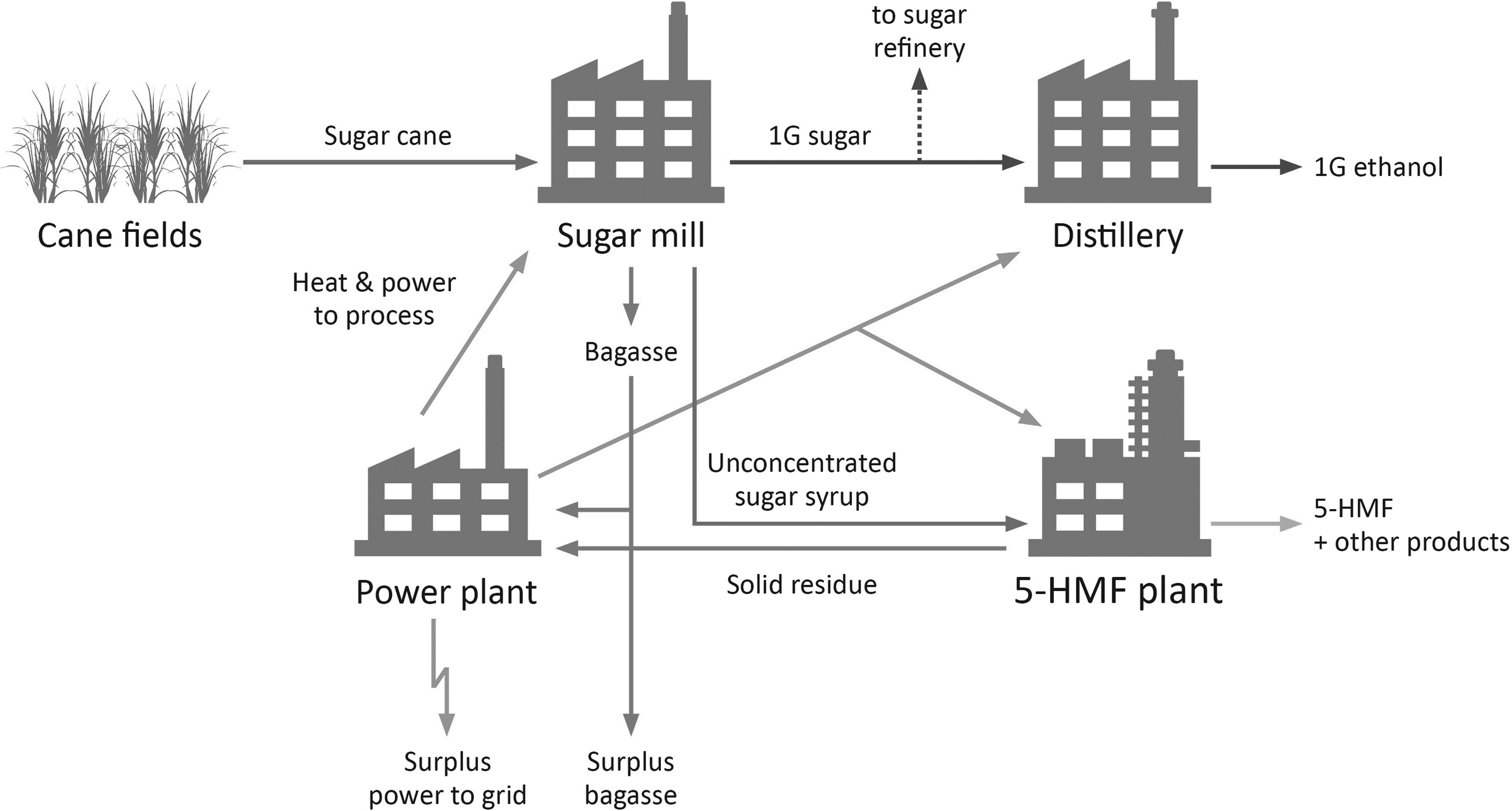
AVA Biochem's modified hydrothermal carbonization (HTC) process.
Whereas condensation or polymerization reactions in the conventional HTC process would turn biomass into biocoal, the modified HTC process allows for the extraction of 5-HMF before this stage, while still allowing the process to run continuously. As 5-HMF is not a very stable molecule and the HTC process follows many non-linear reaction pathways, it was a challenge to design the process to achieve efficient extraction of the chemical. Due to the complexity of the HTC reaction, not all sugars react at the same time and not all sugars turn into 5-HMF or other biocoal precursors. The modifications to the HTC process included the recycling of non-reacted sugars to increase yields. The new process produces crystallized 5-HMF at commercial scale at purities of up to 99.9%. Furthermore, it allows for the production of 5-HMF in solution, which opens the door to more applications (Fig. 2).
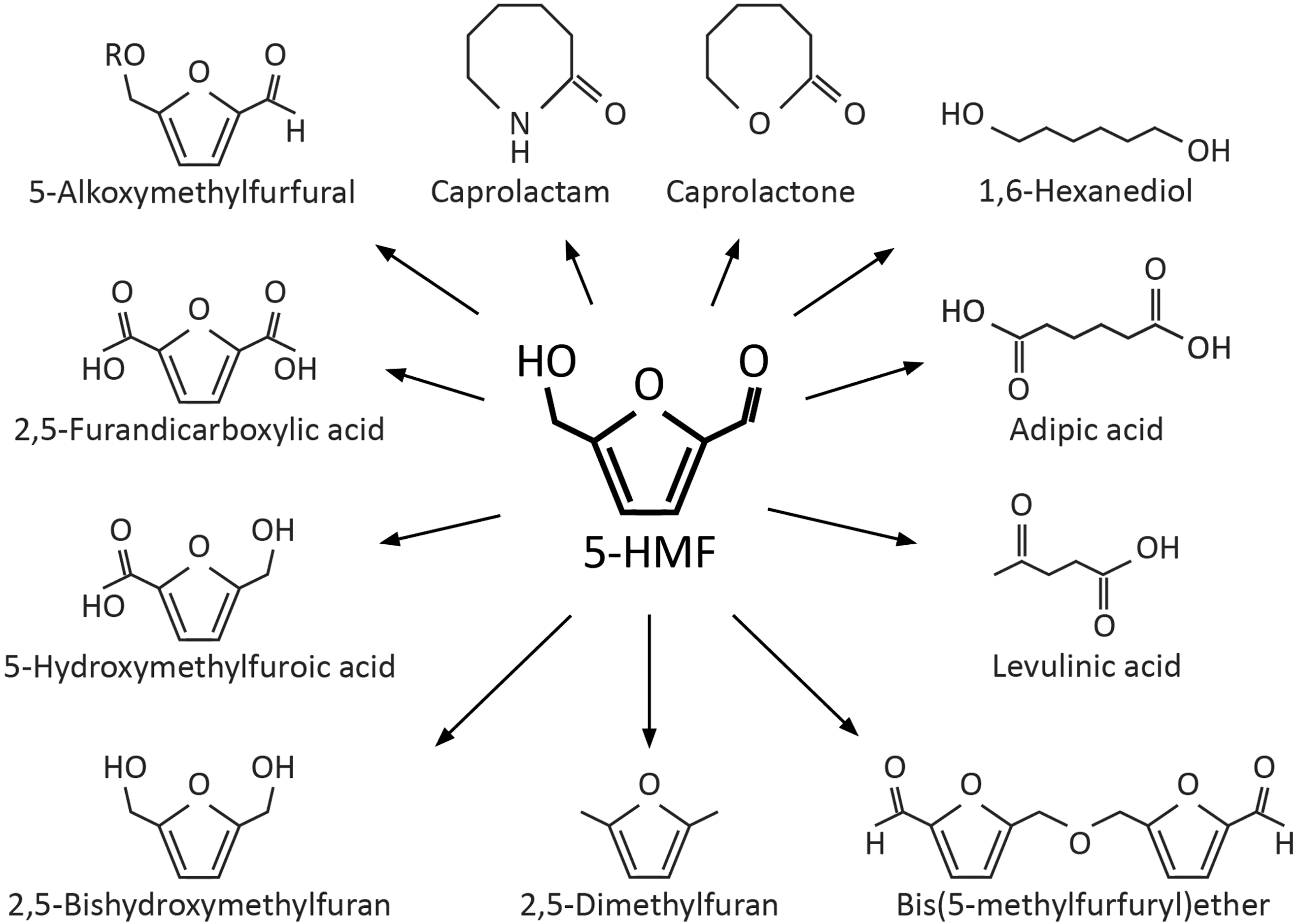
5-HMF applications.
One Chemical—Many Uses
5-HMF was first synthesized in 1895 from inuline and examined by Louis Maillard in 1912 in studies on non-enzymatic glucose reactions. It has two functional reactive groups—a primary hydroxyl group and a carbonyl group; in combination with these two substituents, the furan ring is also a reactive structure. 5-HMF is able to undergo reduction, oxidation, esterification, and many other reactions. For example, the hydroxyl group in 5-HMF can be oxidized into an aldehyde or carboxyl group, and the carbonyl group into a carboxyl group. Therefore, 5-HMF can undergo selective oxidation reactions under different conditions.
As 5-HMF is biobased, it can produce polymers with a low refractory deformation temperature, a clear advantage for biopolymers. 5-HMF conversion to monomers and polymers can be categorized into three main groups: • Polymers containing a furan ring: e.g., furan-2,5-dicarboxylic acid (FDCA), 2,5-dihydroxymethylfuran (DHMF), or 5-hydroxymethylfuran-2-carboxylic acid (HMFCA) • Polymers containing C6 carbon chains with adipic acid or 1,6 hexanediol as building blocks • Other polymers made from FDCA with ethylene via the Diels-Alder-reaction e.g. promising building blocks levulinic acid and terephthalic acid
Many chemicals can be created from 5-HMF oxidization including HMFCA, 5-formylfuran-2-carboxylic acid (FFCA), 2,5 difurmyl furan (DFF), and FDCA. FDCA can be used to produce polyethylene furanoate (PEF), which can potentially replace terephthalic acid in polyester, especially in polyethylene terephthalate (PET). FDCA can be produced from 5-HMF either through fermentation or chemical oxidation. Fermentation seems to be the better approach–by using two types of bacteria to help synthesize 5-HMF—as the result tends to be a purer FDCA. Replacing PET with renewable PEF could have a substantial impact on the packaging and bottling sectors, as 100% biobased PEF bottles could substitute for fossil-based PET bottles.
Sustainability is not the only advantage PEF could bring to the industry. The PEF gas barrier is 10 times better than PET for oxygen and 5 times better for carbon dioxide, which could potentially allow for new applications such as tea or beer packaging in PEF plastic bottles. Another advantage of PEF is its higher tensile strength, which would help reduce production costs.
Other key 5-HMF-derived chemicals are created when the platform chemical is reduced. For example, 2,5-bis(hydroxymethyl)furan is a widely used polymer and polyurethane foam building block. Other biobased polymers that could be made from 5-HMF include certain polyesters, polyamides, and resins.
The potential to replace formaldehyde through 5-HMF offers yet another important application. Formaldehyde is an organic compound with the formula CH2O or HCHO. It is the simplest aldehyde, also known by its systematic name methanal. In view of formaldehyde's widespread use, toxicity, and volatility, exposure is a significant human health issue. In 2011, the US National Toxicology Program concluded that formaldehyde was “known to be a human carcinogen.” 3 The replacement of formaldehyde through 5-HMF in applications such as textiles, pharmaceuticals, cosmetics, or various types of synthetic materials is therefore of great importance to public health as well.
Finally, 5-HMF could play an interesting role as an Active Pharmaceutical Ingredient (API). In 2006, 5-HMF was granted Orphan Drug Status by the US Food and Drug Administration (FDA) for the investigational prophylactic treatment of sickle cell disease. 4 A recent study published in the journal Free Radical Research suggests that 5-HMF also prevents against oxidative injury via APE/Ref-1. 5 Oxidative injury is involved in many disorders, including ischemic and neuro-degenerative diseases. Antioxidant drugs can be used to relieve the oxidative injury caused by these diseases, but there are few antioxidant drugs available for clinical use. The study found that 5-HMF protects against the oxidative damage induced by cerebral ischemia in rats by hydrogen peroxide in PC12 cells.
What Challenges Remain?
With the new, scalable, modified HTC process, 5-HMF could soon become a bulk chemical. However, to reach price-competitiveness with petro-based chemicals, two aspects are critical. First, large quantities of feedstock for the production of fructose at competitive prices must be available close to the production site to minimize transport costs. Second, energy prices for the production process must be comparatively low, since the cost of energy is one of the main influences on 5-HMF production. For these reasons, it is crucial for bulk production to consider site location and co-location benefits. If these criteria are fulfilled, large-scale 5-HMF production is within reach.
Despite strong growth, the biobased chemical industry is still in its infancy. Even with ensuring consistency and quality in its products and generously investing in innovation processes, it will still be difficult to compete with the petro-based industry due to pricing. In Europe and Asia, the industry also needs to catch up in biobased chemical development and investment.
Recent innovations in biobased chemical technology such as the modified HTC process and industrial breakthroughs, including turning lignocellulosic biomass into sugars and the development of key platform molecule formations, are driving the expansion of the biobased products industry and the bioeconomy. These improvements will help grow the biobased chemicals market and help reduce society's dependence on fossil-based resources. This a critical issue given the limited petro-based alternatives available to the chemical industry.