




Abstract
Pulp and paper mills have an abundance of underutilized waste wood with the potential for use as feedstock for the production of algae biomass. Enzymatic hydrolysates originating from pine softwood, southern hardwoods, and northern hardwoods pretreated using a proprietary process were tested for their ability to support heterotrophic growth of microalgae. Focusing on Hawaiian Chlorella and Scenedesmus species, growth varied with each type of wood hydrolysate, depending on the pentose (C5) and hexose (C6) sugar composition as well as process residuals such as organic acids and alcohols. Both species were able to utilize pentose sugars. A 1.6-fold higher biomass productivity, of 2.87 g/L/day in batch culture, was obtained on a medium with Bleached Southern Pine (BSP) hydrolysate than with the equivalent C5 and C6 model sugars alone, suggesting enhanced growth stimulation on wood hydrolysates compared to purified sugar streams. Biomass yield per gram of sugar consumed ranged from 0.45:1 in BSP hydrolysate to 1.15:1 in hardwood (similar to Southern Hardwood Chips) hydrolysate in which ethanol was also present. Oil refinery wastewater, on the other hand, represents a different source of feedstock with different nutrients to support algae biomass production. With oil refinery wastewater the goal is to reduce nutrient load for effluent outflow, resulting in the generation of usable biomass. An algae-wastewater pilot facility at an oil refinery was designed and constructed to mimic deep treatment ponds for polishing of wastewater through microalgae augmentation. Operation in batch mode using a mixed microbial consortium enriched for Scenedesmus showed 97% reduction in ammonia-nitrogen; 69% reduction in total nitrogen; 90% reduction in total phosphorous; and 100% reduction in total suspended solids.
Introduction
The use of microalgae as biofactories or biosubstrates to capture value from certain industrial waste streams offers intriguing possibilities to generate massive volumes of microalgal biomass suitable for applications in animal feed, functional foods, production agriculture, chemical intermediates, and strategic metals recovery. Pulp and paper mills have an abundance of underutilized waste wood that ends up as low-value hog fuel. Instead, reduction to its component wood sugars by enzyme treatment may make it a potential feedstock for the production of valuable algae biomass as part of an integrated biorefinery. 1 While cellulosic sugars are increasingly attractive for supporting microalgal biomass production, use of wood sugars has not yet been described. 2 One potential shortcoming is the resulting impurities and inhibitors in the wood hydrolysates that may be incompatible with microalgae cultivation. A second potential shortcoming is the unsuitability of a mixed pentose (C5) and hexose (C6) sugar stream for maximizing algal biomass production. Both factors could directly impact performance for the full range of end applications.
Oil refinery wastewater, on the other hand, represents a different feedstock source with different nutrients to support algae biomass production, but can also be highly variable and chemically challenging. While the levels of nitrogen (N) and phosphorus (P) in oil refinery wastewater are generally much lower than in wastewater from municipal, agricultural, and other industrial waste streams, these nutrients must be kept below certain limits to avoid eutrophication of receiving water bodies. 3 Prior to discharge and reuse, treatment of wastewater is therefore required to reduce the nutrients to acceptable limits. Conventional wastewater treatment utilizes chemical and physical methods, which are expensive and energy-intensive. Biological treatment can be used exclusively or in conjunction with the other methods, with microbes and plants assimilating inorganic nutrients for their growth. Among various organisms used for this purpose, microalgae offer the additional advantages of assimilating waste carbon dioxide (CO2) to reduce greenhouse emissions, producing biomass for renewable energy, and generating extractable byproducts that can be used as fertilizers or animal feed. 4
Over the past decades, extensive studies have been reported on the use of microalgae for wastewater treatment. Among the wide range of microalgal species studied, Chlorella sp. and Scenedesmus sp. have shown great potential and have been used to treat municipal, agricultural, and industrial wastewater. 5 –8 However, most of these studies were performed at laboratory scale using axenic and diluted wastewater; therefore, the methods used and results are not directly translatable to industrial-scale applications in which wastewater is heavily contaminated with other microbes and toxic chemicals that could greatly affect the growth of microalgae and, consequently, their ability to scavenge and utilize N and P.
This paper describes microalgal biomass production using waste wood hydrolysates from a pulp and paper mill, and initial operation of an algae-wastewater pilot facility at an oil refinery that was designed and constructed to mimic deep treatment ponds for nutrient-reduction purposes.
Materials and Methods
Pulp and Paper Mill Waste (Wood Sugars)
Wood hydrolysates, algae species, and heterotrophic cultivation
Enzymatic hydrolysates of various compositions were produced according to US. Patent No. 8617851 from various wood residuals (Table 1) provided by Cellulose Sciences International (Madison, WI). The algae strains selected for testing were based on their potential biomass applications for biofuels, feed, and specialty products (pigments) and were capable of heterotrophic growth. These included Chlorella and Scenedesmus collected in Hawaii and identified at the species level using DNA sequencing; KAS908 was 100% identical to Chlorella sorokiniana based on 18S sequence, and KAS740 was 100% identical to Scenedesmus armatus based on 23S sequence. Cultures were screened previously for their ability to grow on sugars and were adapted for heterotrophic growth in modified f/2-Si (Si-free) freshwater medium containing 18 g/L glucose plus 1.8 g/L yeast extract (YE). 9,10 Basic recipes of f/2 and f media, developed originally for marine diatoms, contain all the nutrients essential for growth of many fresh water microalgae and are easily modified by omission of seawater and silicates. Wood hydrolysates were initially tested for growth at small scale, and the wood hydrolysate concentration with highest growth for each strain was identified. Briefly, heterotrophically adapted KAS908 and KAS740 were grown in the modified f/2-Si fresh water medium in 96-well plates using wood hydrolysate concentrations standardized to 18 g/L and 9 g/L total sugars. These strains were further grown in small flasks at suitable wood hydrolysate concentrations determined during small-scale tests. Growth was monitored daily by measuring optical density at 750 nm (OD750).
Establishment of algal biomass productivity and sugar utilization using aerobic fermentation
Heterotrophic growth experiments were performed for wood hydrolysates at a larger scale using a 7L BioFlo110 fermentor (New Brunswick Scientific, Enfield, CT) and pre-established batch fermentation conditions of T=30°C; pH=7.0; agitation=300 rpm; dissolved oxygen (DO)=100%; and air=1.5 L/min. Briefly, KAS908 was inoculated to a density of 2 g/L in fresh water f medium (0.2 g/L Cell-HI F2P, Varicon Aqua Solutions, Worchestershire, UK)—equivalent to 2x the concentration of f/2 medium—containing concentrations of wood hydrolysates standardized to 18 g/L total sugars. A relatively high-density inoculum approach is similar to that used with Saccharomyces cerevisiae and can be used to simulate a potential commercial approach of building up seed (inoculum) density. 11 The glass fermentor vessel was wrapped in aluminum foil to prevent exposure to light and to ensure heterotrophic growth. Samples were collected every 24 h for 5 days and analyzed for biomass growth measurement (dry weight), and for glucose and xylose utilization through high-performance liquid chromatography (HPLC). Nitrate concentration was monitored qualitatively using a nitrate test kit (Aquarium Pharmaceuticals, Chalfont, PA). As positive controls, and to establish baseline kinetics, fermentation using mixed C5 and C6 model sugars was also performed. KAS908 was grown in f medium (modified for fresh water) containing 16.34 g/L glucose and 1.66 g/L xylose plus 1.8 g/L YE to mimic the corresponding hydrolysate from Bleached Southern Pine (BSP) and grown under the same batch fermentation conditions for 5 days. Biomass productivities (g/L/d) and biomass yield on sugar (g total biomass/g sugar utilized) were calculated.
Sugar analysis by HPLC
Culture samples in 25-mL quantities were collected and immediately centrifuged at 3,000 rpm. The supernatant from each sample was analyzed for glucose and xylose by HPLC using a Waters 2695 Alliance Separations module with a Rezex RPM-Monosaccharide Pb+2(8%) column (Phenomenex, Torrance, CA) and a 2416 refractive index detector (Waters Corp., Milford, MA). Samples not immediately analyzed were stored at −20°C until further use. The system was run isocratically with deionized ultra-pure water. The injection volume was 40 μL/min with a 20-min run time at 85°C.
Oil Refinery Wastewater
Algae plant photobioreactor (PBR) and wastewater simulation tank
The algae-wastewater pilot facility constructed at the Chevron Hawaii Oil Refinery Plant (Kapolei, HI) consisted of a 5,000-L horizontal algae PBR conceived by Kuehnle AgroSystems (Honolulu, HI) using 100-mm diameter Clear-Flex polyurethane seamless tubing with sterile fittings by Siftex (South Windsor, CT), and a 3-m deep wastewater simulation tank with built-in basal pneumatic mixer with discontinuous air and CO2 injection. For removal of suspended solids, four hollow fiber cross-flow filtration (HFF) cartridges (BeviProducer 41, Watersep Technologies, Marlborough, MA) were used in parallel to remove the solids from the final treated effluent. Total suspended solids (TSS) before and after HFF-treatment was analyzed by gravimetric method. All parts used were comprised of off-the-shelf components and industrial equipment. This allowed direct deployment into existing deep wastewater treatment ponds without added treatment facilities, as described. 12 The green alga KAS740 (Scenedesmus armatus) was grown in the PBR using f/2 medium formulated in non-potable, treated process water normally used for onsite fire hydrants. Supplementation of a 1:10 mixture of waste CO2 and air was carried out during the daytime to enhance algae growth and to regulate pH. For the PBR, temperature was kept under 32°C using intermittent overhead irrigation. pH was targeted within the range of 8–10, and nutrients were spiked almost daily to prevent depletion. The tank water temperature ranged from 25–27°C.
CO2 enrichment using refinery waste gas emissions
Industrial CO2, comprised of 95% CO2, 3% water, 2% hydrogen, and nominal amounts of propane, propene, butane, and isobutene, was drawn from the hydrogen-formation plant at the refinery to support algae growth in a US Environmental Protection Agency (EPA)-recognized- project. 13 The wet gas was dehumidified and petroleum aromatics were removed after passage through a 3-inch diameter, 12-inch long, activated carbon filter cylinder, prior to compression in a gas-compression system reprogrammed by the fabricator to maintain the compressor cavity at about 180°F (82°C) above dew point, to prevent condensation of corrosive carbonic acid. The gas was directed from the compressor (18.4 ft 3 /min) through a coalescing filter to a refrigerated dryer, then onto a 0.1-micron filter and a carbon filter into a storage tank at 100 psi. The site-wide CO2-distribution piping enabled flow through a manual regulator to set the desired flow rate, and solenoid valves operated by the pH-control system allowed gas to flow into the PBR at user-entered set points. The CO2 was introduced into the PBR process stream via a gas sparging system designed at a 1:10 ratio of 5 standard ft 3 /h (SCFH) CO2:45 SCFH air. For demonstration purposes, the CO2 was introduced discontinuously into the simulation tank at a 1:10 ratio of 12 SCFH CO2:120 SCFH air every 5 sec. 12
Batch run
The simulation tank was partially filled with approximately 28,000 L of effluent water sourced from a post-oxidation pond. Prior to enriching with algae, samples were collected in triplicate for various analyses, namely cell count, TSS, bacterial count, pH, DO, temperature, ammonia-N, Total Kjeldahl Nitrogen (TKN), nitrate-nitrite N (NOx-N), total nitrogen (TN), and total phosphorus (TP). A volume of 4,700 L of exponentially growing algae at a density of 0.5 g/L from the algae plant PBR was pumped into the simulation tank to form a mixed-microbial consortium. The final volume of 32,700 L provided a water depth of approximately 1 m with an algae density of 0.07 g/L. To facilitate algae growth, the tank was mixed using a basal pneumatic mixer and was supplied with a 1:10 mixture of CO2 and air. Daily samples were collected until N and P levels were no longer decreasing. Final samples were collected in triplicate on day 3 and analyzed for the aforementioned parameters. Initial and final analyses were performed by TestAmerica Laboratories, Inc. (Honolulu, HI).
Results and Discussion
Wood Sugars
All wood hydrolysates supported growth of microalgae, but performance varied with each type of hydrolysate.
Growth study of wood hydrolysates at small scale
Multi-well plates were used as an initial screening tool to determine the capability of these cultures to grow on wood hydrolysates. Relative growth patterns under these conditions were used as a guide to design larger-scale shake flask and fermentor experiments. Three different wood hydrolysates, standardized to 18 g/L total sugars, showed different growth profiles, with one hydrolysate—Southern Pine Finer Chips (SPFC) — being inhibitory (Fig. 1). Inhibitory effects of SPFC were overcome by using more dilute concentrations, such that SPFC corresponding to 9 g/L total sugars grew as well (in 96-well plates) or better than in medium containing 9 g/L glucose alone based on Student's t means testing (p=0.02; Fig. 2). These data indicate possible inhibition by the process residuals at higher concentrations of hydrolysates. For example, SPFC contained two undissociated organic acids—acetic acid and lactic acid (Table 1)—with unknown effects on these species.
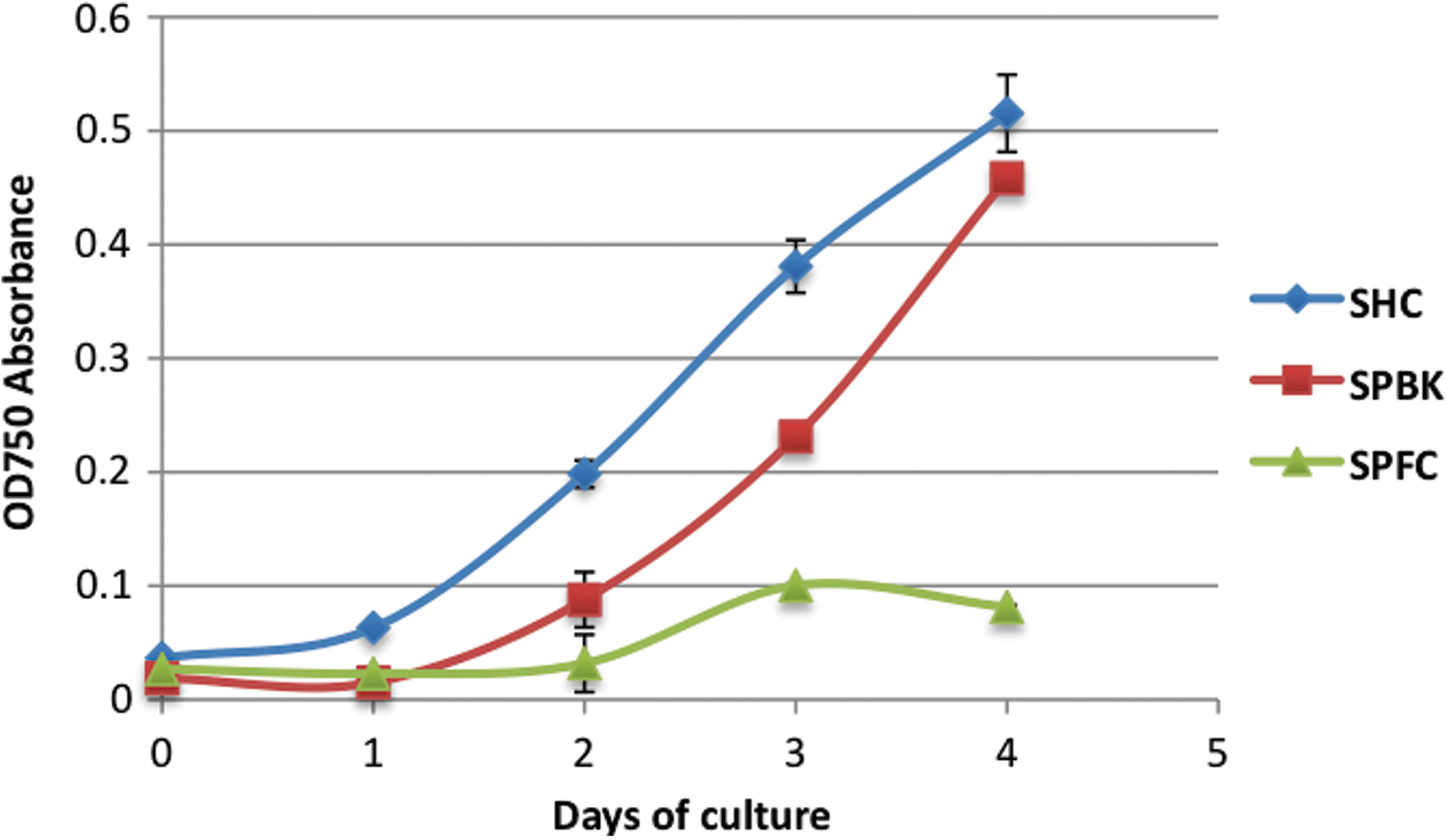
OD750 profiles of KAS908 (Chlorella sorokiniana) grown heterotrophically in triplicate in 96-well plates in three wood hydrolysates: Southern Hardwood Chips (SHC), Southern Pine Bleached Kraft (SPBK), and Southern Pine Finer Chips (SPFC).

Comparison of heterotrophic growth in duplicated 50-mL flasks measured by OD750 absorbance of KAS740 (Scenedesmus armatus) on Southern Pine Finer Chips (SPFC) hydrolysate and equivalent glucose concentration (standard error bars too small to be visible).
Composition of Wood Enzymatic Hydrolysates from Cellulose Sciences International
ND, not detected.
Aerobic fermentation
In the 7L batch fermentor, a 1.6-fold higher biomass productivity of 2.87 g/L/day for KAS908 was obtained in a medium containing BSP hydrolysate compared to 1.7 g/L/day obtained from a medium containing an equivalent mixture of C5 and C6 model sugars. BSP was identified as similar to Southern Pine Bleached Kraft (SPBK) by the supplier of the hydrolysate, and made available for larger-scale experiments. Wood hydrolysates outperformed model sugars with higher biomass productivities, possibly due to the presence of micronutrients from wood hydrolysates. Whereas this is the first report of successful microalgal heterotrophy using wood hydrolysates to our knowledge, other cellulosic hydrolysates from rice straw using Chlorella pyrenoidosa grown mixotrophically and from wheat bran using Chlorella vulgaris and Scenedesmus obliquus grown mixotrophically or heterotrophically were reported to support similar or higher growth rates compared to model sugar-supplemented media. 14,15
Since the cost of organic substrates (sugars) to support high biomass yields using microalgae can be a limiting factor affecting feasibility for large-scale production of various target products, efforts are underway to obtain massive amounts of relatively inexpensive wood sugars from underutilized wood waste at pulp and paper mills at acceptable costs.
1,16
Preferably, this feedstock could be used by microalgae capable of complete utilization of C5 and C6 sugars for maximal biomass yield in impure and variable hydrolysate streams. Many microalgae strains appear unable to utilize C5 and C6 sugars during fermentation.
17
The Chlorella KAS908 was observed to utilize glucose and xylose in series during fermentation, as shown by a decrease and eventual depletion of both sugars in the culture medium containing wood hydrolysates (Fig. 3A), a trend mimicked during growth on model sugars (Fig. 3B). Chlorella assimilates glucose from the growth medium because it possesses an inducible active hexose/H+ symport system.
18
It was recently proposed that the same system works as a low-affinity
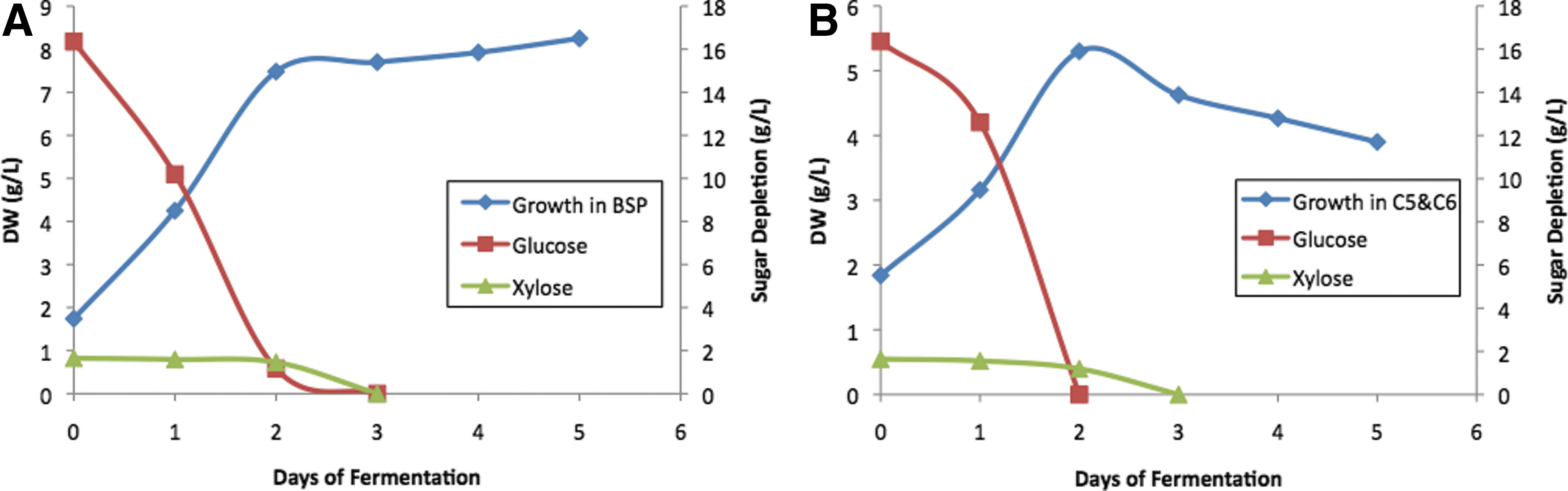
Growth and sugar utilization (glucose and xylose uptake monitored by HPLC) of KAS908 (Chlorella sorokiniana) under heterotrophic fermentation in
Various Chlorella species have been reported to be able to utilize xylose or other C5 sugars such as arabinose or xylitol with increased productivity only when grown in the presence of light, while C. vulgaris was shown to utilize xylose (1.5 g/L) under heterotrophic conditions. 20,21
Biomass yield on sugar consumed (dry weight of biomass produced per gram of sugar utilized) is a useful parameter in calculating overall process efficiency and biomass production cost. Sugar utilization of microalgae using different hydrolysate streams varied with the composition and impurities present. A ratio of 1.15:1 biomass produced per gram of sugar utilized, as measured by HPLC, was obtained for KAS908 grown in hardwood hydrolysate (similar to Southern Hardwood Chips). This was somewhat higher than the theoretical biomass yield per gram sugar utilized of 0.5:1 reported for protein-rich algal biomass ideal for animal feed. 22 In comparison, BSP hydrolysate gave a 0.45:1 ratio, close to the theoretical biomass yield per sugar utilized. Taken together, these results show high compatibility of two different algal genera for heterotrophic growth on wood hydrolysates and their potential to support scale-up feasibility and favorable process economics for using microalgae for feed and pigment production as well as to contribute to the potential of establishing integrated biorefineries for the pulp and paper industry. 23 Once the targeted main product and coproducts are identified for a biorefinery, the algae strain can be optimized in tandem with the sugar and nutrient feeds as well as operational conditions. 24
Wastewater
Wastewater characterization
Microscopic evaluation of the wastewater sample revealed a microbial community composed of microalgae, bacteria, protozoa, and swimming grazers or zooplankters. Several species of Scenedesmus were observed to be dominant, as has been reported in other wastewater streams such as municipal and dairy wastewater. 6,7,25 Other algae present appeared to be Chlorella-like green algae, cyanobacteria, and diatoms. Cell density was around 4.0×10⁴ cells/mL, with a relatively low bacterial population of 1.0×10⁴ colony-forming unit (CFU)/mL and TSS of 0.063 g/L. Analysis of the initial wastewater sample showed an NH3-N concentration of 2.63 ppm, NOx-N concentration of 0.045 ppm, and TP of 0.49 ppm, corresponding to an N/P ratio of 5.5:1. These values are well suited for an algae-mediated polishing step prior to discharge.
N and P levels in wastewater enriched with KAS740 Scenedesmus algae after implementation of basal mixing and intermittent CO2 bubbling
Measurements taken from the deep tank 3 days after augmenting the wastewater with microalgae from the PBR showed a 97% reduction in NH3-N, 69% reduction in TN, and 90% reduction in TP (Table 2). These values validate the use of microalgae for the treatment of wastewater, specifically for scavenging N and P. Similar results have been reported for Scenedesmus in other smaller-scale experiments, wherein removal efficiencies for TN and TP ranged from 79–100% and 20–98%, respectively. 5,8,26 Therefore, results from this pilot-scale study further solidify the potential use of the technology in full-scale industrial wastewater treatment facilities. Moreover, HFF-treatment of the final effluent generated a clear permeate free of suspended solids. Gravimetric analysis performed on the pretreated effluent and permeate confirmed 100% reduction in TSS, from 0.11 g/L to zero. Based on these results, this technology presents an attractive alternative to replace aging or more expensive systems currently in place for reducing suspended solids in oil refinery wastewater prior to discharge.
Nitrogen and Phosphorus Values in Treated Wastewater
Total N calculated by adding Total Kjeldahl Nitrogen (ammonia-N plus organic N) and nitrate-nitrite N.
Includes total PO4-P present after addition of the algae culture.
Results showed that KAS740 was able to thrive in the wastewater, and it could be clearly distinguished from other members of the microbial consortium by its much smaller size. Previous laboratory data have shown that KAS740 is able to utilize NO3 as a nitrogen source (data not shown). The literature also indicates that this species is able to utilize NH3 efficiently in wastewater. 5,26 Results from this batch run further confirm that KAS740 can survive and thrive in medium containing mostly NH3. This result is very important as it suggests that KAS740 could be used to treat wastewater with mixed and variable amounts of NH3 and NO3. Furthermore, it may even be possible to apply it to wastewater upstream of post-oxidation ponds, which should in theory contain higher levels of ammonia. KAS740 Scenedesmus biomass is well suited for processing into biofuels, yielding 38.4% fatty acid methyl esters on an ash-free dry weight basis when processed using supercritical methanolysis (conversion by Inventure Chemical, Tuscaloosa, AL; Kuehnle AgroSystems, unpublished data).
Taken together, these results would support the use of microalgae at an oil refinery for final polishing of wastewater from the standpoint of managing nutrient loads and suspended solids, and to generate biomass with bioenergy value. Such a system would be ready for continuous operation with a few nominal calibrations and modifications (i.e., adjustment of residence time, algae loading density, mixing rate) that could address fluctuations in the chemical profile and microbial population in the wastewater being treated.
Conclusions
Pulp and paper mills and oil refineries present contrasting and challenging sources of waste streams. The use of microalgae to treat these effluents and generate biomass for specialty chemicals and commodity components is still largely in its infancy. By adding microalgae to these waste streams—one at the operational site and one in the laboratory—we were able to achieve meaningful outcomes to support further development to help bolster and broaden the commercially beneficial impact of waste streams using microalgae. Process optimization with scale-up will provide further data to build economic models and target strains for their biomass value for moderate- and high-volume markets. For pulp and paper mill biorefineries, wood hydrolysates appear quite promising to support heterotrophic microalgal growth, but future studies should also address management of the CO2 stream that will be generated. For the oil refinery, this approach uses off-the-shelf industrial equipment with existing, basic infrastructure for a low-cost method that has minimum capital expenditures, a small footprint, and utilizes the advantages in the ecology of oxidation and post-oxidation ponds for a cost-effective sustainable solution.
Footnotes
Acknowledgments
This work was supported in part by US Department of Agriculture Award 2011-10006-30377 Integrated Biorefinery at the Domtar Plymouth, North Carolina Pulp Mill, sub-award to Kuehnle AgroSystems; US Dept of Energy and the Hawaii Renewable Energy Development Venture (HREDV) Award 2910-536 Algae Biomass for Biofuel Production; Office of Naval Research Award N00014-10-C-0412 Biofuels Production from Nonedible Bio-oils; Chevron Hawaii; and The Kolohala Hydrogen & Renewable Energy Fund.
Author Disclosure Statement
No competing financial interests exist.