




Abstract
The Virtual Sugarcane Biorefinery (VSB) is a simulation and evaluation tool designed to assess the development of new technologies and innovations in the production and processing of biomass. The VSB integrates computer simulation platforms with economic, social, and environmental evaluation tools to assess the sustainability impacts of different sugarcane biorefinery alternatives. It considers all phases of the process, from sugarcane production and conversion to products use and disposal. The VSB can evaluate the stage of development of new technologies and perform comparative assessments of biorefinery alternatives, which make it a tool with great potential to support the formulation of political policies in the context of bioenergy. To demonstrate the potential of VSB, two scenarios are examined: (1) the optimization of first-generation plants and straw recovery for maximal electricity generation; and (2) the assessment of ethanol production from sugarcane lignocellulosic materials (2G process) integrated with a first-generation process that uses the sugar directly. Results show that cogenerating electricity improves profitability and decreases risks, which enables sugarcane facilities to achieve better economic results. Straw recovery plays an important role in maximizing electricity generation and requires additional investigation. Capital, biomass, and enzyme costs currently account for almost 90% of 2G ethanol production costs and must be lowered to improve the economic competitiveness of 2G ethanol. Given the importance of sugarcane-based energy for Brazil's economy and energy matrix, policies that accelerate the development of 2G processes are required to increase the industry's competitiveness and sustainability.
Introduction
Since the early 2000s, there has been a significant increase in ethanol demand as a result of rising consumption from the introduction of flex-fuel vehicles, growing worldwide interest in the partial substitution of gasoline to mitigate greenhouse gas emissions, and a resurgence of Brazil's alcohol chemistry industry. 1 –3 Ethanol is traditionally produced from sugar- and starch-based feedstocks, such as sugarcane, sugar beet, and corn; this ethanol is commonly called first generation (1G) ethanol. 4 In Brazil, conventional ethanol production is based on sugarcane juice fermentation and takes place in either autonomous distilleries, which produce both ethanol and electricity, or in annexed plants, which also produce sugar. 5
To supply Brazil's forecasted ethanol demand using the 1G route, dozens of new plants and distilleries would have to be built along with a proportional increase in sugarcane acreage. Thus, the development of 2G ethanol—also called cellulosic ethanol—from lignocellulosic materials, such as agricultural and forest residues and non-food crops, has emerged as an alternative to achieve a significant increase in the production of ethanol. 4 Such a production scheme would use whole sugarcane (i.e., sugarcane juice, bagasse, and straw), without increasing the planted area.
Granbio (Alagoas) and Raízen (São Paulo) have each begun operation of commercial-scale 2G facilities in recent years, but, overall, this process is still at the start of the learning curve. It will take several years before 2G ethanol production reaches maturity. Challenges related to 2G production include the adaptation of pretreatment conditions for each biomass, high enzyme costs, the challenges to obtaining high ethanol productivity in the fermentation of C5 sugars (xylose), and the separation of fine particles of the insoluble solids after pretreatment and hydrolysis. 6 –9
The Brazilian Bioethanol Science and Technology Laboratory (CTBE; Campinas, Brazil) was created to contribute to the development of Brazil's ethanol production expertise. CTBE is integrated into the National Center for Research in Energy and Materials (CNPEM) and engages in bioenergy R&D—contributing to the advancement of scientific and technological knowledge of the production of sugarcane ethanol and other chemical compounds from biomass.
Within the 2G biorefinery concept, different raw materials and production routes can be employed, generating coproducts with differing uses and added value, such as xylitol, hydroxymethylfurfural, levulinic acid, and phenol resins. 10 Taking into account the complexity of the production chain, CTBE identified the need to develop a strategy to measure the success and maturity of different biorefinery configurations. The Virtual Sugarcane Biorefinery (VSB), a simulation and evaluation platform, was designed for this purpose. The VSB integrates computer modeling and simulation platforms with economic, social, and environmental evaluation tools to assess the technical and sustainability impacts of different sugarcane biorefinery alternatives. It considers all phases of the sugarcane production process—agricultural production, feedstock transport, industrial conversion, logistics for products transport and commercialization, and the final use and/or disposal of the products. 11
The ability of VSB to evaluate the stage of development of new technologies, considering the entire production chain, and to perform comparative assessments with biorefinery alternatives are a few of the features that make VSB a tool with great potential to support the formulation of political policies in the bioenergy context. VSB results are used to identify technology and sustainability bottlenecks, a capability that is useful for defining research priorities. Research programs and financial incentives, including specific funding programs, special credit lines for cellulosic ethanol plants, tax incentives, mandates for biofuel blending in transportation fuel, and premium prices to motivate greenhouse gas emission reduction are examples of public policy instruments that can be based on VSB data.
To demonstrate the potential of VSB results to support public policy formulation, two cases are presented: first, the optimization of 1G plants and straw recovery to maximize electricity generation; and second, an assessment of ethanol production from sugarcane lignocellulosic materials (a 2G process) integrated with a 1G ethanol production process.
Materials and Methods
VSB
The VSB comprises an innovative tool that assesses the success and maturity of different technologies based on an evaluation of the technical, economic, social, and environmental impacts of the sugarcane production process, from agricultural production to feestock and product transport, industrial conversion, and use and disposal of the products. Figure 1 presents the general concept of the VSB.
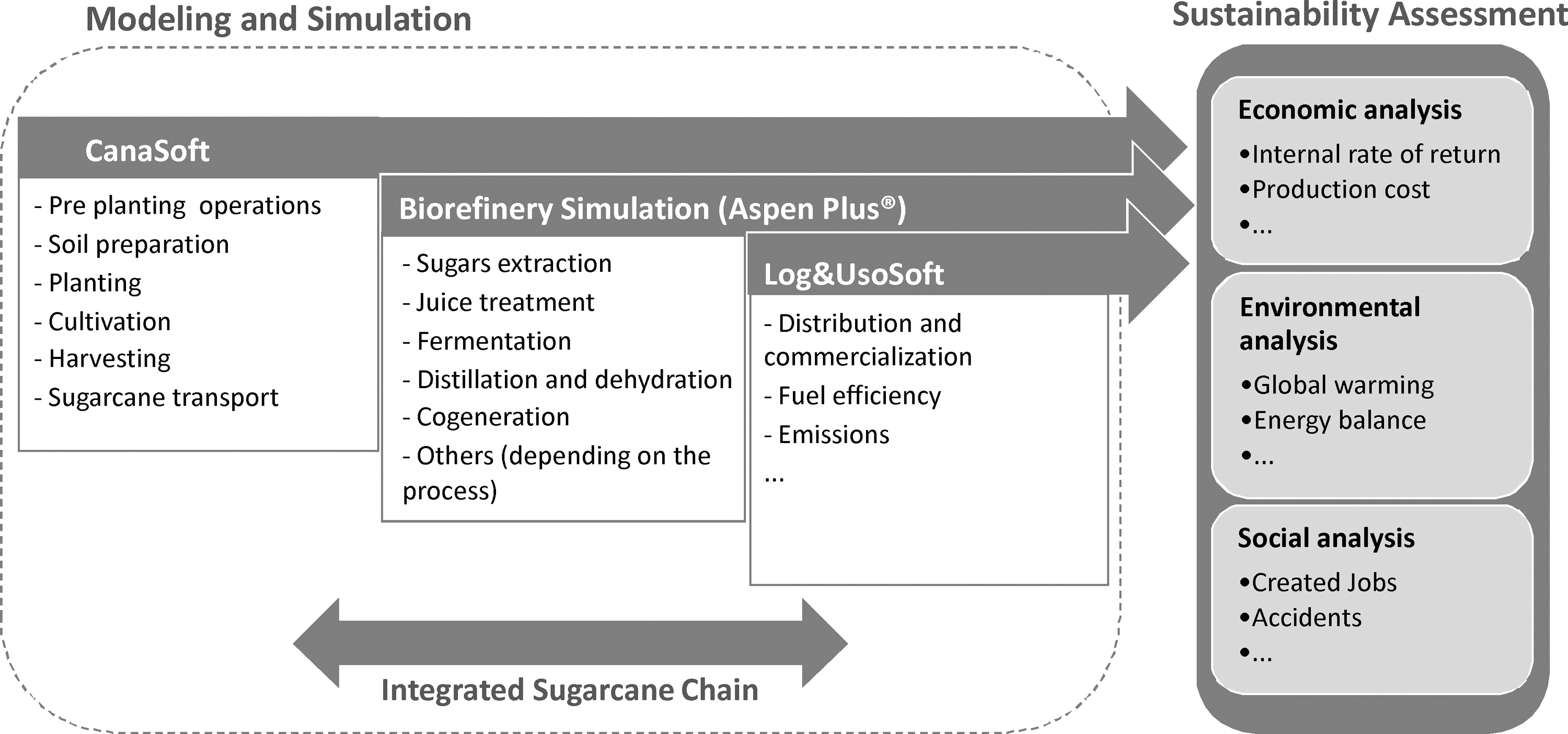
Virtual Sugarcane Biorefinery concept.
To simulate the agricultural phase in the VSB, the CanaSoft model was developed. It incorporates the most important parameters of the agricultural production system of sugarcane, including productivity, type of crop, type of cultivation, transportation, agricultural operations, machinery, implements, labor, agrochemicals, and fertilizers, among others. The different industrial scenarios are defined based on the process configuration, operating conditions, and yields commonly found in a Brazilian sugarcane mill. Mass and energy balances are performed using Aspen Plus, a process simulator that contains a comprehensive library of components, properties, and unit operation models as well as several thermodynamic packages. A model called Log&UsoSoft is being developed to assess the impacts of different distribution, marketing, and use options of biorefinery products, starting with ethanol. The model includes transport of ethanol to/among commercialization agents, mixture with gasoline (gasohol alternative), and the use of ethanol in vehicles. These models are integrated so that the impacts of agricultural technologies on both the industrial phase (and vice versa) and usage stage are evaluated in the VSB.
Economic evaluation takes into consideration economic impacts obtained with traditional economic engineering tools, e.g., production cost, internal rate of return, and net present value. For the environmental assessment, a life cycle analysis methodology is employed. It considers resource use and emissions from all stages of production—from raw materials to products, as well as product use. This assessment is facilitated by the use of commercial software like SimaPro. Some of the impacts calculated are global warming potential, energy balance (relationship between the renewable energy produced and the fossil energy consumed), and land and water use, among others. It is worth mentioning that issues related to food and energy competition can also be included in the evaluation (in the context of each country). Such complex issues need to be properly addressed depending on the scope and objective of the analysis. Finally, to evaluate the social impacts of different technologies, VSB combines input-output analysis, which quantifies the changes in the levels of activity in each sector, with social databases.
Case Study 1: Maximizing Electricity Generation in a 1G Facility
In addition to ethanol and sugar, electricity became a product of sugarcane mills with the introduction of electricity from sugarcane biomass (initially bagasse) into the national energy matrix (through public commercialization auctions). Currently, electricity from sugarcane biomass and ethanol represent almost 18% of primary energy and 38% of renewable energy produced in Brazil. 12 The potential to sell energy to the grid at elevated prices has motivated some mills to invest in more efficient cogeneration systems and complementary biomass use (e.g., sugarcane straw) to increase electricity generation and competitiveness. Large quantities of straw are available because field-burning practices have been phased out and harvests have transitioned from manual to mechanized. However, the amount of straw that must remain on the field depends on specific conditions of sugarcane production such as location, cane variety, stage of cut, harvesting period, climate, and other considerations. 13
Two scenarios are presented to demonstrate the potential benefits of an efficient cogeneration system and straw recovery for electricity generation in a 1G plant (autonomous distillery): “1G basic,” which is comprised of an autonomous distillery with a representative configuration of sugarcane mills with large steam consumption and no surplus electricity; and “1G optimized,” which is an autonomous distillery with an efficient cogeneration system, lower steam consumption, and straw recovery (50% of what is available in the field) that is configured to maximize surplus electricity. Table 1 compares the main characteristics of both scenarios.
Main Characteristics of First-Generation Scenarios
Amount includes both vegetal impurities and straw bales.
LHV, lower heating value.
Case Study 2: Integrated 1G2G Ethanol Production Process
The use of lignocellulosic materials for 2G ethanol production is a promising alternative for large-scale production of biofuels for the transportation sector. In the 2G process, ethanol is produced by fermentation of sugars obtained from lignocellulosic feedstock. This route includes pretreatment, enzymatic hydrolysis, and fermentation. Fermentation of C6 sugars released as a result of enzymatic hydrolysis can be performed using the same yeasts employed in 1G ethanol production, but C5 sugars derived from pretreatment can only be properly fermented using genetically modified microorganisms. However, the development of robust strains with the ability to produce ethanol from all sugars available in lignocellulosic hydrolysates (in the presence of inhibitors) at high yields and production rates is still a challenge for 2G production. 8
The integration of 1G and 2G production (“1G2G”) makes it possible to take advantage of the synergies between both processes, especially in juice concentration, fermentation of C6 sugars, distillation, dehydration, cogeneration, and utilities such as water-cooling systems. Figure 2 shows the integration of a 2G process into an autonomous distillery.
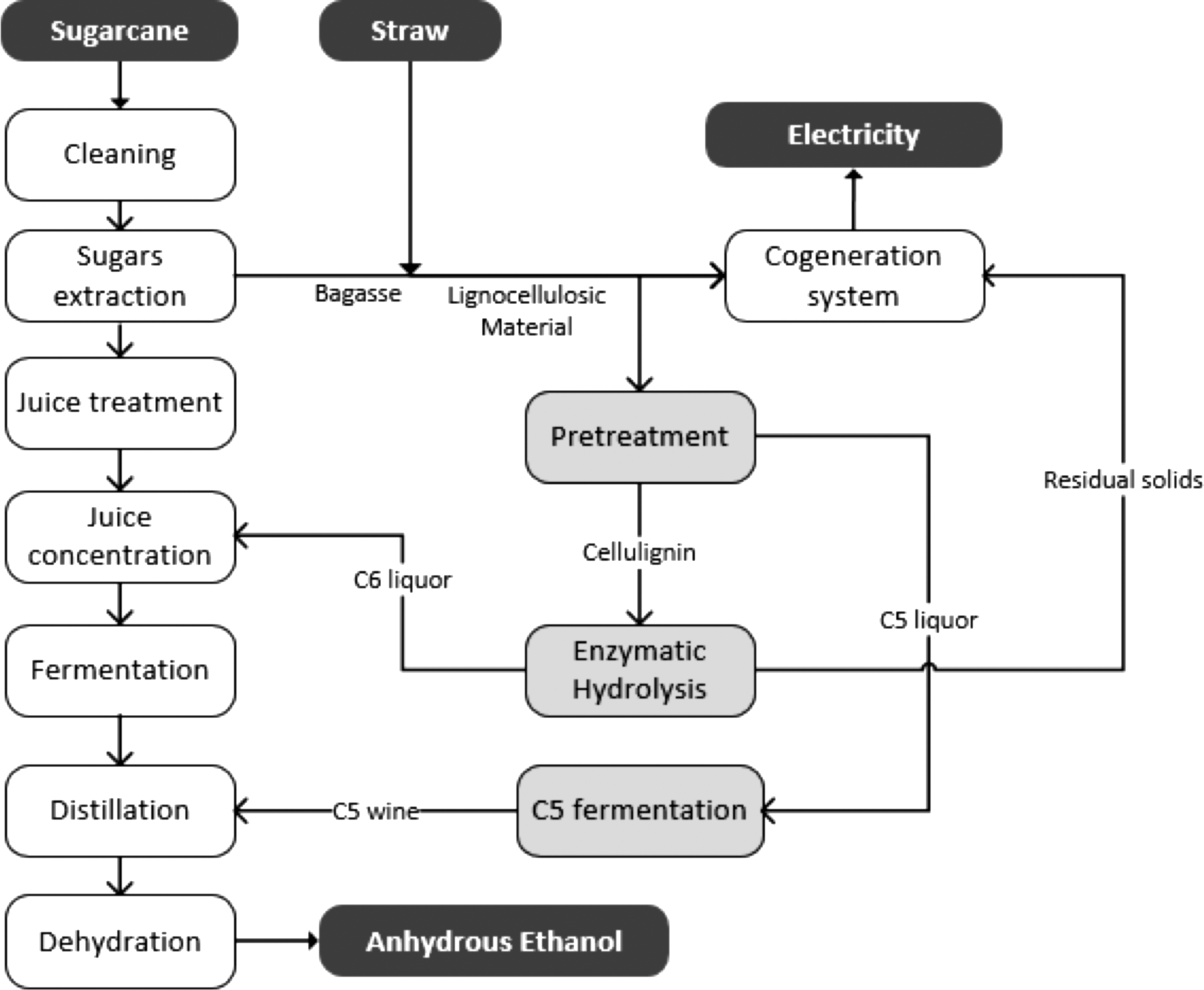
Block flow diagram of integrated 1G2G process.
To assess the impacts of integrating a 2G process into an optimized autonomous distillery (similar to the 1G optimized case described above), an additional scenario was defined: “1G2G advanced,” based on an integrated process that includes advanced 2G ethanol production with long-term process yields and productivity described by Milanez et al. 14 The production of ethanol is maximized using all lignocellulosic material available (sugarcane bagasse and straw), since the steam is produced only to meet the process requirement and only back-pressure turbines are employed. Part of the lignocellulosic material is stored to run the 2G process and cogeneration system in the sugarcane off-season (which lasts 130 days out of the year).
Techno-Economic Assessment Methodology
Agricultural and industrial sectors were simulated for the different scenarios described. Sugarcane and straw costs were estimated using CanaSoft with the assumption that the agricultural system is fully integrated into the industrial scenarios. These costs, along with inputs and products from mass and energy balances, were used to calculate expenses and revenues. These values, together with investment costs, were the basis for determining cash flow. The internal rate of return (IRR) and net present value (NPV) for each alternative were calculated and compared, taking into account the economic assumptions summarized in Table 2.
Main Parameters for Economic Assessment
Opportunity cost of bagasse was based on 60% of the potential revenues that would be obtained producing electricity.
The ethanol production cost was calculated based on the allocation procedure detailed in Milanez et al. 14 First, all costs were allocated between ethanol and electricity based on their contribution to revenues. This approach is used for both 1G and combined 1G2G ethanol in scenarios 1G optimized and 1G2G advanced. Additionally, it is assumed that the 1G2G ethanol cost is the weighted average of 1G and 2G costs according to their share of the total ethanol production. Finally, to calculate the cost of second-generation ethanol, the 1G ethanol cost is fixed at a value equal to that of the 1G plant.
Results and Discussion
Maximizing Electricity Generation
Technical results for comparing basic and optimized 1G ethanol plants are shown in Table 3. Ethanol production was not affected by the efforts to maximize electricity generation. At the same time, a significant impact on surplus electricity was achieved by introducing an efficient cogeneration system, reducing steam demand and use of straw as a complementary fuel. It is noteworthy that, although these technologies are already available, surplus electricity of this magnitude is not yet a reality in the Brazilian sugar-energy sector.
Ethanol and Electricity Outputs for 1G Scenarios
In the 1G basic scenario, surplus bagasse (around 24 kg/t of cane) is generated and sold; this amount corresponds to approximately 10% of the bagasse produced in the mill.
Surplus electricity is not commercialized in the 1G basic scenario since this amount would not justify the investment in production and transmission lines.
Figure 3 shows that the investment in 1G optimized is more than twice that for 1G basic, not only because processing capacity is doubled, but also due to the additional investment for plant optimization, cogeneration with straw, and electricity transmission lines. The benefits of electricity maximization are shown by the increase in the IRR (about 1%) and the higher NPV. This means that the additional investment and the cost of straw recovery are compensated for by the increase in revenues from the sale of electricity.
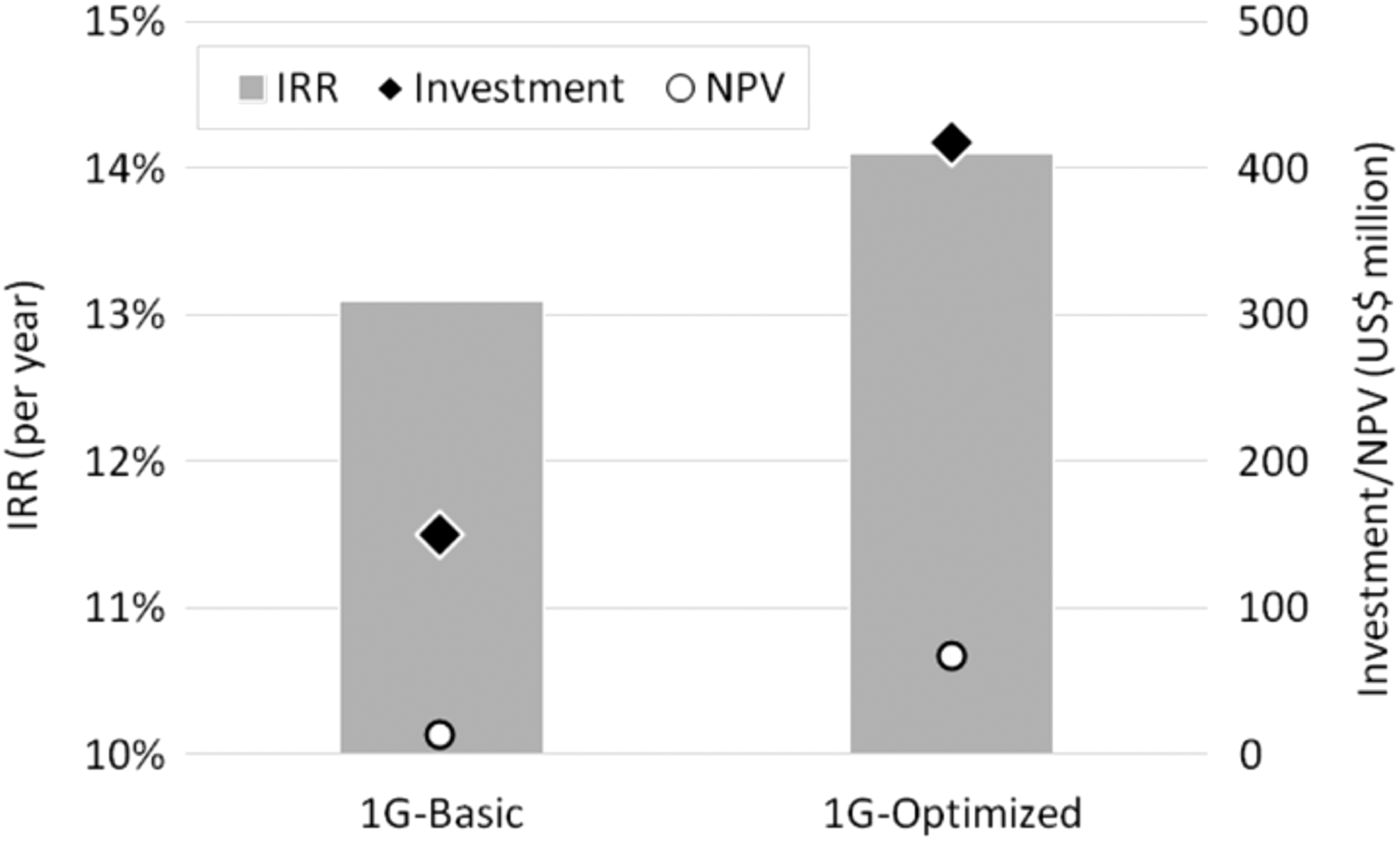
Investment, internal rate of return (IRR), and net present value (NPV) for 1G scenarios.
These results show the importance of public policies to motivate investments that modernize cogeneration systems (e.g., high-pressure boilers) and improve straw recovery systems, ultimately increasing biorefinery revenues. Increasing the amount of electricity generated from biomass in the Brazilian energy matrix also plays an important role in reducing greenhouse gas emissions, since natural gas-powered thermoelectricity can be replaced. 2 Therefore, public policies to support these actions can improve both profitability and the environmental impact of the sugar-energy sector.
Integrated 1G2G Ethanol Production Process
Technical results comparing 1G optimized and 1G2G advanced scenarios are depicted in Figure 4. The introduction of a 2G process with advanced technology increases ethanol production by 46% through the integral use of biomass, without increasing the sugarcane planting area. However, surplus electricity generation is significantly reduced, being around one third of that generated in the 1G optimized scenario. Figure 5 shows that despite lower surplus electricity generation, 1G2G advanced plants present better economic impacts, specifically higher IRR and NPV. Since the investments are relatively similar for both scenarios, it can be concluded that higher revenues from increased ethanol production more than compensate for the decrease in electricity sales.
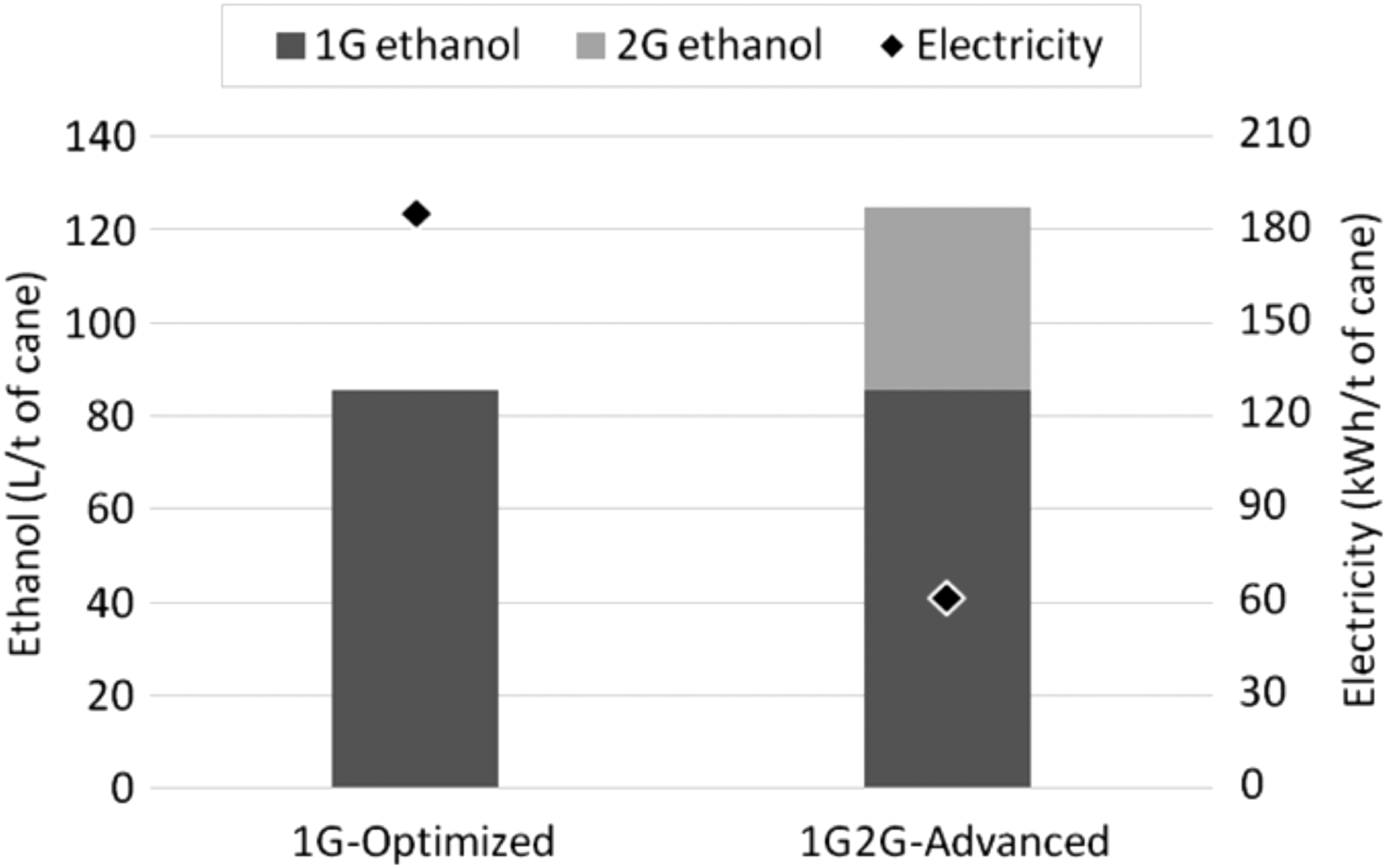
Ethanol and electricity outputs for first-generation and first-generation/second-generation scenarios.

Investment, internal rate of return (IRR), and net present value (NPV) for 1G and 1G2G scenarios.
Figure 6 compares the costs of 1G ethanol (from the 1G optimized scenario) and 2G ethanol, calculated based on the allocation between 1G and 2G ethanol in the 1G2G advanced scenario. A significant cost reduction (30%) was observed for 2G ethanol when compared to 1G ethanol. Biomass and capital costs are the largest contributors to production costs; together they account for 89% and 67% of 1G and 2G ethanol costs, respectively. In addition, enzyme costs are responsible for 20% of 2G ethanol costs.
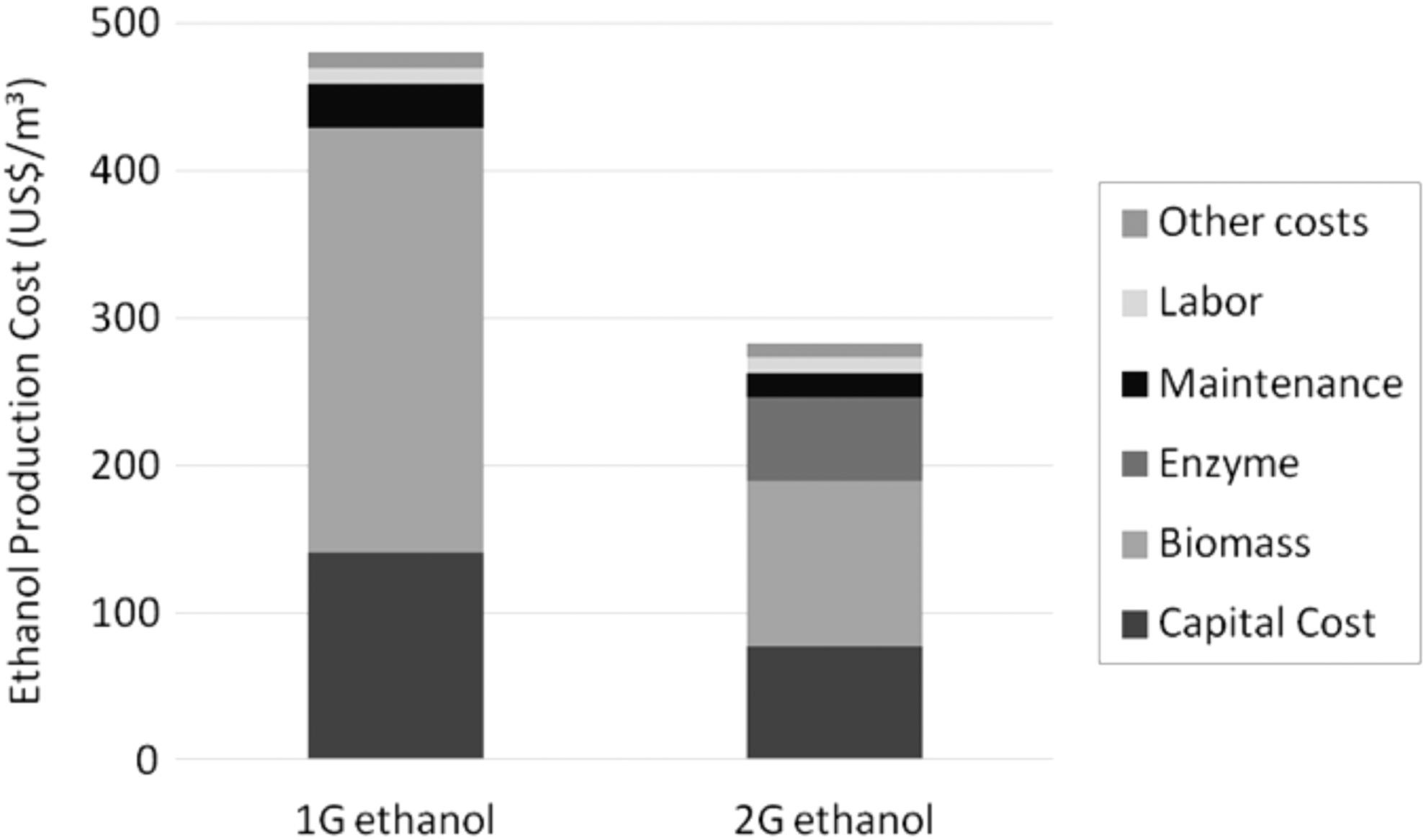
Breakdown of costs for 1G and 2G ethanol.
As a long-term prospect, 2G ethanol has the potential to decrease ethanol production costs, thus increasing competitiveness. Public policies that encourage research and development as well as production and consumption of 2G ethanol in Brazil play a crucial role in accelerating the maturation of the technology along the learning curve, overcoming technical challenges, and achieving the process targets considered in this study. For instance, the capital cost is much larger in the integrated 1G2G plant compared to a 1G plant, thus special credit lines for cellulosic ethanol plants may motivate the implementation of 2G processes in Brazil.
Conclusions
A significant increase in electricity output was achieved in the 1G plant model by introducing optimization features and using straw as fuel along with bagasse. Electricity proved to be an important product. It improved profitability and decreased risks by diversifying the portfolio of a sugarcane mill.
Second-generation ethanol results showed that implementation can be very competitive if long-term prospects become a reality. Towards this end, public policy instruments are necessary to motivate production and consumption of 2G ethanol and to support research programs focused on the main cost drivers—capital, biomass, and enzyme costs. Given the importance of the sugar-energy industry in Brazil's economy and energy matrix, policies that accelerate the development of 2G processes will help increase both economic competitiveness and sustainability.
So far, only a few public policy proposals have been based on scientific and quantitative assessment results. By translating sustainability into public policies, the VSB can be employed to support decision-making processes for a variety of bioenergy alternatives. Two case studies were evaluated in this work to demonstrate the potential applications of this tool.
Footnotes
Acknowledgments
The authors acknowledge the contributions of Professors Rubens Maciel Filho (State University of Campinas), Marina Dias (Federal University of São Paulo) and Marcelo Zaiat (University of São Paulo) on the development of the Virtual Sugarcane Biorefinery. The authors gratefully acknowledge financial support received from FAPESP (grant numbers: 2011/51902-9 and 2010/17139-3), CAPES, CNPq, and BNDES.
Author Disclosure Statement
No competing financial interests exist.