




Abstract
Limited options exist for efficiently and effectively treating water runoff from agricultural fields and landfills. Traditional treatments include excavation, transport to landfills, incineration, stabilization, and vitrification. In general, treatment options relying on biological methods such as bioremediation have the ability to be applied in situ and offer a sustainable remedial option with a lower environmental impact and reduced long-term operating expenses. These methods are generally considered ecologically friendly, particularly when compared to traditional physicochemical cleanup options. Phytoremediation, which relies on plants to take up and/or transform the contaminant of interest, is another alternative treatment method which has been developed. However, phytoremediation is not widely used, largely due to its low treatment efficiency. Endophytic phytoaugmentation is a variation on phytoremediation that relies on augmenting the phytoremediating plants with exogenous strains to stimulate associated plant-microbe interactions to facilitate and improve remediation efficiency. In this review, we offer a summary of the current knowledge as well as developments in endophytic phytoaugmentation and present some potential future applications for this technology. There has been a limited number of published endophytic phytoaugmentation case studies and much remains to be done to transition lab-scale results to field applications. Future research needs include large-scale endophytic phytoaugmentation experiments as well as the development of more exhaustive tools for monitoring plant-microbe-pollutant interactions.
Introduction
Pollutants associated with industrial and agricultural runoffs are of concern to human and ecological health as they can be challenging to efficiently and effectively treat. For example, wood treatment and petroleum wastes can contain high levels of carcinogenic polycyclic aromatic hydrocarbons (PAHs); livestock wastes contain high levels of nitrates associated with “baby blue syndrome” and algal blooms; and urban runoffs contain heavy metals such as zinc and lead that are known to be toxic to humans and animals. 1 –4 Plant-based remediation, or phytoremediation, directly uses plants and their associated microbes in situ for the stabilization or reduction of contaminants. Phytoremediation has been used for remediation in soil, sludge, sediment, surface water, and groundwater for a diverse range of contaminants. 5 –7 This wide remedial ability is owed in part to the multifarious levels of contaminant treatment (Fig. 1). Plants have the ability to control, degrade, or remove contaminants. Below-ground techniques rely on transformation, stabilization, or degradation stimulation. Once absorbed into the plant, transformation, stabilization or immobilization, and degradation can also occur. Methods of phytoremediation are thoroughly reviewed in Salt et al. and Ali et al. 1,5
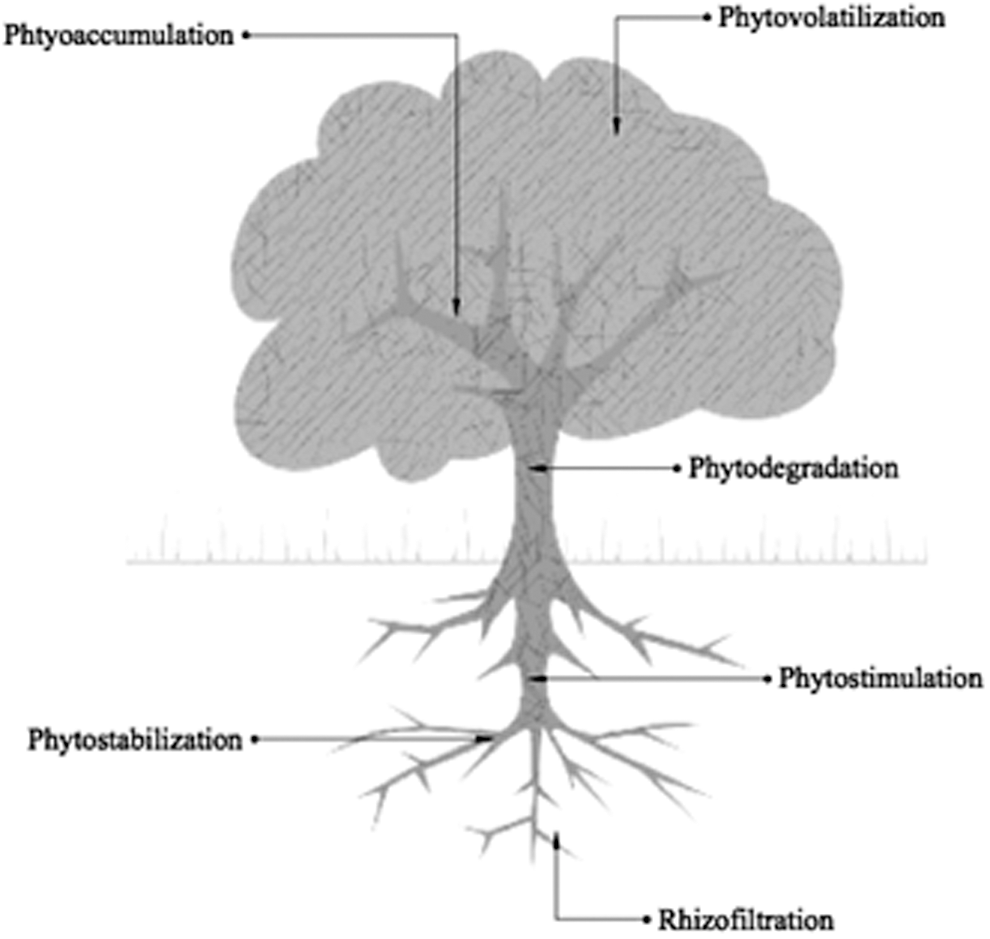
Methods of contaminant removal through phytoremediation. The driving force behind phytotechnology is the plant-microbe interactions. Plants and their associated microbial communities influence the control and degradation of contaminants.
Phytoremediation has been used to remediate numerous chemicals including metals, radionuclides, pesticides and herbicides, excessive nutrients, and organic pollutants. 1,7 –12 Depending on the location and desired treatment outcome, there are several types of phytoremediation planting schemes and applications that have been shown to be successful. The most common phytoremediation applications are riparian buffer strips, which consist of a strip of plantings along a wetland, stream, river, or lake, or a vegetation filter, which is used more commonly for managing municipal wastes and landfill leachates. 13,14
Along with phytoremediation, in situ bioremediation is another in situ treatment option that is more ecologically friendly than traditional remediation technologies. 15 Bioaugmentation is a common bioremediation strategy that consists of adding exogenous microorganisms such as endophytes to remediate contaminated sediments and soils. However, in this context, bioremediation may be ineffective or inefficient if the bioaugmented strain is unable to thrive under the specific physical site conditions and local microbial ecology. In endophytic phytoremediation, endophytes interact and exchange genes with both the rhizospheric and phyllospheric bacterial communities. 7 In doing so, the overall microbial community develops degradation capacities without requiring survival of the donor strain. Thus, the combined use of endophytic augmentation and phytoremediation, or endophytic phytoaugmentation, may offer an effective option for in situ treatment of runoff and waste systems.
Endophytic phytoaugmentation is a promising area of research, with numerous direct and indirect benefits. For instance, endophytes are known to help the growth and health of various bioenergy- and biofiber-related crops, including poplars, willows, and cotton. 6,16 –20 Primary and secondary wood products from poplar and willow trees, including pulp and paper, lumber, veneer and plywood, composite panels, structural composite lumber and pallets, furniture, containers and utensils, and animal feed, are expected to increase. 21 Furthermore, phytosystems also help aid in carbon dioxide (CO2) sequestration and may be useful for reducing greenhouse gases. 22 Endophytic phytoaugmentation may also be useful for agricultural systems for applications such as healthier tomato crops or grapevine growth. 14,23,24 This approach may also be used for biocontrol systems to provide enhanced aesthetics, to act as soil stabilizers, and to reduce dust dispersal. 16,25,26
Biology and Function of Endophytic Augmentation in Phytoremediation
Endophytic Biology
Plants are colonized by a range of microflora such as bacteria, fungi, yeasts, viruses, and protists, as well as epiphytes including algae and nematodes. Plant-microbe populations are dynamic, and variations in microbial communities that are influenced by the large fluctuations in the physical and nutritional conditions, as well as other biotic and abiotic influences, have been observed. 2,27 –32 Some microorganisms, predominantly bacteria and fungi, are recruited to enter the plant locally and systemically as endophytes, establishing asymptomatic or mutualistic relationships. 2,20,33,34 Endophytes are found systemically in roots, stems, leaves, seeds, fruits, tubers, ovules, and some nodules. 2,35,36 Endophytes may be recruited to their host through chemotaxis, electrotaxis, or simply accidental encounter and are most commonly recruited from the roots. 31,37,38 Roots have been shown to have the highest localized concentration of endophytes, and endophytic densities tend to decrease from stem to leaf. 39,40 The most commonly reported endophytic locations are the intercellular spaces and xylem vessels. 41 Endophytic communities depend on the taxa within a given community, host genotype and corresponding host developmental stage, inoculum density, temporal and seasonal conditions, plant location, and environmental conditions. 14,17,42,43 Though dynamic, many endophytic communities have been shown to contain common soil taxa such as Pseudomonas, Burkholderia, Bacillus, and Azospirillua. 37,44
Diversity and Function of Endophytes
Endophytes have been isolated from a diversity of plants, yet their exact function and associations remain unclear. 38 For instance, it is unclear how endophytes interact with each other in the plant, and little is known about the complex endophyte-host molecular interactions or their gene regulation and expression. 28,41 Endophytes seem to form diverse and complex associations with their hosts, including mutualistic and symbiotic relationships. 5,45 –48 In many cases, endophytes are believed to be beneficial to their plant hosts through nitrogen fixation, accelerated seedling emergence, protection from environmental stressors, enhanced nutrient availability and vitamin supply, and contaminant protection and removal. 9,28,31,37 Endophytes are capable of producing bioactive compounds associated with increased plant growth and health, and offer protection from abiotic and biotic stresses. 7,8,37,38,49 –55 Endophytes may also offer their plant host protection and defense against microbial diseases, insects, and nematodes. 19,25,33,38,56 For example, endophytic actinobacteria offer defense against the pathogenic fungus Gaeumannomyces graminis in wheat and potatoes, and the endophyte Curtobacterium flaccumfaciens protects citrus plants from the pathogen Xylella fastidiosa. 34 Interestingly, even some mycorrhizal fungi themselves have endosymbiotic bacteria for protection. 52,57 –60 More in-depth endophyte reviews are provided by Newman and Reynolds, Sturz et al., Strobel and Daisy, Mercado-Blanco, Tadych and White, and Lodewyckx et al. 32,44,61 –64
Endophytic Augmentation
Many endophytes have shown a natural capacity for xenobiotic degradation. 9 Further, plant-associated microorganisms capable of direct degradation are more abundant among endophytes than in the rhizosphere at contaminated sites. 65 This may be because the plants themselves selectively enrich degraders inside and around the phytoremediating host plants. Siciliano et al. found that plants grown in soil contaminated with xenobiotics naturally recruit endophytes with contaminant-degrading genes. 30 This selective enrichment suggests a potential against a wide-range of contaminants and sites. 26,30,31,65 –67 The natural ability of some endophytes to degrade xenobiotics has been investigated with regard to improving phytoremediation efficiency (Table 1). 7 –9,18,20,27,38,51 –53,65,67 –79
Previously Published Endophytic Phytoaugmentation Systems for Remediation
An advantage of using endophytic degraders in remediation is toxic xenobiotics may be degraded in planta, reducing phytotoxic effects and eliminating any toxic effects on herbivorous fauna residing on or near contaminated sites. 4,9,15 More specifically, some highly water-soluble and volatile organic xenobiotic compounds are quickly absorbed and may remain in the xylem for up to two days, allowing endophytic detoxification. 6,8,37,63,80 When plant species and environmental conditions are relatively constant, contaminant uptake depends on the lipophilicity, or the log of the octanol-water partition coefficient (log Kow). 7 Relatively hydrophilic compounds, or compounds with a log Kow between 0.5–3.5, such as benzene and toluene, tend to be absorbed rapidly into the plant. 7,45,48,81,82 Once absorbed into the plant, there are several kinetic processes for phytoremediation that may occur, including uptake, transformation, and stabilization via immobilization, which are thoroughly reviewed elsewhere. 1,5,7,13 When the log Kow is outside of the uptake range, it may still interact with the plant-microbe system through other methods like adsorption or volatilization. Further, mixed inoculations consisting of more than one endophytic bacterium that inhibit plant growth individually may result in plant-growth promotion, suggesting some important but poorly understood in planta interactions. 38 Consequently, full characterization of the plant-microbe interactions and their effects on pollutant degradation is needed.
Candidates for Endophytic Phytoaugmentation
In general, phytoremediation-based treatment approaches have gained attention for their ecological and economic benefits. Along with site remediation, phytoremediation provides the additional benefits of a high level of public acceptance, pleasing aesthetics, use of naturally occurring plant processes, enhancement of soil and plant health, and improved wildlife habitats. 1,5,7,53
Several plant species have been tested in phytoaugmentation applications. Poplars (Populus spp.) and willows (Salix spp.) are commonly used because of their rapid growth, deep roots, and large uptake of water. 83,84 Along with trees, recent reports suggest that hyperacculumators (plants that can accumulate high levels of toxins) and their associated microbes may play a key role in phytoremediation and can support organized endophytic communities. 1,5,12,45,64,85 Hyperaccumulators may be used to accumulate heavy metals often found in wastes and at contaminated sites such as As, Cu, Pb, Se, and Zn. 86,87 This is critical as metals are difficult to remove using traditional techniques and are often only controlled or immobilized. Phytoremediation offers the advantage of metal extraction without disturbing the site. For example, Thlaspi caerulescens (Alpine pennycress) is commonly used to accumulate large amounts of zinc and cadmium, and Thlaspi goesingense is able to accumulate large amounts of nickel. 88 –90 The metals may then be reclaimed and reused. 23,91
Along with hyperaccumulators, some other plants are capable of producing root exudates that enhance contaminant desorption, which may make some compounds more bioavailable for the subsequent degradation by microbial communities. 39,79 In addition, when augmented with endophytes, some plants have been shown to have improved health and growth, increased drought resistance, reduced transplanting shock, increased resistance to pathogens, and lower mortality. 5,8,23,25,40,52,76,79 It has been reported that several endophytic taxa from contaminant-exposed poplar trees have the potential to enhance phytoremediation of volatile organics and herbicides. 17,52,76,92,93 A review of phytoremediation plant species and their respective endophytes may be found in Mastretta et al. 31
Phytoaugmentation has proven feasible for several endophytic species (Table 1). One key example is the inoculation with a Pseudomonas endophyte capable of degrading the organochlorine herbicide 2,4-dichlorophenoxyacetic (2,4-D) to pea plants, reported by Germaine et al. 76 The phytoaugmented plants demonstrated increased removal of 2,4-D and showed no 2,4-D acid accumulation in aerial tissues. 76 There is potential to phytoaugment with naturally engineered endophytes, or those who have been genetically altered via natural gene transfer or recombinant DNA technology. 8 For example, naturally engineered endophytic Burkholderia cepacia strains with a nickel-resistance operon improved phytoremediation and promoted plant tolerance to toluene. 51,68 Lodewyckx et al. demonstrated that this same engineered B. cepacia endophytic strain increased the nickel accumulation and tolerance of inoculated plants when added to yellow lupine. 74 Transgenic, or genetically engineered, trees may also be designed to increase remediation. 94,95
Though several studies have reported positive findings such as increased remediation potential or improved plant health with pollutant exposure, there are still research and technology gaps to fill before widespread use can be adopted. Many of the current studies have been conducted at lab scale and with controlled parameters; it is unclear how they may translate to the field or large scale use with dynamic environmental conditions. For instance, it is unknown what metabolites will be produced from pollutant degradation during endophytic phytoaugmentation in the field, nor the ecological impact of long-term endophytic colonization. In addition, though some engineered endophytes are transformed naturally, public education and assurance of safety will need to be demonstrated prior to large-scale use. 32 Poorly understood plant-microbe-pollutant interactions before, during, and after endophytic phytoaugmentation are another obstacle, as are the limited tools and techniques for monitoring these interactions.
Propagation of Beneficial Genes Through Horizontal Gene Transfer
Interest in genetically modifying endophytes is increasing because of their enhanced ability to degrade or resist targeted contaminants. The advantages and obstacles to using bioengineered endophytes have been clearly discussed by Weyens et al. 46 Recently, there has been a focus on naturally modified endophytes, through horizontal gene transfer (HGT). Taghavi et al. found the degradative plasmid pTOM-BU61 transferred naturally to a number of different endophytes in planta, resulting in more efficient degradation of toluene in poplar plants. 51 It has also been reported that HGT in planta is likely to be widespread. 9 Further, endophytes have been shown to interact and exchange genes with the rhizopheric and phyllospheric bacterial communities through HGT. 7 For instance, genetic transfer to enhance phenol degradation in planta and in the rhizosphere has been demonstrated. 96 Similar to genetic bioaugmentation, endophytic phytoaugmentation strategies relying on genetic transfer between the exogenous and indigenous strains have an increased likelihood of success, as they do not require the survival of the donor strains. 60,97 –100 Though promising, targeted genetic transfer to increase degradation potential is novel, and little has been done at field scale. From a regulatory standpoint, guidelines for endophytic phytoaugmentation are needed, particularly with respect to engineered endophytes.
Potential Field-Scale Treatment Systems
The translation of endophytic phytoaugmentation from lab scale to the field scale is an area of interest, but there are a number of challenges. Optimization of contamination removal in field-level phytosystems, including artificial wetlands, riparian buffers, and vegetative filters, has been a topic of ongoing research. For example, endophytic phytoaugmentation in vegetative buffer systems may be used to treat industrial wastewaters, or wastewaters that may contain high levels of dyes, phenolic compounds, and metals. Using endophytic phytoaugmentation, Shehzadi et al. were able to treat effluent from a textile plant in a field-scale constructed wetland reactor. 29,66 They reported significant reductions in chemical oxygen demand (79%), biological oxygen demand (77%), total dissolved solids (59%) and total suspended solids (27%) in the constructed wetlands phytoaugmented with Typha domingensis and the textile effluent-degrading endophytes Microbacterium arborescens TYSI04 and Bacillus pumilus PIRI30.
Willow vegetative filters may be used at field scale for municipal wastewater and sludge treatment. 12,56,83,101 When filtering wastewater effluents through willow buffers, there is selective uptake of heavy metals, removal of excessive nutrients, and possible treatment of emerging contaminants. Willows may offer an economical and efficient solution for removing micropollutants such as endocrine-disrupting chemicals (e.g, estrogenic compounds) that are of concern in wastewater effluent. 102 Although much has been done with willows in traditional phytoremediation, little has been done with endophytic phytoaugmentation of willow systems. Riparian buffers can also help reduce excessive nutrient runoff and capture some of the pesticide/herbicide and heavy metal runoff. 10,65,103 They have been shown to be effective at field scale in channelized runoff, agricultural watersheds and drainage waters, and landfill leachate. 13,65,69,80,92,96,104,105 The treatment of wastewater effluent containing nonylphenols compounds from a tannery has also been investigated, as have hydrocarbons, persistent organic pollutants, and polychlorinated biphenyls. 6,11,26,59,78,80,81,93,106
Challenges
Complex and poorly understood community-plant interactions, natural microbial community dynamics, and variations in environmental conditions may limit the application of endophyte inoculation or waste treatments. When immediate or emergency action is required, endophytic phytoaugmentation may not be as appropriate as it is typically slower and only seasonally effective. 8,9,107 All of these considerations would require optimization in design and removal, which would require further research and understanding of the plant-microbe and plant-pollutant interactions.
Weyens et al. emphasized that although successfully applied in several laboratory-scale experiments, the large-scale field application of endophytic phytoaugmentation is limited by a number of issues including the levels of contaminants tolerated by plants; the limited bioavailability of organic contaminants; and the unacceptable levels of evapotranspiration of volatile organic compounds into the atmosphere. 7
Furthermore, there is no clear best method for monitoring endophytic phytoaugmentation. Endophytic colonization has been measured using fluorescently tagged endophytes. 52,77 This approach may be helpful for future model development but is unreasonable for field-scale studies. Monitoring a metabolite such as peroxidase may be a potential way of monitoring markers of plant health, while others have suggested using duckweed to monitor pollutant levels. 2,42 Unfortunately, these methods do not monitor plant-endophyte interaction. Preferably, a reproducible method would be developed to monitor three-way plant-microbe-contaminant interactions in the field.
Another challenge is that phytosystems occasionally absorb enough contaminants that leaves and stems may be classified as toxic waste, thereby making waste management difficult. In some cases, such as with metals, the contaminants may be reclaimed and reused, but for other contaminants the plants may need to be disposed of as biohazard waste. 13 Still, disposal of contaminant plant biomass may be simpler than full-scale site remediation using traditional methods such as excavation or chemical oxidation. Thus, it is critical that in-depth analyses be carried on a site-by-site basis.
Conclusions
Endophytic phytoaugmentation with naturally occurring xenobiotic-degrading endophytes have the advantage of reduced competition in the internal plant tissue and do not require re-inoculation, but there is still a need to determine what conditions help support a successful augmentation event. Additionally, natural endophytes have the potential to be isolated and genetically enhanced to degrade target compounds once reintroduced to the host, though the ecological implications of genetically altered microbes will need to be fully characterized. 63
A more in-depth understanding of the three-way plant-microbe-contaminant interactions is needed to capitalize on the potential benefits. In the future, tools will be needed to determine three-way interactions before, during, and after endophytic phytoaugmentation. Though green fluorescent protein tagging has been effective in monitoring endophyte-associated HGT at small scale (as previously discussed), more environmentally relevant, exhaustive, and field-level techniques and tools are needed. To do this, improved metagenomic, metatranscriptomic, and metaproteomic work on plant-microbe relationships is needed to fully understand and thereby optimize the augmented phytoremediation system. As methods of genomic and proteomic analysis become cheaper and faster, it has become more feasible to determine the relationship between the biotic systems and the pollutant systems. For example, targeting pollutant catabolic genes within endophyte communities using quantitative gene expression may be a useful tool for assessing colonization and remediation. 28 Other protein-associated techniques, such as modified enzyme-linked immunosorbent assay (ELISA test) and chromatin immunoprecipitation sequencing (ChIP-Seq), may help accurately describe the DNA-protein interactions between the plant and microbial community. Given the large numbers of environmental variables and parameters, these tools need to be applied to more field-scale endophytic phytoaugmentation studies to fully characterize the remediation potential. With a more complete understanding of the “-omics” associated with remediation and of the changes in field-level parameters, a system for reproducible and reliable endophytic phytoaugmentation may be established. Simple biomarkers or indicators of remediation (e.g., monitoring levels of a specific gene or protein) along with more exhaustive tools and techniques to monitor colonization and communications, would be valuable for large-scale or long-term projects. Though many research gaps remain, the use of endophytic phytoaugmentation may provide an economical and environmentally friendly alternative to traditional remediation techniques.
Footnotes
Acknowledgments
Duke's Superfund Research Center and the National Institute for Environmental Health Sciences under the grant NIEHS P42-ES010356 provided support for this work.
Author Disclosure Statement
No competing financial interests exist.