




Abstract
The return on investment in the biotechnology industry is comparatively slow, and for this reason it is important to protect innovation with intellectual property rights. The Brazilian government has implemented public policies aimed at improving the strategic use of intellectual property to ensure increased competitiveness of national industries, including biotechnology. Despite these initiatives, the innovation space in Brazil suffers from insufficient patent applications. Reasons for Brazil's poor performance in patent applications are mainly related to the low proportion of researchers in companies and the long time required for a patent to be granted.
Introduction
Brazil has several attributes that favor biotechnology industry development, such as a strong scientific base, abundant natural resources, and biodiversity. The growth and aging of the population, the ascension of millions of Brazilians to the middle class, increasing access to healthcare services, and demand for sustainably produced food also favor growth and expansion of the biotechnology industry. 1 The country is currently a leader in agribusiness and the production of biofuels, areas that benefit considerably from biotechnology. 1 For many years, Brazil has been a pioneer in the use and development of genetically modified organisms in agriculture. In 2013, the country ranked second in terms of biotechnology crop production—behind only the United States—with 40 million hectares dedicated to corn, soy, and cotton. 2
Brazil also stands out in biology and biochemistry, which provide a core underpinning to biomedical and biopharmaceutical development. 3 In recent years, the Brazilian biopharmaceutical industry has been growing due to initiatives implemented by the government, such as the Partnership for Productive Development (PDP). This program is a partnership between private companies that transfer technology and public institutions that manufacture strategic products for the Brazilian Unified Health System (SUS). 4 Biotechnology is a field in which technology advances rapidly, but returns on investments may be slow. For this reason, it is important for public research organizations and enterprises to protect the innovation they generate with intellectual property (IP) rights. This provides a basis for return on investment in research and development by granting exclusive rights for a certain period of time to their owners. 5
The State of IP Protection in Brazil
IP encompasses any new creation that is given the legal status of property. Tools to protect IP include patents, industrial designs, domain names, copyrights, trademarks, plant variety protection rights, and trade secrets. 6 Depending on the strategy, biotechnology companies may benefit from any of these IP tools, and it is not unusual for a trademark to be more relevant than a granted patent. According to the Brazilian Pharmaceutical Industry Association of Research's (Interfarma; São Paulo) latest study, the two best-selling pharmaceutical products in the country are branded analgesic medications. Even though they are not patent-protected and several generic copies are available in the market, both are associated with a strong trademark. 7
In this review, we emphasize the history and current status of patent data. In 1809, Brazil was just the fourth country in the world to enact a patent law. The country was also one of the founding members of the Paris Convention in 1882 and became a member of the Patent Cooperation Treaty (PCT) in 1978 and the World Trade Organization (WTO) in 1995. Brazil established the National Institute of Industrial Property (INPI) in 1970 for the purpose of examining IP. Patents are filed with INPI directly or under PCT rules. 8,9
Researchers and companies must keep in mind that each country has individual patentability requirements for biotechnology inventions. In Brazil, according to the Industrial Property Law No. 9.279 of 1996, some items are not patentable because they are not considered inventions, while other items are considered inventions, but are not patentable, such as entire or part of natural living organisms—whether they are naturally occurring substances present in nature or produced in laboratories, including the genome or germplasm. An exception is made for stable and reproducible transgenic microorganisms. 10 Later on, the Law No. 10.196 of 2001 further amended the Industrial Property Law to statutorily foreclose all pending patent applications filed before December 31, 1994 that claimed products or processes designed to create or modify pharmaceutical products, medicines, or processes designed to create or modify foodstuff products. The practical purpose of this amendment was to create specific rules for examining patent applications filed during the transition period between the former Code of Industrial Property No. 5.772 of 1971 and the current Law No. 9.279. 11,12
The Brazilian government has implemented public polices to improve the strategic use of IP and ensure increased competitiveness of national industries, including biotechnology. A major legal framework was the Technological Innovation Law No. 10.973 of 2004, which provided incentives for innovation and scientific and technological research in a productive environment. This law created increased legal security during interactions of public and private institutions, especially concerning IP originating from the collaborations. It also established technology transfer offices for managing innovation policy, including aspects of intellectual property, licensing, and technology partnerships in universities and research institutions. 13
The Biotechnology Development Policy was established in 2007 by Decree No. 6.041 to foster an adequate IP environment for the development of innovative biotechnology products, services, and processes and increase innovation and technology implementation in Brazilian companies. Two of the major objectives of this policy were to increase the number of patents with Brazilian ownership—both in the country and abroad—and to propose actions to disseminate a culture focused on innovation and IP. 14
Brazil's Law No. 13.123, which regulates access to the nation's biodiversity became effective in November of 2015. It replaces the Provisional Act No. 2.186-16/01, which governed access to national genetic heritage, as well as the associated traditional knowledge. The law promotes sustainable development aligned with the preservation of the environment and rights concerning natural resources. In doing so, the Brazilian government clearly intends to reduce biopiracy and ensure that those who research the country's genetic heritage or gain traditional knowledge can receive fair compensation from the profits generated by any products that knowledge helps to create. According to the new law, all patent applications for which the objects derive from genetic heritage or associated traditional knowledge material will require the applicant to file an online record of use prior to submitting the patent application. 15
Besides the implementation of legal policy mentioned above, entities such as INPI, Ministry of Development, and Industry and Foreign Trade (MDIC), as well as certain funding agencies such as National Bank of Economic and Social Development (BNDES) and Funding Authority for Studies and Projects (FINEP), have created other initiatives to assist with IP rights. One of these, created in the beginning of 2013 by BNDES, in partnership with MDIC and INPI, provides financial services as well as trademark registration and patent application through a BNDES card. The BNDES card is exclusive to micro-, small-, and medium-sized enterprises with a preapproved credit limit of up to R$1 million (USD$247,000), which is also available to finance the acquisition of goods and services with an attractive rate and long-term payment. 16 INPI created new guidelines for the examination of patent applications in the biotechnology field, considering the need for greater uniformity and predictability in examination analysis. The guideline provides useful support for applicants, refines some of the terms in biotechnology, clarifies when an applicant is required to file a sequence listing attached to the application, establishes rules regarding genetic heritage in patent applications, and defines elements not eligible for protection according to Brazilian legislation, among others. 17,18
The main funding agencies in Brazil recognize that commercializing a technology for which a patent has been filed or granted is a major challenge for companies. Both Inovacred Expresso from FINEP and MPEME Inovadora from BNDES offer attractive financing rates for the development and commercialization of innovative products and services. 19,20
Ongoing Challenges
Despite the initiatives of Brazilian policymakers to increase innovation and establish an IP-focused culture in companies and research institutions, an insufficient number of patent application filings characterizes the current innovation scenario of the country. According to INPI statistics, based on the nationality of the patent applicant, in 2012 the United States was the most prominent country represented at the Brazilian Patent Trademark office in all sectors, followed by Brazil and Germany (Fig. 1). 21 Even though Brazilian institutions were ranked second in patent applications in Brazil, to determine whether these institutions were establishing a patent culture, the compound annual growth rate (CARG) in the number of patent applications was calculated from 2000 to 2012 ( Fig. 2 ). When Brazil is compared to other emerging markets, the results are concerning. 21 Between 2009 and 2011, the patent activity of Brazilian institutions in the INPI's database is 15.5% of the total, and when patent applications related to biotechnology are analyzed, 17.2% are from Brazilian institutions. By comparison, the US accounted for 49.3% of the total patents filed with the US Patent and Trademark Office (USPTO) and Europe for 65.1% of those filed with the European Patent Office (EPO) in 2009–2011. When broken out by biotechnology patents, the tally is 63.4% and 55.8%, respectively. Compared to other countries, Brazilian organizations are not patenting their inventions, which is surprising considering the importance of IP. 22 According to the World Intellectual Property Organization (WIPO), in 2014 Brazil was ranked 22nd globally in patent applications. 23
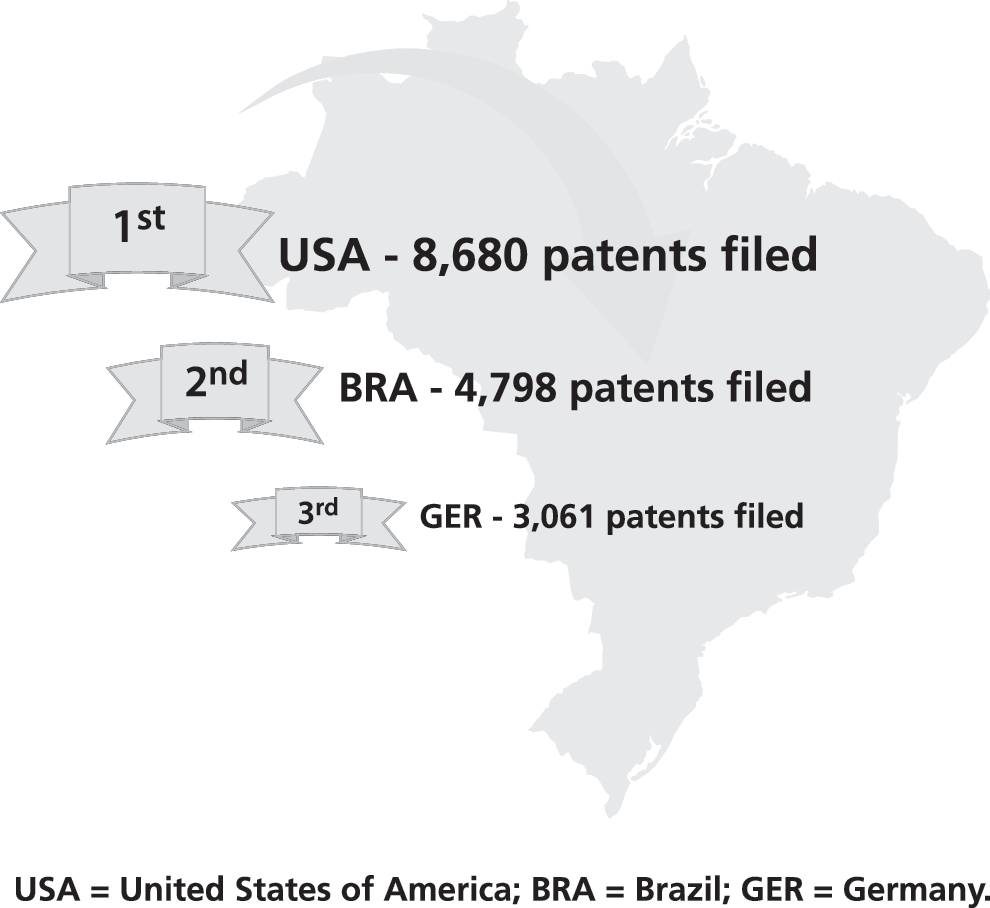
In 2012, the United States was the most prominent country at the Brazilian Patent Trademark office in all sectors, followed by Brazil and Germany.
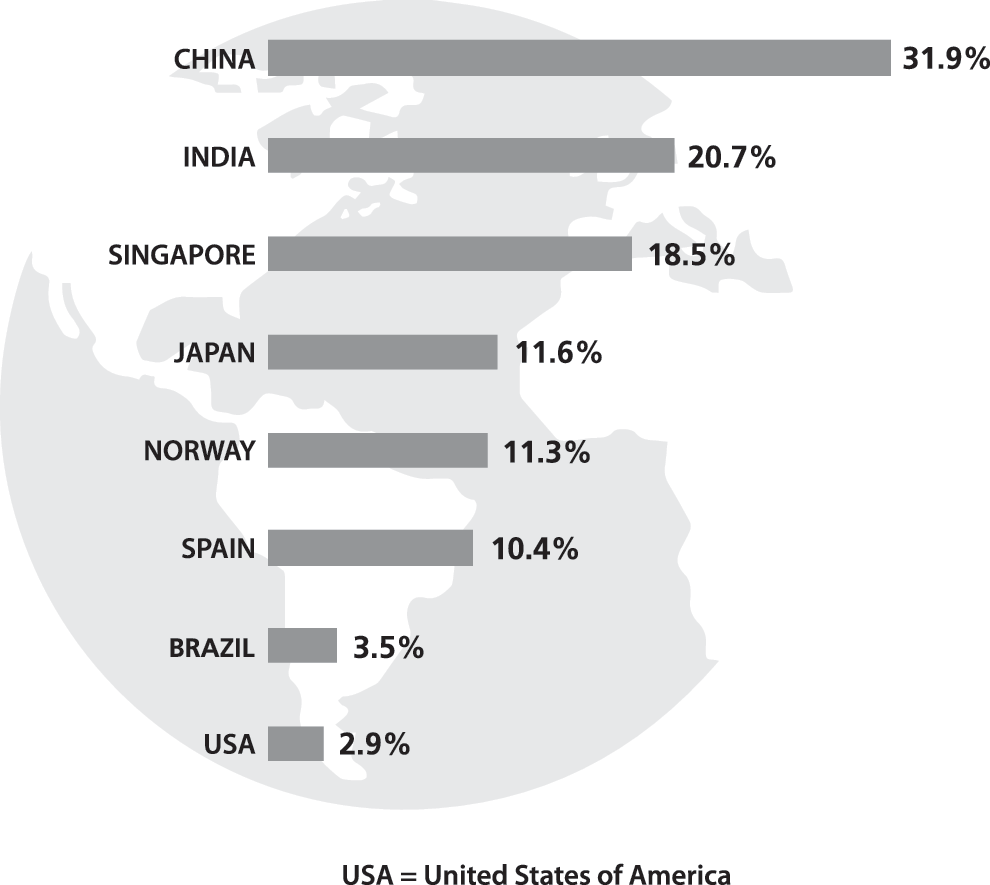
The compound annual growth rate (CARG) of patent applications in Brazil by selected countries from 2000 to 2012.
Another important parameter is the ratio between patents filed abroad and patents filed in Brazil by Brazilian organizations. Considering all sectors, the Brazilian ratio is smaller than that of the US, and when focusing on biotechnology patents, the figure is roughly the same (Fig. 3). These data show that many Brazilian biotechnology patents are not protected abroad. Some assumptions can be made as to why. For instance, the Brazilian institutions may adopt a strategy to file a patent only in Brazil because their interests are only in exploring the national market, or there may be a lack of both knowledge about procedures and financial and human resources for filing and obtaining an international patent application. The latter assumption is alarming. 22
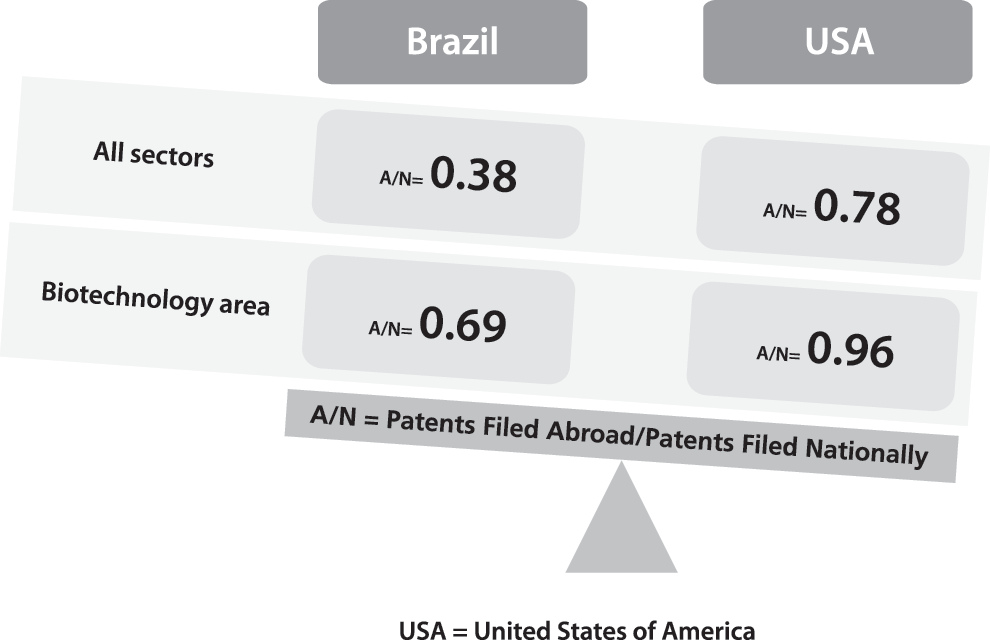
Ratio between patents filed abroad and patents filed in Brazil by national organizations, considering all sectors and, specifically, biotechnology.
One reason for Brazil's poor performance in the rankings of patent applications in international offices is the low proportion of researchers in companies. In developed countries, up to 80% of researchers are working in commercial enterprises, while only 20% are dedicated to academic activities. In Brazil, the situation is the opposite. 23 Fewer opportunities for PhDs in industry have led many to pursue careers in teaching and academics, resulting in a shortage of researchers for life science R&D. 1 Therefore, public policies to provide incentives for Brazilian companies to employ scientists are currently being implemented. Government funding agencies like the National Council for Scientific and Technological Development (CNPq) and state research foundations (FAPs) have created fellowship programs to promote greater integration of researchers with Master's and doctoral degrees in industry. 24 Besides the low proportion of researchers in Brazilian companies, business expenditure on R&D is also relatively small. As a percentage, Brazilian companies invested 48% of the total national gross expenditure on R&D in 2010. 3
The amount of time required to gain a patent in Brazil is another challenge. This fact is mainly due to a significant increase in the number and complexity of patent applications and a limited number of qualified examiners. Considering all sectors, patent requests are subject to a long waiting line at INPI. In 2012, 166,181 patents were waiting for analysis. This figure grew to 181,681 in 2013—a 9.3% increase. It is important to note that between 2012 and 2013, only five examiners were hired. 25
INPI has established certain actions to enhance the efficiency of examinations, such as the implementation of an electronic filing system for patent applications, known as the E-Patent system and the reorganization of channels for application, which creates examination lines for each type of application. 26 To expedite examination, especially for technologies of interest to the SUS, in 2013 INPI started to offer priority examination of strategic patent applications. The Ministry of Health may require patents related to pharmaceuticals products, processes, equipment, and materials associated to healthcare to have priority. Researchers and companies may request priority for cases in which the patent application is associated with the diagnosis, prophylaxis, and treatment of acquired immune deficiency syndrome (AIDS), cancer, or certain neglected diseases such as dengue, Chagas disease, and tuberculosis, among others. 27,28
However, these actions are not enough to substantially reduce the backlog in Brazil. INPI needs to move forward with hiring and training new examiners, especially in the areas of pharmaceuticals and biotechnology. These excessive deadlines, among other issues, are a barrier for researchers and companies attempting to protect their technology. 26,29 Additionally, any patent application related to a pharmaceutical product or process is subject to prior consent of the National Health Surveillance Agency (ANVISA), which also increases the delays in patent evaluation. To issue the prior consent, the agency analyzes the product or process and its potential impacts on public health. A patent application is considered to be contrary to public health when the pharmaceutical product or process disclosed in the patent application presents a health risk. This might include applications that claim a substance that has been prohibited in Brazil. Additional delays may arise when the pharmaceutical product or process is of interest to the medicinal or pharmaceutical policies of the SUS and do not comply with the patentability requirements under Brazilian Law. 30,31
Conclusions
Although Brazil has made some improvements to IP protection over the years, there are still several issues that prevent the country from achieving a positive IP environment across technology sectors, particularly with respect to the area of biotechnology. Past reforms have reaffirmed that changes in the patent law have encouraged innovation in Brazil's biotech industry. But while conditions are improving, biotechnology companies are still hesitant to seek market authorization for their products in Brazil due to the backlog at the country's patent office. 32
Footnotes
Author Disclosure Statement
No competing financial interests exist.