




Abstract

Recent years have seen an increased interest in developing genetically modified microalgae and cyanobacteria for use in biofuel and biobased chemical production, but this comes at a time when there is uncertainty within the industry and the academic community about how such uses will be regulated by governments in the US and elsewhere in the world. However, a reasonable road map is emerging of a regulatory regime that can allow pilot, demonstration, and commercial stage uses of modified algae without jurisdictional conflicts. In the US, regulations of the US Environmental Protection Agency (EPA) would govern the industrial use of algae or cyanobacteria in contained photobioreactors and open ponds, but regulations of the US Department of Agriculture (USDA) could in rare cases also apply. Although these regulations require assessments of potential environmental risks, recent government approvals show that the process can be successfully managed with proper preparation, and that approvals can also be achieved both for contained manufacturing as well as for proposed outdoor, open-pond testing of modified algae.
Introduction
Genetically modified microalgae, cyanobacteria, and other microorganisms are increasingly a focus of development for the production of renewable fuels and biobased chemicals. Innovations enabling biological methods of manufacturing commodity products currently made from petrochemical feedstocks promise to make an important contribution to the reduction of global carbon emissions and the movement to more sustainable industrial activities. The proposed use of genetically modified organisms offers potentially significant advantages over traditional industrial uses of microorganisms, such as improved productivity, decreased operational costs, the ability to use a more diverse range of feedstocks, and possibly more favorable carbon footprints. Recent interest in using modified microalgae and cyanobacteria for this purpose derives largely from the hope of being able to capitalize on the ability of photosynthetic organisms to synthesize useful compounds from sunlight, while also enabling capture and beneficial use of carbon dioxide from sources such as industrial waste streams.
However, in the US and most other countries around the world, manufacturing processes involving genetically modified algae and other microorganisms (GMMs) would likely trigger additional regulatory scrutiny before manufacturing could begin and products could be sold. This article reviews the regulations most applicable to fuel and chemical production using genetically modified microalgae and cyanobacteria, focusing mainly on the situation in the US, but including limited discussion of regulatory regimes elsewhere in the world. The article also discusses the scientific concerns that have led to the imposition of these regulations, and the issues underlying the risk assessments associated with such government oversight. With proper planning and management, approvals for research and development (R&D) or commercial use of genetically modified algae in industrial biotechnology should be relatively straightforward to obtain.
Potential Commercial Uses and Environmental Impacts of Genetically Modified Algae
Strategies for Genetic Modification of Algae
Much of today's commercial activity using advanced biotechnology for biofuel or biobased chemical production focuses on the creation, selection or improvement of strains of desired microorganisms or algae having enhanced properties for functions important for the production process. Historically, production methods have made use of naturally occurring or classically selected microorganisms, but advanced biotechnologies are now being investigated or used to develop enhanced strains.
Although most industrial activity to date has focused on the use of heterotrophic microorganisms, photosynthetic organisms such as microalgae and cyanobacteria have also been used for commercial purposes. 1 Historically, species such as Chlamydomonas, Chlorella, Haematococcus, Nannochloropsis, Dunaliela, Botryococcus, Scenedesmus, and others have been used for the production of industrially useful compounds. 1 –4 Genetic modifications are being considered for industrially useful strains of microalgae, to enable their use to produce commodity fuels and chemicals. Possible approaches to engineering microalgae are described in several recently published review articles and are summarized in Table 1. 2,3,5 –11 These strategies range from traditional genetic engineering approaches to overexpress or knock out targeted functions, to the use of synthetic biology and other advanced techniques to modify metabolic pathways or to create entirely new pathways for synthesis of desired compounds.
Genetic Engineering Strategies for Algae
Growth of Genetically Modified Algae at Industrial Scale
Growth of genetically modified microorganisms at industrial scales will usually involve the same hardware and processes that have typically been used for native microbial and algal species that have been exploited commercially. However, when considering the potential health and safety impacts of these industrial processes as part of government regulatory requirements, the conditions of manufacturing and processing of the organisms and their products must be taken into account, as they may affect the potential for worker exposure to the microorganism or its products, and the potential for release (accidental or otherwise) of the organism to the open environment.
Although improved strains of heterotrophic microorganisms would usually be grown in traditional fermentations, conducted under familiar industrial conditions that would afford protection against exposure or accidental release of the microorganism, the same may not be true for modified algae. Industrially useful algae strains (and to some extent cyanobacteria) have traditionally been grown in open-pond reactors, but the use of such reactors for genetically modified algae would pose much different issues for regulators conducting a risk assessment because of the inherent exposure of the production organism to the environment. 1,11 On the other hand, many algal and cyanobacterial strains can be grown in enclosed photobioreactors, which offer a greater level of containment and can be expected to minimize the issues that may arise in regulatory risk assessments and decision-making. 1,11 Although not resembling traditional microbial fermentation systems, in theory a photobioreactor can be operated in a way that minimizes or prevents release of the production organism into the environment: as such, these can be evaluated and regulated in the same manner as industrial uses of other microorganisms.
Potential Environmental Impacts of Genetically Modified Algae
As the biotechnology industry grew, government regulatory frameworks developed in order to ensure the safe conduct of larger-scale industrial uses of genetically modified organisms. Central to such government regulation is the need to assess potential environmental impacts, and to develop appropriate risk assessment methods in support of such regulatory programs. 12,13
As shown in Table 2, there are legitimate scientific concerns about the potential environmental effects of the industrial uses of microalgae having novel traits, particularly the concern that a new organism escaping or being released into the environment might have some competitive advantage over naturally occurring organisms, so that it could establish itself in the environment to detrimental effect. Some of these concerns are not unique to engineered organisms, and many observers would have similar concerns about large-scale industrial uses or releases of any novel organism, whether recombinant or not (e.g., see Gressel, et al.). 14 Most responsible observers in the industry have differed from critics in the overall perception of how significant the risk may be: while some in environmental groups and the general public fear that engineered microorganisms and plants, especially those created using newer techniques of synthetic biology, inherently have potentially serious environmental risks (e.g., see Glaser and Ryan), many scientists and industry officials feel that whatever risks may exist are easily assessable and manageable, and in any event do not differ in degree from the risks posed by similar uses of naturally occurring organisms. 15,16
Key Issues in Risk Assessments of Large-Scale Industrial Uses of Algae
The potential environmental impacts of introduced microorganisms have been studied and analyzed since the early days of the biotechnology industry. 13 More recently, there have been several papers specifically addressing the potential environmental impacts of the use of genetically modified (GM) algae and the types of risk assessments needed to evaluate such potential impacts. 10,14,17 –19 A recent workshop on this topic led to conclusions that coincide with many of the points raised in recent papers. 11 Henley et al. present the most comprehensive review of the potential environmental impacts of the “commodity-scale” use of GM algae, discussing such issues as the potential of a released strain to grow, persist, and mutate in the environment, the possibility that GM algae could produce toxins or harmful algal blooms or have other negative effects on aquatic ecosystems, and the possibility that introduced genes could spread by horizontal gene transfer and be expressed in indigenous microorganisms. 10 These authors also summarize the potential risks that might be associated with a number of different approaches for genetic enhancement of algae, while also presenting a framework for risk assessments of industrial use of GM algae. In a shorter paper, Snow and Smith cover many of these same issues, particularly the need to assess environmental survival and persistence of an introduced strain and the potential for horizontal gene transfer. 18 Both papers speculate on possible physical barriers or biological containment (e.g., so-called “suicide genes”; also discussed by Gressel, et al. 2013) that might be effective in reducing environmental dispersal or survival of a released GM algae strain. 14
In two recent papers, Gressel, et al. assess the possible risks of large-scale industrial uses of both naturally occurring and modified algal strains that have been domesticated for industrial use, and conclude that environmental risks should be assessed prior to large-scale use of either type of strain, particularly since accidental releases from production reactors are likely inevitable, even from contained photobioreactors. 14,19 These authors propose mitigation strategies designed to limit the ability of production strains to survive and persist in the environment in the event of escape from production facilities, including the application of risk management strategies similar to the principles of Good Industrial Large Scale Practice (GILSP), by using algae strains known to be nonpathogenic and to have a history of safe use.
Biotechnology Regulations
Historical Overview
Regulatory frameworks have been developed in the US and other countries to provide oversight over biotechnology and its commercial uses and to ensure that potential environmental impacts are assessed. Because the earliest public debates over biotechnology regulatory policies were often contentious or even confrontational, the perception developed within the industry that such government regulations were difficult to navigate. Such perceptions have been reinforced by negative public opinion opposing the possible use of genetically modified organisms (GMOs) in industrial or agricultural applications, particularly those involving open environment use. Although this is not true, this misperception persists in many quarters to this day, and so it is useful to put today's regulatory frameworks into some historical perspective.
Biotechnology regulatory frameworks in most countries arose out of the health and safety issues first raised shortly after recombinant DNA (rDNA) techniques were developed in the early to mid 1970s. (This early history is well documented by others, including Krimsky and Glass). 20 –22 Such concerns led to the adoption of research guidelines, which in some cases had limited applicability (e.g., the US National Institutes of Health rDNA guidelines, which were binding only on federally funded research). Over time, the focus of regulatory concern shifted not only to the larger scale uses inherent in the commercial application of this new technology, but also to deal with the intended use of engineered plants, animals, and microorganisms for use outside the lab, in the open environment (e.g., in agriculture).
In the US, the outcome of several years of public policy discussions was the adoption of a “Coordinated Framework” for biotechnology regulation in 1986. 23 Under this framework, it was decided that the commercial products of biotechnology would be regulated under existing laws and regulations and that it was not necessary to enact a specific law broadly covering all biotechnology activities. This gave primary responsibility to three agencies, the Food and Drug Administration (FDA), the EPA, and the USDA, to regulate biotechnology products in familiar product categories under existing laws. However, it also became necessary to create new regulatory structures for some classes of commercial products not covered by existing regulations. These primarily included new regulations from EPA and USDA that, as it turned out, are the ones that may govern many uses of modified organisms for production of fuels or chemicals in the US.
Biotechnology regulations also exist elsewhere in the world, although they have developed differently than in the US. Many other industrialized countries or regions, particularly the European Union, Canada, Australia and Japan, implemented biotechnology laws and regulations in the early days of the growth of the industry (i.e., the 1980s and 1990s), in differing ways that were consistent with the regulatory approaches of these jurisdictions. More recently, many other countries around the world have adopted biotechnology laws and regulations based on the principles of an international convention adopted in 2000—the Cartagena Protocol on Biosafety, described in more detail below. Countries taking this route generally have a single biotechnology law that, in principle, is applicable to all research and industrial uses of GMOs, although often primarily focused on food and agricultural applications and cross-boundary movement of GMOs.
Overview of Regulations Applicable to Biofuels and Biobased Chemicals
US EPA regulations under TSCA
Many uses of modified microorganisms, including algae or cyanobacteria, in biofuel or biobased chemical production, would be subject to regulations adopted by the EPA under the Toxic Substances Control Act (TSCA). 22,24 These regulations require notification to the agency before commercial use or importation of certain modified microorganisms, as well as agency review of proposed outdoor R&D activities of such modified organisms, e.g., open-pond growth of modified algae.
TSCA (15 U.S. Code 2601) is a law requiring companies or individuals to notify EPA at least 90 days before commencing manufacture or importation of any “new” chemical, i.e., one that is not already in commerce in the US, and which is intended to be used for a purpose not subject to federal regulation as a pesticide or under the food and drug laws. Similarly, in the 1986 Coordinated Framework, EPA proposed to use TSCA to oversee those new microorganisms to be used in commerce that were not regulated by other federal agencies. 23 The primary areas expected to become subject to the TSCA biotechnology regulations were microorganisms used for production of non-food-additive industrial enzymes or other specialty chemicals, and in other bioprocesses; microorganisms used as or to produce pesticide intermediates; microorganisms used for nonpesticidal agricultural purposes (e.g., nitrogen fixation); and microorganisms used for other purposes in the environment, such as bioremediation. As the field of industrial biotechnology has developed, areas related to production of biofuels and biobased chemicals have become the most prominent applications that might fall subject to TSCA.
Although EPA established an interim policy of TSCA regulation under the 1986 coordinated framework, because of political difficulties and interagency disputes the agency was not able to publish proposed biotechnology regulations until 1994 and was not able to finalize these regulations until 1997. 22,25 These rules, when finally issued, created new regulations (40 CFR Part 725), that specify the requirements and procedures for EPA notification prior to commercial use of new microorganisms (which paralleled the commercial notifications used for new chemicals), and new requirements to provide oversight over outdoor uses of those GM microorganisms within TSCA jurisdiction.
In these regulations, a “new microorganism” is defined as “a microorganism that is formed by the deliberate combination of genetic material originally isolated from organisms of different taxonomic genera”–i.e., an “intergeneric organism.” (EPA has clarified that a synthetic nucleotide sequence derived from a naturally occurring gene would be deemed to have arisen from the species in which the native gene occurred.) The definition of a “new microorganism” above is the same definition originally proposed in the Coordinated Framework and used under the interim policy, under the rationale that microorganisms that are classified within the same genus were more likely to be able to exchange genetic information in nature than microorganisms found in different genera, so that an “intergeneric” combination of genes was judged to be less likely to have occurred naturally (without human intervention) than an “intrageneric” combination. Under this formulation, microorganisms that are not intergeneric are considered not to be new, and such organisms, including naturally occurring and classically mutated or selected microorganisms, as well as GMMs modified only through gene deletions or improved through directed evolution approaches, are exempt from reporting requirements under TSCA.
Although there has been some uncertainty in the past, it now seems clear that genetically modified algae strains would fall under EPA jurisdiction under TSCA if intergeneric and if used for a TSCA-regulated purpose. Section 725.3 of the TSCA regulations define the term “microorganism” as encompassing “those organisms classified in the kingdoms Monera (or Procaryotae), Protista, and Fungi, the Chlorophyta and the Rhodophyta of the Plantae, and viruses and virus-like particles.” EPA clarified this definition in the preamble to the 1997 Federal Register notice, by stating that the definition included “green and red algae”; and in the Regulatory Impact Analysis accompanying the 1997 rule, EPA pointed out that “Language in [TSCA] has been interpreted to include living microorganisms (i.e., microscopic living cells such as bacteria, fungi, protozoa, microscopic algae, and viruses).” 25,26 Neither the preamble language nor the Regulatory Impact Analysis language carries the force of law, but this language makes it clear that the Agency considers that it has the legal authority to regulate industrial uses of genetically modified algae, a position borne out by recent regulatory filings discussed below.
USDA biotechnology regulations
Despite the likely applicability of the EPA regulations, it is necessary to consider the potential impact of the biotechnology regulations maintained by the USDA. These regulations, found at 7 CFR Part 340, have been the major US government rules that have covered uses of transgenic plants in agriculture and in the production of pharmaceuticals, industrial products, and phytoremediation. (The USDA biotechnology regulations would, in many cases, cover uses of transgenic plants as biofuel or chemical feedstocks, but such uses are outside the scope of this article.) A small number of modified agricultural microorganisms have also fallen under this regulation, and there have been some in the algae community that have expressed a preference for the USDA to use this regulation to assert jurisdiction over industrial uses of modified algae, due to the commonalities between algalculture and agriculture and USDA's historical support for, and involvement with, the algae industry. 4,10
As an immediate outgrowth of the Coordinated Framework, USDA proposed to use existing statutory authority under a law then known as the Plant Pest Act to regulate certain genetically engineered plants intended for field testing and eventual commercial use in the open environment, to assess the potential environmental effects of such uses. The basis for this rule was the possibility, however remote, that such engineered plants might pose a plant pest risk, based on the presence of nucleic acid sequences arising from genera listed in the rule. These regulations were finalized in June 1987, and have been administered by a dedicated biotechnology office within USDA's Animal and Plant Health Inspection Service (APHIS). 27
The possible applicability of the rule to engineered algae rests within its definitions. Although “eukaryotic algae” are included within the rule's definition of the term “plant,” it is not “plants” that are regulated articles under the rule: “regulated articles” are defined to include only “organisms that are or contain plant pests.” This has been interpreted to cover only those plants (or microorganisms) engineered to contain nucleic acid sequences from certain specific microbial, viral, plant, and animal genera that include species that were considered to be potential plant pests. The regulations included a fairly broad list of such genera, including the genus Agrobacterium, having the practical effect of causing most transgenic plants to be captured by the regulations because of the prevalence of plant transformation procedures using DNA sequences from Agrobacterium tumefaciens. The list of known or potential plant pest species is contained in 7 CFR Part 340.2, and this list does not appear to include the names of any of the genera of algae that have been suggested for industrial use.
The regulations give APHIS the leeway to make a determination that an organism altered or produced through genetic engineering is a plant pest, or that there is reason to believe the organism is a plant pest, but generally speaking, if an engineered algal strain is not from one of the genera shown on the list in Part 340.2, or does not contain any nucleic acids from any such genera (e.g., through use of an Agrobacterium or a viral vector), it would not a priori be subject to regulation under the existing rules. (USDA now has potentially broader regulatory ability. In 2000, the Plant Pest Act, the law on which the Part 340 regulations were based, was combined with other statutes to create a new law, the Agriculture Risk Protection Act, which includes language that could give USDA the ability to regulate modified organisms based on potential invasiveness or weediness. In 2008, the USDA published some possible options to amend the regulations to accomplish this, but to date the USDA has not proposed any specific regulations for this purpose.)
Alternatively, it is unlikely that USDA would use its regulatory leeway to assert authority over a proposed industrial use of a modified algal strain unless it was a fairly large-scale open-pond commercial use of the strain, and only if there were some clear link–such as a possible plant pest risk–to agriculture or to a particular region or sector of US agriculture. However, in view of USDA's regulatory discretion, and the possible involvement of state regulatory agencies, advance consultation with USDA may be advisable for proposed outdoor uses of certain modified algae strains.
Questions of regulatory jurisdiction over industrial uses of algae have arisen in the past. In 2005, Mera Pharmaceuticals (Kailua-Kona, HI) proposed to transport as many as eight modified strains of Chlamydomonas reinhardtii from California into Hawaii, to be used in pharmaceutical research. It was reported that three federal agencies, FDA, USDA, and EPA, all waived oversight of these field trials. 28 The Hawaii Department of Agriculture (DOA) eventually took responsibility for permitting the trials, because Chlamydomonas is listed on the state DOA's “list of restricted organisms” under its quarantine laws. This project became quite controversial, and although the Hawaii DOA eventually granted permits to allow at least some portions of the trial, a local citizen's group filed a lawsuit that resulted in a judicial ruling that an environmental assessment would be needed before the trials could proceed. 28,29 This decision was ultimately affirmed by an appeals court.
In April 2008, the aquaculture company Coastal BioMarine (Bridgewater, CT) sought USDA clarification of the regulatory status of three marine algal species engineered with a gene encoding a glucose transporter protein that were intended for use in fish feed. In response, USDA informed the company that, because neither the recipient (“host”) species nor the source of the glucose transporter gene is listed on the “plant pest” list in Part 340.2 of the regulations, the modified strains were not subject to the agency's regulations. The agency's letter further stated that use of the organisms in a contained reactor would not be subject to the regulations because such use did not constitute interstate transport or environmental release, but that larger-scale use of these organisms might raise environmental issues that would trigger a need for USDA oversight.
Because of the way EPA interprets its authority, according to the Agency, its regulations would cover any use of modified algae for an industrial use within TSCA's scope. Should a circumstance arise in which USDA also claimed authority, it is likely that the agencies would cooperate in their reviews. This has happened from time to time, particularly in the early years under the Coordinated Framework. 30
FDA regulations
Certain uses of modified microorganisms or algae could fall subject to FDA regulations, if used to produce foods, pharmaceuticals, or other products within FDA's traditional jurisdiction. The nature of such regulations and their scientific basis are outside the scope of this article. However, a common strategy for companies developing modified yeasts or other nonpathogenic microorganisms for ethanol, fuel, or chemical production is to contemplate the use of the spent biomass that remains after the production process in animal feed. This has traditionally been done in the ethanol industry, through the production of dried distillers grains containing inactivated yeast for use in animal feed. Any proposed use of modified microorganisms in animal feed would likely require review by the animal feed division of the FDA (or equivalent bodies in other countries), although in the US, FDA shares some responsibility for oversight over animal feed ingredients with the Association of American Feed Control Officials (AAFCO), as described further below.
Aquaculture regulations
Companies should also be aware that, in certain countries and US states, the industrial use of algae strains in open ponds could be subject to laws and regulations governing aquaculture. While likely not common or widespread, applicability would depend on whether the term “aquatic organism” or the equivalent is defined under the laws of the jurisdiction in question broadly enough to include microalgae. Where applicable, such laws could lead to additional permit requirements or, in rare cases, the need for additional environmental assessments. Further information can be found in online fact sheets maintained by the Food and Agriculture Organization. 31
International biotechnology regulation
As mentioned above, many countries have adopted biotechnology laws or regulations based on the Cartagena Protocol on Biosafety. The Protocol was adopted on January 29, 2000, as a supplementary agreement to the Convention on Biological Diversity, and took effect on September 11, 2003. 32 A key goal of the Protocol was to ensure that national authorities are notified of any proposed introduction of living modified organisms (LMOs) into their countries, particularly for the purpose of deliberate release into the environment or for use in food or feed, and further to ensure that information about uses of LMOs is provided to the public and to other countries and interested parties. To accomplish this, the Protocol requires there to be Advance Informed Agreements (AIA) when LMOs are shipped across national boundaries, to ensure that the recipient nation is notified and can conduct risk assessments when needed. Under national biosafety laws modeled on the Cartagena Protocol, one can expect that importation of an LMO into a country would require notification or approval from the applicable government agency, and that approvals would also be needed for many industrial activities using LMOs. The definition of LMO is broad enough to unambiguously cover algae along with other microorganisms.
The Protocol and the biotechnology laws of most other countries make the distinction between contained uses and uses in the open environment (“deliberate releases”), with different regulatory requirements for each at both R&D and commercial levels. For example, the European Union (EU) has adopted different directives for these purposes, which have been implemented in each EU member state by the adoption of corresponding national laws. 11 Contained uses of modified microorganisms would generally require national government notification, and in some cases possibly also approval, in accordance with the EU Contained Use Directive 2009/41/EC, while uses of modified algae or other microorganisms in open ponds would be covered by national laws corresponding to EU Directive 2001/18/EC on “Environmental Release.” 33,34
Similar situations exist in other countries. Under Japanese Law 97 of 2003, which forms the basis for Japan's biotechnology regulatory regime, distinctions are made between “Type 1” uses of LMOs, which are deliberate releases, and “Type 2” uses, which are contained uses. 35 In Australia, the Gene Technology Act of 2000, which has been implemented by the Gene Technology Regulations of 2011, defines contained uses of microorganisms as “dealings not involving release” (DNIR), and open-pond or other outdoor uses as “dealings involving release” (DIR). 36 In Canada, both contained and open-environment uses of modified microorganisms may require approval from Environment Canada under the New Substances Notification regulations under the Canadian Environmental Protection Act. 37 These regulations cover the use of any microorganism that is new to commercial use in Canada, but would give a greater level of scrutiny for open-environment uses. In most countries, there is no ambiguity about applicability to algae, although the responsible government agency may differ from country to country.
Regulation of Research Uses of Modified Microorganisms
Although most biotechnology regulation is aimed at oversight over commercial applications, R&D activities may also be covered, particularly research uses of algae or cyanobacteria in open-pond reactors. The following regulations may apply to R&D uses of modified microorganisms.
EPA regulation of research uses of modified microorganisms
TSCA is a commercial statute, and so its jurisdiction generally does not include R&D activities. The TSCA regulations include an exemption for “small quantities” of new chemicals used solely for R&D. This exemption was largely carried over into the biotechnology rule, except that EPA made the (somewhat debatable) distinction that microorganisms, because they are self-replicating, could not be considered ever to be used solely in “small quantities” unless certain restrictions were placed on how they were used. Thus, new microorganisms used solely for R&D purposes could qualify for the exemption only if they were used under suitably contained conditions, i.e., in “contained structures.”
Under the regulations, a “structure” is defined as any “building or vessel which effectively surrounds and encloses the microorganism and includes features
Under this definition, most laboratory research in biofuels or biobased chemicals would be exempt from commercial reporting, and many uses of engineered microorganisms in pilot plants or demonstration plants could also qualify as exempt, as long as the purpose is solely research and development and neither the organisms nor their product are used or sold commercially. Many enclosed photobioreactors would qualify as contained structures under the rule, but most open-pond algae reactors would not meet the definition. R&D use of microorganisms in the open environment, or in vessels or facilities judged not to be suitably contained, requires notification to EPA at least 60 days before the proposed use, under an application known as a TSCA Experimental Release Application (TERA). The data requirements for TERAs are outlined in 725.255 and 725.260 of the regulations, and these requirements address the key issues that should be considered in environmental risk assessments, as summarized in Table 3.
Data Required for Submission in a TSCA Environmental Release Application (TERA)
EPA is required to review the submitted information and decide whether or not to approve the proposed outdoor R&D activity within the 60-day period, although the agency could extend the review by an additional 60 days. If EPA determines that the proposed activity does not present an unreasonable risk of injury to health or the environment, it will notify the applicant in writing that the TERA has been approved. After approval, activities under a TERA are limited by the conditions described in the application document and any requirements or conditions included in EPA's written approval. In most cases, it is likely that EPA will require applicants to conduct some form of monitoring, to detect the possible spread or dispersal of the microorganism from the test site, or to detect any other potential adverse environmental effects.
As of this writing, there has only been limited experience with TERAs, with only 30 TERAs filed since the biotechnology rule was put into place in 1997, and these have almost exclusively covered agricultural microorganisms, or microorganisms to be used for bioremediation or for detection of hazardous contaminants in soil. 24,38 All of these have been to propose small-scale, early-stage R&D projects, and all but three of these were approved. However, in 2013, EPA approved the first TERAs submitted for the experimental outdoor use of genetically modified algae. These were a series of applications submitted by Sapphire Energy, Inc. (San Diego, CA) for open-pond testing of five intergeneric strains of the photosynthetic green algae Scenedesmus dimorphus, approved by EPA on September 25, 2013.
The stated purpose of the testing proposed in the Sapphire TERAs is summarized on the EPA website: 1) to evaluate the translatability of the genetically modified strains from the laboratory to an outdoor setting; and 2) to characterize the potential ecological impact (dispersion and invasion) of the genetically modified microalgae. The introduced intergeneric DNA sequences include certain “metabolism genes” and a marker gene that enables detection of the microorganism in environmental samples. Although the details of the genetic engineering have been claimed as confidential (as allowed under the regulations), it appears that the so-called metabolism genes enable or enhance the ability of the strains to synthesize the mixture of compounds Sapphire refers to as “green crude.” The company proposed to conduct the field trials at the University of California San Diego Biology Field Station in La Jolla, CA.
The TERA included data from the extensive prior use of wild type S. dimorphus at Sapphire's facilities, both in closed reactors and outdoor ponds. Sapphire performed and submitted studies to show that the strains survived poorly (i.e., zero or negative growth) in soil and water. As required by the regulations, the TERA also included a detailed description of the proposed outdoor experimentation and the procedures that were to be followed to minimize and monitor the potential release of the organism from the test plots. The algae were to be grown in “miniponds” located within a lined sand/soil berm acting as secondary containment, and experiments to detect possible survival and spread of the algae were described. Conducting such monitoring during a small-scale outdoor field trial of a GMO is a very important way of obtaining data on the potential for environmental dispersal that would be needed in future regulatory reviews to assess the impacts of larger-scale testing and use.
The studies under this TERA have been carried out. Among the main findings were that the modified algae were capable of dispersing and colonizing trap tanks up to 50 meters distant from the test site, but that the rate of dispersal declines with distance. Furthermore, both the modified and the wild-type algae were capable of growing in water from nearby lakes. And, the GM algae had no apparent effects on biomass, diversity, or composition of native algae species found in the nearby lakes. In particular, the studies showed that the GM Scenedesmus is ecologically indistinguishable from the wild-type strains in its impact on native ecosystems (J. Shurin, personal communication).
The potential environmental effects of outdoor uses of genetically modified algae are best assessed in actual field research, through controlled, monitored testing in a stepwise progression from small scale to larger scale, under a regulatory regime that not only provides oversight but also flexibility and accountability. The TERA process is well-suited for this purpose, allowing environmental risk assessment questions to be addressed with data from actual small-scale environmental use, thus facilitating subsequent risk assessments for larger-scale uses. The TERA process is compatible with the orderly and responsible conduct of the normal phases of scaled field testing, under a level of regulatory scrutiny that is accessible to academic scientists as well as companies.
USDA regulation of research uses of modified microorganisms
The USDA regulations explicitly cover certain R&D activities, and the majority of actions taken by USDA under its biotechnology rule have been to review and approve proposed outdoor R&D uses of modified plants and, to some extent, microorganisms in field tests of varied size and duration. The rule initially required submission of permit applications for all proposed outdoor uses of regulated organisms, but the rule was substantially relaxed, first in 1993, and then again in 1997, to create a much simpler notification process for those plant species deemed to have low potential risks. 39,40 Transgenic varieties of most common agricultural crops and other familiar plant species meeting criteria specified in the regulations can be used in research field tests simply with 30 days advance notice to APHIS and the submission of minimal information about the modified plants and the proposed field use. Such field tests must be conducted in accordance with performance standards specified in the regulations. Only outdoor uses of less-familiar transgenic plants and any modified microorganisms falling under the regulations would be required to undergo the longer permitting process. The USDA regulations would not cover R&D activities inside contained structures.
As mentioned above, the applicability of this rule to modified algae is far from clear, but if an open-pond use of a modified algal strain were judged to fall under these regulations, it is likely that permits would be needed for outdoor testing, even at small scale. The regulations covering permit applications for environmental use of regulated articles are found at 7 CFR Part 340.4. The data requirements for such applications are similar to what would be required in an EPA TERA, including a detailed description of the microorganism, the location and design of the experimental plot, and the provisions for monitoring the test. The regulations specify a review period of 120 days, and also require USDA to seek the involvement and comment of the department of agriculture in any state in which the field experimentation is proposed. Approved permits generally cover testing of 1–2 years, and subsequent years of testing, particularly at increasingly larger scales, would require new permit applications. As mentioned above, it would be expected that, in the event both EPA and USDA claimed jurisdiction, the agencies would coordinate their reviews as has been done in the past. 30
International regulation of research uses of modified microorganisms
Although regulatory requirements will naturally differ from country to country, it is possible to make some general observations. In many cases, R&D conducted in contained structures would not require advance government approval, although it would be prudent to assume that, in many countries, the Cartagena Protocol would at least require notification of the appropriate government agency before importation of an LMO for research purposes, even though Article 6(2) of the Protocol provides an exemption from the AIA notification procedures for shipments of LMOs intended solely for contained use. However, the definition of “contained use” in the Protocol does not distinguish between research use and commercial use; therefore, countries that have laws based on the Protocol but that require government approval for contained uses may require approvals even for R&D uses. On the other hand, proposed R&D activities in the open environment would likely require government review and approval in almost any country. For example, proposed uses such as field tests of modified algae in open ponds would likely require approvals in Europe under the EU Environmental Release directive, as DIRs in Australia, or as Type 1 uses in Japan.
Regulation of Commercial Uses of Modified Microorganisms
EPA regulation of commercial uses of modified microorganisms
Commercial uses of “new microorganisms” used for a “TSCA purpose” (that is, not regulated elsewhere in the federal government) may require notification to EPA at least 90 days in advance of commercial use or importation. This notification takes the form of Microbial Commercial Activity Notices (MCANs). An individual MCAN is needed for each modified strain intended to be commercialized, although EPA maintains procedures to facilitate submission and review of “consolidated” MCANs covering related strains of similar genetic make-up.
The information and other data that applicants need to submit in the MCAN are listed in Section 725.155 of the regulations and summarized in Table 4. Much of the required information has to do with the biological characterization of the modified microorganism and a detailed description of how it was constructed. However, information must also be submitted on the proposed use of the microorganism, the proposed production process, the containment and control procedures to be used, the likelihood for worker exposure and the steps taken to control exposure, and an assessment of the potential environmental effects of the microorganism should it be released from the facility. MCAN applicants can claim much or all of the submitted information as “confidential business information,” which the agency must keep confidential and which cannot be released to the public, but the applicant must include in the MCAN the justification for the confidentiality claim. EPA has published a detailed “Points to Consider” document summarizing the required data and the format for submission, which, together with guidance from the publicly available versions of previously filed MCANs (i.e., the parts of prior MCANs not claimed by the applicant as confidential), can be used to help applicants prepare MCAN submissions. 41
MCAN Data Requirements
EPA review of MCANs is usually fairly straightforward and will focus on the potential risks and benefits of the commercial use of the modified microorganism. Most of EPA's prior reviews of MCANs have taken place within the 90-day period specified in the regulations, although EPA has the power to unilaterally extend the review period by an additional 90 days, or to ask the applicant to suspend the review period voluntarily, if the Agency decides it needs more time to complete its review. MCANs for the contained use of new microorganisms in biobased manufacturing have generally not caused any concerns or significant issues in EPA's review, and most have been routinely cleared for commercial use without any delays or difficulties; however, it is possible that MCANs for algae or cyanobacteria might take slightly longer for EPA review, due to initial unfamiliarity with the species and the proposed conditions for growth and manufacture. MCANs (like chemical pre-manufacture notices, or PMNs) are not “approved” per se, but if no issues emerge they are cleared for commercialization if EPA takes no action within 90 days. However, if issues are identified, EPA has the authority to require additional data from the MCAN submitter or to limit approved uses of the microorganism in a variety of ways. Once an MCAN is dropped from review, an applicant must file a Notice of Commencement within 30 days of beginning commercial use or importation of the microorganism, a notice that requires submission only of minimal information, but which triggers recordkeeping and reporting requirements once commercialization begins. EPA also has the power to regulate new microorganisms after commercialization has begun, if the agency decides that it is necessary to address unreasonable risks to health or the environment.
The rule applied to biotechnology products provides certain exemptions from MCAN reporting that are available for specific organisms that qualify. These are the so-called “tiered exemptions” available for certain uses of modified strains of well-studied, common industrial microorganisms (as listed in Section 725.420 of the regulations). However, there are no algae or cyanobacteria species eligible for this exemption.
EPA has been receiving MCANs and other notifications of biotechnology products under its interim TSCA policy since 1987 and under the current rules since 1997, and these regulations have not proven to be a barrier to industrial biotechnology companies, including those developing biofuel products or processes. As of this writing, there are 63 MCANs listed on the EPA website as having been filed from the 1997 inception of the regulations through December 2013. 24, 38 The number and frequency of these filings have increased substantially in the last 3 years, as can be seen in Figure 1, largely due to a greater number of proposals for biofuel or biobased chemical production. 24,38 All but one of the MCANs listed on the EPA website were favorably reviewed by EPA.
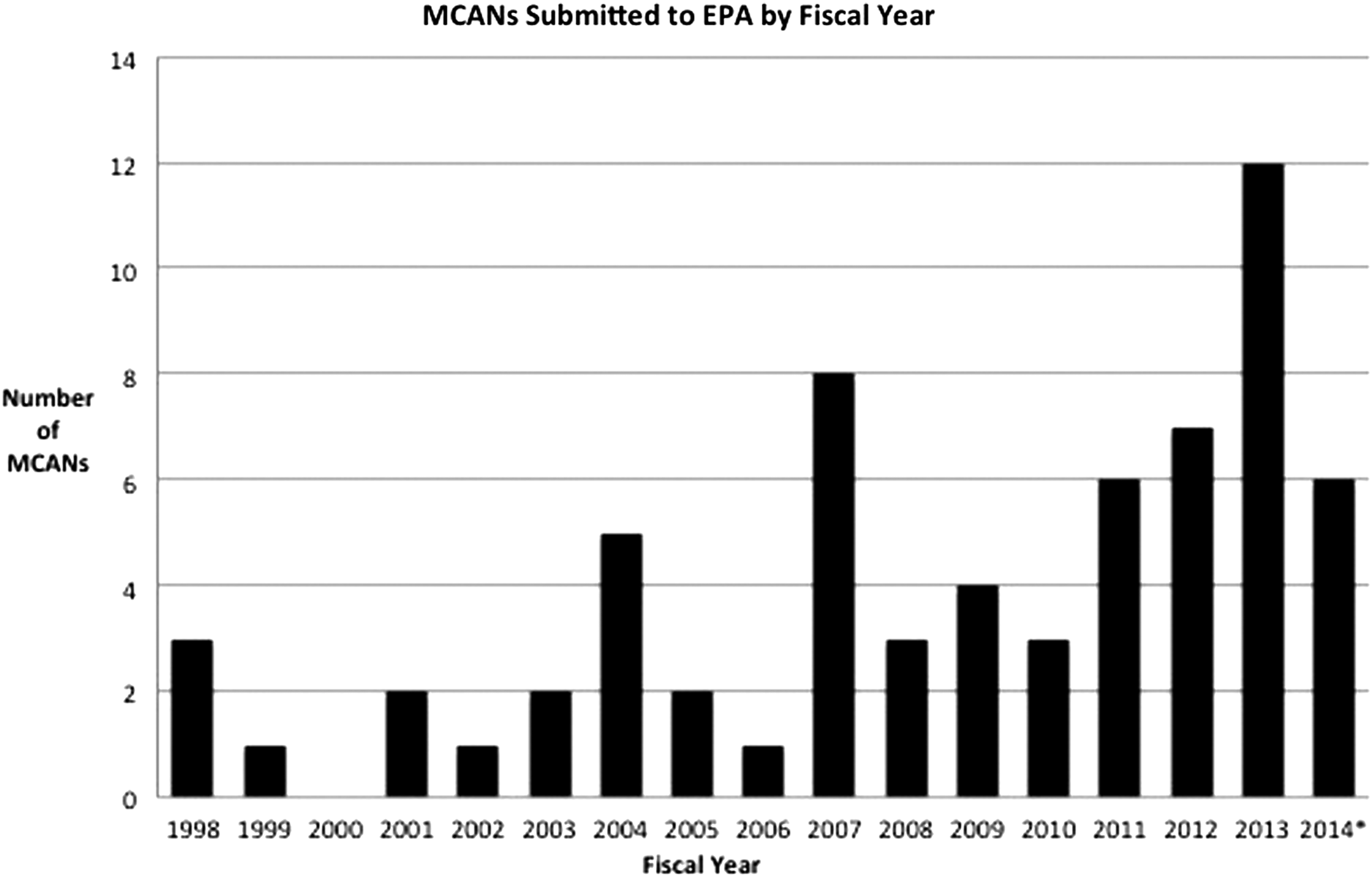
MCANs submitted to EPA, by US government fiscal year. *Data for FY2014 only includes MCANs filed through December 31, 2013. 38
Most of the MCANs cleared by EPA have been for uses of intergeneric microorganisms to manufacture industrial enzymes. Many of these, particularly in recent years, have been for enzymes intended for use in the production of cellulosic ethanol or other biofuels. In recent years, the number of MCANs for biofuel or biobased chemical production organisms has dramatically increased, such that production of fuel ethanol has become the second largest category, and notably, 16 of the 22 MCANs for this purpose have involved the use of modified strains of Saccharomyces cerevisiae.
Among the most recent filings are two MCANs submitted by Solazyme (South San Francisco, CA), which are the first received and favorably reviewed by EPA under TSCA for the industrial use of modified eukaryotic algae. Although the identity of the microalgae species has been claimed as confidential in these MCANs, presumably one or both are for modified versions of the same algae species, Prototheca moriformis, which has been identified in online documents describing Solazyme's approval for commercial use in Brazil (described below). Unlike many industrial uses of microalgae, Solazyme grows its algae strains in traditional contained fermentations, with the organisms growing heterotrophically, i.e. deriving their energy from chemical nutrients rather than via photosynthesis. These modified algae would be used to produce one or more chemicals, the identities of which have been claimed as confidential by the company.
MCANs have also been submitted for modified cyanobacteria. In 2012, Joule Unlimited Technologies (Bedford, MA) filed the first MCAN for a modified strain of Synechococcus for production of ethanol. Algenol has also filed and received EPA clearance for an MCAN for a modified cyanobacteria strain for ethanol production. 42
Joule's MCAN is unique among all previously filed MCANs in that the organisms would be grown outdoors, in durable, contained transparent photobioreactors arrayed horizontally to gather sunlight, rather than in a traditional stainless-steel fermenter. In its evaluation of Joule's MCAN, EPA had no health or safety objections to use of the modified strain at Joule's Hobbs, New Mexico facility. However, because of the innovative nature of Joule's photobioreactors, EPA was not prepared simply to drop the MCAN from review, thereby granting the company unlimited rights to use the MCAN strain under any conditions. Instead, EPA and Joule entered into a voluntary consent order, which allows Joule to use the strain commercially at the Hobbs facility, while also providing EPA with further data resulting from such use.
USDA regulation of commercial uses of modified microorganisms
If the USDA regulations were applicable to a given technology involving modified algae, commercial use would require approval of a petition for determination of nonregulated status under 7 CFR Part 340.6. These are the provisions of the regulation that have been used for USDA review and approval of new transgenic crop varieties. These petitions require the data that are specified in 7 CFR Part 340.6, which are quite extensive and must usually include data from prior years' field testing to show efficacy and environmental effects. Although this process has been used successfully for dozens of varieties of transgenic crop plants, in recent years the review process has become more complicated, with USDA generally required to prepare Environmental Assessments in compliance with the National Environmental Policy Act and to solicit public comment before granting approval for any petition. The need for Environmental Assessments has lengthened the process of gaining commercial approvals, creating some consternation within the regulated community, and would prove to be a rather unwieldy process for commercial approval of any algae-based manufacturing process that might fall subject to these regulations. 43
FDA regulation of modified microorganisms used in animal feed
The use of spent biomass in animal feed, or to produce a substance to be used in animal feed, would be regulated in the US by the FDA through its Center for Veterinary Medicine (CVM). Although FDA does not require premarket review of human or animal “food,” FDA regulation is largely directed at new substances proposed for use as human food additives or as animal feed additives. Under the Federal Food, Drug and Cosmetic Act (FFDCA), most such new substances that are intended to be components of food or to affect components of food are considered to be “food additives” and must be approved through the submission of a Food Additive Petition or, in the case of products for animal consumption, “feed additives” requiring Feed Additive Petitions. However, under the FFDCA, substances that are “generally recognized, among experts qualified by scientific training and experience to evaluate their safety as having been adequately shown … to be safe under the conditions of their intended use,” are not considered as food additives. This created the category of substances known as “generally recognized as safe” (GRAS), and many food or feed substances are used in food or feed on this basis.
There are several options to obtain clearance for new animal feed ingredients. One option is to file a Feed Additive Petition, which requires compilation of a significant amount of data and an often-lengthy FDA review process. The primary alternative would be to achieve GRAS status for the product, either by a manufacturer's self-certification that a substance is GRAS for a specific use, if supported by appropriate publicly available data, or by seeking FDA's concurrence to the company's GRAS determination through the GRAS Notification procedure, a relatively new process instituted by CVM in 2010 (following the successful use of a similar program within FDA's human food branch). 44
However, another option also exists. Although the law and regulations give FDA the ultimate regulatory authority, in practice CVM operates in cooperation with the Association of American Feed Control Officials (AAFCO), which is composed of state, federal, and international regulatory officials who are responsible for the enforcement of state laws regulating the safe production and labeling of animal feed. FDA, CVM, and AAFCO work together to review proposed new feed ingredients and to establish definitions for those that are approved. Each year AAFCO publishes its Official Publication, which includes a list of accepted feed ingredients, and most US states allow the use and sale of only those feed ingredients listed in the publication. New feed additives approved by FDA under the petition process are generally accepted as new ingredients by AAFCO, but this may not be true for products self-certified as GRAS. It is possible to work directly with AAFCO to obtain a new ingredient definition for a GRAS substance, an action to which FDA may later consent.
Regardless of the regulatory route chosen, the scientific criteria that would be considered in the regulatory risk assessments for feed use would be different from the environmental effects issues that would be considered for the programs described above, in part because of the different intended use, and in part because microorganisms used in animal feed have generally been inactivated before such uses. Therefore, these regulatory programs will not be discussed here in any additional detail.
International regulation of commercial uses of modified microorganisms
In most countries, it is likely that industrial uses of microorganisms both in contained manufacturing and in open-pond cultivation will require government approval from the applicable agency. However, proposals for contained uses will generally be subject to far less stringent oversight than proposals for open-pond cultivation of algae. The Cartagena Protocol can be viewed as establishing minimum requirements for applicants proposing to use LMOs in contained commercial manufacturing, such as the possible requirement to notify the competent national authority, with the understanding that national laws may impose additional requirements in certain countries. Further, the government agency having oversight for commercial manufacturing will differ from country to country.
In principle, under the Protocol, the process to seek approval to use an LMO in the open environment (e.g., in an open-pond algae reactor) would not be much different than for a proposed use in contained manufacturing, in that the recipient national government would need to be notified and would need to conduct a risk assessment. However, in the case of an intended release to the environment, an Advance Informed Agreement would absolutely be required (which is not necessarily the case for a proposed contained use) and the risk assessment would almost certainly be more rigorous. The Protocol specifies in Annex I the minimal information needed for AIAs and provides guidance for risk assessments in Annex III. In most countries, a permit or some affirmative government permission would be needed before the LMO could be used in the open environment. Such proposals may also engender public or community interest and perhaps opposition.
There has been at least one approval for industrial–i.e., non-pharmaceutical, non-food–use of modified algae outside the US. This was an approval received in Brazil in October 2013 by Solazyme Renewable Oils and Bio Products Brazil Ltda. Solazyme requested the advice of the Brazilian advisory committee known by its Portuguese acronym CTNBio on the proposed use of the genetically modified microorganism Prototheca moriformis strain S2014 for the commercial production of triglycerides and bioproducts. Prototheca moriformis is a single-celled non-chlorophyll-containing obligatory heterotroph that reproduces asexually and does not produce spores. In a decision announced in October 2013, CTNBio approved the commercial release of the genetically modified Prototheca moriformis, strain S2014, for the production of triglyceride oils and other bioproducts. (Limited details on this approval can be found in Portuguese in a CTNBio Technical Report. 45 )
Conclusions
As more companies and research groups begin to contemplate or implement the use of genetically modified algae or cyanobacteria for biofuel or biobased chemical production, greater attention will focus on the need for appropriate science-based regulation and risk assessment. The pathways to gain the needed regulatory approvals exist in the US and in most industrialized countries, but these regulatory programs are not as well known or as well understood as are those for other applications of biotechnology such as pharmaceutical development. In addition, because of early concerns over the outdoor testing of GMOs, and continuing controversies over use of GMOs (transgenic plants) in food, the perception persists even within industry that the need for regulatory review poses a significant barrier to commercialization plans involving modified microorganisms and algae, particularly any proposed open-pond use of modified algae.
As described in this article, the regulatory jurisdiction for industrial uses of algae, cyanobacteria, and other microorganisms in the US and elsewhere in the world has become clear. Although there has been some uncertainty about US agency jurisdiction in the past, it appears that EPA's actions in reviewing and allowing uses of algae and cyanobacteria under MCANs and TERAs has settled the question, and that a role for the USDA would occur only rarely, and even then interagency cooperation would be expected. The applicable regulations are, in most cases, straightforward and have been successfully navigated by companies and in some cases by non-profit institutions as well. These regulatory successes include approvals for uses of modified algae and cyanobacteria, including the first approval for open-pond research use of modified algae. These regulations rely on sound scientific principles of environmental risk assessment and address legitimate questions of environmental impacts, even though it can be argued that the microorganisms and processes most likely to be used commercially are ones that are highly unlikely to pose environmental concerns. Nevertheless, the scientific basis for the needed risk assessments is well understood and is itself the subject of ongoing research, thus providing a firm basis for governments around the world to conduct adequate assessments of proposed R&D and commercial uses.
Review and approval for commercial uses of algae or cyanobacteria in contained reactors (e.g., photobioreactors) should be fairly straightforward, as any potential risks would largely be mitigated by the choice of the production organism and design features of the reactor–e.g., in accordance with Good Industrial Large Scale Practice. In most industrialized countries around the world, the roadmaps for achieving such approvals, the data needed to support applications, and the procedural requirements are well understood. Companies planning such activities should identify and contact the applicable regulatory agency well in advance of proposed activities, to open a dialogue with agency officials to be sure that all testing and data requirements are known and can be addressed. Although specifics will vary, the needed regulatory dossier can rely on both published evidence from the literature as well as company conducted testing to address potential environmental impacts.
Proposals for research or commercial uses of algae in open-ponds will face much tougher regulatory review, particularly outside the US, but with proper preparation this need not be an impossible task. The optimal strategy would be to address as many potential environmental effects, such as survival of the strain in soil or water, in laboratory or microcosm testing prior to seeking approval for small-scale, appropriately controlled and monitored, field-testing. Here too, advance consultation with the applicable regulatory agency would be critical. Regulatory procedures like the TERA process of the US EPA can ensure that risks are assessed in a stepwise manner, as field experimentation moves from small-scale to large-scale under conditions designed to minimize the potential spread of the organism from the test plot, and with appropriate monitoring and data collection to support later experimentation or use at larger scale. If data derived from such small-scale studies provide no evidence suggesting any potential environmental harm, such studies could be followed up with larger-scale studies in much the way new plant varieties and other new agricultural products are field tested in progressively larger field trials.
Collaborations between industry, academia, and government can be helpful to ensure that the technology moves forward in a responsible manner. Academic scientists can play an important role in continuing to develop a comprehensive research base to support the necessary risk assessments, so that regulations are based on sound science and do not pose arbitrary barriers to commercialization. Although a good deal of data regarding the environmental impacts of algae already exist, there is clearly a need for additional research and additional data, as several authors have suggested. 18 In addition, because of the desirability of carrying out environmental monitoring during initial, small-scale field testing, these early-stage tests might often be best carried out as collaborations between industry and academic or government scientists, perhaps even making use of government research facilities. The Sapphire-UCSD collaboration provides an excellent example of such a strategy, and the ultimate peer-reviewed publication of the results of environmental monitoring from such collaborations would add to the research base in support of future regulatory risk assessments.
The United States is among the countries having the best-developed regulatory frameworks for industrial, agricultural, and environmental uses of GMOs, and although public concerns or opposition persist to some degree regarding plant species engineered for food use, it seems at least anecdotally that there is currently little public opposition to uses of modified microorganisms in the manufacture of beneficial products. This is in contrast to other regions of the world, such as Europe, where significant opposition to GMOs is still found in many EU nations, and even in countries such as Brazil, where reasonable regulatory frameworks exist on paper, but where, in practice, it has proven difficult or time-consuming to obtain needed approvals. It is probably too early in the development of the industrial biotechnology sector to know if a relatively stable, predictable regulatory regime might give US industry a competitive edge over other jurisdictions, but the maturity of the regulatory framework arguably creates a clear, understandable roadmap for companies developing processes involving modified algae or other microorganisms. Regulatory certainty is one critical factor that can lead to successful development of new, algae-based processes that can address critical worldwide needs of developing novel sources of energy, while reducing carbon emissions and avoiding other detrimental environmental impacts.
Footnotes
Author Disclosure Statement
The author coordinated the preparation of Joule Unlimited Technologies' MCAN and handled all interactions with EPA during its review of the filing, while employed by Joule Unlimited. The author also declares a financial interest in this company.