




Abstract
Introduction
China is playing an increasingly important role in the world economy. According to an assessment by the World Bank's International Comparison Program, China is the world's second largest economy. 1 Evidence of the rapid growth of the Chinese economy includes the widespread use of made-in-China electronic devices, clothes, toys, and other goods, and witnessing more and more Chinese travelers worldwide. While enjoying their increased purchasing power, the Chinese people have also suffered a great deal from environmental deterioration and shortages of energy and other resources related to this rapid economic growth. These side effects have been quite puzzling to Chinese society.
Green and sustainable development has become an urgent national need of China. Industrial biotechnology–understanding, creating, and utilizing living organisms to foster new, green, wealth-creating industries–has become one of the most exciting scientific frontiers and the strategic choice of many countries targeting sustainable development. Given this exciting but challenging background, the Chinese Academy of Sciences (CAS) and the Tianjin Municipal Government decided in 2009 to co-found the Tianjin Institute of Industrial Biotechnology (TIB) to welcome and eventually lead the industrial biotechnology revolution. After 3 years of preparation, with a total investment of more than $100 million, the TIB officially came into being on November 29, 2012. Presently, 280 employees recruited from all over the world and 180 graduate students work daily at the TIB in a modern construction complex of 43,000 square meters. The number of employees is expected to double in 2-3 years to ensure full functionality of the Institute.
The Mission
The mission of the TIB is to establish a national innovation system for industrial biotechnology to promote eco-friendly development of the economy. The key scientific question is the design of biological tools and their application. As an institution of the CAS and an exclusive governmental facility covering the whole span of industrial biotechnology, the TIB represents the core national team to lead the country's national R&D activities in the area of industrial biotechnology.
Scientists at the TIB are committed to decreasing the carbon footprint associated with economic development and to reducing the adverse environmental effects of human activity through innovation in industrial biotechnology. With a commitment to provide scientific and technological solutions to industrial challenges, TIB researchers are using life sciences knowledge and biotechnological approaches. Furthermore, the focus on fostering a new era in which “green” wealth and prosperity will be created by changing global industrial manufacturing patterns in sectors as diverse as energy, chemicals, materials, textiles, and pharmaceuticals. Overall, the TIB is pursuing a harmonic, coordinated development of economy, society, and environment by designing and constructing an eco-friendly route for industrial development.
This mission will be fulfilled through the development of a multidisciplinary science termed “new biology,” which integrates industrial-scale protein science, systems biology, synthetic biology, and fermentation science, together with biology, chemistry, mathematics, engineering science, and computing science. New biology will lead to a better understanding of the biological processes and mechanisms of living organisms at the molecular, cellular, and systems levels. It will also stimulate the development of novel biocatalytic, biosynthetic, biorefining, and bioprocessing technologies based on the design of synthetic biocatalysts, which can be proteins, cells, or biological systems.
More concretely, the TIB has defined its mission in terms of three long-term strategic tasks: 1) Substitution of nonrenewable fossil resources with renewable resources, which should include carbonous matters such as biomass, CO2, syngas, and renewable energy from sunlight, electricity, etc. 2) Substitution of traditional chemical processes with clean and effective bioprocesses. Chemical processes often involve the use of heavy metals and organic solvents that endanger the environment. Well-designed bioprocesses should be able to eliminate these drawbacks, taking advantage of the harmonious relationships between living organisms and the environment. 3) Promotion of traditional industries through engagement of modern biotechnology. China's manufacturing industries rank among the world's largest in areas such as fermentation, pharmaceuticals, textiles, leathers, and mining. Engagement of biotechnology in such industrial sectors may help achieve significant decreases in costs and create environmental benefits.
The Mechanisms
The TIB is taking multiple measures to assure realization of its commitment and mission. These include top-down planning and coordination of R&D. The TIB established a department called Strategy and Integration (SI), which sets up the projects, invites the internal or external groups to form R&D teams, monitors the milestones, and evaluates the performance of the team members. The research groups at the TIB are encouraged to get involved in the projects led by SI.
Another measure put in place is active evaluation based on contribution and influence. An annual evaluation of the research groups focuses less on the number of publications and patents and places more importance on the contribution to the Institute and to society, as well as influence within the community as a measure of quality.
Two important institute policies relate to profit sharing and talent recruitment. Regarding profit sharing, after successful transfer of technology, the inventors share a significant portion of the profits. This policy encourages the scientists to carry out application-oriented projects and encourage technology transfer. The TIB's active policy for talent recruitment is part of the Institute's mid- to long-term blueprint. Talented scientists from all over the world (not limited to China) are recruited with substantial financial support from China, the CAS, and the municipal government. To date, 31 scientists have been recruited from the United States, Canada, Japan, Australia, and Europe, and the number is increasing.
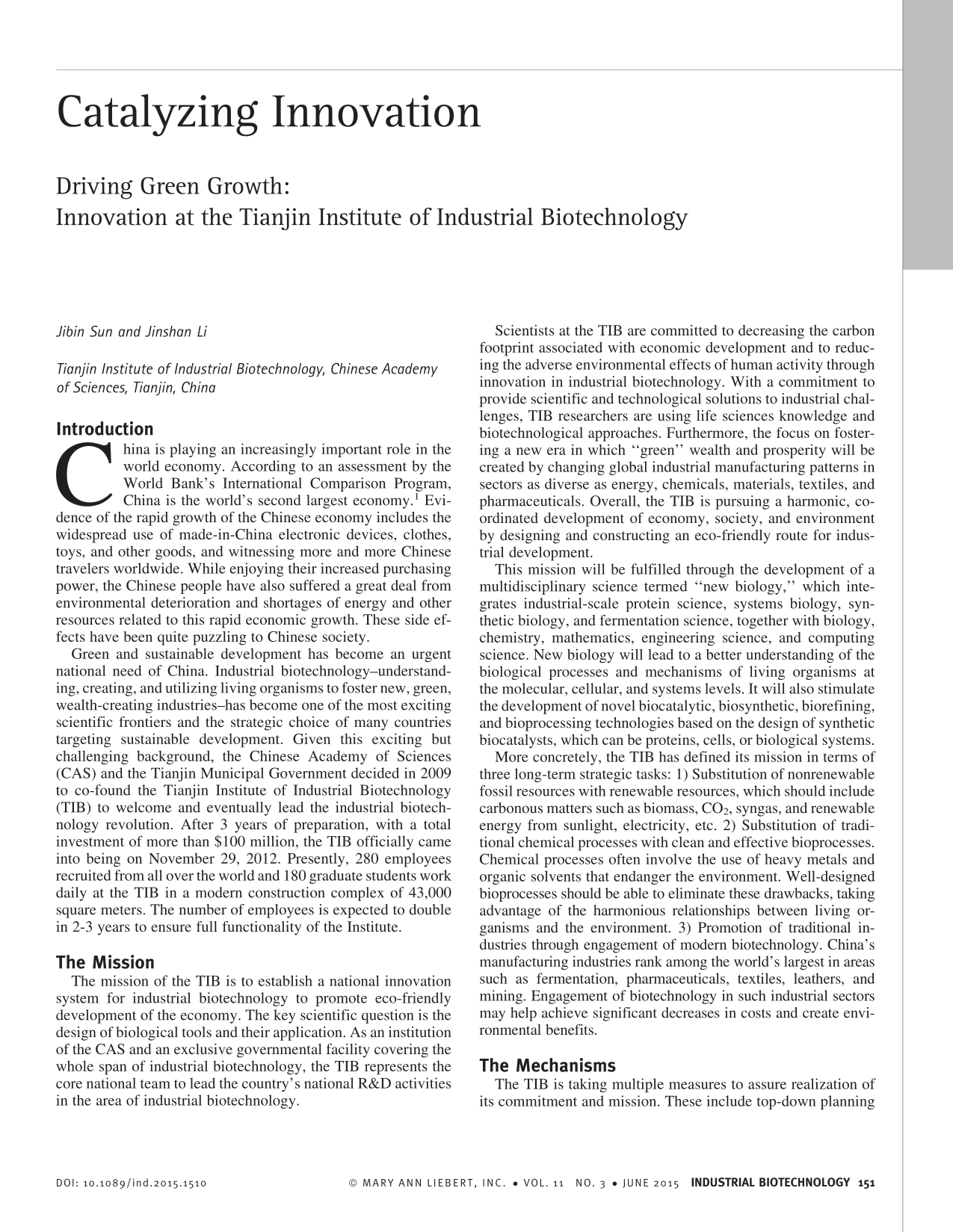
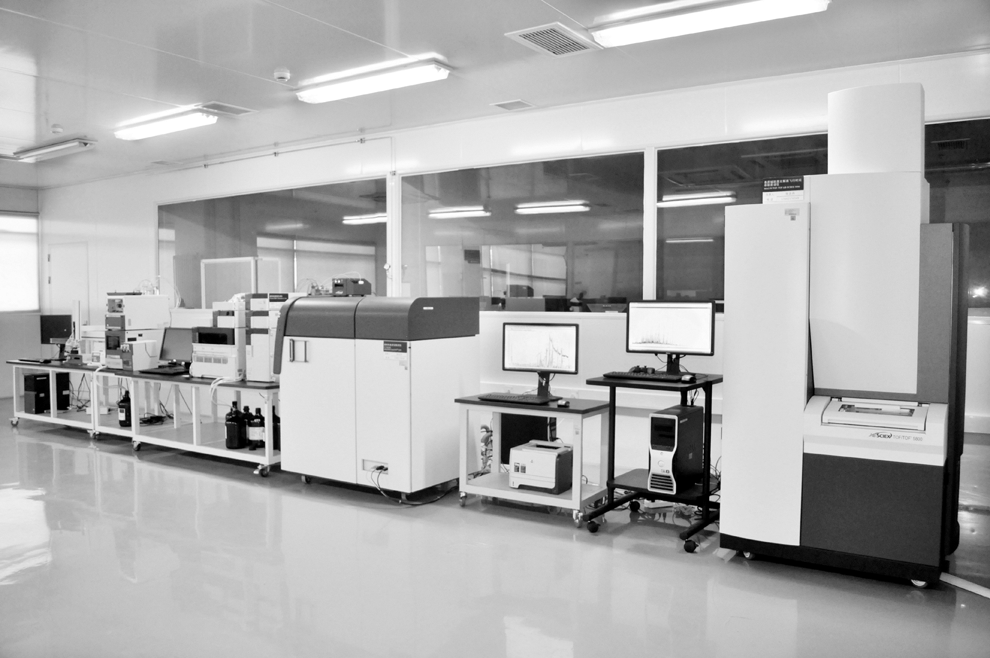
The establishment of first-class core facilities is another core mechanism. TIB invested more than $20 million to set up multifunctional, world-class research facilities that include technology platforms for robot-based high-throughput screening, systems biology, industrial enzymes, pilot-scale production, and scale-up (Figs. 1 and 2). These cover the full R&D chain in industrial biotechnology, from discovery to product or process delivery.
Systems biology core.
Fermentation core.
The TIB operates on an open-collaboration policy and has established wide-ranging domestic and international public-private partnerships with more than 60 companies to help overcome the barriers between scientific discoveries and commercial applications. At present, 18 joint laboratories in partnership with leading national companies have been established. More than 80 industrial contract-based projects account for greater than 60% of the annual operational costs of the Institute. TIB also interacts with local governments and has signed a number of strategic collaboration agreements with Shandong, Jiangxi, Sichuan, Tianjin, and others.
To realize its mission, TIB has defined industrial protein science and biocatalytic engineering, synthetic biology and microbial manufacturing engineering, and biological systems and bioprocess engineering as its core scientific areas. Accordingly, TIB established a National Engineering Laboratory for Industrial Enzymes, a CAS Key Laboratory for Microbial Systems Biotechnology, and a Tianjin Key Laboratory for Industrial Biosystems and Process Engineering.
Recent Progress
Due to the industry-oriented configuration and active measures described above, the TIB has already exhibited great potential to support the advancement of companies and improve the green portion of China's economy. In the last 2 years, more than 20 technologies were successfully transferred or ready to transfer to industry. Compared with competing technologies, industrial biotechnology offers clear advantages that include reduced energy consumption, less emissions of CO2 and wastewater, lower cost, and more sustainability. Following are several examples.
Microbial production of succinate
TIB developed an efficient and IP-independent cell factory and anaerobic fermentation process. The technology successfully passed the pilot stage and is now being scaled up to 50,000 metric tons at Landian's facility in Shandong province. This is one of the world's largest industrial demonstrations of biobased succinate production. The technology has made it possible to decrease production costs by 20–30% and reduce emissions of CO2 by 90% in comparison to the traditional processes used in the chemical industry. These benefits are sufficient to override the recent rapid price slide in fossil-based oils. The production line will be put into operation in the second quarter of 2015, and a production line of biodegradable polybutylene succinate (PBS)-based plastic dervied from the biobased succinate will become operational as well.
L-Lysine production
The conversion yield of sugar was enhanced by 13%, leading to a significant reduction in feedstock consumption, emissions, and production cost per unit of product. Scale-up of the technology led to industrial-scale production of 100,000 metric tons at a facility in Anhui Province, which generated substantial profits for the collaborating company.
Microbial production of L-alanine
An optimized cell factory is able to produce L-alanine from low-cost renewable sources such as glucose in a single step, outperforming the conventional five-step chemical/biochemical processes. Production costs were reduced by 50%, and the production was scaled up to 10,000 metric tons. The partnering company receives more than 50% of the market share.
Microbial production of trans-4-Hydroxy-L-proline (Hyp)
Hyp is an important pharmaceutical intermediate produced by chemical extraction from protein-based materials. The process emits wastewater containing high concentrations of salts and nitrogen. A new microbial cell factory is being used to produce Hyp from glucose at up to 75 g/L, with no wastewater issues and costs reduced by 90%. This industrial production line will be in operation in the third quarter of 2015.
Microbial production of plant natural products
Plant natural products are widely used in healthcare industries, however, their production is largely limited by the availability of high quality plant materials and the rare content of active compounds; the latter often leads to high environmental pollution during extraction processes. TIB invented microbial cell factories able to produce different plant natural products in simple bioreactors. The successful cases now include ginsenoside, scutellarin, salidroside, lycopene, and beta-carotene, and this list is expanding rapidly.
Future Vision
Industrial biotechnology is in the right place to provide more sustainable solutions to industrial manufacturing. Only 2 years since the birth of the TIB, the Institute has established a suitable environment to safeguard and drive innovation and has demonstrated the potential of industrial biotechnology. In the context of a fast-growing economy and a steady internal environment in China, we are confident that the TIB can continue to contribute innovative ideas and technologies to the community and the society and have an even more visible and tangible influence on the development of the national and international bioeconomy. We believe that together with the joint effort of the global industrial biotechnology community, the world will become much greener and more sustainable.