




Abstract

It is crucial for the pulp and paper industry to use raw materials more efficiently. The world is using over 1.5 times the earth's resources and climate change remains a major environmental issue. Solutions based on renewable biomass provide wide-reaching benefits. Thus, it is vital to discover new and innovative ways to use biomass.
Transforming biomass resources into raw materials that can be further refined–whether virgin biomaterials or residues such as agricultural and forestry waste–is key for a successful, integrated biorefinery process. Environmentally friendly platforms should rely on biomass that does not compete with food production, while simultaneously managing pulp and byproducts as efficiently as possible. In 2012, Stora Enso created the Stora Enso Biomaterials division, which investigates new biorefinery concepts and technologies in addition to the company's traditional pulp and paper offering.
Biomaterials open up a range of applications in many industries including food, packaging, construction, automotive, home, and personal care industries. Biorefineries can be part of the solution to reducing society's dependence on fossil fuels. They represent a huge untapped potential, given the changing climate and challenges we now face.
Acquiring New Technologies
In 2014, Stora Enso acquired US-based biotechnology company Virdia, including its extraction and separation technology, a major step in creating a new biorefinery process. This shift in business priorities, towards producing intermediates to substitute petro-based products, is key for a biorefinery model that addresses new market needs across value chains. Developing a biorefinery concept also meant addressing cost and purity issues, as well as increasing the flexibility of the process. In this concept, high-purity xylose, lignin, and glucose streams can all be extracted. The cellulose fraction can be hydrolyzed into glucose or used in its polymeric form and converted directly into chemicals or materials. These processes lead to important intermediates that boost further value chain creation or final products with increased performance compared to oil-based products.
Stora Enso has access to significant pulp feedstocks due to its existing infrastructure in pulp and paper. Its biorefinery technology does not have any feedstock limitations, so other types of biomass, such as bagasse, can also be used as feedstock. It is important for new technologies to get the most out of non-food-competing biomass that is as sustainable as possible. Wood and waste biomass need to be used more efficiently.
The company also needed to consider which strategy to take: whether to focus on biochemicals as a drop-in or the performance pathway. Raw material cost is crucial when considering drop-ins and the process itself needs to be highly efficient. By concentrating on the performance pathway, which has more flexible costs, the company found that this was a more innovative route to create new entities from biomass.
Using the chemical composition of biobased building blocks is key for creating biomaterials that can compete on cost with fossil-based products. Cellulosic materials such as cellulose ethers and esters have already been used in various applications. By focusing on the structure property relationship of raw materials as well as the final product perspective, cellulose with different properties could emerge, allowing new uses.
Developing The New Biorefinery Concept
The new biorefinery process (Fig. 1) consists of three different platforms: xylose (C5 sugars), lignin and cellulose, or glucose (C6 sugars). The purification procedures are crucial to ensuring the availability of high-purity sugars. With well-designed purification procedures, the sugar compositions can be varied to meet the requirements set by the end application—the conversion pathway used for chemicals—giving access to a more tailored product.
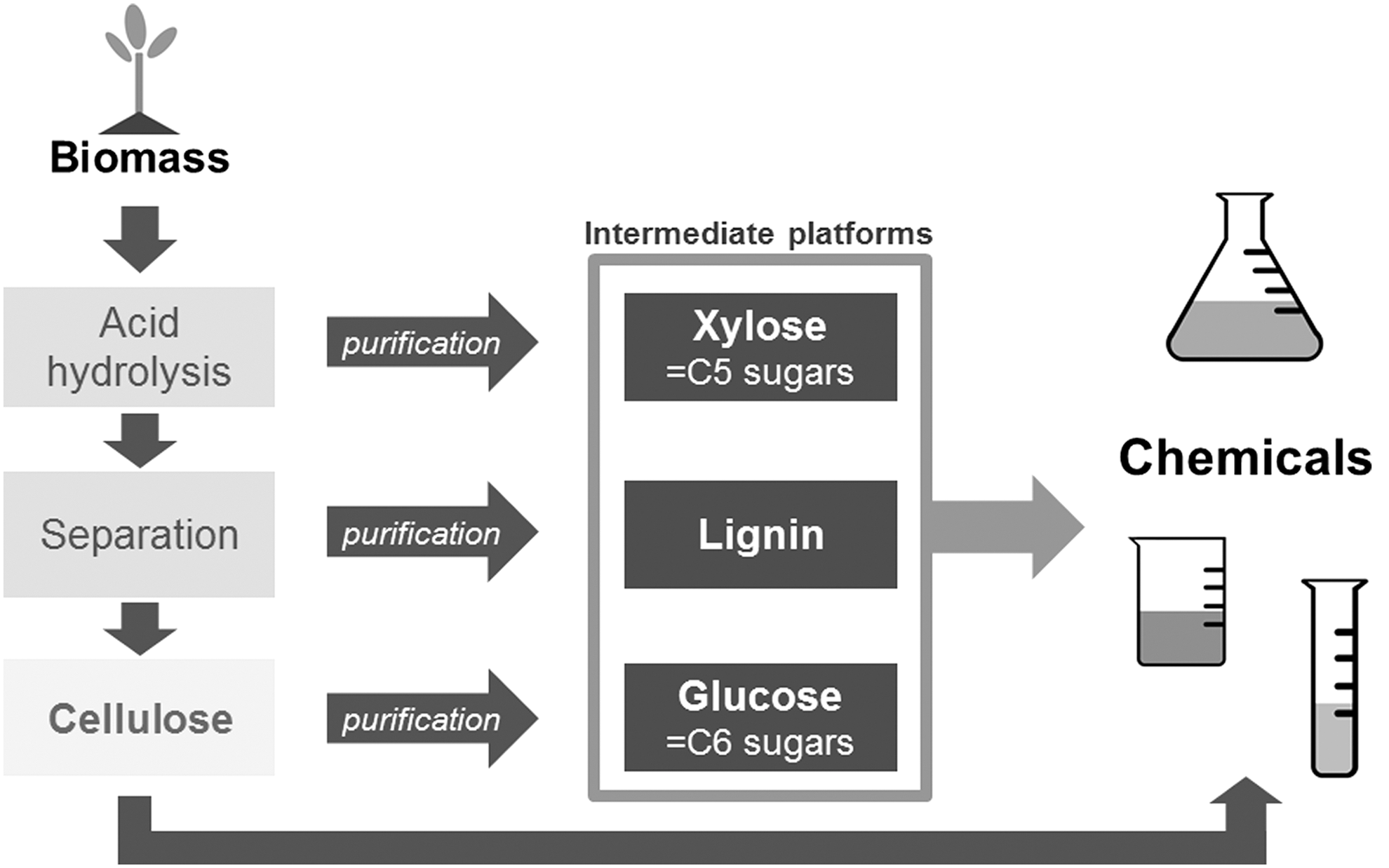
The new biorefinery process.
Lignin from this process has very different characteristics than kraft lignin, opening up new application opportunities in the automotive and construction industries, among others. Lignin has been said to have endless applications but limited business opportunities. However, lignin can be used in oil-based phenolic materials, which is crucial for the biobased industries. Also important are the many varieties of lignin, which vary according to the extraction process. Different types of lignin vary in performance; it is not a one-size-fits-all product. Biorefinery byproducts such as tall oil, turpentine, and biomethanol, and new chemical, mechanical, and enzymatic processes will also help unlock the power of sugars and high-purity cellulose contained in lignocellulosic feedstocks from different sources.
Testing New Approaches And Technology
Traditionally, the pulp and paper industry built large production sites to make processes more efficient and reduce energy use. With biorefineries, a different approach is occurring. As biorefineries must deal with biomass, logistical issues can arise; for example, the low density of most biomass makes it uneconomical to ship over long distances. It is therefore crucial to make sure the biorefinery is co-located near the feedstock, close to the biomass source. Small biorefineries are more flexible and allow communities to use their local biomass, reducing the need for imported energy and materials. They can also be beneficial for farming communities, creating jobs by taking in waste residues.
In 2014, Stora Enso invested €32 million (USD36 million) to build a demonstration plant in Raceland, Louisiana, to implement the biorefinery technology recently acquired from Virdia. The new facility will convert cellulosic biomass into highly refined sugars and will test the newly acquired technology. By extracting xylose from sugar cane bagasse, it can be further developed to xylitol, which is widely used in food and oral care applications.
The plant will be located close to the bagasse piles and next to the sugar mill to ensure proximity to raw materials and will use waste treatment facilities at the sugar plant. This reduces the need for additional infrastructure and leverages existing facilities. Once this approach is proven, it is highly scalable and could be applied globally across a range of feedstocks. The feedstock-agnostic technology serves the biorefinery's real purpose—extracting all the value from biomass through the efficient use of all the renewable raw material. The acquired biorefinery technology will provide flexible separation and purification concepts that can be tailored case-by-case according to processing needs.
Applying The Biorefinery Model
The biorefining model also allows for integration of the technology into existing pulp mills and for development of a small biorefinery mill concept. This approach also allows for the extraction of components from streams currently treated as waste. Extracted material brings extra value and improves bottlenecks in the existing process. The company's biorefinery product portfolio will address well-identified and unmet needs in specific industries outside of pulp's traditional businesses.
Existing pulp mills could be considered as a type of biorefinery, because wood is already separated into other components such as hemicellulose, lignin, and cellulose. The focus on producing pulp, rather than on extraction of hemicellulose and lignin, means that the value of these components has been ignored, as they are kept in the waste stream. Therefore, it was crucial for the concept to consider new technologies that minimized waste and extracted the maximum value possible from wood. Stora Enso's Sunila mill, set to come online in 2015, will isolate lignin.
A dissolving pulp mill is another option for integrating biorefinery technology, as high-alpha cellulose—highly-purified cellulose—is already being produced. All other components, including hemicellulose, would have to be efficiently extracted to increase the alpha content of the final pulp. A pre-hydrolysis step that removes hemicellulose already exists and, if biorefinery technology were integrated, it could further refine a C5 sugar stream directly to chemicals or purified sugars.
Future Outlook
Alongside continued investment in lignin extraction, related areas of development also being considered by Stora Enso at the moment include: • Microfibrillated Cellulose (MFC): a special cellulosic material that has different dimensions than conventional pulp, resulting in different properties such as increased viscosity and gelling behavior. The company is developing new applications for a variety of business segments • Lignin-based products to replace chemicals and materials derived from fossil fuels • Biochemicals, including pulp mill byproducts and functional chemicals for specialty uses
With continued development of new biorefinery technologies and co-localization of biorefineries with feedstock sources, the biobased industry will grow and expand. Wider sustainability concerns and energy trends will drive demands for an alternative business model with renewable energy, biomaterials, and intermediates. A new biorefinery concept is central in this shifting landscape.