




Abstract

Introduction
This English short version of the study “Sustainable Biomass Potentials for Biofuels in Competition to Food, Feed, Bioenergy and Industrial Material Use in Germany, Europe and the World” summarizes and discusses the most important results of the study. The authors differentiate between the global level, the European Union, and Germany and provide a perspective on future trends and developments. This project was funded by the German Federal Ministry for Food and Agriculture (BMEL) and the German Federal Ministry for Economic Affairs and Energy (BMWi) under grant number 22501112 resp. 12BMU011, and was carried out by an expert team at the nova-Institut. The results of the study were published in August 2015. The German long version “Nachhaltig nutzbare Potenziale für Biokraftstoffe in Nutzungskonkurrenz zur Lebens- und Futtermittelproduktion, Bioenergie sowie zur stofflichen Nutzung in Deutschland, Europa und der Welt,” details all parameters, scenario assumptions, and full results. 1
The English short version presents only the main assumptions and results in an aggregated form, and also differs from the German short version in several aspects. Most importantly, it is focused only on the global level, and contains an additional scenario (High demand – low pressure). This scenario has been developed in the project “Sustainable Agriculture, Forestry and Fisheries in the Bioeconomy - A Challenge for Europe.” 2 This project was carried out by an expert group of the Standing Committee on Agricultural Research (SCAR) as the 4th Foresight Exercise and presented to the public in October 2015. Michael Carus was part of this group as “long-term expert.”
The results of the present study provide a detailed view of possible scenarios for a sustainable supply of biomass until the year 2050, and of the development of demand in all biomass sectors: food, feed, chemicals and materials, bioenergy, and biofuels. Due to this approach, one can clearly see under which assumptions global supply shortages or a sufficient coverage of demand may occur. Moreover, a modeling tool is now available with which it is relatively easy to calculate new biomass scenarios based on a varied set of input parameters. Policy makers, nongovernmental organizations (NGOs), associations, and companies are invited to make use of this tool. (All documents are available for download at
Global Baseline 2011
In order to have a solid basis for the development of scenarios for biomass supply and demand up to the year 2050, a comprehensive analysis of the current global situation in the year 2011 was conducted. For the first time, a consistent picture of the total biomass supply on the one side and of biomass demand for food, feed, materials, bioenergy and biofuels on the other could be drawn. Biomass supply and demand was determined and analyzed by origin (harvested agricultural biomass, harvest residues, grazed biomass, and wood) as well as by major constituents of the biomass (sugar/starch, [hemi-]cellulose, oil/fat, protein). In an iterative process, a match was achieved between supply and demand on the basis of metric tons (t) of dry matter (dm) and biomass constituents. The difference between biomass supply and demand as found using this method was only 6%—a remarkably good result given the high uncertainties of the underlying data (described in greater detail in the Annex of the full report). The biggest challenge was the analysis of the demand for material uses, which includes thousands of applications, and has been ignored in most studies to date.
Figures 1 , 2 , and 3 show the results. In the year 2011, globally about 11.4 billion t dm of biomass were harvested or extracted for use and processed into food, feed, biobased products, energy carriers, and biofuels. At the same time, demand was around 12.1 billion t dm. The difference of 6% arises due to the data uncertainties. The demand for material uses is about 10 times higher than that for biofuels. This may surprise those interested in the topic. However, today the share of biofuels may be higher (2%, up from 1% in 2011).
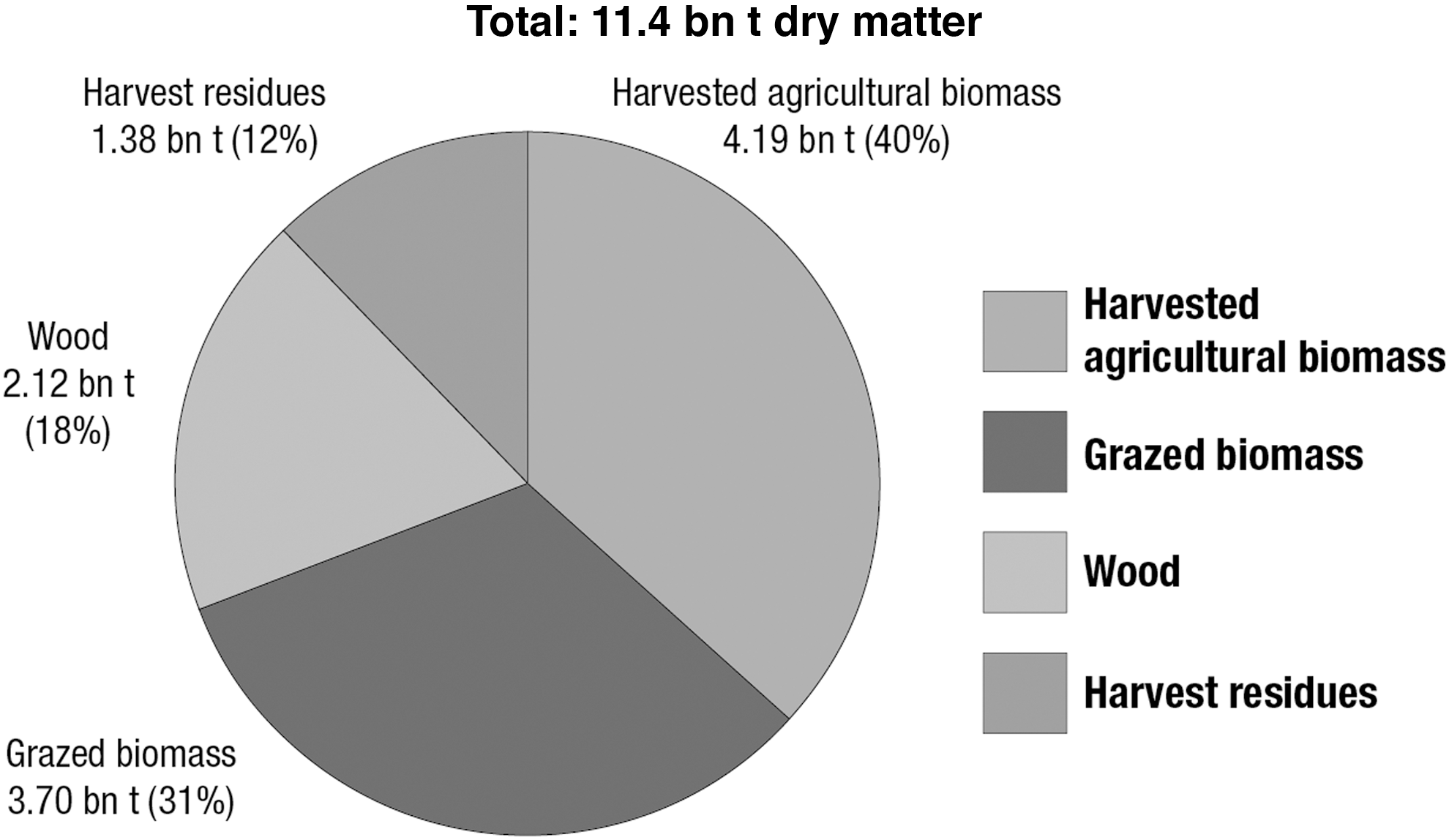
Global biomass supply 2011, by biomass sources. 3

Global biomass supply 2011, by biomass constituents. 3
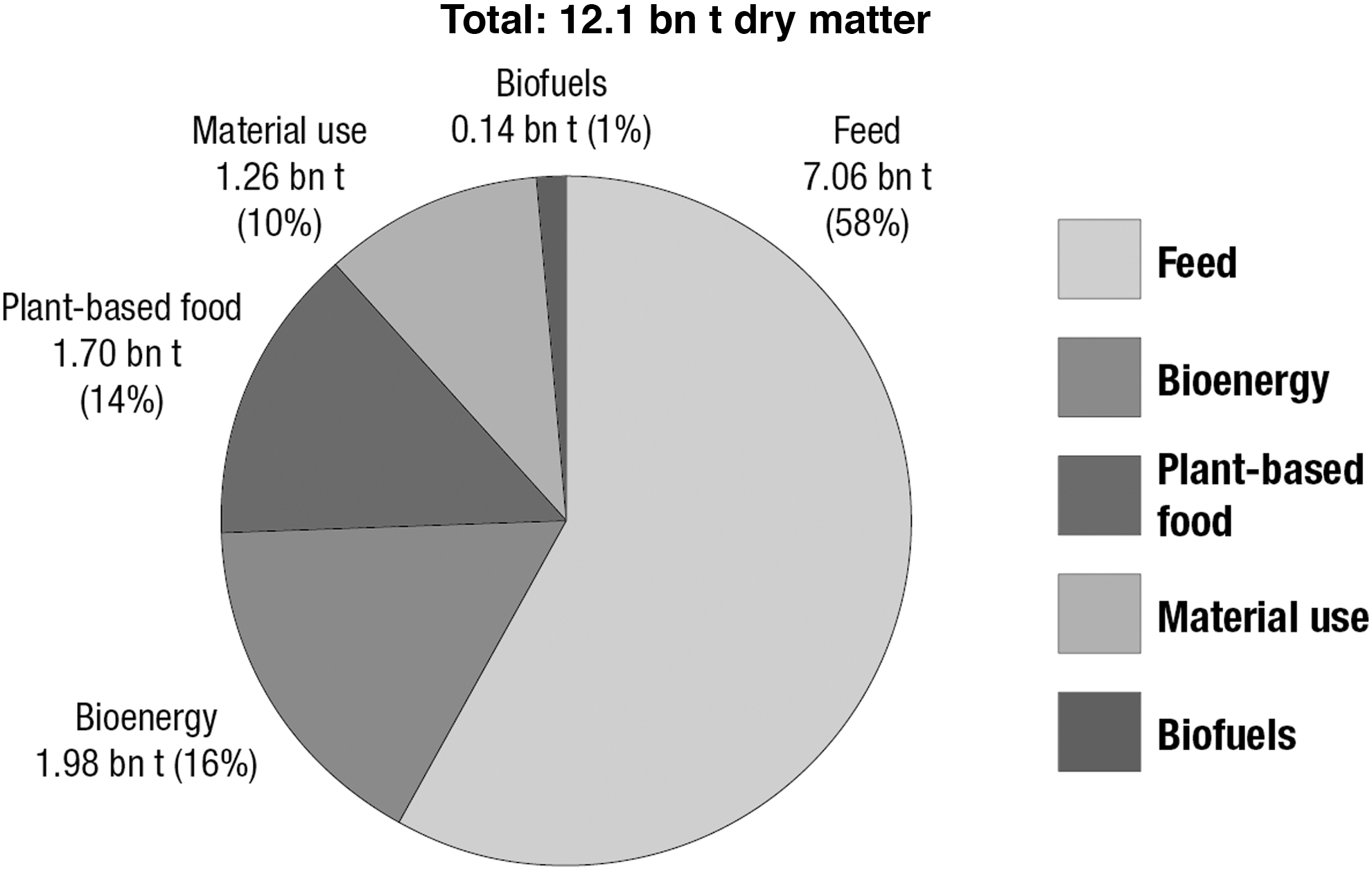
Global biomass demand 2011, by sectors. 3
Explorative Scenarios for 2050 (World)
Based on these data, several explorative scenarios have been defined for the year 2050. These scenarios highlight how under different plausible and consistent assumptions the supply and demand of biomass may develop. For about 100 parameters that significantly determine future supply and demand, different sets of assumptions have been applied. It was then calculated what these imply for the supply (by biomass constituents) and demand (by sectors) for biomass in the year 2050.
There are three supply scenarios: LOW, Business-As-Usual (BAU), and HIGH). The four possible demand scenarios are BAU, Biobased, Biobased High and High growth-low pressure. Since the number of parameters is very high, this summary will focus on only the most important ones. The long version of the study describes all parameters in detail and can be easily changed for new explorative scenarios and models.
Scenarios for Biomass Supply
Supply Scenario Low
This scenario is characterized by very moderate intensification of agriculture. Accordingly, we assume that no expansion of agricultural land takes place. Instead, due to soil degradation, the area used for arable and permanent crops decreases by a total of 100 million ha. Based on several studies, we concluded that in the past the loss of agricultural area due to all forms of degradation amounted to about 10 million ha/y, so from 2011 to 2050 the total loss could amount to almost 400 million ha. 4 –7 However, in the LOW scenario we assume a lower loss of only 100 million ha due to lower pressure on agricultural land.
Regarding crop yields, Alexandratos and Bruinsma presented assumptions for yield increases of 13 main crops or crop groups until 2050. 8 For the LOW scenario, we assume 50% lower yield increases than projected by Alexandratos and Bruinsma. Finally, we assume that the average annual increase of the Multi Cropping Index (MCI) is reduced between 2011 and 2050 from about 0.003 to 0.001. The MCI then reaches a value of 0.91 in the year 2050. In total, biomass supply reaches about 12.4 billion t dm in this scenario in 2050, so it would be only slightly higher than in 2011.
Supply Scenario Bau
This scenario is characterized by higher biomass production and concomitantly higher intensification and expansion of agricultural area and hence more pressure on other forms of land cover. In the BAU scenario we assume that loss of agricultural land due to degradation will amount to 400 million ha until 2050. However, these losses are offset by cultivation of new agricultural areas of 435 million ha. These are areas suitable for rain-fed cultivation that are not currently used for crop production and are not protected. We assume that 50% of these areas were previously used as meadows and pastures, so that the area of meadows and pastures decreases by about 218 million ha. Additionally, 100 million ha of forests are converted into agricultural land. As the basis for this scenario we have assumed that the current trend of deforestation continues until 2030 and then comes to a halt as internationally declared. 9 Overall, the area for arable and permanent crops increases globally by about 135 million ha between 2011 and 2050 from 1.55 billion ha to 1.69 billion ha.
Regarding crop yields, we assume the yields as projected by Alexandratos and Bruinsma. 8 For the MCI, we assume that the average annual increase of about 0.003 continues until 2050. The MCI then reaches a value of 0.96 in the year 2050. In the BAU scenario compared to the LOW scenario, we assume an increase of the utilization of primary harvest residues from 25% to 40%. Regarding forest biomass, we assume that the effective utilization of the forests other than planted forest increases from 10% to 25% and the wood yield from planted forests increases from 8.5 cubic meter per hectare per year (cbm/ha/y) to 14 cbm/ha/y. Furthermore, the area of the planted forests increases by 195 million ha. In total, biomass supply reaches about 18.2 billion t dm in this scenario in 2050.
Supply Scenario High
In the supply scenario HIGH we assume that loss of agricultural land due to degradation will amount to 500 million ha in 2050. However, these losses are offset by cultivation of new agricultural areas of 760 million ha. These are areas suitable for rain-fed cultivation that are not currently used for crop production and are not protected. We assume that 50% of these areas were previously used as meadows and pastures, so that the area of meadows and pastures decreases by about 380 million ha. Additionally, 100 million ha of forests are converted into agricultural land, as in the BAU scenario. In total, the land for arable and permanent crops therefore increases by 360 million ha.
Regarding crop yields, we assume 25% higher yields than projected by Alexandratos and Bruinsma. 8 For the MCI, we assume that the average annual increase of about 0.003 increases to about 0.004 in 2050. The MCI then reaches a value of 1.01 in the year 2050. Regarding forest biomass, we assume that the effective utilization of forests other than planted forest increases from 10% to 25%, as in the BAU scenario and the wood yield from planted forests increases from 8.5 cbm/ha/y to 20 cbm/ha/y. In addition, the area of the planted forests increases by 390 million ha compared to 2011.
Furthermore, we assume an increase of the utilization of primary harvest residues from 25% to 50%. This increase in the use of harvest residues could still be consistent with a sustainable cultivation as long as long-term soil fertility is not threatened, as might be the case for humus draining crops. In many cases, countermeasures might become necessary such as the cultivation of catch crops. In total, biomass supply reaches about 25.2 billion t dm in this scenario in 2050.
Supply Scenarios Summary
Table 1 shows the summary of global biomass supply in the base year 2011 as well as in the three scenarios LOW, BAU, and HIGH.
Biomass Supply of the World, 2011 and 2050, in Different Scenarios, in Billion Metric Tons Dry Matter (Based on Piotrowski et al.) 1
Scenarios for Biomass Demand
We formulated five different demand scenarios. All of these demand scenarios share the same assumptions regarding the demand for food and feed: the average annual growth rate of the demand for plant-based food is calculated to be about 0.7% and that of the demand for feed to be about 0.4%. Input parameters for these results were the growth of world population (from 7 billion in 2011 to 9.55 billion in 2050), a higher per capita demand for food, a growing share of animal-based food, and at the same time a reduction of global food waste from 30% in 2011 to 20% in 2050, and an increase in feed efficiency. 10
Furthermore, we assumed that the global demand for energy increases by less than 1% annually, while the demand for biomass for bioenergy increases by about 2% annually. An interesting result of this study is that the total demand for materials increases by about 1% to 4% annually (depending on the sector) and, thereby, growth in demand is significantly stronger than in the energy sector, with 1% annually, at the most. This means that the share of material use in petrochemistry as well as in the bioeconomy increases significantly, from about 5–10% at present to about 20–30% in 2050.
The evaluation of a large number of market studies has shown an annual global growth of 3.5% for chemicals and plastics (in Europe 1.75%) and of 3% for textiles. Other material sectors typically grow by between 1% and 2% annually. In this assessment, an increase in the global recycling rate from 15% to 25% has been taken into account. This increase in the recycling rate is also partly based on stronger cascading use of biomass.
Figure 4 shows an example of how the 59 million t dm of biomass in 2010 for the chemical and plastics industry becomes 470 million t dm in 2050 assuming an annual growth rate of 3.5%, and an increase in the share of biomass in the total organic raw material demand of the chemical industry from 10% in 2010 to 20% in 2050. The main differences in the following five demand scenarios are due to different assumptions regarding the contribution of the bioeconomy for covering the material demand.

Global raw material demand of the chemical industry (scenario BAU, includes energy for processing).
Demand Scenario Low
This scenario is linked to the supply scenario LOW, i.e., supply LOW and demand LOW exactly match. In the supply scenario LOW, only the demand for food and feed can be fully covered. The material use and bioenergy sectors can only be partially covered. Less than 20% of the available biomass is left for materials and bioenergy, which is less than in 2011 (27%). That means that the demand for materials and energy has to be covered mainly by other sources (fossils or other renewables). As sustainable as the LOW scenario may appear from the agricultural side, the bioeconomy can contribute only little to cover the demand of the other sectors or to a lowering of greenhouse gas emissions.
Demand Scenario Bau
This scenario is linked to the supply scenario BAU. In the supply scenario BAU (moderate net increase of arable land and planted forest, decreasing permanent pastures and meadows, increase of yields and MCI), the demand for food, feed, materials, and bioenergy of the demand scenario BAU can be met. The share of biomass used in the chemical and plastics industry will increase from 10% currently to 20%. The demand for bioenergy (4.3 billion t dm) is based on the International Energy Agency (IEA)-scenario ETP 2012 2°C (ETP 2DS). 11 This scenario “sets out cost-effective strategies for reducing greenhouse gas emissions in the energy sector by 50% in 2050 compared to 2005 levels” and keeping the +2°C climate target. Biomass demand from food and feed, materials, and bioenergy can be covered by supply scenario BAU.
The left-over biomass (about 1 million t dm) may be used for biofuels. This is about 7 times the quantity used in 2011. The IEA 2012 expects that a total of 3–4 billion t dm of biomass (equivalent to 60 exajoules [EJ]) would be needed for biofuels in order to reach the +2°C climate goal (however, without taking into account the CO2-savings due to the higher material use of biomass). With 1 billion t dm, about 25–30% of this demand could be met.
Demand Scenario Biobased
The Biobased demand scenario is characterized by a higher biomass demand for materials as well as bioenergy and biofuels. The share of biomass needed to cover the demand of the chemical and plastics industry will increase from 10% at present to 40%, and together with higher growth rates in other material sectors (construction, furniture, and textiles), total biomass demand for materials increases from 1.3 billion t dm in 2011 to 4.0 billion t dm in 2050.
Compared to the BAU scenario, the Biobased scenario further assumes that the demand for bioenergy and biofuels as projected by the IEA (4.3 billion t dm for bioenergy and about 3.5 billion t dm for biofuels) would need to be fully covered by biomass. 11 The only adjustment we have made in this scenario pertains to black liquor which shifts from energy use to material use due to the higher demand from the material sector. For compensation, more agricultural biomass would be used for bioenergy and, due to the higher energy density of agricultural biomass compared to black liquor, the total biomass for bioenergy eventually slightly decreases from 4.3 billion t dm to 4.2 billion t dm.
Overall, in the Biobased demand scenario, biomass demand from food, feed, materials, and bioenergy would not quite be met by supply scenario BAU. Hence, the biomass from supply scenario BAU would no longer be sufficient to cover any of the demand for biofuels. The higher total biomass demand can be covered by the HIGH supply scenario—which can still be realized in a sustainable way, but this requires modern and advanced agricultural techniques such as precision farming. Because of the additional arable land and planted forest required, an additional loss of biodiversity can hardly be avoided.
Demand Scenario Biobased High
In this scenario, the share of biomass needed to cover the demand of the chemical and plastics industry will increase from 10% at present to 95%, while all other parameters (food, feed, bioenergy and biofuels) do not change compared to the Bio-based demand scenario. As a consequence, the demand for food, feed, and materials can still be fully met in the supply scenario BAU, but already the demand for bioenergy can be covered only by half, so no biomass would be left for biofuels. The sustainable potential of traditional agriculture and forestry comes to a limit and cannot stay in a “safe operating space.” The additional biomass demand can only be covered by high supply scenarios, including a strong increase of microalgae on non-arable land, especially macroalgae ocean farming, and transforming deserts into arable land with cheap solar energy for producing sweet water.
Demand Scenario High Growth–Low Pressure
This scenario, elaborated by Mathijs et al., tries to find a way to cover the highest demand from all scenarios with the lowest pressure on ecosystems and biodiversity.
2
This is challenging and needs to integrate optimistic technology developments. The demand is the same as in the Biobased High scenario, but this demand is met to a larger extent by other renewables, and especially solar energy. That means that the left-over biomass demand can be covered by the BAU supply scenario. The non-fossil demand for materials and energy is mainly covered by other renewable energies such as solar, wind, and hydro energy and storage systems. This scenario leads to the following: • The total material demand for the chemical and plastics industry is covered mainly by solar chemicals and only to a lesser extent by complex biomolecules • The energy demand is mostly covered by renewables (solar, wind, etc.) and less by bioenergy (same level as in 2011) • The fuel demand is covered mainly by solar fuels, with a low share of biofuels (same level as BAU scenario). Together with electric cars driven by renewable energies, the left-over demand for fossil fuels is lower than in all other scenarios
In total about 4.5 billion t dm have to be substituted by solar chemicals and solar fuels in 2050. Will this be possible? From a technology point of view, it is already possible today to produce gaseous and liquid molecules such as methane, methanol, kerosene, and more from CO2 and water using renewable electricity. These products can be used as fuels or raw material for the chemical industry. The efficiency for this transformation is about 60% at present and can probably be increased to about 80% by 2050.
Different technologies can be used for this transformation, for example via electrolysis and methanization or Fischer-Tropsch, algae, and biotechnology, and in the future also different kinds of artificial photosynthesis. Those technologies are also called power-to-gas, power-to-liquid, or power-to-chemicals. 12 Today, worldwide, more than 30 pilot plants are running, and the first commercial plants will start operation soon. The costs are higher than for fossil fuels but almost on the same level as for biofuels.
What land area is needed to produce, for example, 4.5 billion t of methane from power-to-gas? With existing technologies it is possible to produce about 80 t of methane per ha per year in the desert (with 80,000 GJ solar radiation per ha per year). To produce 4.5 billion t of methane, 57 million ha of desert land would therefore be needed. The total desert area is about 2.75 billion ha. 1 Therefore, about 2% of deserts worldwide would be enough to meet more than 95% of the total demand of the (organic) chemical and plastics industry and also a relevant demand for fuels.
Demand Scenarios Summary
Table 2 shows the summary of global biomass demand in the base year 2011 as well as in the five scenarios (LOW, BAU, Biobased, Biobased High and High growth–low pressure).
Matching Between Supply and Demand
Given the described assumptions, the global biomass supply will scarcely change from 2011 to 2050 in the supply scenario LOW, while it will almost double in the BAU scenario and more than double in the HIGH scenario. The range of global biomass supply in 2050 based on these scenarios will be between 12.4 billion t dm and 25.2 billion t dm. As described above, the LOW and BAU demand scenarios exactly match the respective supply scenarios. The results have shown that the LOW supply scenario would just be able to cover the demand for food and feed, but hardly any of the demand for materials and bioenergy and none of the demand for biofuels. In comparison, the BAU supply scenario could cover the demand for food, feed, materials, and bioenergy and could even leave room for an expansion of biofuels of up to 1 billion t dm of biomass.
Sustainability
Under the criterion of a “safe operating space,” which essentially means that the global loss of biodiversity comes to a halt in 2020, the global areas for arable and permanent crops may witness a net expansion to up to 1.64 billion ha according to Bringezu et al. 13 This sustainability criterion is only achieved in the LOW scenario but not in the BAU and HIGH scenarios, which significantly exceed the boundaries within which sustainable development is regarded to be feasible. However, the exclusive focus on the expansion of agricultural area neglects many other factors that play a role in the evaluation of the sustainability of land use, e.g., the type of cultivation and the creation of protection zones.
It is important also to note that in the BAU and HIGH scenarios no more forests are converted into arable land from the year 2030 onwards, protection zones are not infringed upon, and only those areas that do not need artificial irrigation are converted into arable land. In the forests, an expansion of naturally regenerated, non-primary forests and planted forests is assumed. The areas newly converted into arable land are mainly meadows and pastures. The area expansion in the BAU and HIGH scenarios can be realized while meeting the criteria of the currently applied certification systems for sustainable biomass and the United Nation's Food and Agriculture Organization (FAO)—however, presumably not without accepting a negative impact on biodiversity. A challenge for future agriculture will be how to achieve higher yields while at the same time incurring fewer environmental impacts. Technologies such as precision farming will play a central role in this respect. All biomass supply scenarios assume that the respective supply can be provided on a long-term basis so that the actual main sustainability criterion is satisfied. All scenarios first cover the demand for food and feed and can therefore also be regarded to be sustainable from this perspective since they first address the basic needs of humankind.
The matching between supply and demand is based on a hierarchical order of uses. Only when the demand for plant-based food and animal products is globally satisfied, the demand for biomass for biobased products is covered, which, in turn, is prioritized over bioenergy and biofuels. The reason for this approach is the fact that already today, technologies such as solar and wind energy exist that provide energy more efficiently and ecologically than bioenergy and conventional systems, while in many cases there are no alternatives for certain material properties of biomass (among others protein, fat, and carbohydrates).
Furthermore, all supply scenarios are in accordance with the strategy for sustainable crop production intensification (SCPI) of the FAO. Even in the HIGH scenario it is assumed that the increase in yields can be sustainably achieved by the improvement of production systems, the use of innovative technologies, improved and adapted plant varieties, and the reduction of field and post-harvest losses. At the same time the economic participation of farmers and forest owners in developing countries could be improved.
In principle, biomass can be sustainably produced in all three supply scenarios in 2050, meeting the requirements of the currently accepted certification systems, provided that modern agricultural technologies, optimized production systems, and the safeguarding of social standards are globally implemented and reinforced. Even the significant expansion of arable land in the HIGH scenario does not take place at the expense of protected areas or the conversion of primary or other naturally regenerated forest (from 2030 on), but through conversion of permanent meadows and pastures, which may of course be critical from a biodiversity perspective.
In comparison, the evaluation on the basis of other sustainability requirements, such as the “safe operating space,” is considerably more difficult. In the first instance, it appears that the LOW supply scenario fulfills the criteria, since here no expansion of arable land takes place—in fact, the available arable land actually decreases due to degradation—and yield increases are very moderate. Only efficiency gains, including a reduction of the field and harvest losses, enable the biomass supply to be kept at approximately the same level as in the base year 2011.
In the supply scenarios BAU and HIGH, a relevant net expansion of land for arable and permanent crops takes place and, concomitantly, there is a considerable threat of a further reduction of biodiversity as well as increased emissions of greenhouse gases from agriculture. Hence, these scenarios do not appear to be sustainable at first. However, two important aspects qualify this classification. First, it must be taken into account that in the scenario LOW, only the demand for food and feed can be covered—the elementary needs for material products and energy cannot be satisfied even partially by biomass. When the demand for materials and energy is not to be covered by fossil fuels either (they are depleting sources and cause CO2 emissions), then massive investments in solar and wind energy as well as storage systems and Carbon Capture & Utilization (CCU) technologies must take place. Only then it is ensured that sustainable agriculture and forestry is not counterproductive to the sustainable development of a global economy as a whole.
Furthermore, a review of future trends shows technologies and systems that could allow the supply of very large quantities of additional biomass without significantly increasing the pressure on nature and biodiversity. These include desert greening, the desalinization of marine water with solar energy, and marine farming of the macroalgae kelp. In 2050, more biomass could be supplied with the help of these technologies and systems than achieved in the HIGH supply scenario through expansion of agricultural areas and intensification of cultivation. The demand described above (High demand–low pressure) even goes one step further and assumes a massive development of solar and CCU technologies and shows that it is possible to cover the highest demand of all scenarios while at the same time using less biomass than in the BAU scenario.
Which of the biomass supply scenarios may be regarded as sustainable depends primarily on the chosen sustainability concept and the system boundaries. According to the concept of a “safe operating space” with a special focus on maintaining biodiversity, only the LOW supply scenario may be considered to be sustainable. However, this scenario, while ensuring sustainable agriculture and forestry, also gives rise to a threat against the sustainable development of a global economy as a whole—if this development is not balanced by massively investing in renewable energy and CCU technologies based thereon.
According to other requirements for sustainable development of agriculture (FAO and currently accepted certification systems), the biomass supply and demand in the scenarios BAU and HIGH can also be designed sustainably, but not without threatening biodiversity. Therefore, if biodiversity ranks high in an evaluation of sustainability, especially the HIGH scenario can no longer be considered to be sustainable. In any case, the supply scenarios BAU and HIGH, and therefore the bioeconomy as a whole, can significantly contribute to the sustainable development of the global economy and a relevant reduction of greenhouse gas emissions of the material and energy economy. In turn, climate change and related greenhouse gas emissions are one of the main causes for the global reduction of biodiversity.
Outlook
The identified future trends far exceed the scenarios described and detailed above. Even though on a global scale already in the BAU scenario no real shortages are predicted to occur, the biomass supply, or rather the supply of renewable carbon, can be expanded much further by exploiting the described new technologies and system optimizations, which allow a higher output with less input, and at the same time reduced environmental burdens. Hence, shortages by 2050 could be largely ruled out. Greening of deserts with deep water recovered by solar energy and fresh water through desalinization of marine water, the introduction of salt and heat resistant crops, large-scale marine cultivation of macroalgae, tailored fertilization, plant protection and irrigation through precision farming, optimized crop rotation and combinations of crops, soil improvements, modern plant breeding, and more would contribute to this achievement.
Since the new technologies would reclaim new areas and use the current areas more efficiently, the pressure on semi-natural areas, protected zones, and also on biodiversity would decrease significantly. At the same time, a circular economy with strongly expanded recycling and an integrated cascading and reduction of losses in the agricultural and food chain, as well as more efficient production of animal protein (insects), can reduce the demand for fresh biomass in spite of a growing world population.
Adding to this are new possibilities for utilization of ever cheaper solar and wind energy that do not just supply electricity and heat, but also produce fuels and raw materials for the chemical industry from water and CO2 with a high area efficiency (CCU). In terms of bare figures, the global demand of organic chemistry in 2050 could be covered by less than 2% of the deserts by CO2 utilization. Overall, this means that in the future, the contradiction between the creation and preservation of protection zones and natural areas on the one hand and a significantly increased biomass production and other forms of renewable carbon carriers on the other can be permanently overcome. The bioeconomy and renewable energies in conjunction with CCU technologies are able to sustainably and permanently secure global raw material supply without threatening nature and biodiversity.
Even the demand from high growth scenarios can be covered with less fossil resources and also a sustainable growth in biomass supply, if there is also a strong investment in solar and other renewables, delivering not only heat and electricity, but also almost all raw materials for the chemical industry and a high share of synthetic fuels (solar fuels). In such a scenario, high growth can be combined with low pressure on natural resources and low pressure on the climate. But it needs a strong commitment to, investment in, and implementation of solar, wind and other renewables, and CCU technologies to produce raw materials and fuels from solar and wind. The bioeconomy can, embedded in the right overarching strategy with a strong expansion of renewable energies and in conjunction with CO2 utilization, contribute to global sustainable development.