




Abstract
Concentrated, non-purified juice can be produced from industrial beets and stabilized to retain sugars and extend the processing campaigns of newly envisioned, nonfood fermentation industries. However, pre-storage juice concentration and acidification (to enable long-term sugar retention), and post-storage juice conditioning (to enable ethanol fermentation) could impact yeast (Saccharomyces cerevisiae) performance. In this work, ammonium and sodium salts were synthesized in diffuser juice acidified from pH 6.5 to 3.5 with one of three mineral acids—hydrochloric, sulfuric, or phosphoric—and partially neutralized to pH 4.8 with one of two bases—sodium hydroxide or ammonium hydroxide. Alternatively, juice was directly supplemented with salts in the quantities synthesized in situ. A follow-up experiment was conducted to confirm the effects detected on yeast fermentation of sugars in diffuser juice. This experiment involved concentrated, non-purified juice acidified from pH 6.4 to 3.5 with only sulfuric acid, and partially neutralized to pH 4.8 with either sodium hydroxide or ammonium hydroxide. In both experiments, the only effects detected on yeast fermentation were beneficial and resulted from ammonium salts, either synthesized or added to the juice. Ammonium-salt cations increased total Kjeldahl nitrogen (TKN) in diffuser juice by 40% to 60%, which almost doubled yeast ethanol production rates between 6 h and 12 h. Although ammonium cations increased TKN in concentrated juice by about 20%, this resulted only in slight improvements in ethanol production rates. Pre-storage acidification and post-storage partial neutralization of concentrated beet juice could be used to synthesize ammonium salts that can improve yeast fermentation rates.
Introduction
Industrial beets (Beta vulgaris L.) could soon become a major source of sugar for nonfood industrial fermentations. Industrial beets already have significant advantages over corn grain, the primary source of sugar for nonfood fermentations in the U.S. For example, beets produce readily-fermentable sugars, eliminating the need for energy-intensive pretreatment steps that corn grain undergoes to hydrolyze its starch into fermentable sugars. Moreover, industrial beets have reached an average productivity of 12.6 Mg/ha of hexose equivalents. 1 This is 70% greater than the average productivity of corn, which reached 7.4 Mg/ha of hexose equivalents in 2014 (assuming a starch weight fraction of 72% and a stoichiometric starch-to-glucose weight ratio of 0.9:1). 2,3 Despite these advantages, the success of industrial beets as a bioproduct feedstock will depend largely on the development of energy-efficient systems for storage, transportation, and conversion. The required efficiency level should enable a carbon footprint significantly lower than that of most current systems for corn grain.
The ability to store beet sugar with no or minimal losses dictates the length of processing campaigns in the beet table-sugar industry. Systems for long-term sugar storage are well-established in many factories worldwide. 4 –8 However, those systems maximize purity and retention of sucrose, the primary product of the table-sugar industry. Furthermore, they must meet stringent requirements of the food industry, are energy-intensive, and may far exceed the needs for successful storage of sugar for nonfood industries.
Concentrated, purified beet juice is stored in beet sugar factories worldwide to extend processing campaigns. 5,6,8 Before concentration, this juice undergoes energy-intensive purification steps that enable efficient sucrose crystallization. 9 However, purification may be unnecessary if the sugars in the juice are for nonfood fermentations. In fact, yeast (Saccharomyces cerevisiae) fermentations of beet-processing intermediates (diffuser, purified, and thick juices) have shown similar fermentation rates and efficiencies. 10 Moreover, some European beet sugar factories coproduce ethanol from diffuser juice and molasses due to sugar surplus. 11
Fiedler et al. evaluated concentrated, non-purified beet juice to establish a simple, dependable technique for long-term sugar storage. 12 However, their experiments aimed to retain sucrose rather than overall fermentable sugars (sucrose plus glucose and fructose) by storing juice under alkaline conditions (pH ≥ 9.0) or with formalin. In contrast, we evaluated acidic conditions (pH between 2.0 and 5.0). 13 Acidic pH hydrolyzes sucrose into glucose and fructose; thus, it is not accepted by the beet sugar industry. 14 However, controlled acidic conditions (pH ≤ 3.5) enable up to 99% sugar retention in concentrated, non-purified juice. 13 Moreover, juice stored under acidic conditions requires less pH control than under alkaline conditions, making it more dependable. Nonetheless, post-storage yeast fermentations showed that juice stored under acidic conditions enabled fermentation efficiencies of up to 82%, relative to diffuser juice. 13 Although this was much better than for juice stored under alkaline conditions (efficiencies of up to 53%), those results suggested a need for improvement. 13
Some inorganic salts, including sodium chloride (NaCl), hinder yeast growth due to cell osmotic stress and consequently plasmolysis, and also to ion toxicity. 15 –17 In our previous experiments, NaCl was synthesized in the juice upon post-storage, partial neutralization. 13 Hence, NaCl may have caused the low fermentation efficiencies and rates detected.
Industrial fermentation media are commonly supplemented with ammonium sulfate or ammonium phosphate to improve yeast growth and thereby fermentation rates. 18 These salts contribute nitrogen (through the ammonium cation) and non-metal ions (phosphate and sulfate) required by yeast during fermentation. 19 Ammonium salts are assimilated by yeast into glutamate and glutamine, key precursors in sugar metabolism. 20 Ammonium salts may be synthesized in concentrated, non-purified beet juice following long-term storage. First, the juice can be acidified with a mineral acid (e.g., sulfuric or phosphoric) to enable long-term sugar retention, and partially neutralized with ammonium hydroxide before fermentation. This strategy was incorporated into this work.
This work consisted of two experiments with separate but interrelated objectives. The objectives of the first experiment were to: 1) compare the effects on yeast fermentation of sodium and ammonium salts synthesized separately in diffuser juice through acidification and partial neutralization; 2) determine if those effects were caused by salts or by reactions inherent to acidification and partial neutralization; 3) determine if either the ammonium or sodium cations had specific effects on yeast fermentation; and 4) determine if the anion of either one of three mineral acids used to acidify the juice had specific effects on yeast fermentation. The objectives of the second experiment were to: 1) confirm the first-experiment results in concentrated, non-purified juice; and 2) determine if juice concentration was detrimental to yeast.
Materials and Methods
Beet Juice Samples and Reagents
Two 10-L samples of non-purified beet juice were collected from the diffuser at American Crystal Sugar, Co. (Moorhead, MN)—one during January 2014 and the other during March 2015. Both samples—hereafter referred to as diffuser juice—were stored at −15°C until used in fermentations in April 2015. Additionally, in March 2015, 100 L of non-purified juice were produced using beets collected in November 2013 from a storage pile at the same factory. Those beets were harvested in September 2013 within an average 35-km radius from the factory. The beets were stored at −15°C until juice production by mechanical means in a laboratory. 21 Only first-press juice—hereafter referred to as pressed juice—was collected and concentrated within 48 h.
ACS-grade hydrochloric acid (HCl), sulfuric acid (H2SO4), NaCl, ammonium chloride (NH4Cl), and ammonium sulfate ((NH4)2SO4) were obtained from VWR International (Radnor, PA). ACS-grade phosphoric acid (H3PO4), sodium hydroxide (NaOH), anhydrous sodium sulfate (Na2SO4), anhydrous dibasic sodium phosphate (Na2HPO4), and potassium hydrogen phthalate (KHP) were acquired from EMD Chemicals (Gibbstown, NJ). A stock solution of ammonium hydroxide (NH4OH) at 50% volume fraction was obtained from Alfa Aesar (Ward Hill, MA). Crystal dibasic ammonium phosphate ((NH4)3PO4) was purchased from Avantor Performance Materials (Center Valley, PA). Ethanol Red® S. cerevisiae pellets were obtained from Phibro Ethanol Performance Group (Teaneck, NJ).
Pressed Juice Concentration
Pressed juice with a solids weight fraction of 36% was concentrated in two steps in a single-effect, rising-film evaporator (Standard Industries, Fargo, ND). 22 The evaporator was operated at an internal absolute pressure of 54 kPa, and juice was fed into the calandria at 0.8 kg/min and 0.6 kg/min during the first step and second step, respectively. Saturated steam at 115°C was used as the heat source in the calandria. Juice exited the evaporator at 83°C and with solid weight fractions of 40% and 68% after the first step and second step, respectively. Concentrated, pressed juice collected after the second step was stored at −15°C for up to 4 weeks until used in fermentations in April 2015.
Experimental Design
Two experiments were conducted. The first experiment aimed to evaluate effects of salts formed by acidification and partial neutralization of diffuser juice on yeast fermentation. The second experiment aimed to confirm the results of the first experiment in a subset of treatments prepared with concentrated, pressed juice.
Effects of acidification and partial neutralization of diffuser juice on yeast fermentation
In the first experiment, 3 acids (HCl, H2SO4, and H3PO4) and 2 bases (NaOH and NH4OH) were used to acidify and partially neutralize, respectively, diffuser juice samples, giving a total of 6 acid-base treatment combinations. A parallel set of 6 treatments was prepared by directly supplementing the acidified diffuser juice with the salt compounds of the given acid-base pair. Salts were added in the amounts that would be synthesized during acidification and subsequent partial neutralization. This was done to determine if effects on fermentation were caused by the salts or by the reactions and pH fluctuation inherent to acidification and partial neutralization. Additionally, 3 control treatments were prepared by acidifying diffuser juice with each of the acids to evaluate potential effects of acid anions. Thus, a total of 15 treatments (Table 1) were concurrently fermented in triplicate in this experiment.
Summary of Experimental Treatments Prepared for Fermentations in the First and Second Experiments. Treatments Consisted of Different Juice Types Only Acidified, or Acidified and Either Partially Neutralized with a Base or Supplemented with a Salt.
Effects of acidification and partial neutralization of concentrated, pressed juice on yeast fermentation
In the second experiment, 1 acid (H2SO4) and 2 bases (NaOH and NH4OH) were used to acidify and partially neutralize, respectively, concentrated, pressed juice. This resulted in 2 acid-base treatment combinations. Analogous to the approach described in the subsection above, a parallel set of 2 treatments was prepared by directly adding salts to acidified concentrated, pressed juice to confirm if any effects on fermentation were caused solely by the salts formed during acidification and partial neutralization. A sample of pressed juice and a sample of concentrated, pressed juice were acidified with H2SO4 and used as controls. Moreover, a sample of diffuser juice collected during March 2015 was also acidified with H2SO4 and used to determine if either of the sugar-extraction techniques affected yeast fermentation. In this experiment, a total of 7 treatments (Table 1) were concurrently fermented in triplicate.
Treatment Preparation
Preparation of acid and base solutions for pH adjustment
Aqueous solutions of HCl, H2SO4, and H3PO4, and of NaOH and NH4OH, were each prepared at 5 mol/L. All solutions were standardized in triplicate by titration. 23 Initially, a 5 mol/L NaOH solution was standardized with 5 g of KHP dissolved in 25 g of water. 24 The standardized NaOH solution was then used to titrate 10-mL aliquots of each of the 3 acid solutions. NH4OH was reverse-titrated with 5 mol/L standardized HCl. The standardized acid and base solutions were used to acidify and partially neutralize, respectively, the juice samples.
Acidification and partial neutralization of diffuser juice
Six 350-g samples of diffuser juice collected in 2014, with a sugar concentration of 159 g/L, were acidified in pairs to pH 3.5 with a 5 mol/L solution of either HCl, H2SO4, or H3PO4. The acidified samples were then partially neutralized to pH 4.8 with a 5 mol/L solution of either NaOH or NH4OH (Table 1). The acid and base solutions were added dropwise to each juice sample while continuously stirring at 5 Hz with a magnetic stirrer in a glass beaker. Moreover, during acid and base addition, the pH of each treatment was continuously measured with a benchtop pH meter (Orion Star A111, Thermo Fisher Scientific, Inc., Beverly, MA). The amounts of acid and base solutions used were recorded to determine quantities of salts synthesized according to the corresponding stoichiometric reaction mechanism:
Six additional 350-g samples of the same diffuser juice were acidified in pairs to pH 4.8 with a 5-mol/L solution of either HCl, H2SO4, or H3PO4. Thereafter, either NaCl, NH4Cl, Na2SO4, (NH4)2SO4, Na2HPO4, or (NH4)3PO4 was directly added to each sample with the same anion type (Table 1).
Acidification and partial neutralization of concentrated, pressed juice
Two 85-g samples of concentrated, pressed juice were acidified to pH 3.5 with 5-mol/L H2SO4. Subsequently, these samples were partially neutralized to pH 4.8 with a 5-mol/L solution of either NaOH or NH4OH. Two additional 85-g samples of concentrated, pressed juice were acidified to pH 4.8 with 5-mol/L H2SO4 and then supplemented with either Na2SO4 or (NH4)2SO4 as explained above. Moreover, single samples of diffuser juice collected in 2015, pressed juice, and concentrated, pressed juice were also acidified to pH 4.8 with 5-mol/L H2SO4 (Table 1). The acid and base solutions were added dropwise to each sample while continuously stirring at 5 Hz and monitoring pH. The concentrated juice was stirred in plastic beakers with a 304-stainless-steel, 3-blade propeller agitator with 2.54-cm blades pitched at 45°. In contrast, diffuser juice and pressed juice were stirred with a magnetic stirrer in glass beakers. All acidified samples were diluted to a sugar concentration of 140 g/L, consistent with that in the diffuser juice.
Treatment Fermentation
Inoculum seed preparation
Three inoculum broths were prepared in 500-mL Erlenmeyer flasks, each containing 18.2-MΩ·cm water, glucose (30 g/L), peptone (20 g/L), and yeast extract (6 g/L). The pH of each broth was adjusted to 4.8 with 5-mol/L solutions of either HCl, H2SO4, or H3PO4 to match juice samples acidified with the same acids. The broths were sterilized in an autoclave (Model SSR-3A-PB, Consolidated Still & Sterilizers, Boston, MA) at 121°C and 220 kPa for 20 min, and allowed to reach room temperature in a biosafety cabinet before adding yeast pellets (1.5 g/L). The inoculum seeds were incubated in a water bath orbital shaker (MaxQ7000, Thermo Scientific, Dubuque, IA) at 30°C and 3.3 Hz for 18 h prior to treatment inoculation.
Fermentation setup
A total of 90 mL of each treatment (or fermentation media) was dispensed into 250-mL Erlenmeyer flasks. The fermentation media were then sterilized in an autoclave and allowed to reach room temperature (as described above) before adding inoculum seed at a final-volume fraction of 10%. Six-chamber plastic airlocks (Brew PS, Inc., Moorpark, CA) with No. 6 rubber stoppers, sanitized with a 70% ethanol solution, were used to maintain an anaerobic headspace within the fermentation flasks. The treatments were incubated for 24 h as described in the subsection above.
Analytical Methods
The juices used in both experiments were analyzed in their original state (i.e., before fermentation) for different characteristics. Sulfur dioxide (SO2) was quantified in both diffuser juices by iodometric titration. 25 The solids content of all juices was determined by oven-drying between 10 g to 15 g of juice in aluminum weighing dishes at 105°C for 24 h. Moreover, the total nitrogen content in all juices was determined by the Kjeldahl method. 26
Fermentation media aliquots of 1.5 mL were collected in duplicate from each flask in microcentrifuge tubes at 0, 6, 12, and 24 h. The aliquots were collected in a biosafety cabinet using 5-mL sterile-polyethylene disposable pipettes. Each sample was prepared and used to quantify either fermentable sugars (sucrose, glucose, and fructose) or ethanol by high-performance liquid chromatography (HPLC). 13 Sugars were expressed in hexose equivalents. Ethanol yield was expressed as weight of ethanol produced per weight of hexose equivalents fermented. Fermentation efficiency was calculated as actual ethanol yield divided by maximum theoretical ethanol yield and reported in percentage. The ethanol production rate was calculated as the increase in ethanol concentration within a time interval divided by the time interval.
Statistical Analyses
Results from both experiments were reported as the average of triplicate treatments. Tukey's range test was used for multiple pairwise comparisons of means at a significance level α = 0.05 in SAS (Version 9.4, SAS Institute Inc., Cary, NC).
Results and Discussion
Composition of Diffuser Juices, Pressed Juice, and Concentrated, Pressed Juice
The beet juices used in this study had similar initial pH values (Table 2). The two diffuser juices, each collected during a different beet campaign, had similar solid contents but slightly different sugar contents (Table 2). Nonetheless, the solid and sugar contents of both diffuser juices were typical of diffuser juice in beet processing. 8 In contrast, pressed juice had solid and sugar contents approximately double those of either diffuser juice. Pressed juice was further concentrated to achieve a solids content greater than 645 g/kg, which would enable long-term sugar retention. 13 Most juices (except diffuser juice collected in 2014) had sugar-to-solids ratios between 88% and 90%, despite their different sugar contents (Table 2).
Initial Properties of Beet Juices (Diffuser, Pressed, and Concentrated, Pressed) Used in Fermentations
Reported on a wet basis and as mean ± standard deviation of duplicate analyses; bTotal Kjeldahl nitrogen.
When expressed on a dry basis, total Kjeldahl nitrogen (TKN) contents in diffuser juices collected in 2014 and 2015 were 3.1 g/kg and 3.5 g/kg, respectively. In contrast, the dry-basis TKN contents of pressed juice and concentrated, pressed juice were 6.9 g/kg and 7.2 g/kg, respectively (i.e., approximately double those of the diffuser juices). This contrast was likely related to differences in beet variety and cultivation practices, both of which influence nitrogenous-compound contents in beets. 27 Also, the fundamentally different techniques for juice production (diffusion versus pressing) may have contributed to TKN differences. Dry-basis SO2 contents in diffuser juices collected in 2014 and 2015 were 0.06 g/kg and 0.05 g/kg, respectively, and unlikely to affect yeast fermentation. 28
Effects of Acidification and Partial Neutralization of Diffuser Juice on Yeast Fermentation
Sugars in some of the diffuser-juice treatments were almost completely fermented by 24 h (Fig. 1a-c). In particular, the 6 treatments with ammonium salts (whether synthesized in situ through acidification and partial neutralization of the juice, or directly added to the juice) had residual sugars between 1.2 g/L and 2.7 g/L. In contrast, the 6 treatments with sodium salts and the 3 controls had significantly higher residual sugars between 28.4 g/L and 33.7 g/L (P < 0.0001; Fig. 1a-c), which represented 20% to 24% of their initial sugars.

Sugar concentrations in diffuser juice acidified with
Corresponding ethanol-concentration trends showed that the 6 treatments with ammonium salts reached concentrations between 65.4 g/L and 70.0 g/L by 24 h (Fig. 2a-c). These concentrations were significantly higher than those in the 6 treatments with sodium salts and the 3 controls, which were between 52.0 g/L and 55.4 g/L by 24 h (P < 0.0001). This difference corresponded with sugar concentrations at 24 h.
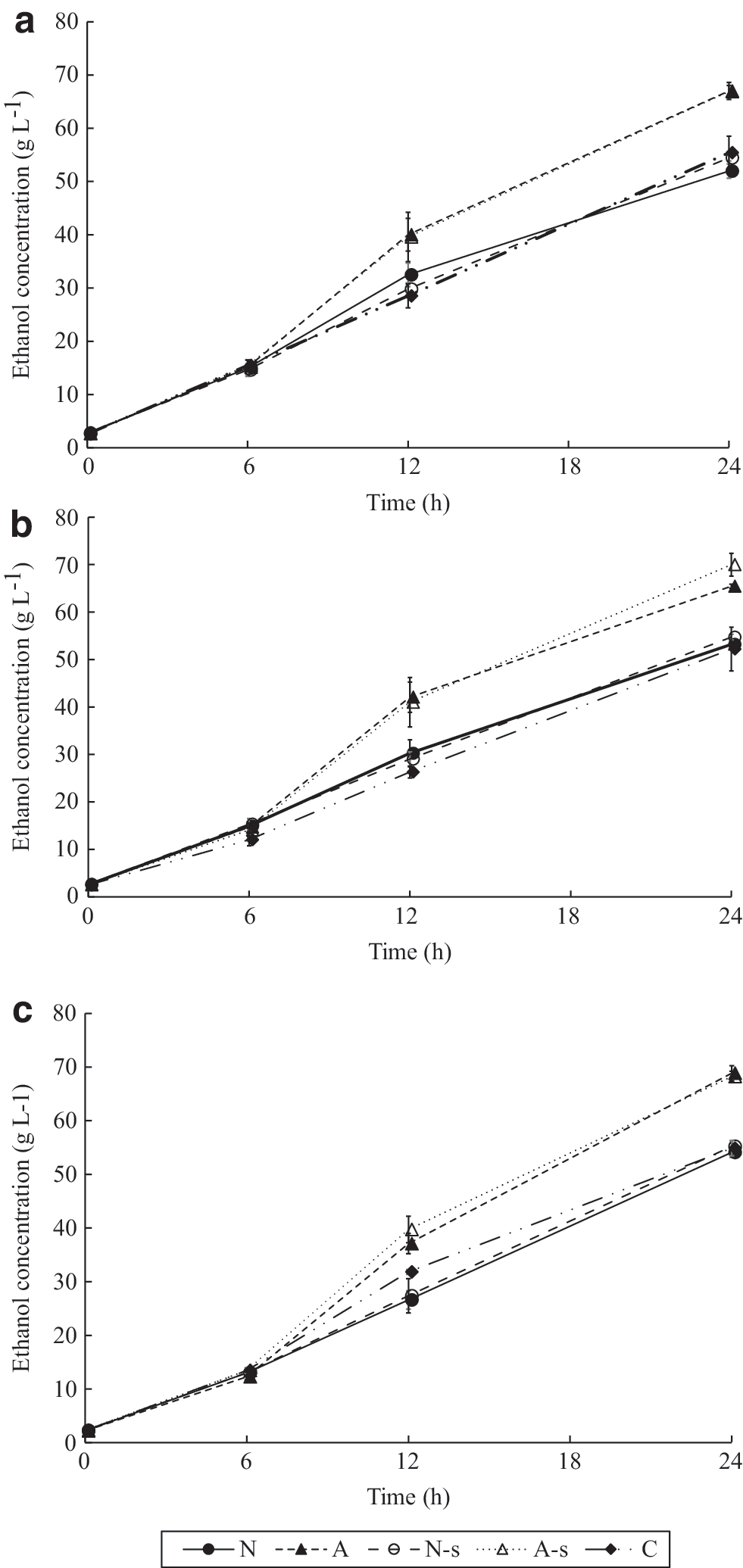
Ethanol concentrations in diffuser juice acidified with
The trends in ethanol concentrations indicate that treatments with added ammonium cations (NH4 +) reached a much higher ethanol production rate as compared to treatments with added sodium cations (Na+). For example, treatments with NH4 + had an average production rate of 4.3 g/L/h between 6 h and 12 h, whereas treatments with Na+ had a statistically lower average rate of 2.5 g/L/h. Moreover, the 6 treatments with Na+ had production rates similar to those of the 3 controls with no added Na+ or NH4 + (P = 0.086). Thus, fermentation rates in treatments with ammonium salts were enhanced by NH4 +. Fermentation media supplementation with mineral sources of nitrogen is known to significantly improve yeast fermentation. 29 In this experiment, ammonium salts increased the TKN in diffuser juice collected in 2014 by 40% to 60% (Tables 2-3), which almost doubled yeast ethanol production rates between 6 h and 12 h.
Synthesized/Added Salts, Nitrogen from Salts, and Total Kjeldahl Nitrogen (TKN) Prior to Fermentation in Treatments Prepared with Diffuser Juice Collected in 2014
TKN before and bTKN after accounting for the dilution effect of an inoculum volume fraction of 10%.
Although there were clear differences in sugar and ethanol concentrations between treatments with added NH4 + and Na+, this was generally not true when comparing treatments with the same anion. For example, ethanol concentrations in treatments acidified with each acid, and either partially neutralized with NaOH or supplemented with sodium salts, were not statistically different at 24 h (P = 0.362). However, treatments either partially neutralized with NH4OH or supplemented with ammonium salts showed small but statistically significant differences in ethanol concentrations (P = 0.030). In particular, diffuser juice acidified with HCl and partially neutralized with NH4OH reached a statistically lower concentration as compared to the other 5 treatments with ammonium salts (Fig. 2b). Nonetheless, since ethanol concentrations in that treatment and the one supplemented directly with NH4Cl were statistically different, there is no evidence of a detrimental effect from the chloride anion on yeast fermentation.
Treatments with ammonium salts achieved fermentation efficiencies between 89% and 95%. Similarly, treatments with sodium salts and the controls achieved efficiencies between 87% and 93% (P = 0.193), all of which were larger than the typical efficiency of ethanol plants (86.5%). 30 These efficiencies indicate that neither ammonium nor sodium salts affected ethanol yields at the levels evaluated. Furthermore, this suggests that treatments with sodium salts could still have reached ethanol concentrations similar to those of treatments with ammonium salts, if allowed to ferment longer.
Effects of Acidification and Partial Neutralization of Concentrated, Pressed Juice on Yeast Fermentation
Only H2SO4 was selected for juice acidification in this experiment since neither sulfate, chloride, nor phosphate anions affected yeast fermentation of diffuser juice in our first experiment. Moreover, the price of bulk H2SO4 is significantly lower than that of H3PO4 and comparable to that of HCl. 31 Therefore, acidification with H2SO4 may significantly reduce operating costs associated with long-term storage of sugars in concentrated juice.
Sugars in most treatments evaluated in this experiment were nearly completely fermented by 24 h (Fig. 3a). Only diffuser juice had a residual sugar fraction of 18%, similar to that of diffuser juice in our first experiment (20% to 24%) with a similar TKN content (Table 2). The 5 treatments prepared with concentrated, pressed juice (i.e., those containing either Na2SO4 or (NH4)2SO4, and the control) had less than 1.5 g/L of residual sugars. Moreover, the corresponding ethanol concentrations in those treatments were among the highest from all treatments (Fig. 3b), resulting in fermentation efficiencies between 97% and 99%.
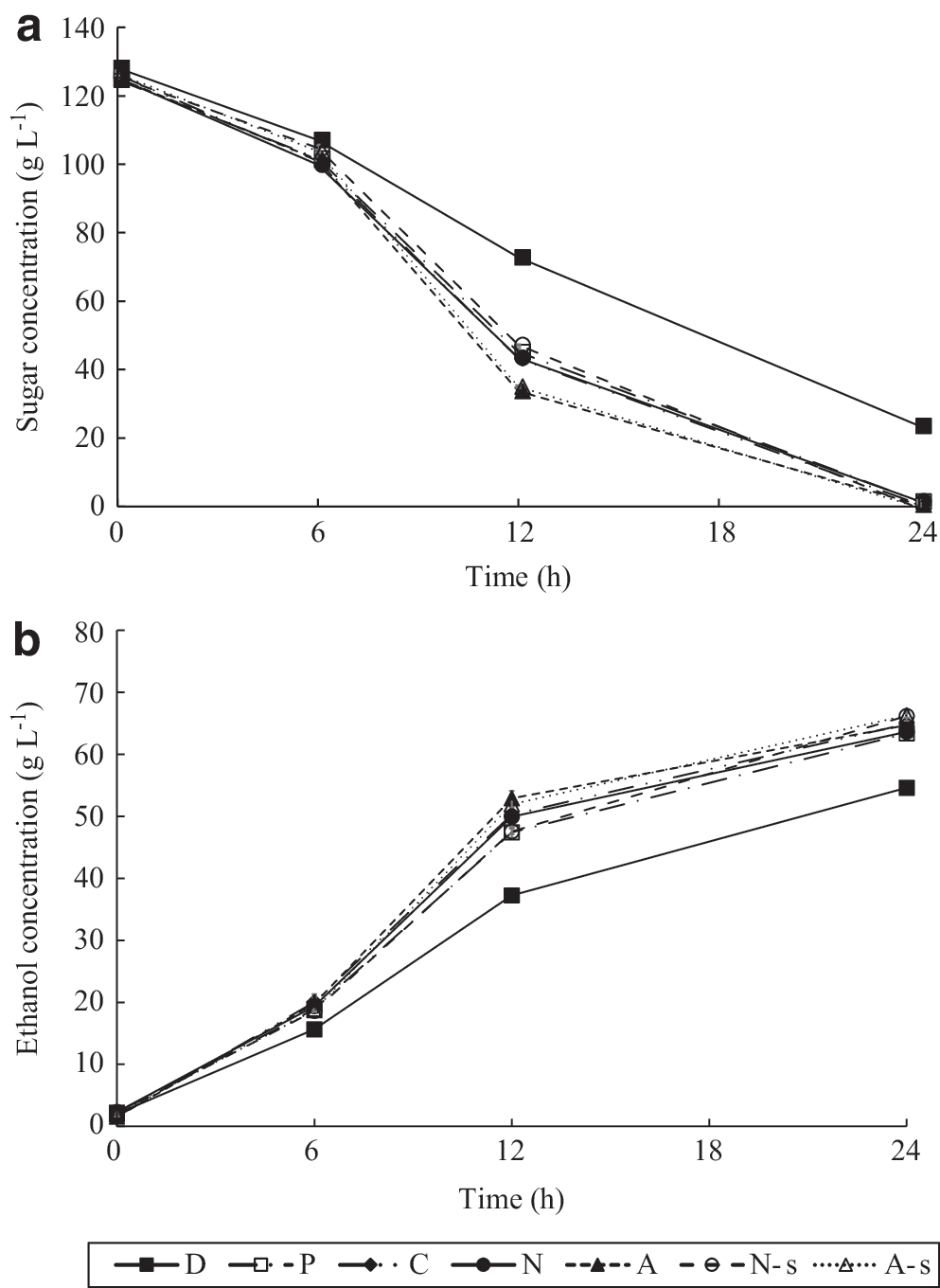
The sugar and ethanol trends confirmed that acidification of concentrated, pressed juice for long-term storage, and partial neutralization, do not hinder yeast fermentation (Figs. 3a-b). Furthermore, neither ammonium nor sodium salts (whether synthesized in situ or added directly) in concentrated, pressed juice are detrimental to yeast at the levels evaluated. However, higher sodium salt concentrations in the juice could hinder yeast growth rates due to osmotic stress and consequently plasmolysis, and also to high cytosolic Na+ concentrations. 15,17,20,32
The pressed juice had a residual-sugar concentration similar to that of the 5 treatments prepared with concentrated, pressed juice (Fig. 3a). The ethanol concentration in pressed juice at 24 h was also similar to concentrations in the concentrated, pressed juice treatments. This indicated that juice concentration by evaporation was not detrimental to yeast whatsoever.
Based on their compositions, the initial dry-basis TKN contents in pressed juice and concentrated, pressed juice were already about double those in diffuser juice in this experiment. The (NH4)2SO4 (whether synthesized in situ or added directly) increased the TKN in concentrated, pressed juice by approximately 20% (Table 4), but NH4 + only slightly improved fermentation rates (Fig. 3a-b). Specifically, it slightly enhanced yeast fermentation between 6 h and 12 h (Fig. 3a). This indicated that the original TKN contents in pressed juice and concentrated, pressed juice were sufficient for yeast fermentability.
Synthesized/Added Salts, Nitrogen from Salts, and Total Kjeldahl Nitrogen (TKN) Prior to Fermentation in Treatments Prepared with Concentrated, Pressed Juice
TKN before and bTKN after accounting for sugar adjustment by water dilution and for the dilution effect of an inoculum volume fraction of 10%.
Conclusions
Sodium salts do not hinder yeast (S. cerevisiae) fermentation of non-purified beet juice at the levels evaluated in this work (up to 1.3 g/kg). Ammonium salts can significantly improve yeast fermentation rates in diffuser juice with TKN deficiencies (less than 0.6 g/kg in this work). These salts can be synthesized in concentrated juice by acidification to enable long-term storage, and post-storage partial neutralization to enable fermentation. No statistical differences were detected in ethanol yields of treatments with either (NH4)3PO4, NH4Cl, or (NH4)2SO4. Therefore, beet ethanol producers could select the least expensive acid (among those reported herein) for juice acidification. Following storage, the acidified juice can be partially neutralized with NH4OH to yield ammonium salts. Future work should evaluate economic implications of concentrated, non-purified beet juice production, pre-storage acidification, and post-storage conditioning.
Footnotes
Acknowledgments
This manuscript is based on work funded by the North Dakota Industrial Commission (Contract No. R-013-025), the North Dakota Agricultural Experiment Station, Green Vision Group, the U.S. Department of Agriculture National Institute of Food and Agriculture (Hatch project ND01476), and the U.S. Department of Transportation through the Sun Grant Initiative (Agreement No. 3TN249), to whom we are grateful. We thank Linda Nordgaard, Patrick Rein, Beverly Jacobson, Larry Carlson, and Gary Bailey from American Crystal Sugar (Moorhead, MN) for providing diffuser juice samples and quantifying SO2 in them. We also thank Laurie Geyer (North Dakota State University (NDSU) Animal Sciences) for quantifying TKN in all samples. We gratefully acknowledge Scott Gemmell (Phibro Ethanol Performance Group) for providing a yeast sample. We extend our appreciation to Dr. Igathinathane Cannayen (NDSU-Agricultural and Biosystems Engineering (ABEN)) for granting access to his laboratory equipment to produce press juice. We also acknowledge the help of Jonathan Roe and Britta Manning (NDSU-ABEN undergraduate research assistants) while producing and concentrating press juice. Finally, we thank Darrin Haagenson and Nurun Nahar (NDSU-ABEN) for their help on the experimental setup and HPLC troubleshooting, respectively.
Author Disclosure Statement
No competing financial interests exist.