




Abstract
The utilization of lignin for fungible fuels and products represents one of the most imminent challenges in the modern biorefinery because most of the bioprocesses for lignocellulosic biofuels results in a lignin-containing waste stream. Considering lignin's abundance and relatively high energy content, this waste stream can be used as a feedstock for value-added products to improve the sustainability and economic feasibility of the biorefinery. Bioconversion of lignin with microbes recently emerged as an alternative lignin-valorization approach with significant potential. Typically, the microbial bioconversion of lignin requires three major steps: lignin depolymerization, aromatic compounds catabolism, and target product biosynthesis. In this review, we summarize the most recent advances in lignin bioconversion to address the challenges in each of the three steps. We further discuss strategies and perspectives for future research to address the challenges in bioconversion of lignin.
Lignin Utilization as a Major Challenge for Sustainable Biorefinery
Bioethanol represents one of the most mature forms of biofuels to displace fossil fuels and mitigate global climate changes. Current United States bioethanol production—about 15 billion gallons annually, derived primarily from corn—contributes approximately 10% to the gasoline transportation fuel supply. However, the U.S. Energy Independence and Security Act bill contains provisions that increase the Renewable Fuel Standard to 36 billion gallons by 2022, among which 22 billion gallons must be advanced biofuels derived from nonfood-based biomass. The majority of this will be lignocellulosic biofuels. The United States Department of Agriculture/Department of Energy Updated Billion Ton report reviewed these demands and concluded that these goals can be addressed using lignocellulosic biomass, including perennial crops, wheat straw, corn stover, other agricultural crop residues, forest residues, tree farms (i.e., hybrid poplar), secondary forest industry waste materials, and other energy crops. 1 –3
Despite the recent advances in processing carbohydrate in lignocellulosics, the utilization of lignin for fungible fuels or chemicals has yet to be achieved. As a main constituent of lignocellulosic biomass (15–30% by weight, up to 40% by energy), lignin is the second-most abundant biopolymer on Earth. 1,4 Nevertheless, lignin has received little attention relative to cellulose in terms of research and development efforts in biofuel production. In 2004, the pulp and paper industry alone produced 50 million tons of extracted lignin, yet only approximately 2% of the lignin available from the pulp and paper industry is used commercially, with the remainder burned as a low value fuel. 5 Nearly 300 million tons of lignin may be available if the Billion-Ton initiative is implemented, and lignin-containing biorefinery residues represent a significant resource for the sustainable production of fuels and chemicals.
From a holistic point of view, the use of the lignin-containing biorefinery waste stream will add new bioproducts to enable the biofuel process to be integrated, sustainable, and cost-effective. Taking corn ethanol as an example, the biorefinery for first-generation biofuel actually produces multiple product streams, including dried distillers grain as animal feed. In the same way, lignocellulosic biorefineries need to develop bioproduct streams other than ethanol for both sustainability and cost-effectiveness. Lignin utilization therefore is a major factor to enable the integrated biorefinery to reduce cost, minimize carbon emissions, and maximize sustainability of lignocellulosic biofuels. Lignocellulosic biomass is naturally recalcitrant to deconstruction by microorganisms and enzymes. 6,7 To facilitate enzymatic saccharification of cellulose, biomass typically requires pretreatment at elevated temperatures (∼150–220°C) and acidic, alkaline, or neutral processing conditions. 6 Regardless of the exact bioprocessing technology employed, almost all biological processing platforms for the conversion of plant polysaccharides to bioethanol (or biobutanol) result in the formation of a significant lignin process stream. 8 This lignin fraction can frequently be utilized as an energy resource for power/electrical generation, partially because there are few efficient chemical-conversion processes available that can convert lignin into transportation biofuels or higher-value chemical substrates. Although a certain amount of lignin (∼30–40%) is needed for the thermal requirements of bioethanol production. including pretreatment and alcohol distillation, a modern biological cellulosic processing plant will have ∼60% excess lignin. 9 The utilization of this excess lignin as feedstock for renewable fuels offers a significant opportunity to enhance the overall operational efficiency and impact of a lignocellulosic biorefinery.
Technologies being pursued to convert lignin to fungible fuels include catalytic pyrolysis, hydrotreatment, alkaline fragmentation/alkylation, and gasification. Several studies have dealt with chemical treatments to fragment lignin into smaller fragments (i.e., C6 to C22) that could be used as an additive to gasoline and/or diesel. Recent patents by Shabtai et al. describe a two-step method to yield a reformulated, partially oxygenated gasoline product, which includes a mixture of C6–C10-substituted phenyl/methyl ethers, cycloalkyl methyl ethers branched paraffins, and alkylated and polyalkylated cycloalkanes. 10 Further technical requirements/challenges are still needed for this approach to achieve cost-effectiveness. Catalytic hydrotreatment of lignin has also been examined as a means of acquiring a low degree of polymerization lignin for biofuels application. Oasmaa et al. report that thermal treatment of softwood and hardwood lignin at 400°C for 40 min in the presence of a metal catalyst and hydrogen resulted in 49–71% yield of a bio-oil. 11 Pyrolysis is an alternative methodology that can convert lignin into a bio-oil. As produced, the bio-oils are very complex mixtures and generally chemically unstable, corrosive, and have a high O:C ratio, which makes their direct use for fuels problematic. Even though thermochemical or chemical processes provide a potentially viable approach to a lignin-to-fuel platform, these methods are often hindered by the low-quality fuel product needing upgrading, corrosive intermediates or end products, and significant cost for waste management. For example, the pyrolysis of lignin generates hundreds of different compounds, most of which are oxygenated. 12 This requires a costly hydrodeoxygenation step that is still being researched. 12 Further technical requirements/challenges still need to be met/solved for this approach to achieve cost-effectiveness. Several reviews have covered the thermochemical conversion of lignin from different aspects. Biotechnology represents an alternative with significant potentials.
Lignin Bioconversion into Various Product Streams by Microorganisms
In nature, lignin is a complex aromatic heteropolymer composed of phenylpropane units cross-linked via a variety of chemically stable bonds, which makes microbial degradation particularly difficult. 13,14 Nevertheless, natural biomass utilization systems evolved mechanisms for lignin degradation, often with at least two sequential steps: lignin depolymerization into aromatic compounds and subsequent degradation of aromatic compounds. 14 Extensive work has gone into understanding the mechanisms of lignin depolymerization in model systems, such as white rot fungi and termites. 14 –19 We have thoroughly reviewed the major Natural Biomass Utilization Systems (NBUS) for their lignin- and biomass-utilization capacities. 14 Most of these NBUS depolymerize lignin with one or more major enzymatic or chemical system, including lignin peroxidase, manganese peroxidase, laccase, and Fenton reaction system. 14 Among which, wood-rot fungi are the most well-studied lignin-degradation microbes with the capacity to completely degrade lignin. 15,20 –23 Despite interest, no fungus-based commercial process for lignin depolymerization has been developed, due in large part to the practical challenges of fungal genetic manipulations.
In addition to white rot fungi, a few members of the Actinobacteria, α-Proteobacteria, and γ-Proteobacteria (including Pseudomonas putida) have lignin-degradation activity in vitro. 24 Using some of these bacteria, recent advances have been made to support the overall concept of bioconversion of lignin into fungible fuels and products. Several studies have established that oleaginous bacteria Rhodococcus opacus can utilize lignin as its sole carbon source and directly convert processed lignin into lipid. 25,26 Highly recalcitrant and relatively pure substrates like kraft lignin and ethanol organosolv lignin (EOL) lignin were used as substrates in these studies, indicating the capacity of lignin depolymerization thus exists in bacteria and can be further enhanced. Meanwhile, other studies further demonstrated that P. putida KT2440 could accumulate significant amounts of polyhydroxyalkanoates (PHA) when grown on alkali-pretreated, lignin-enriched biorefinery streams. 27 Moreover, recent studies showed that metabolically engineered P. putida KT2440 could accumulate significant amounts of muconate from lignin-derived aromatics. 28 Overall, the studies point to the feasibility of using various microorganisms to convert biorefinery waste into different types of bioproducts. The studies unveil enormous opportunities for microbial conversion to enable the integrated biorefinery.
Major Steps of Lignin Bioconversion and Challenges
Despite progress, the final bioproduct titer for most of the previous studies remained too low to be commercially relevant. Fundamental understanding of the lignin-bioconversion process is crucial to optimize each step and improve efficiency. As mentioned previously, lignin is a complex aromatic heteropolymer composed of phenylpropane units that are cross-linked via a variety of chemically stable bonds. Lignin needs to first be depolymerized into small molecular aromatic compounds before it can be used as a carbon source for microbes. Lignin-derived aromatic compounds can be catabolized by the microbes to channel the carbon to central metabolites like acetyl-CoA. In the third step, the central metabolites or key intermediates will be used to produce certain bioproducts like lipids, PHA, and others. Therefore, an efficient lignin-conversion process basically needs to coordinate and enhance all three steps—lignin depolymerization, aromatic compound catabolism, and valuable compounds biosynthesis (Fig. 1). First, the relatively weak lignin-depolymerization capacity of bacteria needs to be augmented to improve growth rate and yield on processed lignin. Second, biosynthetic pathways need to be engineered so that valuable bioproducts accumulate to higher levels under a wider range of fermentation conditions. Third, the three steps of lignin depolymerization, aromatic compound degradation, and bioproduct production need to be balanced to enable rapid growth to a high cell density with reasonable bioproduct accumulation. We hereby discuss the progresses and challenges in optimization of each of these three steps.
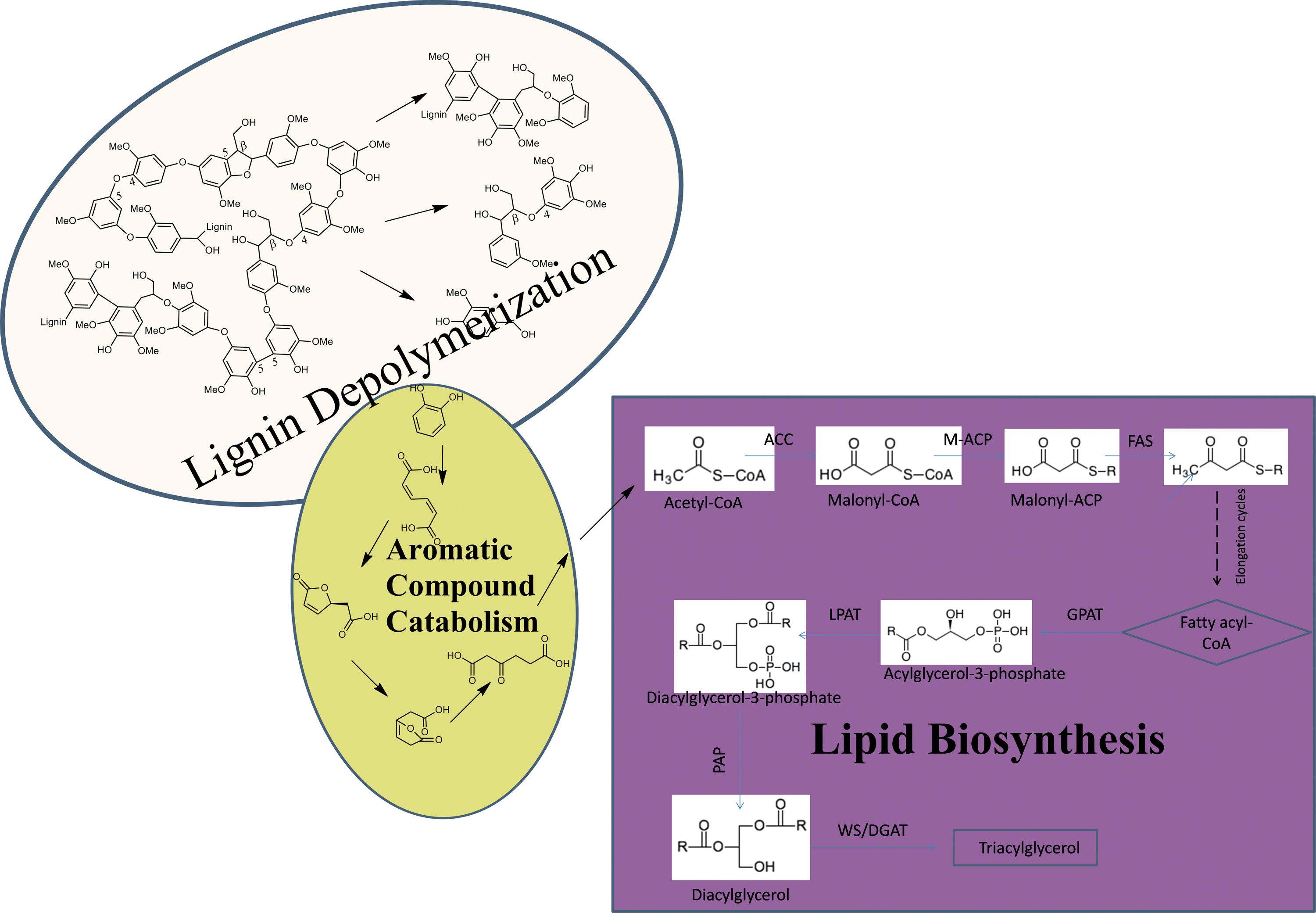
The bioconversion of lignin by microbes is normally carried out in three major steps: lignin depolymerization, aromatic compound catabolism, and target product biosynthesis. Here lignin-to-lipid bioconversion is chosen as a model to graphically explain the major steps of lignin bioconversion. Color images available online at
Lignin Depolymerization
Lignin depolymerization is the first—and probably most challenging—step in converting lignin to valuable products. 29,30 Lignin depolymerization is drastically different from depolymerization or saccharification of cellulose and hemicellulose. On one side, cellulose and hemicellulose saccharification often involves hydrolysis reactions with glycosyl hydrolases, while lignin depolymerization heavily relies on a redox reaction involving electron transfer and redox potential. Cellulose contains glucose monomers linked by β-1,4-glucosidic bond, while lignin monomers are connected with more than ten types of very different chemical linkages. Even though some bacteria can use lignin-derived aromatic compounds, the lignin-depolymerization capacity of most of these bacteria are relatively weak compared to white rot fungus or termites. In order to achieve higher product titer and efficient lignin utilization, it is critical to have an efficient lignin-depolymerization process to degrade lignin heteropolymers into aromatic compounds that can be used by microorganisms. Lignin depolymerization can be achieved with both biological and chemical approaches.
Biological or biochemical lignin depolymerization often involves lignin-degradation enzymes or Fenton reaction to catalyze the oxidation of lignin for breaking a broad range of chemical linkages within lignin. Among the major lignin-depolymerization enzymes, laccase was recently chosen for a study of the synergy between enzymatic and bacterial degradation of lignin due to its self-sustainable generation of radicals for redox reactions and capacity to cleave broad chemical bonds in lignin (Fig. 2). 26,31 Previous study has established that the laccase and R. opacus cells synergized to degrade lignin with complementary chemical functions. 26 Basically, 31P nuclear magnetic resonance analysis suggested that laccase and R. opacus PD630 selectively degrade different chemical linkages to synergize lignin depolymerization. Based on mechanistic study, a new simultaneous depolymerization and fermentation process is developed to significantly increase cell growth and lipid yield for lignin fermentation by R. opacus. Besides laccase, Fenton reaction and other enzymes like lignin peroxidase and magnesium peroxidase could also be explored for lignin degradation in the future. However, it has been indicated that the synergy between Fenton reaction and bacterial cells is not as effective as laccase, probably due to the lack of continuous supply of H2O2 in the system. In fact, for both peroxidase and Fenton reaction, the key limitation is the requirement for a sustainable redox environment. In other words, both peroxidase and Fenton reaction relies on the continuous supply of H2O2 and/or other radicals to sustain the reaction for lignin depolymerization. Such a requirement could be fulfilled by cells with capacities to produce H2O2 and other radicals or cofactors. Besides supplying the external enzymes, engineering microorganisms to produce lignin-degradation enzymes for lignin depolymerization is another major direction for the future. It is worth mentioning that most of the biological lignin-depolymerization processes are achieved under aerobic conditions through a redox reaction. Therefore, oxygen supplement will be another important consideration for efficient biological lignin degradation.
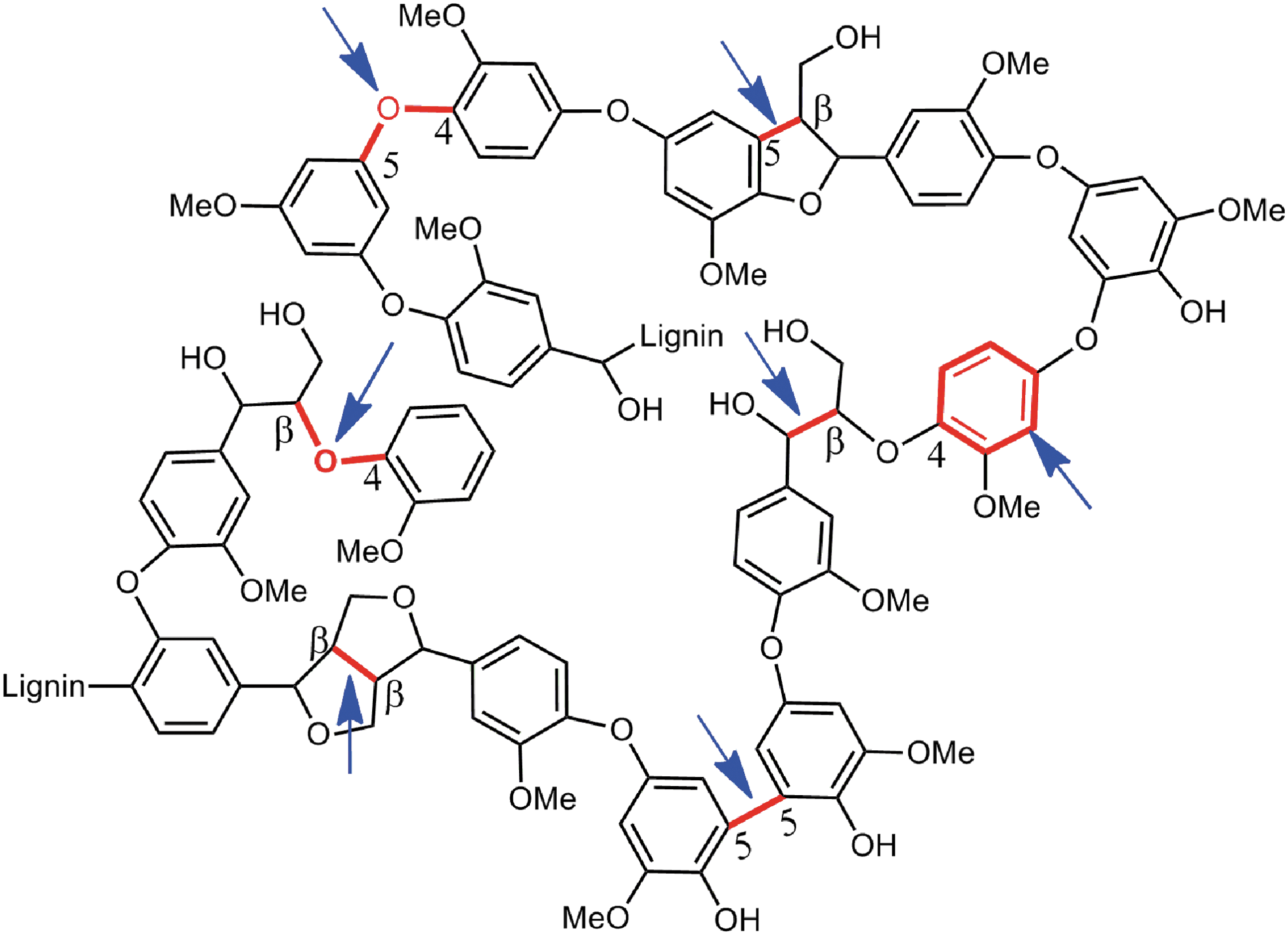
The proposed lignin-depolymerization mechanism by laccase. The figure presents an example of the possible structure for native lignin. The major interunit linkages in native lignin include the β-O-4, 5-5, β-β, 4-O-5, and β-5 bonds. The red bold linkages and blue arrows indicate the putative chemical bonds that could be cleaved by laccase, based on previous studies. Color images available online at
Chemical fractionation of lignin is another approach being explored for lignin bioconversion. The chemical fractionation of lignin has been thoroughly reviewed in several recent publications, even though the combination of chemical fractionation and bioconversion was barely discussed. 32,33 In fact, most of these chemical fractionation methods cannot be readily applied to generate aromatics for bioconversion because the often toxic products inhibit microbial growth. Nevertheless, several chemical approaches have been effective in producing fractionated biorefinery waste or kraft lignin for improved bioconversion. Linger et al. developed a NaOH-anthraquinone-based method to pretreat biorefinery waste under high pressure (30–40 psi). The method can be effectively integrated with P. putida KT2440 bioconversion of biorefinery waste for PHA and cis,cis-muconate production. 27,28 In addition, Wei et al. showed that O2 pretreatment could reduce the recalcitrance of alkali lignin and make it more processable for R. opacus DSM1069 bioconversion of kraft lignin to lipids. 34
Despiteadvances in lignin depolymerization, an efficient bioconversion process with higher titer relies on more effective lignin depolymerization or fractionation. On one hand, biological or chemical approaches compatible with microbial fermentation need to be developed and optimized. Multiple enzyme and treatment approaches need to be integrated. Eventually, the engineering of microorganisms to secrete lignin-degradation enzymes could be particularly enabling for consolidated lignin processing. On the other hand, the processibility of lignin needs to be taken into consideration for both lignin depolymerization and subsequent conversion. Our preliminary studies indicate that lignin-depolymerization efficiency by either enzymatic or chemical treatment could be significantly impacted by the type of lignin used. Chapple et al. also demonstrated that the lignin monomer composition affected lignocellulose degradability. 35,36 Consequently, the composition of residue lignin from biorefinery waste could be modified by either altering the biomass pretreatment process or redirecting the lignin-biosynthesis pathway in plant feedstock to form a certain type of lignin. Future study could evaluate how different feedstock lignin-modification strategies could increase the processibility and compatibility of lignin for microbial bioconversion.
Aromatic Compound Catabolism
The second step for lignin bioconversion is the catabolism of aromatic compounds derived from lignin by microorganisms, where further advantages can be gained from manipulation and enhancement of bacterial species. Recent sequences on various microbes has helped to advance understanding of the molecular mechanisms for microbial aromatic compounds catabolism. The best studied among the Gram-positive bacteria are Rhodococcus, and among the Gram-negative bacteria, Pseudomonas. A large number of aromatic compound catabolic pathways have been characterized in bacteria, including those responsible for growth on benzene, benzoate, (tere)phthalates, biphenyl, styrene, phenylacetate, and vanillin. 37 –42 Generally speaking, bacterial aromatic catabolism is arranged with two types of pathways: a large number of “peripheral aromatic” pathways funneling a range of natural and xenobiotic compounds into a restricted number of “central aromatic” pathways. 43 For example, the peripheral Van pathway transforms vanillin and vanillate to protocatechuate, which in turn is transformed to central metabolites via β-ketoadipate pathway to integrate with the tricarboxylic acid cycle and produce acetyl-CoA. 37 Sainsbury et al. demonstrated that an engineered strain of Rhodococcus sp. RHA1 lacking vanillin dehydrogenase accumulates vanillin when incubated with Kraft lignin or lignocellulose. 44 Mohn and Eltis have also identified the transporters for aromatic compound conversion, and suggest that the capacity of the transporters in bacterial cell membrane for aromatic compound transportation is another key limiting factor for efficient aromatic compounds catabolism. 45
As noted above, lignin is a complex aromatic heteropolymer, and a diverse range of aromatic compounds are often released after lignin depolymerization. It is therefore critical for the microbes to process the diverse range of aromatic compounds for lignin conversion. Meanwhile, many lignin-derived compounds are strong inhibitors for microbial growth, especially when they reach a certain concentration in the medium. These compounds included phenol, vanillin, 4-hydroxybenzoic acid, and coumaric acid. 46,47 One of the approaches to address this challenge has been to screen and select suitable strains for degrading and tolerating a broad range of aromatic compounds. For example, Shi et al. screened and identified a β-proteobacterium Cupriavidus basilensis B-8, which has high capacity in lignin-derived aromatic compounds catabolism. 48 Extensive microbial strain screening and characterization works need to be carried out to identify suitable strains with a broad range of aromatic compound degradation capacity and high tolerance to the inhibitors.
In addition, understanding the molecular and genomic mechanisms for aromatic compound degradation and tolerance of lignin-derived inhibitors is important for designing efficient conversion of aromatic compounds. The entire microbial aromatic compounds catabolism pathways should be balanced from peripheral aromatic pathways to central aromatic pathways that target different lignin-derived aromatic compounds. Further progresses should be made in characterizing pathways and expressing heterologous enzymes in target microbes to enable improved aromatic compound catabolism capacity. For example, expression of the genes from SYK-6 (ligA, ligB, ligC) conferred the ability to convert protocatechuate into a novel polymer-based material in P. putida. 49 The tolerance of the strain to lignin-derived inhibitors could also be improved by molecular adaptation and metabolic engineering. Yoneda et al. found that R. opacus adaptively evolved to phenol tolerance showed significantly upregulated phenol degradation pathways and putative transporters. 50 Consequently, inhibitor tolerance could be enhanced by reverse genetic engineering to overexpress the inhibitor transporter and the genes in degradation pathways. These examples highlight the potential for using systems and synthetic biology to modify microbial aromatic compounds utilization toward efficient lignin bioconversion in bacteria. Overall, both strain screening and metabolic engineering will be important in obtaining suitable bioconversion strain with broader range of aromatic compound degradation capacity toward lignin bioconversion.
Biosynthesis of Valuable Compounds
The final metabolic step for lignin bioconversion is to channel the carbon flux toward certain target products. A diverse range of target bioproducts can be sought for lignin bioconversion. Traditional bioproducts include carbon-storage compounds, like PHA and lipids, which are derived from central metabolism intermediates like acetyl-CoA. However, considering the aromatic monomers of lignin, other products can be derived from the intermediates of aromatic compound degradation.
From a metabolic flux perspective, multiple steps of lignin-degradation pathways can be engineered to produce valuable products (Fig. 3). For example, the deletion of vanillin dehydrogenase in Rhodococcus sp. RHA1 resulted in the accumulation of vanillin, an aromatic compound broadly used in food additives. 44 Recently, Vardon et al. demonstrated that P. putida KT2440 could be engineered to accumulate significant amount of cis,cis-muconate, an intermediate of catechol metabolism in β-ketoadipate pathway, by blocking its funneling into the next intermediate, muconolactone. 28 The engineered P. putida KT2440 could accumulate 0.7 g/L muconate grown on lignin-enriched biorefinery stream.
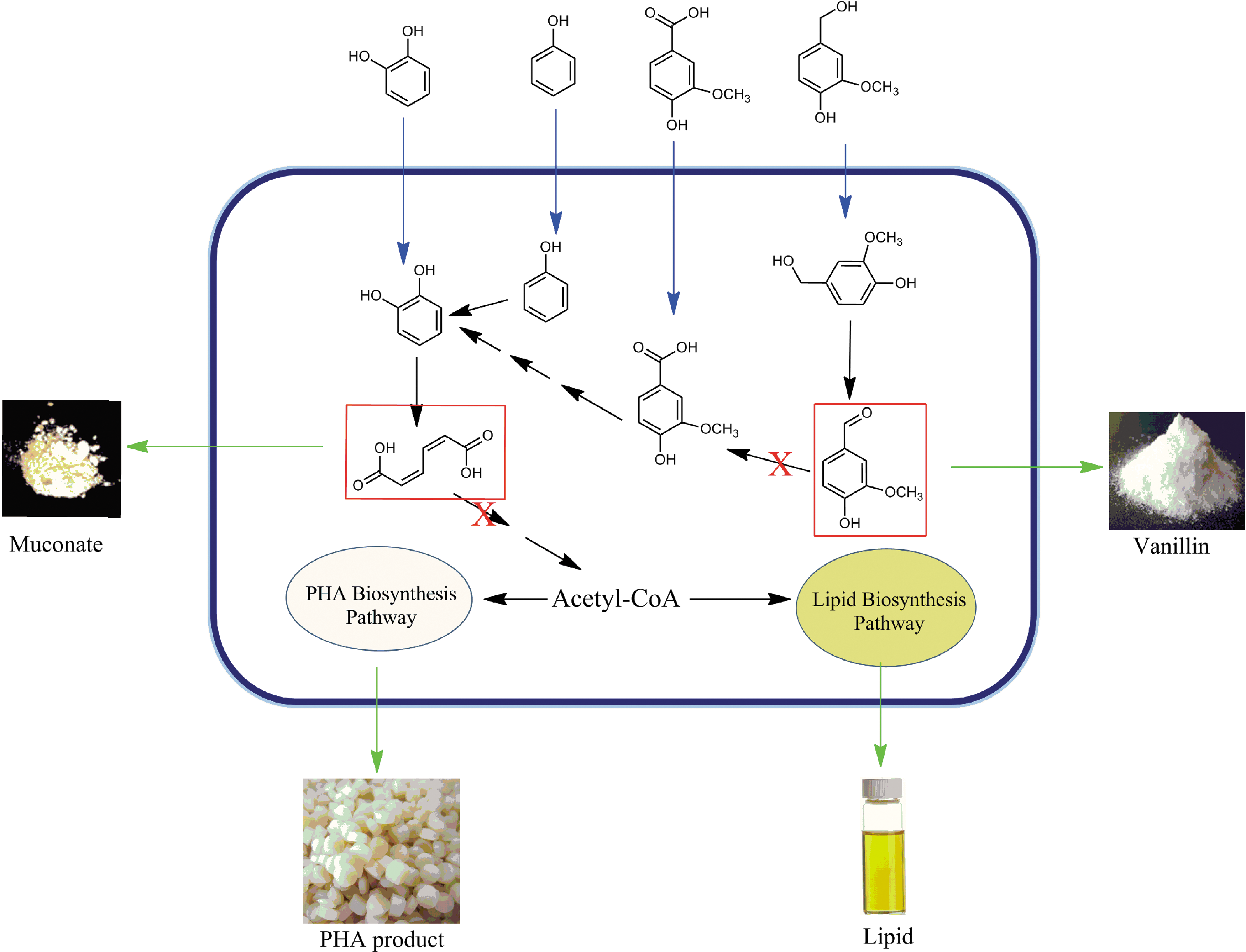
Metabolic pathways in microbes for producing valuable chemicals from lignin-derived aromatic compounds. Only several aromatic compounds are displayed. The catechol branch of β-ketoadipate pathway is selected as an example to illustrate the metabolic pathway for the production of high-value chemicals. Color images available online at
The peripheral and central aromatic compound degradation pathways will eventually funnel the carbon from aromatic compounds into central metabolites, such as acetyl-CoA and pyruvate. 51 These central metabolites from primary metabolism can be widely used for synthesis of various target metabolites including lipid, PHA, terpene, and others. Kosa et al. showed that R. opacus DSM 1069 and PD630 strains, under nitrogen-limiting conditions, convert lignin-derived compounds, such as 4-hydroxybenzoic and vanillic acid into triacylglycerols (TAGs). 30 They further demonstrated that EOL can be converted into TAG for use as another biofuel precursor. In the same way, processed biorefinery waste has been converted to PHA for bioplastics, as shown by Linger et al. 27 Despite such progress, the titers for the current lignin-conversion systems are all very low compared to carbohydrate-based system, making it difficult for commercial applications. Even though many bacteria have naturally evolved pathways to accumulate bioproducts for carbon storage, it is critical to have systems-level understanding of how these pathways are regulated under lignin substrate. The systems biology-guided biodesign can be an effective approach to increase the titer to achieve economic biorefinery streams.
Conclusions
The utilization of lignin-containing biorefinery waste stream for fungible bioproducts represents a critical challenge for the integrated biorefinery. Inevitably, an effective biorefinery stream derived from traditional biorefinery waste will increase the cost-effectiveness and carbon- and energy-efficiency to enable lignocellulosic biofuel. However, several major challenges need to be addressed before such an integrated biorefinery strategy is viable. First, extensive process development and optimization need to be carried out to enhance the bioproduct titer for converting the lignin-containing waste stream. Second, extensive research has been carried out for engineering and screening microorganisms for cellulose and hemicellulose utilization. Similar efforts need to be implemented to derive effective microbes or microbial consortium to effectively depolymerize and convert lignin to various fungible products. Third, the utilization of lignin can be an integrated approach, where microbes utilize a certain amount of aromatic compounds, while leaving the rest to be used as carbon fiber or other materials. Lastly, in order to build an integrated biorefinery schema, pretreatment needs to be optimized to both produce high ethanol yield and optimized production of multiple streams of bioproducts. Eventually, technoeconomic and life cycle analysis need to be carried out to thoroughly evaluate the integrated biorefinery.
Footnotes
Acknowledgment
This work is supported by US Department of Energy funding EE0006112.
Author Disclosure Statement
No competing financial interests exist.