




Abstract

Introduction
Technavio's market study report, Global Green and Bio Solvents Market, 2016–2020, presents a detailed segmentation of the global green and biobased solvents market by type (lactate esters, methyl soyate solvents, alcohols, and D-limonene), by application (paints and coatings, printing inks, cleaning products, and adhesives and sealants), and by geography (Asia Pacific, Central and South America, Europe, North America, and Rest of the World). The key vendors in the market are Archer Daniels Midland (ADM, Chicago, IL), BASF (Ludwigshafen, Germany), BioAmber (Plymouth, MN), Cargill (Wayzata, MN), Dow Chemical (Midland, MI), DuPont (Wilmington, DE), and Huntsman (Salt Lake City, UT).
Extensive research carried out by the analysts at Technavio has shown that the global green and biobased solvents market will grow at an impressive compound annual growth rate (CAGR) of more than 8% during the forecast period. Growing acceptance among numerous end-user industries is driving the market for green and biobased solvents globally. The need for greener and sustainable chemicals has increased the research and development of renewable feedstock. Moreover, most companies prefer green and biobased solvents over conventional chemical solvents. Also, green solvents use renewable raw materials as feedstock and emit less volatile organic compounds (VOCs). The low toxicity of green solvents has enabled their use in a variety of applications such as painting and coatings, printing inks, cleaning products, adhesives and sealants, pharmaceuticals, and agriculture chemicals, among others. The extensive applications of green and biobased solvents across various industries are likely to propel the growth prospects of the green and biobased solvents market during the forecast period.
This Industry Report presents excerpts from a market study prepared by London-based Technavio. The full, 69-page report, Global Green and Bio Solvents Market 2016–2020, can be ordered at
In this industry research report, analysts have estimated factors like the growing awareness of the various benefits of using methyl soyate as a biobased solvent to impel the prospects for market growth in the coming years. In 2006, BioSpan Technologies (Washington, MO) developed a variant of soy-based solvent that helped to replace conventional solvents like hydrocarbons. Moreover, the company developed a replacement for asphalt cement by blending biobased solvents such as methyl soyate and other newly created solvents. The various uses of methyl soyate as a biobased solvent will bolster this market's growth potential until the end of 2020.
Market Size and Forecast
The global green and bio solvents market reported revenue of $6.52 billion in 2015 and will post a revenue of $9.79 billion by 2020, growing at a CAGR of 8.47% (Fig. 1)

Global green and biobased solvents market 2015–2020 ($ billions). Source: Technavio.
The high demand for green and biobased solvents in different industries, including cleaners (domestic and industrial) and paints and coatings, will upsurge their overall consumption. Market vendors are witnessing rising demand for green and biobased solvents globally. Production is primarily dominated by North America, especially the US. Countries such as the US, Germany, Japan, China, India, the UK, and the Netherlands are the rising markets for these solvents. Green and biobased solvent-producing research institutions and companies are infusing massive investment in technology development. These investments are expected to create biobased solvents with comparable performance to conventional solvents.
Market Overview
In 2015, lactate esters registered the highest market share of green and biobased solvents at 45%, followed by methyl soyate solvents and alcohols. This is expected to continue until 2020. The consumption of lactate esters in cleaning products, owing to their relatively low toxicity, is encouraged by many manufacturers, including ADM and other major vendors. Methyl soyate solvents recorded the fastest growth among other green and biobased solvents, owing to the high demand and easy availability.
The unique properties of lactate esters, including high solvency rate, low price in comparison to other biobased solvents, and easy availability will increase the demand for lactate esters. Also, lactate esters are used to replace numerous toxic and conventional solvents consumed for several applications. Agencies such as the Environmental Protection Agency (EPA) and European Chemicals Agency have executed many regulations supporting the use of green and biobased solvents. The Montreal Protocol is also likely to drive the growth of the market during the forecast period.
Global Green and Biobased Solvents Market for Paints and Coatings
In 2015, the paints and coatings segment was the largest consumer of green and biobased solvents, consuming 42.18%. This can be attributed to the high consumption of green solvents in different applications, such as automotive, architecture, and pharmaceutical (Fig. 2). We expect this trend to continue during the forecast period owing to the numerous advantages and diverse application base of green and biobased solvents (Fig. 3).
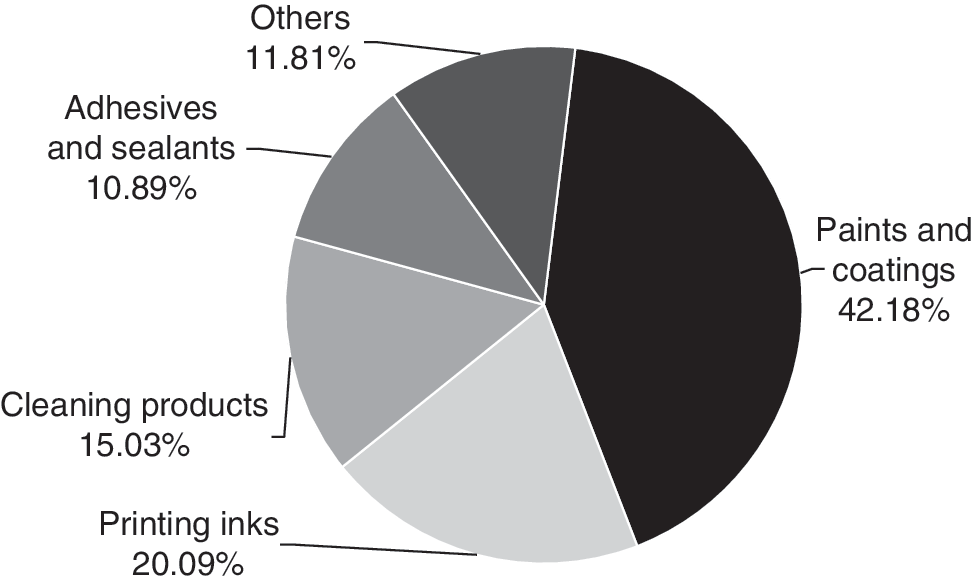
Global green and biobased solvents market by application (2015). Source: Technavio.
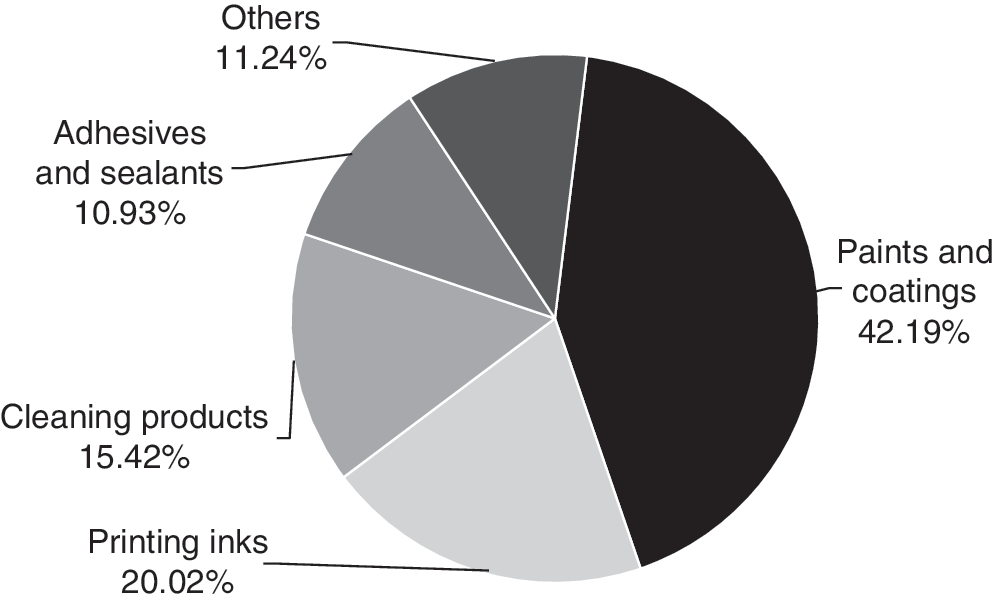
Global green and biobased solvents market by application (2020). Source: Technavio.
The market for green and biobased solvents in the paints and coatings industry recorded revenue of $2.75 billion in 2015 and will likely reach $4.13 billion by 2020, growing at a CAGR of 8.47%. This growing consumption is being driven by increased environmental awareness. This has forced paints and coatings manufacturers, including powder coatings, high-solids, and waterborne coatings, to shift toward solvents that contain less toxins and low VOC content. We expect the share of this industry to increase during the forecast period due to the implementation of stringent restrictive coatings regulations that will come into effect in the US and the EU during the forecast period. In the US, there is a rise in the use of VOC-free solvents that help lower atmospheric pollution.
Environmental and regulatory demands by governments around the world is also causing a shift in preference for paints and coating manufacturers. The challenges for these manufacturers are to develop and manufacture paints and coatings that comply with these regulations and deal with the increasing costs of raw materials. The furniture industry is the largest consumer of paints and coatings. In addition, automotive coatings are used to paint automobiles as well as protect them from ultraviolet rays, rain, snow, corrosion, and chippings from stones.
Regional Overview
North America dominated the global market for green and biobased solvents in 2015, accounting for a share of 37.12%. The market in this region is driven by the Mexican and the US markets. Asia Pacific will be the fastest growing regional market for green and biobased solvents, at an estimated CAGR of 8.93% during the forecast period. A rise in spending among consumers for construction in China and India, coupled with growing industrialization, will spur the market growth in Asia Pacific. Europe is a fairly mature market and is expected to reach saturation soon. This market is driven by the green initiatives taken by the governments in this region.
The demand for green and biobased solvents in China is expected to increase at an average annual rate of 5–6% during the forecast period. Also, due to environmental regulations in the US and the EU, the demand for green and biobased solvents is expected to remain stable or increase from these geographies in the near future. This limits the use of synthetic solvents and encourages the use of green and biobased solvents.
North America
The market for green and biobased solvents in North America was valued at $2.42 billion in 2015 and will likely reach $3.63 billion by 2020, growing at a CAGR of 8.45%.
The revival of the construction industry will result in a significant increase in the demand for biobased solvents in North America during the forecast period. In addition, the above-average growth of the customer-oriented markets such as cleaning products, cosmetics, and toiletries will boost the need for green and biobased solvents, especially butanediol derivatives, alcohols, and lactate esters. The growth of the market for green and biobased solvents in North America is due to a rise in government rules and regulations for the manufacture and use of these solvents.
In North America, demand for green solvents is increasing four times faster than that of conventional solvents due to the growing awareness about the benefits of using green solvents in cleaning products, cosmetics, and toiletries. The government has mandated regulations to reduce the emission of VOCs, increasing the demand for glycol solvents in coatings.
Manufacturers are also using butanediol and its derivatives to reduce the VOC emissions. The construction industry is increasingly opting for alcohols for green solvent applications to comply with environmental regulations.
Europe
The market for green and biobased solvents in Europe was valued at $1.82 billion in 2015 and will likely reach $2.74 billion by 2020, growing at a CAGR of 8.53%.
The green and biobased solvents market in Europe will grow at a steady pace between 2015 and 2020. The market in Europe will continue to pursue its goal of reducing VOC emissions. A shift toward water-based and other solvent-free paints is positively impacting the demand for green and biobased solvents for paints and coating applications in this region. The market for green and biobased solvents is also affected by the growing environmental awareness of end consumers. Changes aimed at reducing the environmental effects of conventional solvents will focus on manufacturing methods and hence, encourage the use of alternatives such as green and biobased solvents.
The production of solvents from renewable resources reduces the dependence on petroleum-based solvents and directly contributes to reductions in carbon emissions. Hence, the governments of different countries in this region are continuously focusing on encouraging the use of biobased solvents. The replacement of conventional solvents by new, advanced green solvents in end-uses like cosmetics, pharmaceuticals, adhesives, and paints and coatings have been seen.
Trends
Availability of Biofuels
The rise in the biobased economy is likely to produce some intermediate chemicals for the production of bioplastics. These molecules can be used to produce solvents similar to petrochemical equivalents. High volumes of biofuels have generated huge opportunities for biobased solvents such as ethanol and its derivatives, or vegetable oil products that include glycerol and biodiesel. The conversion of these feedstocks into biobased solvents depends on legal restrictions and market demand. However, many solvents used at present are acquired from feasible chemical transformations of biomass at a laboratory, pilot plant, or established biorefinery processes.
Environmental Awareness
The volatility of petroleum-based raw materials and the growing demand for sustainable products have led chemical producers to shift from conventional solvents. Also, the major vendors in the global green and biobased solvents market are coming up with technology to manufacture green and biobased solvents with several benefits, including lower environmental pollution, conservation of resources, higher productivity, and less energy consumption.
Emerging Opportunities for Soy Solvents
Growing awareness of the use of methyl soyate as a green and biobased solvent is increasing its use in different applications. The demand for soy-based solvents increased considerably in 2015. BioSpan Technologies in 2006 developed a new variant of soy-based solvent, which helped in the replacement of conventional solvents like hydrocarbons and the commercialization of soy solvents for new applications. The company developed a replacement for asphalt cement by blending biobased solvents such as methyl soyate and other newly created solvents. The development of methyl soyate is creating huge growth opportunities in the market as it is safer than other conventional solvents.