




Abstract

One of the great challenges of our generation is to address human society's over-reliance on the use of fossil resources for the production of energy and products by transitioning to a more sustainable and renewable base. Advances in many fields of science, including industrial biotechnology, green chemistry, and bioprocess engineering, are providing opportunities to produce our future energy and chemical requirements from renewable biobased feedstocks. Biorefineries that convert biomass from agricultural and forestry residues and wastes into higher-value chemicals, fuels, feeds, and fiber products are a key opportunity to contribute to this global challenge.
Australia has the world's twelfth largest economy, dominated by services, mining, and agricultural industries. 1 Agriculture is an important part of Australia's economy. The value of agricultural production exceeds A$50 billion (USD38 billion) per year and contributes 15% of total Australian merchandise exports. Australian agriculture has a long history of export success, with about 65% of agricultural production exported largely to markets in Asia and North America. Australian agriculture directly employs an estimated 270,000 people with another 223,000 employed in food and related manufacturing businesses. 2 In 2014, Deloitte Access Economics nominated agribusiness as one of five sectors that have the potential to take over from mining as key drivers of economic growth in Australia. International markets for agribusiness products are burgeoning, largely as a result of population growth and rising incomes in countries close to Australia. 3
While manufacturing as a share of economic output has declined over several decades, it still contributes about 8% of Australia's total economic output. In 2012, manufacturing employment in Australia was approximately 950,000, with the strongest growth in the food and beverage sectors. Manufacturing contributes significantly to Australia's exports and innovation agenda. 4
In 2014, Queensland University of Technology (QUT) commissioned a report by Deloitte Access Economics and Corelli Consulting to investigate the economic potential of establishing a tropical biorefinery industry in Queensland as a case study of the opportunities more broadly available in Australia. 5 The study investigated a scenario in which seven potential new biorefinery opportunities would be developed in regional Queensland and assessed the statewide economic impact that would result from this development. The biorefinery projects assessed in the study considered the conversion of sugarcane bagasse, sorghum stover, forestry residues, and green waste into a range of chemicals, resins, and fuel products (Fig. 1). The projects selected were not intended to identify specific market opportunities, but instead to represent projects encompassing a range of scales, feedstocks, and products that could be reasonably expected to be part of a developing and maturing industry.
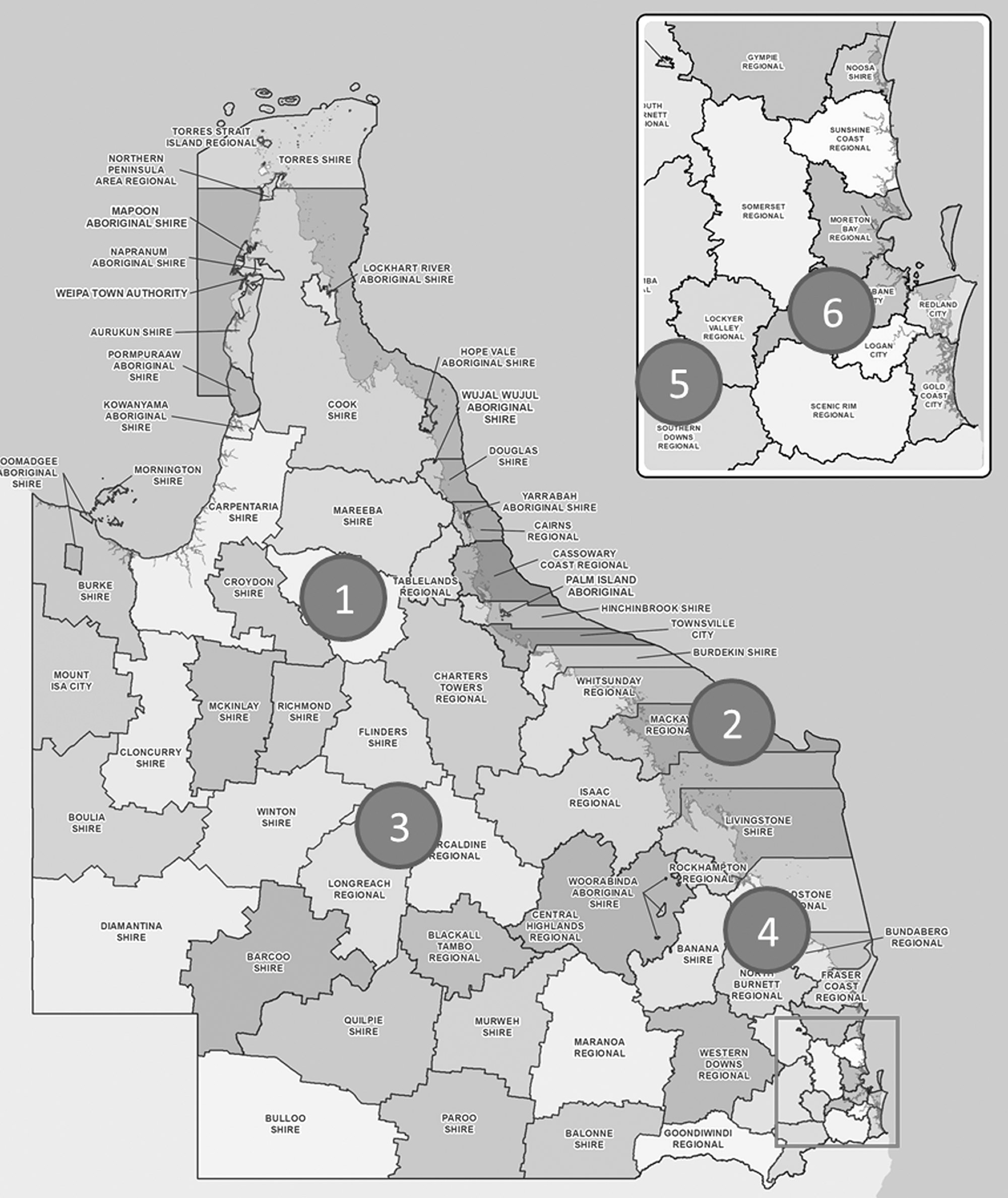
Description and location of the projects identified for the modeled scenario.
For each project in the scenario, the potential revenue, capital, and operating costs were identified (Table 1) for use as inputs into the Deloitte Access Economics in-house generalized equilibrium model to assess the estimated impacts of the scenario on the Queensland economy over a 20-year horizon. The potential economic impacts of the scenario were compared against the case in which the proposed developments did not proceed.
Revenue and Cost Data Used for the Economic Modeling
in A$
The results of the economic modeling showed that the development of a tropical biorefinery industry as described in this scenario would result in an increase in gross state product by over A$1.8 billion (USD1.4 billion) per year (net present value of the contribution over the modeled period of A$21.5 billion [USD16.4 billion]) and create more than 6,600 new full-time jobs in Queensland alone by 2035 (Fig. 2). The benefits in economic output and jobs would accrue broadly across the economy, resulting not only in economic uplift in the expected sectors of agriculture and manufacturing, but also in trade, transport, and services industries (Table 2). While this modeling considered a Queensland state scenario, the potential opportunities for establishing a biorefinery industry across Australia would likely be correspondingly greater.
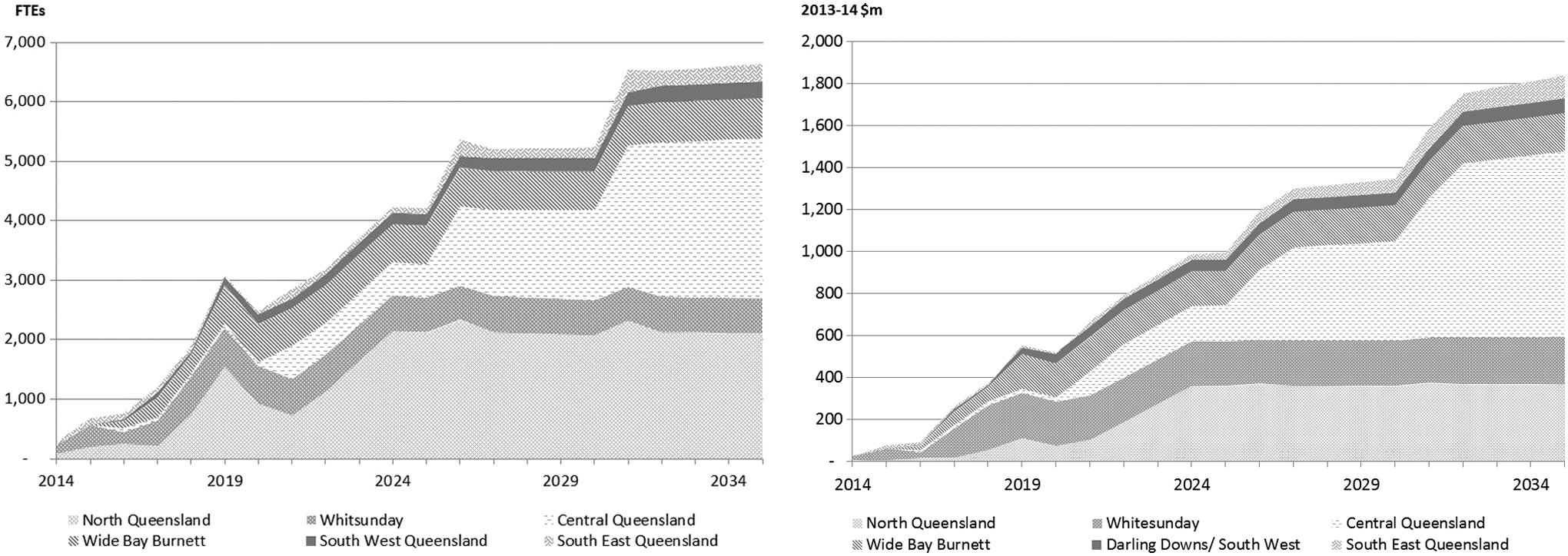
Economic impacts resulting from the scenario modeled.
Economic Impacts by Sector Resulting from the Scenario Modeled
in A$
FTE, full-time equivalents
Australia has a comparative advantage in biorefining, as its climate and agricultural sector ensure a large supply of biomass material for use in producing chemicals, plastics and fuels. Biorefineries in Australia are likely to be viable sources of economic growth and diversification. Their output can be used as inputs to domestic industries as well as generate export earnings. In addition, biorefinery industries can significantly add value to agricultural outputs, diversifying the revenue base of agricultural producers.
International experience shows that governments can make an important contribution to attracting investment, for example, by developing technology precincts and facilitating relationships between international companies and domestic industry. To this end the Queensland government has recently identified “Biofutures” as a priority industry in Queensland and has developed a 10-year roadmap and action plan. 6 The roadmap outlines the Queensland government's vision for a “$1 billion sustainable and export-oriented industrial biotechnology and bioproducts sector, attracting significant international investment, and creating regional, high-value and knowledge-intensive jobs” and identifies policy measures to support this development.
Ultimately, the adoption of biorefining technologies depends on the return on investment of individual projects. However, the Queensland biorefinery report identifies the broader economic value to Queensland and Australia of developing Biofutures industries. Biorefinery development in Australia offers the opportunity for economic growth and jobs in the bioeconomy. Ongoing rapid technology development in this field will lead to new and more highly skilled manufacturing jobs and help to underpin the economic future of regional communities.