




Abstract

Despite a checkered past, biobased materials and chemicals (BBMC) today offer a clear value proposition when compared with their petroleum-based counterparts. However, smart business execution is critical to eventual success, according to a recent report by Lux Research (Boston, MA).
The first generation of BBMC products, such as starch-based plastics, were inferior substitutes that could not compete in performance or price. While developers had hoped that simply producing a “green” product would be a sufficient driver for market adoption, they soon found out that most customers were not willing to pay a premium for products with inferior performance.
As a result, companies began focusing on driving down price or improving performance for the second generation of BBMC products. During times of high oil prices, they looked to bioequivalent chemicals that could function as drop-in replacements in existing supply chains without modifications. While this concrete value proposition led to significant growth in the BBMC industry, the business execution of many high-profile companies, such as Gevo (Englewood, CO) and Solazyme (South San Francisco, CA; now TerraVia), failed to meet expectations. Moreover, the sudden drop of oil prices in June 2014 exacerbated the situation in the BBMC space, rendering drop-in biobased chemicals non-competitive in price.
Now, we are seeing the emergence of a new generation of BBMC products that actually perform better than petroleum-derived incumbents. “With demonstrated performance benefits over petroleum-derived incumbents in uses from lubricants to personal care, opportunities exist for companies to utilize improved bio-based options,” says Ross Kozarsky, Lux Research Senior Analyst and co-author of the report titled, Hunting for Value and Performance in the Bio-based Materials and Chemicals Space. “Specialty chemicals, biopolymers, and advanced materials are all promising areas of technology development, but smart business execution is just as critical—so we set out to highlight downstream applications where these innovations offer concrete value propositions,” he added.
Lux Research analysts evaluated biobased players on the Lux Innovation Grid, focusing on six areas: adhesives, lubricants, coatings, personal care and cosmetics, packaging, and advanced materials (Fig. 1).
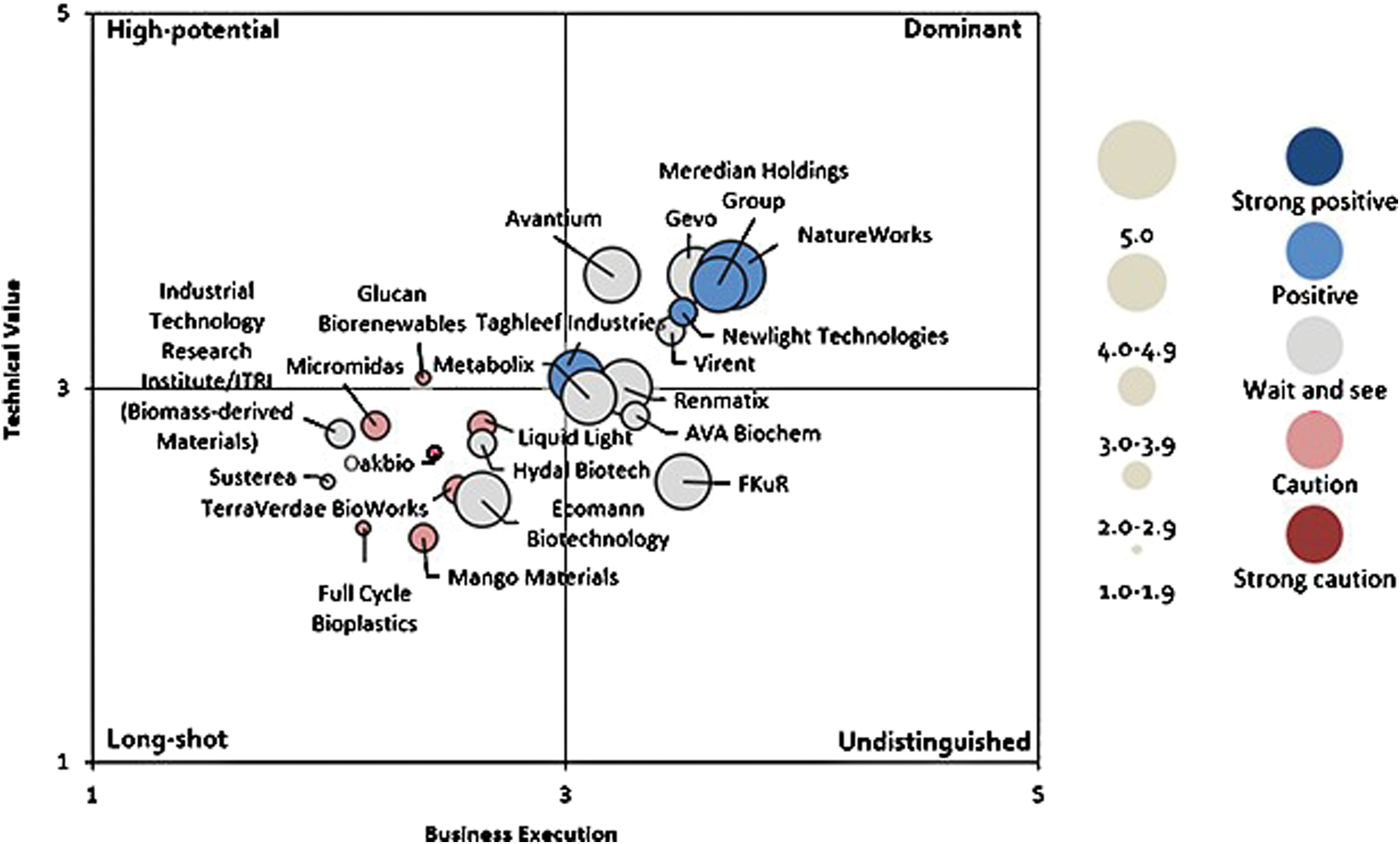
BBMC developers targeting packaging. Source: Lux Research. Color images available online at
Biobased adhesives have been driven by both a desire for improved performance and an increased awareness of environmental issues. Improved properties including curing time, increased ease of handling at ambient temperatures, and high resistance to water and ultraviolet rays has driven growth and technological development in this space. That being said, this sector is commercially immature and economic challenges must be addressed before widespread market adoption.
The biobased lubricants sector is one of the most mature within the BBMC space, with developers showing strong technological value and business execution. Biobased lubricants have shown performance advantages over incumbents, including high viscosity indices and flash points, as well as biodegradability and non-toxicity. Biosynthetic Technologies (Irvine, CA)—placed in the “Dominant” quadrant—recently got a $115 million loan from the U.S. Department of Agriculture, and would be a good fit for partners pursuing an established company generating products with existing market traction. Meanwhile, “Long shot” Altranex (Markham, ON; now Advonex International) scores above average in technology and is a worthwhile acquisition target.
Environmental concerns have driven coatings development. Regulators are pushing to cut volatile organic compounds (VOCs) in coatings, creating opportunity for diverse biobased technologies that reduce or even eliminate VOCs. While commercial progress is mixed, opportunities exist to capitalize on high potential technologies. In this space BioAmber (Minneapolis) is among the “Dominant” firms while “Long shots” TopChim (Boston, MA) and Novomer (Waltham, MA) boast promising technology.
Increasing consumer demand for natural and sustainable products have driven growth in biobased personal care and cosmetics. Given its high margin, low-volume end markets, this sector has driven growth for the overall BBMC space.
Sustainability programs bolster packaging. Biopolymers offer niches for companies seeking sustainable packaging solutions in markets like the $6.2-billion market for petroleum-based polyethylene terephthalate (PET) in bottles, jars, and tubs. Avantium (Amsterdam, NL) is one to watch for its technology as much as for its partnerships with Coca-Cola (Atlanta, GA) and Danone (Paris, FR). Micromidas (Sacramento, CA) is a “Long shot” for its catalytic process that may be quicker and simpler than incumbent methods.
Lastly, biobased advanced materials—particularly nanocrystalline cellulose (NCC) and synthetic spider silk—have compelling mechanical properties, but face non-trivial commercial challenges, such as applications development, market demand, and high production costs. NCC and spider silk, along with immature self-assembled, self-healing, and structurally colored biobased materials, are examined in another recent Lux Research report, Navigating the Web of Bio-based Performance Materials. This report found NCC to be overhyped—although there are many potential applications thrown around for NCC, none of these applications have been proven commercially although capacities have been expanding. Spider silk, on the other hand, is scalable and has concrete value in high-performance textiles. Out of the less mature materials, self-assembled materials have shown potential for both scalability and value proposition, while biobased self-healing and structurally colored materials are likely to face major hurdles reaching commercial scale. That being said, given the high value of these properties, such materials should be used as a design paradigm to develop biomimetic materials, enabling these compelling biological properties in more accessible materials.