




Abstract

Over the years in Brussels, I have seen many a European Union policy come and go. The latest of these initiatives is the Circular Economy Package. So how do we ensure that the Circular Economy concept does not leave the bioeconomy behind and does not become a useless policy bandwagon?
There is a lot of good going on around the bioeconomy in Europe. By bringing the bioeconomy and the circular economy closer together, there will be many more opportunities for growth and political support. Europe has a rich history of agriculture and of chemistry and the bioeconomy presents a new way to bring those two worlds together. So why did the Circular Economy Package not explicitly focus on the bioeconomy? When we look at the now-famous circular economy diagram promoted by the Ellen MacArthur Foundation (Fig. 1), we see that one of the cycles in a circular economy is the biobased or renewables cycle. This idea originated with Braungart and McDonough's Cradle to Cradle movement.
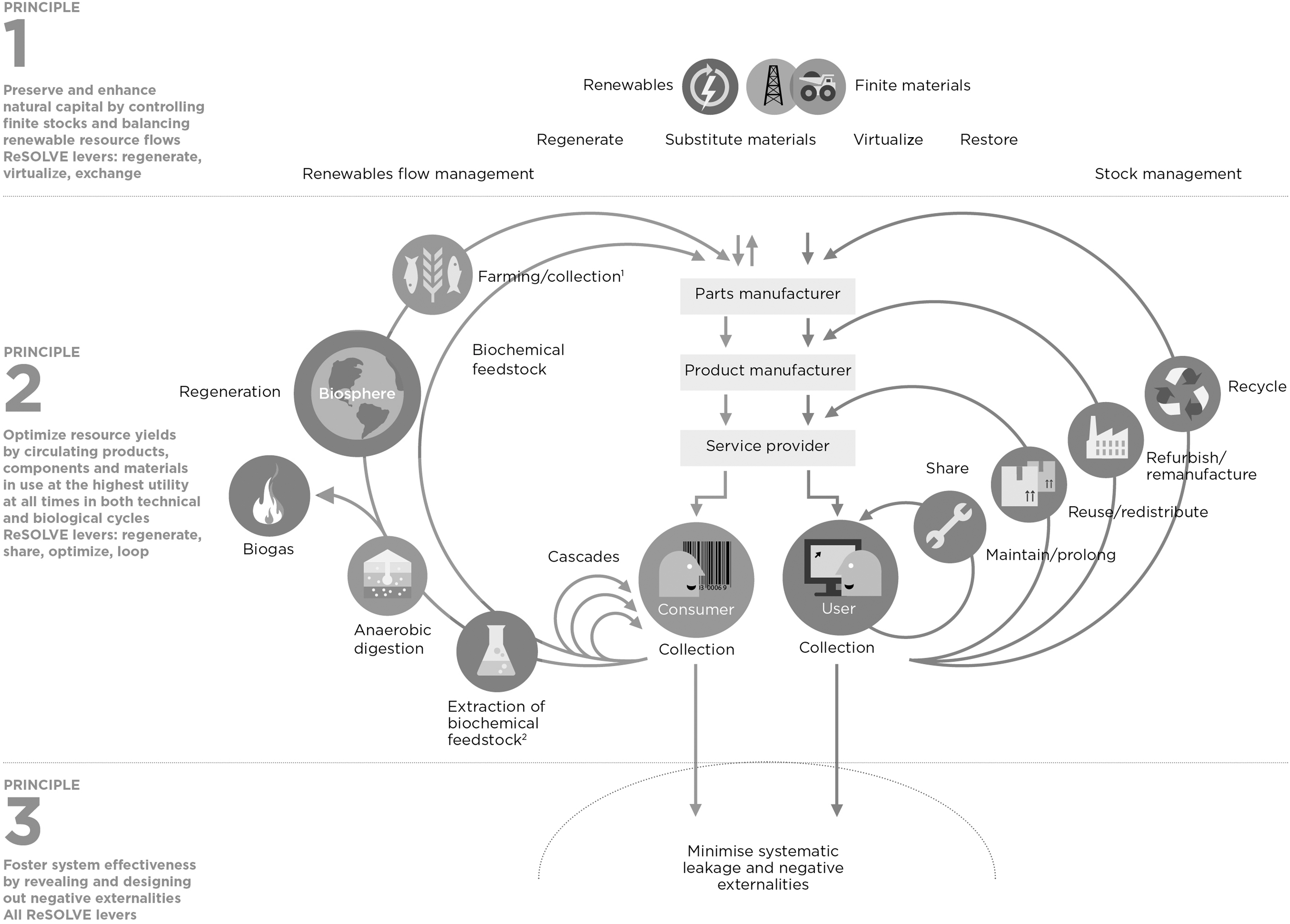
Outline of a circular economy. 1Hunting and fishing; 2Can take both post-harvest and post-consumer waste as an input. Source: Adapted from Ellen MacArthur Foundation, SUN, and McKinsey Center for Business and Environment; Drawing from Baungart & McDonough, Cradle to Cradle (C2C).
The goal of the Circular Economy Package was to revisit how Europe approaches its economic and environmental future. It contained concrete actions and goals including targets on municipal waste recycling. More than €6 billion is to be made available in EU funding.
Initially, European bioeconomy trade associations EuropaBio and European Bioplastics were skeptical, saying the package was not ambitious enough. EuropaBio called for the prioritization of biotech solutions for a circular economy in Horizon 2020 and for the promotion of agricultural productivity and efficiency. It also pointed out the distortion of the market from subsidies received by the fossil fuel industry.
Biomaterials: The Circular Economy
Recycling is part of the solution, but as most materials recycling requires some input of virgin materials, it is not really circular or a closed loop. Even reuse and redistribution, part of the materials cycle of the circular economy, are finite. The bioeconomy presents a solution for circularity in materials design and production.
Biomaterials are circular by nature as they rely on renewable resources. The European Commission recognized this in a 2014 report on the bioeconomy showing the bioeconomy as a circular economy from the beginning of the value chain. However, the 2015 Circular Economy Package did not, in our view, put sufficient focus on the bioeconomy.
The important role of biomaterials in developing a circular economy has been taken up by EU bioeconomy trade associations, most prominently the new European Bioeconomy Alliance (EUBA). EUBA summarized its position in an April 2016 report, which argued that Europe can benefit substantially from integrating biorefineries into the Seventh EU Environment Action Plan to 2020. It also believes the EU should reward zero waste industries which use renewable resources.
EUBA summarized four main points, which, it believes, would promote a circular bioeconomy: fostering investment, facilitating access to sustainable feedstocks, open and transparent dialogue around the development of the circular economy in Europe, and market creation measures.
The Bio Industries Consortium (BIC) published a report in November 2015, confirming that the bioeconomy is circular by nature as it incorporates renewable resources. Despite numerous EU initiatives and some serious research funding, the bioeconomy's role in the circular economy is often understated.
This really is a missed opportunity, as developing a strong bioeconomy in Europe will not only prop up a struggling farming sector and create jobs but will help reduce carbon emissions by substituting petro-based materials with biobased.
Promoting the Bioeconomy
As a biobased industry, we need to be more vocal in our promotion of biomaterials. For consumers to be informed about their benefits, we need a broad public information campaign and to continue working directly with consumer-facing brands like Ikea (Delft, Netherlands) and Lego (Billund, Denmark), who are actively pursuing biomaterials.
Ikea has set a target to use only bioplastics or recycled plastics by 2020 and Lego is hiring over 100 scientists and investing $146 million to switch every Lego block over to bioplastics by 2030. Such ambitious goals set an example to other big brands that biomaterials present a solution to lower carbon footprints, adhere to circular economy principles and engage the consumer in dialogue about how products are made and the impact they have.
In my recent TEDx talk on bioplastics, I symbolically broke up with a barrel of oil on stage. I may be one of the most vocal advocates for biomaterials, taking the message far and wide to big brands as well as within the chemical and plastics industries. But I am also realistic about the challenges we face as an industry today. Investors who expected the demand for biobased products to boom more quickly are getting nervous with the time it is taking for biobased solutions to become more mainstream. Bringing biorefineries online is a time-consuming and costly business and developing the market becomes ever more important. Yet pioneers like Coca-Cola (Atlanta, GA) with the PlantBottle and São Paulo, Brazil's Braskem with Green polyethylene already have reached commercial success with biomaterials. Other companies are nipping at their heels. I firmly believe the bioeconomy is here to stay and without resorting to ‘buzzword bingo’, I hope that in Europe we can better join the dots between bio and circularity.
As a tried-and-true advocate of the bioeconomy, I firmly believe that we have much to gain by combining the efforts of the bioeconomy and the circular economy. Investors, established companies and other stakeholders often look at sustainability as a holistic project to work on. By combining efforts and creating a truly circular bioeconomy, we will attract more business, deepen the impact of our sector and in doing so, change the economy for the better.