




Abstract
A sequential process for the recovery and purification of multiple products was used on a mixture of algal biomass comprised of Spirulina platensis (Arthrospira platensis) and Dunaliella salina. Activated charcoal was selected as the best adsorbent for phycocyanin recovery and purity in the discrete step product recovery studies based on adsorption coefficients of Langmuir (qm: 0.16 g/g) and Freundlich isotherms (Kf: 0.6 g/g) with R2 = 0.99. The partition coefficient of beta-carotene in various solvent systems was reported as the log P value. Higher log P solvents (≥2.9) were shown to be good for the recovery and purity of beta-carotene for both algae. The presence of polyethylene glycol in an aqueous two-phase separation of beta-carotene resulted in enhanced purity (≥90%). A high gamma-linolenic to linoleic fatty acid index (≥1.8) in the presence of 100% acetone was essential for accomplishing the final gamma-linolenic acid purity of 90%. The results of sequential separation correlated with discrete recovery operations. These results suggest a biorefinery design for biofuels and nutraceuticals.
Introduction
Algal biomass is a repository for multiple products of low, intermediate, and high value. Various microalgal members accumulate intracellular products in an abundance, such as pigments, 1 polysaccharides, 2 carotenoids, 3 poly-unsaturated fatty acids, 4 and triglycerides. 5 All the aforementioned products are known for their multiple health benefits and food applications. 6,7 However, with the present-day industrial processing of microalgae, a predominant product is targeted while other products are left unexploited in the biomass. Therefore, the design of a process for the exhaustive separation of products requires modifications to raw materials in their fortification and proportional feeding in refineries. In addition, the recovery and purification protocols that suit discrete operations with a single biomass should be verified and reoriented for their application to a biomass mixture. Thus, a viable design should be suited to the processing of a mixture of algal species for the broadest applicability possible. It has been suggested that multiple species with common intracellular products are considered as a raw material in a biorefinery as to achieve lower production costs.
As an example, the selection of a biomass with a low specific yield of carotene may not be a viable option. Hence, other carotene-rich biomasses can be fortified with the original biomass. A similar scenario exists with polyunsaturated fatty acids (PUFA) where gamma linolenic acid and eicosapentaenoic acid can be recovered from a biomass mixture comprising Spirulina and Nannochloropsis. This suggests that when a raw material is a source of multiple products in varying proportions, biomass fortification will help with the augment of a specific yield of the desired product. Nevertheless, single-species biomass with an appreciable number of multiple products can always be considered in the recovery operations.
While algae is predominately seen as a source of biofuel, they are used commercially for the production of some high-value products, such as the cyanobacterial phycocyanin (C-PC), 8 beta-carotene, 9 and gamma-linolenic acid (GLA). 10 This means that the recovery of the aforementioned products in a sequential operation of multiple species would be beneficial for the commercial utilization of biomass.
The extraction and purification of algal products involve various methods and processes, such as solvent digestion, solvent-based cell permeation, saponification, 11 transmethylation, 12 selective extraction, 13,14 solvent phase separation, 15 and fractionation with various organic compounds. 16 A review of industrial methods and patent claims shows that the industrial production of phycocyanin by Cyanotech (Kailua-Kona, HI) uses ocean water to protect heat-sensitive phycocyanin. Earthrise (Irvine, CA) and Hainan DIC (Tokyo, Japan) are major producers of phycocyanin; Earthrise adopts a series of unit operations for the production of phycocyanin (Linablue). Their process involves using Spirulina platensis spray dried powder for which a series of unit operations are performed, including initial water extraction, separation, ultrafiltration, color value adjustment, spray drying, heat sterilization, and packaging.
Several other studies on phycocyanin recovery have shown buffer-based recovery and precipitation with ammonium sulphate followed by the chromatographic separation of phycocyanin. 17 –20 A study by Furuki et al. illustrated the recovery of C-phycocyanin from Spirulina platensis using 0.1 M PBS at pH of 6.8 while using sonication at 28 KHz for the extraction, which was followed by ultra-centrifugation at 200,000 × g for purification (90% purity). 20 Oliveira et al. studied the effect of drying on the recovery of phycocyanin and fatty acid from Spirulina platensis. 21 They reported that, under convective hot air drying conditions (55°C and 3.7 mm), the phycocyanin loss percentage was approximately 37%, with no significant difference in the fatty acid composition of the microalga. Lipids were found to comprise 34.4% of the microalga, and gamma-linolenic acid comprised 20.6% of the total fatty acids of the microalga.
Hoffmann-La Roche Inc. researched the treatment of algal slurry biomass with calcium hydroxide (50–100°C) to recover a filter residue which is rich in carotene. 22 Carotene was further recovered from the filter residue using methylene chloride and hexane in a Soxhlet apparatus. Additionally, a study by Sasol Chemical Industries examined the separation of beta-carotene from Dunaliella by means of organic and aqueous phase (vegetable oil) separation. 23
In another study, Marchel et al. found 65% β-carotene recovery with ethyl oleate. 24 The high hydrophobicity of beta-carotene, which is highly demanded by the pharmaceutical and agro-food industry, makes it a good choice for production by creating an aqueous/organic biphase. Leon et al. investigated the viability of a two-phase system for producing beta-carotene from marine microalgae, Dunaliella salina, using decane as an organic phase (log P value of 5.6). 25 Batista et al. further demonstrated the use of the acid digestion of biomass. 26 They used 4 N HCl with the Soxhlet method along with petroleum ether for 6 h, resulting in the recovery of GLA from Spirulina maxima. Cervera et al. used silver ion-silica gel column chromatography for the purification of GLA-containing triglycerides (GLA-TGs) from evening primrose seed oil. 27 Sagilata et al. have fractionated the lipids and suggested the use of glycolipid fractions for the recovery of GLA. 28 Purification was attempted using the urea fractionation method (84% purity) and silver silica gel chromatography (>96% purity and 66% recovery).
The aforementioned discrete step recovery and purification procedures could be revisited to determine the comprehensive utilization of biomass for multi-end products. In biomass mixtures, it is envisioned that common products can be recovered and purified by simple add-on operations. However, the biomass ratio is important when a product is contributed to by a single species in a biomass mixture. The mutual masking effect of these biomass in a mixed raw material could severely hamper the product recovery.
During multiproduct recovery from single or multiple species, routine industrial methods can be exploited using selective solvent extraction methods and supplementary purification procedures. Some of the key issues to be resolved in the design of sequential processes include biomass selection, biomass fortification with additional algal strains, the reconstitution of the biomass surface area, and the cross-contamination of desired products. The present study was aimed at developing the methodology and steps required for the recovery of multiple products from algal biomass. Discrete steps were optimized for the recovery of C-PC, beta-carotene, and GLA. A continuous sequential operation has been attempted for the recovery of the aforesaid products from a biomass mixture. Furthermore, this work establishes the purification criteria for the products in the supplementary unit operations.
Materials and Methods
Microalgae and Culture Medium
Discrete optimization experiments for the recovery of C-PC, beta-carotene and GLA were carried out with a spray dried commercial strain of Spirulina platensis (Parry's Nutraceutical Pvt. Ltd, Chennai, India) and Dunaliella salina 42.88 (SAG, Goettingen Germany).
The following medium was adopted for culturing Dunaliella salina: a stock solution of KNO3, 1 g/100 mL; K2HPO4, 0.1 g/100 mL was prepared and stored. Twenty mL of each of these nutrients were mixed with 30 mL of the soil extract and 930 mL artificial seawater to make a 1 L solution of Dunaliella medium.
Preparation of Soil Extract and Artificial Seawater Medium
About one-third of the garden or leaf soil medium was put into a 2-L flask. Deionized water was added until the water was about 5 cm above the soil. It was sterilized every hour over a period of 24 hours. The decanted extract was separated from soil particles by centrifugation (10,000 rpm, 10min). The obtained supernatant was sterilized for 20 min at 121°C in an autoclave and was subsequently stored in a refrigerator. The following composition was used for preparing the artificial sea water: 60.0 g NaCl, 10.0 g MgSO4.7H2O, 1.5 g KCl, and 2.0g CaSO4.2H2O in 1,000 mL of distilled water.
Gamma Linolenic Acid Recovery and Estimation
The GLA-rich glycolipid fraction was recovered from Spirulina biomass by heat digestion with acetone for 2 h in a hot water bath. The recovered lipid phase was saponified to produce a mixture of GLA-rich fatty acids. The fatty acid composition was identified before saponification by using a direct transesterification method. 29 The total fatty acids were estimated using gas chromatography (Thermo Scientific 8610) fitted with a flame ionization detector (FID). A fused silica capillary column made of 70% cyanopropyl polysiloxane as stationary phase (SGE, BPX-70, 25 m length x 0.32 mm I.D x 0.25 μ film thickness) was employed for the detection of fatty acid methyl esters (FAME). The injection and detector ports were kept at temperatures of 240°C and 250°C, respectively.
The fatty acid analysis was performed by injecting 0.5 μL of the sample into the split mode (1:50) with nitrogen as a carrier gas. The following temperature program was adopted for detecting FAME: The initial temperature was 100°C for one min and was then increased at a rate of 10°C/min up to180°C, with a one-min hold; thereafter, a second temperature ramp of 10°C/min up to 240°C with a 2-min hold was used. GLA was quantified using heptadecanoic acid as an internal standard.
Carotenoid Extraction and Analysis
About 200 mg of the sample was homogenized in 20 mL of 80% acetone. A butylated hydroxy toluene (BHT) solution (0.1%) was added as an antioxidant. The resulting extract was centrifuged at 8,000 rpm for 15 min at 10°C. The supernatant was collected and concentrated using a rotary evaporator while the residue was washed twice with 80% acetone and re-concentrated using a similar procedure. The extract was then transferred to 100-mL volumetric flask and stored for analysis of carotenoids. HPLC analysis (Model: SPD 20A, Shimazdu) was performed on a reverse phase C18 analytical column (Hibar, Purospher STAR, Merck) with detection at 450 nm. The mobile phase (70:30: methanol: hexane) in isocratic mode was operated at 1.5 mL/min. A standard sample of β-carotene (Sigma Aldrich, St. Louis, MO) was used for comparing the retention time of the carotene. An external standard method was used for quantifying the beta-carotene.
Phycocyanin Recovery and Estimation
Cyanobacterial Phycocyanin was extracted from spray-dried Spirulina platensis (Parry's Nutraceuticals). In various experiments, about 200 mg of biomass (B) was dissolved into a 50 mM phosphate buffer or distilled water with a pH of 6.8 (20 mL) in 250 mL Erlenmeyer conical flasks (Borosil, Mumbai, India). In experimental studies targeting the simultaneous recovery and purification of C-PC, CaCl2.2H2O (0.25M) and various adsorbents (A; A/B ratio = 80%) were added to the biomass-solvent mixture. About 20 g of 0.65 mm glass beads (Merck) was weighed and pre-mixed with the biomass and thesolvent. The recovery studies were carried on a rotary shaker (Pharmacon) at 150 rpm for 30 min. The lysed biomass was centrifuged (10,000 rpm, 10 min at 10°C), and the supernatant was estimated for recovery and purity of C-PC using a double beam UV-Vis spectrophotometer (Dynamica, Halo DB 20). The peak for C-PC was detected at 620 nm. The purity of C-PC was estimated by the absorbance index (A620/A280). The concentration of C-PC (mg/mL) was estimated using the following equation:
30
Fatty Acid Purification
The urea fractionation method was adopted for the purification of GLA. 31 The modification of the urea fractionation was facilitated by allowing the urea crystal formation in the presence of inert materials, such as glass wool and cotton packings, for enhancing the recovery of GLA. In the modified method, to 1 g of GLA rich fatty acids, 10 mL of hot methanol comprising 4 g of urea and 1 g of either glass wool or cotton was included. The crystal complex was allowed to form at room temperature. The supernatant was vacuum filtered and re-extracted into a hexane-methanol system. The hexane fraction comprised of unbound GLA that was present in the fatty acid mixture.
Beta-Carotene Purification
Aqueous two-phase separation (ATPS), which is a liquid-liquid extraction, involves the transfer of a solute from one aqueous phase to another based on solute polarity. The log P for a compound is the logarithm (base 10) of the partition coefficient. In beta-carotene purification, a polyethylene glycol (PEG) and n-Hexane-Pet-ether mixture (4:1) was used as a two-phase system. Beta-carotene preferentially dissolved into the n-Hexane:Pet-ether phase (3:7) due to its high log P while other polar carotenoids were removed by the PEG treatment. The carotene phase (Hexane:Pet-ether) was used in the HPLC analysis to establish the purity of the recovered compound.
Specific Adsorption of Methylene Blue
Methylene blue (MB) was obtained from Merck. The concentration of the methylene blue was 2 mg/mL. The adsorption of MB onto different adsorbents was carried out in the water at 293 K and pH 7.0. In the experiment, 5 mL of 2 mg/mL of each adsorbent was added to 25 mL of MB solution (0.4–2.0 mg/mL). The contents were mixed on an orbital shaker (150 rpm for 30 min). The solution was centrifuged (8,000 rpm, 15 min) and the supernatant was assayed at 664 nm (UV-visible Spectrophotometer-Dynamica Halo DB 20) for the MB content left after adsorption.
Langmuir and Fendurlich Isotherms for Adsorption Studies
The sorption studies were conducted on various adsorbents: activated charcoal, graphite, filter aid, sawdust, and chitosan using the total protein (crude C-PC extract) obtained from S. platensis (Parry's Nutraceuticals). The specific sorption capacity of the adsorbent was determined by equilibrium studies. The equilibrium relationship between the adsorbent and the total protein was described by adsorption isotherms, which usually provide the index comprising of total protein adsorbed to the quantity remaining in the solution after adsorption at equilibrium.
In general, 5 mL of 2 mg/mL of adsorbents were added to each 20 mL of total protein solution (C-PC crude extract). After mixing the solution on the orbital shaker (30 min, 200 rpm) the adsorbents were then separated from the respective protein solutions by centrifugation (10,000 rpm, 5 min). The final concentration (Ce) of the protein in solution after adsorption was determined by Lowry's method. 32 The resulting data were used to plot the adsorption isotherms:
The Freundlich isotherm
The adsorption intensity of the sorbent towards the adsorbent was estimated using Freundlich isotherm.
Where Ce (g/mL) is the final concentration of the protein solution and q is the equilibrium adsorption amount (g/g). The linearized equation was used to determine the binding constants, Kf (g/g) and n, which were determined from the intercept and slope, respectively.
The Langmuir isotherm
The maximum adsorption capacity of the adsorbents was estimated using the Langmuir isotherm, given below.
Where q is an equilibrium adsorption amount (g/g), qm is the maximum adsorption amount (g/g), Ce is the equilibrium protein concentration in the solution (g/mL), and K is the Langmuir adsorption equilibrium constant (mL/g).
Statistical Analyses
Statistical analyses were conducted using Graph Pad, In-Stat 3.0. A one-way ANOVA was performed to determine the probability (P) and regression values between groups. All experiments were repeated in triplicate, and the results were reported as the mean value of the triplicate samples.
Results and Discussion
Quantitative Analysis of Bioactive Compounds From Algal Biomass
Microalgae have been used as a nutrient-rich food by ancient Mexicans, Africans, and Asians. 33 Among such microalgae, S. platensis, and D. salina are known for their high nutritional profile and medicinal benefits. 34 D. salina is known to accumulate a high content of β-carotene and other carotenoids during stressful conditions. In addition, D. salina is a good source of lipids and hydrocarbons.
S. platensis, a cyanobacteriumcontaining over 63% protein, is also the source of several important phytonutrients, like carotenoids, water-soluble pigments (C-PC), and essential fatty acids (GLA). A detailed analysis (Supplementary Table S1; Supplementary Data are available online at
A lipid fractionation (Supplementary Table S2) of S. platensis confirms that a major fraction of fatty acid (GLA) is distributed predominately in glycolipid fraction. The study also confirms there is a higher GLA to linolenic acid (LA) index in glycolipids than in neutral and phospholipids.
The majority of GLA was primarily present in the polar lipids and especially in glycolipids (86.4% of the total GLA). The increase in the proportion of unsaturated fatty acids (GLA) in the polar lipids enhances the membrane flexibility of the organism. This relative abundance in a specific lipid fraction leaves room to design a suitable recovery method in the anticipated sequential process. Understanding the distribution of the products of common interest in the algal biomass mixture is of immense use for the development of a cost-effective process for extraction and purification.
Discrete Step Optimization for Phycocyanin Recovery and Purification
The recovery and yield of targeted products play a vital role in any extraction process. However, process intensification approaches for the recovery and purification of desired products using the minimum number of operations are important from an economic perspective. The statement assumes significance, as most algal biomasses harbor both high- and low-value products.
While C-PC is a well-known heat-sensitive pigment, it is useful to measure the actual loss values with various drying mechanisms when designing a biorefinery process. The C-PC loss (Supplementary Table S3) during the spray dry was 69.3% over fresh biomass. The microwave drying, however, resulted in retention of only 13.8% of the maximum available C-PC in the biomass. The recovery and specific yield of C-PC from S. platensis with fresh and dried biomasses showed the optimum pigment recovery of wet biomass. However, the need for biomass procurement, transport logistics, and prolonged storage might make dry biomass more desirable than wet biomass in practice.
Protein adsorption with suitable adsorbent has been in practice over decades in protein purification protocols. About 63% of the Spirulina dry biomass is a protein. In addition, the intracellular C-PC itself is a pigment-protein complex. Hence, in this work, an effort has been made to understand the application of this unit operation in the purification of C-PC. Adsorption is the adhesion of ions or molecules of a dissolved pigment solid to the surface of an adsorbent. This process creates a film of the adsorbate on the surface of the adsorbent. To evaluate the use of adsorbents in the recovery and purification of C-PC, various adsorbents (Table 1) were tested, and their strength of adsorption was evaluated with isotherm constants. Both models (Langurean and Freundlich) were calibrated initially with methylene blue dye. The methylene blue dye adsorption showed the highest specific adsorption by activated charcoal, followed by graphite, sawdust, filter aid, and chitosan.
Physical Properties and Isotherm Constants Derived for Various Adsorbents
Pure methylene blue dye used to calibrate the adsorbents prior to the adosorption studies of crude phycocyanin; bLangmuir constants: qm and K attained with phycocyanin-protein adsorption studies with various adsorbents; cFreundlich constants: n and Kf attained with phycocyanin-protein adsorption studies with various adsorbents.
The specific adsorption of protein in a crude phycocyanin solution revealed a similar order, with the maximum specific adsorption of protein being eight times higher than that of chitosan. Although the Langmuir and Freundlich isotherms follow a similar sequence of ranking for adsorbents, Langmurean rankings showed significant variations in qm over the K parameter compared to the Freundlich model. Both models revealed the specific adsorption capacity of the adsorbent. Irrespective of variations in the magnitude of the constants in both cases, activated charcoal was shown to perform better than other adsorbents that were tested in the present study.
C-PC is essentially a protein–pigment complex. The adsorption of C-PC was attributed partly due to the protein complex associated with the pigment chromophore. The algal biomass was shown to contain 63% total protein. During the cell lysis and recovery of intracellular pigment-protein complexes, supplemental protein (contaminating protein) is anticipated in the total crude protein extract of C-PC. The data in Table 2 shows the total protein partition profile of the crude C-PC solutions. The data defines the initial conditions of respective protein concentrations before adsorption. With such solutions, when adsorption is performed, it is anticipated that the contaminant, which is a protein, is adsorbed, separating the C-PC from the solution. Nevertheless, C-PC, as a protein complex, is expected to bind to the adsorbent at various mass ratios. As such, it is imperative to accept the loss of C-PC during the adsorption process. The data (Table 3) depict the contaminant protein adsorbed and the C-PC recovered (%) after adsorption from the adsorbent (C-PC loss percent). The loss percent of C-PC is very small with charcoal. The charcoal in 100% crude C-PC solution after treatment showed 70.8% and 6.4% adsorption of contaminant and C-PC, respectively. At all diluted concentrations of crude C-PC (80%, 60%, 40%, and 20%), charcoal adsorption resulted in the minimum loss of C-PC followed by sawdust and chitosan. Graphite, however, proved to have more affinity towards both C-PC and contaminant protein.
Protein Partition Profile for Various Concentrations of Crude a Phycocyanin Used in Adsorption Studies
Crude phycocyanin (total protein), defined by pigment-protein complex (C-PC) + contaminant protein; b100:0 is the undiluted crude protein phycocyanin (w/v) recovered in a buffer from spray dried Spirulina biomass; 20:80; 40:60; 60:40; 80:20 (v/v) are the diluted concentration variants of 100% crude phycocyanin.
Adsorption Studies at Various Concentrations of Crude Phycocyanin Extract from Spirulina platensis a
Spray dried Spirulina was used for recovery of crude phycocyanin; bConcentrations of crude phycocyanin (80%, 60%,40% and 20%) are the diluted variants of 100% C-PC; c100% C-PC is the undiluted crude protein pigment (w/v) recovered in a buffer from algal biomass; dPurity index: A620/A280.
A supplementary study (Supplementary Table S4) on the optimization of concentration shows that 1% (w/v) activated charcoal retained 79.3% of the C-PC while adsorbing 64.8% of the contaminant protein. A significant loss in C-PC was observed in 5% activated charcoal despite the high purity index attained during the process. Based on scalability and economic feasibility, activated charcoal (1%) was chosen to be the material of choice for the simultaneous recovery and purification of C-PC.
Discrete Studies on Recovery and Purification of Beta-Carotene
A substantially low amount of beta-carotene is present in S. platensis (0.3% w/w). In view of other multiple products in the sequential operation and feasibility for the fortification of beta-carotene-enriched biomass from other algae in the mixture, various solvent recovery and purification experiments were carried out to choose the best solvent system for the recovery of beta-carotene with high initial purity. In the present work, various pure solvents and co-solvent mixtures were tested for their effect on the selective extractability of beta-carotene.
Log P octanol measures the hydrophobicity of a compound and its preferential solubility in a given solvent or co-solvent mixture. The log P of beta-carotene was 14.0, which attributes hydrophobicity to the compound. It is anticipated that solvents with high log P octanol are suitable for the selective extraction of the compound.
The log P of the solvents in the present study were, however, in the range of −0.4424 to 4.39. Acetone (80% v/v) exhibited the highest recovery of beta-carotene (Table 4). Nevertheless, the recovery (100%) occurred only at the expense of the least purity obtained with Spirulina (17.1%) versus the 16.7% purity attained with Dunaliella, which experienced similar recovery. The Hexane-Pet-ether (3:7) has shown 40% and 70% purity with Dunaliella and Spirulina, respectively. Nevertheless, recovery losses of 17.54% and 44.27% were apparent with Dunaliella and Spirulina species, respectively. With Dunaliella (except toluene) higher and lower log P solvents showed a similar trend of high extractability. Purity was significantly affected for both Spirulina and Dunaliella by solvents having lower log P values. For most cases, the application of high-log P solvents resulted in higher selectivity (high purity) and recovery for both organisms.
Spray dried Spirulina; bSAG, Germany; cRelative recovery calculated based on available carotene in dry biomass (Spirulina, 0.27%; Dunaliella, 1.7%).
Beta-carotene is a lipid-derived and extensively methylated non-polar compound. Accordingly, the carotene was selectively extracted from the biomass with high initial purity. In the quest for high recovery, a practice of rigorous operations (heat digestion, high shear) was generally excluded, owing to the cross-contamination of desired products (carotenes with lipids or chlorophyll).
Supplementary Table S5 shows the effect of recovery methods on the selective extraction of beta-carotene (β-car) and the extent of the cross-contamination of the product with either chlorophyll (chl) or total fatty acids (TFA). The study shows high recovery with bead extraction while purity is compromised in both cultures. The β-car/chl and β-car/TFA combinations were found to be lower with bead extraction. However, among the recovery methods tested, mechanical agitation resulted in high purity and moderate recovery with a high β-car/chl-a or β-car/TFA index. The index parameters were considered a predictable indicator for adopting the best selective recovery method for carotene in a sequential process. The GLA remained intact in the biomass while carotene was selectively recovered from the operation.
Supplementary Table S6 shows an aqueous two-phase treatment system (ATPS) adopted for final purification of beta-carotene from S. platensis. The glycols used in the present experiment resulted in varying purities among the tested compounds. The purity of beta-carotene was 10% more with polyethylene glycol in an ATPS over the diethylene glycol treated system. Nevertheless, a combination of PEG and chitosan resulted in highest purity (94.5% w/v) of beta-carotene.
Discrete Step GLA Recovery and Purification From High GLA/LA Fatty Acid Index Enriched Mixtures
During the optimization of GLA recovery and purification, the LA owing to its close structural proximity (chain length and positional unsaturation), extracts equally into the solvent system. Therefore, the separation of GLA, without the contamination of LA, is the key to the successful purification of GLA from S. platensis.
An acetone extraction (Table 5) resulted in the highest recovery (85%) and a high GLA/LA index (1.89), with 21.35% purity of GLA. Acetone:EtOH (80:20) showed the highest recovery (100%) while its fatty acid index (1.32) was worse only than that of the 100% acetone extraction. Extraction procedures with tri-chloromethane-EtOH combinations and 100% tri-chloromethane, however, resulted in low recoveries, lower purity, and a lower fatty acid index. Amid the mixed results, the selection of acetone could be favored in sequential processes with a compromise of a 15% loss in recovery at the expense of the level of purity that can be attained with a high GLA/LA fatty acid index. The effect of the solvent and heat digestion time (Supplementary Table S7) on the recovery and purity of GLA was optimized and shown to be better with acetone than with MetOH. Although the average purity of GLA was shown to be 21%, the GLA/LA index was as high as 3.06 with 37.63% GLA purity on a few occasions in the presence of acetone during 1 h of heat digestion.
Solvents Efficacies on GLA a Recovery and Purity
GLA recovered from spray dried Spirulina biomass; bMetOH, methanol; cEtOH, ethanol.
During recovery operations of fatty acid mixtures, it is often noticed that LA is associated with GLA. Hence, a suitable indicator of the purification of a batch is the GLA/LA index. During the recovery step, the GLA/LA index could be used to decide whether to reject or pass the batch for further purification. With the insight from the present experimental studies, the ideal expected unsaturated fatty acid index (GLA/LA) in the recovery and purification of GLA is ≥2.0. However, an index of ≥3.0 is very much desirable for reaching the final purity (≥ 90%).
GLA purification with urea fractionation is a well-established technique in unsaturated fatty acid purification. 31 Urea in excess of methanol binds to saturated fatty acids while unsaturated fatty acids loosely-bound to the urea are extracted with excess methanol. Supplementary Table S8 shows the effects of different packings in urea-MetOH during the fractionation of fatty acids. Inert glass wool packing showed 9% better recovery than the control and 12.6% better recovery than cotton fibers.
Integrated Sequential Process Development and Analysis
In the sequential process (Fig.1), a mixture of algal species which share common intracellular products is subjected to bioprocessing, during which products can be isolated, enriched, and processed without wastage from the biomass. In the present work, the discretely optimized steps for each product were integrated into a single continuous operation for the sequential extraction and purification of C-PC, β-carotene, and GLA.
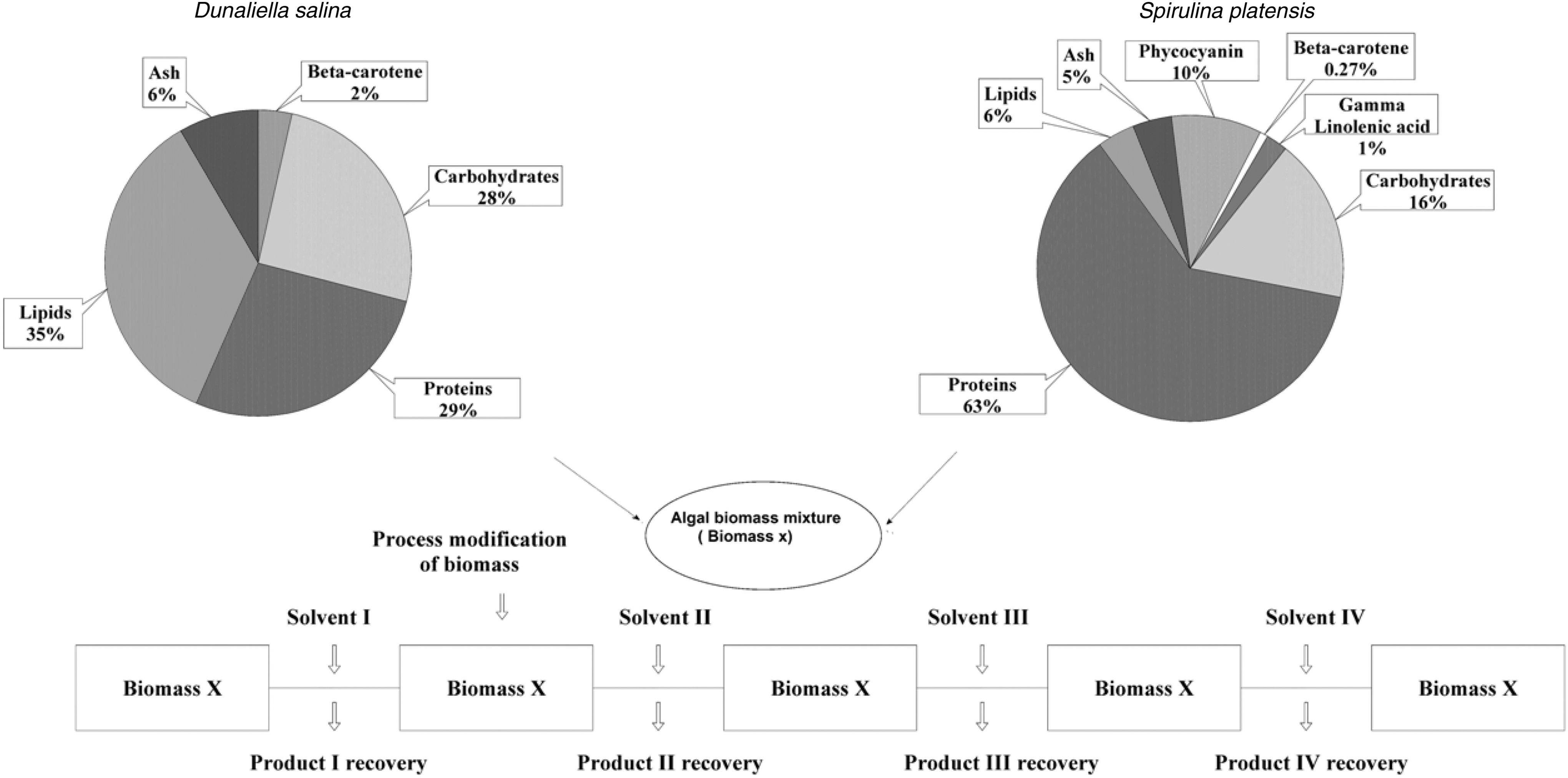
Sequential separation of products from algal biomass mixture. In this example, the biomass X is shown to comprise Spirulina and Dunaliella. This process can be adopted for either single biomass or for a mixture of algal species. The mixed biomass is sequentially fractionated for multiple products in a bio-refining process.
Table 6 depicts a comparison of two case studies for the recovery of multiple products from a single species (Spirulina) and from the biomass mixture (Dunaliella Sp. and Spirulina Sp.). A subsequent experiment with Spirulina biomass shows that phycocyanin recovery and purification under operating conditions (1% w/v activated charcoal; 0.25MCaCl2.2H2O; biomass to solvent: 1%w/v), resulted in 74.8% recovery. The purity index was 1.64, retaining food grade purity. In the cascading step, the pigment depleted, dried, and sieved biomass with solvent digestion using n-hexane:Pet-ether (30:70) showed 57.28% beta-carotene recovery and 70.2% purity. In a supplementary unit operation, the carotene-rich solvent, which was subjected to aqueous two-phase separation, (PEG:Hexane-petroleum-ether [70:30] 4:1) resulted in 93% pure beta-carotene.
Process Development for Sequential Separation of C-PC, Beta-Carotene, and GLA from Single and Mixture of Species
The C-PC that is recovered from biomass; bpurity index is the ratio of absorbance at 620 nm and 280nm; crelative recovery estimated based on the total concentration of pigment available in the biomass (4% w/w); dconcentration estimated based on the area under the peak with HPLC; ebeta-carotene recovery percent is based on total available carotene: Spirulina (0.27% w/w), Dunaliella sp (2% w/w); finitial purity is defined by percent area of beta-carotene peak at defined retention time in the chromatogram; gaqueous two phase separation (ATPS); hC-PC and beta-carotene depleted biomass was digested in acetone to extract glycolipids having GLA at higher purity; iGLA purity is defined by percent dry weight estimated based on area under the GLA peak in the gas chromatogram; j GLA purity is defined by percent area under the chromatogram peak; krecovery was estimated from GLA peak area before and after purification; l S.platensis from Parry's Nutraceuticals; m D. salina, SAG, Germany.
In the final step, the carotene depleted dried biomass was directly subjected to a 100% acetone digestion. Results showed 70.26% GLA recovery with 31.77% purity (GLA/LA index: 3.0). In a supplementary purification, the urea fractionation of the fatty acid mixture resulted in 85% purity. A similar approach for a biomass mixture (1:1 Spirulina and Dunaliella) shows phycocyanin with a purity index of 1.34. The recovery was 75%. Beta-carotene recovery was 64.9% with 91.2% purity. The final biomass mixture had a GLA recovery of 68% with 81% purity. For both cases, after GLA recovery, the triglycerides (neutral lipids) were found to be intact with the biomass. This indicates that triglyceride-rich biomass creates an option for its application in the synthesis of biofuels.
The schematic sketch of a process (Fig. 2) in a typical algal biorefinery highlights the need for the instrumentation and control of processes. In product recovery operations, a network of multiple closed solvent digestion vessels equipped with temperature and pressure controlling devices is shown interconnected down the line, and the recovery of crude products and purification is accomplished in a parallel process. At each stage, the product depleted biomass is channeled to a separation tank, where the moisture control and the reconstitution of the biomass surface area are accomplished with hot air blowers and mixers, respectively.
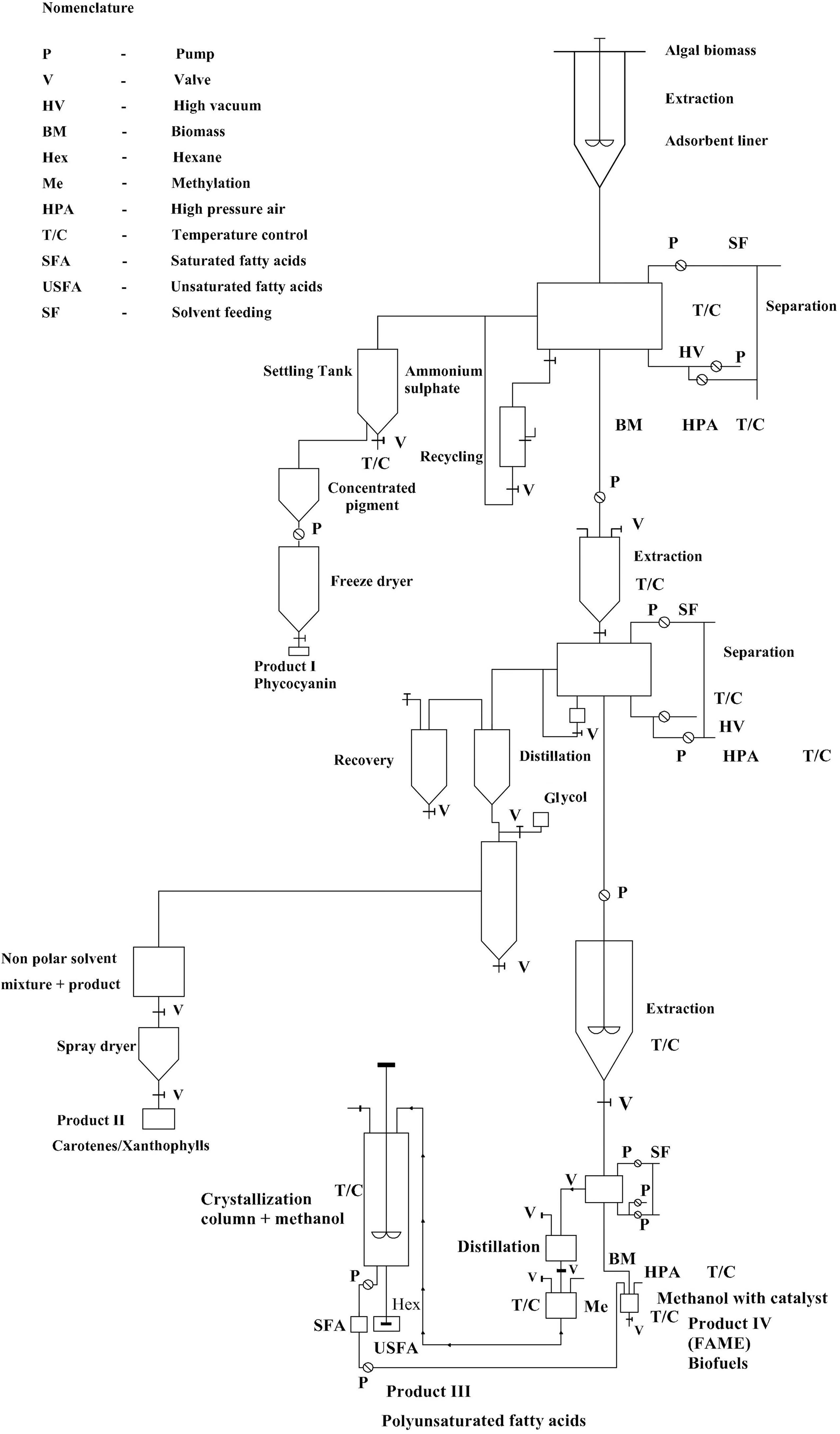
Schematic sketch of a proposed biorefinery design for production of nutraceuticals and biofuels.
In the product purification process, unit operations for heat transfer are accomplished with spray drying and freeze drying while a crystallizer helps with the purification of fatty acid methyl esters. The design is essentially an integrated biorefinery for the production of nutraceuticals and biofuels. Figure 3 shows a material balance flow sheet for a prospective biorefinery that has adopted sequential fractionation processes. The biomasses used in the example are fortified with the introduction of two algal species: S. platensis and D. salina. The volume of key organic solvents introduced into the system is conserved with a little evaporation loss, which can be effectively re-used upon condensation in a typical batch process.
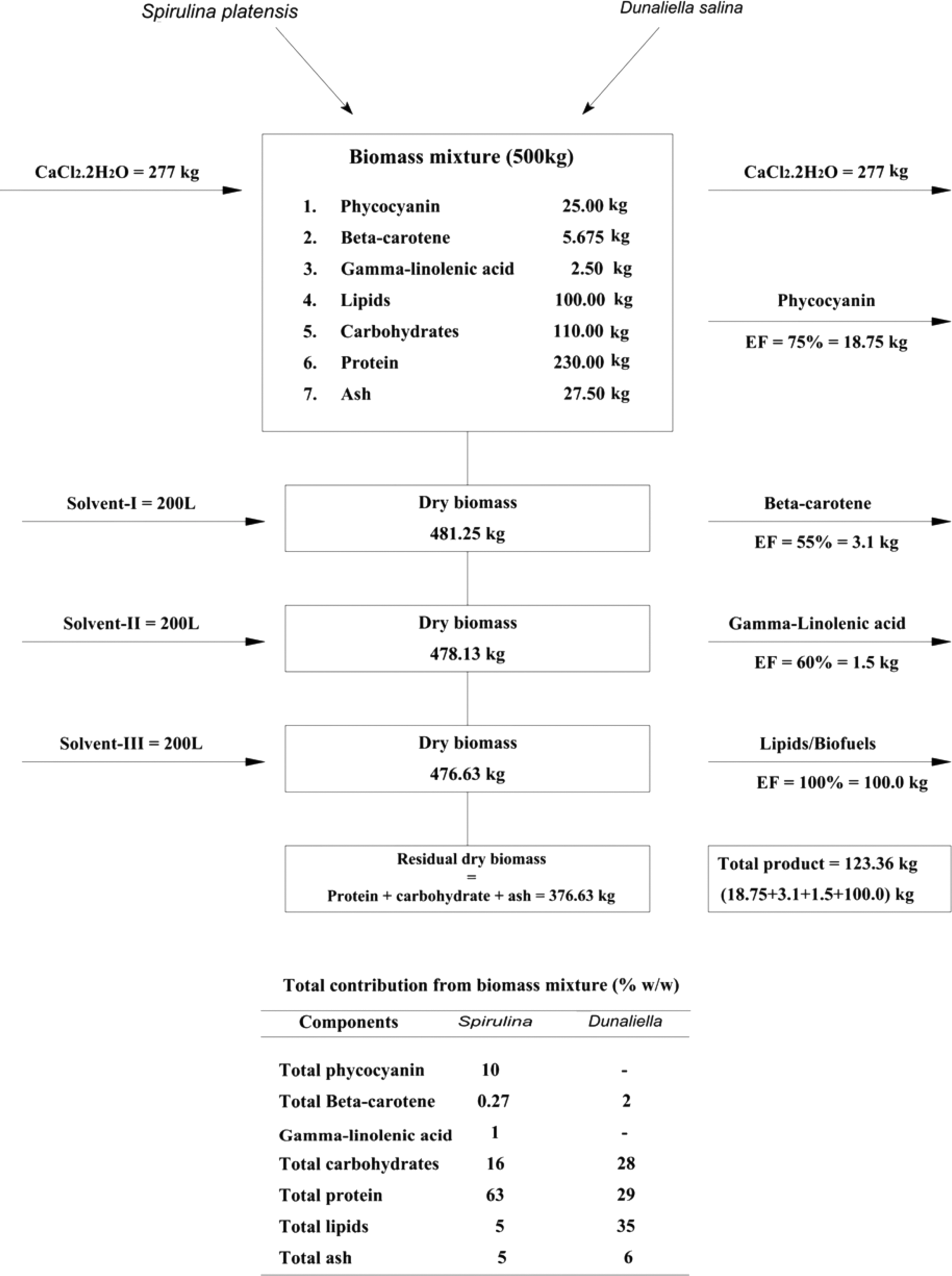
Mass balance showing total mass flows entering the process and total mass leaving the process. This illustration shows equal ratios of biomass mixed in the refinery. A similar mass balance can be performed for a single species or multiple species. Product recovery efficiency (EF) was 100% for lipids, 75% for phycocyanin, 60% for GLA, and 55% for beta-carotene.
Conclusion
The design and development of sequential separation processes for biorefinery are needed before any economic analysis can be undertaken to analyze the merit of a multiproduct approach. The recovery of a spectrum of products suggests that a 1% activated charcoal-water system, Hexane-Pet-ether (30:70), and 100% acetone are highly promising for the recovery of phycocyanins (C-PC), carotenes (beta-carotene), and essential fatty acids (GLA), respectively. Supplementary unit operations optimized with activated charcoal, polyethylene glycol, and urea fractionation resulted in purities of >90%.
The processes used and optimized for the recovery and purification of these products are more economical and choice-based unit operations than other processes. The current work exploits the protein binding capacity of the activated charcoal for simultaneous recovery and purification of phycocyanin. This work shows the effective use of glycol and chitosan mixture in the ATPS purification process. Likewise, the fatty acid solvent recovery using alcohol (MetOH) has been replaced by amphipolar solvent (acetone) for the selective recovery of glycolipid fractions comprising a large proportion of GLA. In addition, this work establishes indicator parameters for the viability of a purification process in industrial applications for fatty acid and carotene production. A high GLA/LA index for fatty acid purification and the initial purity of carotene used during solvent recovery are two indicators that suggest a successful batch purification process. Thus, the final biomass depleted by pigments and fatty acids may be further used for the preparation of optional byproducts, such as the biofuels.
In conclusion, biorefining multiple algal biomass mixtures could be the only option to meet the shortage of raw materials. Biomass fortification would highly benefit sequential processes in the compromised situations under the scarcity of biomass resources. Future studies should focus on the feeding strategy of biomass mixture, cross-contamination of desired products, particle size and storage conditions for a successful biorefinery application.
Footnotes
Acknowledgments
This study was supported by the Department of Science and Technology, Government of India under the SERC (SR/FT/LS-009).
Author Disclosure Statement
No competing financial interests exist.
References
Supplementary Material
Please find the following supplemental material available below.
For Open Access articles published under a Creative Commons License, all supplemental material carries the same license as the article it is associated with.
For non-Open Access articles published, all supplemental material carries a non-exclusive license, and permission requests for re-use of supplemental material or any part of supplemental material shall be sent directly to the copyright owner as specified in the copyright notice associated with the article.
