




Abstract
In this study, solid-state fermentation was optimized for the production of chitinases by fungus Metarhizium anisopliae using sugarcane bagasse as substrate. A Central Composite Rotatable Design (CCRD) was used to determine the effect of temperature, moisture, and chitin mass in chitinase production. The highest value for the total chitinolytic activity was obtained at 33°C, chitin mass 0.75 g, and moisture content 60%.
Introduction
Fungi are recognized for their ability to secrete several enzymes. Fungal chitinolytic enzymes have important biotechnological applications in agriculture to control pests. Chitin, an insoluble homopolymer of N-acetylglucosamine (GlcNAC) with high molecular weight, is a major component of insect cuticle. Enzymes that can fully degrade chitin into N-acetylglucosamine monomers are divided into N-acetylglucosaminidases (EC3.2.1.52, Glycoside hydrolase (GH) family 20) and chitinases (EC3.2.1.14, GH family 18 and 19). 1
Chitinases can be used in the management of agricultural pests and in a variety of applications, such as medicine, biochemical bioprocessing engineering, and waste management. 2 Moreover, chitinases used as bioinsecticide show low toxicity to vertebrates, as they do not have chitin as a structural component. 3
One limiting factor for the use of chitinases in agriculture is the lack of large-scale commercial production; therefore, more studies on this subject are needed. 4 The production of large-scale chitinases is widely dependent on key factors, such as cost production, self-life stability, and improvement in enzyme properties by immobilization. 5 Solid-state fermentation has been used to increase chitinase production, due to several advantages over conventional submerged fermentation. 6 Different types of solid substrates, such as agricultural residues, have been reported for chitinase production. 7 There is high production of sugarcane bagasse in Brazil; in 2015–2016 growing season, roughly 166.4 million tons of sugarcane bagasse were generated. 8 Sugarcane bagasse as substrate to produce chitinase fungi represents an environmentally favorable use, since it is a waste and can cause negative environmental impacts when improperly disposed. 9
Metarhizium anisopliae is a well-characterized filamentous fungus used in the biological control of agricultural and livestock pests and disease vectors. 10 In addition, enzymes from Metarhizium sp. are frequently used as industrial catalysts. 11 Optimization of culture media is very important to maximize enzyme production and minimize production costs. Therefore, this study aimed to determine optimal conditions for maximum chitinase production by M. anisopliae in solid-state fermentation systems using sugarcane bagasse as substrate.
Material and Methods
Microorganism
M. anisopliae strain E6, originally isolated from Deois flavopicta (Hemiptera: Cercopidae) in Espírito Santo State, Brazil, was previously assessed as highly virulent strain against Rhipicephalus (Boophilus) microplus. 12 M. anisopliae has been used for pest control in agriculture in several countries for many years and cases of infection in humans has been caused by other species of the genus Metarhizium and wrongly associated to M. anisopliae. 13
Solid Substrate
Sugarcane bagasse was obtained from a micro distillery of bioethanol production. In the laboratory, the residue was dried at 60°C for 24 h, grounded in a cutting mill, and sieved with final particle size 8 mm mesh. Sugarcane bagasse is a safe byproduct and already used as a fiber source of in human food. 14
Preparation of Colloidal Chitin
Colloidal chitin was prepared. 15 First, 4 g of practical grade chitin (Sigma, Aldrich, St. Louis, MO) was suspended in 40 mL (v/w) of 37% (v/v) HCl and mixed for 50 min. Next, 1 L of ice-cold water was added dropwise. After centrifugation, the pellet was collected and washed in distilled water until the pH of the washing water reached 5.0.
Production of Chitinolytic Enzymes and Assays
Solid-state fermentations were carried out in conical flasks (200 mL) containing 5 g of sugarcane bagasse. The moisture content was adjusted at specified level in the solid substrate, as described below. Each flask was covered with hydrophobic cotton and autoclaved at 121°C for 20 min. After cooling, each flask was inoculated with 1-mycelium discs (3-mm diameter) and incubated for 96 h.
Based on preliminary tests and the literature, a central composite rotational design (CCRD) for three independent variables was conceived to investigate the influence of temperature of incubation, moisture content, and chitin mass on production of chitinolytic enzymes by M. anisopliae. The 3D response surface plot described by the regression model was drawn to illustrate the effects of the most important independent variables, and their combined effect, upon the response variable. 16 The range of variables investigated was: 28, 30, 33, 36, and 38°C; 43, 50, 60, 70, and 77% sugarcane bagasse moisture content; and 0.3, 0.5, 0.75, 1.0, and 1.2 g of chitin mass.
Extraction of Chitinolytic Enzymes and Assays
At the end of fermentation, chitinolytic enzymes were extracted using 100 mL of distilled water in an orbital shaker at 120 rpm and 28°C during 1 h. Afterwards, 30 mL of the enzyme extract was removed to determine enzymatic activities.
Chitinolytic activity was measured using 1 mL of diluted enzymatic extract in 2 mL of a 3.5% (m/v) colloidal chitin in a 50 mM phosphate buffer (pH 5.2), and the reaction was carried out at 37°C during 60 min. For all measurements of enzymatic activity, a standard without substrate was carried out to subtract the initial amount of reducing sugars (RS). Reducing sugars were measured by the spectrophotometric DNS method, using N-acetylglucosamine (GlcNAC) as standard for chitinolytic activity. In all cases, absorbance of samples was measured at 540 nm. 17 One unit of enzymatic activity was defined as the amount of enzyme that forms 1 μmol of N-acetylglucosamine per min under assay conditions (U/g).
Statistical Analysis
All the results were analyzed using the software Statistica® 7.0 (Statsoft Inc., Tulsa, OK), considering a significance level of 90%.
Results and Discussion
Table 1 presents the results in terms of chitinolytic activities obtained in 17 runs of CCRD. The mean chitinolytic activity obtained in 17 runs of CCRD was 5.02 U/g. The highest chitinolytic activity (6.78 U/g) was obtained in experiment 15, at 33°C, chitin mass 0.75g, and moisture content 60%, all factors at level (0), followed by experiment 10 (6.40 U/g). The best results of chitinolytic activity were obtained in runs with temperature above 35°C, while chitin concentration at lower levels. 18
Independent and Dependent Variables in CCRD Related with Chitinolytic Activity of Metarhizium anisopliae in Solid-State Fermentation Systems Using Sugarcane Bagasse as Substrate
T, temperature; M, moisture content; C, chitin mass; CA, chitinolytic activity.
The activities obtained here are in agreement with other studies reported in literature. The activity of M. anisopliae was studied in terms of chitinolytic activity, ranging from 0.5–1.5 U/g for different strains with an incubation time of 4 d and 48% moisture. 19 This result is about six times lower than that obtained in our study under similar conditions. Furthermore, chitinase production by M. anisopliae under optimized conditions was two times higher than that observed for the production by Trichoderma harzianum (3.14 U/g of substrate) under solid-state fermentation (SSF) using a mixture of colloidal chitin and wheat bran as substrate, after 96 h of incubation at 30°C. 20
The best substrate for maximum chitinase production (4.82 mg/g protein) by chitinolytic fungi Aspergillus terru isolated from different soil samples was shrimp-shell powder (2%). 21 Chitinase production was also studied in Bacillus pumilus MCB-7 and optimization of pH, chitin, and peptone concentration resulted in a 6.9-fold increase in enzyme activity (23 U/mL). 22 In another study, Penicillium ochrochloron MTCC 517 showed higher chitinase activity using wheat bran as a substrate. 2
In SSF, optimum moisture content for growth and substrate use was found to vary between 40 and 70%, depending on the organism and substrate for cultivation. 23 The use of shrimp shells was studied for chitinase production in solid state. The isolated from Bacillus thuringiensis R176 presented the greatest production and the optimal condition contained shrimp shells mixed with rice straw (1:1), ground chitin (0.5% w/w), and ammonium sulphate (0.5% m/m). 24
The influence of the independent variables of growth time and medium humidity on chitinase production by four strains of M. anisopliae was analyzed. 19 Both variables showed a positive effect on the production of extracellular chitinase for all strains, providing an increase in the enzymatic levels. The Pareto chart for enzyme production shows that the linear variable growth time has a positive effect on enzyme production; nevertheless, very long periods have a negative effect. The linear variable moisture shows that the addition of tap water is favorable for chitinase production; however, too much water reduces the efficiency of production.
Studies have obtained important results for chitinase use in pest control. A purified chitinase of Pseudomonas fluorescens MP-13 showed insecticide activity against Helopeltis spp., with 100% of mortality in vitro. 25 Chitinase enzymes from Trichoderma viride were used for the control of Bombyx mori under in vitro conditions. There were changes in the structure and permeability of the peritrophic matrix, reducing the development of larvae and pupae mass, even causing insect death. 26
Table 1 data was used to determine the effects of the variables studied on chitinolytic activity using sugarcane bagasse as substrate. Figure 1 presents the effects, in the Pareto chart, of the chitinase production variables studied. Quadratic effects for moisture content and chitin concentration, interaction effect between temperature and chitin concentration, and interaction between moisture content and chitin concentration were statistically significant, all positives, with 89% of significance (p < 0.11). The negative signs of quadratic terms for chitin and moisture content indicate the presence of a maximum point within the range studied. This explains the fact that linear terms for these variables were not significant because the increase from level −1 to +1 of the CCRD did not lead to an increase in enzyme production. The chitinolytic activity of Penicillium ochrocloron increased with higher chitin concentration; however, after the optimum level, it decreased possibly because end products repress chitinase activity. 27
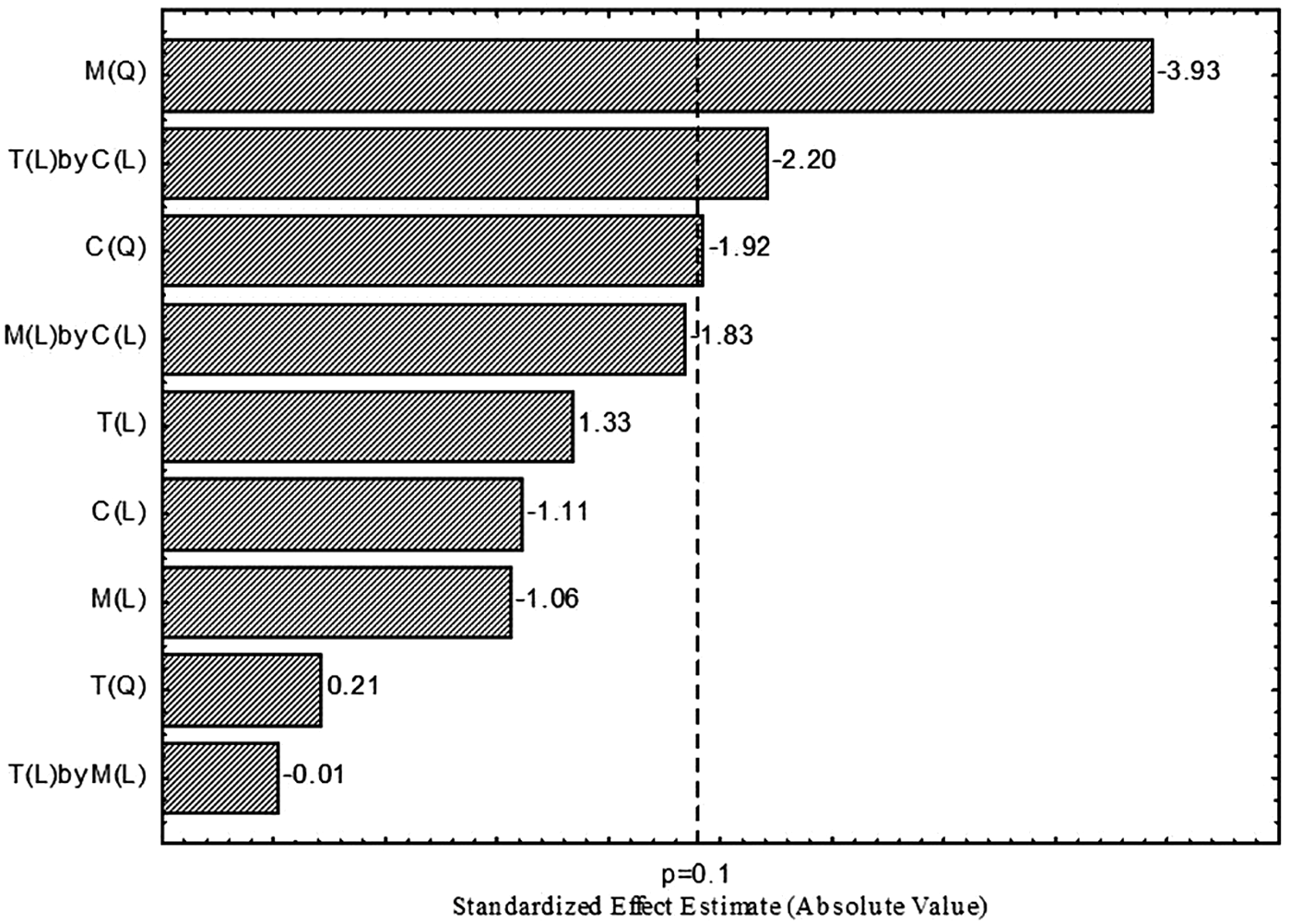
Pareto chart expressing the effects of variables on chitinolytic activity of Metharizium anisopliae under CCRD. C, chitin mass; T, temperature incubation; M, moisture content; L, linear effect; Q, quadratic effect.
However, determination of this maximum (optimum) point (or range) is possible only after a graphical interpretation of the results. Thus, Table 1 data was used to estimate parameters of the quadratic model in Equation 1, considering only the significant terms (p < 0.11):
where CA is the chitinolytic activity (U/g) and C, T and M are the coded chitin concentration, temperature, and moisture content, respectively. This model was validated by the analysis of variance (ANOVA), presenting a calculated F-test 1.3 times higher than Table 1 and a determination coefficient (r2) of 0.8171. This enables the use of the model to predict the activities within the range studied.
Figure 2 presents the influence of independent variables on the production of chitinase by solid-state fermentation. Figure 2a refers to influence of temperature and chitin concentration, showing that optimum activity can be achieved in two distinct regions, one at high temperature and low chitin concentration and another at high chitin concentration and low temperature. Regarding the effects of moisture and chitin (Fig. 2b), the best results were obtained at the central point for both variables. In contour plots for moisture and temperature (Fig. 2c), high chitinase activity was obtained at the central point for moisture and higher values of temperature.
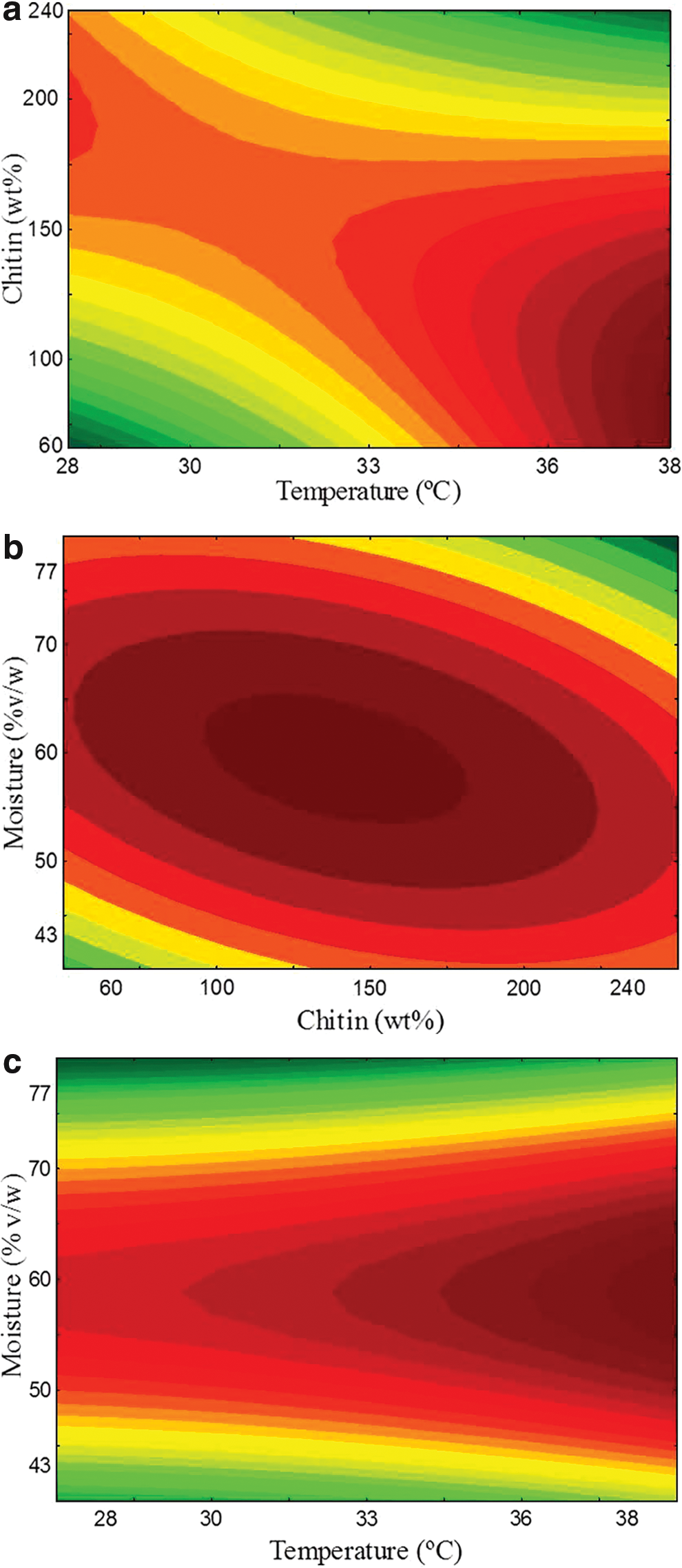
Contour plots for optimization of chitinolytic enzyme production by Metharizium anisopliae using sugarcane bagasse as substrate;
The results obtained in this work show that the highest value for total chitinolytic activity reached 6.78 U/g. This result was obtained at 33°C, chitin mass 0.75 g, and moisture content 60. The fungus M. anisopliae showed promising chitinolytic activity for future studies on biopesticide production.
Footnotes
Acknowledgments
The authors thank the National Council of Technological and Scientific Development (CNPq) and Coordination for the Improvement of Higher Education Personnel (CAPES) for providing scholarships and financial support of this work.
Author Disclosure Statement
No competing financial interests exist.