




Abstract

Stora Enso's (Helsinki, Finland) biomaterials philosophy—that everything that's made out of fossil-based materials today can be made from a tree tomorrow—underpins its Biomaterials division's ambition to transform from a pure pulp producer to an integrated biochemical company. Currently, the company's products include consumer board, packaging solutions, biomaterials, wood products, and paper. Biomaterials, however, “is the heart of the company transformation,” says Andreas Birmoser, senior vice president business development at Stora Enso's biomaterials division. “We aim to differentiate our pulp business and create new platforms for growth.”
Transformation is already rooted in the company's history. Before merging with Finnish forestry products company Enso Oyj in 1998, Stora was the world's oldest limited liability company in the world (its first share dates back to 1288). Originally a copper mining company, Stora diversified into pulp and paper production in the late 1800s. In the 1970s divested most of its mining and steel mill operations. The transformation currently underway will shift the company from a traditional pulp and paper company into a renewables growth company. Today, Stora Enso employs 25,000 people and is active in 35 countries. It reported sales of €9.8 billion (USD10.9 billion) in 2016 and is listed on the Nasdaq in both Helsinki and Stockholm.
Biomaterials sales have grown to 14% of the company's total revenue in four years' time. Paper—a maturing end market—has shrunk from 70% of total revenue in 2006 to 31% in the fourth quarter of 2016. “67% of our sales last year were in growth divisions: biomaterials, consumer board, renewable packaging, and wood products,” Birmoser says. “This is quite different from 10–11 years ago, when paper was 70% of our revenues. Paper is declining, but we believe this will taper off. There will always be a need for paper.”
But, Birmoser says, the world is changing and Stora Enso needs to change as well. Growing populations and global trends toward health and sustainability are driving interest in biomaterials. “There is a need for renewable materials,” he says. “We are already exploiting natural resources to their limits. We believe that anything produced today from fossil fuel-based materials can one day be made from a tree. Of course, there are challenges to make that technologically and economically feasible. But that is what we are working toward.” Much of this work is done at Stora Ensos' new Innovation Centre for Biomaterials in Stockholm.
Stora Enso's Biomaterials division, in addition to standard-grade pulp for paper and board, provides fluff for hygiene applications; dissolving pulp for the textile industry; and tall oil and turpentine for manufacturers of chemicals and fuels. The company also aims to develop new ways to maximize the extractable value from wood and other kinds of non-food-competing biomasses. Sugars and lignin hold potential for applications in specialty chemical, construction, personal care, and food industries, Birmoser says.
Stora Enso's feedstock—pine, birch, and spruce trees, mostly, and eucalyptus in Latin America—can be broken down into lignin (20–30%), hemicellulose (25–35%) and cellulose (35–45%). “Our roots are in the forest,” Birmoser says. “100% of our wood is traceable to its forest of origin,” Birmoser says. Most comes from Finland and Sweden, and for every tree collected, 2–3 new trees are planted, he adds. The use of resources and management of waste and byproducts are an important part of the company's sustainability efforts globally and locally, says Henrik Holm Mill Director at Stora Enso Skutskär Pulp Mill.
While most pulp makers burn the lignin and hemicellulose for energy, Stora Enso aims to instead build an integrated biorefinery where these materials are converted into polymers, chemicals, coatings, adhesives, textiles, and food ingredients (Fig. 1). The company is optimizing extraction and separation technologies that generate purified platforms of lignin, hemicellulose, and cellulose that will allow it to harvest much more value out of the tree. “Today we use less than 50% of the fractions in wood for pulp and the rest is burned for energy,” Birmoser says. “There is wide business potential in the other half.”

Wood chips at Stora Enso's Skutskär pulp mill.
The company has created four innovation clusters to turn its vision into reality. The first, pulp applications, focuses on developing its pulp offering for niche markets where the company can gain more value. The second, cellulose modifications and pulp process byproducts, aims to take cellulose and use it in the production of non-wovens, rheology modifiers, and additives. Also, lignin extraction is already enabling applications—for example, in phenol replacement for adhesives and carbon fiber. Typical byproducts also include crude tall oil and turpentine. Stora Enso's third innovation cluster is focused on optimizing its extraction technology. “A lot of companies are focusing on extraction, but you don't yet see anyone that is really going at an industrial scale in a biorefining concept, which is what we are aiming at,” Birmoser says. “This requires a lot of research and a lot of effort.” The fourth cluster focuses on transforming extracted sugars into chemical intermediates that can be used in many applications. “We have the hemicellulose, which are the C5 sugars, and the cellulose, which are the C6 sugars. In this cluster we are looking at how we can transform these sugars into value-added products,” Birmoser says.
Stora Enso's biomaterials transformation began in 2012, when it set up a biomaterials division. In 2014, it acquired Virdia's technology and R&D center at Danville, Virginia. Virdia's CASE technology—cellulosic biomass to fermentable sugars using acid hydrolysis—enabled Stora Enso to explore the full potential of biomass extraction and separation technology to enable a portfolio of products from hemicellulose, cellulose, and lignin.
In 2014, Stora Enso also announced a demonstration plant at Raceland, Louisiana to test Virdia's technology at larger scale. Slated to come online later this year, the Raceland plant will extract hemicellulose from sugarcane bagasse to produce 7,000 metric tons per year of xylose for use in xylitol manufacturing. Xylitol, a low-intensity sweetener used in chewing gum and toothpaste, is an attractive end market growing 4–6%/year, Birmoser says. Xylitol producers include Roquette (Nord-Pas-de-Calais, France), DuPont (Wilmington, DE), and Futase (Qingdao, China). Stora Enso's biomass-to-C5 sugar technology yields more liquid xylose than competitors, Birmoser says. Most xylitol is produced from corn, with DuPont the only other to use wood-based feedstock. “We are a frontrunner in produce xylose directly from non-food biomass,” Birmoser says.
In 2015, the company began extracting lignin at its Sunila mill at Kotka, Finland (Fig. 2) “We will replace 70% of the natural gas in that plant with lignin, reducing 27,000 tons of carbon annually,” Birmoser says. The lignin capacity of the Sunila mill is around 50,000 tons. Stora Enso's first application for that lignin has been replacing phenolic resins in wood adhesives. “Phenol is a toxic chemical,” Birmoser says. “It's difficult to handle, and difficult to store. We believe that lignin can be a much more attractive solution in wood adhesives.” Lignin, by comparison, is easy to store and easy to handle. Phenol prices are also volatile, being closely linked to oil prices. Birmoser says the lignin extracted at Sunila is is an industry-leading 95% pure. The Sunila mill employs over 150 people and has an annual capacity of 370,000 metric tons of softwood pulp and 45,000 metric tons of kraft lignin.
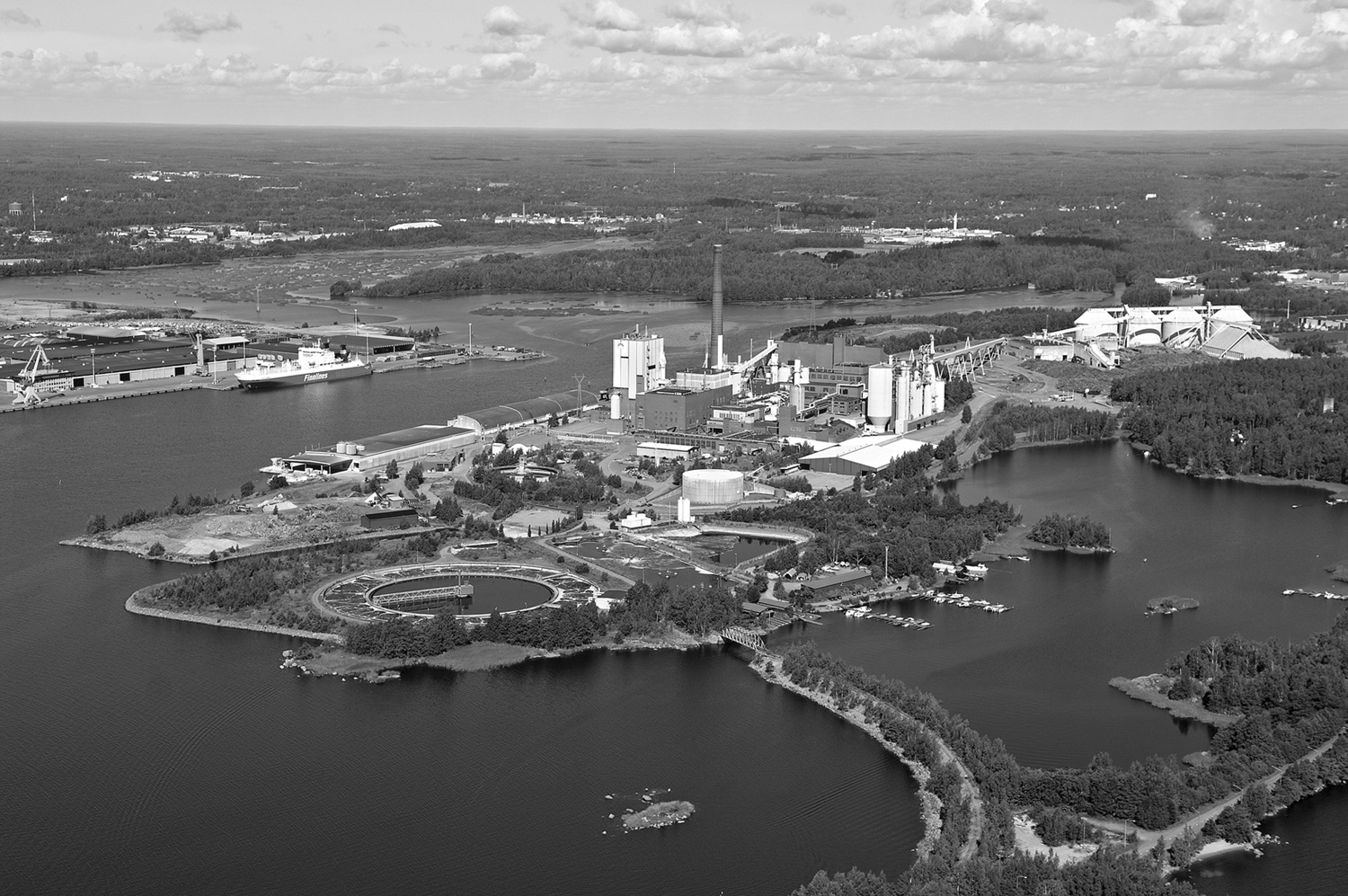
Stora Enso's Sunila kraft pulp mill at Kotka, Finland.
Stora Enso's Enocell mill Eastern Finland has an annual capacity of 460,000 metric tons and employs around 170 people (Fig. 3). The mill produces softwood pulp from pine and spruce and dissolving pulp from birch for textile applications. Stora Enso's biomaterials division is also involved in two joint ventures. Veracel, a joint venture with Fibria, operates a pulp mill and eucalyptus plantations in southern Bahia, Brazil and produces 1.1 million tons of pulp annually. Montes del Plata is a joint operation with Chilean pulp producer Arauco located in Uruguay. The mill produces 1.3 million metric tons of eucalyptus wood pulp every year.

Stora Enso's Enocell mill Eastern Finland.
Stora Enso's Skutskär pulp mill produces softwood and birch grades for printing and writing papers, specialty papers, graphic papers, packaging paperboards and tissue (Fig. 4). It also produces fluff grades for the company's Stora Enso Care brand, with end markets such as absorbing hygiene, sanitary and airlaid products such as baby diapers and incontinence pads (Fig. 5). The company is investing to increase fluff capacity at Skutskär by 157,000 metric tons/year. Starting in 2018, the mill will have an annual fluff capacity of 415,000 metric tons, making it the largest fluff pulp mill in Europe. The main use of the expanded production will be hygiene applications, which are growing 3.6% per year.

Debarking at Stora Enso's Skutskär pulp mill.

Fluff is used in end markets such as absorbing hygiene, sanitary and airlaid products such as baby diapers and incontinence pads.
The company is still developing the technologies it will ultimately deploy in its first biorefinery. A technology platform that could be plugged into an existing site would ultimately derisk the investment, Birmoser says. “We are assessing what role we want to play in each of these value chains,” Birmoser says. “In some of these, we might want to go further downstream. In some we might want to stop and instead find the right downstream partner.” The cellulose fraction—the C6 sugars—is a much more developed market, and where the company will likely just focus on extraction and purification, he adds.