




Abstract
Modern agricultural management is heavily dependent on the fertilizers for promotion of crop production, but the massive use of inorganic and chemical-based fertilizers currently available may be a serious threat to human health and environment. Fertilizer research is therefore focusing on shifting to the exploitation of microbes as a more ecofriendly approach for sustainable agriculture. The biotechnological toolbox contains microorganisms such as microalgae, cyanobacteria, endo- and ecto-mycorrhizal fungi, rhizobacteria, and others that are able to live in association with higher plants. This review article focuses on the research achievements on microalgae- and cyanobacteria-based plant biofertilizers and biostimulants in the agricultural applications. The challenges to commercializing these kinds of biofertilizers are also discussed.
Introduction
In general, biofertilizers are defined as the organic compounds from living microorganisms to promote the growth of seeds, plants, or soil bacterial consortia by essential nutrients such as nitrogen, phosphate, potassium and other mineral nutrients. 1 –3 They should be distinguished from the NPK fertilizers, which are based on Nitrogen (N), Phosphorous (P), and Potassium (K)—the three main nutrients necessary in high quantities for healthy growth of higher plants. Biofertilizers are classified by the microorganisms and the benefits achieved by their application: nitrogen-fixators; phosphates- and potassium-solubilizing biofertilizers; phosphorus-mobilizing biofertilizers; and biofertilizers for secondary macronutrients, zinc- and iron-solubilizers, plant-growth-promoting rhizobacteria (PGPR), and compost. 2,4
The remarkable features of biofertilizers include improved crop productivity per area in a relatively short time; reduced amounts of energy consumption and contamination of soil and water; increased soil fertility; and promoted antagonism and biological control of phyto-pathogenic organisms. 5 Biofertilizers will provide renewable and environmental friendly solutions for modern agriculture, especially in the form of integrated nutrient management (INM) and integrated plant nutrition system (IPNS), which may lead to sustainable economic development. 6,7 However, several challenges are associated with biofertilizers, such as the short period of shelf life (3–4 months) and the conditions required for storage (cool temperatures because of their temperature sensitivity). 8
Recent studies have indicated that different types of photosynthetic microorganisms such as cyanobacteria and microalgae (MA) can be used as biofertilizers and soil conditioners. 9,10 Microalgae are generally divided into Chlorophyta (green algae), Rhodophyta (red algae), Phaeophyta (brown algae), Euglenophyta, Pyrrophyta, Chrysophyta. Cyanobacteria are the only photosynthetic prokaryotes able to produce oxygen. 11 There are around 30,000 species of both unicellular microalgae and more complex multicellular organisms. 12 Among them, 150 genera and more than 2000 species of microalgae have been listed. 13 The applications of microalgae in various sectors are depicted in Fig. 1. In this review, except when specified, the term algae refers to both eukaryotic microalgae and prokaryotic cyanobacteria.
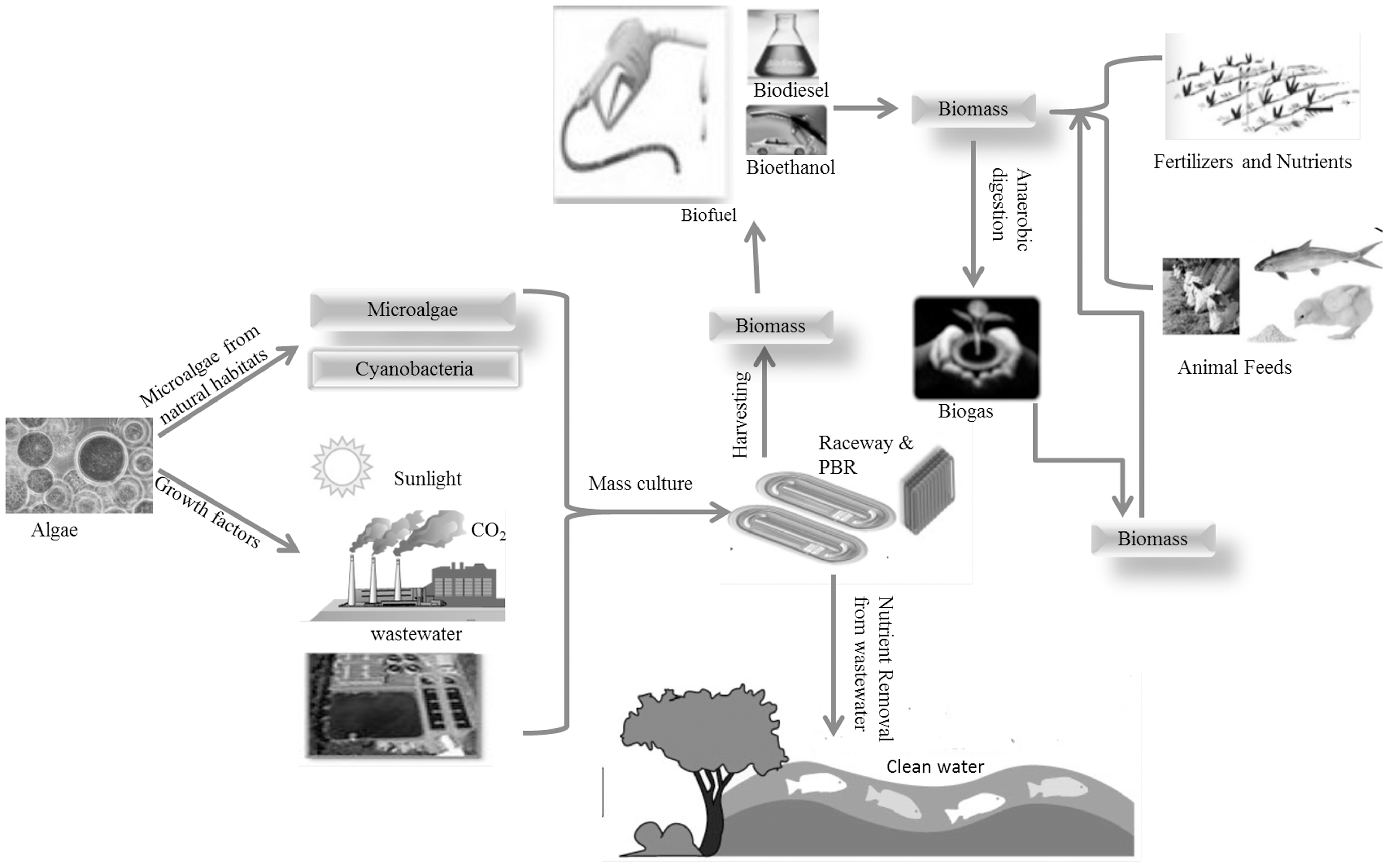
Overview for current technologies using microalgae.
Research on industrial applications of algae has been conducted since early 1950s, when productivity and yields were first studied in mass culture. 14 The main industrial benefits of algae are their ability to grow with minimum freshwater inputs and utilize lands that are otherwise agriculturally non-productive. Algae are widely considered to have major influence on essential ecosystem services since they can be cultivated in wastewater and agricultural runoff, recovering excess nutrients and reclaiming water for further use. They can also reduce greenhouse gas emissions by sequestering carbon dioxide and nitrous oxides from industrial sources. 15
Cyanobacteria are considered the simplest, living autotrophic plants. These organisms are capable of building up food materials from inorganic matter and are widely distributed in the aquatic environment. 16 Several unique features of cyanobacteria, such as water-holding capacity, short generation time, ability to fix atmospheric N2, and adaptation to extreme conditions, make them an effective biofertilizer source to improve soil physico-chemical properties. 16,17 Cyanobacteria can also secrete plant growth hormones as secondary metabolites, promote the transport of nutrients from soil to plants, cause agglomeration of soil, and improve the chemical properties of the soil. 18,19 Their diverse morphology and physiological properties enable wide distribution in the ecosystem and tolerance to environmental stresses. 20 This paper explores photoautotrophic microorganisms for functions that facilitate the development of biological fertilizers in the agricultural sector.
Algae-Based Biofertilizers
Algae biotechnology research in the field of biofertilizers has increased in recent years. The majority of the studies published from 2015 to 2017 used Chlorella sp. as the model system (Table 1). 21 –30 The most striking potential of algae is that they can survive even in the presence of highly concentrated organic and inorganic chemicals in varying waste streams which are toxic to living organisms. This is important in enabling more sustainable and efficient production in agriculture.
Formulation and Application of Some MA-Based Biofertilizers
Soil Fertility
Algal biomass formation from wastewater treatment can add value to land use as a biofertilizer, although not much information is available on how it may affect soil nutrient dynamics. Research focused on the indigenous species of Anabaena has showed the ability of this strain to promote soil fertility while decreasing soil density, 31 even in land with herbicide residuals and limited water supply. 32 Similarly, Marks et al. investigated the effects of unicellular green algae on the soil organic carbon using microalga Chlorella sp. grown in the liquid slurry. Their results indicated that photoautotrophic growth of Chlorella sp. was 3.5 times higher than that grown in dark and culture filtrates without algal cells, and soil respiration was significantly increased. 21
Another interesting research area is the study of algal and bacterial consortia in the biofertilizer application. In fact, it could not only be more efficient in detoxification of pollutants and removal of nutrients from wastewaters compared to the use of individual microorganisms, but such consortia could also allow maximum use of available N, P, and K in the soil. The pollutant abatement between algae and bacteria would lead to the success of consortium engineering. 29,33 –36 Furthermore, literature suggests that algae/bacteria consortia have great potential for soil amendment of marginal lands, helping to transform them into agricultural soil. 29,33 –36
Nitrogen Fixation
One reason to use cyanobacteria as biofertilizers is based on their nitrogen-fixing ability. Cyanobacteroa converts inorganic nitrogen (N2) from the air into organic nitrogen that can be easily utilized by higher plants. 13 Efforts to use cyanobacteria to promote rice growth have been made both in India and Chile. Local cyanobacterial strains in Chile have shown to increase nitrogen accumulation efficiency in rice paddles. 37 Vaishampayan et al. recommended that the Azolla-Anabaena (the free-living cyanobacteria Anabaena and the water fern Azolla) symbiotic N2-fixing complex be considered self-renewable natural nitrogen resources to reduce inorganic N requirements to the bare minimum. 34 The cyanobacterium Tolypothrix sp. was found to produce bioproducts in tropical regions by using low nitrogen-containing water sources. 38 According to a comparative study with N 15 -labelled fertilizer and indigenous cyanobacteria, N2 recovery by the soil–plant system from cyanobacteria was higher than that from chemical fertilizer. 39 This algal strain was highly capable of increasing the growth of rice plants due to its nitrogen-fixation ability. 24 In another work, following treatment with immobilized Chlorella pyrenoidosa, dairy waste water effluent used as a biofertilizer increased rice plants' root and shoot length by 30%. 24 In another work, the inoculants of Anabaena laxa and Anabaena–Rhizobium consortium were used to formulate biofilm in Chickpea cultivation. The A. laxa inoculation for the biofilm led to 50% higher grain yield (1,724 kg/ha) compared to the control (847 kg/ha). 40 In addition, microbial association (21 different microorganisms containing proteobacteria, bacteriodetes, chlorophyta, etc.) was shown to have a high capacity for N fixation (10,294 nmol ethylene/g dry weight/h), when used as a biofertilizer. 29 A more comprehensive description of cyanobacteria use in agriculture as nutrient supplements can be found in (Table 2), 7,19,35,37,41 –43 in particular for nitrogen fixation in the wet land rice cultivation.
Formulation and Application of Some Cyanobacterial-Based Biofertilizers
Production of Plant Growth Biostimulants
Some algal metabolites have been found to stimulate plant growth directly or indirectly by interacting with soil microbes for biomineralization or plant-microbe symbiosis, thereby increasing nutrient availability. 44 To verify this concept, Lupinus termis was grown with plant growth-stimulating substances from cyanobacteria and bacteria. The addition of the cyanobacterial filtrate combined with bacterial suspension significantly increased the average germination compared to seeds untreated or treated by hormones (IAA, GA3, and cytokinins). In particular, the germination rates with such treatments were 53.13%, 211.48%, 129.04%, and 104.18% higher in comparison to 1) untreated seeds, 2) seeds treated with IAA, 3) seeds treated by GA3, and 4) seeds treated by cytokinins, respectively. 45 Furthermore, algal species isolated from different rice cultivations in the Iranian region were examined for the production of phytohormones that affect plant growth. 46 Under optimal conditions, the cyanobacterium Nostoc could produce 8.66 μg/ml IAA, and sprouting was effectively promoted when the infiltrate was added to taro corn field. 37 In another work by Rodríguez et al., it was found that the extracellular products of Scytonema hofmanni have produced gibberellin-like plant growth regulators, which enabled the hormone homeostasis of rice seedlings under salt stress. 47 On the other hand, Saadatnia et al. isolated four species of Anabaena strains and tested them in the germination process of rice seeds. The results showed a significant higher germination rate compared to the control. 31 Similar outcomes were shown in the study of Zaydan et al. where the cyanobacteria and Azotobacter sp. consortium was established. 35
Biopesticidal Substances
Algae can be used as biocontrol agents with nematicidal effect, 48,49 where extracts and exudates of cyanobacteria have been reported to inhibit hatching and to cause immobility and mortality of juvenile plant parasitic nematodes in vitro. Antifungal and antibacterial activities 50 –52 were also studied where culture filtrate has hydrolytic activity againt phytopathogens. The most economically important funganal pathogen is Fusarium sp., and other fungal pathogens have also controlled under above studied. Studies on the biocidal effects of algae have revealed new possibilities to develop novel pest control methods. Future investigations are necessary to validate their spectrum and applications for commercial use.
Algal Toleration and Mutation
Tolerance to Extreme Environmental Conditions
Algae are able tolerate various types of environmental stresses. In regard to pesticide resistance, Ningthoujam et al. have found that Anabaena variabilis was able to tolerate 100 μg/mL malathion. 53 As an example of salinity tolerance ability, Jha et al. demonstrated that cyanobacteria could be negatively affected by Mn and sodium (Na, −30.19%). However, this negative relationship with Na enabled cyanobacteria to be used as an ameliorating agent for salt-affected soil. 54 In another study, the cyanobacterium Anabaena oryzae was found to release PO4 −3 enzymatically under salt stress conditions, suggesting that it could be used in high salinity and alkaline (calcium (Ca2+)-rich) soils. 55 Sinha and Häder discussed the photoprotective mechanism of cyanobacteria against UV-B, which may play a potential role in biofertilizers for the growth of agricultural crops. 56 The main practical problem of commercialized biofertilizer is related to adaptability of active microorganisms in the environment.
Mutation of Algae for Better Biofertilizers
Some studies have suggested possible solutions for the limitations of biotic and abiotic factors on algae and their performances. Therefore, it is appropriate to use novel approaches to produce cyanobacterial mutants in order to explore the potential of cyanobacteria. 57,58 Singh et al. demonstrated that A. variabilis mutant strains exposed to herbicides were able to resist the herbicide and increase rice growth under outdoor conditions in flooded soils. 59 In another work, the plasmid pRL489 was constructed by Ravindran et al. and introduced into Oscillatoria MKU 277 by electroporation to establish the gene transfer system in the cyanobacteria. 60 This work has improved the mutational techniques for the development of more powerful and viable biofertilizer strains. A chlorate-resistant mutant (Clo-R) of Nostoc ANTH for lack of nitrate was studied by Bhattacharya et al. It was observed that heterocyst formation and N2-fixation in the presence of nitrate was able to separate nitrate and nitrite transport systems of the mutant. This mutant is supplementary to chemical nitrate fertilizer as a biofertilizer without N2-fixation being adversely affected in rice field. 61 Similarly, a nitrogenase-derepressed mutant of Anabaena variabili has shown potential for developing biofertilizer for rice production, especially when the rice-production systems aim to minimize environmental pollution from inorganic N fertilizers. 62 In more recent study, cyanobacteria mutant induced by the UV-B has showed tolerance to Cu toxicity, provided that the nitrogen fixation ability was suppressed. 63 Singh et al. also improved the A.variabilis mutant grown in herbicide(s)-stressed agro-ecosystem. 64
Recent advances in synthetic biology can provide a better solution for handling these challenges and have created a new research area in algal biotechnology.
Large-Scale Algal Growth
Algal biomass for agricultural applications, in particularly obtained from waste streams, has become an economically attractive investment. Numerous research groups have integrated production of algal biomass with industrial wastewaters bioremediations. For example, Nisha et al. and Galhano et al. have studied the use of cyanobacteria for both soil fertility and crop protection against residual herbicides. Their potential for improving soil structural stability, nutrient availability and crop productivity has been further exploited under limited water regime which is fundamental for sustainable agricultural management. 32,65 According to the outcomes of the above studies, indigenous algal strains are more suitable for fertilizer applications.
As compared to photobioreactors, open raceways (especially with wastewater) are more effective for small capital investments and low power consumption in a large-scale production algal biomass. 66 The important role that algae may play on the elimination of contaminants in various environments is still underestimated. 67 Many studies have pointed out that economically feasible algal production is of critical importance. Algal biomass after harvest can be used as forage, biogas feedstock or biofertilizer. In several review articles, 68 it was shown that algal species were grown with satisfactory results on petrochemical effluent, sewage wastewater, 69 piggery wastewater, 70 municipal wastewater, 71 domestic wastewater, 72 industrial wastewater, 73 aquaculture wastewater, 42 and dairy effluent. 24 Barminski et al. have provided a media recipes for raceway cultivation of N-fixing cyanobacteria 74 by i) tank method, (ii) pit method, (iii) field method, and (iv) nursery cum algal production method. The former two methods are designed for small-scale and latter two are for bulk production on a commercial scale. 9
Formulation of Algal Biofertilizers
Algal biofertilizer formulation has been developed and tested for commercialization. Among them, Dubey et al. used clay-based inoculants for strain inoculation in soil for longer duration. The algae population in soil was about 10–70 times higher than that of the non-inoculated plots, even after four months. 75 Mishra et al. offered technology to farmers after getting a soil-based starter culture, which allowed them to produce the biofertilizer on their own with minimum additional inputs. 76 Tripathi et al., used a so-called fly-ash (FA) approach, in which the cyanobacteria and nitrogen fertilizer were mixed to improve growth rate and yield of rice plants. This approach reduced nitrogen fertilizers demand. 77 In the study where cyanobacterial-based fertilizers were employed with two carriers (wheat straw and multani mitti-clay), the experiments were compared with traditional soil-based cyanobacterial biofertilizer. It was observed that both the straw-based and soil-based biofertilizer treatments have showed high yields when supplemented with 90 and 120 kg N/ha, respectively. It was thus proven that cyanobacterial biofertilizers can be formulated to maximize crop productivity and reduce inputs of chemical fertilizers in rice cultivation. 78 Paddy straw compost:vermiculite (1:1) as carrier-based formulation was also studied by Prasanna et al. and Renuka et al., 40,79 who found that the adaptation rates of some cyanobacteria (Anabaena torulosa, Nostoc carneum, Nostoc piscinale, Anabaena doliolum) were higher in the rice field when vermi-compost was used as their carrier. 80
The shelf-life of cyanobacterial biofertilizer can be augmented by selecting translucent packing material, dry mixing, and using paddy straw as a carrier. Dry mixing with a mixing ratio of 50:50 (carrier:cyanobacteria) has given better performance in inoculum loading and shelf-life. 81 Hori et al. used phytoextracts of neem (Azadirachta indica), bel (Aegle marmelos), and tobacco (Nicotiana tabacum) in controling cyanobacterial disease during storage. They found that tobacco waste was superior to others in disease prevention. 81 Moreover, akinetes were suggested to be used as a biofertilizer after drying processes, as they could be stored for at least several weeks when in a dried state. 82 It was found that algal growth largely depends on temperature and pH. 13 Cyanobacterial preservation can be obtained either by air drying or drying wet Blue Green Algae (BGA) in oven at 35–40°C for 24 h in dark. This method is easy to be applied to ensure a high germination rate. 83
Foliar biofertilization by algae on willow monocultures was studied by Grzesik et al. 26 and shown to significantly increase productivity. In particular, studies have indicated that the foliar application of Acutodesmus dimorphus aqueous extracts and formulation of growth media have created a positive effect on seed germination and plant growth. It was observed that A. dimorphus cellular extract and dry biomass could be used both as a biostimulant and a biofertilizer to trigger faster germination and to enhance plant growth and floral production in Roma tomato plants. 25,84 Based on the above reports in the literature, we can conclude that the carrier-based formulation is more suitable for N2 fixing fertilizer and soil conditioning, while foliar-based formulation is more appropriate for germination-promoting effects.
Challenges and Measures for Commercialization
The commercial utilization of N2-fixing organisms in agriculture has encountered some difficulties. As Kumar illustrated, factors such as a suitable carrier for individual algal, soil, and climate factors and biotic and abiotic stress in the field are the main constraints for commercial use of algae as biofertilizer. 13 Cyanobacteria-based biofertilizers were widely used in paddy field cultivation due to their habitat and growth requirements. According to several studies, there are some limitations for cyanobacterial biofertilizers in areas possibly contaminated by pesticide residues, herbicides residues, and heavy metals (i.e., nickel and copper), or in land with high salinity. These factors can inhibit algal growth, cellular photosynthesis, and nitrogen-fixing activity. 85,86 He et al. reported the inhibition on growth, synthesis of pigments, and photosystem II (PSII) activity of the nitrogen-fixing cyanobacterium Nostoc sp. by stress caused by the addition of butachlor. 86 Debnath et al. studied the impacts of commonly used pesticide, fungicide, and insecticide on the growth and enzymes production of four cyanobacterial species—Nostoc ellipsosporum, Scytonema simplex, Tolypothrix tenuis, and Westiellopsis prolifica. It was observed that both the fungicides and insecticides at EC50 concentration would cause an inhibitory effect on the expression of nitrogenase and glutamine synthetase (GS) in all four cyanobacterial species studied. 87 These four cyanobacterial strains have been the favored models for deeper understanding of intracellular metabolic processes involved in the production of compounds of medicinal and commercial value. 57 Sharma et al. pointed out the need to adopt multidisciplinary approaches with a multiproduct process (biorefinery) strategy to harness the maximum benefit of cyanobacteria. 88
Conclusion
Algae-based biofertilizers have shown significant benefits in the development of green agriculture. Figure 2 illustrates future research areas for algae-based bifertilizers coupled with high energy generation. Beside N2 fixation, they are able to increase soil fertility and give the PGPR effect to the crops. Some algal fertilizers can be produced as metabolic byproducts during the wastewater treatment processes, making them renewable sources for sustainable agriculture. Carrier systems for maintaining BGA biomass for long periods of time are readily available from natural (soil, clay) and also renewable sources (paddy straw, multani mitti, etc.). Moreover, handing over the technology to farmers for their needs can create value and build up small-scale biofertilizer production within their individual circumstances. The development of organic farming without requiring a large land for production or even effectively exploiting marginal land are other other advantages of algal fertilizers. In summary, applications of algal biofertilizers will meet the needs of sustainable agriculture with three main objectives: a healthy environment, economic profitability, and a socio-economic equity.
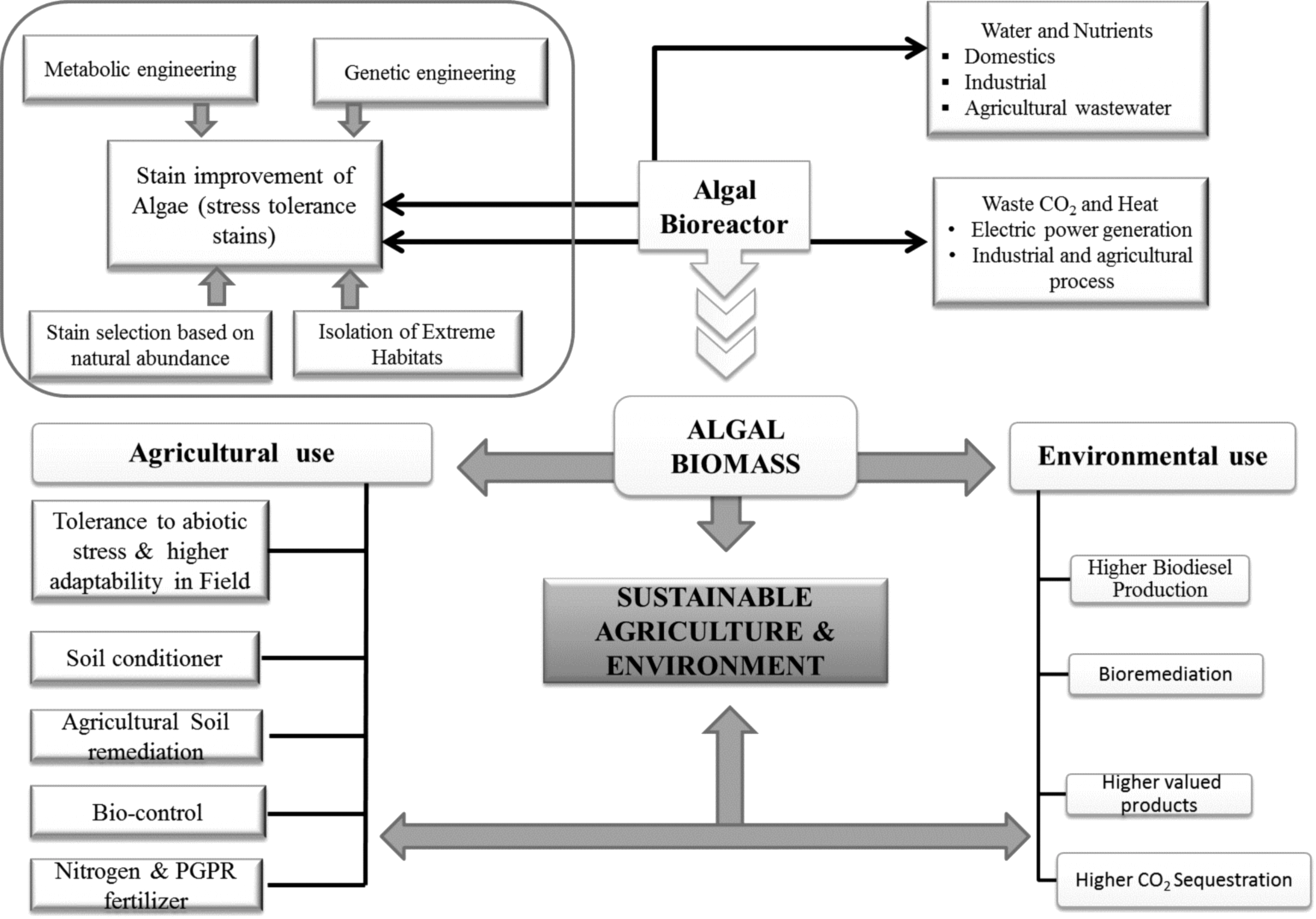
A vision for future development.
Footnotes
Author Disclosure Statement
No competing financial interests exist.