




Abstract
This work is a comparative study of the bioproduction of pectin methylesterase (PME) with medium composed of agro-industrial residues and synthetic medium using the filamentous fungus Aspergillus niger. After medium optimization, a kinetic evaluation was carried out, and the enzyme was characterized in terms of optimum pH and temperatures and stability at high and low temperatures. The maximum activity of PME in synthetic medium (42 g/L pectin, 1 g/L magnesium sulphate, and 10 g/L potassium phosphate) was 9.4 U/mL and in agro-industrial medium (120 g/L orange peel, 301.2 g/L corn steep liquor, and 600 g/L parboiled rice water) was 130 U/mL. These results were obtained in 56 and 124 h of bioproduction (180 rpm, 30°C, pHinitial 5.5, 5.106 spores/mL), respectively. Partial characterization of the crude extract of PME showed optimum pH and temperature of 11 and 55°C, respectively. Ed were 18 and 15 kJ/mol, with half-life times (t1/2) of 4,728 and 1,547 h for PME produced in synthetic and agro-industrial medium, respectively. Utilization of agro-industrial residues for enzymes production using submerged fermentation minimizes pollution and allows high added-value products to be obtained using economical technology.
Introduction
The development of research using agro-industrial residues for obtaining enzymes—products of high added value—will enable a lower cost of production. 1,2 Brazil is an agricultural country that produces millions of tons of fruits and vegetables annually, including mango, citrus, apple, and banana. The cell wall and middle lamella of these fruits are enriched with pectin ingredients. 3 Dried citrus peel contains a large amount of carbohydrates and proteins, but fact fat contents are low. The significant amount of pectin in citrus peel makes them a suitable substrate for microorganisms to produce pectinolytic enzymes. Microbial systems can enhance pectinolytic production using pectin as inducer. 4,5
During raw processing of agriculture material for food, a large amount of agro wastes are generated. The agro residues of coffee, orange, rice, and sugarcane provide a suitable platform for bioproduction of different enzymes using fermentation processes, thereby generating value from waste products. 6 –9 Orange bagasse contains large amounts of soluble carbohydrates—particularly fructose, glucose, sucrose, and pectin, as well as insoluble cellulose—and has been used as for fermentation products, including enzymes. 10 –12 The pectinolytic enzymes or pectinases are classified into pectin methylesterase, pectin lyase, and polygalacturonase on the basis of their mechanism of attack on pectin substances. 13 –16 Pectin methylesterase (E.C. 3.1.1.11) catalyzes the de-esterification of pectin by breaking the ester bond between the methyl group and carboxylic acid of galacturonic residues 17,18 and is found in bacteria, fungi and plants. Pectin methylesterase has the ability to clarify fruit juice together with polyaglacturonase 19,20 and increase the firmness of fruits and vegetables. 21,22 Various microorganisms are known to produce pectinase with different molecular mass and catalytic properties. 13,23 –29 Aspergillus niger is used most often for the industrial production of pectinase. 14,15,30
Submerged fermentation has advantages in scale-up, because it facilitates control of process parameters such as pH, temperature, and oxygen transfer. 19,20 Also, it is important to understand the catalytic properties of the enzyme 24,31,32 as well as their stability under different conditions (pH and temperature) to determine their application.
The objective of this comparative study is the bioproduction of the pectin methylesterase in submerged fermentation with medium composed of agro-industrial residues (orange peel, parboiled rice water, and corn steep liquor) and synthetic medium using the filamentous fungus Aspergillus niger ATCC 9642. After the medium was optimized, a kinetic evaluation was carried out, and the enzyme was characterized in terms of optimum pH and temperatures and stability at high and low temperatures.
Material and Methods
Micro-Organisms
Aspergillus niger ATCC 9642 was purchased in the lyophilized form, from FIOCRUZ (Manguinhos, Brazil), an international distributor of American Type of Culture Collection (ATCC). The propagation of this culture was done on Potato Dextrose Agar (PDA) and incubated at 30°C until sporulation (1 week). Harvesting of the spores from the slants was done using 5 mL of Tween 80–water (0.02%). The spore suspension was collected in sterile falcon tube and stored at 4°C until the study began. The concentration of the suspension was adjusted to 5.106 spores/mL. 14
Bioproduction of Pectin Methylesterase (PME)
Synthetic medium
A sequential strategy of experimental designs was carried out to evaluate the effects of the composition of the culture medium and fermentation conditions on enzyme production. First, a Plackett-Burman design (screening design) with 3 central points was performed (Table 1). The independent variables investigated were pectin (2.0–22.0 g/L), magnesium sulphate (0–1.0 g/L), potassium phosphate (0–4.0 g/L), iron sulphate II (0–0.02 g/L), L-asparagine (0–4.0 g/L), and yeast extract (0–20.0 g/L). Based on the results obtained in the Plackett-Burman design and factorial design, design (CCRD) 23 was carried out (Table 2). The independent variables investigated were pectin (22.0–42.0 g/L), magnesium sulphate (1.0–2.0 g/L), and potassium phosphate (4.0–8.0 g/L). Temperature (30°C), agitation (180 rpm), pHinitial (5.5), cell concentration (5.106 spores/mL), and time (72 h) were kept fixed based on the results obtained by Gomes et al. 14
Matrix of the Plackett-Burman (Real and Coded Values) Experimental Design with the Response in Activity of Pectin Methylesterase (PME) Production in Synthetic Medium
X1 = Pectin (g/L), X2 = L-asparagine (g/L), X3 = yeast extract (g/L), X4 = magnesium sulphate (g/L), X5 = potassium phosphate (g/L), X6 = iron sulphate II (g/L); independent variables fixed: 180 rpm, 30°C, 72 h, pHinitial 5.5 and 5.106 spores/mL.
Matrix of the Central Composite Rotatable Design (CCRD) 23 and Response as Pectin Methylesterase (PME) Production in Synthetic and Agro-Industrial Medium
X1 = Pectin (g/L), X4 = magnesium sulphate (g/L), X5 = potassium phosphate (g/L); bX6 = orange peel (g/L), X7 = corn steep liquor (g/L), X8 = parboiled rice water (g/L). Independent variables fixed: 180 rpm, 30°C, pHinitial 5.5 and 5.106 spores/mL.
Agro-industrial substrates
The agro-industrial substrates used were corn steep liquor (CSL) donated by Corn Products (Mogi Guaçu, Brazil), parboiled rice water (PRW) acquired from Industrial Nelson Wendt (Pelotas, Brazil), and orange peel (residue from juice production, moisture content 65%) acquired from a restaurant in Erechim. The agro-industrial waste remained frozen (-20°C) until time of use.
The effects of the composition of the culture medium for the bioproduction of PME was assessed by CCRD 23 (17 assays with 3 central points) (Table 2), and the independent variables investigated were orange peel (52.8–187.2 gL), CSL (1.2–301.2 g/L), and parboiled rice water (48–552 g/L). The variables temperature (30°C), agitation (180 rpm), pHinitial (5.5), cell concentration (5.106 spores/mL) and time 120 h were kept fixed based on the results obtained by Gomes et al. 14 The response or dependents variable studied was PME activity (U/mL).
After the production optimization step (synthetic and agro-industrial medium), the kinetics of substrate consumption (total nitrogen, potassium, magnesium, iron, total organic carbon [TOC], and pectin), pH evolution and PME production were followed by periodic sampling.
Partial Characterization
To determine the optimum values of temperature and pH in terms of enzyme activity, a central composite rotatable design (CCRD) 22 was carried out using the enzymatic extract from A. niger ATCC 9642. The studied range for pH was 5.0 to 11.0 and T1 for temperature 30 to 80°C (Table 3). The stability of the crude enzymatic extract was measure determining the enzyme activity periodically.
Matrix of the Central Composite Rotatable Design (CCRD) 22 with the Responses of PME Activity in Different pH and Temperature
42 g/Lpectin, 1.0 g/L magnesium sulphate, 10 g/L potassium phosphate, 5.106 spores/mL, 30°C, 72 h, pHInitial 5.5 and 180 rpm; b120 g/Lorange peel, 301.2 g/L corn steep liquor and 300.0 g/L parboiled rice water, 180 rpm, 30°C, 120 h, pHinitial 5.5 and 5.106 spores/mL.
The temperature stability of the enzymatic extract (maximum activity of PME with synthetic and agro-industrial medium) was determined using enzyme incubation at a fixed pH of 11.0 for both the synthetic and agro-industrial medium and different temperatures: −80, −10, 4, 25, 30, 35, 40, 55, 60, 80, and 100°C. The pH stability was determined by incubating the enzyme extract obtained at 55°C for the synthetic and agro-industrial medium respectively, at pH 5.0–11.0. The samples were retired at regular time intervals.
The activation energy was estimated from the slope of the graph containing the logarithm neperian (ln) values of the initial enzyme activity (Ao) in the assays against the reciprocal temperature in degrees Kelvin (°K). Using linear regressions between these values, the activation energy was calculated, establishing that the slope was proportional to the activation energy (-K = -Ea/R), where K is the slope of the straight line and R the gas constant. 33
Analytical Determination
Pectin methylesterase activity
For all determination of PME activity, the bioproduction medium was filtered to separate the biomass. The filtrate was denominated by crude enzymatic extract; the activity of the PME was determined following the methodology described by Hultin and Levine, 34 with some modifications. Initially, 1 mL of enzymatic extract was added to 30 mL of citric pectin (1% wt/v) and 1 mL of NaCl 0.2 mol/L. The pH of the solution was adjusted to 7.0 for 10 min using NaOH 0.01 mol/L at 25°C. One unit of PME was defined as the amount of enzyme able to catalyze the demethylation of pectin corresponding to the consumption of 1 μmol of NaOH/min/mL, under the assay conditions.
Total organic carbon and pectin
The total organic carbon (TOC) in the agro-industrial waste (corn steep liquor and parboiled rice water) and medium (synthetic and agro-industrial) was determined by oxidation using catalytic combustion at 680°C and infrared detection (Shimadzu model TOC-VCSH).
Determination of pectin in the orange peel and medium agro-industrial were based on the procedure proposed by Ruck. 35 Initially, 50 g of sample was boiled in 400 mL of water for 1 h while replacing water lost by evaporation. The volume of the sample was increased to 500 mL and filtered. 100 mL of aliquot was taken, and 10 mL NaOH and water added up to 800 mL while stirring constantly. It was then left to stand for 5 min. 25 mL of 1.0 mol/L CaCl2 solution was added while stirring and allowed to stand for 1 h. It was heated to boiling, allowed to boil for 1 min, filtered through filter paper that had been washed with hot water, oven-dried for 2 h at 100°C, and then cooled and weighed. The precipitate was washed with almost boiling water until chloride free. It was tested for white precipitate with AgNO3. The filter paper was dried overnight at 100°C, cooled and weighed.
Reducing sugars
The amount of reducing sugar in the agro-industrial medium was estimated by 3, 5 dinitrosalicylic acid method using glucose as standard. 36
Mineral compounds
Macro (Mg and Mn) and micronutrients (Fe and K) in the medium and agro-industrial waste were determined by flame atomic absorption spectrometry (FAAS; Varian Spectra AA-55) following the methodology described by Association of Official Analytical Chemists (AOAC). 37 Hollow cathode lamps of Mg and Fe were used as a radiation source. The elements were measured in optimized operational conditions by FAAS in flame of air/acetylene or nitrous oxide/acetylene. The readings for Mg, Mn, Fe, and K were performed by FAAS in absorption mode. To eliminate possible interferences determining Mg content, lanthanum oxide (1%, wt/v) was added to the samples and to the standard solutions. The determination of the minerals contents on the samples, calibration curves of standard solutions were used.
The nitrogen content in the medium and agro-industrial waste were determined by the Kjedahl method (VELP DK-20 e UDK-126D), following the methodology of AOAC. 37
pH
The pH in the medium (synthetic and agro-industrial) was monitored using a potentiometer (Digimed, DMPH-2), after calibration with standard solutions pH 4.0 and 7.0. 37
Statistical Analysis
Statistical analysis to estimate the effects of each variable was carried out using global error and relative standard deviation between the planned and experimental data. Other results were treated by variance analysis followed by Tukey's test. The statistical analysis was carried out using the software Statistica version 5.0 (StatSoft Inc.), considering a confidence level of 95% (p < 0.05).
Results and Discussion
Bioproduction of Pectin Methylesterase
The matrix and respective responses in terms of PME activity in synthetic medium in the first experimental design (Plackett–Burman) are presented in Table 1. The results verify that the maximum PME activity was 3.20 U/mL obtained in run 5 (22 g/L pectin, 4.0 g/L L-asparagine, 1.0 g/L magnesium sulphate, and 4.0 g/L potassium phosphate).
This can be better observed (Pareto chart of effects, data not shown) where the variables potassium phosphate and magnesium sulphate presented a positive significant effect (p < 0.05), demonstrating that the displacement of these variables to upper levels could lead to an increase of enzyme activity. The variables L-asparagine, yeast extract, and iron sulphate II presented a negative significant effect (p < 0.05). Considering that the lower level of these variables was zero (−1), these variables were removed from the culture medium in the sequential experimental design.
A 23 full experimental design was carried out to maximize enzyme production. Results are presented in Table 2. The maximum activity of PME (9.0 U/mL) was obtained in run 4 (42.0 g/L pectin, 1.0 g/L magnesium sulphate, and 8.0 g/L potassium phosphate) at 180 rpm, 30°C, 72 h, of bioproduction, pHinitial5.5, and 5.106 spores/mL.
Equation 1 presents the first order coded model as a function of variables studied. The model was validated by analysis of variance, with a correlation coefficient of 0.98. Fcalculated was 3.11 times higher than the tabled one. The non significant parameters were added to the lack of fit for the analysis of variance (ANOVA), allowing the construction of the contour curve presented in Fig. 1a. The maximum activity of PME (9.0 U/mL) occurs at concentrations about 1.0 g/L magnesium sulphate and 8 g/L potassium phosphate.

Contour curve for PME activity (U/mL) as a function of
where PME is pectin methylesterase activity (U/mL), X4 is magnesium sulphate (g/L), and X5 is potassium phosphate (g/L).
To confirm these results, we performed an experiment in triplicate varying the potassium phosphate concentration to 8.0, 10.0, 12.0, and 16.0 g/L; fixing the citrus pectin and magnesium sulphate concentrations at at 42.0 g/L and 1.0 g/L, respectively (180 rpm, 30°C, 72 h, pHinitial 5.5). The maximum production of PME was 9.46 U/mL, at 16.0 g/L potassium phosphate, but this was not statistically different (p < 0.05) from concentrations of 10 and 12.0 g/L potassium phosphate. In this regard, the potassium phosphate concentration was fixed at 10 g/L in order to reduce the cost of the substrate.
Table 2 presents the coded and real values of the complete 23 factorial design and the responses in terms of the PME activity in agro-industrial medium. The maximum PME activity (39.05 U/mL) was obtained in run 15 (120.0 g/L orange peel, 300.0 g/L PRW, and 301.2 g/L CSL). This data was statistically treated, and Equation 2 presents the second order coded model, which describes the PME activity as a function of the independent variables analyzed, within the studied range. The model was validated by the analysis of variance with correlation coefficient of 0.98. Fcalculated was 1.09 times higher than the listed one, allowing for the construction of the contour curve presented in Fig. 1b. The maximum activity of PME, 39.5 U/mL, occurs at concentrations about 120.0 g/L orange peel, 301.2 g/L corn steep liquor, and 300.0 g/L parboiled rice water.
where PME is pectin methylesterase activity (U/mL), X7 is corn steep liquor (g/L) and X8 is parboiled rice water (g/L).
Based on the results of 23 factorial design, fixed to the orange peel concentrations (120 g/L), parboiled rice water (300 g/L) and was held assay by varying the concentration of CSL (301.2, 340, 380, 500 and 600 g/L). The maximum activity of PME was 106 U/mL when employing 600 g/L of CSL, 120 g/L of orange peel and 300 g/L PRW at 180 rpm, 30°C, pHinitial 5.5 and 5.106 spores/mL and 120 h production.
PME activity produced with agro-industrial medium (Table 2) was 14 times higher than that of synthetic medium (Table 2). This is due to the complex composition of these substrates. Corn steep liquor has the highest levels of nitrogen (3.64 mg/L), sodium (2.84 mg/L), magnesium (640.0 mg/L), iron (10.0 mg/L), zinc (19.0 mg/L), and copper (1.4 mg/L), and is a substantial source of organic carbon (33.98 mg/L). The orange peel content has considerable pectin (33.0 mg/g) and calcium (783.0 mg/g). In relation to the parboiled rice water, higher levels of calcium (452.0 mg/L), iron (8.0 g/L), zinc (13.0 mg/L) and copper (1.1 mg/L) were obtained compared to orange peel and CLS.
Figure 2 presents the kinetic evaluation of PME activity, biomass production, substrate consumption (COT, N2, K, Mg, Mn and Fe), and pH in the optimized condition in medium synthetic (Fig. 2a,b) and agro-industrial (Fig. 2c,d), respectively. The maximum activity of PME in synthetic medium (Fig. 2a) was 9.4 U/mL obtained at 56 h of bioproduction, being related to a decrease in pH (5.5 to 3.7). The consumption of total organic carbon (Fig. 2b) in the first 12 h was approximately 39%, and after this period this consumption was progressive, with a total consumption of 52%. The consumption of potassium (Fig. 2a) and magnesium, manganese, and nitrogen (Fig. 2b) proceeded gradually, with a total consumption of about 16, 6, 26, and 58% in 60 h, respectively. The higher iron (Fig. 2b) intake was in the first 9 h (8.6 to 7.54 mg/L) and after remained practically stable.
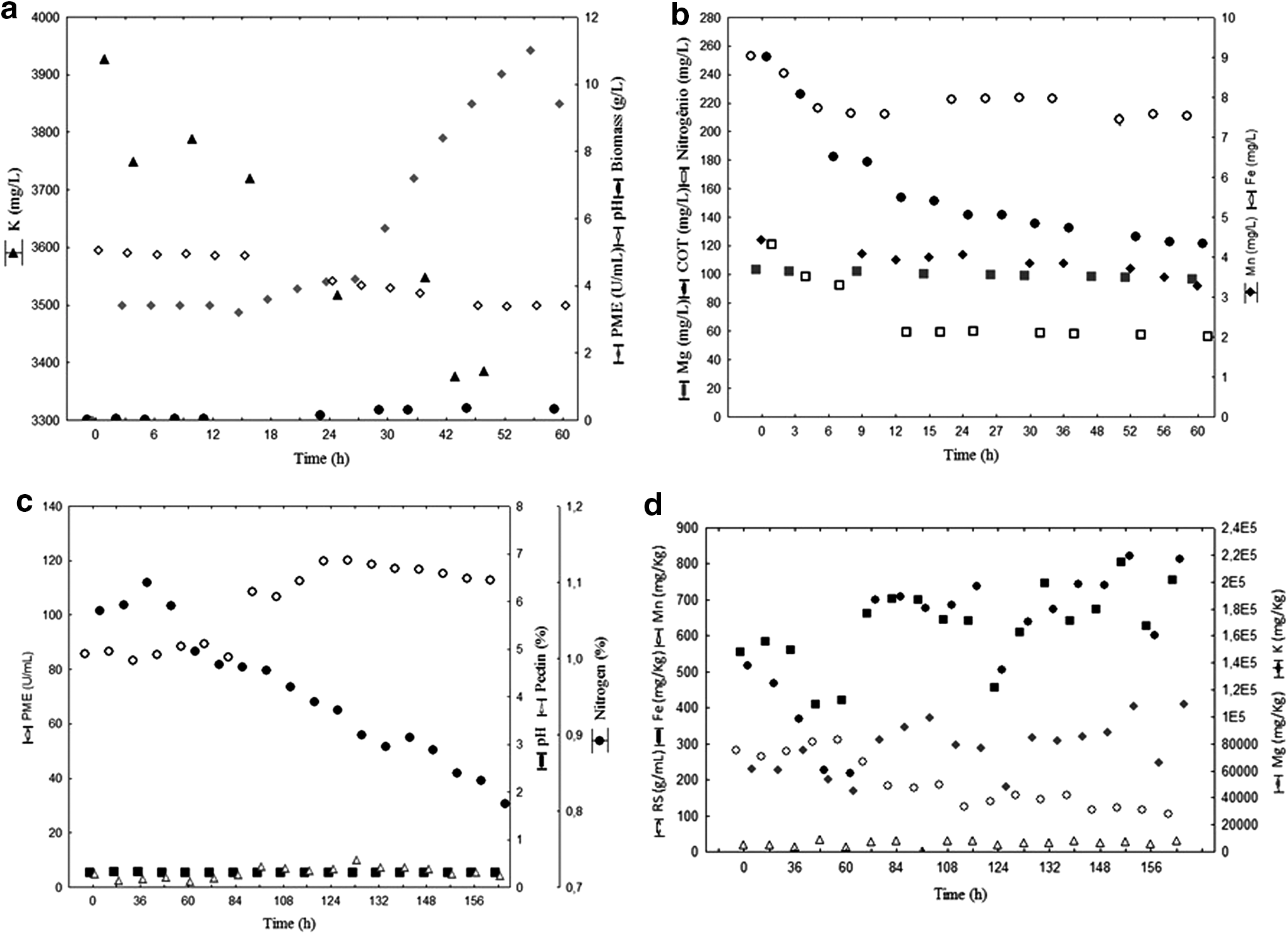
Kinetic curves for bioproduction of PME in
The maximum activity of PME in agro-industrial (Fig. 2c) environment was 130 U/mL obtained in 124 h of bioproduction. The pH remained practically stable, ranging from 5.5 to 5.7 during 168 h. Compared with the use of agro-industrial substrates, it was observed that pectin (Fig. 2c) and reducing sugars (Fig. 2d) had assimilation of 57% and 63%, respectively, in the period of maximum production of PME. Nitrogen (Fig. 2c), manganese, and potassium (Fig. 2d) showed assimilation corresponding to 23%, 34%, and 57% of total consumption, respectively.
Figure 2 shows that several factors affect microbial growth, and enzyme biosynthesis can highlight the composition of the culture medium, particularly the carbon source, the presence of inducers (pectin), and other cultivation conditions, such as pH, incubation time, and medium nutrient (N2, K, Mg, Mn, and Fe). The present results indicate that agro-industrial wastes such as corn steep liquor, orange peel, and parboiled rice water are suitable for PME production by A. niger in submerged fermentation.
Studies on the production of PME by microorganisms are scarce in the current literature. It is important to mention that PME activity of 4.80 U/mL has been obtained by the filamentous fungi Penicillium brasillianum. 38 Mantovani et al. 39 reports commercial PME (Pectinex AR) values of 3.58 U/mL. The most cited works are referred to the enzymatic extract from papaya, 40 apple, 41 peach, 42,43 pear, 44 tomato, 45 banana, 46 and mango. 47
Biotechnological production of PME for industrial applications, through microorganisms, has several advantages. Production can occur in a small space and is not subject to environmental conditions such as climate, season, and soil composition. Growth conditions can also be controlled to ensure higher pectinase production with low-cost substrates.
PME Partial Characterization
Optimum pH and temperature
Evaluation of the optimum pH and temperature was carried out using a CCRD 22. Table 3 presents the matrix of the experimental design with the studied ranges of the variables and the responses in terms of PME activity. The highest activities were 26.40 and 115.05 U/mL in synthetic medium and agro-industrial (run 6), respectively (55°C, pH 11.0).
These results were statistically treated, and empirical models were obtained using Equations 3 and 4. These models represent the behavior of PME activity in terms of temperature and pH in the studied range; they were validated using analysis of variance, where a correlation coefficient of 0.98 was obtained and Fcalculated were 8 and 21.84 times higher than the value listed in statistical tables for synthetic medium and agro-industrial medium, respectively.
Figure 3 shows the contour curve for PME in synthetic medium (Fig. 3a) and agro-industrial medium (Fig. 3b). The maximum activity of PME is in the range of 30–80°C and pH values around 11.
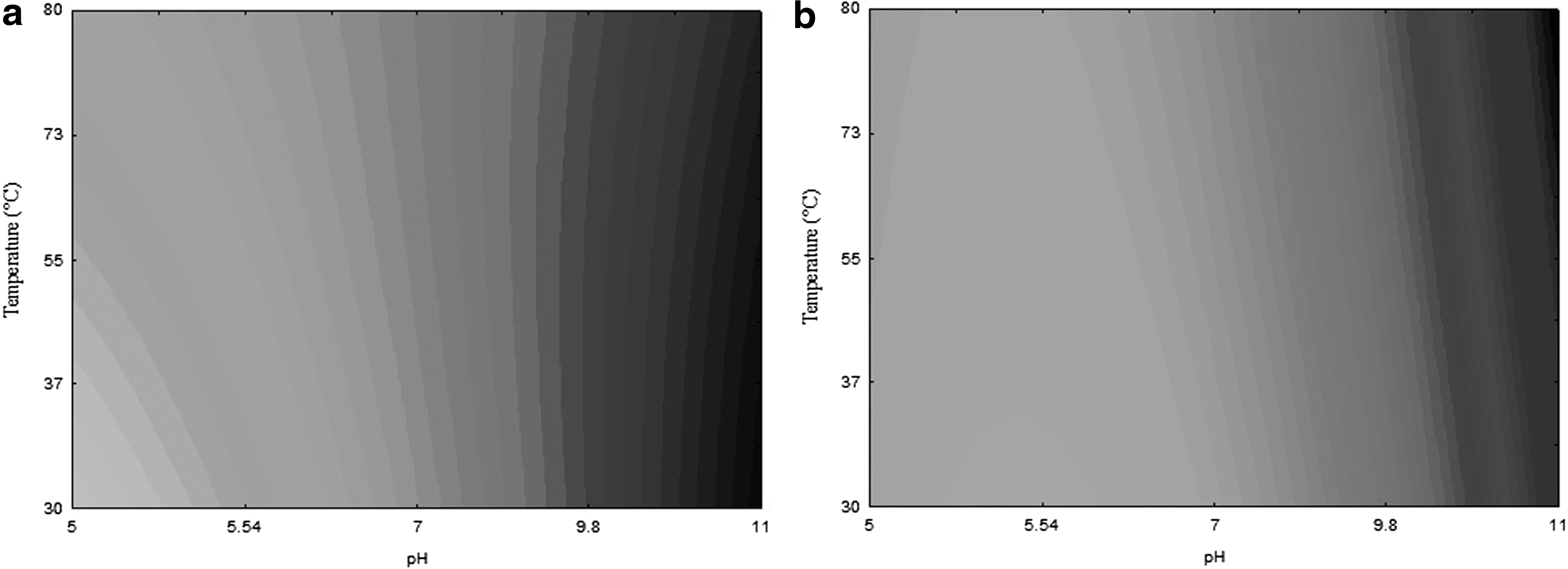
Contour curve for PME (U/mL) as a function of temperature (°C) and pH in
where PME is activity of pectin methylesterase (U/mL), T is temperature (°C); and pH.
Thermal stability
Crude PME extracts (Fig. 4) were stored at −80, −10, 4, 30, 40, 55, 60, 80, and 100°C, and the enzyme activity was measured periodically. The extract produced with synthetic medium (Fig. 4a) retained 80% of its initial activity after storage at −10, −80, and 4°C for a period of 3,528, 4,032, and 5,088 h, respectively. At 100°C the enzyme (Fig. 4b) was inactivated for 4.5 h storage. On the other hand, at temperatures of 55 and 60°C, 50% of residual activity was retained for approximately 4,720 h.
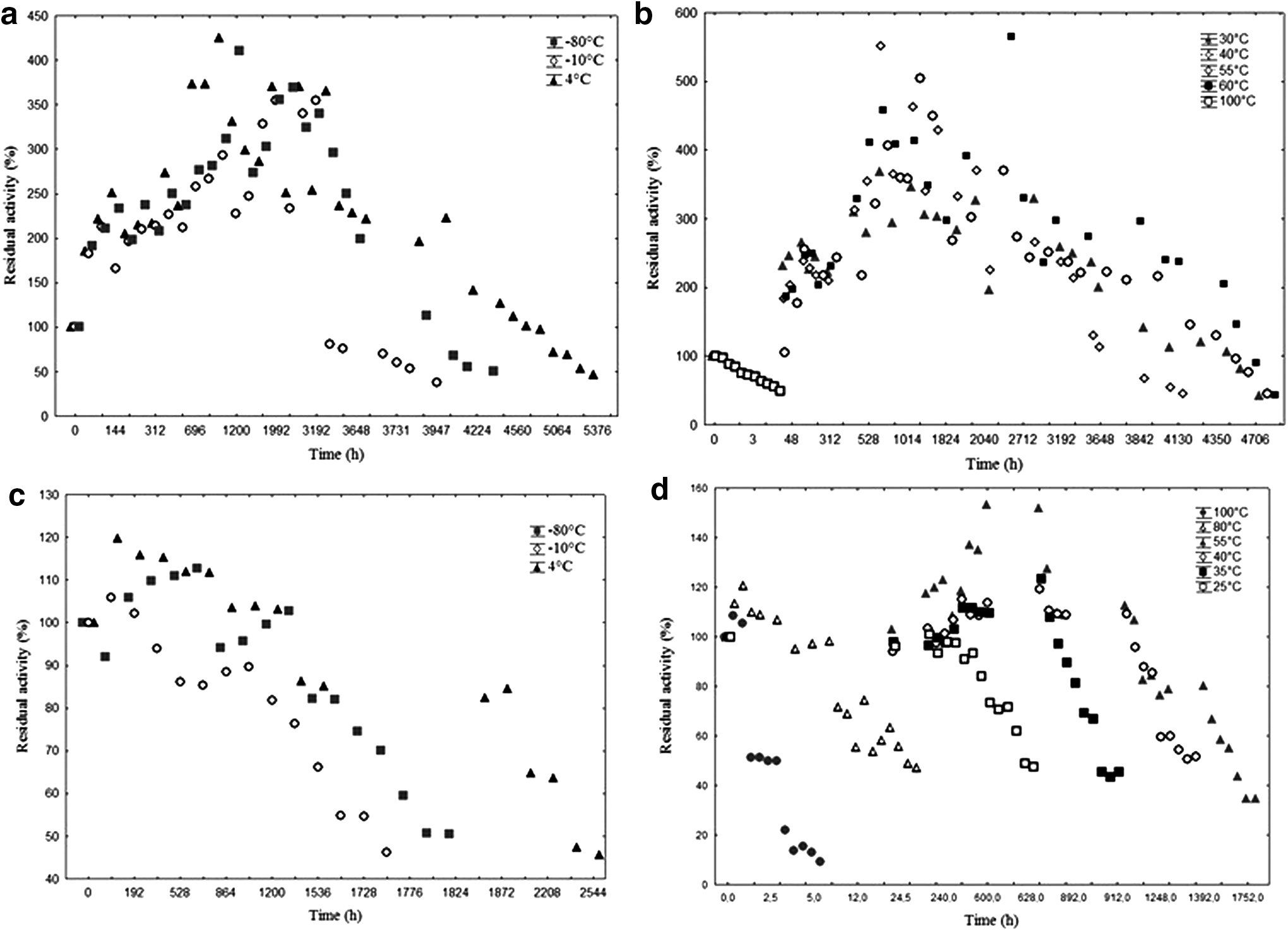
Influence of low (−80, −10, and 4°C) and high (30, 40, 55, 60, 80, and 100°C) temperatures on PME stability in
The extract produced with agro-industrial substrates (Fig. 4c) retained approximately 50% of its initial activity after storage for 2,544, 1,824, and 1,728 h at 4, −80, and −10°C, respectively. However, when stored at high temperatures (Fig. 4d), it was most stable at 55°C, retaining 50% of the initial activity of approximately 1,500 h.
Ed obtained was 18 and 15 kJ/mol for PME produced in synthetic and agro-industrial medium, respectively. The results showed that within the range studied, PME in synthetic and agro-industrial medium (Table 4) from microorganisms was more stable at 55°C, with half-life times (t1/2) of 4,728 and 1,547 h, respectively.
Parameters for Thermal Inactivation of the Crude Enzyme Extract of PME Obtained by A. niger ATCC 9642 in Synthetic and Agro-Industrial Medium
Partial characterization of the crude enzyme extract of PME (Table 3, Fig. 3) showed optimum pH and temperature conditions of 11 and 55°C, respectively. For PME produced in synthetic and agro-industrial medium, Ed was 18 and 15 kJ/mol, half-life times (t1/2) were 4,728 and 1,547 h (Table 4), respectively (55°C).
The observed differences in PME thermostability are possibly related to the composition of synthetic and agro-industrial medium, allowing enzymes with different thermal stability characteristics. The thermostability of an enzyme is the ability to resist thermal unfolding in the absence of substrates. The enzyme obtained from agro-industrial waste, in addition to being a lower cost medium, has minor thermal stability advantages with PME activity 14 times higher. Although the enzyme produced from agro-industrial waste presented higher activity, it also has lower thermal stability, which may also have different catalytic specificity. This is possibly associated with the presence of inhibitors such as metal ions, 24 secondary metabolites, and others. These react with the sulfhydryl groups of proteins, causing decreased PME activity in the extract crude enzyme.
Stability to pH
The stability of the crude PME (Fig. 5) was evaluated by incubating the extract at different pH values (5, 7, 9, and 11) and monitoring the activity over time. The PME extract produced by synthetic medium (Fig. 5a) retained approximately 50% of the initial activity when stored for a period of 2,014 h at pH 11. The PME extract produced with agro-industrial substrates remained (∼50%) at pH 11 and 9.8 at 1,188 and 1,040 h, respectively. Thus, this is the optimal pH range for the enzyme (Fig. 3).
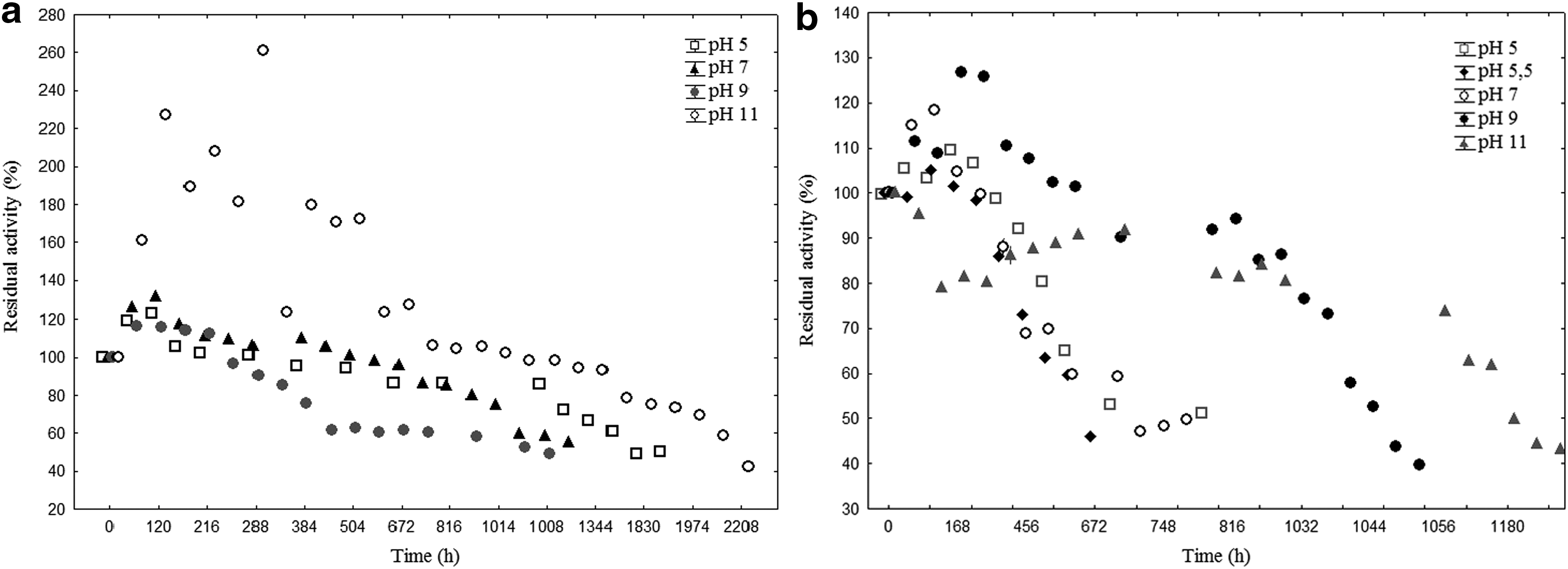
Stability of the crude enzyme extract PME subjected to pH 5, 7, 9, and 11 in
The optimum pH for PME (Fig. 3) and its storage stability (Fig. 5) were in the range of 9–11. The properties of the pectin methyl esterase enzyme obtained in this study show characteristics of alkaline pectinase. Alkaline pectinases have been used in textile processing, 48,49 pharmaceutical, leather, detergent and paper industry, 50 and maceration of vegetables to facilitate extraction of oils and pigments. 51
Studies on the thermal inactivation of microbial PME are rare. Gonzalez et al. 52 studied the thermal inactivation of exogenous PME (Pectinex 100L Plus) in mango juice and found that inactivation occurred in 20 min at 75°C. Zeni et al. 38 reported higher activities of PME by Penicillium brasilianum with temperature of 55°C and pH 11. Bastos et al. 53 found that approximately 80% of initial PME activity of Cladosporium cladosporioides was retained at pH 8.0 and 30°C. The author suggests that this enzyme may be applied in acidic and basic industrial processes, with temperatures up to 30°C and lasting up to 107 h, without reducing its action potential.
However, most studies report the effect of pH and temperature on activity in PME fruit extracts. Assis et al. 54 related higher activities for PME from acerola (Malpighia glabra L.) at pH of 9.0. Researches using other fruits as a PME source presented higher activities at lower values of pH 8.0 for pectin methylesterase from orange juice. 55 Ly-Nguyen et al. 56 found the optimal pH to be 7.0 using crude PME extracts from strawberries. Amaral et al. 55 evaluated the effect of temperature on the activity of purified PME from orange and determined the optimal temperature as 50°C. Cardello and Lourenço 57 evaluated the stability of partially purified PME extract from eggplant (Solanum melongena L.) by incubation for 60 min, and verified that the extract was stable in pH values in the range of 5.0 from 8.0.
Conclusion
The maximum activity of PME in synthetic medium (42 g/L pectin, 1 g/L magnesium sulphate, and 10 g/L potassium phosphate) was 9.4 U/mL, and in agro-industrial medium (120 g/L orange peel, 301.2 g/L corn steep liquor, and 600 g/L parboiled rice water), was 130 U/mL. These figures were obtained during 56 and 124 h of bioproduction (180 rpm, 30°C, pHinitial 5.5, 5.106 spores/mL) for synthetic medium and agro-industrial medium, respectively. Partial characterization of the crude enzyme extract of PME showed optimum pH and temperature conditions of 11 and 55°C, respectively. The Ed obtained was 18 and 15 kJ/mol with half-life times (t1/2) of 4,728 and 1,547 h (temperature 55°C) for PME produced in synthetic and agro-industrial medium, respectively.
Utilization of agro-industrial residues for enzymes production using submerged fermentation minimizes the pollution and allows high added-value products to be obtained economically. Thus, the estimated cost to produce PME crude extract using agro-industrial wastes such as corn steep liquor, orange peel, and parboiled rice water would be approximately 70 times lower than commercial pectin methylesterase considering the individual cost components of the medium cultivation, energetic cost, and equipment depreciation.
Footnotes
Acknowledgments
The authors thank CNPq, FAPERGS, and CAPES for the financial support and scholarships.
Author Disclosure Statement
No competing financial interests exist.