




Abstract
In this research, the potential of using the microbial-induced carbonate precipitation method was considered for the stabilization of sand using corn steep liquor, the byproduct of Glucosan Factory (Qazvin, Iran) and an inexpensive culture media for preparation of bacterial suspensions. Sporosarsina pasteurii, a urease-producing bacterium, was used for preparing bacterial suspension. The aim was also to compare the use of the industrial dehydrate calcium chloride and tetra hydrate calcium nitrate as calcium reagents in cementation solutions to treat loose silica sand samples using the microbial-induced calcite precipitation method. The results showed that corn steep liquor with 10% dilution rate could be used in culture media instead of yeast extract to prepare bacterial suspensions with appropriate specific urease activity. The unconfined compression strengths of the treated samples with two types of calcium reagents with limited concentrations (0.75M) were not significantly different. However, in the surface stabilization of sand dunes, it seems that the use of calcium nitrate is preferred to calcium chloride from an environmental perspective. It is concluded that, in industrial field-scale projects, both industrial dehydrate calcium chloride and tetra hydrate calcium nitrate reagents could be used as inexpensive calcium sources for microbial sand stabilization, and corn steep liquor could be used as an inexpensive alternative for yeast extract.
Introduction
Microbial-induced carbonate precipitation (MICP) is one of the methods used for biocementing granular soils. 1 –3 In the MICP method, ureolytic bacteria is used to produce urease enzyme. Urease hydrolyzes urea to ammonium and carbonate ions, as shown in Equation 1. According to Equation 2, carbonate anions in the presence of calcium cations lead to the precipitation of calcium carbonate between sand particles, joining them together with improvements in strength and stiffness. 1 –4

This new, biotechnology-based ground reinforcement method has mostly been limited to laboratory research. Up-scaled Borehole microbial stabilization of 1,000 m 3 gravel using the MICP to prevent collapsing of gravel deposits in a horizontal directional drilling (HDD) project was conducted in 2010. 5 However, in large-scale projects, using standard laboratory growth media for production of bacterial suspensions is not cost effective. Waste or industrial byproducts of food or agricultural industries such as corn steep liquor (CSL), lactose mother liquor, Torula yeast, Vegemite, brewery waste yeast, dairy wastes, and sludge biomass could be used as inexpensive protein sources for preparing a large amount of growth media. 1,6 –9 Some researchers have studied the use CSL as a low-cost nutrient in the growth medium for generating urease-producing bacteria. 10,11 One of the main goals of this research was to consider the potential of producing bacterial suspensions with inexpensive growth media. Thus, in this research, the use of CSL in growth media was studied for producing high efficiency, cost-effective bacterial suspensions that could be used in large-scale microbial soil improvement projects. In most research, 20 g/L yeast extract with 10 g/L ammonium chloride or ammonium sulfate was used to prepare growth media for S. pasteurii. However, in this research, 5, 10, and 20% CSL was used instead of the yeast extract.
In most research, including laboratory and field studies of MICP, calcium chloride was selected as the calcium source of the cementation solution, and thus ammonium chloride was a byproduct of the reaction. 2 Calcium nitrate has not been widely studied as a calcium source in cementation solutions in MICP. Wiffin considered the inhibitory effect of using calcium nitrate alone or in combination with calcium chloride on the urease activity of S.pasteurii. 1 Other researchers studied the role of calcium sources in the strength and microstructure of microbial mortar with upward pumping of bacterial and cementation solutions. 12 The MICP method could be used to stabilize loose sand such as the sand of dunes to prevent their movement. One of the important purposes of this study was to consider the potential of using industrial calcium nitrate as a calcium reagent in cementation solution instead of chloride calcium, and also to evaluate the strength of the microbial-treated loose sand samples using an industrial calcium nitrate reagent comparing to the industrial calcium chloride. We used downward surface percolation method to treat the loose sand samples without any previous vibration and compaction. In addition, the environmental aspects of using these calcium sources and produced byproducts were considered.
Materials and Methods
Microorganism and Culture Media
Ureolytic bacteria, S.pasteurii, provided from Persian Type Culture Collection (PTCC 1645) were used in this study. The CSL was supplied from Glucosan Factory (Qazvin, Iran). The CSL is a byproduct obtained during the process of extracting starch, oil, and sweeteners from corn. 13 Chemical composition of this byproduct includes protein and non-fiber carbohydrates 13 and thus could be used as a suitable nutrient source for bacterial cultivation. The pH value of the supplied CSL was 3.86. Laboratory-grade ammonium chloride provided from Dr. Mojallali Industrial Chemical Complex was used to prepare culture media.
Urea and Calcium Source in the Cementation Solution
Granular fertilizer urea provided from Razi Petrochemical Co. was used instead of laboratory-grade urea in the cementation solution. Industrial tetra hydrate calcium nitrate, Ca(NO3)2.4H2O, provided from the Gohar Chemistry Expert Company (Goharshimi) as well as industrial dihydrate calcium chloride, CaCl2.2H2O, provided from Chinese staple source available in market, was used to prepare the cementation solutions.
Sand Samples
Firouz-Kooh #161 crushed silica sand, i.e., a uniformly graded sand, was used in this study for microbial sand treatment via the MICP method (Fig. 1).
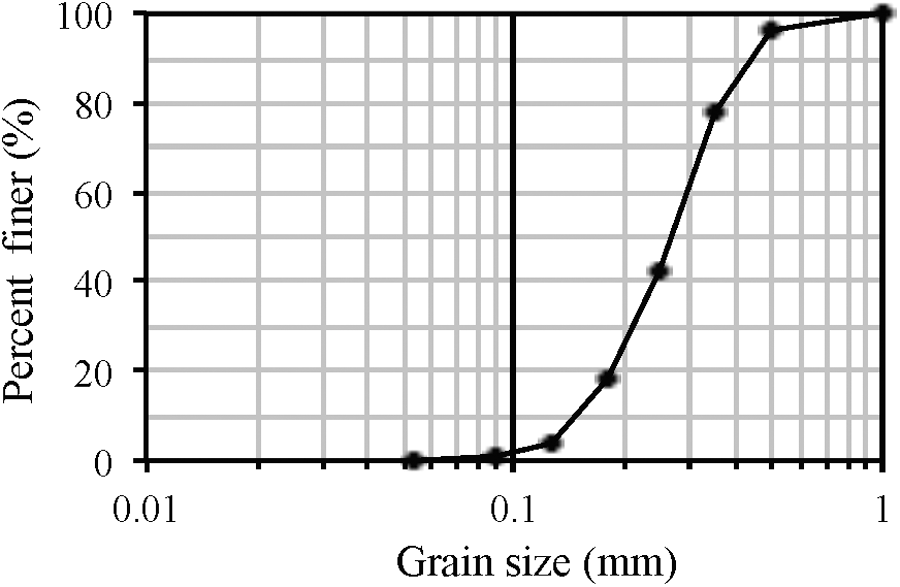
Curve of the grain size distribution for the Firouz-Kooh #161 sand.
Preparation of Growth Media and Cultivation
S. pasteurii was cultured in 200 mL of medium containing bacto pepton (10 g/L), yeast extract (10 g/L), and urea (20 g/L) at pH 9 to prepare an inoculation suspension. 14 50, 100, and 200 mL of the CSL broth were then diluted with 950, 900, and 800 mL distilled water in three 1,000 mL glass containers to prepare 5, 10, and 20% CSL culture media called CSL (5), CSL (10) and CSL (20), respectively. Then, 10 g ammonium chloride was added to each medium. The prepared CSL-NH4CL growth media were acidic, and to raise the pH value, 4N NaOH was added to reach a pH of 9. Because of the turbidity of the prepared solutions, after the pH adjustment, they were filtered by filter paper to prepare clear growth media, and then each growth medium was poured in a pair of 1,000-mL glass containers so that each container had 500 mL growth medium. Subsequently, three pairs of containers (six containers) were autoclaved at 121°C and pressure of 15 (lb/in 2 ) for 15 min. Afterwards, 50 mL of each prepared growth medium was selected and kept at 4°C in the refrigerator as blank samples to measure the optical density. The CSL-NH4CL growth media were inoculated with 5 mL of the S. pasteurii inoculation suspension and then incubated for 36 h at 30°C in a shaker incubator operating at 170 rpm. After incubation, the prepared bacterial suspensions were stored at 4°C before use.
Optical Density and Urease Activity
Optical density of the grown biomass was measured at 600 nm with a UV-visible spectrophotometer. An electrical conductivity device was used to measure the amount of the urease activity. For this purpose, 5 mL of each bacterial suspension was added to 45 mL of 1.11 M urea, and the amount of electrical conductivity was measured over 5 min at 20°C. 4 The value of the urease activity was obtained by calculating the slope of conductivity changes versus time in mS/cm/min. The urease activity was then calculated taking the dilution into account to provide the undiluted value. 2
Treatment of the Loose Sand Samples
For performing microbial treatment tests, the dry sand was poured into cylindrical columns with the diameter of 32 mm and height of 297 mm without any mechanical vibration and compaction. These cylindrical columns were made of transparent plastic papers. 30-mm at the top of every column was kept blank to pour the bacterial and cementation solutions. A fine textile mesh was placed in the bottom of every column. Ten sand columns were built in the treatment table with the possibility of free drainage from the bottom (Fig. 2, Table 1). In this study, the cementation solution containing 0.75 M urea and 0.75 M CaCl2.2H2O or 0.75M urea and 0.75M Ca(NO3)2.4H2O was used. Increases in the molar amount of calcium nitrate in the cementation solution has inhibitory effect on the urease activity of the bacterial biomass; thus, the appropriate amount of 0.75 M was selected for the calcium nitrate reagent in the cementation solution. 1 Because of the possibility of comparing the results of the treatments, the amount of 0.75 was also selected for the calcium chloride reagent. The surface percolation method in 4 layers was used for stepwise addition of the bacterial and cementation solutions to the samples in microbial-cementation cycles. 15 The bacterial suspension cultivated by CSL(10)-NH4Cl was selected to treat the loose sand samples. The water retention capacity of the samples was around 100 mL. The microbial sand treatment consisted of two types of cycles including a microbial-cementation cycle and cementation cycle (Table 1). In the microbial-cementation cycle, a 4-layer addition of microbial and cementation solutions was initiated for the sample: 25 mL of the bacterial suspension, 25 mL of the cementation solution, 25 mL of the bacterial suspension, and finally 25 mL of the cementation solution were loaded into the sample columns continuously by gravity. In the cementation cycle, 100 mL of the cementation solution were loaded into the sample columns by gravity. The interval time between all the treatment cycles was 24 h. In the treatment samples, C1-C5 and N1-N5, dihydrate calcium chloride and tetra hydrate calcium nitrate were used as calcium reagents in the cementation solutions, respectively. As previously mentioned, each cementation solution includes 0.75 M urea and 0.75 M calcium reagent. Before each treatment, 300 mL water was passed from each sample.
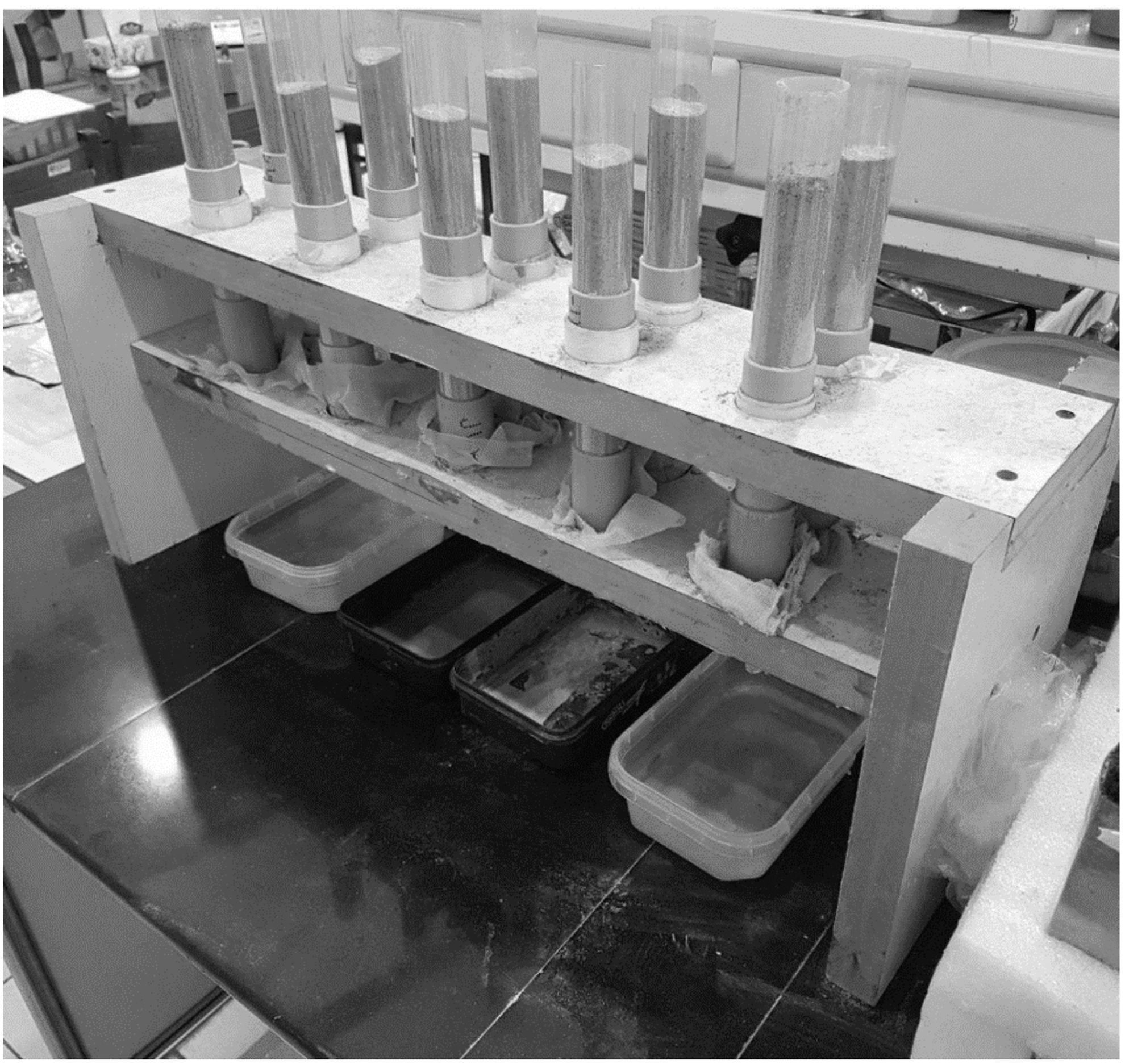
The table of the microbial treatment, including ten loose sand samples.
Microbial Treatment Cycles of Loose Sand Samples Using Calcium Chloride Reagent (C1-C5) and Calcium Nitrate Reagent (N1-N5) in Cementation Solution via the MICP Method
Evaluation of the Strength
After the treatment, the treated samples were kept under water for 48 h, and, after drying, at 75°C for 48 h. Each treated sample was divided into three cylindrical sandstone pieces with a length-to-diameter ratio of around 2–2.5. The unconfined compressive strength of the pieces was measured to evaluate the average strength of each treated sample.
SEM Analysis Of The Microbial Treated Sand
A part of the microbial-treated sample, which was treated with bacterial suspension (prepared using the CSL) and calcium nitrate as the calcium source in the cementation solution (N2), was selected to examine the precipitated calcium carbonate crystals by the FESEM examination.
Results and Discussion
Urease Activity and Optical Density of the Prepared Bacterial Suspensions
The urease activity (taking the dilution into account by multiplying to 10) and optical density of the bacterial suspensions cultivated by the CSL(5), CSL(10), and CSL(20) with ammonium chloride (10 g/L in all of them) are shown in Table 2. In the CSL(20)-NH4Cl culture medium, no growth of bacteria was seen. The optimum specific urease activity was obtained by the CSL(10)-NH4Cl growth medium. As compared to the results of the other researches, gaining to the specific urease activity of 0.43 mS/cm/min/OD600 with an industrial byproduct (CSL) is a relatively appreciate amount. 2,16 However, the full optimization process of the CSL growth medium with and without NH4Cl in growth media in sterile and non-sterile states to reach better and more efficient results will be included in our future research.
The Urease Activity and Optical Density of the Bacterial Suspensions
Advantages of Using CSL in Growth Media
A CSL-urea medium containing an industrial byproduct of the corn wet milling industry, 2% urea, and 25 mM calcium chloride was used for the microbial sand plugging purpose and biocalcification of cement mortar cubes. 10 Calcium chloride was mixed with the CSL-urea medium before cultivation in this research. In another study, a CSL medium including Tris base, urea, and CSL (provided in liquid form as a commercially available product from Sigma Aldrich, St. Louis, MO) was used for biomineralization of cement-based materials. 17 They used the CSL as an alternative replacement of the yeast extract. In our research, none of the urea and calcium sources were mixed with the growth medium (CSL-NH4Cl) before cultivation, but they were used in the cementation solution in the treatment stage. Thus, the absence of urea and calcium sources in the growth media led to an appropriate amount of specific urease activity. CSL is an inexpensive nutrient medium compared to yeast extract and peptone. 10 Therefore, from an economic perspective and with sufficient specific urease activity of the produced biomass, large-scale field projects including underground sand treatment and surface stabilization of sand dunes via MICP will be applicable using CSL in growth media. In addition, through the MICP method, low-cost CSL culture media could be used in many industrial bio-improvement and bio-remediation applications. Manufacture of self-healing concrete, high-strength bio-cement (mortar), and biobrick for construction and architecture; improvement of loose and liquefiable sands and bio-grouting in geotechnical engineering; historical masonry building restoration; and environmental bioremediation of heavy metals from contaminated soils are possible examples. 2,18 –23
Unconfined Compression Strength of the Treated Samples
According to the FESEM images of the microbial treated sand sample using inexpensive treatment materials (Fig. 3), precipitated calcium carbonate crystal has joined the sand grains together as bridges. The unconfined compression strength of the microbial treated loose sand samples is shown in Fig. 4. The results showed that the unconfined compression strength of all the samples treated with calcium nitrate in the cementation solution (N-N5) was 83–92% of the average strength of similar samples treated with calcium chloride (C1-C5). Using calcium nitrate instead of calcium chloride does not have a significant effect on the strength reduction. Figure 4 also shows the effect of the number of cycles of the microbial treatment on the loose sand samples via the MICP. The average strength of the treated samples C1 and N1 with one cementation cycle is around 95–96% of it in the C2 and N2 samples with two cementation cycles. The average strength of the treated samples C1 and N1 with one cementation cycle is around 78–88% of it in the treated samples C3 and N3 with three cementation cycles. The average strength of the C1 and N1 treated samples with one microbial-cementation cycle is around 74–85% of it in the treated samples C4 and N4 with two microbial-cementation cycles and 66–70% of it in the treated samples C5 and N5 with three microbial-cementation cycles. Therefore, the number of the microbial-cementation cycles and cementation cycles does not have remarkable effects on enhancing the strength of the treated samples.
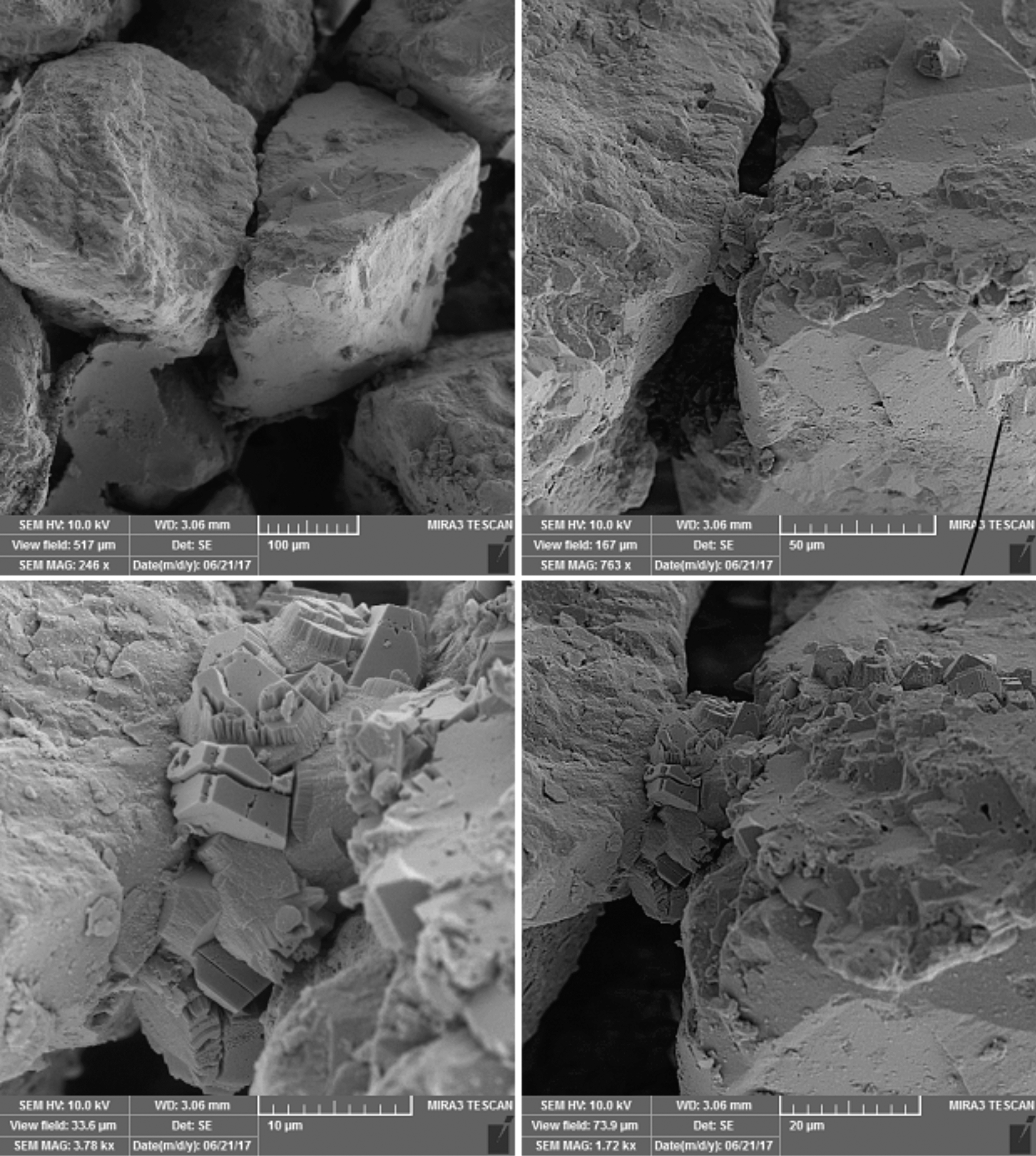
The FESEM images of the microbial treated sand and calcium carbonate crystal bridges between the sand grains.

The unconfined compression strength of the microbial treated loose sand samples.
Environmental Aspects of the Calcium Source in the Cementation Solutions in Sand Stabilization Using Micp
According to Equations 3 and 4, in the process of microbial calcium carbonate precipitation via MICP in the presence of urease enzyme, calcium chloride and calcium nitrate are calcium sources while ammonium chloride and ammonium nitrate are byproducts.


The ammonia byproduct is soluble in water and thus must be removed to prevent undesired ecological effects in the surface water and surrounding ground. 24,25 Because of the high concentrations of ammonia and its high toxicity in most organisms, it is recommended that this waste be treated by nitrification/denitrification. 4 Moreover, the physical extraction and rinsing of ammonia with water and the use of extraction wells in field studies and projects are recommended. 2,5,26 Methods such as ammonium oxidation are not recommended because of the acidifying process and dissolving the precipitated calcium carbonate. 27 Therefore, the byproduct ammonia may require expensive remediation processes and may not be acceptable to many ground environments; hence, the control and mitigation of ammonia are necessary to minimize the environmental risk. 15,28
To mitigate the hazards of ammonia byproducts at field-scale, underground subsurface sand stabilization via MICP, extraction wells could be used to remove most of the residual by products. However, for surface sand stabilization, especially in desertification projects, extracting the ammonia byproduct from a wide area is not possible. Surface stabilization of calcareous sand dunes via chemical methods (phosphoric acid mulching liquid) with no production of toxic byproducts between the sand particles could be preferred to the MICP with unwanted byproducts between the sand particles. 29 Using MICP for stabilization of non-calcareous sand dunes with inexpensive bacterial suspension, industrial urea and calcium reagent is economical. However, from an environmental perspective, using industrial calcium nitrate could be preferred in surface sand stabilization. This is because ammonium nitrate as the byproduct of the microbial process is an agricultural fertilizer. In addition, in some areas of the microbial stabilization field, if the reaction between calcium nitrate and urea does not occur and calcium nitrate and urea stay unreacted in the sand medium, both of them are fertilizers and safe. And, in depth stabilization of sand via MICP, both nitrate and chloride ammonium byproducts are hazardous if they stay in the sand medium and are not extracted or remediated, as the residual byproducts could pollute surface and underground waters.
Conclusion
CSL byproduct, granular fertilizer urea, and industrial calcium reagents including dihydrate calcium chloride or tetra hydrate calcium nitrate could be used as inexpensive materials to treat sand via MICP method in depth and surface sand stabilization in large- and field-scale projects. CSL could be used instead of yeast extract as a nitrogen source in culture media to produce appropriate specific urease activity. The strength of the treated loose sand samples using calcium nitrate as a calcium source in cementation solutions is close to that of the treated sand samples using calcium chloride. Therefore, in surface-stabilization projects of sand such as sand-dune stabilization via MICP, using calcium nitrate at low concentrations could be preferred to calcium chloride because of byproducts. For in-depth stabilization projects of sand via the MICP method, both calcium nitrate and calcium chloride could be used as a calcium source; however, the byproducts of the reaction—ammonium nitrate or ammonium chloride—must be removed to prevent pollution of groundwater and underground soil.
Footnotes
Acknowledgments
The authors would like to thank Mr. Seyed Ali Koohestani from the Glucosan Company for providing corn steep liquor and the Gohar Chemistry Expert Company for providing industrial tetra hydrate calcium nitrate.
Author Disclosure Statement
No competing financial interests exist.