




Abstract
The new lipase formulation NS-40116 (Thermomyces lanuginosus) was immobilized in a hydrophobic matrix obtained by the sol-gel technique. Tetraethyl orthosilicate was used as the silica precursor. For the xerogel formation step, three catalysts were evaluated: acidic (HCl), basic (NH4OH), and nucleophilic (HBr). Polyethyleneglycol (PEG 1500) was used as a stabilizing agent (additive) and the influence of using it on the immobilization step was analyzed. The efficiency of the process was evaluated by measuring esterification activity. The basic xerogel with additive PEG was the immobilized formulation that presented the highest enzymatic activity, as well as greater yield (1,533%). The thermal stability in basic and acid immobilized with and without PEG showed the best results; even at 60°C, they exhibited approximately 50% of the initial activity and showed activity at 70°C. The free enzyme and the nucleophilic immobilized with and without PEG showed very reduced activity at 70°C, with a reduction of around 60% of the initial activity. The basic xerogel with PEG addition presented higher enzymatic activity, yield, number of cycles of use, and thermal stability than its free form and others xerogels, showing great potential for industrial applications.
Introduction
Lipases are enzymes that catalyze various reactions, such as complete or partial triacylglycerols hydrolysis and the esterification reactions, lipids transesterification and interesterification. They are relevant to the industry because of their versatility, and their use is associated with aromas production, fats hydrolysis, modification of flavor, removal of lipids, and esterification, among others. 1 –4
Lipases are specifically used for raw materials with high content of free fatty acids (FFA), since they carry out hydrolysis, esterification, and transesterification.
However, the use of enzymes in their free form is limited due to low stability—possibly due to denaturation at high temperatures or pH values—as well as high cost and the inability to reuse them due to their their solubility in reaction medium. 5,6
Enzymatic immobilization confines the enzyme in a solid support for later reuse of the biocatalyst to reduce such limitations. There are many methods to immobilize enzymes, including confinement, encapsulation, binding to the support (ionic bonding, adsorption, Van der Walls), and cross-linking. 7 –9
Sol-gel enzymatic immobilization is preferable because it preserves enzymatic activity and minimizes leaching. In the sol-gel process, the enhanced hydrophobicity in the silica oxide matrix correlates with the increase of enzyme activity. 10 Higher thermal stability and enzymatic activity result from multipoint interactions through hydrogen bonds. It is still possible to add additives such as polyethyleneglycol (PEG) that could improve the efficiency of enzyme encapsulation and the final expressed activity.
The objective of this study was to immobilize, for the first time in the literature, the new NS-40116 lipase formulation through the sol-gel technique with additive PEG to evaluate characteristics of the immobilized formulation as well as verify possible applications in hydrolysis reactions.
Materials and Methods
Materials
Lipase NS 40116 was provided by Novozymes (Bagsværd, Denmark) and polyethyleneglycol (PEG 1500, Merck, Darmstadt, Germany) was used as stabilizing agent (additive). For the precursor, silica tetraethyl tin silicate (TEOS) (Aldrich, St. Louis, MO), ammonium hydroxide (minimum 28%) (Quimex, Midlothian, IL), and hydrochloric acid (minimum 36%) (Vetec) were used. To determine the esterification activity, ethyl alcohol (at least 99%) (Merck), acetone (Merck), oleic acid (Synth), sodium hydroxide (Synth), and distilled water were used. For esterification, butyric acid (Vetec) and 95% citronellol (Sigma-Aldrich) were used as substrates. For the hydrolysis reaction, olive oil (Galo), gum arabic (Synth), and 100 mM phosphate buffer pH 7.0 were used.
Methods
Sol-gel immobilization technique
The methodology used was adapted from Soares et al. 11 Initially, 5 mL of TEOS was dissolved in 5 mL of absolute ethanol. After dissolution, 1.61 mL of distilled water and 3 drops of the catalyst were added in a molar ratio of water to TEOS of 4:1. Hydrochloric acid (acidic), ammonium hydroxide (basic) and hydrobromic acid (nucleophilic) were used as catalysts for the condensation reaction. The reaction systems were then subjected to a stirring step in an orbital shaker at 40°C and 180 rpm for 90 min. Next, 1 mL of the enzyme solution (160 mg/mL) was added. NS-40116 lipase, a liquid formulation produced from the microorganism Thermomyces lanuginosus, was donated by Novozymes.
1 mL of a PEG 1500 additive solution (concentration 5 mg/mL) was added to the sample testing additive use. In the reactions carried out in acidic and nucleophilic medium, 1.75 mL of hydrolysis solution (0.25 mL of ammonium hydroxide dissolved in 1.5 mL of ethanol) was added.
The reaction systems were then kept under static conditions for 24 h to complete the chemical condensation. After this time, the support was packed in a vacuum desiccator for another 24 h for complete drying and evaporation of the water. Subsequently, the immobilized derivative was sieved to standardize granulometry.
Support characterization by X-Ray diffraction
Immobilized derivative was characterized by X-Ray diffraction analysis (XRD, Rigaku, Miniflex II) diffractometer with Cu-Ka radiation (λ = 1.54056 Å). For X-ray data collection, without calcination, a sample was placed in a glass measurement cell that was quickly closed to avoid contact with moisture. The analysis was performed at a rate of 5 degrees per minute from 2 to 65 degrees theta under ambient temperature of 23°C.
Esterification activity
Esterification activity was determined in the enzyme solution (free enzyme) and the immobilized derivatives. Esterification activity was quantified by the reaction for ethyl oleate synthesis using oleic acid and ethyl alcohol in molar ratio of 1:1 (standard mixture). 12 The reaction was started by the addition of the immobilized (xerogel with enzyme) or free enzyme (approximately 0.1 g) in 5 mL of the standard mixture. The reaction was conducted in glass vials sealed at 40°C on an orbital shaker at 160 rpm for 40 min. Aliquots of 0.5 mL were extracted from the reaction medium in triplicate. 15 mL of an acetone-ethanol (1:1) (v/v) solution was added to each solution to stop the reaction. The amount of oleic acid consumed was determined by titration with 0.05 M NaOH until the medium reached pH 11. The blank assays of the samples contained 0.5 mL of the standard mixture and 15 mL of the acetone-ethanol solution.
A unit of enzyme activity was defined as the amount of enzyme that consumes 1 μmol of fatty acid in one minute, calculated by Equation 1:
where AE: esterification activity (U/g), Vb: volume of NaOH spent on titration of the blank sample (mL); Va: volume of NaOH spent on titration of the sample withdrawn after 40 min (mL); M: Molarity of the NaOH solution (mol/L); Vf: total volume of reaction (mL); t: time (minutes); m: mass of the free enzyme solution or immobilization xerogel (g); and Vc: volume of the reaction aliquot taken for titration (mL).
Immobilization yield
Yield of the immobilization was calculated from Equation 2:
where Y (%): yield; AT: total esterification activity of derivative; and AA: total esterification activity present in the mass of free enzyme added in the immobilization.
Determination of thermal stability
Determination of the thermal stability of the xerogel immobilized and the free enzyme was performed by esterification reaction at temperatures of 40, 60, and 70°C. The same methodology specified in determining esterification activity was used, only the temperature of the reaction was changed. The activity results were compared with those of the initial activity.
Thermal deactivation constant (kd) at each temperature was calculated according to the Arrhenius kinetic model, considering that the inactivation of the enzymes follows the first order kinetics, according to Equation 3:
where: A: final activity; A0: initial activity; kd: deactivation constant; and t: time.
Recycling of lipase derivative
After 40 min reaction time, the xerogel-immobilized lipase was removed by filtration and new substrate (oleic acid and ethanol) was added. The sample was then taken for further reaction. The enzymatic activity was measured at each exchange of the reaction medium. Reactions were repeated until the derivative reached a residual activity greater than or equal to 50% of the initial activity.
Hydrolysis ability
Enzymatic activity was determined by the hydrolysis method outlined by Soares et al., with modifications.
13
The substrate was prepared by adding 18 g olive oil, 9 g gum arabic 5% (w/v), and 180 mL of sodium phosphate buffer solution (0.1 M, pH 7.0) in a portable homogenizer. 18 mL of substrate and 0.1 g of free enzyme, which corresponded to a concentration equal to 0.5 g of immobilized enzyme, were added to 125-mL Erlenmeyer flasks. The vials were incubated at 37°C for 20 min at 160 rpm in shaker. After the incubation period, the reaction was stopped by the addition 20 mL of acetone and ethanol (1:1). Fatty acids content was determined by titration up to pH 11 with 0.05 M NaOH.
14,15
At the same time, blank tests were performed using only the emulsion and the acetone-ethanol solution, without addition of lipase. The determination of hydrolytic activity of lipase (free and immobilized) was done according to Equation 4:
where, AH: hydrolysis ability (U/mL or U/g); Va: volume of NaOH spent on titration of the sample (mL); Vb: volume of NaOH spent on titration of the blank sample (mL); M: Molarity of the NaOH solution (mol/L); m: mass of the free enzyme solution or derivative used (g); and t: reaction time (minutes).
Statistical analysis
The results were analyzed by Analysis of Variance (ANOVA) and means were compared by the Tukey test at 5% level of probability.
Results and Discussion
Supports Characterization by DRX
The supports obtained in the presence of NS-40116 lipase showed no peaks characteristic of crystalline materials, but rather halos in the region of 15–30° (2θ), which are characteristic of materials without crystalline order (amorphous materials) (Fig. 1). For a better presentation of the diffractogram, it was decided to present only the result of two samples. However, all samples were submitted to analysis, and both presented very similar characteristics.
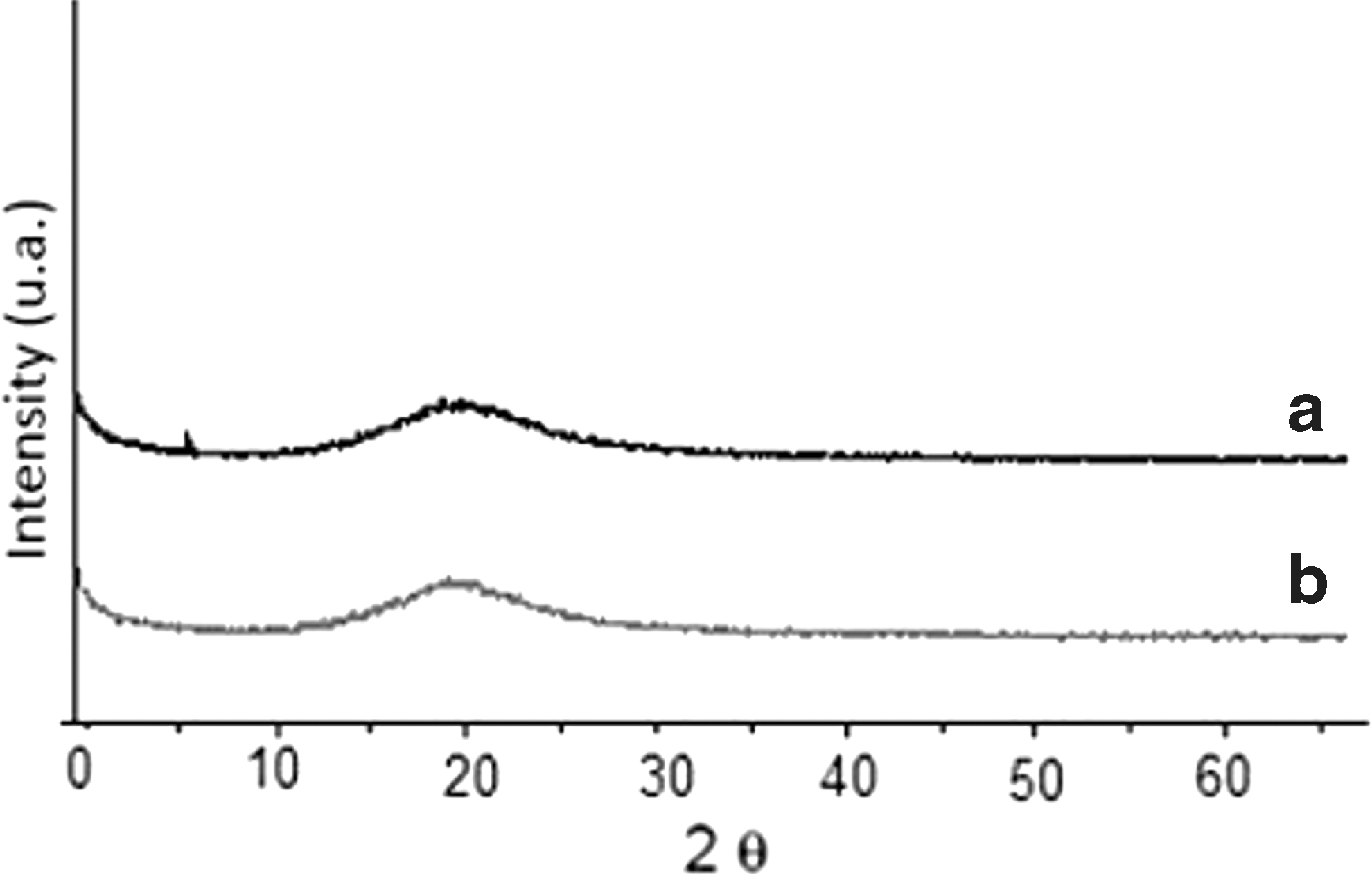
X-ray diffractogram of the immobilized derivatives in the presence of the NS-40116 enzyme
In general, materials obtained by the sol-gel method, are amorphous. 16 Hydrolysis and condensation of the silica monomer in the presence of an acid or basic catalyst act as a cross-linking agent with the formation of the SiO2 amorphous structure in which the three-dimensional lattice is formed around the enzyme. 17
Esterification Activity and Immobilization Yield
Table 1 shows the immobilized enzyme mass obtained, the immobilized enzyme activity per gram, the total esterification activity of the immobilized enzyme, and the yields obtained from the immobilization of acidic, basic, and nucleophilic xerogel with and without the use of the additive PEG 1500. For immobilization, 1 g of free enzyme was added, showing 274.22 U/g esterification activity.
Yield of the Immobilization of the Enzyme Lipase NS-40116 in Acidic, Basic, and Nucleophilic Xerogel With and Without the Use of PEG 1500 Additive 1
Same letters in the same column indicate no significant difference at the confidence level of 5%; PS: dry weight of the enzymatic derivative; AE: esterification activity per gram of enzymatic derivative; AT: total activity of the derivative; R: yield of immobilization.
The immobilized enzyme presenting the highest enzymatic activity, as well as greatest yield (1,533%), was the basic xerogel with additive PEG. Lipase from T. lanuginosus was immobilized by single and multipoint covalent attachment in chitosan and showed yields ranging from 16.6 to 94.1%. 18 Cal-B lipase immobilized by the sol-gel method demonstrated higher yield than nucleophilic medium immobilized with PEG (92.32%). 19
Table 1 also shows that all derivatives obtained with PEG additive presented higher yields when compared to xerogel without additive, a fact already reported in the literature. 19,20 The presence of polyethyleneglycol affects the moisture level, modifying the hydrophobicity of the lipase with substrate and altering the morphology of the pores, thus facilitating the transfer of internal mass and providing a better substrate accessibility. 21
Thermal Stability
Thermal stability is important for an enzyme to be viable in industrial applications, since many processes use temperatures in the range of 40–50°C. 22 Figure 2 shows the enzymatic activity of the free and immobilized lipase in acidic, basic, and nucleophilic medium, with and without addition of PEG 1500, after the shaker esterification reaction at 40, 60, and 70°C.
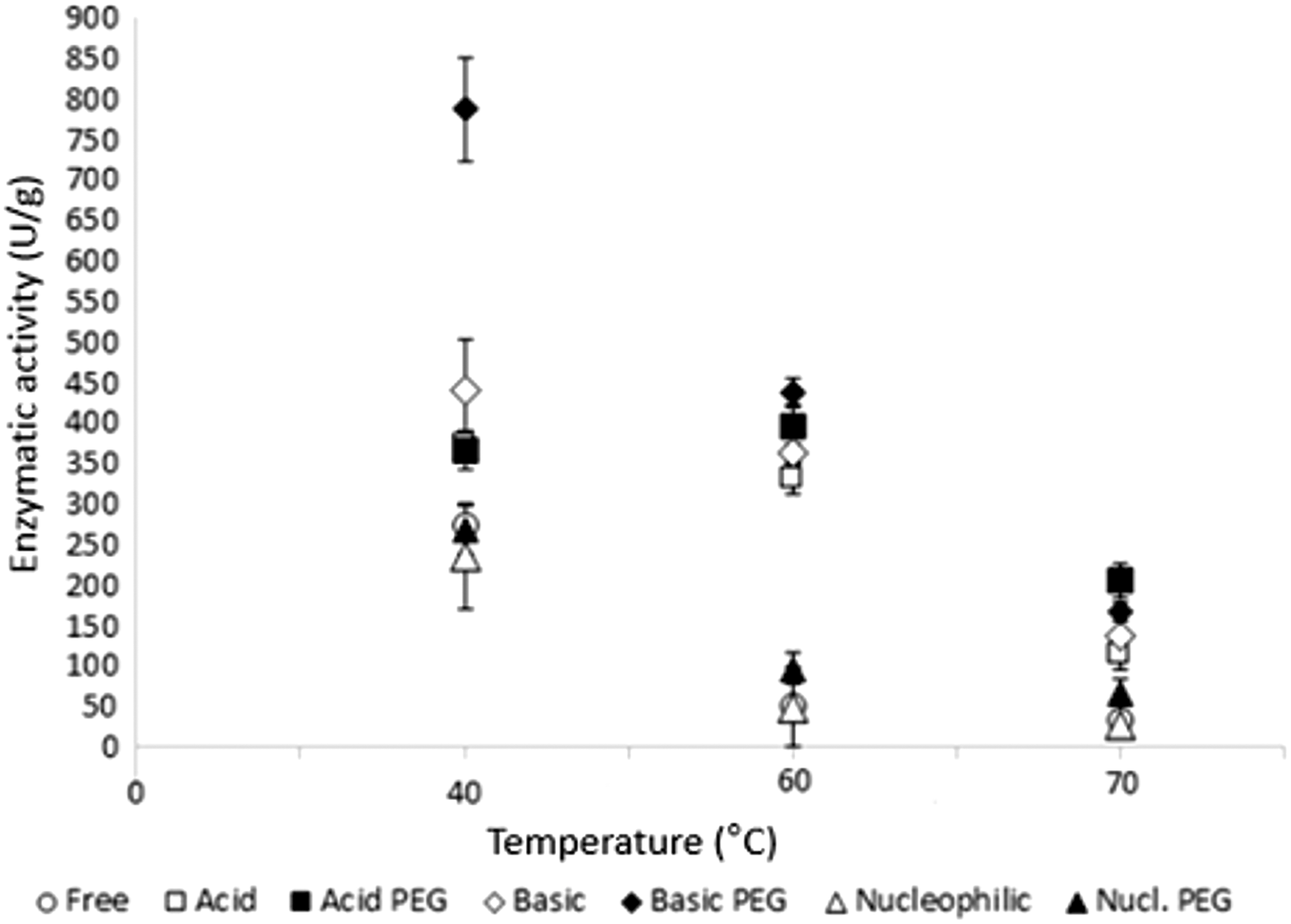
Thermal stability of free and different derivatives of NS-40116 lipase
All samples showed a decrease in activity as the reaction temperature increased. The acid and base immobilized with and without PEG presented higher thermal stability than the free enzyme, whereas the nucleophile immobilized with and without PEG showed similar results to the free enzyme.
It is still possible to verify that the basic immobilized sample containing PEG additive presented higher thermal stability compared to the other samples. The basic and acidic media immobilized with and without PEG showed the best results; even at 60°C they exhibited approximately 50% of the initial activity and showed activity at 70°C. The free enzyme and the nucleophilic enzyme immobilized with and without PEG showed very reduced activity at 70°C.
There is no standard method defined to assess thermal stability, which makes it difficult to compare results. In evaluating the thermal stability of Bacillus sp. ITP-001 immobilized on sol-gel, lipase showed thermal stability at 37°C and kept residual activity in the 50% range. 22 For Cal-B immobilized on sol-gel for 60 min at 80°C, the only xerogels that presented residual activity were basic, with and without PEG, with residual activity of 38 and 20%, respectively. 19 In study using T. lanuginosus lipase immobilized in Fe3O4 nanoparticles and chitosan, it was observed that immobilized lipase presented better thermal stability and retained 80 and 53% activity after incubation at 60 and 70°C, respectively. In comparison to immobilized lipase, free lipase is less stable at high temperature, showing only 65 and 21% activity at 60 and 70°C, respectively. 23 The binding of the support probably limited the conformational mobility of the enzyme molecules at high temperatures, protecting it from inactivation. 24 Therefore, free lipase can easily undergo denaturation while the immobilized lipase is protected in terms of rigid conformation, 25 so immobilized lipase may maintain its high catalytic activity.
Thermal stability was also evaluated by calculating the thermal deactivation constant (kd) and the half-life (t1/2). The results are shown in Table 2.
Constant Thermal Deactivation (Kd), Determination Coefficients (R2) and Half-Life Times (t1/ 2) of Free and Immobilized Lipase
With the exception of 40°C, all other conditions presented lower immobilized lipid kd values and longer half-life (t1/2) than those obtained for the free enzyme. Both results suggest that the thermal stability of the immobilized enzyme is greater than that of the free enzyme, suggesting that the support in question acts to protect the enzyme from the negative effects of temperature on its active conformation, allowing its use in processes that require higher temperatures.
Recycling of Immobilized Lipase
The reuse of enzymes in more than one reaction cycle is one of the main objectives of immobilization. This is particularly important for lipases due to their price; currently, the cost of the enzyme is one of the main problems limiting its use in industrial application. Normally, an enzyme can be reused until its activity is greater than or equal to 50% of the value of the initial activity. 19
Lipases, like NS-40116, catalyze the hydrolysis of fats and oils. They can be used for biodiesel synthesis and flavor esterification, for example. The immobilization of these enzymes increases their operational stability and reuse, creating an economic advantage. 26 –28
The operational stability of reuse of sol-gel immobilized lipase NS-40116 was evaluated in continuous reuse, and the results are shown in Fig. 3. The sample that presented the best result was the basic enzyme with PEG; it maintained more that 50% of its residual activity after 4 recycles. It should be noted that the decrease in catalytic activity may be related to the denaturation of the enzyme or leaching during the course of the recycles.
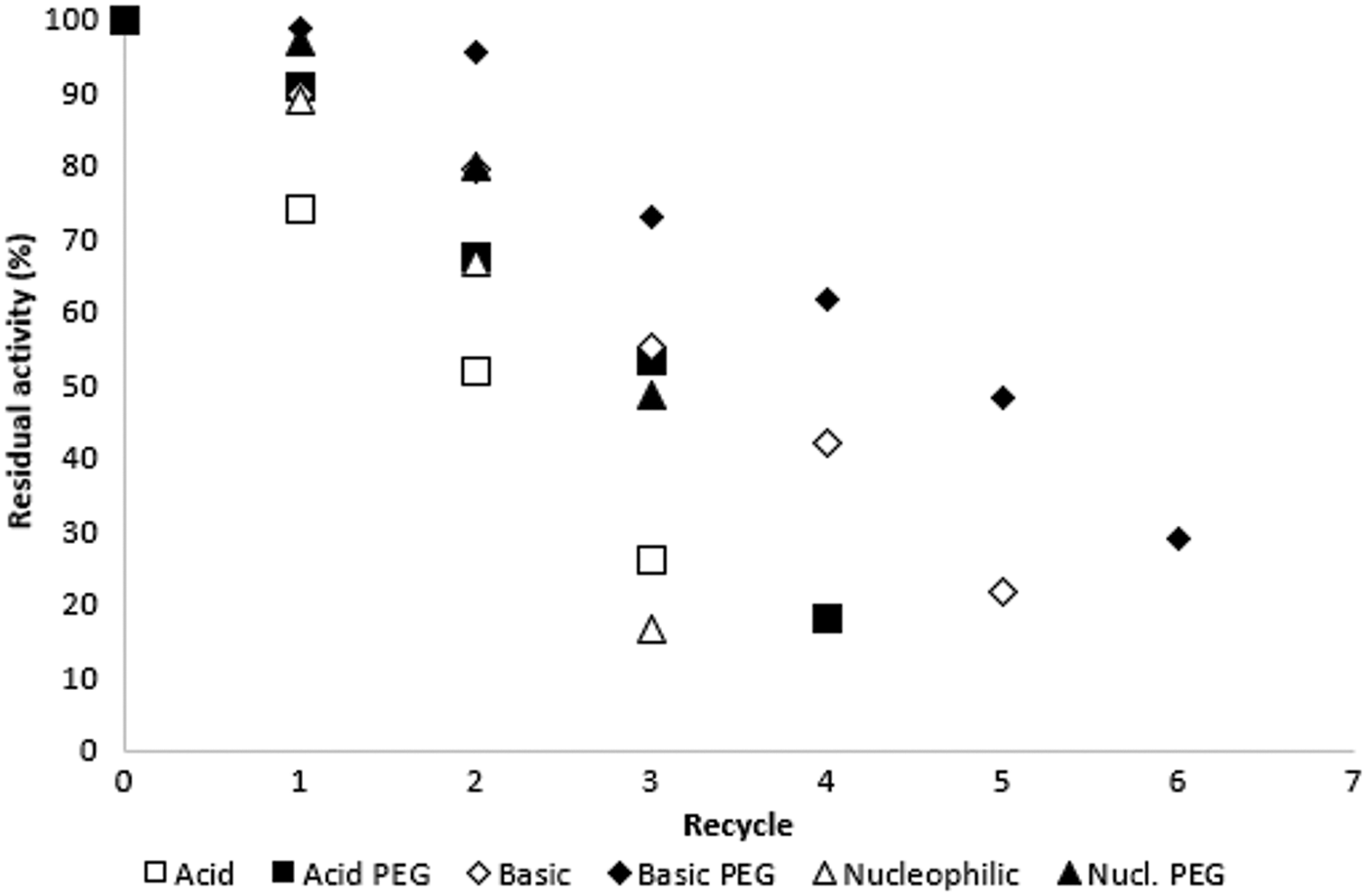
Recycling of immobilized lipase
Similar results were found in Braga et al., 29 who reported that the enzyme β-galactosidase immobilized on Eupergit®C showed that the enzyme/support system maintained up to 50% of the initial activity after 5 cycles of use. Antunes, Dallago, and Tres observed that the lipase Candida antarctica B immobilized in polyurethane of density D30 and D18 presented residual activity of around 50% after 5 recycles. 30
Lipase Candida antarctica B immobilized by the sol-gel technique showed the best result after 5 cycles with the basic derivative with PEG. 31 The lipase from Bacillus sp. immobilized by the sol-gel technique using Aliquat 336 as an additive maintained up to 50% of the initial activity after 3 cycles of reuse. 20
Hydrolysis Ability
The enzymatic hydrolysis of oils and fats, or lipolysis, is well known in the production of fatty acids and to modify fats by esterification, transesterification, and interesterification. 32
Lipase NS-40116 presents lipid hydrolysis potential in its free and immobilized form of 6.80 ± 1.57 and 32.33 ± 1.08, respectively. However, the basic immobilized form presented hydrolytic activity five times higher than the free enzyme.
T. lanuginosus lipase immobilized in different organic substrates showed hydrolytic activity of 76.7 U/g when immobilized on polyhydroxybutyrate (PHB), 183.6 U/g when immobilized on cane bagasse, and 54.8 U/g having chitosan-alginate-laurinaldehyde as support. 33
Conclusions
It is possible to immobilize NS-40116 lipase by means of the sol-gel technique. Between free form and others xerogels, the basic xerogel with PEG addition presented higher enzymatic activity, yield, number of cycles of use, and thermal stability. These results suggest great potential for industrial applications. It was further found that NS-40116 lipase can be used for esterification and hydrolysis both in its free and immobilized form. The immobilization process increased activity by more than 1,500% compared to the activity presented in the free form. This work presents innovative results regarding immobilization of lipase NS-40116.
Footnotes
Acknowledgments
The authors would like to thank the National Council for Scientific and Technological Development (CNPq), the Coordination for the Improvement of Higher Education Personnel (CAPES) and the Research Support Foundation of the State of Rio Grande do Sul (FAPERGS).
Author Disclosure Statement
No competing financial interests exist.