




Abstract
Spirulina is an excellent source of proteins, vitamins, minerals, and essential fatty acids. Due to its nutritional composition, this microalga has been commercially produced and used in a variety of foods. Spirulina has also been studied in the production of fermented milk to enhance the viability of probiotics, but the use of Spirulina in freeze-dried yogurts has not been studied. This study seeks to evaluate the effects of Spirulina sp. LEB 18 in freeze-dried yogurts, with addition before fermentation and after freeze drying. The yogurts' chemical characteristics and lactic acid bacteria count remained stable after freeze drying. The fatty acids that presented higher concentration were palmitic, stearic, and oleic acid. Moreover, it is possible to affirm that the addition of Spirulina sp. LEB 18 provided significant antioxidant activity and increased protein concentration of freeze-dried yogurt. The freeze-dried yogurt with added Spirulina sp. LEB 18 presented an acceptability index of 82.4%, proving that it satisfies consumer needs and provides nutritional and health benefits.
Introduction
Developing food products is increasingly challenging given consumer demand for products that are concomitantly healthy, tasty, and attractive. Yogurt is one of the most popular dairy products with consumers because of its nutritional value, pleasant creamy taste, and health benefits. The beneficial effects of milk derivatives have led manufacturers to produce a variety of yogurts with different flavors, textures, and consistencies in response to consumer preferences. 1
Freeze-dried products have practical transport and storage advantages over hydrated products. Dehydrated products take up less space and do not require the use of refrigeration chambers, provided they are suitably sealed in a vacuum package so as to not to absorb moisture and remain oxygen-free. Reducing moisture content also makes the product lighter, reducing transportation and storage costs, and is a good solution for long shipping requirements where weight should as low as possible. 2,3
Nutrition research has found that the fortification of milk products using natural resources is one of the best ways to ameliorate overall dietary intake of food with minimal undesirable effects. 4 One recent trend has been to add microalgae to fermented milks to increase functional product characteristics by promoting the viability of probiotics and enhancing nutritional attributes. 5 –7 Several foods have already been developed with microalga Spirulina. 8 –11 However, there are no studies in the literature regarding the development and characterization of freeze-dried yogurt with Spirulina added.
Spirulina is a microalga with high protein content (60–70%), essential fatty acids, essential amino acids, minerals, vitamins (especially B12), antioxidant pigments, and polysaccharides. 12,13 Consumption of Spirulina is legally authorized in several countries by the Food and Drug Administration. 14 Thus, the biomass of this microalga can be used in food, pharmaceutical, and medical fields without presenting health risks. 15,16
The objective of this study was to evaluate the effects of Spirulina sp. LEB 18 in freeze-dried yogurts with addition before fermentation and after freeze-drying.
Material and Methods
Microalgal Biomass
The microalga added to foods was Spirulina sp. LEB 18, which was produced at a pilot plant located on the shores of Mangueira Lagoon (33°30'13''S and 53°08'59''W) in Santa Vitória do Palmar, Rio Grande do Sul, Brazil. 12 The Spirulina biomass was subjected to drying in an oven (50°C), grinding in a ball mill (Quimis, Model Q298, Brazil), and sieving to obtain particles with a diameter of 0.053 mm.
Yogurt Development
The yogurt was developed in the Food Processing Laboratory of the Regional University of Blumenau (FURB) with the following formulation: whole milk, whole milk powder, sucrose, lactic culture (Lactobacillus acidophilus LA-5®, Bifidobacterium BB-12®, and Streptococcus thermophilus), and aroma of green grape donated by the food industry (Duas Rodas Industrial S.A., Jaraguá do Sul, Santa Catarina, Brazil).
The milk was initially heated at 90°C for 5 min. 17 The milk was then cooled to 45°C, and the other ingredients were added together with the lactic culture (previously homogenized). The mixture was incubated at 45°C for 4 h, then cooled to 4°C and stored in a refrigerator. For yogurt freeze-drying, 40 g of the yogurt was used, and the samples were frozen for 10 h. The containers were then placed in the freeze drier (Terroni®, Enterprise II, Brazil) for 24 h.
The addition of Spirulina biomass was carried out in two ways: before fermentation with subsequent freeze-drying (freeze-dried yogurt fermented with Spirulina); and with addition after the freeze-drying process (freeze-dried yogurt with added Spirulina). For both products, 1.6 g of microalgal biomass was added per 100 g of reconstituted yogurt. Freeze-dried yogurt without microalga was also developed as control.
Lactic Bacteria Count
The total lactic acid bacteria count was determined by the plating method in depth and overlayed in MRS [de Man, Rogosa and Sharpe] medium and incubated at 32°C for 48 h, according to methodology described by Silva et al. 18 The results were evaluated by analysis of variance (ANOVA) with 95% confidence and difference of means through the Tukey test.
Chemical Composition, Antioxidant Activity and Fatty Acid Profile
Protein, carbohydrate, and lipid analyses were performed according to AOAC. 19 The antioxidant activity was determined using the free radical 2,2-diphenyl-picryl-hydrazyl (DPPH). 20
A gas chromatography/mass spectrometry (GC-MS, GCMS-QP2010 Plus, Shimadzu, Japan) was used to determine the fatty acid profile. For analysis, 150 mg of sample was used with 1 mL of methanol and 1 drop of concentrated H2SO4. The samples were heated for 30 min at 60°C, and 2 mL of n-heptane and 2 mL of 10% NaCl were added. The system was stirred vigorously and allowed to stand until phase separation. The organic phase was separated and subjected to gas chromatography (GC) analysis. 21
The GC analysis was performed using an RTX-5MS capillary column (30 m × 0.25 mm i.d., 0.25 μm film thickness). Helium (99.999%) was used as the carrier gas with a constant flow rate of 1 mL/min. Oven temperature began at 50°C (2 min) and was increased 5°C/min until it reaches 280°C, keeping for 12 min. The injector temperature was 250°C. MS was conducted with the following operation conditions: interface 290°C, ion source 280°C. The fatty acids were identified by comparing the GC–MS spectra with those in the NIST 08 Mass Spectral Database.
All determinations were performed in triplicate. The data were compared using ANOVA, and the average values obtained were compared using Tukey's test, with statistical significance (p < 0.05).
Sensory Analysis
Sensory analysis was previously approved by the Ethics Committee on Human Research of the Regional University of Blumenau (FURB), SC, Brazil (protocol number CAEE 47908915.3.0000.5370). The panelists received the freeze-dried yogurt added with Spirulina (20 g) placed in a capped container. The panelists added chilled water (50 mL) directly into the vessel, followed by stirring and consumption. Sensory analysis was performed at the FURB Sensory Analysis Laboratory in an individual cabin with lighting and with 50 untrained panelists.
To analyze the acceptance of freeze-dried yogurt with the addition of the microalga, a global acceptance sensorial test was performed using a structured nine-point hedonic scale. 22 The consumer's attitude towards consuming the product was evaluated using a five-point scale. 23
The results were evaluated through ANOVA with 95% confidence and difference of means through the Tukey test. In addition, it was performed the mean scores, as well as the Acceptability Index (IA, %). 24
Results and Discussion
Lactic Bacteria Count
Lactic acid bacteria count was found to be above 107 CFU/g for the developed yogurts (Table 1), in accordance with the control established by Codex alimentarius, 25 where the minimum amount of lactic acid bacteria is 106 CFU/g in yogurts.
Lactic Bacteria Count of Developed Yogurts
Same letters indicate that the averages do not differ significantly (p > 0.05) by Tukey test.
Lactic bacteria have the ability to improve the shelf life, nutritional value, flavor, aroma, texture, and benefits of food. The beneficial effects of lactic acid bacteria are linked to increased digestibility, high levels of B-complex vitamins and some amino acids, better use of lactose, reduced levels of lactose in the product, and increased availability of lactase. 26,27 Moreover, other beneficial effects may be cited, such as modulation of the immune system, binding and/or degradation of carcinogenic potentials, and qualitative and quantitative improvement of intestinal microflora. 28
Yogurts with added Spirulina sp. LEB 18 had higher lactic bacteria count when compared to control yogurt. According to Perez et al., the addition of Spirulina platensis biomass beneficially influences the survival of lactic bacteria. Compounds that promote the growth of these microorganisms, such as vitamins, amino acids, and nucleic acids, are probably released from the microalgal biomass. 29
In other studies, it was also verified that microalgae, including Chlorella vulgaris and Arthrospira platensis, can increase the viability of probiotic bacteria. 6,30,31 Beheshtipour et al. studied the effects of addition of A. platensis and Chlorella vulgaris (0.25, 0.50, and 1%, and a control without microalgae) on pH, titratable acidity, and redox potential changes as well as on the viability of probiotic bacteria during fermentation and during a 28-d refrigerated storage period (5°C) in yogurt. The addition of microalgae significantly (p < 0.05) increased the viability of L. acidophilus and bifidobacteria at the end of fermentation and during the storage period. 5
Chemical Composition, Antioxidant Activity and Fatty Acid Profile
Freeze-dried yogurt fermented with Spirulina sp. LEB 18 and freeze-dried yogurt with added microalgal biomass presented an increase of 3.5% and 4.5% in protein content, respectively, when compared to control yogurt (Table 2). This shows that Spirulina sp. LEB 18 nutritionally enriched the yogurt, and the protein remained stable during the freeze-drying process.
Chemical Composition and Antioxidant Activity of Yogurts
Same letters in the same column indicate that the averages do not differ significantly (p > 0.05) by Tukey test.
The increased protein content of the developed yogurts is interesting because proteins are a source of amino acids needed by the human body. Moreover, an increase in the protein content of a food is an effective way to provide greater satiety. 32
Spirulina's proteins contain all the essential amino acids (leucine, isoleucine, lysine, methionine, threonine, tryptophan, phenylalanine and valine), which account for 47% of its total dry weight. The nutritional value of Spirulina's amino acids is comparable to the conventional proteins used in food supplementation. In addition, Spirulina's proteins are promising sources when comparing some biological value parameters, such as coefficient of digestibility, net protein utilization, and coefficient of protein efficacy of conventional proteins. 33
Other studies of products with added Spirulina have shown similar results. Morais et al. added S. platensis to chocolate cookies with the objective of evaluating the physicochemical characteristics after the addition of the microalga. They observed that with the addition of 5% (w/w) of the microalga, the protein content of the cookie increased by 7.7%. 8 Thus, the study corroborates that Spirulina can be added as a protein supplement and used in foods such as yogurt.
The samples did not differ statistically with regards to lipid and carbohydrate content. Agustini et al. also observed no significant difference in carbohydrate and fat content between control and S. platensis-fortified dairy yogurts. 34 In another study, Carvalho et al. also did not observe any influence on the content of these components in foods developed for athletes with added Spirulina. This may be related to the composition of these nutrients in Spirulina sp. LEB 18. 35 According to Moreira et al., Spirulina sp. LEB 18 presents approximately 19% (w/w) of carbohydrates and 9% (w/w) of lipids. 36
The results of antioxidant activity by DPPH free radical scavenging activity method confirmed the importance of using Spirulina sp. LEB 18 as a natural antioxidant. The results of this analysis showed that the products developed with the biomass of Spirulina sp. LEB 18 presented antioxidant activity about 2 times higher than the control yogurt.
Studies show that the antioxidant activity of yogurts was enhanced by the presence of microalgae biomass. 37,38 The antioxidant activity conferred to Spirulina can be associated with compounds such as phenols and pigments such as carotenoids, 39 chlorophyll, 40 and phycocyanin. 41 The concentration of phycocyanin generally reaches about 20% of the total protein present in microalga dry biomass. 42 According to Bhat and Madyastha, the antioxidant action of phycocyanin is due to its ability to eliminate free radicals and react with other oxidants of pathological relevance. 43 Moreover, Barkallah et al. suggested that yogurt processing did not have an impact on antioxidant compounds. 7
Some benefits of phycocyanin from Spirulina for human health have been proven in the literature. Bertolin et al. showed the antioxidant potential of phycocyanin present in Spirulina and indicated that the amount administered (5 mg/d) was enough to reduce the oxidative damage caused by monosodium glutamate in vivo. 44 Phycocyanin from Spirulina was also effective in reducing high-density lipoprotein cholesterol concentrations and attenuating lung damage, and has been proposed for neurological treatment and anti-cancer characteristics. 45,46
The antioxidant activity of the Spirulina can also be related to the peptides present in certain protein sequences, and their activity is based on the respective composition and sequence of amino acid residues. 47 These peptides with antioxidant activity, besides bringing health benefits bioactivities, can be used for food preservation. Furthermore, depending on the structure, composition, and sequence, the peptides generated by the hydrolysis of microalgae proteins may present antihypertensive, hypocholesterolemic, antibacterial and immunomodulatory. 48
According to the fatty acid profile, high concentrations of palmitic, stearic, and oleic acids were observed (Table 3). Oleic acid showed no significant difference (p > 0.05) among the three samples. When compared to control yogurt values, the stearic acid content of yogurts developed with Spirulina increased by an average of 7.5%.
Fatty Acid Profile of Yogurts
Same letters in the same column indicate that the averages do not differ significantly (p > 0.05) by Tukey test.
Palmitic acid was found in higher concentrations in the yogurts with added Spirulina sp. LEB 18. Compared to control yogurt, the increase was 6.4% for freeze-dried yogurt fermented with Spirulina sp. LEB 18 and 4.8% for freeze-dried yogurt with microalgal biomass added. Barkallah et al. verified that the most abundant fatty acids in control yogurt (without Spirulina) were palmitic acid (38.3%), followed by oleic acid (24.7%), lauric acid (13.6%), and stearic acid (8.5%). 7 These results were similar to those found in the present study.
Costa et al. studied the fatty acid profile of Spirulina sp. LEB 18 cultivated in different concentrations of carbon dioxide (CO2) and sodium bicarbonate (NaHCO3). They found values between 35.4% and 46.4% of palmitic acid, indicating that yogurt, even after freeze-drying, kept a stable fatty acid profile and presented similar values to those of microalgal biomass. 49 According to Willis et al., this saturated fatty acid is important for infant nutrition and is found in human milk at concentrations of 20–30%. 50 In addition, saturated fatty acids are primarily responsible for energy production and the spatial distribution of palmitic acid (sn-2 positioning) is essential to maximize calcium absorption. 51
It is relevant to note that in the past it was widely known that the intake of saturated fatty acids, which are present in relevant amounts in milk fat, appeared to be unhealthy in excessive amounts. However, this will depend on the matrix in which these compounds are contained. Recent research has shown that various components of the milk matrix, especially calcium, peptides, phosphorus, and the milk fat globule membrane, modify the lipid responses of blood to the intake of saturated fatty acids. 52,53 Moreover, according to Ruiz-Núñez et al., saturated fatty acids, previously considered hypercholesterolemic, would have no impact on cardiovascular health parameters when supplied in the dairy matrix. 54
Sensory Analysis OF freeze-Dried Yogurt
As there was no statistical difference in nutritional composition between freeze-dried yogurt fermented with Spirulina and freeze-dried yogurt with added Spirulina, the sensory analysis was performed only for freeze-dried yogurt with added Spirulina. The mean of the overall acceptance scores of freeze-dried yogurt with added Spirulina sp. LEB 18 was 7.42.
Santos et al. developed shakes for the elderly with added Spirulina and it was stated that the addition of the microalgal biomass does not influence the acceptance of the product. The mean acceptance found by the authors for the product with added Spirulina was 7.77. 10
Considering the three highest values of the hedonic scale, the results of the sensory analysis showed that 88% of the panelists expressed their opinions as “Like extremely”, “Like very much,” or “Like moderately”, indicating approval of the developed product (Fig. 1). The acceptability index was 82.4%, indicating that the freeze-dried yogurt developed with Spirulina sp. LEB 18 was accepted. According to Spehar and Santos, for a product be considered acceptable, it must obtain a minimum score of 70%. 55
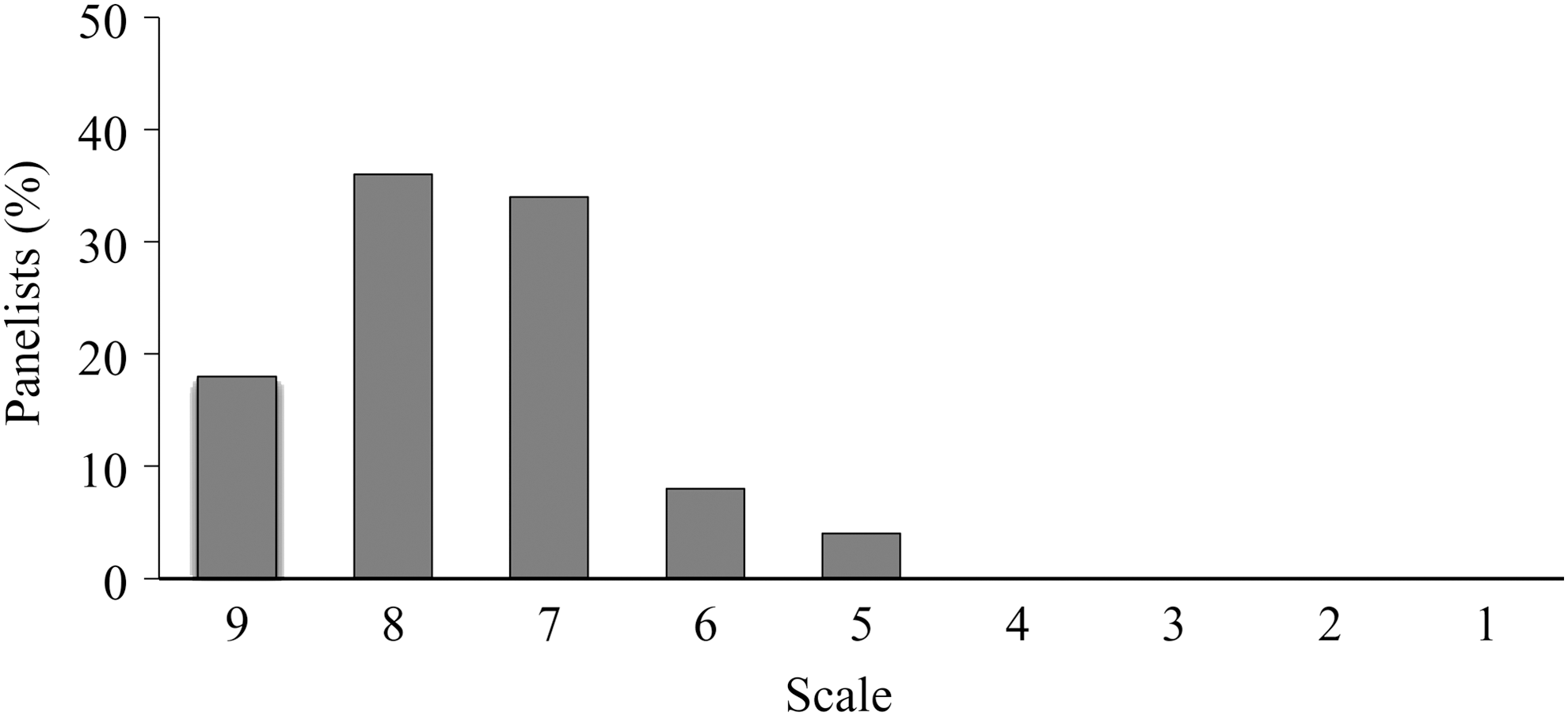
Responses for overall appearance acceptance to the nine-point hedonic scale; 1 - Dislike extremely, 2 - Dislike very much, 3 - Dislike moderately, 4 - Dislike slightly, 5 - Neither like nor dislike, 6 - Like slightly, 7 - Like moderately, 8 - Like very much, 9 - Like extremely.
Other studies have also confirmed the acceptance of the addition of Spirulina in different products, such as foods for athletes, 35 gluten-free bread, 56 pasta, 9 and snacks. 57
The sensorial analysis showed 72% of the panelists, in an intention of consumption panel, marked the option “Would eat frequently” or “Would eat occasionally”. The panelists' intention to consume the freeze-dried yogurt with Spirulina sp. LEB 18 added shows that the biomass of this microalga is an attractive and innovative alternative to enrich this type of food product.
In a study performed by Barkallah et al., the results of the hedonic scale showed the highest scores for yogurts containing 0.25% Spirulina. The yogurts developed with higher microalgae concentrations (0.75 and 1%) possessed lower sensory acceptability for all organoleptic properties compared to the control. 7 Contrary to this study, the panelists mentioned in the sensory evaluation sheet that the predominant flavor in the yogurt with Spirulina sp. LEB 18 was the green grape flavor, and they reported appreciating this taste, describing it as enjoyable and similar to yogurts found on the market. They also identified that the color blue-green of the yogurt was attributed only to the pigment constituents of the microalgal biomass, and there was good acceptance of the color.
Conclusions
The study revealed that there was no statistical difference in nutritional composition and antioxidant potential between freeze-dried yogurt fermented with Spirulina sp. LEB 18 and freeze-dried yogurt with added microalga. Freeze-dried yogurts developed with Spirulina sp. LEB 18 were similar in protein content, antioxidant activity, lactic bacteria count, and palmitic and stearic acid content when compared to yogurt without microalga addition. Besides that, the freeze-dried yogurt with added Spirulina sp. LEB 18 was accepted by the panelists, which shows that the addition of the microalga did not influence the acceptance of the product.
In this way, Spirulina sp. LEB 18 can be used to develop a freeze-dried yogurt with nutritional properties for those seeking health and well-being benefits. Moreover, the freeze-dried product with microalgal biomass added provides practical consumption for consumers, without the need for refrigeration during storage.
Footnotes
Acknowledgments
This study was financed in part by the Coordenação de Aperfeiçoamento de Pessoal de Nível Superior - Brasil (CAPES) - Finance Code 001.
Author Disclosure Statement
No competing financial interests exist.