




Abstract

Since the European Commission presented its Circular Economy Strategy and the related Action Plan “Closing the loop” in 2014 and 2015, a lot has been written both on the topic of circular economy alone and on the relationship between bioeconomy and circular economy. Several authors have suggested that both concepts should be fully integrated—or, in other words, that bioeconomy is simply one part of circular economy and should be treated as such. 1,2 While some of the publicly discussed concepts seem worth pursuing, some others do not hold up when put against the backdrop of economic, political, and physical reality. Others may be based on misunderstandings or oversights.
This paper aims to highlight the most important aspects related to bioeconomy and circular economy, clarifying some common misconceptions and addressing limitations we need to consider on our way to a “Circular Bioeconomy.” For this, the paper will first illustrate the different concepts of bioeconomy, circular economy, and cascading use, and will then delve into their relationships to each other: What are the overlaps between the concepts, what are the differences? How can one contribute to another and where can we use synergies? But also, what are the limitations to fully integrating the concepts into another and what do we need to pay attention to?
Definitions and Relationships Between the Bioeconomy, the Circular Economy, and Cascading Use
Bioeconomy
The bioeconomy encompasses the production of renewable biological resources and the conversion of these resources and waste streams into value added products, such as food, feed, bio-based products and bioenergy. 3
It promises to: i. introduce healthy, safe and nutritious food, resource efficient and healthy animal feed, new food supplements; ii. provide new chemicals, building blocks, and polymers and other materials with new functionalities and properties; iii. provide bioenergy and biofuels, replacing fossil energy; iv. develop new, more efficient, and sustainable agricultural and marine practices, improved bioprocessing and biorefinery concepts, and new process technologies such as industrial biotechnology; and v. deliver solutions for green and sustainable chemistry; thereby: vi. contributing to mitigating climate change through the substitution of petrochemicals by materials with lower greenhouse gas (GHG) emissions from cradle to grave and of fossil fuels by biofuels; vii. providing the most important renewable carbon source (biomass is the only source for renewable carbon, as long as the direct utilization of carbon dioxide (CO2) is still in an embryonic state); and viii. bringing new business opportunities, investment and employment to rural, coastal and marine areas, fostering regional development and supporting small-to-medium enterprises.
Especially new biorefinery concepts can contribute to an optimized utilization of biomass to reach these goals. The European Commission has encouraged that these biorefineries should adopt a cascading approach that favors highest value added and resource efficient products over e.g., bioenergy:
“Biorefineries should adopt a cascading approach to the use of their inputs, favoring highest value added and resource efficient products, such as bio-based products and industrial materials, over bioenergy and the advantages of the products over conventional products range from more sustainable production processes, to improved functionalities (e.g. enzyme-based detergents that work more efficiently at lower temperatures, save energy and replace phosphorus) and characteristics (e.g. biodegradability, lower toxicity).” 3
Circular Economy
In its Circular Economy Action Plan, the Commission defines the “circular economy [as the economic space] where the value of products, materials and resources is maintained in the economy for as long as possible, and the generation of waste minimized.” 4 The document sets a special focus on the efficient use of resources (economic and ecological) and not only on waste, which is treated as a resource, consistent with the previous European Commission policy. The Action Plan includes two sectorial priorities directly linked to the bioeconomy: food waste and efficient conversion of biomass: “Food waste is a key area in the circular economy and should be addressed at many levels along the value chain.”
The Ellen MacArthur Foundation, as a key player in this debate, developed comprehensive concepts and definitions on circular economy, which are mostly in line with the definition of the European Circular Economy Package. They present the circular economy as a restorative, regenerative model where “nothing is lost and everything feeds a new cycle.” 5
The differentiation between technical and biological cycles—shown in the famous “butterfly” figure 6 —could be quite misleading because biobased products seem to be entering only—or mainly—the biological cycle. In reality, the majority of biobased products enters the technical cycle (share, maintain, reuse, remanufacture, recycle) and only a small share enters the biological cycle (biodegradation). This is for a good reason; from a life-cycle assessment point of view, the biological cycle is often linked to higher GHG emissions than the technical cycle. 7
As an attempt to provide a comprehensive concept of circular economy that goes beyond the differentiation in technical and biological cycles—which cannot hold up in reality—nova-Institute (Hürth, Germany) has published an alternative illustration of material flows in the circular economy in 2017.
Figure 1 shows all kinds of material streams and their different utilization routes belonging to a circular economy. Organic recycling (biodegradation) and even the capture and utilization of CO2 from industrial processes or the atmosphere are included. At the top, there are all kinds of raw materials entering the cycle: fossil resources (crude oil, natural gas, coal); minerals; metals; biomass from agriculture, forest, and marine; and potentially CO2 emissions from industry. Biomass is used for a wide range of applications, which include food, feed, bioenergy and all kind of biobased materials and products. There are also additional raw material flows from manufacturing sidestreams and product recycling.

Comprehensive concept of circular economy. Biomass includes all kinds of biomass, from agriculture, forestry and marine environments as well as organic waste streams.
7
Color images available online at
The raw materials will be manufactured into products, traded, used, and then will enter the waste hierarchy from share/maintain, reuse/redistribute, remanufacture to recycling (mechanical and chemical), including most of the biobased products. Digested and excreted food products can end up in organic recycling, energy recovery or landfill. Biodegradable products add organic recycling (biodegradation, composting, carbon recycling through photosynthesis) to the end-of-life options and carbon capture and utilization (CCU), the recycling of CO2. The use of a landfill is the least desirable option. Most biobased products are potentially part of the circular economy; those parts usually called cascading are represented through the remanufacturing and recycling stages.
Some special features of the bioeconomy in the context of the circular economy should be mentioned here: • The bioeconomy provides renewable carbon to the industry and can directly replace fossil carbon in almost all applications—unlike minerals and metals. • It is a challenge to keep the value of biomass during cascading, which is much easier with metals and minerals. Thus, the circular economy is dominated so far by the metal and mineral industry. • Organic recycling as an expansion of circular economy still has to find its position and acceptance in the circular economy, e.g., through new legislation on fertilizers, including biobased ones.
The circular economy is still in an early stage, stronger on paper than in practice. Several recent articles indicate that this might still continue, since national policy makers cannot seem to find agreement on ambitious targets proposed by the European Commission and the European Parliament, respectively. 8,9
In December 2017, European Union institutions reached a provisional agreement with member states on crucial waste laws to accelerate the transition to a circular economy in Europe, with member states required to recycle at least 55% of their municipal waste by 2025; 60% by 2030; and 65% by 2035:
“The European Environmental Bureau (EEB) said that the new laws and targets will be crucial in supporting Europe to transition towards a circular economy, but regrets that member states slashed almost all targets proposed by a more ambitious European Parliament. Piotr Barczak, waste policy officer at the EEB said: “‘This is not the outcome we all hoped for, but it is nonetheless a significant improvement compared with the laws that are currently in place. We are happy the discussions are now over. Now member states and EU institutions need to build on this decision to fully transition to a circular economy. Member states lacked the ambition shown by the European Parliament and Commission throughout the negotiations, especially with regards to recycling and preparation for reuse.’” 10
So, it seems that circular economy policy is headed in the right direction, but moves slowly. Nevertheless, the circular economy has huge potential and is crucial for a sustainable world.
Cascading Use of Biomass
The cascading use of biomass is strongly overlapping with the concept of the circular economy and is mostly a part of it. In this respect, the Bioeconomy Strategy has been anticipating main concepts that were subsequently further developed in the Circular Economy Package, as applied to the biological resource. The main target of cascading and circular economy is an increased resource efficiency at less demand for fresh materials, with both of these frequently linked to added value and job creation.
One of the most comprehensive reports on cascading use was commissioned by DG Growth and published in March 2016. The study defines cascading use (with a focus on wood) as:
“‘the efficient utilization of resources by using residues and recycled materials for material use to extend total biomass availability within a given system.’ From a technical perspective, the cascading use of wood takes place when wood is processed into a product and this product is used at least once more either for material or energy purposes. In a single stage cascade, wood is processed into a product and this product is used once more for energy purposes; in a multi-stage cascade, wood is processed into a product and this product is used at least once more in material form before disposal or recovery for energy purposes.” 11
In some biobased sectors, cascading use has already been established for decades, many years before the term circular economy became mainstream policy. Examples include the pulp and paper or textile industries. A cascade comes into existence as a result of recycling and remanufacturing and is, as such, part of the circular economy and governed by the waste hierarchy (Fig. 1). However, the possibility for cascading is dependent on a point in time before the waste hierarchy applies—it depends on the decision of how to use the fresh biomass. It makes a huge difference whether the biomass is processed into materials/products or whether it is used for energy purposes:
“If a bio-based product is created from biomass, the waste hierarchy governs cascading use anyway—but not before. That means that the cascading principle closes the gap between biomass utilization and the waste hierarchy. It is a paradox situation: Before the biomass becomes a biobased product, incentives lead the biomass directly to energetic use, while after the biomass has been turned into a bio-based product, incineration is only the least preferred option in the waste hierarchy.” 12
Policy support for cascading use can be expected to grow in the context of the circular economy: “This combined with the circular economy initiative and resource efficiency agenda, sees a confluence of policy objectives and a real opportunity to embed the cascading use of woody biomass into EU policy and national and regional implementation.” 11
Overlaps and Differences Between Circular Economy and Bioeconomy
Strong Overlaps
The bioeconomy and circular economy share some of the same targets: a more sustainable and resource-efficient world with a low-carbon footprint. Both the circular economy and the bioeconomy avoid using additional fossil carbon to contribute to climate targets.
The circular economy strengthens the resource efficiency of processes and the use of recycled materials to reduce the use of additional fossil carbon (either embedded in the material or emitted during manufacturing/extraction processes). The bioeconomy substitutes fossil carbon by renewable carbon from biomass from agriculture, forestry, and marine environment (including byproducts and wastes). These are different but complementary approaches.
The Circular Bioeconomy is defined as the intersection of bioeconomy and circular economy demonstrated in Fig. 2, 13 which also lists the common topics. The overlap between different material sectors and the concept of circular economy is shown in Fig 3. 13
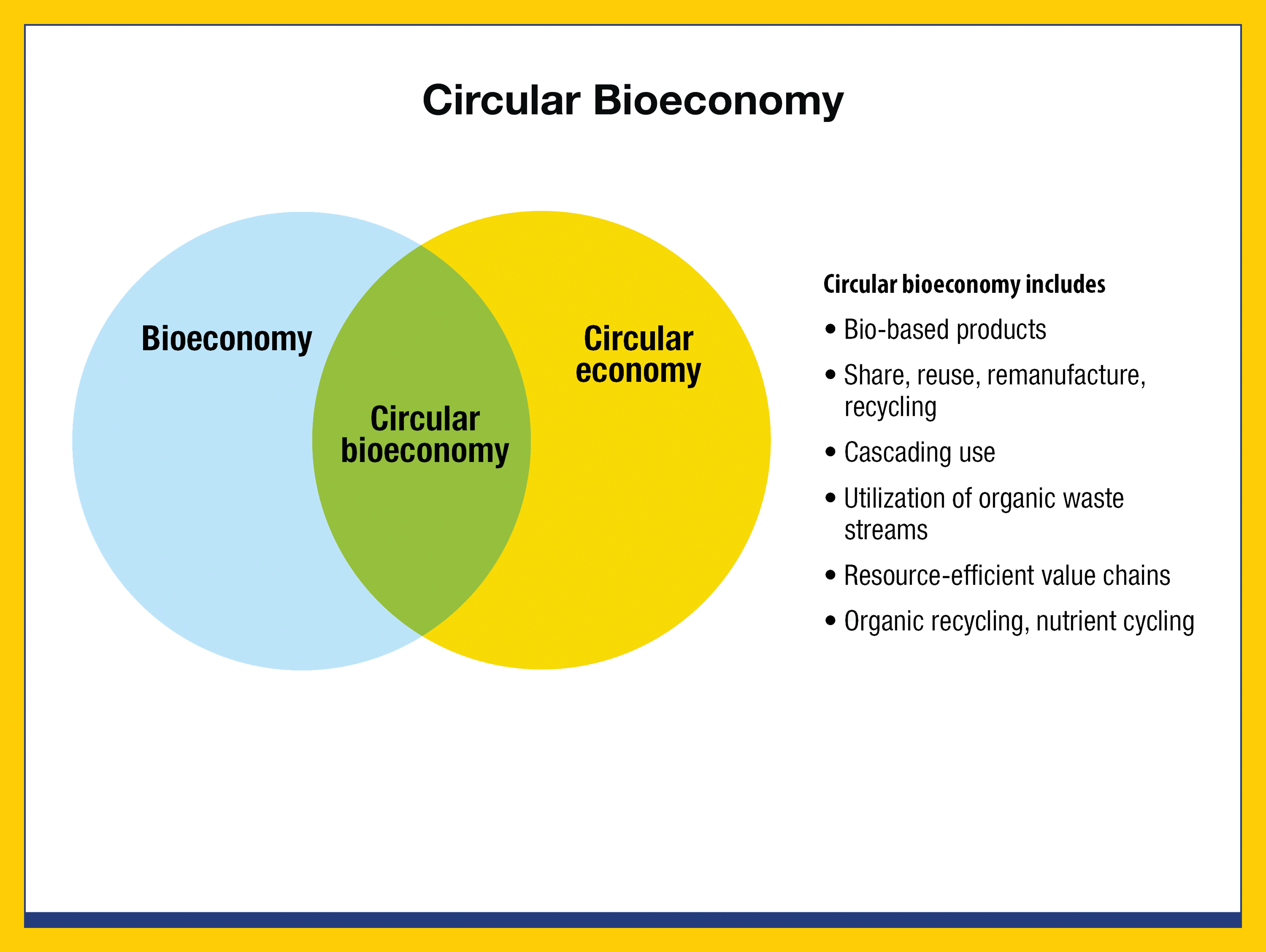
Circular bioeconomy.
13
Color images available online at
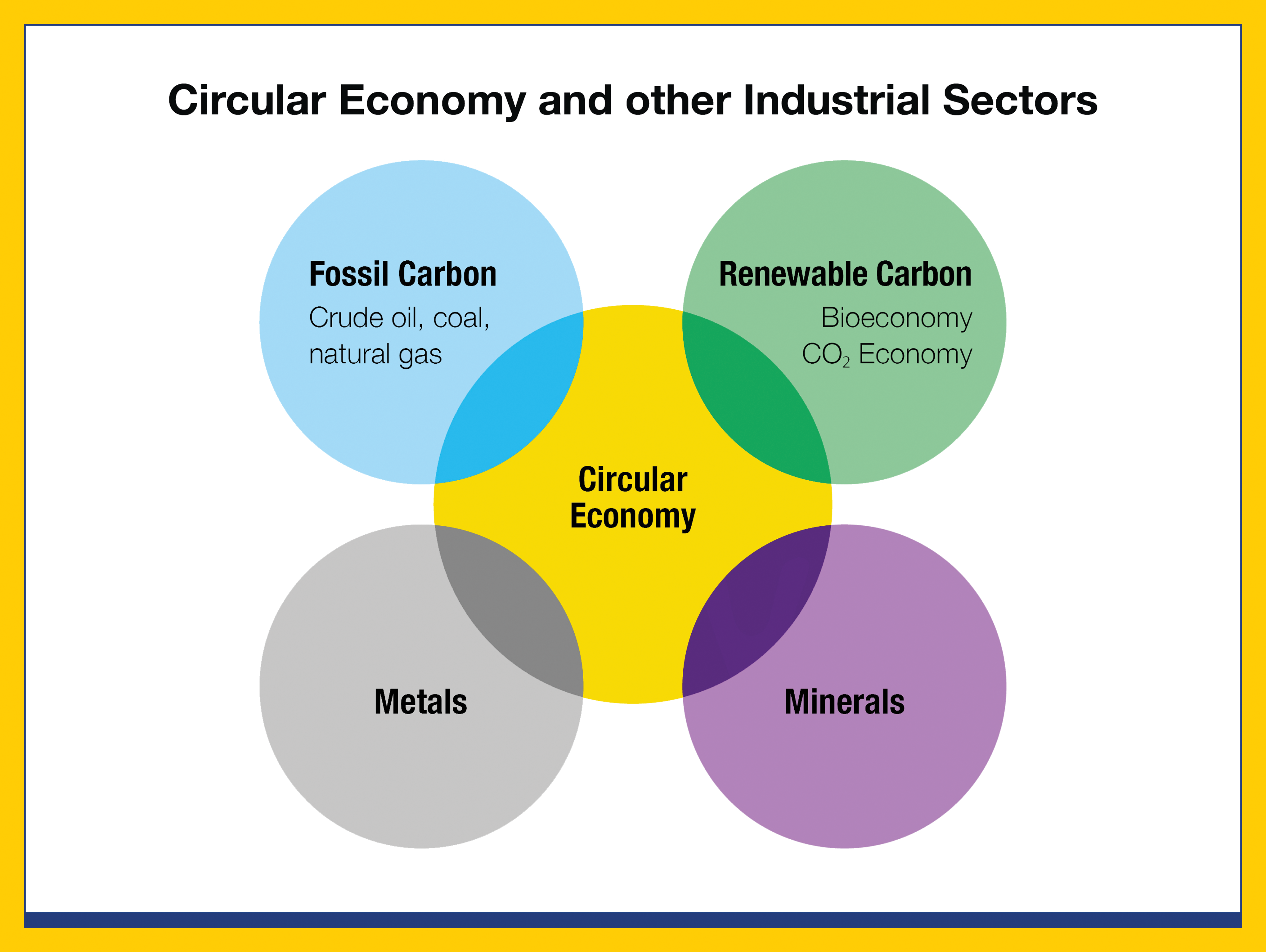
Circular economy and other industrial sectors.
13
Color images available online at
What do the concepts of bioeconomy and circular economy have in common?
• Improved resource and eco-efficiency
• Low GHG footprint
• Reducing the demand for fossil carbon
• Valorization of waste and side streams
Relevant Differences
Despite the similarities and overlaps, the bioeconomy and circular economy differ in a variety of aspects. The bioeconomy is not fully part of the circular economy, and neither are fossil carbon, metals, and minerals. The differences between the economic systems stem from various circumstances: i. At present, most of the material flows—fossil, biomass, metals, and minerals—are NOT part of the circular economy since the economic system does not yet sufficiently accommodate cascading and circulating mechanisms (Fig. 3). A large proportion of metals and minerals are not maintained in the economy, but lost in the environment or in landfills. Fossil and renewable carbon is mainly used for energy purposes (fossil, 93%; biomass, two-thirds), and, utilized in this way, it is lost for cascading use. Fossil- or biobased products often end up in landfills or the environment, so they are also lost to the circular economy. ii. Potentially, a large proportion of all materials can become part of the circular economy, and thus the overlap will increase as we advance in sustainability. iii. Some sectors of the bioeconomy will never be fully part of the circular economy: The impossibility for re-use or recycling is inherent in several applications; energy and fuels are the “dead ends” of carbon utilization, at least under the current conditions of circular economy (without CO2 utilization). But also, most detergents, cosmetics, coatings, and paints cannot be collected and recycled. For some of these applications, biodegradable solutions could be part of organic recycling in the future. iv. The concepts of the bioeconomy and circular economy ultimately pursue different main targets; while circular economy only focuses on “maintaining the value of products, materials, and resources in the economy for as long as possible,” many of the bioeconomy's elements go beyond this objective.
Regarding the inherent impossibility for re-use or recycling, it is interesting to look at some of the facts and figures of material use in the European Union. Fossil and renewable carbon are mainly used for energy purposes (fossil, 93%; biomass, two-thirds), and, utilized in this way, it is lost for cascading use. To be more exact, in 2013, the demand for biomass in the European Union (EU-27) was 1.07 billion tonnes dry matter. Food accounts for 10% (food waste is about 18% of this 10%, or 2% of the total), feed for 46%, bioenergy and biofuels for 19%, and exported biomass, 10%. Only 15% were used for biobased chemicals and materials with the theoretical potential of cascading use. 14 –16 Most detergents, cosmetics, coating, and paints cannot currently be recycled, therefore currently only about 10–15% of biomass utilization (including food waste) in the European Union is available to become the object of cascading use. For some additional applications, biodegradable solutions could enable organic recycling in the future.
The only way to increase this potential is to utilize an increased amount of fresh biomass as chemicals and materials, with the option of cascading after the end of a lifetime, instead of using high amounts of fresh biomass for bioenergy and biofuels. A circular bioeconomy should thus encourage the cascading use of biomass, where energy uses come in the last place.
Regarding the fact that our economic system does not yet sufficiently accommodate cascading and circulating approaches, it also needs to be kept in mind that keeping the value of biobased products is much more challenging than it is for metals and minerals.
Bioeconomy: Beyond Circular Economy
The concept of bioeconomy is much more than the biomass flow itself (Fig. 4). Important aspects of the bioeconomy, as well as important aspects of the other material sectors, are structurally outside the circular economy, which only focuses on “maintain[ing] the value of products, materials and resources in the economy for as long as possible” and increasing the eco-efficiency of processes. 4
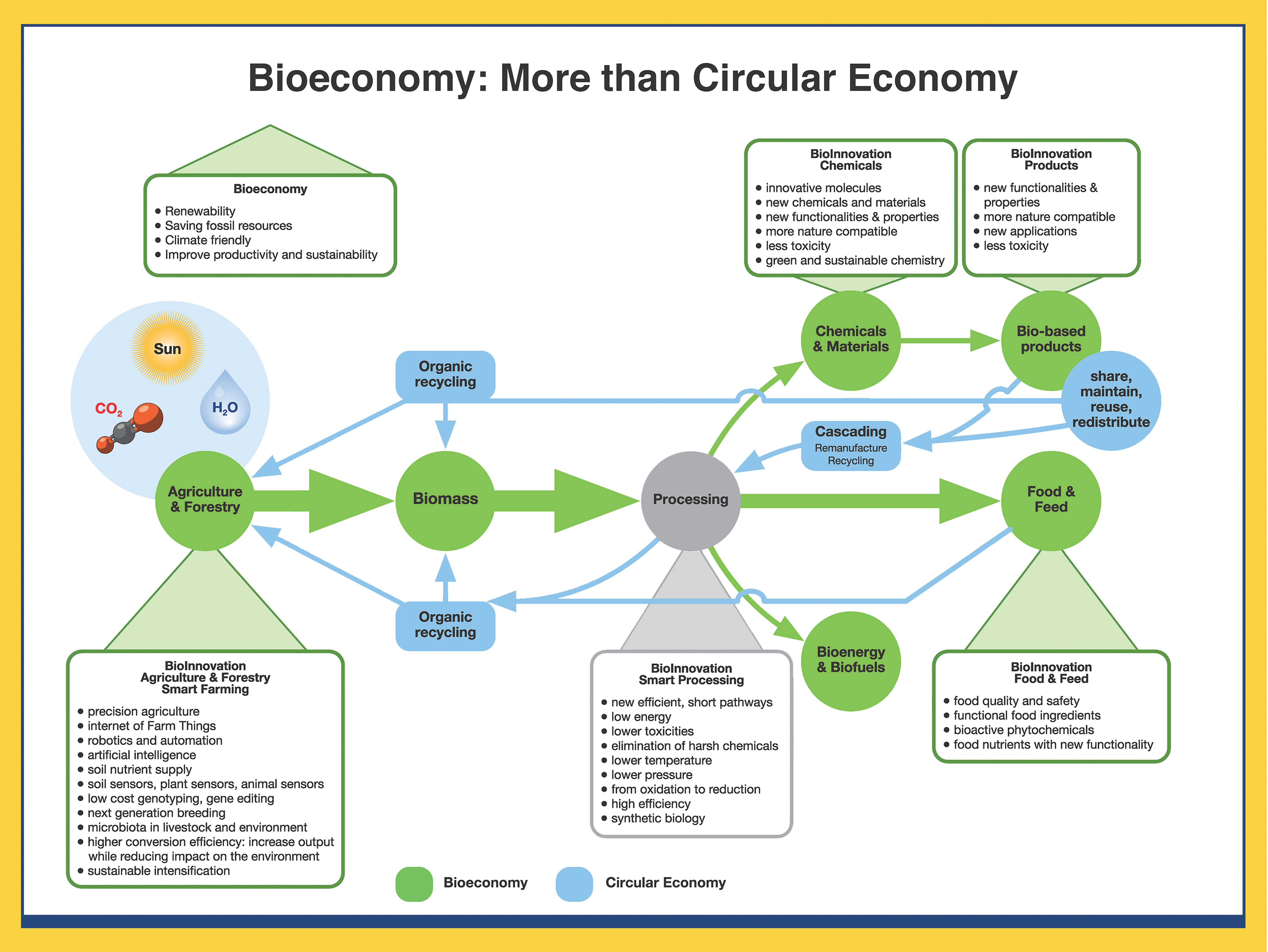
Bioeconomy beyond circular economy; Agriculture & Forestry includes all kinds of biomass, from agriculture, forestry, and marine sources as well as organic waste streams.
7
Color images available online at
Many elements of the bioeconomy go beyond objectives of circular economy, including aspects focused on product or service functionality (new chemical building blocks, new processing routes, new functionalities and properties of products). In Figure 4, the biomass flow (green) starts on the left side with solar radiation, CO2 and water utilized in agriculture, forestry (and also marine/fishery), and then continues via biomass, processing to food/feed, bioenergy/biofuels, chemicals/materials and finally to biobased products. By-products and biowaste can be utilized again in cascading and organic recycling (blue): These parts constitute the ‘Circular Bioeconomy’.
The green and grey boxes in Figure 4 show the specific features of the bioeconomy along the value chain, which are not covered by the concept of circular economy. This includes the new developments in agriculture and forestry (precision farming, gene editing), new processing pathways with lower toxicities and less harsh chemicals, biotechnology, chemicals and materials with new properties and functionalities as well as more nature-compatible, healthy biobased products (more details in the green and grey boxes).
Contribution of the Bioeconomy to the Circular Economy (and Vice Versa)
Summarizing the previous chapters, the concepts of bioeconomy and circular economy have similar targets and they are overlapping to a degree, but neither is fully part of the other nor embedded in the other.
It would be a great loss for the bioeconomy to be misunderstood as merely a part of the circular economy, which does not include certain crucial aspects of the bioeconomy (Fig. 4). 7 The bioeconomy research agenda, strategy, and policy will overlap with a circular economy strategy (for example in eco-efficiency of processes), but will always need additional and specific topics.
The circular economy is not complete without the bioeconomy and vice versa. The huge volumes of organic side and waste streams from agriculture, forestry, fishery, food and feed, and organic process waste can only be integrated in the circular economy through bioeconomy processes, while the bioeconomy will hugely profit from increased circularity. New knowledge-based processes (such as biotechnology, algae, or insects for food and feed), new applications, and new links between bioeconomy and other industrial sectors are needed.
The bioeconomy and circular economy can contribute in several ways to each other, including: • Utilization of organic side and waste streams from agriculture, forestry, fishery, aquaculture, food and feed, and organic process waste to applications such as aquaculture feed and all kinds of chemicals and materials; • Biodegradable products being returned to the organic and nutrient cycles; • Successful cascading of paper, other wood products, natural fibers textiles and many more; • Innovative additives from oleochemicals enhancing recyclability of other materials; • Once the critical volume of new, biobased polymers is reached, collection and recycling of bioplastics will become economically viable and attractive; • Linking different industrial sectors (food industries and chemical industry).
European Projects and Investment
In recent years, some new trends have become visible. These include developments in new value chains in the bioeconomy and circular economy. These are found in both food and feed, and forest and marine industries—for example linking food and feed side-streams to chemicals.
Food industry companies valorize their biogenic waste/side streams. This can be economically very attractive, but the huge potential had not been seen previously. The companies are first attracted by the circular economy and then become part of the biobased economy, 17 by activating additional biomass and feedstock for the chemical and other industries. Examples are the side streams of the milk, cheese, and alcohol industries to produce organic acids and biobased plastics; side-streams of olive and orange juice industries can be used for the extraction of high-value organic components; as well as proteins and fatty acids from the fish-processing industry.
The forest industry would allow a highly efficient side-stream utilization and cascading due to its well-developed infrastructure and experiences in cascading of paper. However, the barriers from the bioenergy and biofuels policy need to be overcome (non-level playing field for energy and material use), which only supports an energetic use of biomass and not a cascading use. 7 Side-streams of the pulp and paper industries can also be better valorized than was doable in the past due to technological innovation, while boards and panels from construction could be re-used to a larger extent.
Insects, bacteria, and fungi can transform food waste or agricultural/forest side-streams to food/feed or chemicals. Hence, bioeconomy processes are able to reintegrate “lost materials” to the circular economy.
The circular economy brings different industrial sectors together, linking their material flows. The knowledge-based bioeconomy can support this with special biobased processes, such as biotechnology and extraction, and organic recycling to utilize material flows, which could not be used with traditional processes. Thus, the circular economy can inspire companies to utilize new options and bioeconomy technologies—and vice versa.
Many of the research projects on these topics were supported by funding of the European Commission. Different Horizon 2020 (both Societal Challenge 2, SC2; and Bio-Based Industries, BBI) calls from 2014 to 2015 had the contribution of the bioeconomy to the circular economy as a focus. More than 40 projects could be identified to work in the overlap of bioeconomy and circular economy. Main topics were biowaste and side streams utilization from agriculture, food, wood, and fishery; CO2 utilization; and cascading and resource efficiency. The total costs of all 42 projects were €315 million (SC2: €93 million, BBI: €222 million). Including 2016, total costs were €415 million, out of which €157 Million could directly be allocated to both circular economy and bioeconomy.
Limits and Key Messages of the Circular Bioeconomy
Although cascading use usually increases the efficient use of resources, the direct connection to a reduced release of GHG emission is more complex. Emissions only decrease if those emissions caused by the collection, separation, and processing of the biowaste stream for another biobased product are lower than the emissions caused by sourcing and producing another virgin biobased product. However, there is no general rule for this. In some cases, after cascading stage two or three, the additional energy needed for processing, etc., cannot justify an additional use. Sometimes even any material re-use at the first stage is inefficient. In other cases, for example pulp and paper, even long cascades show positive effects. Using renewable energy, including bioenergy, will make more cascading stages justifiable from a GHG footprint perspective. For a comprehensive sustainability assessment of a cascade, a full life cycle assessment is crucial:
“LCA is a comprehensive tool to assess the environmental impacts of products, end-of-life treatments and also economies at the level of society. LCA is therefore a tool that is suitable to assess the environmental performance of circular product designs but also large-scale changes, for example the movement towards a more circular economy. The ultimate goal to lower environmental impacts is common to LCA and the CE concept. In cases where LCA results contradict the CE ideas, as shown in the presentation examples, the circularity should not be enforced. It is crucial, however, to also assess systemic changes, such as the restructuring of the energy sector for future system evaluations.” 18
Moreover, additional limitations exist. Along the cascade, products can accumulate toxic or critical substances, which can serve as barriers for further recycling or even incineration. It is important to keep in mind that the overall result must not be the maximization of cascading as such, but the optimization of the overall outcome in terms of ecoefficiency. In practice, the biggest issue is the legal framework which regulates the sequence of the use of biomass, especially if economic or market demand aspects are not in line with the cascading principle. Several recent articles have pointed out that some of the policies discussed in the frame of “waste to energy” and especially within the renewable energy arena run the risk to counteract the waste hierarchy. Public subsidies for waste incineration make it economically more attractive to burn waste instead of recycling it. And if the waste is biogenic, member states can even fulfill their renewables obligations by incinerating it. In some member states, waste incineration capacities have been developed at such a large scale that they already experience waste shortages—making it very probable that waste reduction and valorization in other value chains will not happen. 19 –21
Key Messages for Implementation
• If climate change mitigation is the priority, cascading chains with long-time carbon sequestration should be prioritized.
• The creation of “wrong” incentives that make energy use more attractive than material use should be avoided.
• Regulation should consider that a preferential cascading use will release all of the biomass for bioenergy use again. There will only be a delay because the biomass is stored during the lifetime of the products along the cascade.
• Energy is needed to produce any type of biobased product, at whatever stage of the cascade. Given the objective to reduce the use of fossil fuels, this means that renewable energy (including bioenergy) should be preferentially used to produce biobased products.
• In the future, the demand for feedstock for biobased products will grow much faster than the demand for bioenergy (materials worldwide: 3–4%/year; Europe: 1.5–2%/year; energy worldwide: 1%/year; Europe: almost no increase).
• The cascading principle can only work with good data on biomass flows and a good logistics system connecting the different sectors.
• In the case of residues from agriculture or forestry, the circular economy should also consider the use/need of such biomass for soil management (i.e., fertility and protection) and/or animal feed.
• There can also be other impacts on side stream utilization from the circular economy/cascading use. It should be considered whether the side stream already has had a previous application. Substituting one utilization with another can lead to unwanted economic and ecological effects.
• The oceans and seas offer huge potential for the cascading use in the bioeconomy. A few of many examples include the use of fisheries discards, algal biorefineries, seaweed farming, the multi-use of marine space in off-shore platforms, zero-waste and circular aquaculture, new products from jellyfish, and new pharmaceuticals from marine ecosystems.
In summary, applying the most eco-efficient sequence of the use of biomass depends on the global policy framework, as well as the local circumstances, such as local supply and demand and infrastructure.
In conclusion, the concepts of bioeconomy and circular economy have similar targets and they are overlapping to a degree, but neither is fully part of the other nor embedded in the other.
The Circular Bioeconomy is defined as the intersection of bioeconomy and circular economy.
It would be a great loss for the bioeconomy to be misunderstood as merely a part of the circular economy, which does not include certain crucial aspects of the bioeconomy. The bioeconomy research agenda, strategy, and policy will overlap with a circular economy strategy (for example in eco-efficiency of processes), but will always need additional and specific topics.
Footnotes
Michael Carus, Dpl.-Phys, is Managing Director, nova-Institute for Ecology and Innovation, Chemiepark Knapsack, Industriestrasse 300, 50354 Hürth, Germany. Phone: +492233-48-14 40; Fax: +492233-48-14 50; Email: