




Abstract

When we at Concentric talk about catalyzing innovation, we discuss the need to educate growers in the same breath. In our work with high-value produce and row-crop growers throughout the Americas, we find that most are unsure how to incorporate microbial and plant nutrition inputs on their farms.
We can't expect our growers to be microbiologists. It is our job to advise them about when, where, and how to use our products, how to mix them correctly with standard farm nutrients, and on which crops they are likely to be most beneficial. Without reliable information, they are unlikely to realize the yield increases, improved soil health, and cleaner groundwater that microbial products deliver.
To that end, we have dedicated time and money to hundreds of multi-year field trials that give us real data, and guide our growers in the best use of our products based on their crop focus and geographic constraints.
Testing Impact on Strawberry Yield in California
Many of our trials, such as one we completed in Oxnard, California, are designed to evaluate how our microbial and plant nutrition technologies impact yield. In this trial, we tested our product with organic strawberries, which tend to present multiple challenges to growers, but are highly desired by consumers.
We designed a trial to evaluate adding a biologically based product in an organic system to evaluate strawberry yield. Concentric contracted with an independent researcher, Holden Research, to conduct a replicated trial in organic strawberries. The primary control (or baseline for yield) was the standard grower practice in this area for organic inputs such as fertilizers, irrigation scheduling, and pest control. There were six replications of each treatment, all experimental units and treatments being assigned in a randomized complete block design. The Concentric treatment consisted of using 1 gallon per acre per month in addition to other inputs in the organic strawberry system. This trial showed that our product works well in organic strawberry production, as we were able to increase yield by 31.8%, along with some decreased mortality and improved harvest quality of strawberries (Fig. 1).

Strawberry trial with Holden Research (Oxnard, CA).
The graphs in Fig. 1 show the cumulative yield of Concentric-treated strawberries, the marketable production percentages, and cumulative marketable production and net return by pick day. The bar graph shows the total yield per acre by treatment.
How Biology Can Help with Environmental Issues
Many areas of the U.S. have higher than optimal nitrates in groundwater supplies. Some places are looking to tackle this with potential regulations. The state of California has been debating how, when, and where to regulate synthetic nitrogen fertilizers due to increased concerns over nitrates in groundwater supplies. 1 Based upon this potential regulation looming on the horizon, as well as growers' concerns for the nitrogen fertilizer they use, and the desire to be increasingly environmentally friendly, growers are looking for alternatives.
We designed a field trial to evaluate adding a biologically based product combined with fertilizer applications (standard and reduced nitrogen fertilizer amounts) to evaluate lettuce yield. The basis for this trial is simple in theory; with reduced nitrogen inputs there will be less nitrate making its way into groundwater. The trick is showing that yield levels can be maintained at similar levels compared to grower standard practices today.
Concentric contracted with an independent research firm, Pacific Ag Research, to conduct an extensive multi-treatment replicated field trial in lettuce in the Salinas Valley in California. The primary control (or baseline for yield) was the standard grower practice in this area (and by the producer whose land the trial was conducted on) for inputs such as fertilizers, irrigation scheduling, and pesticides. One of the treatments added an Concentric product once per month to the fertilizer regime (weekly or biweekly) in the lettuce crop. The irrigation and fertilizer (and Concentric product) were delivered through a complex manifold valve system and numerous drip lines running throughout the field. There were six treatments in all, each treatment having a dedicated manifold valve and drip tube line running to each replicate of the treatments. There were six replications in the field for each of the six treatments, all plots and treatments being assigned in a randomized complete block design. Table 1 gives the standard fertilizer regime as well as details on each individual treatment. Lettuce is a very nitrogen-intensive crop; the total amount of nitrogen applied in this trial was 168.5 pounds per acre.
Lettuce Standard Fertilizer Program, Individual Treatments, and Application Timings
IN-M1 is marketed as Golden Solution® in the U.S. and Synergro™ in Canada.
Each individual plot was 40 feet in length. All heads from each plot were harvested and graded as cull, small, medium, or large size rating, as well as calculations for number of boxes per acre and total marketable weight per acre for the lettuce crop. The bar graph below shows the total yield per acre by treatment. Error bars are included to show variability of the field. While there is certainly a large amount of error in this one yield trial and no treatments are statistically significant (p = 0.1), there are some clear trends. The table also shows the percent yield of each treatment relative to the grower standard.
As expected, as you reduce nitrogen, you reduce yield Fig. 2 . Concentric added to the grower standard increased yield a modest 4.5% (Table 2). Reducing nitrogen amounts from grower standard by 10% plus the addition of Concentric kept yield loss to under five percent. Even when reducing nitrogen levels by 20% to the grower standard, with the addition of a biological product such as Concentric we are able to maintain yield loss to roughly 10% of total yield. When reducing nitrogen by 30% relative to the grower standard you see a yield loss of nearly one-third of the entire crop. However, with the addition of a biological product such as Concentric, this yield reduction, even with 30% less nitrogen, is greatly mitigated to around a 10% percent overall yield reduction.
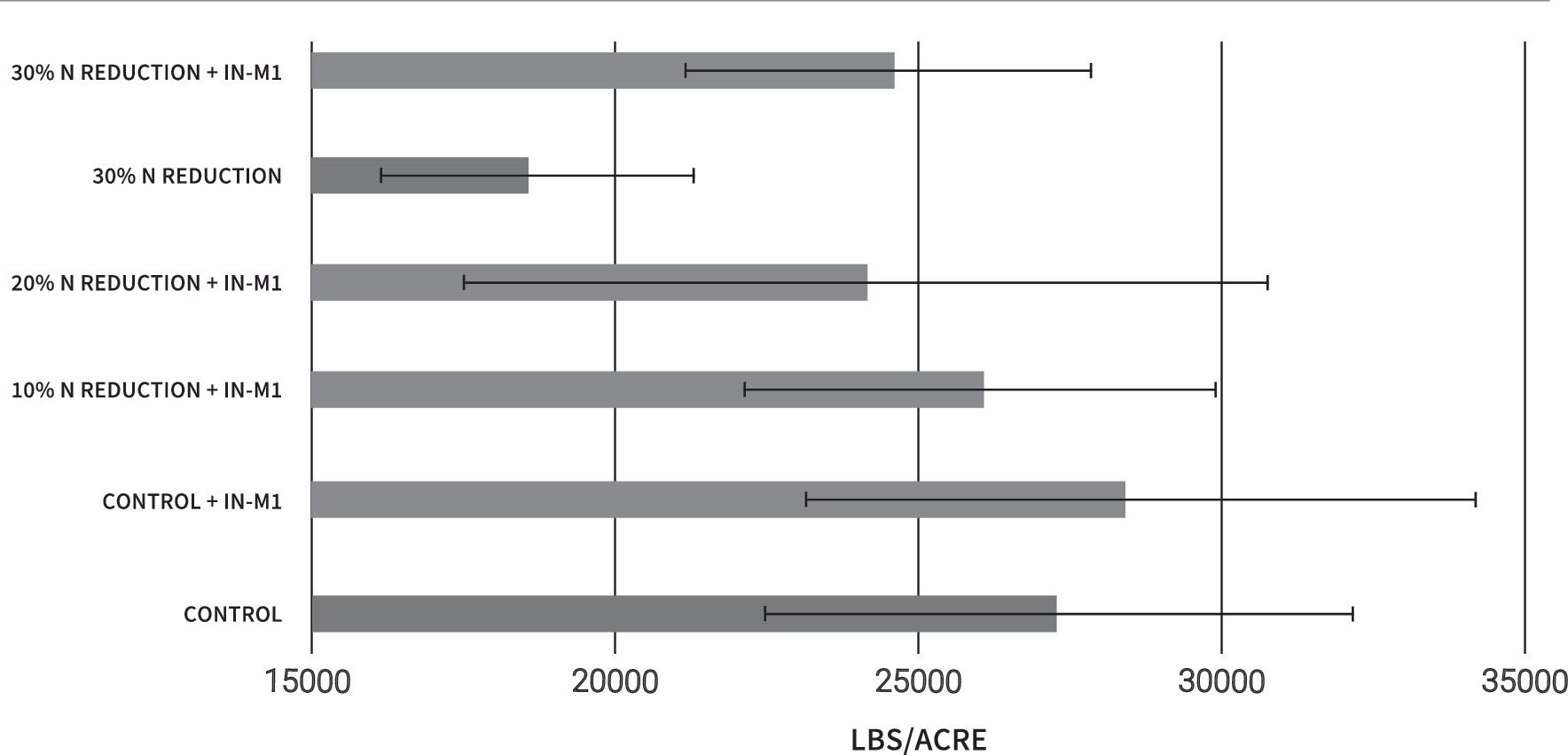
Total lettuce yield (lbs/acre) with reduced nitrogen and Concentric product.
Lettuce Yields (lbs/acre) and Yield Relative to Grower Standard Fertilizer Program
Any yield reduction is not good, though with the addition of a biological product we are able to keep the yield level similar to the grower standard, or greatly mitigate the yield loss. While nitrogen is relatively inexpensive, these nitrogen reductions may not make economic sense for the grower. However, when the environmental effects and/or potential legislation regulating nitrogen applications come into play, these yield levels relative to the grower standard while reducing nitrogen inputs are very exciting. Further trials of this nature are certainly justified and needed to further evaluate the ability to reduce nitrogen levels and maintain yield levels or mitigate yield losses.
Conclusion
We look to challenges like this as a great opportunity to put biology into action to help us grow more calories with the same amount of inputs, or grow the same amount of calories using fewer synthetic inputs as a whole. As we further refine our understanding of soil microbiology and how the entire phyto-microbiome relates to itself and to specific crops, we will certainly come up with newer and even more efficacious biological treatments and products. Current and future biological products certainly hold a promising and very important place to help us maintain or improve yield as we look to increase food production with current practices, or decrease our overall use of synthetic inputs and maintain yield.
We must strive to continually find more sustainable ways to increase crop yields, regardless of the technology used. Not everything synthetic is inherently bad, just the same as not everything organic or naturally occurring is automatically good. Blindly labeling any tool or technology in such a fashion does our entire global food production system a disservice. Production systems utilizing only synthetic or only organic/naturally occurring tools and technologies are not optimal, with respect to overall yield, environmental impact, and long-term sustainability. The question should not be how do we eliminate or use only one system entirely, but rather, how do we use all the tools at our disposal, all the new technologies, equipment, methodologies, and our many years of experience and knowledge, to not only continue our current calorie output, but to also increase it, now and for many years to come?