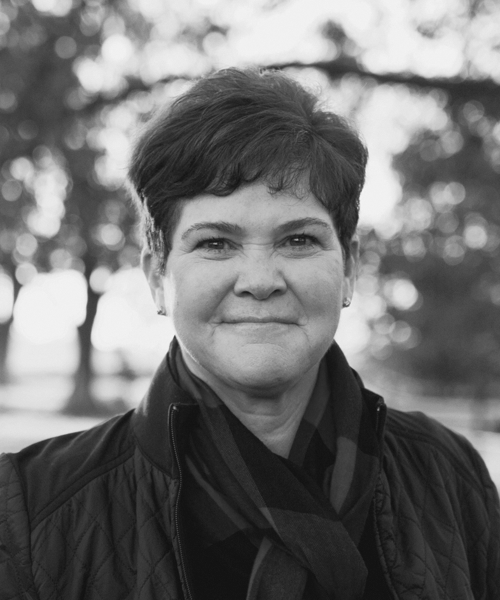
INDUSTRIAL BIOTECHNOLOGY:Krysta, congratulations on receiving the 2018 Rosalind Franklin Award for Leadership in Industrial Biotechnology and Agriculture. As Chief Sustainability Officer at Corteva Agriscience, Agriculture Division of DowDuPont, you lead the company's public policy and government affairs strategy, in addition to its sustainability, philanthropy, communications, and ag development. Your career has also spanned jobs as deputy secretary of the US Department of Agriculture, where you helped shape food and agriculture policy and expand opportunities for women, young people, immigrants, socially disadvantaged producers, returning veterans, and retirees. You also founded USDA's Women in Agriculture Mentoring Network, which supports and engages women across all areas of agriculture and fosters professional partnerships between women with shared goals.
We like to share with our readers the human side of innovation and innovators. Can you talk a little bit about how your career unfolded and led you to your current role at Corteva Agriscience?
KRYSTA HARDEN: I grew up on a farm in southwest Georgia. So that's the beginning of everything for me, where I came to really understand the difficulties of agriculture, the need for new solutions, and the importance of science and technology.
I didn't study agriculture or science. I went to the journalism school at University of Georgia, and then came to DC really to be involved in politics and policy. Pretty quickly I got involved in agriculture on the House Ag committee. When I left, I was looking at renewable fuels and biodiesel. That was really how I cut my teeth in the soybean industry. I worked for about 11 years with that industry. It was the early days of the biodiesel industry, with the first tax credit and the inclusion in EPAC. But when I look at the growth of that industry, I realize that it's come a long way but is still only in its early stages.
Conservation, sustainability, and stewardship for land owners are passions for me and led me to USDA under President [Barack] Obama. I was very fortunate to start out with Secretary [Tom] Vilsack at USDA. I was able to build on that relationship and ended up as Deputy Secretary, where I really had the whole view of management of the department but also was able to focus on areas that were important to me.
IB:Can you talk about your role at Corteva Agriscience and how the group maintains an innovation ecology?
HARDEN: Increasing innovation in agriculture was one of the driving forces for the merger of Dow Chemical and DuPont and commitment to split into three companies—to have resources to look at the problems that farmers, land owners, and renters are facing on the ag side and look for solutions. To have a more robust effort for our pipelines, encompassing the emerging technologies of Dow, Dupont, and the Pioneer seed company. I'm the Vice President, Head of External Affairs, but also Chief Sustainability Officer, which really focuses my thinking about Corteva Agriscience as an emerging new, pure-play, publicly traded ag company and what that responsibility means for sustainability.
IB:What are the top few scientific or technical challenges that Corteva Agriscience must address for successful deployment of industrial biotechnology and agricultural technology?
HARDEN: I think there is a lot of resistance sometimes from consumers not recognizing that our technologies address problems and make enhancements that will actually benefit them as a consuming public. We just haven't done a very good job explaining that as an industry—explaining why we make these investments in science. Biotechnology is critical, clearly on the food side if you think about getting more from every acre. And sometimes that can mean farming in a different way with different commodities. Science is going to help us figure that out. Science is also going to help us preserve natural resources. Soil health is so critical in making sure that farmers have the ability to produce food for the growing population. So everything that we do addresses the changing climate and considers the demands of farmers, rangers, and land owners in producing food—whether that is happening in the US, or by a small shareholder in Asia or Africa. They all need solutions, and we want to be a part of those solutions. For the consuming public in developed nations like the US and Western Europe, agriculture needs are about convenience, shelf life, and less food waste. So we are investing in technologies that can help answer some of these problems, whether it's potato blight, or citrus greening in oranges, or mold on strawberries. Technology and science are going to be needed. So Corteva Agriscience is investing in gene editing and CRISPR, which are breakthrough biology tools to help find some of those answers.
IB: Can you talk about policy opportunities and challenges?
HARDEN: It's an interesting time right now in agriculture. Economically, it's a difficult time for our customers. Agriculture is certainly cyclical and you're seeing a trough. The trade situations we're in and how policy is made, may or may not enhance or possibly hurt certain sectors. The pork and soybean industries are very important sectors for the US agricultural economy, and uncertainty is the last thing you want in agriculture. There is already so much uncertainty innate to agriculture because of Mother Nature. You need stability in programs and policies; you need markets, you need to know where you're going to be able to sell. We can compete with the world, I'm convinced of that. But US farmers need a fair, balanced approach to policy. And for us, we need certainty of knowing that you can get products approved and can enter some of these markets that need solutions.
IB:How does life cycle assessment and sustainable development play a role in your work at Corteva Agriscience?
HARDEN: I think all of us in Corporate America have responsibility for our own footprint, whether you're looking at greenhouse gas emission and energy use. These are critical elements of environmental footprint for us as a company. But we also have to think about our products as tools for our customers and having those tools be sustainable. So it's clearly an area that we focus on both on the operational side and on the customer side. A big part of our effort is making sure we are good corporate citizens no matter where our facilities are located. But we also consider: Are we providing products that help our customers be better stewards?
IB:How have you seen the opportunities for representation of women change at the level of bench scientist up through management?
HARDEN: I think we are doing better. I think there's been a lot more focus. Dr. Rosalind Franklin was not recognized for her significant contributions. Really game-changing contributions by women were just not recognized at the time. But in my acceptance speech, I gave an example of a woman who felt the same way just 3 or 4 years ago.
I do think that more women are coming into STEM careers and they're starting to see that they have role models. There are women in these companies, in academia, in government. It just has to be a conscious decision in these organizations, to want diversity of thought. We want diversity of background, of talent, of interest. We still have to find a way to create career paths for women who may be on a different timetable than Corporate America. We have make that commitment to continue to promote women and work to retain women.
Recently a young woman at Corteva Agriscience got a big promotion and I could hear this collective cheer across our company. That's real progress. There are steps being made, but we're not completely there yet.
IB:What advice would you pass along to young women just starting out in this field?
HARDEN: To do what you love. And love what you do. And that it's worth it; it is worth the challenge and it is worth the sacrifice. Stay focused and know yourself first. Nobody's a better advocate for you than you. And there are a lot of us who've been on this path longer who want to help you. We'll have your back!
Editor's Note: The following text is excerpted from remarks delivered by Krysta Harden on receiving 2018 Rosalind Franklin Award for Leadership in Industrial Biotechnology and Agriculture, from the Biotechnology Innovation Organization (BIO) at the BIO World Congress, July 28, 2018, in Philadelphia, Pennsylvania.
What a wonderful honor. I would like to say thank you to the Rosalind Franklin Society, BIO, to my company, and to my colleagues. I would especially like to thank Corteva Agriscience's COO, Jim Collins for coming, and my friends in the biodiesel industry. I learned so much about renewal fuels from you all and I appreciate you being here as well.
I'm not a scientist, as you just heard, and I don't even play one on TV. But I have been at that intersection of policy and science my entire career. It is women like Dr. Franklin and men who have really helped me understand the importance of solving problems through science and technology. And I am very fortunate to work for a company that continues to recognize the contributions of women. I think about all the young women who I work with now, and women across the world who frankly are dedicating their lives and their careers to finding solutions to problems and turning challenges into opportunities—and I thank them. I accept this award on behalf of all of them because it's never about just one person. It certainly has not been in my career.
But I'm reminded that it's not always a positive story. There's still women struggling for recognition, to be appreciated, and to have their work valued in this field. When I was thinking about this honor, as humbling as it is—and it truly is—I wish I could duplicate it for those who deserve it even more. One woman in particular comes to mind. I was once giving a speech about women in agriculture at a big conference, and this woman came up to me afterwards and thanked me for my remarks. She said how much she appreciated it but wanted to know if I'd listen to her story. And I, of course, was very excited to do so. She had told me that she had led a team of researchers at a company and their work created a breakthrough. I won't give you specifics because you might figure it out.
She was not surprised that, after many years and years of work, the results were presented by her male boss to the CEO and to company's Board. She kind of assumed that might happen. She knew that she would at least get a little recognition, and she was included in a group photo afterwards. She was smaller so she was kind of relegated to the end. And when the photo got into the annual report, it had been cropped—she was actually cut out of the photo! Her name was buried at the bottom of the story and she was not recognized as the lead of the team for all those years, working on this breakthrough. She said to me, “You know, I don't need the thank you. I didn't need the recognition.” Like so many people, she was humbled. She said, “My family knows. I know. My colleagues know. But what hit me was how easily it is to be overlooked. With my pedigree, coming from some of the finest universities in the world. My experience, my hard work, my dedication, my commitment to this project and it was so easily, just to be buried in the bottom of the story.”
And I felt like we were talking about Dr. Franklin. Hard work is not always recognized as it should be. It is not always appreciated. It is not always valued. So I am pleased to work for a company and for an industry that is making an effort to change that. This is a great honor for me. It is a great honor for all the women, whether they are in fields, or labs, in classrooms, in offices, and boardrooms, who are making a difference for all of us. Thank you very much.