




Abstract

Introduction
The chemical industry is faced with enormous challenges in meeting the climate goals set by the European Commission and the sustainability expectations held by societies around the globe 1 —the demand for energy must be further reduced through optimized processes and met by renewable energies. The products' sustainability during their use phase as well as at their end-of-life must be improved. A stringent circular economy needs to increase resource efficiency, decrease raw material consumption and minimize ecologically harmful loss pathways (“microparticles”). “Political ambitions of such a nature require a shift in paradigms which must be supported by technological breakthroughs.” 2
However, something which is inextricably linked with the above challenges is oftentimes ignored: The chemical industry may only develop into a sustainable sector once it bids farewell to fossil raw materials such as crude oil, natural gas and coal for good and uses nothing but renewable carbon as a raw material in organic chemistry.
However, it is not decarbonization, as it is quite reasonably called for in the energy sector, that will help this industry. After all, organic chemistry cannot be decarbonized, as it is entirely based on the use of carbon. This also includes the plastics industry—the modern world is inconceivable without its versatile polymers unless you are prepared to accept considerable sacrifices or higher greenhouse gas emissions. 3
The equivalent to decarbonization in the energy sector is a transition to carbon from renewable sources in the chemical and plastics industries. Only a full phase-out of fossil carbon will help prevent a further increase in CO2 concentrations. All of the fossil carbon extracted from the ground will sooner or later be released into the atmosphere where the CO2 concentration will go up as a consequence.
Current political and public discussions primarily weigh up the pros and cons of bans, rules and taxes for a whole variety of plastics and chemical applications—oftentimes this is only tantamount to gesture politics. The major goal of transitioning the chemical industry to renewable carbon is often lost sight of, even though this may help solve many problems in a systemic manner. Apparently, politicians and the general public cannot see the wood for the trees.
Climate expert Joachim Schellnhuber who is with the Potsdam Institute for Climate Impact Research said in an interview with Süddeutsche Zeitung daily newspaper published on 15 May 2018: “A strange kind of calmness is still prevailing. We are headed towards an uncontrollable global situation at a mindboggling speed, risks basically multiply every hour, but a lot of media only cover the developments in an agonizingly trivial manner. The World Bank has just published a report saying they expect 140 million “climate refugees” by 2050 within the affected countries alone, i.e. without cross-border migration.”
He believes this ignorance results from something called “cognitive dissonance”: “When you are confronted with an enormous problem and have no clue about how to get a grip on it, you just ignore it. Or you even intensify your inappropriate behavior.” If we do not get a grip on climate change, there will be no more need to discuss a ban of disposable crockery or the land use for biomass production, because matters like that will simply be relegated to footnote status.
In a range of studies scientists have calculated exactly how much more fossil carbon may be extracted from the ground until the climate goals must be abandoned. For instance, in a paper published by Nature magazine, Christophe McGlade and Paul Ekins write: “Our results suggest that, globally, a third of oil reserves, half of gas reserves and over 80% of current coal reserves should remain unused from 2010 to 2050 in order to meet the target of 2°C.” 4
As long as the chemical industry continues to use fossil carbon, it will add to the greenhouse effect in an increasingly significant fashion. While the non-energetic or material use of crude oil amounts to 8% (including asphalt) of its overall use today, experts expect that figure to grow to roughly 30% by 2050. There are two main reasons for this estimate: the sharp increase of solar and wind power will reduce the demand in fossil energy carriers, and the growing number of electric drive vehicles will slow down the demand in fossil fuels. In the field of chemicals and plastics, however, most market observers expect the production to increase globally by 3–4% each year as demand in furnishings, clothing, transport and packaging is set to grow strongly due to a rise in the global population and improved standards of living.
Then again, this also means that the chemical industry's share of greenhouse gas emissions will further grow in spite of comprehensive improvements in efficiency, and as a consequence public attention will undoubtedly increase. Only a clear strategic focus on renewable carbon will prevent further damage to its reputation—or may even help the industry to show itself in a more favorable light than before.
Renewable Carbon—Recycling, Biomass, and Direct CO2 Usage
There are only three sources of renewable carbon: Renewable carbon from recycling of already existing plastics and other organic chemistry products (mechanical and chemical recycling); Renewable carbon gained from all types of biomass; and Renewable carbon from direct CO2 utilization of fossil point sources (while they still exist) as well as from permanently biogenous point sources and direct air capture.
All three sources are essential for a complete transition to renewable carbon, and all of them should be similarly used by the industry, supported by politics and accepted by the population.
Strictly speaking, you could try to establish that distinction. But we prefer to continue talking about renewable carbon in all three sources—above all because a real distinction is hardly possible. CO2 from direct air capture is certainly not recycled carbon: the technical plant uses the same CO2 as plants or trees. On the other hand, it is usually said that in bioeconomy, CO2 is used in a circular fashion (Fig. 1). Which means that after all, biogenic carbon is also recycled carbon. Do algae fed with fossil CO2 from power plants supply recycled or renewable carbon? And what about mechanically recycled biobased plastics? Are they recycled or renewable? These discussions make little sense.
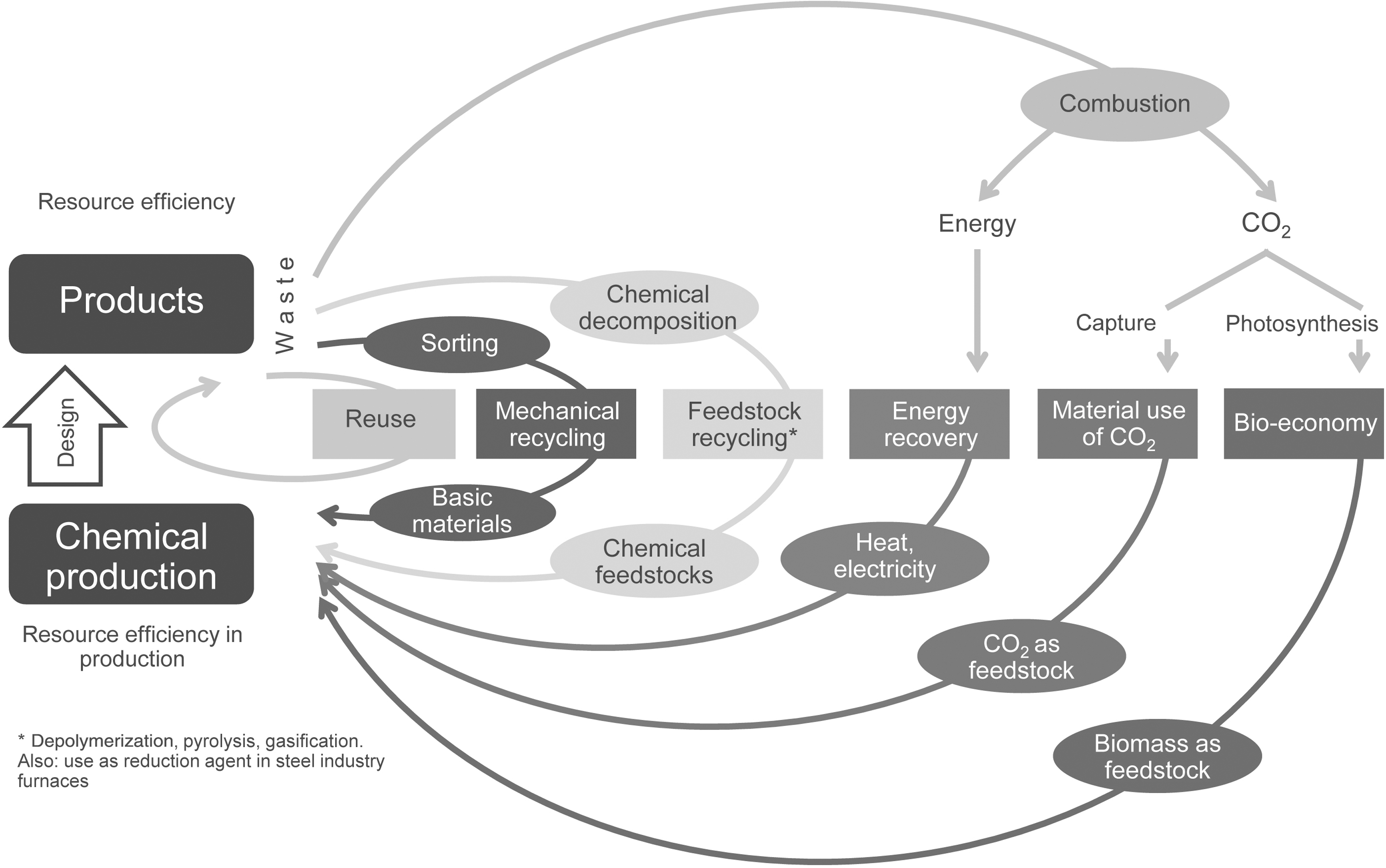
Circular economy: Possible loops in the chemical industry. Source: Utz Tillmann, Director General of VCI, at the Opening Press Conference of ACHEMA on June 11, 2018, Chart 3.
In the end, it is important that no additional fossil carbon is released into the atmosphere, and this is the case in all three alternatives.
And strategically it is important to have a clear message and to avoid fratricidal wars between these three solutions.
Renewable Carbon Gained from Recycled Plastics and Other Organic Chemistry Products
Currently politicians mainly count on recycling schemes to preserve fossil resources. In a circular economy the recycling of existing plastic materials and other organic chemistry products is, without any doubt, an important source of renewable carbon which could and should be exploited more comprehensively.
However, you should not succumb to the illusion that recycling will be able to provide the lion's share of renewable carbon in a sustainable manner. Recycling must not be turned into an incontrovertibly true principle that is applied without any sustainability assessments. For instance, the recycling industry's huge energy requirements should be fully covered by renewable energies to prevent the indirect release of additional fossil CO2.
Which amounts and which grades of recyclable plastics and other products may reasonably be collected and recycled in reality? Which product characteristics are achievable with recycled plastic materials and how much new material must be added in the process? Discussions about the large-scale utilization of used plastics as railway sleepers and paving stones reflect the awkward search for suitable applications for materials of an inferior quality. Does the effort involved possibly even outweigh the benefits? How does the environmental footprint of recycling compare to the exploitation of other renewable carbon sources? How can waste and recycling streams be managed and standardized?
If mechanical recycling is complemented by chemical recycling in a next step, i.e. the breaking down of plastics into their chemical components, the application range of the intermediate products will become far larger and expected quality losses will be clearly lower or even non-existing. Completely new are biotechnological processes for the treatment of waste from the chemical and plastics industry. However, here too, sustainability analyses will have to show how these new technologies perform when compared to other solutions.
The role of the process called thermal recycling (in other words, incineration), which de facto dominates today, is set to change as the transition to renewable carbon kicks off, since it does not release any additional fossil carbon into the atmosphere. Waste streams that require substantial recycling efforts, either mechanically or chemically, may continue to qualify for thermal recycling even in a sustainable economy, as the exploitation of the released carbon-rich exhaust gases contributes to material recycling endeavors at the same time.
Renewable Carbon Gained from All Types of Biomass
Plants convert CO2 from the air and solar energy into biomass through photosynthesis. The biomass is then used as food and animal feed, chemical feedstock, material or as an energy carrier. In 2015, the European Union covered 14% of the carbon required within organic chemistry applications through biomass, i.e. the share of renewable carbon in organic chemistry products was as high as 14%. 5 Over the past few years that figure has grown consistently, coming from 11% in 2008.
The biomass used in this context breaks down into either primary biomass straight from fields and forests or biomass derived from biogenic waste and side streams, e.g., generated by the agriculture and forestry sector, the food, feed and chemicals industries, the production of wood and paper as well as by private households. Utilizing this kind of “organic waste” in a sophisticated manner is key to a biobased circular economy.
When it comes to utilizing biomass, dogmas such as “no food crops for industrial use” are not helping much. The focus on so-called second-generation biomass, such as wood or straw, makes biomass utilization by the chemicals industry complicated and expensive. These raw materials frequently require upstream processing and converting, which often does not result in a better sustainability footprint compared to first-generation solutions. 6 While there exist certain general shortages in the food sector, these pertain to proteins, whereas sugar, for example, is copiously available. There is currently a global excess production of sugar while awareness campaigns are launched and taxes are introduced to further reduce the human intake of sugar. At the same time, in a comparison of all cultivated plants, sugar beet and sugar cane excel with an unsurpassed yield and per-acreage-efficiency. However, the chemical industry currently shies away from processing more sugar because of a fear of negative repercussions on their reputation (i.e., no food for industrial use). Alas, what a wasted opportunity.
When it comes to using biomass, comprehensive sustainability assessments are indispensable for any given region to identify the most suitable local type of biomass for certain applications in order to keep unwanted side effects at bay. In discussions on land use, direct and indirect land use changes (LUC and iLUC) and food security there should be much higher consideration of the enormous risks climate change poses to agricultural land and food production, and at the same time how widely biomass products may help reduce greenhouse gas emissions.
How much of the chemical industry's raw material demand can be covered by biomass until 2050? Experts suggest that the 14% share seen in 2015 may double or even triple by 2050. At the end of the day, among other things, the societal and political acceptance for main agricultural products (such as wheat, corn, or sugar beet) to be used as biomass in the chemicals sector will determine how much of this potential can be realized. On the surface, their use seems to undermine food security, in-depth analyses show, however, that they rather contribute to a reliable supply of food. 7 Once the demand in biofuels starts to decrease gradually as the decarbonization of transport advances, land becoming available may be harnessed for the chemical industry to increase its biomass rates without the need for more arable land.
The utilization of biomass makes particular sense wherever functional and complex molecular units remain intact after chemical conversion, so they can be used further. For instance, oleochemical, natural rubber and lignin applications qualify in this respect as do numerous novel biobased components such as organic acids and furan-based products. Washing, cleaning and care agents as well as polymers based on these new components frequently outperform existing products with regard to their health and environmental benefits. Additionally, industrial biotechnology may help manufacture complex molecules using short and gentle processes and made-to-measure production organisms. Lignin, for instance, little used to date and a by-product of wood processing, may be a future candidate in the production of aromatic compounds.
Remarkably, it seems to be comparatively easy to build a distinctive feature into biomass-based products, namely the biodegradability of polymers. Industry, politicians and NGOs have similarly failed so far in this respect, and, as a consequence, this potential is still waiting to be tapped to a large extent. In Europe alone, hundreds of thousands of tons of plastic materials end up in the environment at their end of life or use: many of them even when they are used appropriately, simply because there is no way of collecting them, e.g. tree guard foils, carrier polymers for fertilizers or pesticides or binder twines used in agriculture. They are currently not part of the circular economy. However, with the use of suitable polymers they could be degraded by microorganisms and be converted into CO2 again without any harm for the environment.
Renewable Carbon from Direct CO2 Utilization of Fossil and Biogenous Point Sources as Well as Direct Air Capture—Carbon Capture and Utilization (CCU)
One nearly endlessly available source of renewable carbon is the CO2 contained in exhaust gases, waste air and the atmosphere, which may be utilized as a raw material for the chemical industry by means of a number of technologies.
Nowadays, fossil CO2 is obtained from fossil point sources in power plants, in the steel and cement/lime industries as well as the chemical industry, and for some of these industries, owing to the specific technologies used there, the generation of CO2 will remain unavoidable in the decades to come. Biogenous CO2 is typically generated during the fermentation process in the food and animal feed industries but also in biogas plants, when combusting biomass or in the paper industry. The largest reserve of CO2 is in the atmosphere, from which CO2 may be retrieved using specialized facilities in a process called direct air capture.
In order to make the carbon contained in CO2 usable once more, it must be chemically reduced, which requires large amounts of energy. From an ecological viewpoint, this means that only renewable energies or existing process energy qualify as options. And this in turn means that, in order to be able to use the CO2 itself as a source of raw materials, there must be massive, worldwide growth in renewable energies such as solar and wind energy, hydropower and geothermal energy.
Provided there is sufficient renewable energy, direct CO2 utilization is an inexhaustible and sustainable source of carbon for the chemical industry. Our own calculations demonstrate that a size of just two per cent of the world's desert areas would suffice to cover the chemical industry's growing entire 2050 carbon demand by means of photovoltaics and CO2 utilization!
It only takes a simple chemical reaction to turn CO2 and H2 (hydrogen), the latter of which may be obtained from renewable energies, into methane, methanol, formic acid, ethene and alcohols, which in turn may be used to produce the bulk of today's chemicals. The Fischer-Tropsch process adds naphta and long-chained waxes, permitting even today's refinery structures for the production of platform chemicals to be maintained and, at the same time, decoupled from fossil raw materials. New chemical catalysts allow for the development of novel CO2-based chemicals and polymers, and even complex organic molecules may be directly obtained from CO2 thanks to biotechnological solutions.
Even if the chemical industry switches over to renewable carbon today, society would not have to do without anything it has become used to over time.
In the medium to long term, considerable progress is also expected in the development of artificial photosynthesis and photocatalysis, with the aid of which sunlight is to be used directly for the production of chemicals. The foundation are developments based on novel nanomaterials and polymer systems, through which efficient use of solar radiation, water splitting and CO2 reduction can be directly coupled with the synthesis of the desired products. Commercial systems with artificial photosynthesis are expected to be on the market by 2050. Compared to the utilization of biomass, direct CO2 utilization has some considerable advantages: The requirement for space and water is significantly below the one incurred by the utilization of biomass. In 2017, Searchinger et al. calculated that on world average, the area requirement for the production of ethanol from wood is 85 times higher than the one for ethanol production from photovoltaics and direct CO2 utilization. 8 The reason for this discrepancy is the significantly better yield of modern solar cells (20–25%; experts even believe efficiency rates of 40% to be possible by 2050) compared to natural photosynthesis, where—considering the entire process chain including agriculture and downstream processes—only 0.1–0.3% of solar exposure ends up in the final product.
Therefore it is to be expected that in a sustainable chemical industry, bulk chemicals will primarily rely on chemical CO2 utilization through methane, methanol and naphtha, while specialty chemicals and complex molecules will more likely be produced from biomass (and CO2 fermentation). At the same time, mechanical and chemical recycling will reduce the need for additional renewable carbon on the whole.
Whereas traditional recycling re-uses products and materials, the use of biomass and direct CO2 utilization is tantamount to a carbon recycling process which also constitutes part of an extended circular economy.
A future scenario for the plastics industry might look as follows: Due to its annual growth of 3–4%, the global production of plastics will soon reach the mark of 400 million metric tons per year (ca. 370 million metric tons in 2016; Fig. 2). Pronounced recycling efforts might hold the continuously growing demand for virgin plastics between 400 million and 500 million metric tons, out of approximately 1,200 metric tons, by 2050. This need for fresh material could then be covered by, for example, 30% biomass and 70% direct CO2 utilization. The total of biomass required to do so would amount to roughly 1% of biomass currently used around the globe in all fields of application (13–14 billion metric tons, of which 60% alone are attributable to animal feed for the production of milk and meat).
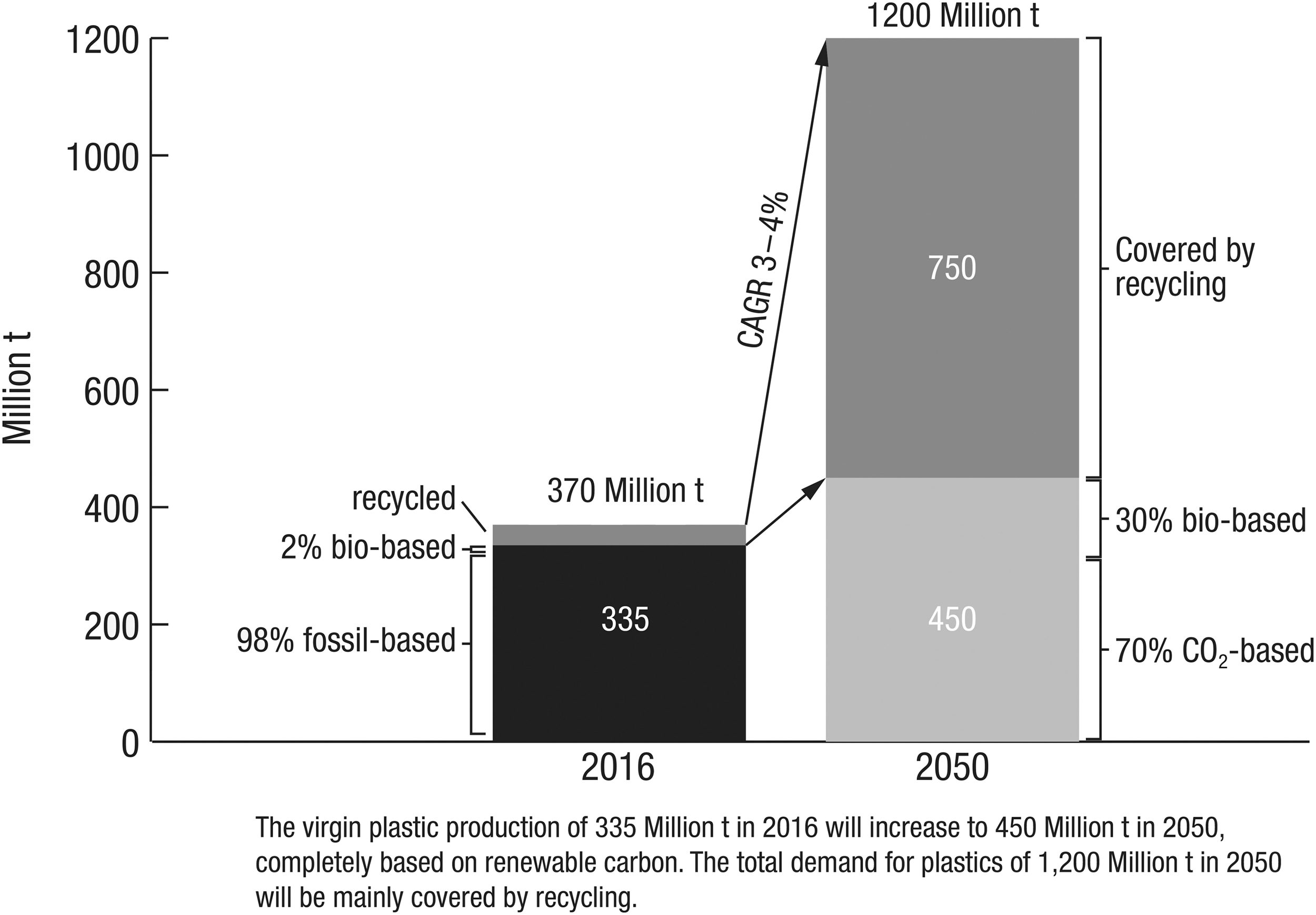
World plastic production and carbon feedstock in 2016 and forecast for 2050 (in millions of metric tons).
Richard Northcote, Chief Sustainability Officer at Covestro chemical group, said in April 2018: “Can you imagine in 2050, for example, that we're not touching oil as an industry, but we are basically taking CO2 out of the air and we are creating all these products? Then you have an industry that is totally circular. That is the dream. We are not anywhere near that, but if you start looking at what you can achieve when we start really harnessing AI and other things, who knows where we could get to in terms of chemistry?”
In January 2018, Sang Yup Lee of the Korea Advanced Institute of Science and Technology (KAIST) wrote: “Carbon dioxide will one day be used as a raw material.”
Economic Efficiency of Renewable Carbon via CCU
Under today's conditions, renewable carbon generally is more expensive than fossil carbon. Economic analyses show that an approximate price parity of direct CO2 utilization with fossil carbon can be achieved at a renewable power price of some two euro cents per kWh. Only very small volumes of renewable power are currently available at this price, and usually are limited on time or regionally restricted at that.
Economic efficiency will significantly improve over time, however, given the increasing prices for crude oil, the rising cost of CO2 in emissions trading, growing surpluses of solar and wind power and the continuing optimization of the technologies used for CO2 utilization and the generation of renewable energy. Another factor will be for politics to take the objective of switching the chemical industry over to renewable carbon seriously and to promote achieving this objective with supportive measures.
Jobs and Security of Supply Through CCU
According to Eurostat, more than 65,000 employees (EU-28) (4,000 in Germany) worked in oil and gas production in Europe in 2016. If the raw material base were to be converted to renewable carbon, this figure would increase considerably—decentrally produced renewable carbon would certainly require 5 to 10 times the number of employees. It will never again be as easy to produce carbon as it is in the fossil age.
Just as important, in Europe, 120,000 people are employed in oil refining, mainly in refineries. Instead of being relocated to the boreholes, with renewable carbon these refineries can continue to operate in Europe and the jobs are maintained.
In addition, there are hundreds of start-ups developing new technologies for the production and use of renewable carbon. Overall, the chemical industry's switch to renewable carbon will create or maintain several hundred thousand new jobs in Europe, and this in new, innovative and promising sectors.
By switching to renewable carbon based on regionally available renewable energies and CO2, an increasing independence from imported fossil (and biogenic) raw materials is achieved. At the same time, the carbon supply security for the chemical industry is increased in a sustained manner.
Political Measures to Support a Quick Transition to Renewable Carbon
What are the instruments and measures which politics may use to promote the chemical industry's shifting to renewable carbon from recycling, biomass and CO2 utilization (Carbon Capture and Utilization (CCU))? There are several options for such an endeavor: Taxation of fossil carbon in chemicals and plastics. To date, the chemical industry does not pay any taxes for their fossil carbon anywhere around the globe. It would be quite possible to introduce a fossil carbon tax if not globally, then only regionally, e.g., in Europe. Imported products would then be taxed, while the tax could be refunded for exports. Discontinuation of any funding programs in the fossil domain. Every year, the G7 countries spend at least USD 100 billion for the production and consumption of oil, gas, and coal.
9
Higher costs for fossil CO2 emissions in the emissions trading system (ETS). The German VCI (Verband der Chemischen Industrie e.V.) is committed to a globally uniform pricing of CO2 emissions, at least in the G20 countries, which are responsible for 80% of global emissions. A uniform CO2 price could be set via the Emissions Trading System (ETS) or as a uniform CO2 tax (VDI nachrichten, 2018-06-15). The environment and energy ministers of nine German federal states have confirmed their demand to the federal government to introduce a minimum price for CO2 emissions. French President Emmanuel Macron has demanded a minimum CO2 price of 30 €/t—currently the CO2 price in the ETS is roughly half of that target (VDI nachrichten, 2018-07-20). Political rewarding for/preference of chemicals and plastics with low greenhouse gas emissions; this would directly benefit chemicals and plastics made from renewable carbon. Development of certificates and labels which indicate the share of renewable carbon (total share of recycled material, biomass and CO2) in products. Establishing quotas of renewable carbon in “drop-in” products in the chemical and plastics industries (e.g., 30% of all polypropylene must be made from renewable carbon by 2030) Obliging companies from the chemical and plastics industries to issue an annual report about the percentage of renewable carbon used in their production processes. Binding targets for the use of renewable carbon in the chemical and plastics industries. Tax credits for the sequestration, storage and utilization of CO2. This is currently under debate in the United States Congress.
10
Tightening of environmental requirements for chemicals (no hormone-active plasticizers, improved degradation behavior of detergents and solvents etc.) This will mean a systemic preference of biomass-based solutions, in particular the fermentation of biomass/CO2. Systematic expansion of mechanical and chemical recycling. Considerable funding for R&D work will be required in order to further develop chemical recycling, improve its efficiency and examine its sustainability. Additional and improved financial support for research, development and implementation of sustainable future-oriented technologies in the field of material biomass and CO2 technologies used to provide and utilize renewable carbon (CCU). Considerably increased use of renewable energies and inclusion of CCU as an option for storing and providing renewable carbon.
Politics should target all of its measures at renewable carbon and not confine itself to recycling, biomass or CO2 utilization—all three paths must be followed simultaneously in order to be able to abandon fossil raw materials entirely as soon as possible. The current strong focus on recycling and the circular economy must comprehensively be expanded to include the utilization of biomass and CO2 as raw materials for the chemical industry.
Which technology is to be evaluated as most appropriate for different applications and in different regions with their specific circumstances and networks from an economic, ecological and social standpoint must be elaborated by sustainability analyses, not by political dogma. Even small changes in market conditions may cause cascades in innovation.
The transition from the fossil to the renewable age will take place in an act of creative destruction as described by the famous Austrian political economist Joseph Alois Schumpeter. “According to Schumpeter, the ‘gale of creative destruction’ describes the ‘process of industrial mutation that revolutionizes the economic structure from within, destroying the old one, incessantly creating a new one.’ Through a new combination of production factors, which successfully prevail, old structures are displaced and eventually destroyed. The destruction is therefore necessary—not a system error—so that a new order can take place.” 11
And in order to stop climate change, we need a comprehensive new economic structure of raw materials supply towards renewable carbon.
Footnotes
1.
The German chemical industry supports ambitious global climate protection under the Paris Agreement. It also supports the EU target of 80–95% lower greenhouse gas emissions by 2050—a contribution to achieving the internationally agreed long-term goals of Paris.” Available at:
2.
Dechema 2017. Low carbon energy and feedstock for the European chemical industry. Frankfurt am Main, Juni 2017.
3.
Many material properties which make current-day products possible in the first place cannot be obtained without plastics. A study based on the analysis of several life cycle assessments showed that in 2005 chemical products of the plastics industry helped save up to 2.6 units of CO2 equivalents per emitted carbon unit during the useful life of these chemicals. (International Council of Chemical Associations, 2009).
4.
McGlade C, Ekins P. The geographical distribution of fossil fuels unused when limiting global warming to 2°C. Nature 2015;517:187–190.
5.
Piotrowski S, Carus M. European Bioeconomy in Figures, 2008–2015. Available at: www.bio-based.eu (Last accessed November 2018).
6.
Dammer L, Carus M, Piotrowski S, et al. Sustainable first and second-generation bioethanol for Europe: A sustainability assessment in the context of the European Commission's REDII proposal. Ind Biotechnol 2017;13:6.
7.
So-called food crops often have the best efficiency-per-acreage values, deliver high-quality proteins as by-products and provide an additional buffer for the food market in times of crisis. Carus M, Dammer L. Food or non-Food: Which agricultural feedstocks are best for industrial uses? Ind Biotechnol 2013;9(4):171–176.
8.
Searchinger T, Beringer T, Strong A. 2017: Does the world have low-carbon bioenergy potential from the dedicated use of land? Energ Policy 2017;110:434–446.
9.
Source:
10.
Martin K. Tax equity and carbon sequestration credits. Available at:
11.
Creative destruction, Wikipedia. Available at: