




Abstract
The valorization of residual forest biomass from sawmills is an economic and ecological opportunity in Québec. With specialized metabolites and biological activities, several residues from Québec's tree species could have commercial potential. This study aims to study the antimicrobial efficacy of extracts from bark residues to determine their potential as a natural disinfectant. We first performed a quantification of phenolic metabolites by colorimetric tests which showed higher flavonoids and proanthocyanidins content (>27.88 mmol catechin equivalents (CE)/100 g of bark extract and >3.90 mmol CE/100g of bark extract respectively) in black spruce extracts compared to balsam fir, quaking aspen and white birch. Extraction with water (WE) followed by fractionation with ethyl acetate yielded a fraction enriched with oligomeric proanthocyanidins (OPF). WE and OPF antimicrobial activity on Escherichia coli using the broth microdilution and the dilution-neutralization methods (AOAC 960.09) demonstrated an increased antimicrobial potency with OPF. A minimal inhibitory concentration and a minimum bactericidal concentration of 0.83 mg/mL and 4.44 mg/mL respectively as well as a microbial reduction of 4.83 log CFU/mL (3% w/w with 10 min contact) and ≥5.09 log CFU/mL (1.5% w/w with 120 min contact time) were obtained. Compounds characterization using UPLC-QTOF-MS allowed to putatively identify nine antimicrobial compounds in the OPF. Taxifolin, dihydroxykampferol and andrographolide seemed to be associated with the increase of the antimicrobial activity of this fraction.
Introduction
The under-exploitation of residues from sawmills remains an important opportunity for Québec's forest industries. In Québec, more than 3 million tonnes of residues are generated annually, including bark, sawdust, and shavings, and this biomass is usually burned to produce energy or buried in the ground. 1,2 In an attempt to value these residues, several researchers have turned to specialized metabolites present naturally in plants. These confer interesting biological activities (e.g., antimicrobial, antioxidant, anti-inflammatory) that support the development of novel, high-added-value products. 2 –5
Black spruce (Picea mariana) is an interesting tree species because of the availability of residual biomass. This coniferous tree is dominant in the boreal forest and the most abundant species of the Canadian territory. 2,6,7 Black spruce is heavily exploited to produce lumber and pulp and paper because of its accessibility and also the quality of its wood, which has long, dense fibers. 3,8 In addition to its favorable mechanical properties, black spruce is interesting because of its specialized metabolites with biological and pharmacological properties. For example, previous studies on black spruce essential oils found high concentration of terpenoids, specialized metabolites, and antimicrobial activity on several microorganisms. 3,9 Also, Royer et al. reported that black spruce extracts contained large amounts of phenolic specialized metabolites such as flavonoids and condensed tannins (proanthocyanidins). 10 It was suggested that these metabolites are responsible for the antioxidant, anti-inflammatory, and antiproliferative properties Specifically, studies have shown that it was the proanthocyanidin-enriched extracts, also referred to as condensed tannins, that confer some of the biological properties. Moreover, these studies have also reported that these molecules are abundant in black spruce extracts when using appropriated extraction methods for isolating and concentrating these metabolites. 11,12
Proanthocyanidins (PAs) are a sub-category of phenolic specialized metabolites and correspond to oligomers (2 to 10 units) and polymers (> 10 units) of (+)-catechin and (-)-epicatechin units, two flavan-3-ol compounds (Fig. 1). 13 –15 PAs are found in fruits, vegetables, flowers and barks of plants. These metabolites, previously considered uninteresting, have long been overshadowed by their metabolic precursors, the flavonoids. However, in recent years, PAs have been the subject of several studies, and they are now highly sought after in foods for their potential health benefits. PA molecules are known to have high free radical scavenging efficiency. 15 –17 Although most PA studies are oriented toward their antioxidant potential, some studies have demonstrated the antimicrobial potential of these complex molecules. 15,16,18 For example, Puupponen-Pimia et al. and Leitao et al. investigated the antimicrobial activity of condensed tannins from different berries and confirmed important inhibitory effect of these molecules on the proliferation of several pathogenic microorganisms. 19,20

Chemical structures of common PA of plant origin;
The biological activity of PAs and other phenolic metabolites may be relevant for the development of new antimicrobial agents. Currently, the need to develop new bioactive molecules against resistant pathogenic microorganisms has oriented researches toward metabolites from plant origin for the discovery of new antimicrobials. Natural extracts rich in phenolic metabolites are particularly suitable for the production of disinfectants since these complex and diverse molecules usually have the advantage of having several mechanisms of action therefore being multi-target antimicrobials. 21 –23 A plant extract having a broad spectrum of action would prevent mechanisms of resistance, a characteristic sought after in the development of disinfectant and products intended to clean food-contact surfaces and medical equipment. 24,25 Thus, the use of natural extract is an interesting alternative to synthetic compounds routinely used as disinfectants such as quaternary ammonium compounds (CAQ), iodophors, and peroxygens. These chemicals are known to lead to the formation of potentially carcinogenic by-products in wastewater, to be harmful for the environment and ecosystems, and to contribute to the emergence of resistant microbes. 26 –29
To date, no study has examined the antimicrobial activity of PAs from black spruce bark residues. Therefore, this work evaluates the antimicrobial potential of black spruce bark extracts rich in phenolic metabolites and PAs. Phenolic metabolites were extracted from black spruce bark residues with different solvents. The amounts of total phenolic compounds and subgroups such as flavonoids and PAs were evaluated and compared with those of other abundant tree species in Québec. The separation of oligomers and polymers PAs was performed with the black spruce residues. The antimicrobial activity of these extracts was tested using the broth microdilution and the dilution-neutralization method. The latter is a protocol of the Association of Official Analytical Chemists (AOAC) more specific to disinfectants for sanitary operations. Finally, molecules present in the extract were identified using Ultra-Performance Liquid Chromatography Quadrupole Time-of-Flight Mass Spectrometry (UPLC-QTOF-MS), and PAs were quantified using High-Performance Liquid Chromatography (HPLC) . The results of this study will support long-term efforts to develop natural active agents to replace synthetic agents in the formulation of disinfectants and other cleaning products. In addition, it can also help to valorize black spruce bark residues, an abundant and untapped biomass resource.
Materials and Methods
Materials
Hexane (99.9%, HPLC-grade) was purchased from Fisher Chemical and ethyl acetate (99.6%, certified ACS) from Acros Organics. Methanol (99.9%; HPLC-grade), denaturized ethanol (87.75% EtOH, 13.7% MeOH, 0.85% ethyl acetate) and dimethyl sulfoxide (DMSO 99.8%, certified ACS) were purchased from Fisher Scientific. Quaternary ammonium compounds BTC 6358 solution (1.19 g/L) was obtain from the Sani Marc Group (Victoriaville, Canada), a sanitation products company. The 2-p-iodophenyl-3-p-nitrophenyl-5-phenyl tetrazolium chloride (INT), Folin & Ciocalteu's phenol reagent and aluminium trichloride (AlCl3) were purchased from Sigma . The 4-(dimethylamino)-cinnamaldehyde (DMCA), Tween-80 and lecithin were purchased from Thermo Scientific , Fisher, and Acros Organic respectively.
Plant Materials and Sample Preparation
Plant materials included bark from sawmill residues of black spruce (Picea mariana) (BS), balsam fir (Abies balsamea) (BF), quaking aspen (Populus tremuloide) (QA) and white birch (Betula papyrifera) (WB). Black spruce and balsam fir residues were provided by the cogeneration plant Greenleaf Power located in St-Félicien, Lac-Saint-Jean, Québec, Canada. Quaking aspen and white birch were provided by the Thomas-Louis Tremblay Industry in Ste-Monique, Lac-St-Jean, Québec, Canada. Samples were collected during January 2017. The biomass was dried at room temperature (∼20°C) and sifted to remove fractions <3 mm that contained contaminants (rocks and sand) and inorganic materials.
Microbial Strain
The bacterial strain used to determine the antimicrobial activity of black spruce bark extracts was Escherichia coli (ATCC® CRM-11229TM) from American Type Culture collection (ATCC). Before use in the two performed tests, strains were grown for 24 h at 37°C on Mueller Hinton agar (MHA) for the broth microdilution test and on tryptic soy extract agar (TSA) for the dilution-neutralization method.
Extraction and Separation of Proanthocyanidins
Dried bark residues of black spruce, balsam fir, quaking aspen and white birch were ground using a Wiley Mill crusher to 5 mm. Then, 2 x 100 g were extracted using water, ethanol and methanol, which are solvents with affinity for phenolic compounds. Extractions with water and ethanol were carried out using an accelerated solvent extraction apparatus (Dionex ASE 350) at pressure of 1,500 psi during 70 min (6 cycles of 10 min) at 100°C for water and during 45 min (6 cycles of 5 min) at 120°C for ethanol. For each sampled species, 100 g were extracted with a Soxhlet system for 7 h over six cycles of extraction. Liquid extracts were solvent-evaporated in an oven at 60°C. All the extracts were used for colorimetric tests but the black spruce dried water extracts (WE) were also used for further extraction of phenolic compounds using the separation method used by Diouf, Stevanovic and Cloutier, 11 which aimed to obtain an oligomeric PA-rich fraction. 100 g of bark was washed with hexane in a Soxhlet system for 7 h over six cycles/h of extraction, followed by a water extraction as describe before. Two g of the dried WE were suspended in 100 mL of water for a liquid-liquid extraction with 5 x 100 mL of ethyl acetate. The organic fractions were solvent-evaporated using a Rotovap apparatus to obtain the second extracts concentred in oligomeric PA fraction (OPF). Dried extracts were weighted to determine the yield extraction.
Quantification of Total Phenolics, Flavonoids and Proanthocyanidins
Colorimetric tests were performed using a microplate reader (BioTek Cytation5) for spectrophotometry UV-VIS to quantify compounds of interests. This assay was used to compare the chemical profile of black spruce with those of other tree species abundant in Québec. The quantification of total phenolic compounds was performed using Folin Ciocalteu reagent following the procedure proposed in Ainsworth and Gillespie. 30 Results are expressed in gallic acid equivalents (mmol GAE/100 g of bark extract). The quantification of total flavonoids was carried out using the aluminium chloride (AlCl3) reagent following the procedure proposed in Rebaya et al. 31 Finally, the quantification of total PAs was carried out using the 4-(dimethylamino)cinnamaldehyde (DMCA) reagent following the procedure reported by Glavnik, Simonovska and Vovk. 32 Flavonoids and PAs contents were expressed in catechin equivalents (mmol CE/100 g of bark extract). 30 –32
Antimicrobial Activity Evaluation
Broth microdilution method
The broth microdilution test used in this study was adapted from the original standardized method of the Clinical and Laboratory standard institute (CLSI) described in the M07-A9 document. 33 This test allows a semi-quantitative antimicrobial analysis of extracts by determining the minimal inhibitory concentration (MIC). First, extracts were suspended in DMSO at 10 mg/mL. To define the potential of the extracts to be used as disinfectants, a common disinfectant quaternary ammonium compound (QAC) was use as antimicrobial reference compound (stock solution 1 mg/mL). Inoculums were prepared with microbial colonies collected on a 24-h old plate, suspended in a sterilized solution of physiological water (9 g/L of NaCl) to a concentration of 0.5 McFarland, i.e., 1.5 x 10⁸ CFU/mL, by measuring the turbidity using a turbidimeter apparatus. In a 96-well plate, 50 μL of Mueller Hinton (MH) broth culture was added to each well, comprised of either 100 μL of tested extracts (10 mg/mL) or a reference standard (1 mg/mL) in the first column of rows of the plate. Then, a serial dilution was performed by transferring 50 μL of the broth-extract mix from wells of the first column to the second and so on. Finally, 50 μL of E. coli suspension was added to each well. One column of the plate was kept for positive controls (without extract or QAC) and another one for negative controls (without bacterial inoculum). The final concentrations of tested extracts ranged from 4.44 to 0.01 mg/mL and 0.444 to 0.001 mg/mL for the QAC. The plates were incubated at 37°C for 3 h before adding INT (2.85 mg/mL). This tetrazolium salt served as cells' viability indicator by its reduction in red formazan (purple color) by the coenzyme NADH of living bacterial cells. The plates were re-incubated at 37°C for 1 h to allow INT reduction. Then, the MIC values were determined for each extract. MIC was defined as the lowest concentration of extract that did not allow bacterial proliferation, i.e., the last well without purple coloration. The effect of DMSO at 35% v/v (maximal concentration used) was also evaluated and proved to be non-toxic.
The minimal bactericidal concentration (MBC) was evaluated for each extract in agar medium. The MBC was defined as the lowest concentration that suppressed all bacterial colonies (> 99.9% reduction of initial inoculum). After determining the MIC, 100 μL of each well that showed an inhibition of bacterial proliferation was subcultured onto MH agar plate and incubated for 24 h at 37°C. The MBC was determined by absence of visible growth on agar surface.
Dilution-neutralization method
Following the determination of MIC and MIB, another method was used to determine the reduction number of bacteria after a defined contact time with WE and OPF. This disinfection test is an adapted procedure of germicidal and detergent sanitizing action of disinfectant (AOAC 960.09), a dilution-neutralization method more specific to sanitizers used on food-contact surface and on medical devices. 34
Prior to the test, extracts were solubilized in water/methanol (80:20) after the non-toxic effect of this solvent at the maximal concentration used in the test was confirmed. Tryptic soy broth as culture medium and modified Letheen broth (Letheen broth base 25.7 g/L, Tween 80 100 g/L, lecithin 11 g/L) as disinfectant-neutralizing solution were also prepared.
The disinfection test was conducted in triplicate with two extract concentrations (1.5% and 3.0% w/w) and two contact times (10 and 120 min). QAC was used as positive control at a concentration of 0.16% w/w, the usual concentration found in sanitation products, and water was used as the negative control. For each condition mentioned above, 9.9 mL of each extract and control were transferred to 15 mL tubes. In each tube, 100 μL of E. coli suspension in TSB (∼1010 CFU/mL) was added. After contact time of 10 or 120 min, 1 mL of each tube was transferred to 9 mL of neutralizing solution, which was then serial diluted in phosphate buffer (PBS) until reaching a dilution factor of 10−6. To determine the bacterial concentration of the initial inoculum, a serial dilution was carried out on the negative control until a dilution factor of 10−9. Finally, 100 μL of each dilution tube was plated on TSA, then incubated at 37°C for 24 h. The count of colonies on agar plates was carried out and compared to initial inoculum to determine the reduction log.
The antimicrobial efficiency of neutralized extracts was also assessed. The initial inoculum was diluted in PBS at 10−5. One mL of each extract was mixed with 9 mL of neutralizer. Then, 100 μL of the diluted inoculum were added. A dilution of these solutions was carried out by transferring 500 μL of the tube content in 4.5 mL of PBS (dilution factor of 10−10). After 2 min, 100 μL of each previous tube contents were plated on TSA in duplicate. The agar plates were incubated at 37°C for 24 h and the count of bacterial colonies carried out.
Chemical Composition
UPLC-QTOF-MS
UPLC-QTOF-MS analysis was carried out at the Industrial Research Center of Quebec (CRIQ) on a Waters system composed of an Acquity Ultra-Performance LC and a binary pump model. Separation of compounds was carried out using an ethylene bridged hybrid C18 column (100 mm x 2.1 mm id. 1.7 mm particle size), also from Waters. The QTOF micro mass spectrometer was equipped with a z-spray electrospray ionizer. Elution parameters were established as follows: mobile phase solvents A = 0.2% acetic acid and solvent B = acetonitrile (99.9% HPLC grade); solvent flow rate at 0.2 mL/min; injection volume of 10 μL; proportion of eluent B: isocratic 2% (0–1 min), 2–100% (1–30 min), isocratic 100% (30–33 min), 100–2% (33–33.5 min), isocratic 2%(33–40 min). MS analysis was performed in negative mode (M-H) to detect priority phenolic compounds. Data were acquired from 100 to 1250 m/z without collision. Ionization source parameters were source temperature at 120°C, cone gas flow rate at 50 L/h, desolvation gas flow rate at 350 L/h, desolvation gas temperature at 200°C, cone voltage at 30 V and capillatory voltage at 1150 V. Ultra-high purity nitrogen (99%) was used as nebulizing gas. Data acquisition was carried out with Masslynx 4.1 software and mass extraction, isotopes deconvolution and library search were performed using MZMine 2.0 software according to Puskal et al. 35 Molecules identification was determined by the concordance of m/z values with theoretical values using library databases Chemspider, Kegg Compounds Database, LipidMaps Database and CRIQ.
Quantification of PAs by HPLC method
Separation, detection and characterization of PAs in black spruce bark extracts were performed according to an adapted method from Brownmiller, Howard and Prior on an Acquity Ultra-Performance LC system equipped with a fluorescence detector from Waters. 36 Before analysis, solvents and samples were filtered through 13 mm 0.45 μm polypropylene filters (Fisher Scientific). Separation was conducted with a normal phase 4.6 x 250 mm Develosil Diol column (5 micron) connected to a 4 x 3 mm Cyano SecurityGuard column both from Phenomenex (Torrance, CA). This column enabled the elution of PAs in increasing mass order. The elution conditions were: solvent A = 2% acetic acid in acetonitrile (99% HPLC grade) and solvent B = methanol/water/acetic acid (95:3:2 v/v/v); solvent flow rate at 0.8 mL/min; injection volume of 5 μL; column temperature at 35°C; and elution with linear gradient from 0–40% of B (0–35 min), 40–100% of B (35–40 min), isocratic 100% of B (40–45 min) and 100–0% of B (45–50 min). Column was re-equilibrated for 5 min between samples. Fluorescence of PAs was monitored at excitation and emission wavelengths of 230 and 321 nm, respectively, with a fluorescence detector. This detector was set to low sensitivity with a gain of 4X for the entire run. Quantification was performed using an epicatechin calibration curve.
Statistical Analyses
Statistical analyses on data were carried out using JMP software. A one-way analysis of variance ANOVA with a 5% level of probability (P < 0.05) followed by pairwise mean comparison Tukey test were performed to detect significant differences.
Results and Discussion
Extraction Yield
We first performed an extraction of molecules, hereby referred to as extractives, from bark residues of black spruce, balsam fir, quaking aspen and white birch. Three solvents were initially used (water, methanol and ethanol), and the extraction yields were calculated in % of dry weight of extractive/bark (% w/w dry bark) (Table 1). Higher extraction yields were obtained for black spruce extracts specifically with methanol (26.63 ± 0.01% w/w). In contrast, lower extractives were observed for balsam fir, for all solvents, with yields ranging from 5.39 to 9.71% w/w (Table 1). Interestingly, a correlation was observed with respect to the extraction solvent for black spruce, quaking aspen and white birch extracts where better extraction yields were obtained following methanol extraction (Table 1). The high polarity of the solvents used in this study suggests that black spruce contained more polar compounds (e.g., sugars, phenolics or glycosylated compounds) compared to the other tree species. In term of industrial process, extraction of black spruce using water (22.81 ± 0.09% w/w) is more interesting since high extractives content is obtained using water, a well-known, cost-effective, and environmentally friendly solvent.
Extraction Yields from Bark Residues of Black Spruce (BS), Balsam Fir (BF), Quaking Aspen (QA), and White Birch (WB) using Water, Methanol (MeOH) or Ethanol (EtOH)
Results are expressed as % of dry weight of extractive/bark (% w/w dry bark).
Water extracts (WE) from black spruce bark residues were further fractionated using ethyl acetate to yield a fraction enriched with oligomeric proanthocyanidins (OPF). Five times greater yield was achieved using water (WE 22.81% w/w) compared to the ethyl acetate fraction (OPF 4.22% w/w). The lower yield obtained for OPF reflects the extractives loss during the hexane washing step (e.g., lipids, waxes, oils) and in the water phase (e.g., sugars, organic acids) after liquid-liquid extraction. Indeed, 17% of the extractives were recovered in the organic phase. However, according to Sun et al., molecules present in OPF include small phenolic compounds and PAs with low polymerization degree (monomers and oligomers). 37 Unlike water, ethyl acetate should not extract highly polar compounds and polymeric PAs. 37 Phenolic compounds are of particular interest due to their biological activities.
Quantification of Phenolic Compounds
Many phenolic compounds have been studied and shown to have biological properties. For example the antimicrobial activity of condensed tannins on the proliferation of several pathogenic microorganisms has been reported. 19,20 The biological activity of phenolic compounds may be relevant for the development of new antimicrobial agents. Thus, phenolic compounds content, specifically phenols, flavonoids and proanthocyanidins (PAs) content, was evaluated for all extracts (Fig. 2). No correlation was observed between the solvents used and the quantity of compounds extracted. Total phenols content was relatively similar for all four species, however significant differences were observed between the amount of phenols in the quaking aspen extract for ethanol (58.62 ± 0.80 mmol GAE/100 g of bark extract) and methanol (48.58 ± 0.59 mmol GAE/100 g of bark extract) (Fig. 2A). In terms of flavonoid content (Fig. 2B), black spruce extracts contained significantly greater levels compared to other species (p < 0.05). In fact, for black spruce extracts, results showed a content of 36.35 ± 1.91 mmol CE/100 g of extract with water and 34.73 ± 3.49 mmol CE/100 g of extract with methanol (Fig. 2B). The other species' extracts showed a flavonoid content under 23 mmol CE/100 g. Similar results were observed for the PA content in black spruce compared with the other species (Fig. 2C). All black spruce extracts contained a significantly higher amount of PAs, in particular with the water extract (7.53 ± 0.16 mmol CE/100 g of bark extract) followed by the methanol extract (7.09 ± 0.34 mmol CE/100 g of bark extract) (p < 0.05). The other extracts from the other species showed a PA contents under 4 mmol CE/100 g of extract (Fig. 2C).
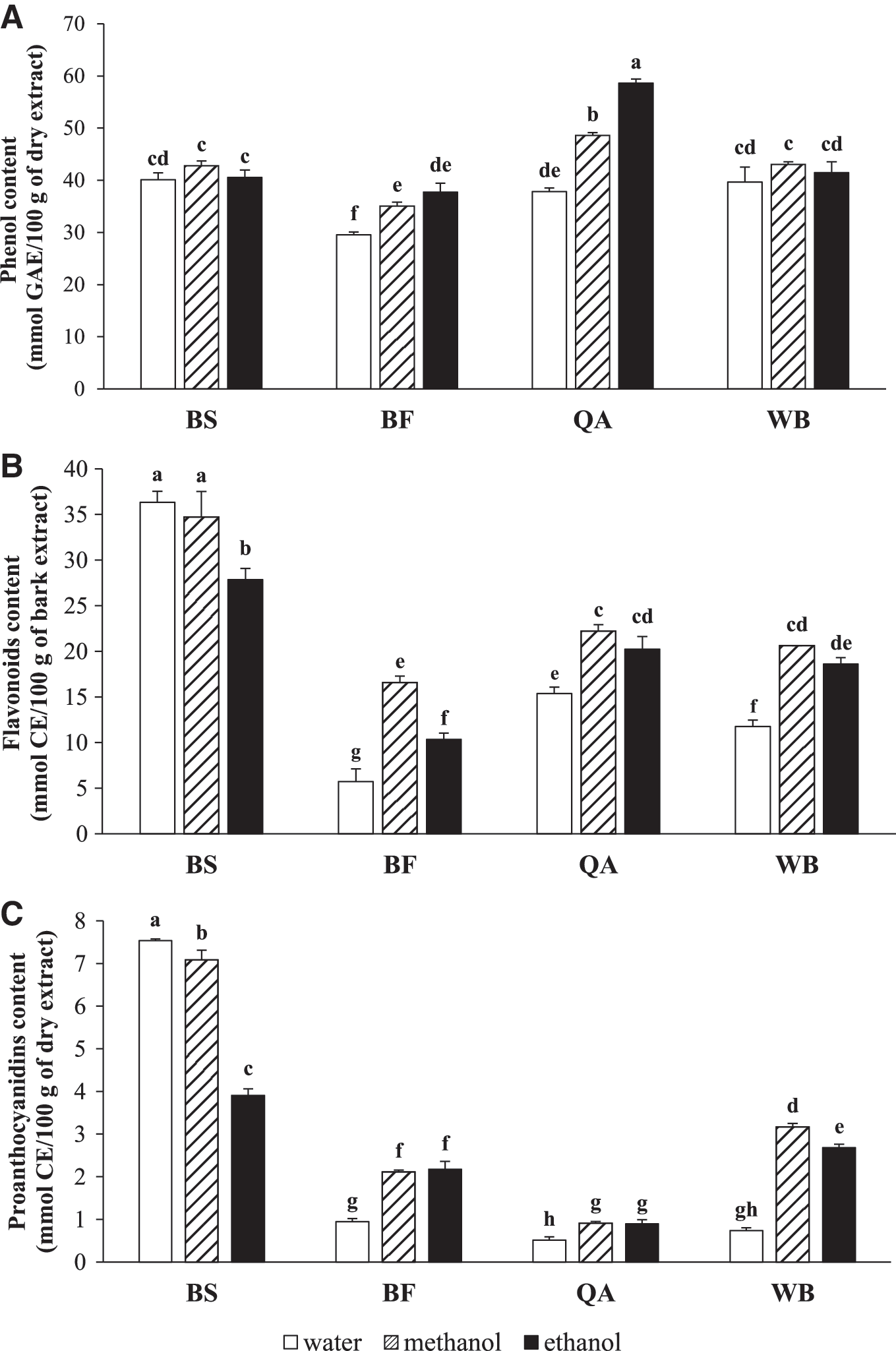
Polyphenolic composition of the various extracts obtained from the bark of Canadian wood species. (BS, black spruce; BF, balsam fir; QA, quaking aspen; WB, white birch) and with different solvents (water, methanol and ethanol).
Results supported that, in terms of total phenolic compounds, quaking aspen appears to be a promising species. 39 In term of flavonoids and PAs, results showed that interest should be focused on black spruce extracts. 38,39 The higher flavonoid content in black spruce was already demonstrated by Garcia-Perez et al. in a study where they compared flavonoid content of black spruce, yellow birch and jack pine. 12 Interest in black spruce for the extraction of bioactive molecules such as flavonoids and PAs can be also motivated by its higher yield upon extraction (Table 1). These results suggest that in black spruce, the phenylpropanoid metabolic pathway, leading to the formation of flavonoids and PAs, promotes biosynthesis of flavan-3-ol and its condensation into polymers. In several plant species, the phenylpropanoid metabolic pathway is an important route leading to the formation of protective molecules against several microorganism pathogens. 15,40 Altogether, results support greater interest in extracting PAs from black spruce to obtain bioactive molecules enriched fractions.
Antimicrobial Activity
To evaluate the antimicrobial potential of the WE and OPF, two different standardized methods were carried out. First, broth microdilution method was used to determine the minimal inhibitory concentration (MIC) and the minimal bactericidal concentration (MBC) for each extract against E. coli strain. The determination of the antimicrobial efficiency for extracts was realized according to Aligiannis et al. based on MIC value set as followed: strong inhibitor with MIC <0.5 mg/mL, moderate inhibitor with MIC between 0.6–1.5 mg/mL and weak inhibitor with MIC >1.6 mg/mL. 41 The most effective extract was OPF which displayed a moderate activity with a MIC value of 0.83 mg/mL (Table 2). The bacteriostatic effect of WE was weak, with MIC of 1.67 mg/mL. Concerning bactericidal effect, only OPF showed activity with MBC value of 4.44 mg/mL whereas no bactericidal effect was observed for WE at 4.44 mg/mL or less (Table 2). The well-known antimicrobial quaternary ammonium compound (QAC; positive control), showed strong antimicrobial activity with MIC value of 0.0026 mg/mL and MBC value of 0.0052 mg/mL, confirming the validity of the method (Table 2).
Antimicrobial Efficiency of Black Spruce Bark Water Extract (WE) and of Oligomeric Proanthocyanidins Fraction (OPF) Against E. coli Using the Broth Microdilution Method
MIC, minimum inhibitory concentration, value given as mg/mL; bMBC, minimum bactericidal concentration, value given as mg/mL; cQAC, quaternary ammonium compound as positive control.
To complement the microdilution test, the neutralization-dilution method was carried out to evaluate efficiency of WE and OPF in terms of log10 reduction (Fig. 3). To assess the effect of concentration, WE and OPF at 1.5 or 3.0% w/w for a contact time of 10 min were initially tested. Results for WE showed a 1.60 log10 CFU/mL and 2.5 log10 CFU/mL microbial reduction for 1.5% w/w and 3.0% w/w, respectively (Fig. 3A). Thus, the concentration did not affect the antimicrobial potential, since no significant differences were observed between the results (P > 0.05). However, for OPF, the microbial reductions were greater with 3.17 log10 CFU/mL and 4.83 log10 CFU/mL at 1.5% w/w and 3.0% w/w, respectively. The higher concentration of OPF was significantly (P < 0.05) more efficient against E. coli and more efficient than WE at the same concentration (P < 0.05, Fig. 3A).
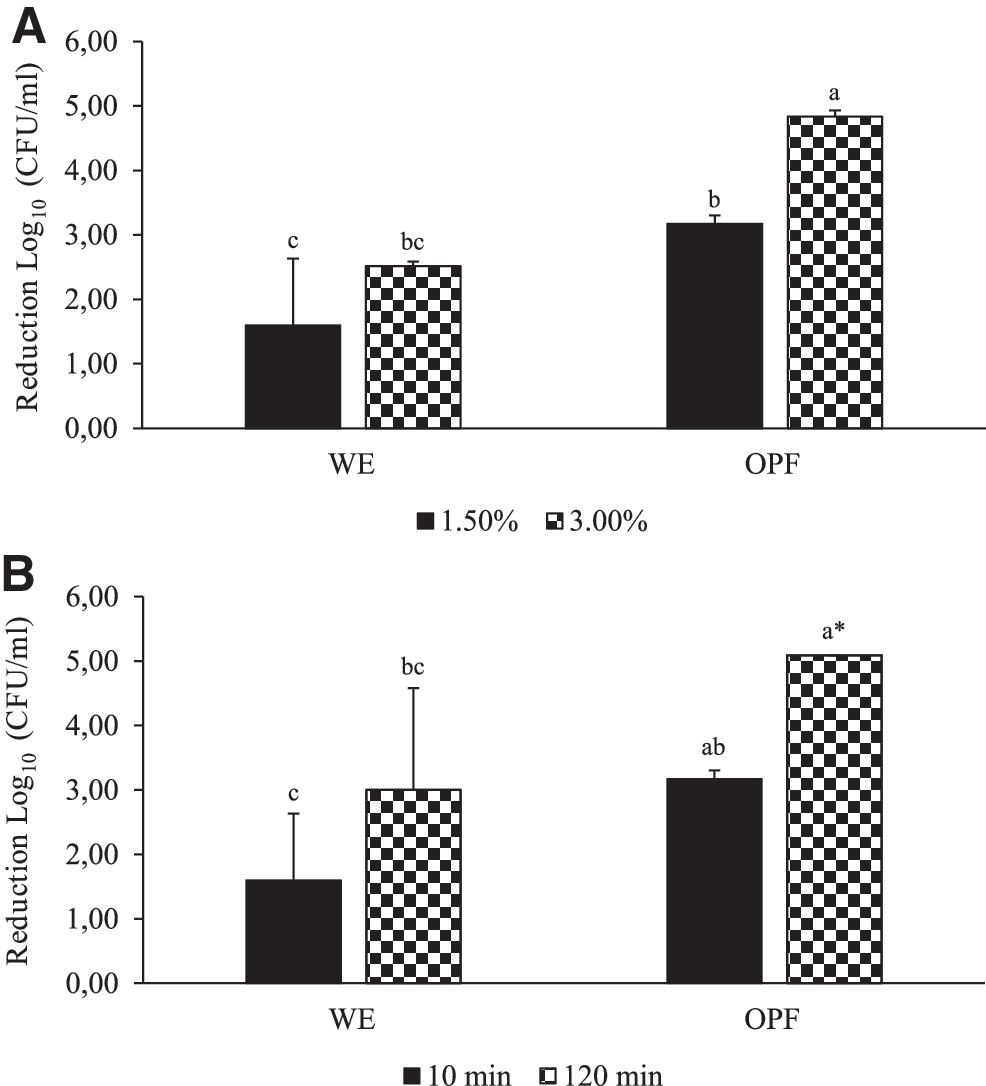
Disinfection efficiency of water extract (WE) and oligomeric proanthocyanidins fraction (OPF) from black spruce bark against E. coli strain using AOAC protocol;
To evaluate the effects of contact time, 1.5% w/w of extracts were tested for 10 and 120 min. For both extracts, increased contact time correlated with an increase of antimicrobial efficacy (Fig. 3B). Colonies' logs reduction for WE went from 1.60 log10 CFU/mL at 10 min to 3.00 log10 CFU/mL at 120 min, whereas for OPF they increased from 3.17 to ≥5.09 log10 CFU/mL at 10 and 120 min, respectively. Similar to the concentration test, OPF displayed a significantly (P < 0.05) higher antimicrobial efficiency than WE (Fig. 3B). In addition, according to the standard deviation represented by error bars, OPF also offers the advantage of lower variability compared to WE, independent of concentration and contact time (Fig. 3). Finally, a reduction of 5.93 log10 CFU/mL was obtained with QAC (0.16% w/w) after 10 min of contact time (results not shown). Neutralizer efficacy was evaluated according to the AOAC 960.09 protocol, and no differences were reported between control and initial inoculum in terms of microbial reduction (result not shown).
Thus, the results obtained using both methods corroborated and showed higher antimicrobial efficiency for OPF compared to WE (Table 2, Fig. 3). Indeed, OPF from black spruce barks was the only one to display a moderate inhibitory effect, a bactericidal effect and a microbial reduction log10 significantly higher than WE. MIC values obtained from extracts of black spruce bark residues were in agreement with values obtained for natural plant extracts. For example, Assob et al. and Khan et al. tested the antimicrobial potential of several plant extracts and the average MIC obtained ranges from 0.30 to 20.00 mg/mL. 42,43 A study by Poaty et al. already demonstrated the bacteriostatic (MIC = 4.1% w/v) and bactericidal (MBC = 8.0% w/v) effects of black spruce essential oil extracts on E. coli strain. 9 Results with extracts from black spruce bark residues corroborated these studies and suggest the presence of antimicrobial metabolites effective against E. coli. However, it should be noted that even if the OPF showed interesting antimicrobial effect in this study, it did not reach efficiency of QAC (positive control), the chemically active but not environmentally friendly ingredient commonly used in commercial formulation of disinfectants. The MIC and MBC values obtained for OPF was 300 to 900 times higher than QAC solution. Also CAQ solution demonstrated a higher antimicrobial activity with 10 min of contact time at a lower concentration following the AOAC 960.09 protocol.
The AOAC 960.09 protocol is the recommended test from Health Canada for hard surface disinfectants and is considered an effective method to determine the potential of an extract for its use as disinfectant. The AOAC 960.09 test assesses the kinetics of active compounds against microbial strains after a specific contact time. According to the Health Canada, an antimicrobial agent to be used as a disinfectant intended for food contact surfaces must reach an efficacy of 5 log10 reduction for E. coli (ATCC 11229) or S. aureus (ATCC 6538) within 30 seconds of contact. 44 Results obtained in this study did not qualify black spruce bark residue extracts as hard surface disinfectants but showed the potential of these extracts for this purpose, especially with regard to OPF. In fact, this natural extract concentrated at 1.5% w/w reached the efficiency standard in terms of inoculum count because it reduced colonies to at least 5.0 log10 CFU/mL. However, to obtain this efficiency, a contact time of 120 min was necessary. Since the standard was not reached within this study, future efforts will be deployed to increase efficiency within a shorter contact time. Considering the yield of extraction obtained for OPF and the difficulty of solubilizing extracts in water, increasing concentration beyond 3.00% w/w is not a logical alternative. It could be possible to increase the antimicrobial activity of OPF by causing a synergic effect in combination with known antimicrobial agents. 45 Recent studies, such as those by Moussaoui and Alaoui and Sanhueza et al., report an increase of antimicrobial activity of natural antimicrobial compounds in combination with conventional antimicrobial peptides. 46,47 Another way to increase antimicrobial efficiency is to add surfactants to the disinfectant formulation. Surfactants generally act as a detergent agent by decreasing the surface tension in several disinfectant, antiseptic and preservative solutions. The amphiphilic character of surfactants allow them to act as solubilizing agents by encapsulating antimicrobial compounds into surfactant micelles and thus promote their dispersion into solution. The polar heads of surfactants allow better interaction with particular cell components such as specific proteins and consequently affect viability of microbial cells. 48,49 In studies reported by Bolfoni et al. and Perez-Conesa, Mclandsborough and Weiss, the addition of surfactants, such as surfynol, centrimide and polypropylene glycol, showed greater antimicrobial activity of the antimicrobial agent. 50,51
Overall, our results reveal interesting antimicrobial activity for OPF against E. coli. Effectiveness towards this bacterial strain demonstrated the potential of black spruce extracts, since this gram-negative bacteria is generally more resistant to antimicrobial agents than gram-positive bacteria. 24 In addition, it is a widespread bacteria, particularly undesirable in food production areas, making it one of the main targets of disinfectant hard surface products. 52 To complete this study and ensure the broad spectrum of action of OPF, it may be relevant to apply the AOAC 960.09 protocol to another strain suggested by this method, namely Staphylococcus aureus (ATCC 6538). It may also be possible to target Health Canada standards that are less difficult to reach for other applications with this extract. For example, according to the ASTM E1153 protocol, a reduction of colonies of at least 3 log10 CFU/mL in 5 min of contact time against S. aureus (ATCC 6538), Klebsiella pneumonia (ATCC 4352) or Enterobacter aerogenes (ATCC 13048) could categorize extract as a surface sanitizer that does not come into contact with food.
Chemical Composition
The plausible structure of molecules in WE and OPF was determined to identify antimicrobial metabolites. Putative identity of molecules that could be present in these extracts was determined according to their mass-to-charge (m/z) ratio obtained following UPLC-QTOF-MS analysis. The m/z values were compared with m/z in databases linked to MZMine 2.0 software. Analysis was carried out in negative ionization mode (M-H) to favor detection of phenolic compounds such as simple phenols, phenolic acids, flavonoids, PAs, etc. 53 Acquisition of m/z ratio values was set for an interval of 100 to 1,250. Results obtained are summarized in Table 3. The % area for all plausible molecules represents the area under peak of the ionized mass (M-H) at a specific retention time (RT). It is possible that a single compound has two peak matches at two different retention times. One of the hypotheses to explain this is a false hit by the library. Also, a second hypothesis is that the two peak matches represent stereoisomeric molecules. The area under the curve depends largely on the ionization potential of molecules. Thus, at similar concentration, an easily ionized molecule will appear more abundant than a less ionizable one. However, since metabolites from same class possess similar functional groups and chemical skeleton, we can infer relative abundance based on % area.
Characterization of Putative Compounds from Black Spruce Bark Extracts After UPLC-QTOF-MS Analysis
Putative compounds were proposed on the basis of mass spectrometry analyses in comparison with databases using the MZMine 2.0 analysis software; bWE, water extract; OPF, oligomeric proanthocyanidins fraction; cRT, retention time; d m/z, Mass to charge ratio, represents exact mass from negative ionization mode analysis; eCompounds with more than one RT. The % area for these compounds was the sum of values for each RT; n.d., not detected.
In total for WE and OPF, 28 molecules could be potentially identified and classified (Table 3). Terpenoids, particularly diterpenoids, were more represented. Specifically, black spruce bark extracts contain several phytohormones of the gibberellin class. For example, gibberellin A12 is the most abundant terpenoid with 13.15 and 17.00 of % area for WE and OPF, respectively. Also, several phenolic metabolites, mostly from flavonoid group, were presumably identified. Taxifolin, with a % area of 17.01 in WE and 14.16 in OPF, appears to be the most abundant flavonoid in both extracts (Table 3). Finally, few glycosylated compounds and one alkaloid (vellosimine) were in the extracts but these molecules seemed to be less represented. Also, all presumed compounds in WE were also present in OPF but with variable relative abundances. Conversely, some metabolites (e.g. andrographolide, lathyrol, inulicin and vellosimine) were detected only in OPF.
To determine which molecules were responsible for the antimicrobial efficiency of black spruce bark residue extracts, a literature search was carried out. This research permitted to determine if putative compounds in Table 3 were reported to have antimicrobial activity. If more than one studies reported on the antimicrobial efficiency of a given molecule, it was transferred to Table 4 along with corresponding relative abundance (based on the % area of a specific metabolite over total % area for all metabolites). 54 –83 Nine metabolites, among the 28 potentially identified, were recognized in more than one publication for their antimicrobial potential (Table 4). Six metabolites were from the phenolic group and three from the terpenoid group. These antimicrobial metabolites represented a relative abundance of 37.83% and 34.43% of all identified metabolites in WE and OPF respectively. Taxifolin was the most prevalent metabolite in both extracts. Other potentially active metabolites were well represented such as (+)-pinoresinol with 5.11% area in WE and andrographolide with 5.49% area in OPF.
Examples of Antimicrobial Compounds Potentially Detected in the Black Spruce Barks Extracts WE and OPF
Relative abundance according to % area values reported in Table 2; +++: > 5%; ++: > 2.5 − ≤ 4%; +: 0.5 − ≤ 2.5%; n.d: not detected.
Chemical characterization of black spruce bark residues composition provided a better understanding on which molecules could be involved for the antimicrobial effect. First, several terpenoids and phenolic metabolites were putatively identified in both extracts. It was reported in numerous studies that these specialized metabolites are synthesized by plants to play a role in defense against pathogens (bacteria, fungi, viruses, etc.). 5,84,85 Table 4 reports three terpenoids and six phenolic metabolites potentially detected in WE and OPF known for their antimicrobial potential. In accordance with Diouf, Stevanovic and Cloutier and Wang et al., the dominant phenolic compound in black spruce extracts would be taxifolin. This metabolite, already known for its antimicrobial properties, is a good candidate to be responsible for the bioactivity of WE and OPF. 11,86
Finally, HPLC analyses were performed to determine that several PAs were found in both extracts. Precisely, monomeric PAs were the most abundant followed by oligomers and polymers (Fig. 4). PA levels are relatively similar in both extracts, with 5.83% w/w in WE and 4.79% w/w in OPF (Fig. 4A). PAs at different polymerization degrees were present in WE at a higher concentration than OPF (Supplementary Table S1). 36 The relative abundance of monomeric, oligomeric and polymeric PAs were also determined for WE and OPF (Fig. 4B). Results showed no differences in abundance of each type of PA between both extracts. Monomers were the most abundant PAs in WE and OPF following by oligomeric and polymeric PAs respectively. These results are consistent with reports on other types of natural plant extracts such as Cocoa 87 and blueberry. 36 The presence of PAs supports the antimicrobial effect of WE and OPF. The antimicrobial mechanisms of action of PAs have been proposed by Scalbert. 88 Briefly, PA molecules can inhibit extracellular enzymes by virtue of their astringent character, can form complexes with cell wall polysaccharides, can alter pathogen metabolism by inhibiting oxidative phosphorylation and finally can complex metal ions essential for microbial growth. 15,16,88
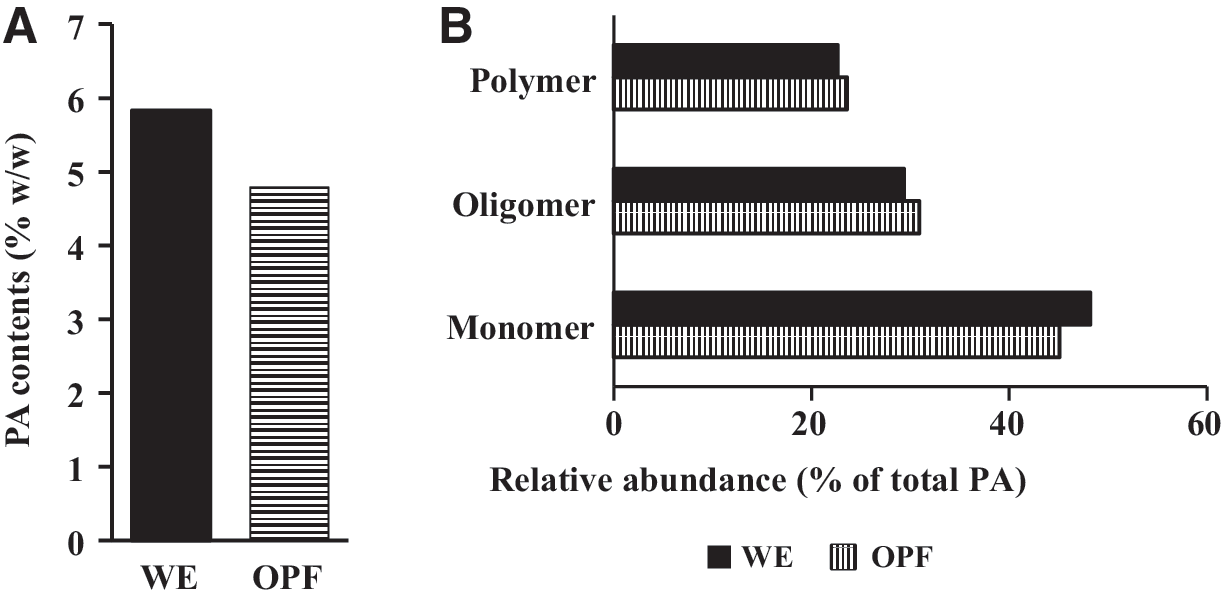
Proportion of proanthocyanidins (PA) in black spruce extracts determine by HPLC analysis;
By carrying out an extraction to isolate oligomeric PAs, it was expected to obtain more peak matches identify more compounds in WE than OPF. Following UPLC-QTOF-MS analysis, opposite was observed. Since there were more extractives in WE extract, some less concentrated molecules were not detectable due to background noise. In OPF, some molecules others than PAs, had been concentrated in organic phase by the liquid-liquid extraction like andrographolide, lathyrol, inulicin and vellosimine molecules. Probably several other molecules have been detected in positive mode and be responsible of the increased antimicrobial activity of the OPF. For example, alkaloids and other nitrogenous compounds are hardly ionized and detected in negative mode because of their nitrogen nucleus, which explains why only one was identified among metabolites extracted from black spruce barks in OPF.
Our antimicrobial results were in accordance with the higher antioxidant activity in an extract enriched in oligomeric PAs reported in study by Diouf, Stevanovic and Cloutier. 11 In contrast to this study and the one of Lee, extraction with ethyl acetate (OPF) did not appear to concentrate oligomeric PAs further. 11,89 In fact, the relative abundance of oligomeric PAs in OPF did not seem to be greater than WE (Fig. 4B). In both extracts, each type of PA has about the same relative abundance indicating that ethyl acetate extraction did not appear to have affinity for PAs with a specific degree of polymerization. This result, in contradiction with results of Diouf, Stevanovic and Cloutier, could be explained by presence of an intermediate phase between organic phase and aqueous phase during liquid-liquid extraction. 11 This water-ethyl acetate miscible phase was preserved with the organic phase because of the volume balance, whereas it has possibly contained some PAs polymer. Thus, results suggested that PAs did not appear to be related to the increasing of antimicrobial activity in OPF. On the other hand, certain compounds, more abundant in OPF than WE, could explain the antimicrobial results observed in this study. For example, dihydrokaempferol and andrographolide are two compounds known for their antimicrobial potential and which are more abundant in OPF than WE. Also, although no studies report antimicrobial efficacy of thyrol, inulicin and vellosimine, it is possible that these compounds, detected only in OPF, also have antimicrobial activity. For example, the study by Camargo et al. revealed that extracts of Geissospermum, containing different alkaloids such as vellosimine, demonstrated antimicrobial activity. 90 However, antimicrobial assays with the reference standards of these compounds would be relevant to determine their specific antimicrobial activity.
Finally, several unidentified molecules could also explain the higher antimicrobial activity of OPF over WE, but the method used limits identification of certain compounds. Indeed, the peak matches were limited to compounds already present in libraries related to MZMine 2.0 software. Although UPLC-QTOF-MS is known for its sensitivity, it still has a detection limit of 1 ppm. Also, the use of negative ionization mode did not allow detection of several compounds that could also have an antimicrobial potential. Alkaloids are a good example of molecules soluble in ethyl acetate that may have been discarded while these molecules, generally of low abundance compared to other metabolites, can have a very high bioactivity. 84,91 Finally, although it was possible to target certain molecules that appeared to be associated with antimicrobial effect on basis of previous studies, it remains difficult to understand what is happening at the molecular scale. Further studies would be required to elucidate the antimicrobial process in complex mixture of bioactive metabolites.
Conclusion
The purpose of this study, which was to characterize and evaluate the antimicrobial properties of black spruce bark residues, determined, for the first time, the antimicrobial potential of PAs and other phenolic metabolites for this species. Determination of extraction yields and quantification of phenolic compounds in bark residues of black spruce and of other abundant tree species in Québec demonstrated the importance of flavonoid and PA content in black spruce. Indeed, an extraction method, known to concentrate oligomeric PAs, yielded an OPF with moderate bacteriostatic efficacy as well as bactericidal effect on E. coli strain. Results obtained following the dilution-neutralization method (AOAC 960.09) revealed that the extract has an important disinfecting power. Characterization of extracts showed that oligomeric PAs did not seem to be responsible for greater antimicrobial efficacy in this extract. It appears that some presumed identified molecules, such as dihydrokaempferol, andrographolide and possibly thyrol, inulicin and vellosimine, concentrated in OPF, may be responsible for the greater antimicrobial activity compared to the water extract. Although, black spruce bark residues have potential as active ingredients for sanitation because it reached Health Canada's effectiveness standards for sanitation products in term of colonies reduction. Future work aims to decrease the time of effectiveness by testing the extract with different surfactant as surfynol, centimide and polypropylene glycol. Thus, integration of black spruce extracts on market could help to valorize residues of this tree and financially assist the forest industry in Québec.
Footnotes
Acknowledgments
The authors wish to thank the partners of this project including Sani Marc group, Greenleaf Power, Forêt modèle du Lac-St-Jean (FMLSJ), la Cooperative de la Valorisation de la Biomasse (CVB), the Consortium for Research and Innovation in Industrial Bioprocesses of Quebec (CRIBIQ) and the Natural Sciences and Engineering Council of Canada (NSERC) for their significant financial support. Authors also wish to thank the Centre de recherche industrielle du Québec (CRIQ), and particularly Pascal Dubé for UPLC-QTOF-MS and HPLC analyses. Professor Simon Barnabé, Patrick Marchand and Dominic Desrosiers are thanked for the chemicals and microbiology equipment provided as well as for their scientific support. Finally, Stéphanie Blais and Josée Doucet are also warmly thanked for their technical support.
Author Disclosure Statement
No competing financial interests exist.
Supplementary Material
Supplementary Table S1
References
Supplementary Material
Please find the following supplemental material available below.
For Open Access articles published under a Creative Commons License, all supplemental material carries the same license as the article it is associated with.
For non-Open Access articles published, all supplemental material carries a non-exclusive license, and permission requests for re-use of supplemental material or any part of supplemental material shall be sent directly to the copyright owner as specified in the copyright notice associated with the article.
