




Abstract
To advance sustainable, safe biotechnologies for removal of heavy metals in industrial effluents, we evaluated two filamentous fungi isolated from chromium-contaminated soil (Aspergillus fumigatus and Cladosporium spp.) as well as three organisms obtained from a microorganism bank (Penicillium commune, Paecilomyces lilacinus and Fusarium equiseti). We tested the ability of these organisms to tolerate and remove Cr(VI) from effluents. The fungi showed visible morphological variations in growth after exposure to medium with traces of Cr(VI). In metal-removal assays (20 mg/L), efficiencies of 99% to 35% were observed, with the highest values for Cladosporium spp. Application in industrial effluent demonstrated removal efficiency of 58% for P. commune. These data suggest that these filamentous fungi have great potential for biological removal of heavy metals and may serve as an alternative to conventional systems.
Introduction
Heavy metals are among the toxic substances that cause environmental problems. They are often used by industries such as mining, metallurgy, electroplating, and tanning, and can be introduced into the environmental by wastewater that is not appropriately treated. 1,2 Accumulation in soils and hydrous bodies is a major concern because these substances are not biodegradable and, when exceeding concentration limits in the environment, cause highly toxic effects in living organisms. 3,4
Hexavalent chromium (Cr(VI)) is one of the most widely used heavy metal ions in industrial processes and is highly toxic even at low concentrations. 5 The US Environmental Protection Agency listed 17 chemical substances posing the greatest threats to human health, among which chromium and its compounds are cited. Toxicity is a function of oxidation states, and compounds with valences of +VI are approximately 500–1000 times more toxic than compounds of valence +III. 6
For removal of heavy metals from effluents, industries often use conventional chemical and physical methods such as chemical precipitation, chemical oxidation, or reduction. 7 Even so, industries constantly seek affordable technologies that offer better options in terms of efficiency and economy, which stimulates the development of economically viable and environmentally safe alternative solutions and techniques. 8,9
Recently, the biological treatment of industrial effluent contaminated with heavy metals has been highlighted as an alternative to the use of chemicals. Biologicals present advantages such as low operating costs and minimization of the volume of chemical sludge produced. 10,11 Some microorganisms are able to interact with chromium in its various forms, and this makes them attractive in the context of environmental biotechnology. 12 Tolerance of these microorganisms to Cr and bioremediation capacity can be explained by several biochemical mechanisms. 13 A variety of autochthonous microorganisms possess high adaptability and colonization in contaminated environments; therefore, they are considered viable alternatives for decontamination processes. 14,15
Fungi, in particular, have excellent metal-binding properties to cell wall material that allow them to tolerate high concentrations of toxic substances. 16 In addition, fungal enzyme-mediated activity provides sufficient metabolites to treat effluents. These enzymes are produced during all stages of the fungal cycle as a response to the exposure of substances in the media. 17 It has been reported that many strains remove Cr(VI) from wastewater by various mechanisms. Aspergillus flavus detoxified Cr(VI) by reduction and other removal mechanisms. 15 Paecilomyces spp. were reported to accomplish extracellular enzyme reduction and intracellular biosorption. 12,18 Fusarium spp. fungus has been reported to biotransform Cr(VI) to Cr(III). 19
Studying viable alternatives for Cr(VI) removal are essential due to Cr(VI)'s high toxicity and concerns surrounding its presence in high concentration in the environment. Because some fungi remove Cr(VI), bioremediation is an attractive technology for treating industrial effluents as alternatives to physicochemical methods.
In the present work, we evaluated the potential of Aspergillus fumigatus, Cladosporium spp., Fusarium equiseti, Paecilomyces lilacinus and Penicillium commune to remove Cr(VI) from aqueous solutions, aiming to achieve subsequent bioremediation of contaminated heavy metal effluents. We studied removal of heavy metal at various concentrations and subsequently applied these organisms to treatment of industrial effluents. The results showed removals of 99% of the Cr(VI) concentration, making it an environmentally friendly alternative in the treatment of wastewater containting heavy metals.
Materials and Methods
Microorganisms
Soil samples were collected from a riverside where there are discharges from treated industrial effluents in Erechim, Rio Grande do Sul, Brazil. Fungi were isolated using serial dilution method 17 with traces of Cr(VI). The suspensions were incubated on malt extract agar (MEA) medium. Two morphologically distinct fungal strains were isolated.
The fungi F. equiseti, P. lilacinus, and P. commune were obtained from the Microorganisms Bank Collection of Tropical Cultures-André Tosello Foundation (Campinas, São Paulo, Brazil).
To identify the Cr(VI)-resistant fungi, morphological variations in fungi growth were evaluated after exposure on the culture medium.
Identification of Fungal Isolates Resistant to Cr(VI)
Two fungi isolated from soil were identified using molecular biology. DNA was extracted from growth pellet aliquots in potato dextrose (PD) liquid culture medium using the Extraction Kit Quick-DNA TM Fungal/Bacterial Miniprep Kit (Zymo Research®), following the manufacturer's instructions. The fungal samples were lysed by bead beating, without using organic denaturants or proteinases. The DNA was isolated and purified in a column followed by centrifugations.
After DNA extraction, the samples were amplified by conventional polymerase chain reaction (PCR). For identification of Aspergilus spp., Bt2 (Bt2a 5′GGTAACCAAATCGGTGCTGCTTTC3′ and Bt2b 5′ACCCTCAGTGTAGTGACCCTTGGC3′ 20 ) and LSU (LROR – 5′ACCCGCTGAACTTAAGC3′ 21 ) and LR5 – 5′TCCTGAGGGAAACTTCG3′ 22 were used. For identification of the genus Cladosporium spp., ITS (ITS1F – 5′CTTGGTCATTTAGAGGAAGTAA3′ 23 and ITS4 – 5′TCCTCCGCTTATTGATATGC3′ 24 ) and EF1 (728F – 5′CATCGAGAAGTTCGAGAAGG3′ and 986R – 5′TACTTGAAGGAACCCTTACC3′ 25 ), were used.
After amplification in a thermocycler, electrophoresis was performed for 40 min at 90V using agarose gel to 1.0 wt% and TBE 1X. The samples were applied to the gel together with the BlueGreen Loading Dye I® (LGC Biotechnology, Teddington, UK) and subsequently observed in ultraviolet light. The result was considered positive when it was possible to observe the presence of bands of the PCR product in the agarose gel after electrophoresis. The PCR products were purified with GenElute PCR cleaning kit® (Sigma, St. Louis, MO), following the manufacturer's instructions. The sequencing of the DNA samples amplified with the described primers was performed by ACTGene Análises Moleculares Ltd. (Center for Biotechnology, UFRGS, Porto Alegre, Brazil) using the automatic sequencer AB 3500 Genetic Analyzer.
The sequenced fragments were analyzed using the program Staden Package 2.0.0b 26 to obtain sequence consensus and were evaluated on NCBI's BLASTn platform. The sequences were compared in terms of query cover and percent identity with other sequences deposited in the platform.
The Capacity of Fungi to Remove Cr(VI)
The fungal strains were evaluated for Cr(VI) removal capacity. Assays were performed on effluents with 20 mg L−1 of Cr(VI), in two conditions: (I) with nutrients + Cr(VI); and (II) only Cr(VI), to evaluate the behavior of fungal strains to heavy metal exposure.
Assays were carried in Erlenmeyer flasks (300 mL) containing 150 mL of a liquid medium with 20 mg/L of Cr(VI) (K2CrO7) at pH 5.30. In the nutrient-addition assays, the medium was prepared as described by Cárdenas-González and Acosta-Rodríguez 12 (expressed as w/v): 0.25% KH2PO4, 0.20% MgSO4, 0.50% (NH4)2SO4, 0.50% NaCl and 0.25% glucose, supplemented with 20 mg/L of Cr(VI) (K2CrO7, as a source of hexavalent Cr(VI)). Subsequently, 0.4 g/L fungal biomass was inoculated into the medium. 27 The samples were incubated in an orbital shaker at 150 rpm and 28°C for 120 h, and the Cr(VI) concentration was quantified every 24 h, using the 1,5-diphenylcarbazide method. 28 The negative control was the synthetic medium without fungal biomass under the same incubation conditions. The removal efficiency was determined by Equation 1, considering the Cr(VI) initial concentration (Ci) and the final concentration (Cf).
Removal at Varying Concentrations
Fungal strains were evaluated for their ability to tolerate higher heavy metal concentrations. The tests were performed in liquid medium with nutrients, as described in the previous section, and were supplemented with 50, 100 and 145 mg/L Cr(VI). The Cr(VI) concentration was quantified every 24 h using the 1,5-diphenylcarbazide method. 28
Tannery Effluents
For the evaluation of the potential for Cr(VI) removal in real effluents, the fungi were exposed to tannery effluent from a modified with approximately 8 mg/L of Cr(VI) (K2CrO7).
Industrial tannery effluents were collected from the effluent discharge section of treatment tanks. Collection and storage were performed in polyethylene bottles and refrigerated at 4°C until use. The characterization was performed (Table 1) according to Standard Methods. 28
Parameters Evaluated in the Tannery Effluent Characterization
The Cr(VI) removal from effluent was performed in Erlenmeyer flasks with 150 mL of sterile effluent. The fungi were inoculated with 0.4 g/L of dry fungal biomass. 27 Samples were incubated on an orbital shaker at 150 rpm, 28°C for 120 h, and the Cr(VI) concentration at the end of the incubation period was quantified using the 1,5-diphenylcarbazide method. 28 The negative control was performed without fungal biomass under the same incubation conditions.
Results and Discussion
Fungal Tolerance Of Cr(VI) and Identification of Potential Fungi
Fungal growth was observed in culture medium with traces of Cr(VI) for P. commune, P. lilacinus and F. equiseti, and from two strains from soil. These soil isolates were identified by molecular techniques and it was concluded that one belongs to the species A. fumigatus and the other to the genus Cladosporium spp. For identification, the two isolates presented query cover and percent identity equal to 100% when compared to other sequences of species and genus identified and present on the BLASTn plataform.
A. fumigatus is a filamentous fungus that can be found and isolated from soil, decomposing material and air. 29 The morphological characteristics of this species in medium potato dextrose agar (PDA) are to present surface color green to dark green, reverse side yellow, and margins entire. In addition, it is able to colonize several niches as it has one of the fastest growths among fungi. 29 The genus Aspergillus tolerates and remediates environments with heavy metals. Aspergillus flavus CR500, isolated from soil, showed efficiency in the removal of Cr(VI) from effluents. 15 Aspergillus niger, A. flavus, A. fumigatus, A. nidulans, A. heteromorphus, A. foetidus, and A. viridinutans also presented tolerance to the presence of Cr(VI). In particular, A. niger had the highest potential for treatment of tannery effluents. 30
The genus Cladosporium is divided into complexes: C. herbarum, C. sphaerospermum and C. cladosporioides. 31 Many species of this genus are diverse, slow growing, and commonly isolated from soil and organic matter. Colonies on PDA medium are olivaceous-grey, reverse leaden-grey to iron-grey, powdery to floccose, margins colorless to grey-olivaceous and with sporulation profuse. 32 The biomass capacity of fungi of the genus Cladosporium efficiently removes various heavy metals from aqueous medium, including copper, 33 cadmium, 34 and Cr(VI). 17,35 This genus tolerates high concentrations of toxic compounds, up to 300 mg/L Cr(VI), 17 with rapid adaptation responses, primarily via oxidoreduction reactions. 35
Our results agree with those of previous studies; however, in relation to the control (without heavy metal), there were changes in the development of the five strains, including colony size reductions and color changes. The same was observed for Penicillium oxalicum SL2 that showed changes in the visible characteristics of growth colonies after exposure to Cr(VI). 36 Paecilomyces lilacinus XLA showed alterations with increased Cr(VI) concentrations. The authors also reported morphological and biochemical alterations in the fungus. 37 This was observed during the accumulation of metal in cells, where it caused physiological changes due to the response of cells to moderate toxicity, characterized by morphological and growth changes. 36,38
The main mechanism of Cr(VI) toxicity in cells is related to rapid diffusion through the cell membrane, followed by modification of oxidation state (VI) to (III), giving rise to free radicals that damage DNA. 39 The tolerance of microorganisms to metals is associated with their ability to survive the toxicity of the compound, using extracellular or intracellular mechanisms in response to stress conditions. 34 Visible alteration of colonies suggests that fungal tolerance occurred due to activation of these defense mechanisms aimed at eliminating oxidative stress produced in response to heavy metal. 18,40
The rapid response of microorganisms occurs through biosorption, bioaccumulation, biotransformation, biomineralization, and extracellular precipitation, among others. 13 These processes are mediated by swelling in the cell wall and the presence of microbubbles that result from the formation of intracellular vacuoles responsible for the sequestration of metal ions in the medium. These processes comprise the intracellular response of filamentous fungi to heavy metals. 18
Considering the tolerance of fungi for Cr(VI), the following assays were used to evaluate their ability to remove the metal from effluents.
Removal of Cr(VI) by Microorganisms
In tests using an initial concentration of 20 mg/L of Cr(VI), the efficiency of Cr(VI) removal by Cladosporium spp. was approximately 99% at 120 h (Fig. 1A), the highest efficiency verified for the fungi. The percentage of Cr(VI) removals for A. fumigatus, P. commune, P. lilacinus, and F. equiseti were 61.75 ± 4.97%, 48.37 ± 3.76%, 39.17 ± 1.36% and 34.87 ± 7.86%, respectively. For all microorganisms, no significant changes in Cr(VI) concentrations were detected in the test without nutrients. The negative controls were conducted in the same conditions as the tests, except in the absence of fungi, to evaluate if abiotic conditions could cause removal of Cr(VI). The results demonstrated that not occurrent changes in initial and final concentrations of Cr(VI).
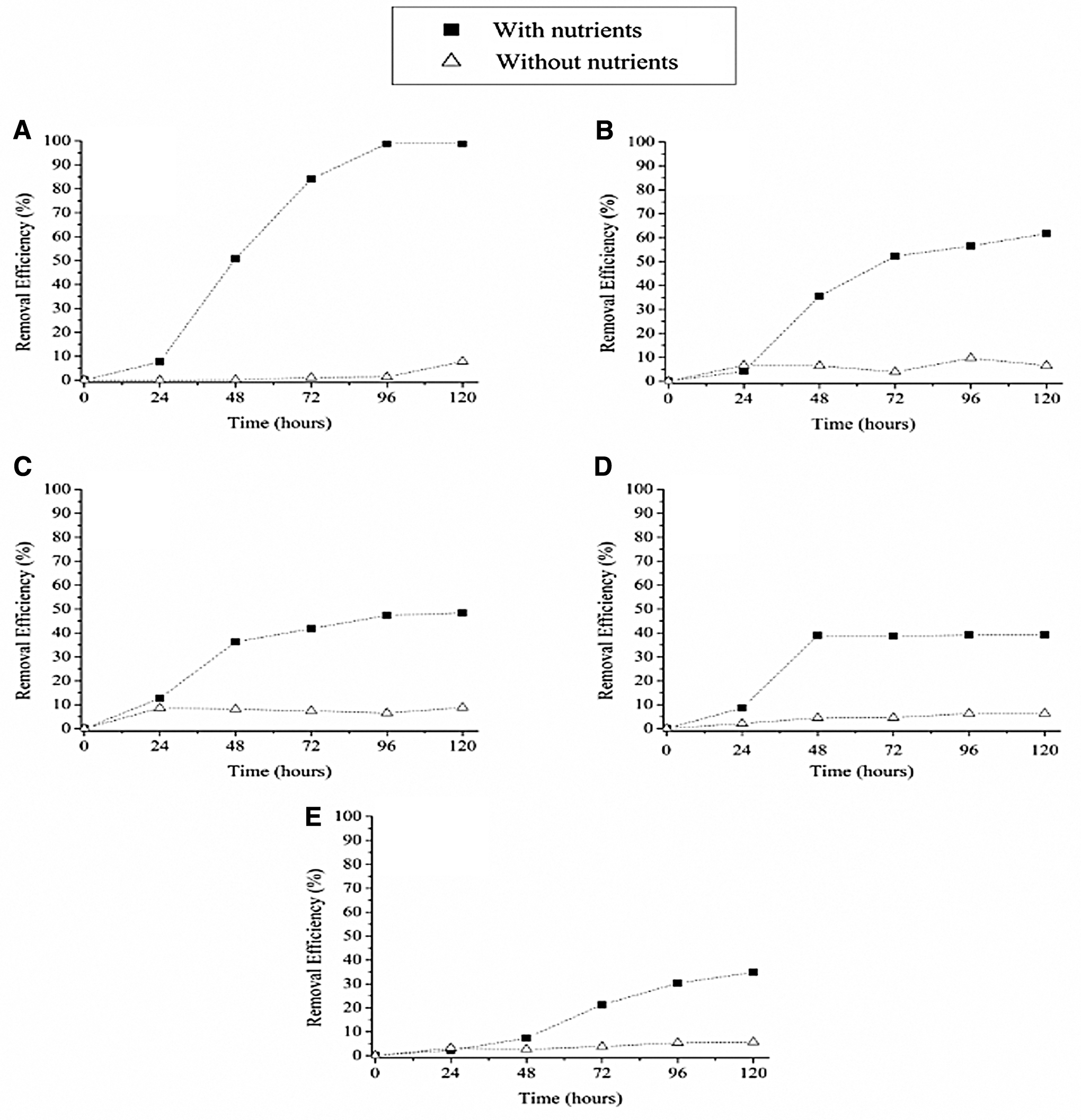
Removal Efficiency of Cr (VI) over 120 h, by
The fungi isolated from the soil with the presence of industrial effluent discharge, A. fumigatus and Cladosporium spp., showed greater efficiency in the removal of metal ions than the other fungi tested. Anthropized environments such as industrial landfills, river sediments, and effluent disposal sites often have microorganisms that can tolerate, reduce, and remove heavy metals such as Cr(VI). 15 In this context, it was found that isolated fungi could potentially treat effluents according to their ability to adapt to the presence of Cr(VI). 41
The removal of Cr(VI) by the fungi occurred in the first 24 h of the study, when the percentage of removal in the presence of nutrients and Cr(VI) was like the removal in the absence of nutrients. After 24 h, there was stabilization of removal in the absence of nutrients (only Cr(VI)), and increased removal in the presence of heavy metal and nutrient sources.
The biosorption mechanism (Fig. 2A) is possibly linked to the removal pattern in the first 24 h of the study. Biosorption is characterized by the process of metal bonding to the cell surface structure of microorganisms. 13 Fungi have unique cell wall characteristics that have excellent metal-binding properties, making them tolerant to toxic metals. 16 Corroborating the observed data, biosorption is the first mechanism to be activated in the presence of toxic compounds because the cell surface is the first cellular component to contact metals, controlling the uptake of ions that are potentially toxic to the cell. 42,43
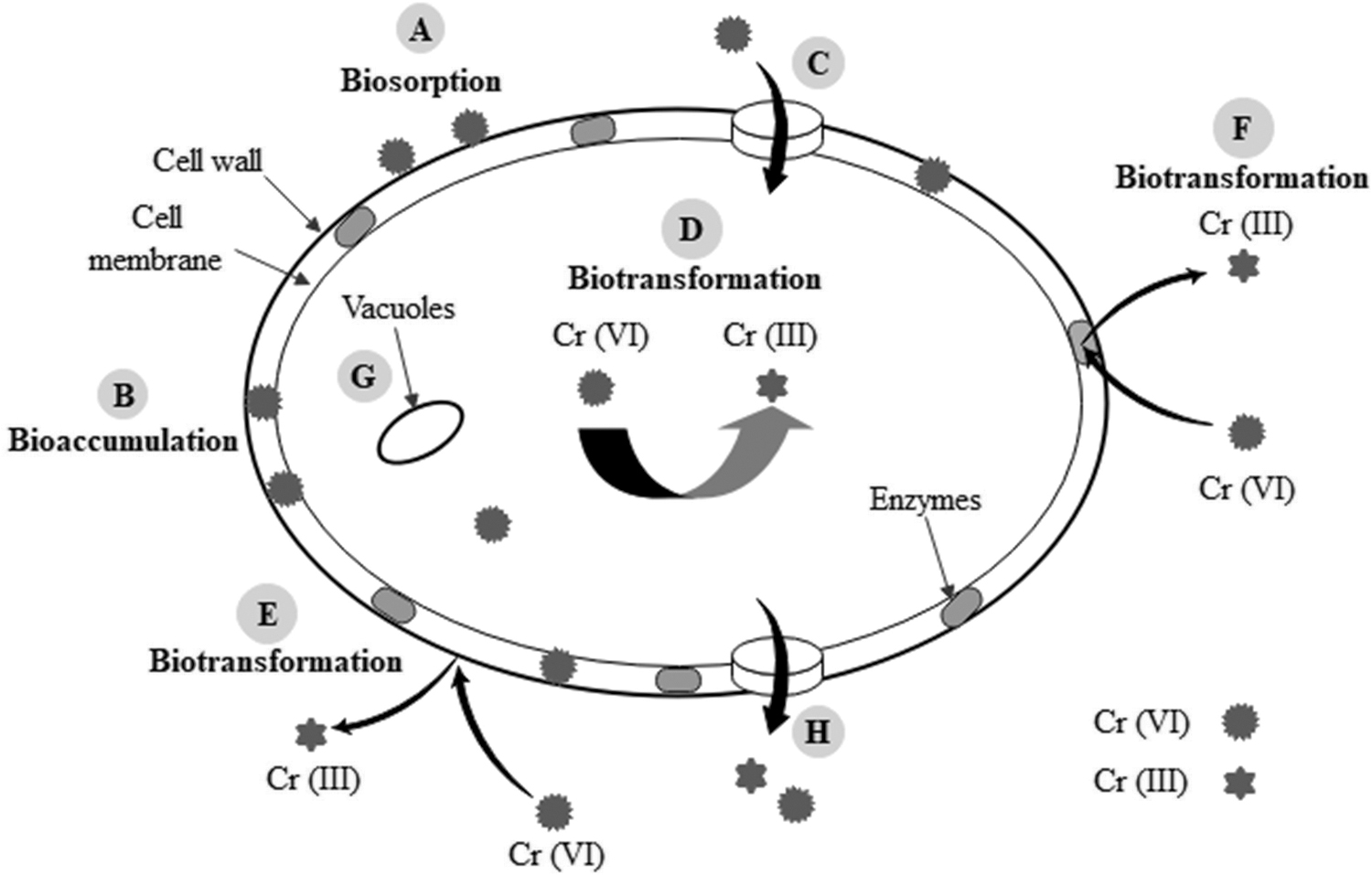
Schematic diagram showing possible mechanisms of chromium removal by fungi.
The difference between Cr(VI) removal efficiencies in the presence and absence of nutrient sources is explained by the lack of metabolism in fungal strains exposed to media without nutrients because of the limited binding of ions to the fungal cell wall. 44,45 After 24 h of removal, biomass with active metabolism (presence of nutrients) continued to reduce the metal concentration of the media, and the opposite was observed for experiments conducted in the absence of nutrients that stabilized metal removal. This is attributed to the ability of live cells to bioaccumulate (Fig. 2B) metal ions after biosorption in the cell wall. The removal of the metal by dead cells or without metabolism activation only involves the biosorption process. 45 The biosorption process basically occurs by two mechanisms, chemisorption and physisorption. Chemisorption usually is irreversible and occurs in a monolayer on the biosorbent surface whereas the is reversible and can occur in multiple layers. 46
In the tests performed in the presence of nutrients, we believed that other mechanisms of Cr(VI) removal were involved, especially those dependent on the metabolic activation of the fungus. Considering that the primary mechanism of toxicity of this metal is passive diffusion through the cell membrane (Fig. 2C), followed by the reduction of the oxidation state, 13 biotransformation ( Fig. 2D-E ) and vacuole formation (Fig. 2G) may have been involved in the removal process in the nutrient assays.
In a recent study, the fungus Paecilomyces lilacinus, after exposure to a concentration of 50 mg/L Cr(VI), presented high intracellular Cr (III) concentrations and low intracellular Cr(VI) concentration. In addition, the authors observed that chromium was mainly present intracellularly in vacuoles and there was activity of enzymes, such as superoxide dismutase and catalase, responsible for oxidation processes. 18 The presence of chromium in a state of oxidation (III) involves metabolic processes of the fungus, including excretion of oxidative enzymes (Fig. 2F) and small molecules with affinity and oxidoreduction characteristics; this is an intracellular response of filamentous fungi to the presence of toxic compounds. 13,37
Intracellular protection mechanisms such as vacuole formation and biotransformation aim to protect the cytosol of cells, usually involving cytoplasmic proteins that carry metal ions to the outside of the cell (Fig. 2H) or allow the formation of the vacuolar compartment that play key roles in molecular degradation and storage of metabolites; the latter is extremely important in ion balance in cytosol and cell detoxification. 43
In the context of biological detoxification mechanisms that may be associated with the efficiency of the removal of the studied fungi, the environmental adaptation of A. fumigatus and Cladosporium spp. resulted in rapid removal of heavy metal from the medium. Nevertheless, it is difficult to characterize fungi uniformly in terms of specific biochemical characteristics because each strain has unique properties, either in the cell wall or in terms of response times to the toxic compound, resulting in varying efficiencies among microorganisms.
The removal of 99% of Cr(VI) for Cladosporium spp. has potential because of the rapid response of the fungus that in 48 h removed approximately 50% of the initial concentration of heavy metal from the medium. A study reported that five fungal strains isolated from soil contaminated soil with Cr(VI) were evaluated for biological wastewater treatment. Among the tolerant strains, the fungus Cladosporium perangustum was used. The efficiency of the fungal consortium was 100% in 120 h. 17 In the current work, the efficiency for only Cladosporium spp. was 99%.
Effect of Increased Initial Cr(VI) Concentration
Results of Cr(VI) removal over time are shown in Table 2. At higher concentrations, the reduction of metal concentration was not effective. The same was reported by Li et al., 37 where the removal rate decreased with increasing heavy metal concentrations.
Efficiency Cr(VI) Removal After 24, 48, 72, 96, and 120 h of Exposure of Cladosporium spp., Aspergillus fumigatus, Penicillium commune, Paecilomyces lilacinus and Fusarium equiseti Fungi in Culture Medium Containing 50, 100, 145 mg/L of Cr(VI)
Results are presented as percentage.
At 50 mg/L, the results were promising for the efficiency of heavy metal removal for Cladosporium spp. (49.65 ± 1.89%), A. fumigatus (34.52 ± 2.35%), P. lilacinus (32.22 ± 3.41%), P. commune (19.42 ± 3.38%) and F. equiseti (16.26 ± 3.18%).
At higher concentrations (100 mg/L and 145 mg/L), process efficiency was reduced, whereas at 145 mg/L of Cr(VI), the fungi studied showed removal stability at 48 h. This result is in agreement with Xu et al. 18 who found that lower concentrations of Cr(VI) (<100 mg/L) occurred as an adaptation mechanism to the toxicity of the compound. However, with the higher concentration (>100 mg/L), there was a limitation of tolerance capacity in the microorganism, resulting in a decrease in biomass production due to rapid bioaccumulation and subsequent stabilization of metal ion sequestration.
The limitation of the Cr(VI) removal process by microorganisms may be associated with the high toxicity of the compound with high accumulation potential in fungal cells. Increasing metal concentration saturates the active sites responsible for the biosorption process, reducing the availability of functional groups and agents that form metal complexes or oxidative stress reducers that may lead to the accumulation of the metal. 45
These results are essential to understand the limitations of biological treatments using fungi at various concentrations of metal. The ability to tolerate, reduce, and remove Cr(VI) by filamentous fungi is a characteristic of effluent monitoring and treatment. Nevertheless, it depends on crucial factors for high process efficiency, and the metal concentration is a fundamental control parameter of the system.
Biological Treatment of Tannery Effluent
To evaluate fungi for expansion to larger scales, it is necessary to evaluate the strains under uncontrolled conditions, exposing them to critical conditions that demonstrate the real application problems of these processes. Tests were thus carried out in tannery effluents to evaluate the potential of tannery effluent treatment through a simplified biotechnological process where the fungal biomass is exposed to industrial heavy metal wastes.
Exposure to tannery effluents reduced the ability of heavy metal to be removed by fungi when compared to the effect in synthetic media, as a result of exposure to other substances that may interfere with process efficiency and affect the growth and removal capacity of the target substance. Nevertheless, the results were significant, showing removals of 58.51 ± 2.97%, 37.92 ± 5.75%, 33.60 ± 4.60%, 29.44 ± 3.75%, and 21.40 ± 0.85% P. commune, A. fumigatus, P. lilacinus, Cladosporium spp. and F. equiseti, respectively. The negative control showed no reduction in the initial concentration.
Many studies have reported heavy metal removal by fungi such as Aspergillus, Penicillium, Fusarium, Trichoderma, and Pleorotus isolated from various locations with promising results. 44,47 –49 Although current chemical treatments have high efficiency rates, these methods are not completely satisfactory, especially when it comes to economic and environmental viability, chemical reagent volume, and high sludge generation. 50
Such application of fungal biomass entails a simplified process applied directly to the effluent. After optimization and reactor study, sludge generation and application of chemical reagents could be reduced. The effluent treatment process using filamentous fungus could occur in continuous effluent feed reactors with intermittent nutrient flow and agitation by oxygen injection. The most relevant contribution of the filamentous fungi evaluated in this study was the application in controlled and uncontrolled effluent treatment processes with heavy metal loading, demonstrating the application of these microorganisms with the possibility of optimizing the removal pathways to increase process control and scaling up of biotechnological applications.
Conclusion
Fungi have the potential to remove Cr(VI) from contaminated effluents, thereby offering a technology that involves a simple and efficient process that can be applied in industrial environments in systems integrated with conventional processes. Cr(VI) removal was 99% for Cladosporium spp. isolated from contaminated soil with 20 mg/L initial Cr(VI) concentration; in industrial effluent with 7.22 mg/L initial Cr(VI) concentration, P. commune showed 58% efficiency over 120 h.
Our results suggest the possibility of biological treatment of effluents in an environmentally safe and viable fashion, as an alternative approach to conventional systems. The process can be applied in integrated systems (conventional and biological) in a continuous effluent stream reactor or in a batch with intermittent nutrient flow, reducing chemical use and sludge generation.
Footnotes
Author Disclosure Statement
No competing financial interests exist.
Funding Information
The authors thank CNPq, CAPES-PNPD and FAPERGS for financial support.