




Abstract
The hydrodynamics and mass transfer characteristics of ethanol stripping with CO2 were evaluated for a 2.0-L pneumatic bioreactor operated in bubble column (BC), concentric-tube airlift (CTA), and split-cylinder airlift (SCA) configurations, as well as for bubble columns with three different working volumes (2.0, 5.0, and 10.0 L). The results showed that an increase of the global gas hold-up (ɛG) did not enhance ethanol removal in any of these prototypes. The volumetric ethanol removal coefficient (kLEa) values were very similar for the three models, despite the higher ɛG obtained for the CTA configuration. The same behavior was observed for the three scales of BC prototypes, except for distinct behavior observed at the 10.0-L scale operated above 2.5 vvm. In order to predict kLEa for different scales and operational conditions, a dimensionless correlation was proposed for the Sherwood number, which provided an excellent fit to the experimental data, with few points exceeding ±10% deviation. The ethanol concentration factor (FC) values increased with decrease of the specific gas flow rates, with the highest FC value of around 6.0 (6 times the original solution concentration) obtained for the 10.0-L scale of BC. Therefore, increasing the prototype size led to an increase of Fc, resulting in greater ethanol enrichment of the gas stream leaving the equipment.
Introduction
Ethanol is currently the biofuel with the greatest global consumption, and its use is becoming increasingly widespread, with expectations of growth in demand and consequently in worldwide production. 1 –4 The main benefits of using renewable energy sources are the reductions of both greenhouse gas emissions and fossil fuel dependence. 2,5 Brazil is the world's second-largest ethanol producer and has the most competitive and economically feasible production process. 6,7 In Brazilian distilleries, sugarcane is employed as the feedstock, 8 and the fermentation process is carried out with recycling of yeast cells, which results in a high cell density in the fermenter. 9 This strategy allows high ethanol yields to be achieved, since more sugar is converted into ethanol, rather than being diverted to yeast cell multiplication. 10 The ethanol industry in Brazil has made great progress over the decades, with an increase in ethanol production of 170% as well as an optimistic outlook. 11
However, during alcoholic fermentation, the ethanol accumulated in the culture broth may become toxic to the yeast cells due its inhibitory effect on metabolism.
12
As a result, low ethanol concentrations are obtained in the final wine, leading to high energy consumption in the distillation process (2.2–2.8 kgsteam
Earlier studies have shown that integrated processes with simultaneous fermentation and separation offer a potential way to minimize the inhibitory effects of ethanol on yeast cells, making the process more efficient and competitive compared to the conventional method.
2
Among the techniques that have been investigated for ethanol removal during the fermentation, stripping with an inert gas has attracted great interest due its relative simplicity, the possibility of selectively removing volatile compounds, and the ability to use the CO2 produced in the fermentation itself as an entraining gas.
8,17
The extraction of the inhibitor product directly from the culture broth enables substrate conversion to be completed in a shorter time, resulting in higher ethanol volumetric productivity. Sonego et al.
17
evaluated extractive fermentation with ethanol removal by CO2 stripping in a bubble column bioreactor with a 5.0 L working volume. The results showed an increase in the substrate consumption rate, which led to a volumetric productivity 25% higher than that obtained in the conventional fermentation. Rodrigues et al.
18
studied the performance of alcoholic extractive fermentation with ethanol removal by gas stripping in a 2.0-L bubble column reactor operated continuously, with yeast cell recycling. The results indicated that the combined use of gas stripping and recycling of yeast allowed the reactor to be fed with fermentation broth containing sucrose at concentrations higher than 400 g
Many investigations have been conducted to evaluate the effects of operating variables including temperature, initial ethanol concentration in the solution, and gas flow rate on ethanol removal by CO2 stripping. 13,17,18 Most of these studies used a hydroalcoholic solution as the liquid phase and were carried out in bubble column bioreactors. However, the pneumatic airlift reactor allows a well-defined flow pattern, which results in substantial changes in hydrodynamics and mass transfer behavior. The main advantages of airlift reactors over bubble columns are better mixing capability and higher mass transfer coefficients (in some instances). 19 Mendes and Badino 20 reported higher volumetric oxygen transfer coefficient (kLa) values for concentric-tube airlift reactors of 5.0 and 10.0 L compared to values obtained in the bubble column reactors. Sánchez et al. 21 evaluated the mixing behavior of three geometrically equivalent bubble column and airlift reactors and observed a shorter mixing time in the bubble column model compared to the other two geometries (a split-cylinder and a draft-tube sparged device).
Previous research has investigated the hydrodynamic characteristics and oxygen transfer performance of bubble column and airlift bioreactors using different working volumes and liquid phases. Choi et al. 22 studied the mass transfer efficiencies in bubble column and airlift slurry reactors with rectangular cross-sections. The bubble column bioreactor showed the poorest mixing performance and non-uniform solids distribution, while the airlift device provided a homogeneous distribution. In addition, the volumetric oxygen mass transfer coefficient (kLa) was slightly higher for the bubble column reactor, compared to the airlift pneumatic reactor. Jesus et al. 23 evaluated the performance of bubble column and airlift reactors in terms of the hydrodynamics and oxygen transfer using Newtonian and non-Newtonian viscous fluids. The results showed that kLa was higher for the airlift reactor at all the gas flow rates studied. The same behavior was observed by Koide et al., 24 who reported higher kLa values for internal loop airlift reactors compared to bubble columns when demineralized water and Newtonian fluids were used as the liquid phase and air was used as the gas phase.
Although the literature contains many studies concerning pneumatic bioreactor performance using aerobic systems, there are no reports concerning the removal of ethanol from the liquid phase by CO2 stripping and the hydrodynamics and mass transfer characteristics for different classes and working volumes of pneumatic bioreactors. A better understanding of such aspects is crucial for implementing the design, operation, optimization, and scale-up of processes for ethanol removal by gas stripping. Therefore, the aim of the present work was to evaluate the hydrodynamics and mass transfer characteristics of ethanol removal by CO2 stripping in bubble columns and airlift reactors operating at scales of 2.0, 5.0, and 10.0 L.
Materials and Methods
Equipment
The experiments were performed using 2.0-L pneumatic bioreactor prototypes operated in bubble column (BC), concentric-tube airlift (CTA), and split-cylinder airlift (SCA) configurations (Fig. 1), as well as using three bubble columns with different working volumes (2.0, 5.0, and 10.0 L). The geometric characteristics of the prototypes used in this study are presented in Table 1.

Schematic geometries of the bioreactor prototypes:
Geometric Characteristics of Bioreactor Prototypes
The external tubes of the prototypes were made of glass, while the base, bottom, and top plates; the draft tube of the CTA reactor (thickness of 1 mm); and the vertical plate of the SCA prototype (thickness of 1 mm) were made of stainless steel. A wing-type sparger made of stainless steel, with a hole diameter (dO) of 0.5 mm, was used in the split-cylinder airlift configuration, while cross-type spargers, also made of stainless steel, were used in the bubble column and concentric-tube airlift models.
Experimental Procedure
The stripping experiments were carried out using ethanol solution with an initial concentration of 80 g
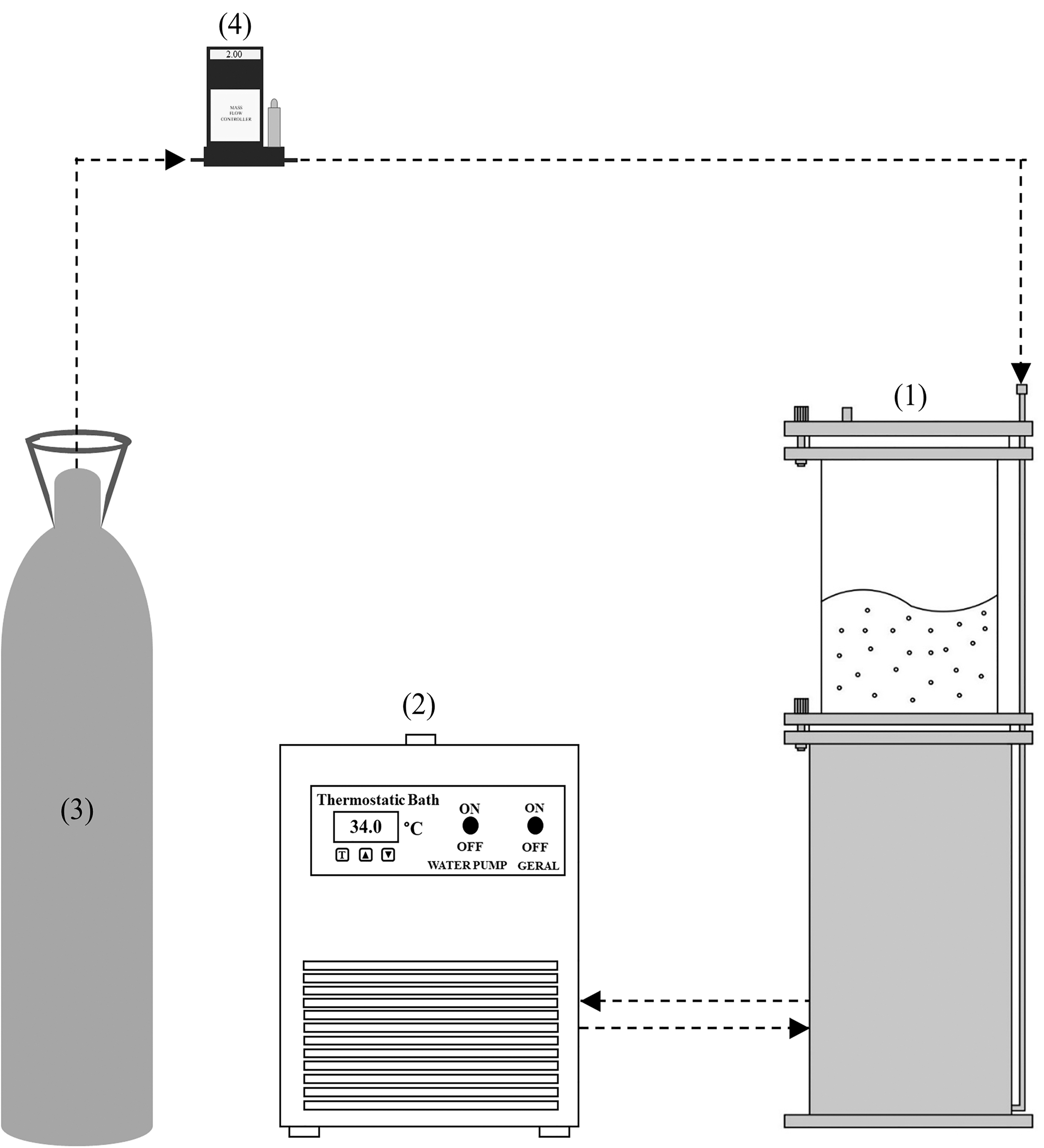
Experimental apparatus:
Specific Gas Flow Rate (ϕ)
The specific gas flow rate (ϕ) corresponds to the ratio between the volumetric CO2 flow rate (QG) and the liquid volume without gasification (VL), as shown in Equation 1. In the present work, the unit used for this variable was vvm (volume of gas/volume of liquid/min).
Volumetric Ethanol Removal Coefficient (kLEa)
The ethanol removal with CO2 stripping was described using the model proposed by Rodrigues et al.,
18
presented in Equations 2
–4
:
where kLEa and kLWa are the volumetric coefficients of ethanol and water removal (h−1); CE and CW are the concentrations of ethanol and water (g
Global Gas Hold-Up (ɛG)
The global gas hold-up (ɛG) was determined (in duplicate) by measuring the increase in height of the gas-liquid dispersion with aeration, as described by Equation 5:
19
where hD is the height of the gas-liquid dispersion and hL is the height of the gas-free liquid.
Mean Bubble Diameter (dB)
The bubble size measurement was performed using a photographic technique previously described by Ruen-ngam et al.
25
and Moraveji et al.
26
The images were obtained using a digital camera (Nikon® D5200) placed on the top section above the riser, and were processed using ImageJ® software. More than 100 bubbles were randomly chosen in ten pictures, for each operational condition. For ellipsoidal bubbles, the major (d1i) and minor (d2i) diameters of the bubble image were measured and the equivalent diameter of the bubble (deqi) was calculated using
Equation 6.
27
The equivalent size of the bubble represents the diameter of a sphere whose volume is equal to that of the ellipsoidal bubble.
The average bubble diameter (dB) was calculated using Equation 7 (Sauter mean diameter):
27
where deqi is the equivalent diameter of each bubble and i is the number of bubbles (from 1 to n).
Ethanol Enrichment
The ethanol concentration factor (FC), which is a measure of the ethanol enrichment of the stream leaving the bioreactor prototype, was determined by Equation 8, as follows:
where CE0 and CEF are the initial and final ethanol concentrations (g
Results and Discussion
Volumetric Ethanol Removal Coefficient (kLEa)
Figure 3A shows the profile of the volumetric ethanol removal coefficient (kLEa), as a function of the specific CO2 flow rate (ϕCO2), for the three configurations of prototypes. The results show a positive relation between kLEa and ϕCO2 within the range studied. As ϕCO2 increases, the resistance to mass transfer declines, enhancing the transfer rate until equilibrium is reached. In addition, increasing the specific gas flow rate leads to an increase of the interfacial area for mass transfer, since a greater number of gas bubbles are formed. Sonego et al. 17 and Rodrigues et al. 18 reported similar behavior using an ethanol solution in bubble columns with 5.0 and 2.0 L working volumes, respectively.
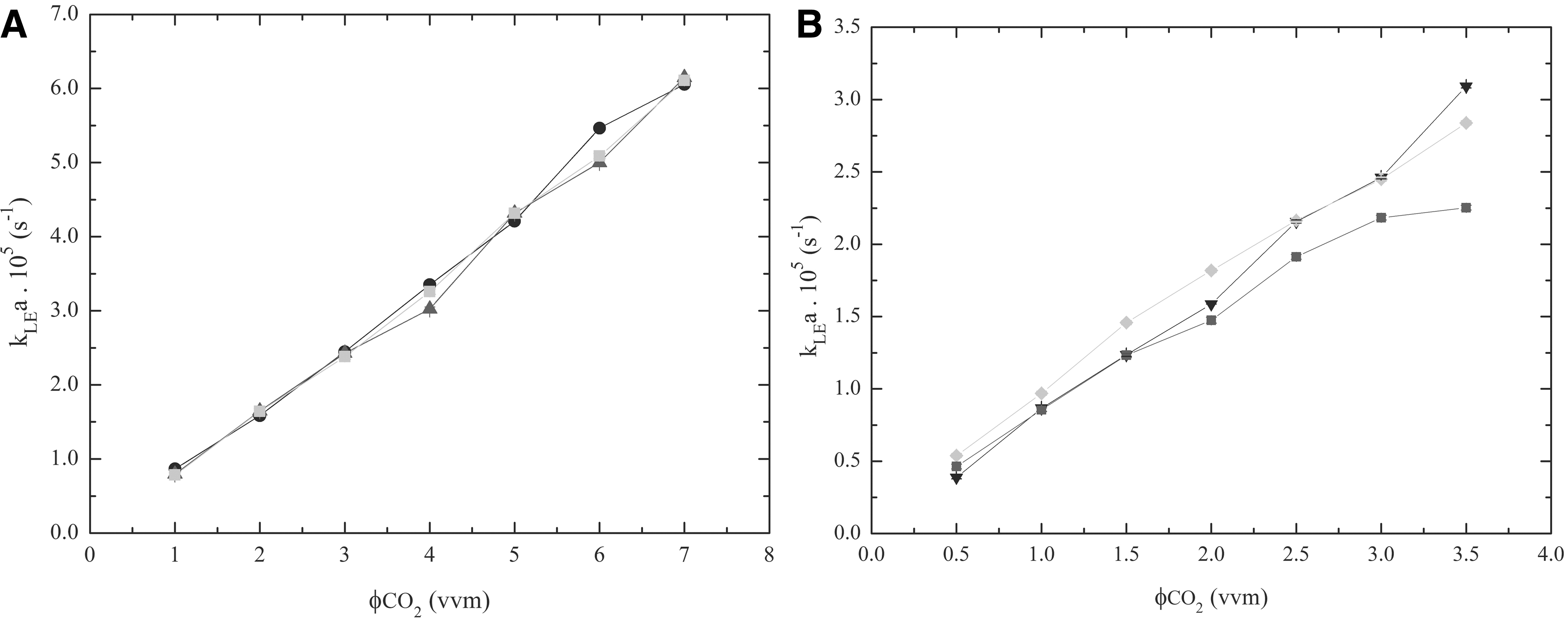
The kLEa values were very similar for the three classes of bioreactor prototypes, indicating that the mass transfer performance of the CTA model in ethanol stripping by CO2 was not greater than for the BC and SCA configurations. Mendes and Badino 20 obtained higher volumetric oxygen mass transfer coefficient (kLa) values for CTA prototype at scales of 5.0 and 10.0 L, using Newtonian fluids. These results were explained by the higher global gas hold-up values found for the CTA configurations compared to the BC and SCA models.
The three types of bioreactors prototypes investigated showed similar performance in terms of ethanol removal. However, the BC model has a simpler internal configuration compared to the CTA and SCA types, which allows fed-batch extractive fermentation studies. Therefore, the bubble column prototype was selected to perform a study of ethanol removal by gas stripping at three different scales. As shown in Fig. 3B, the kLEa values were very similar for the three scales of BC, especially for the 2.0 and 5.0 L bioreactor prototypes. The kLEa value increased almost linearly with increasing ϕCO2 at the three scales investigated, except for the prototype with 10.0-L working volume, which exhibited distinct behavior above 2.5 vvm. Mendes and Badino 20 report higher kLa values for the 10.0-L scale compared to the 5.0-L scale, for three classes of bioreactor prototypes operated with Newtonian fluids. Cerri et al. 28 evaluated oxygen transfer for three scales of concentric-tube airlift bioreactor prototypes (2.0, 5.0, and 10.0 L) and found that the volumetric oxygen mass transfer coefficient (kLa) curves were practically coincident, independent of the prototype scale, which was due to the geometric similarity among the prototypes evaluated. At the maximum specific gas flow rate used for the three models of bioreactor prototypes (7.0 vvm), on average, 73% of ethanol was removed by gas stripping. For the bubble columns, at 3.5 vvm, 49,% 46% and 38% of ethanol were removed at the 2-, 5- and 10-L scales, respectively.
Global Gas Hold-Up (ɛG)
The results for the global gas hold-up (ɛG) as a function of the specific CO2 flow rate (ϕCO2) are presented in Fig. 4A for the three bioreactor prototypes. It can be observed that ɛG increased with an increase of ϕCO2 in the experimental range studied, and that the ɛG values for the CTA configuration were higher than those found for the BC and SCA prototypes in the ϕCO2 range from 4 to 7 vvm. This behavior was due to the fact that increasing ϕCO2 above 4.0 vvm led to an increase of the gas recirculation in the downcomer section of the CTA model, resulting in a longer residence time of the gas bubbles in this bioreactor prototype. However, the increase of ϕCO2 did not lead to higher global gas hold-up in the SCA model compared to the CTA configuration. Mendes and Badino 29 measured the gas hold-up in the riser (ɛR) and downcomer (ɛD) sections of airlift prototypes operated with Newtonian fluids and air, observing that the ɛR values for the SCA design were 6.5% higher, on average, compared to the CTA model. On the other hand, the ɛD values for the CTA prototype were, on average, 40% higher than for the SCA model. Hence, the CTA geometry caused increased gas bubble recirculation in the downcomer section, which led to higher global gas hold-up in the CTA configuration, despite the slightly lower ɛR values obtained for these prototypes. Cerri et al. 28 also reported higher ɛG values for a CTA model compared to the SCA configuration, both with a 2.0 L working volume and operated with water and air as the liquid and gas phases, respectively.
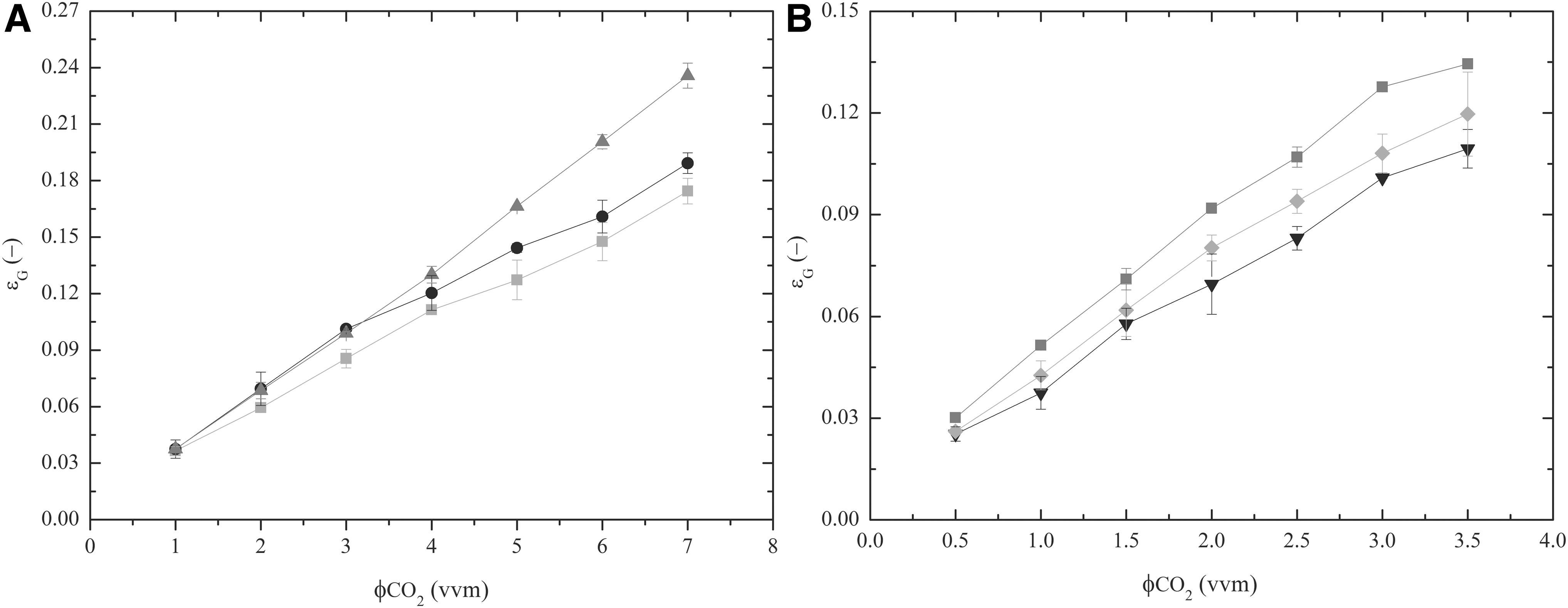
Although the ɛG values obtained here were higher for the CTA configuration within the range 4.0–7.0 vvm, it was not possible to obtain an increase in kLEa, as described previously. The gas bubbles recirculating through the downcomer section in the CTA prototype had probably already reached thermodynamic equilibrium. Therefore, the increase of the bubble residence time, and consequently the increase of the interfacial area for mass transfer, did not enhance ethanol removal by gas stripping.
Figure 4B shows the gas hold-up (ɛG) values obtained for the three scales of BC prototypes as a function of the specific CO2 flow rate (ϕCO2). It can be seen that ɛG was higher for the 10.0-L scale, compared to the 2.0-L and 5.0-L BC prototypes, in the experimental range investigated. Therefore, the increase of scale led to an increase of the gas bubble residence time in the bubble columns operated with ethanol solution and with CO2 as the gas phase. Cerri et al. 28 evaluated the behavior of the gas hold-up for three scales (2.0, 5.0, and 10.0 L) of concentric-tube airlift bioreactor prototypes operated using water and air, and observed that the ɛG values were very close for the three scales. Conversely, Mendes and Badino 20 reported that, for all three prototype configurations (BC, CTA, and SCA), the 10.0-L scale provided higher ɛG values compared to the 5.0-L scale, with the influence of prototype volume being lowest for the bubble column model. Although the 10.0-L scale provided the highest ɛG values, the volumetric ethanol removal coefficient was not higher for this prototype. Hence, the global gas hold-up did not show a positive effect on the ethanol removal by gas stripping.
Mean Bubble Diameter (dB)
Figure 5 presents the experimental mean bubble diameter (dB), as a function of the specific gas flow rate (ϕCO2), for the prototypes operated with 10% (v
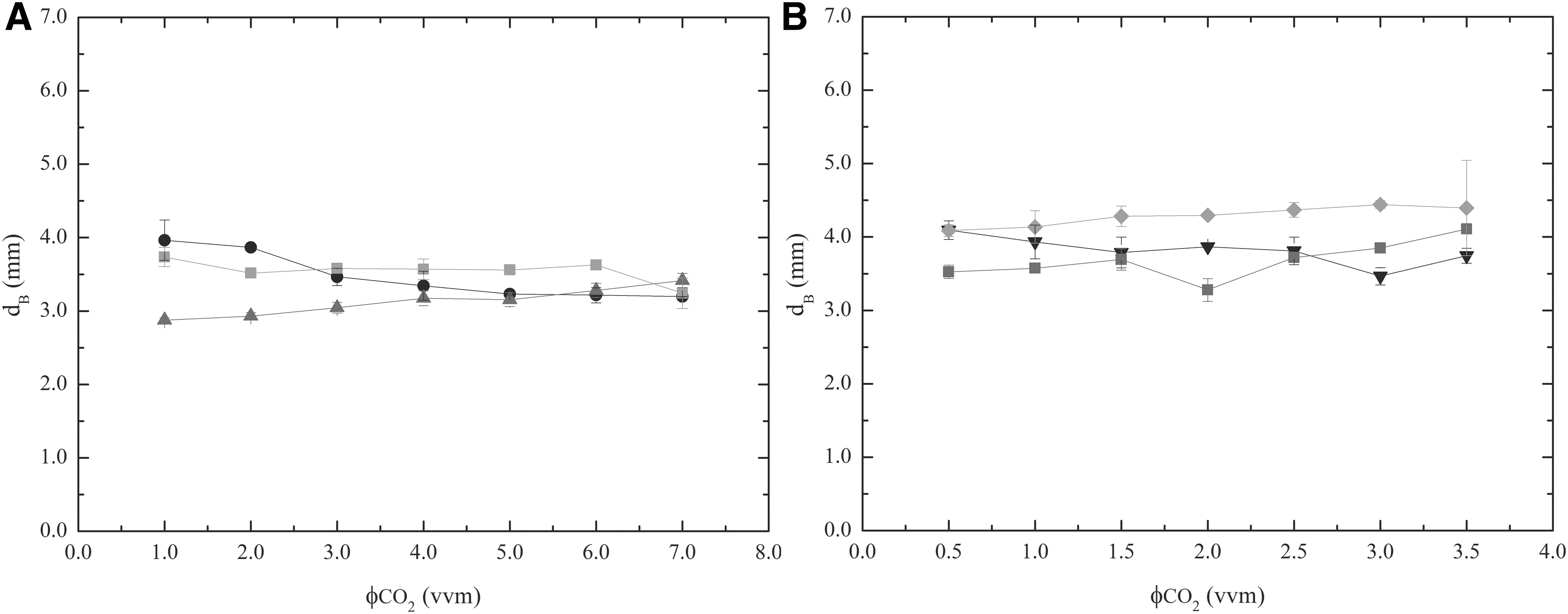
The dB values for the three scales of BC prototype (Figure 5B) showed a small change between 3.2 and 4.5 mm as the specific gas flow rate increased. The dB values were slightly higher for the 5.0-L scale, compared to the 2.0 and 10.0 L scales, due to the larger diameter of the sparger holes of the 5.0-L bioreactor. Jamialahmadi et al. 32 evaluated the bubble diameter over a wide range of gas flow rates in bubble columns using water and air as the liquid and gas phase, respectively. The results showed that the bubble size increased significantly by increasing the orifice diameter from 0.5 to 3 mm. However, the bubble diameter remained almost constant as the liquid height increased from 0.60 to 2.1 m. Therefore, the bubble size appears to be strongly dependent on the sparger hole diameter and independent of liquid height in the reactor. Cerri et al. 30 reported higher dB values for a 5.0-L concentric-tube airlift prototype compared to 2.0- and 10.0-L scales using water and air as the liquid and gas phases, respectively. The dB values measured in the present work were lower than those obtained by these authors. This was because the addition of ethanol decreased the surface tension, resulting in the formation of bubbles with smaller sizes. Wilkinson et al. 33 found that the bubble diameter increased with increasing surface tension and decreased with increasing density of the liquid.
Ethanol Enrichment
The stripping of ethanol with CO2 was also evaluated in terms of the ethanol concentration factor (FC), which is a measure of the ability of the bioreactor prototype to remove ethanol compared to the amount of water removed. The results showed that the FC profile, as a function of the specific CO2 flow rate (ϕCO2), was very similar for the three prototype classes (Fig.6A), with the highest FC values obtained under low specific gas flow rates. The BC and SCA configurations provided higher FC values, on average, compared to those obtained for the CTA type. As the three prototype classes allowed the removal of comparable amounts of ethanol, the CTA geometry presented higher water stripping by CO2 compared to the BC and SCA configurations. This was due to the higher gas recirculation (higher ɛG values) obtained for the CTA model, which enabled greater gas-phase water enrichment. A gas stream leaving the prototype with high water content increases the energy requirements for ethanol recovery. Hence, the BC and SCA models exhibited better performance in the stripping process, since a smaller amount of water was removed together with the ethanol.
Figure 6B presents the ethanol concentration factor (FC) values obtained for the three scales of BC prototypes as a function of ϕCO2. Higher FC values were found for the 10.0-L scale, particularly under low gas flow rates, with values 21% and 16% higher, on average, than those obtained for the 2.0 and 5.0 L scales, respectively. Therefore, increasing the prototype size led to an increase of FC, resulting in higher ethanol/water selectivity for the bubble column configuration. The kLEa values were close for the three scales of BC within the range investigated. Therefore, the highest FC values obtained for the 10.0-L prototype indicated that this scale led to the removal of a smaller amount of water compared to the 2.0- and 5.0-L scales. Silva et al. 13 reported that an increase of ϕCO2 led to greater entrainment of water together with ethanol, resulting in a diluted output gas stream. These authors found higher concentration factor values for a pilot-scale prototype containing industrial fermented wine (without yeast) compared to a bench-scale reactor containing an ethanol solution.
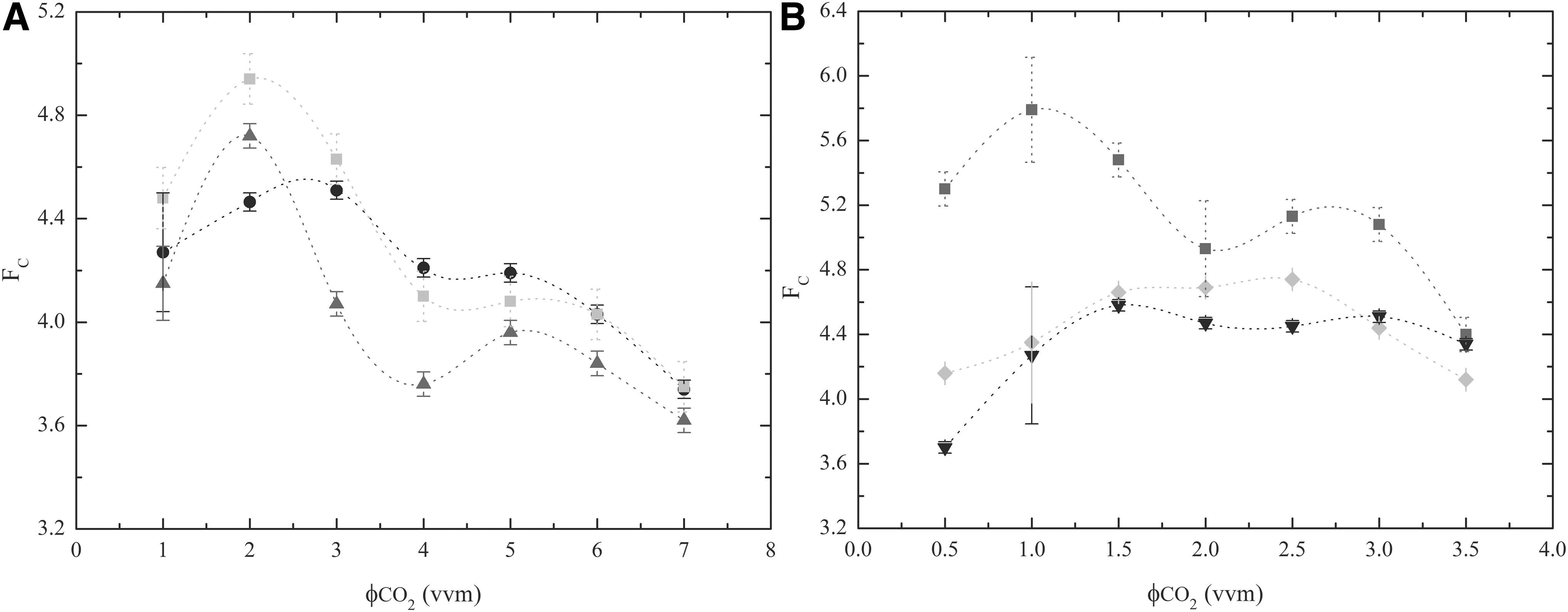
In processes such as aeration, boiling, and evaporation, where liquids and gases are in relative motion, the bursting of gas bubbles at the liquid-gas interface is followed by droplet formation. 34 Under certain gas flow conditions, the droplets become entrained with the stream, resulting in formation of a thin liquid film on the internal surface of the column, with mass loss or gas stream contamination in many cases. 35 This liquid entrainment phenomenon depends mainly on the gas flow rate and plays an important role in mass transfer between phases. 34 Ethanol and water removal in the stripping experiments were due jointly to the vaporization of these volatile compounds and liquid entrainment. The entrained droplets had the same composition as the ethanol solution, while the gas stream had a higher ethanol concentration than that found in the bioreactor prototype. Therefore, the greater liquid entrainment caused by increasing ϕCO2 resulted in lower FC values, since a more diluted output gas stream left the prototype. On the other hand, it was assumed that mass transfer also occurred in the thin film of liquid falling down the inside surface of the circular tube through which the gas stream flowed. Hence, the larger the wetted surface area, the greater the ethanol and water removal by gas stripping (vaporization). Therefore, increasing ϕCO2 led to an increase of the wetted wall column, resulting in greater mass transfer of ethanol and water to the gas phase. Consequently, it is important to ensure operation of the prototype under appropriate specific gas flow rates to enhance ethanol removal by vaporization and avoid the entrainment of liquid together with the gas stream.
Volumetric Ethanol Removal Coefficient (kLEa) Correlation
The effects of the internal tube diameter (De1), superficial gas velocity (UG), diameter of the gas inlet orifice (dO), height of liquid in the prototype (H4), ethanol diffusivity in the water (DL), and the global gas hold-up (ɛG) on the volumetric ethanol removal coefficient (kLEa) were evaluated for the three scales of BC (2.0, 5.0, and 10.0 L). A correlation based on dimensionless groups was proposed for the prediction of kLEa and was fitted to the experimental data of the present work. The correlation determined by dimensional analysis (Equation 9) relates the modified Sherwood number (Sh), which incorporates the desired parameter (kLEa), to the Froud number (Fr), the H/dO ratio, and the global gas hold-up (ɛG).

Equations 10 and 11 present the fitted correlation in expanded and condensed forms, respectively, for the three scales of BC prototypes:
The proposed model based on dimensionless numbers provided a very good fit to the experimental data, with R2 of 97%. It can be observed that the mass transfer, represented by the Sherwood number (Sh) was more affected by the superficial gas velocity than by the H/dO ratio. However, the influence of the liquid height (H) on kLEa is important for the scale-up of this bioreactor type because an increase in the prototype size results in a higher Sherwood number and, consequently, in a higher kLEa value.
Furthermore, according to Equation 11, the global gas hold-up (ɛG) had a negative influence on the Sherwood number. However, Mendes and Badino 20 reported the positive effect of ɛG on the volumetric oxygen mass transfer coefficient (kLa) for two scales (5.0 and 10.0 L) of three bioreactor prototypes containing viscous Newtonian fluids. Similar behavior was reported by Cerri et al. 28 for CTA prototypes with working volumes of 2.0, 5.0, and 10.0 L. Therefore, ɛG has a distinct effect on Sh when the transport of mass occurs from the liquid phase to the gas phase.
Figure 7 presents a comparison between the experimental Sherwood number data (Shexp) and the values predicted by Equation 11 (Shcalc) for the three scales of bubble columns. The results showed that the deviations were lower than 10%, indicating good agreement between the calculated and experimental data. Hence, if kLEa is the criterion chosen for scale-up of the stripping process, the correlation described by Equation 10 can be useful for predicting operating conditions at the new scale.
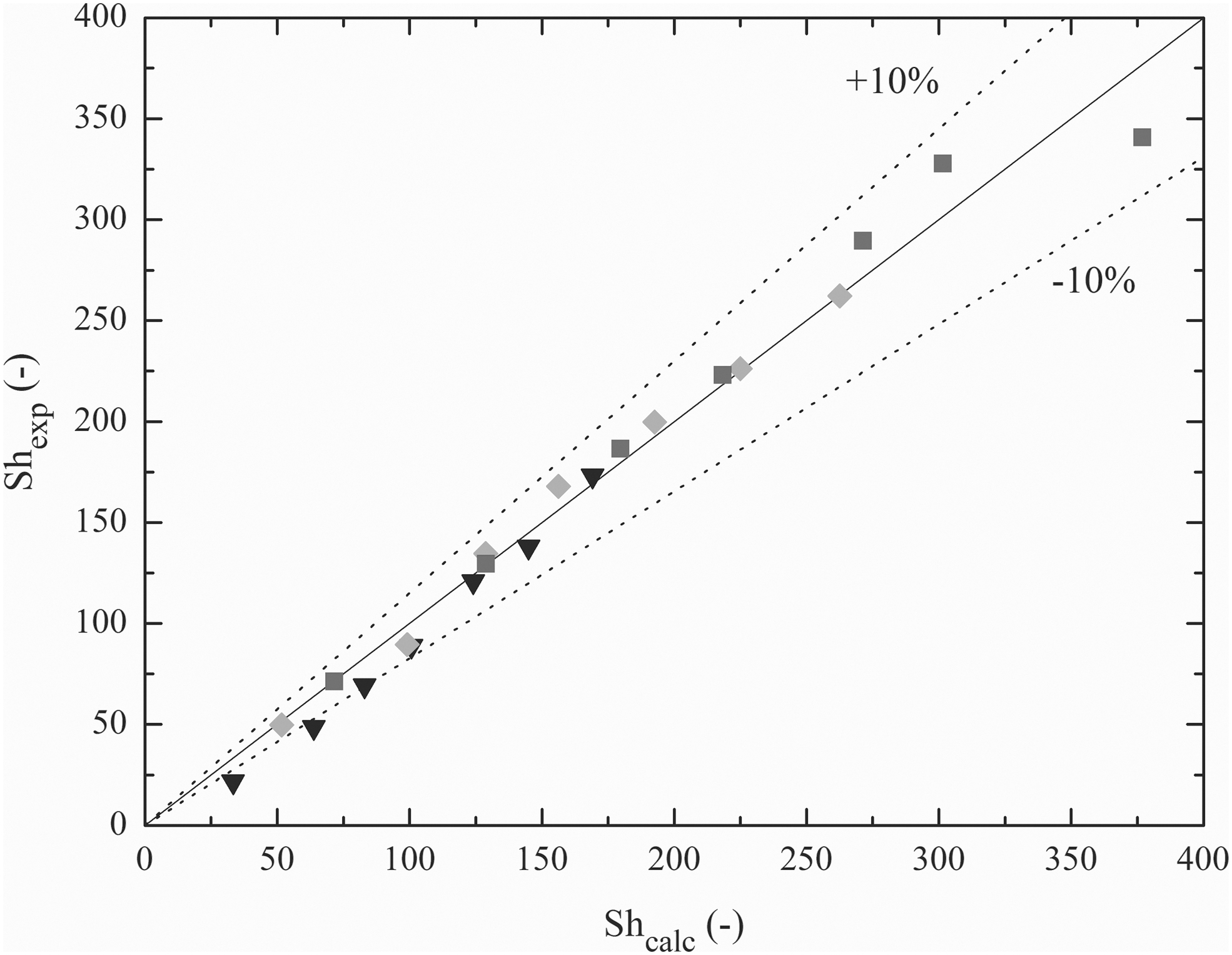
Comparison between experimental (Shexp) and calculated (Shcalc) Sherwood number data for the three scales of BC: (▾) BC (2.0 L), (♦) BC (5.0 L), and (▪) BC (10.0 L).
Conclusions
The main objective of this work was to investigate the hydrodynamics and mass transfer characteristics for ethanol stripping with CO2 in pneumatic bioreactor prototypes. The results showed that an increase of the global gas hold-up did not enhance ethanol removal for the three classes of bioreactor prototypes and for the three scales of bubble columns (BC).
There were no significant changes in the mean bubble diameter (dB) values with increased specific gas flow rate (ϕCO2). The same behavior was observed for the three types of prototypes studied and for the BC configurations with working volumes of 2.0, 5.0, and 10.0 L.
The volumetric ethanol removal coefficient (kLEa) values were very close for the three classes of bioreactors prototypes and the three scales of BC models. In order to predict kLEa for different scales and operational conditions, a dimensionless correlation was proposed for the Sherwood number, which provided an excellent fit to the experimental data, with few points exceeding ±10% deviation. This correlation could be very useful for further design and scale-up studies of ethanol removal by the gas stripping process in bubble columns.
The FC profiles, as a function of the specific CO2 flow rate (ϕCO2), were very similar for the three classes of bioreactor prototypes, with the highest FC values obtained under low specific gas flow rates and for the bubble column and split-cylinder airlift models. The highest FC values were found at the 10.0-L scale. Therefore, increasing prototype size allowed an increase in FC, resulting in greater ethanol enrichment of the gas stream leaving the prototype with a larger volume, which is advantageous for the scale-up of the stripping process.
Footnotes
Author Disclosure Statement
No competing financial interests exist.
Funding Information
The authors would like to thank Coordenação de Aperfeiçoamento de Pessoal de Nível Superior-Brazil (CAPES, Finance Code 001), CNPq (grant numbers 431460/2016-7 and 131780/2018-2), and FAPESP (grant number 2018/11405-5) for financial support of this work.