




Abstract
Mead is an alcoholic beverage made from fermented honey wort. Honey is manly composed of glucose, fructose and water, but it lacks nutrients, including nitrogen, which reduces ethanol yield and influences the production of aroma compounds by the yeast. This work describes the influence of fed-batch and staggered nutrient addition processes in substrate consumption, ethanol formation, yeast growth and production of glycerol, acetic acid and volatile alcohols during mead production. A positive relationship was found between wort's nutrient content and yeast growth. Fed-batch and staggered nutrient addition led to a mead with higher ethanol and lower residual sugar concentrations, with a positive relationship between nutrient addition and glycerol formation. Fed-batch and staggered nutrient addition showed to be an improved method for mead production, resulting in 90% efficiency for ethanol production by the yeast and intermediate concentrations of isoamyl alcohol (441.9 mg/L), isobutyl alcohol (7.6 mg/L) and phenethyl alcohol (1.4 mg/L) during the fermentation of a 150 g/L supplemented honey wort. Staggered nutrient addition, associated or not with fed-batch, showed to be an improved alternative method for mead production.
Introduction
Mead is an alcoholic beverage produced from honey wort fermented mainly by Saccharomyces cerevisiae. 1 Honey is mainly composed of glucose, fructose and water. However, a high carbon-to-nitrogen ratio and microbial-inhibiting substances like medium chain fatty acids (MCFA) and hydroximethylfurfural (HMF) are observed. 2 -4 Moreover, honey lacks minerals and has low pH. The low concentration of nutrients and the presence of inhibitors are both stressful for microorganisms. 5
The supplementation of honey wort is necessary to meet the nutritional demands of yeast since mead production requires a long fermentation process. 6 Nitrogen supplementation has a high impact on yeast growth, fermentation, and the profile of volatile compounds during mead production, 7 but the yeast's nutritional demand is not yet fully understood. Some authors describe the use of potassium tartrate, malic acid and diammonium phosphate (DAP). 8 A commercial nutrient (Enovit®, EAB Group), generally used for wine production, was also evaluated by Gomes et al. 7 The authors observed a positive relationship between nutrient concentration (60–120 g/hL), glucose and fructose consumption, and ethanol production by the yeast. Also, the profile of aroma compounds produced by a specific yeast strain, like esters and higher alcohols, depends on wort composition 9 and will influence the beverage sensory quality.
The dilution of sugars and inhibitors during fed-batch fermentations attenuates the osmotic stress caused by wort during high-density processes and, thus, avoids inhibition of the yeast and lower alcohol production. 10 -13 For this reason, this work evaluates the impact of fed-batch honey wort fermentation (substrate fed-batch) and staggered nutrient addition (nutrient fed-batch) on ethanol formation, yeast growth, and concentrations of glycerol, acetic acid and three different volatile compounds during mead production.
Material and Methods
Honey
Honey was obtained from the apiary of the Experimental Farm of Iguatemi (FEI), Zootech Department of Universidade Estadual de Maringá (UEM) at Iguatemi, Paraná State, Brazil. This wildflower honey was characterized based on the methods of AOAC 14 for color, acidity, residual mineral content, moisture and glucose and fructose concentration.
Wort Preparation and Fermentation
Four independent batch methods were performed—substrate fed-batch; staggered nutrient addition; substrate fed-batch and staggered nutrient addition; and substrate and nutrient batch (control)—to evaluate how batch method impacts fermentation kinetics, ethanol yield, yeast growth, residual sugar content, and the production of three volatile compounds during mead production.
Honey wort was prepared by diluting raw honey with fresh water (filtered drinking water containing chloride) until 150 g/L glucose and fructose concentration. For fed-batch experiments, an additional concentration of 50 g/L of glucose and fructose was added after 48 h. The nutrient used as nitrogen supplement was a mixture with 30% (w/w) of diammonium phosphate (DAP) (Reagen®) and 70% (w/w) of dry beer yeast extract (Nutryervas®). It was added to the wort at 35 g/hL. For the staggered nutrient addition experiments, the total concentration of this nutrient was added fractionally as four portions of 40%, 20%, 20% and 20% at 0, 16, 26 and 60 h after the beginning of the fermentation process, respectively. The yeast used was Itaiquara® fresh baker's yeast at 10 g/L.
The fermentations were carried out at 22°C in a 5-L bioreactor Biostat B™ for 80–100 h. Aliquots were collected at 0, 4, 8, 12, 16, 20, 24, 30, 36, 48, 60, 72, 80 and 100 h using a syringe and were centrifuged at 3,000 rpm. The supernatants were subjected to chemical analysis, while the sedimented cells were used for yeast concentration measurement.
Chemical Analysis and Yeast Concentration Measurement
The concentration of glucose, fructose, ethanol, glycerol and acetic acid was determined by High Performance Liquid Chromatography (HPLC) using Aminex® HPX-87H column, RI detector at 50°C and flow rate of 0.60 mL/min. Isoamyl, isobutyl and phenethyl alcohols were determined by Gas Cromatography (Shimadzu® GC-17A QP5050) with flame ionization detector (FID), equipped with a Supelco PAG capillary column of 30 mm x 0.25 mm film thickness and 0.25 μm internal diameter.
Yeast concentration was estimated by spectrophotometry at 600 nm.
Ethanol and Biomass Yield and Efficiency of Fermentation
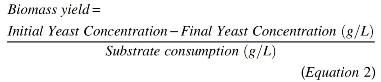
Ethanol yield was calculated as the ratio between ethanol concentration and the consumed sugars (initial minus residual concentrations of glucose plus fructose) at 80 h (Equation 1). In the same way, biomass yield is calculated by Equation 2. Ethanol efficiency was calculated by
Equation 3.
15
Results and Discussion
Characteristics of Honey
The glucose and fructose concentrations in the honey are in accordance with Brazilian legislation (Table 1), as well as acidity and residual mineral content. Moisture under 20% and total reducing sugars above 65% are both required to confirm the absence of adulteration. 3-4
Honey Characteristics and Current Legislation
Fermentation Kinetics
Yeast growth
Substrate fed-batches favor yeast growth even with staggered nutrient addition (Fig. 1). Substrate fed-batch prevents yeast inhibition by sugars at the beginning of the process, supporting healthy growth. The more prominent growth (39.6 g/L at 120 h) was observed when all the nutrient was added at the beginning, suggesting that staggered nutrient addition can limit yeast growth. Mead production with higher concentrations of DAP in the mead wort presents higher yeast growth and late slowdown of cell multiplication. 16-17 Authors reported that microbial growth under nitrogen-limited medium influences the production of volatile compounds in alcoholic beverages like wine. 18-19
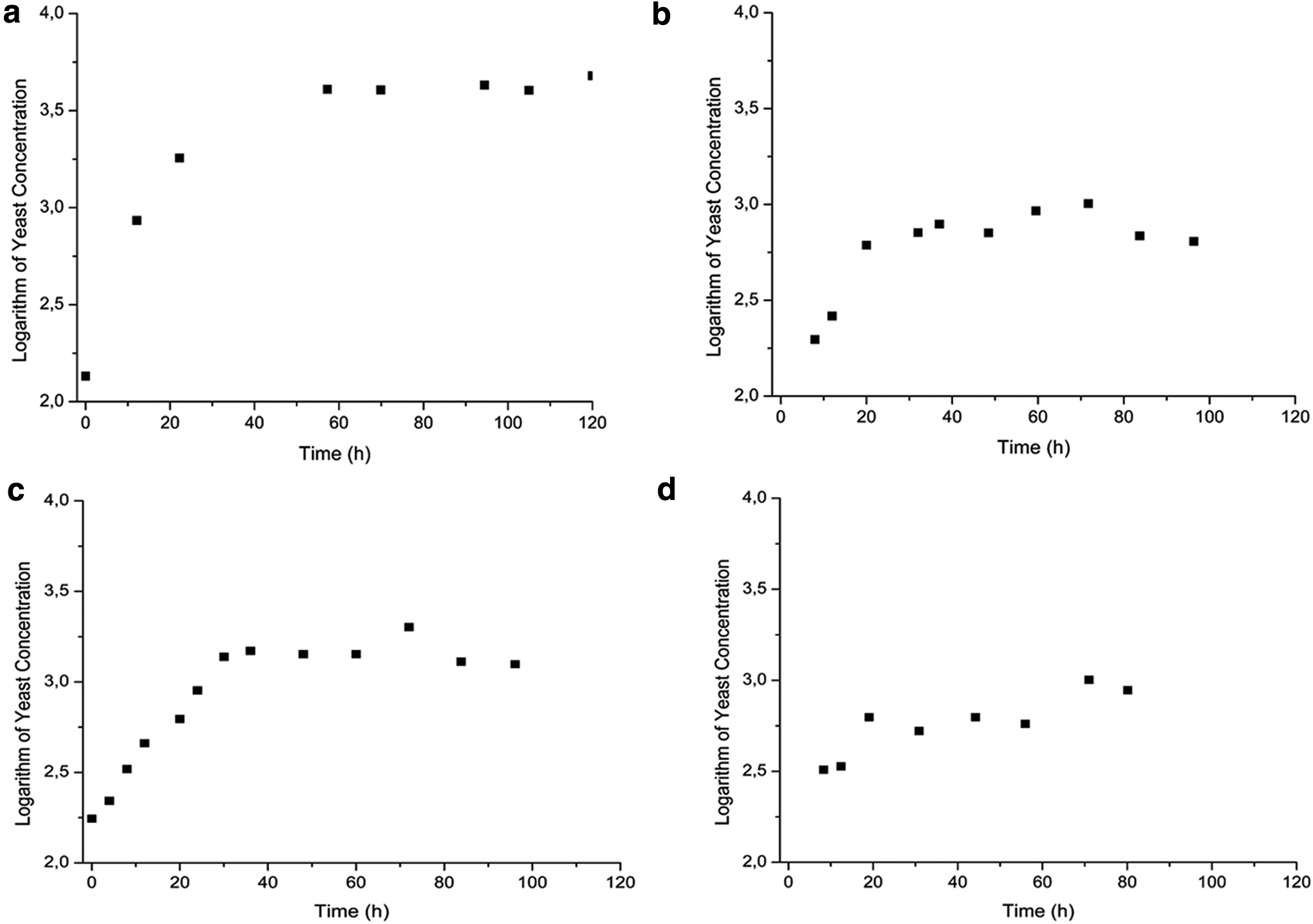
Logarithm of yeast concentration versus time for
Data for biomass yield (Table 2) support that fed-batch method improves yeast growth in honey fermentation. In fact, for a healthy alcoholic beverage fermentation, it is also necessary to have a balance between aroma profile and ethanol formation. Therefore, high yeast growth may not be desired.
Biomass Yield in Meads Produced by Different Strategies of Substrate and Nutrient Addition
Glucose and fructose consumption and ethanol production
All results point to glucose preference by the yeast. Fructose is consumed slower and is prevalent in the composition of residual sugars at the end of fermentation (Fig. 2). Even in the fed-batch experiments, glucose was rapidly consumed, so that no glucose was observed a few hours after substrate additions. This was also observed by Gomes et al. 7 However, staggered nutrient addition had led to slow glucose consumption rates by the yeast, probably due to the lack of nitrogen at the beginning of the process, which is required for nutrient and substrate assimilation by the yeast. 13
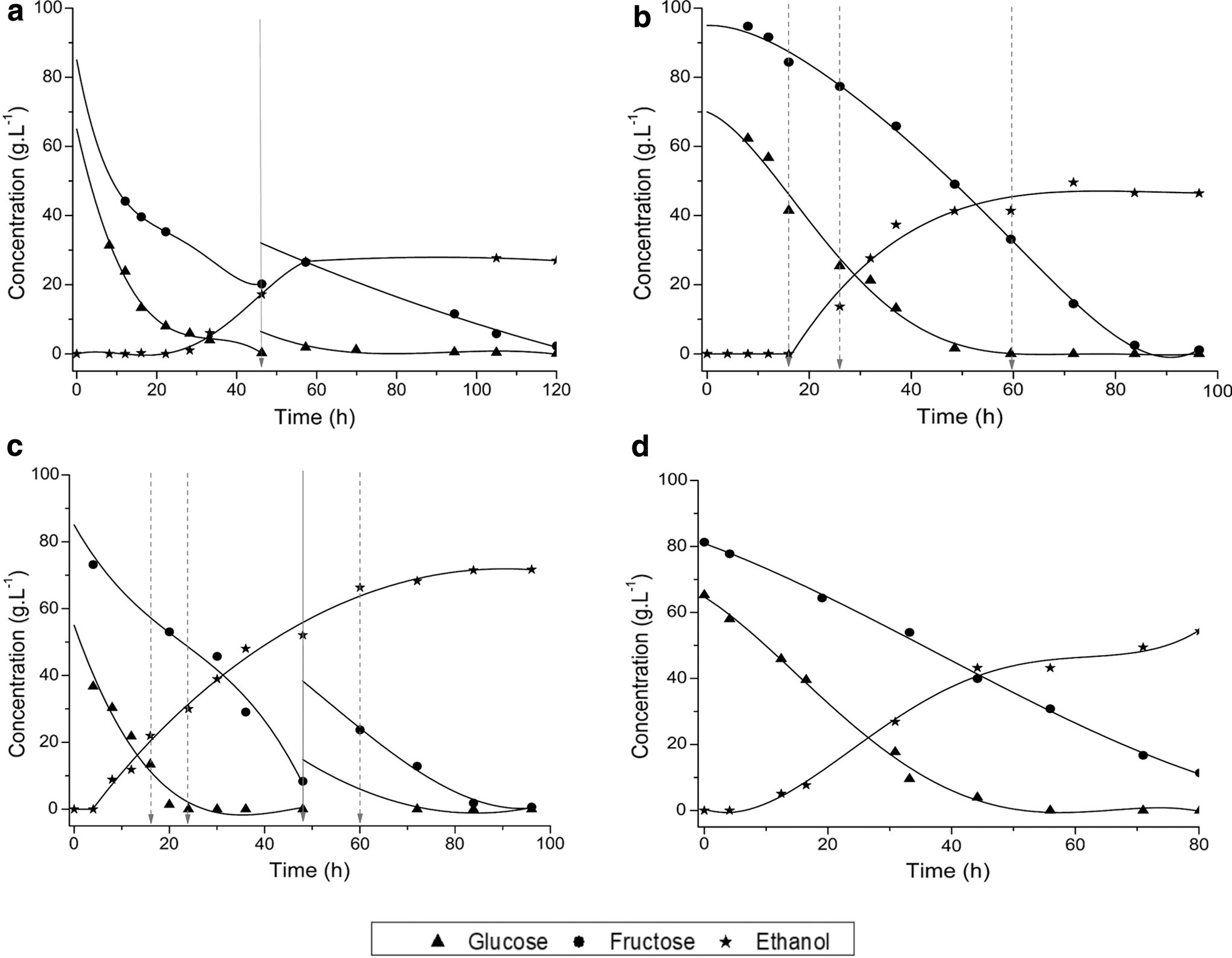
Glucose, fructose, and ethanol concentration versus time for
After 80 h of fermentation, the mead produced through fed-batch presented the highest amount of residual sugars, followed by control (Table 3). On the other hand, the ethanol yield was higher when the fed-batch and staggered nutrient addition method was applied. Staggered nutrient addition and fed-batch experiments alone led to the lowest efficiencies in ethanol (53 and 49%, respectively), suggesting a positive relationship between initial supplementation (substrate and nutrient) and ethanol formation. Mendes-Ferreira et al. 17 observed that supplementation of wort with higher nutrient concentrations was related to faster fermentations. Required nutrients like assimilable nitrogen play essential roles in the product formation by the yeasts. 16,18
Ethanol Yield, Ethanol Efficiency (%), and Residual Sugar Concentration (g/L) in Meads Produced by Different Strategies of Substrate and Nutrient Addition
Ethanol yield and specific growth rate seemed to have a negative correlation. In fact, fermentation is the anaerobic pathway from whicAQh ethanol is produced, but leads to lower production of ATP by cells, and consequently, negligible growth rates. 15 Thus, massive yeast growth is generally not desirable during the production of alcoholic beverages. However, the consumption of glucose and fructose and low ethanol yields could also be related to the production of byproducts, like esters, higher alcohols and volatile fatty acids in mead. 22
Acetic acid and glycerol
Fed-batch and staggered nutrient addition treatment generated a mead with acetic acid concentration above 1.0 g/L (Table 4). Acetic acid is usually monitored during alcoholic fermentations to detect the presence of bacterial contaminants or yeast stress. 20 Gomes et al. 7 observed acetic acid concentrations lower than 1.1 g/L in mead fermented using commercial nutrient in concentrations between 60 and 90 g/hL, which complies with legal limits. In this work, fed-batch, staggered nutrient addition, and control had generated meads with acetic acid concentrations below 0.8 g/L.
Glycerol and Acetic Acid Concentrations (g/L) in Meads Produced by Different Strategies of Substrate and Nutrient Addition
On the other hand, glycerol concentration reached 5.8 g/L in mead produced by fed-batch and staggered nutrient addition and 5.11 g/L when staggered nutrient addition was applied, which suggests a positive relationship between staggered nutrient addition and glycerol production by the yeast. This compound is mostly produced as an osmoregulant by the yeasts and accumulates in stressful osmotic conditions. 20 In mead and wine, glycerol contributes to sensory characteristics, like beverage body, texture, and sweetness and softness at high concentrations (under 8.5 g/L). 9
Meads produced by Gomes et al. 7 had glycerol in concentrations between 5.40 and 7.04 g/L under the conditions described above. In this work, glycerol concentrations ranged between 0.9 and 5.8 g/L, with the lower value attributed to meads produced through fed-batch. This suggests that lower substrate concentrations and total nutrient addition at the beginning prevents osmotic stress, decreasing glycerol formation.
Isoamyl, isobutyl and phenethyl alcohols formation
In alcoholic beverages, higher alcohols can contribute to the overall aroma. However isoamyl and isobutyl alcohols, when present at concentrations above 300 and 75 mg/L, respectively, are associated with solvent characteristics. 9 Between the three volatiles analyzed, isoamyl alcohol was prevalent in all the meads produced, independently of the process applied (Table 5). The control experiment generated mead with lower concentrations of this compound (52.3 mg/L), while fed-batch and fed-batch and staggered nutrient addition led to meads with the higher concentrations (746.18 and 441.9 mg/L, respectively). Mendes-Ferreira et al. 17 observed a negative relationship between nitrogen addition to the wort and higher alcohols concentration in meads. Phenethyl alcohol, commonly associated to floral scent at concentration above 7.5 mg/L, 9 was found at 43.7 mg/L in meads produced by fed-batch.
Concentration (mg/L) of Volatile Substances in Meads Produced by Different Strategies of Substrate and Nutrient Addition
Schwarz et al. 9 emphasizes that high alcohols are formed by nitrogen recycling of amino acids, and mead is a poor source of them. Amino acids like phenylalanine and isoleucine are precursors of phenethyl and isoamyl alcohol. 18 The control experiment seems to have more concentration of nitrogen sources at the beginning and may have suppressed high alcohol formation. Besides that, temperature of fermentation, pitch rate (the amount of yeast that is added to cooled wort), and nitrogen source were also reported to be influencing factors in the volatile profile of meads and wines. 19,21,22
Conclusion
This work evaluates fed-batch and staggered nutrient addition as methods for mead production. Fed-batch alone has induced yeast multiplication, thus generating meads with low ethanol and glycerol concentrations, and with the higher levels of isoamyl and phenethyl alcohols. Staggered nutrient addition, fed-batch or not, led to meads with higher concentrations of ethanol, glycerol and acetic acid, and intermediate concentrations of superior alcohols, therefore was shown to be an improved alternative method for the production of mead.
Footnotes
Author Disclosure Statement
No competing financial interests exist.
Funding Information
The authors are grateful to CAPES (Higher Education Personnel Improvement Coordination) for the financial support that made this study possible.