




Abstract
Bio-desulfurization generally involves the oxidation of sulfide to sedimented, sulfur compounds in microaerobic conditions and is applied at biogas power plants by the palm oil industry. In this work, microbes were screened from various sources, including microalgae, coal waste, Palm Oil Mill Effluent (POME), and cow manure. Screening of potential microbes was conducted using synthetic chemical reagent as the sulfur source. Decomposition of sulfur sources, like Na2S2O3, has been observed through microbial process whereas sulfur was separated into sedimented other sulfur compounds. Screenings were first conducted in modified growth media followed by screening with selective media for Thiobacillus. With the selective media, the treatment was continued with the addition of a sulfur source to see if the microbes are able to convert the sulfur to sulfuric acid or other sulfur compounds as sediment. The preferred microbe would be chosen and applied to the bioscrubber system at Terantam, Indonesia. This work could also be applicable to biogas generation from POME where H2S content is more than 1,200 ppm, which is corrosive to the biogas engine. Finally, we propose a two-step desulfurization in which H2S is absorbed by an alkali solution followed by sulfur separation.
Introduction
Utilization of Palm Oil Mill Effluent (POME) to produce biogas prevents the release of methane (CH4)—a greenhouse gas 28 times more powerful than carbon dioxide in terms of global warming potential—directly into the atmosphere. 1 The Agency for Assessment and Application of Technology (BPPT) has been built a biogas power plant in Terantam, Indonesia using POME as feedstock. The anaerobic digestion, with occurs within a lagoon system, uses mesophilic organisms to biologically convert the POME into biogas containing roughly 57.6% CH4, and 32.5% mol CO2, 1,600 ppm H2S, among other compounds.
Unfortunately, in an engine, H2S causes odor and becomes corrosive when combusted to SO2. 2 Therefore, H2S should be kept at levels less than 200 ppm to prevent the biogas engine from sustaining damage. 3 In addition, H2S has lower calorie value than CH4 and decreasing combustion efficiency.
H2S removal from biogas can be done by various several methods. The most applicable at power-plant scale is through the use of scrubbers, including bioscrubbers, chemical scrubbers, and water scrubbers. Bioscrubbers work based on the performance of sulfur-oxidizing microorganisms like Thiobacillus family to oxidize H2S to sulfate, thiosulfate, and/or elemental sulfur. Chemical scrubbers via an ionic reaction between NaOH and H2S to produce sulfate acid. Water scrubbers work by dissolving H2S in water; to enrich and accelerate the amount of H2S in water, pressurized water is used to absorb H2S. 4
H2S can be oxidized with FeSO4 and subsequent microbial process, 5 but this is only applicable for biogas with H2S concentration above 10,000 ppm. Another work removed H2S from biogas with high aeration of approximately 5% O2. 6 Because the Terantam biogas contains up to 60% flammable methane gas, this work aims to isolate a strain that works at minimum O2 and keep the upper limit of 2% O2 to avoid the potential for explosion.
At the Terantam bioscrubber system, biogas is propelled to the top of the scrubber at pressures up to 50 mbar. The modified liquid media of cover lagoon effluent flows concurrently. The bioscrubber system is also equipped with packing media that will pass through the pipe located at the bottom of the bioscrubber. Biogas that has passed through the system includes media that also serves to increase the contact surface area between biogas and liquid media. The contact between liquid medium and biogas will absorb more H2S than CO2. The bioscrubber not only works based on absorption but also microbial process where the consortium of microbes degrades dissolved sulfur compounds and converts them into sedimented S compounds.
The part of the process where microbes decompose molecules containing sulfur from biogas into other, sedimented S compounds, is the focus of this study, because the sulfur can be readily separated from liquid media. Therefore, this work screens potential microbes or microbial consortia for use as bioscrubber.
Materials and Methods
Materials
Screening for chemoautotrophic, Sulphur-oxidizing microbes was conducted from several environments: coal landfill, biodigester outlet POME, cow manure, and microalgae.
Methods
Microbial screening was done by growing microbes from the aforementioned sources in growth media consisting of modified Potato Dextrose Broth (39 g in 1 L) with some nutrients (CaPO4, NH4Cl, etc) 7 and S sources such as Na2S2O added. 8 Microbial growth was carried out at room temperature and monitored at 30°C in shaking water bath incubator for up to 2 weeks.
The microbes cultivated in growth media were moved to modified selective media 9,10 in 1 L solution containing 0.10 g (NH4)2SO4, 4.00 g K2HPO4, 4.00 g KH2PO4, 0.10 g MgSO4·7H2O, 0.25 g CaCl2, 0.01 g FeCl3·6H2O, 0.02 g MnSO4·H2O, and 10 g Na2S2O3·5H2O. The incubation was conducted and observed for pH. At the end of incubation, total S was measured.
Sulfuric acid analysis
H2SO4 was analyzed based on deposit formation of BaSO 11 by reacting H2SO4 and BaCl2. The analysis was done in buffer solution comprised of 30 g MgCl2·6H2O, 5 g Na(CH3COO) ·2H2O, 1 g KNO3 and 20 mL CH3COOH 99% in 1,000 mL of water. The buffer was used to analyze known sulfuric solutions. The sulfuric solution was made by Na2SO4 anhydrate. The concentration was measured with spectrophotometry (λ = 420 nm). The result was used to make standard curve. Finally, any experimental sample was analyzed using the buffer in the same way as the standard sample and calculated using standard curve.
Sulfur analysis
Total S was analyzed by Sulphur Analyzer (LECO S 632, Leco, Australia). The detector was infrared. The support media, comcat, was put in 1-g container. 0.5 mL of liquid sample was added to the comcat. The sample was burned in the sulphur analyzer. At least 0.1 g sediment of the cultivation product was put in 1 g comcat, and, at the same time, another sample was heated for 2 h at 110°C to measure water content.
Direct Microscopic Count (DMC)
The number of cells in the population was measured by direct microscopic count using haemocytometers. Using a pipette, 100 μL of Trypan Blue-treated cell suspension was applied to the hemocytometer. These are specially designed slides that have chambers of 0.01 mm depth and 0.0025 mm2. The average cell count was taken from each of the sets of 16-corner squares using a hand tally counter. The cell number was multiplied by 10,000/mL.
Results and Discussion
The growth profiles of microbes that are potentially able to separate sulfur in selective media with sodium thiosulphate as a sulfur source are shown in Fig.1. The media was set with total S of 557 ppm at the beginning of cultivation with 2,600 ppm for agar media. Thiosulphate media was used to direct that only Thiobacillus should grow. The lag, or adaptation phase, is usually determined by diffusional inhibition. However, it was not seen clearly and could be ignored because the huge number of microbes (1.5 x 10⁶) was more than 10% the maximum counting after several days of incubation. 12 In addition, the consortium involved might preclude detection because the consortium worked synergistically. A maximum growth curve of specific growth was achieved at a concentration of 5,000 ppm obtained at 6x10⁵/h.
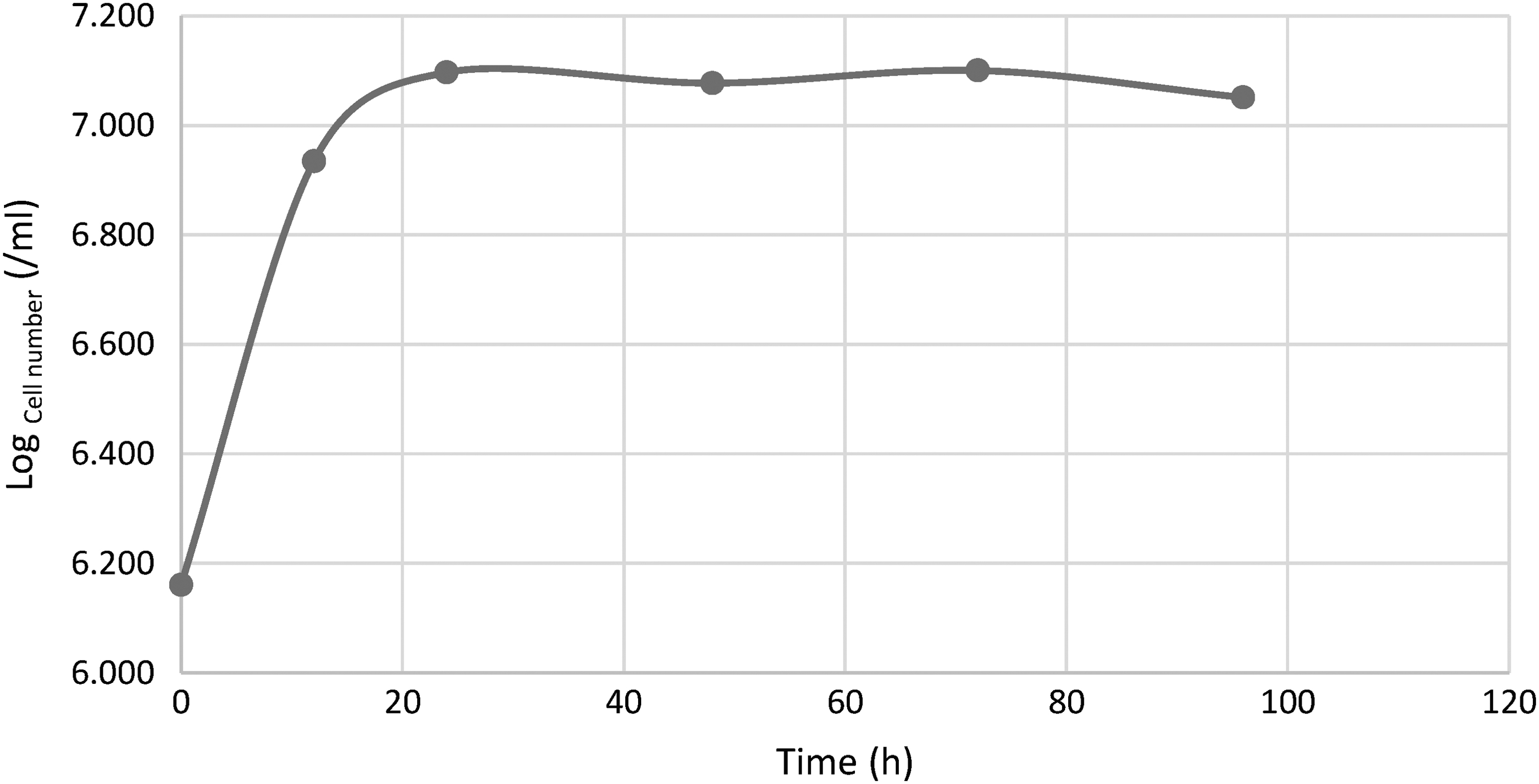
Growth curve of microbes.
The relationship between biomass concentration and reduction of dissolved sulfides was linear, because, in this case, sulfide was considered part of the substrate that influences the cell- specific growth rates,13 even though microbial growth was generally influenced by carbon and nitrogen sources or its ratio. Mathematical models of the cell and sulfide concentration profiles are shown in Equations 1 and 2.
Qualitative analysis of degraded sulfur and the growth of sulfur-oxidizing microbes showed changes in pH, which indicate acid formation that is most likely directly and indirectly due to the influence of derivative products from sulfur content. Yellow sediment was likely the result of decomposition of sulfur content into elemental sulfur, and the total sulfur was decreased.
pH decreased from 6.78 to 2.99 in media cultivated by microbes from microalgae. Observation of pH conditions during the incubation showed that degradation of sulfur source, Na2S2O3, resulted in sulfuric acid formation, as shown on Fig. 2. The sulfuric acid was titrated by BaCl2 and formed sediment. The hypothesis was that S from Na2S2O3 was degraded by the microbes. The sulfur was sedimented and aeration with O2 dissolved into media oxidized the sulfur to form H2SO4. This caused pH to decrease, which was undesirable.

pH conditions during incubation of microbes with sulfur source added periodically.
Other samples with source microbes from POME and cow manure showed that the pH decrease was not significant, dropping from 5.68 to 4.14 and 4.88 to 4.28, respectively. With those samples, some of the sediment that formed was red-yellowish and white. The yellowish sediment could be sulfur, S0 or S8, and the white sediment could a sulfur salt.
The biological oxidation of sulfides that was predicted due to the microbial activities of Thiobacillus family was tested in both aerobic and facultative anaerobic processes. Sulfur degradation and pH of microbes from coal landfill was observed by measuring total sulfur, as shown in Fig. 3. pH decreased, influenced by H2SO4 formation. In the second week, pH was relatively constant, but sludge or sediment began to appear at the bottom of the flask. The sludge may consist of cells and sulfur compounds. The sludge was in the yellowish-reddish deposit. As predicted, the sulfur produced was extracellular and accumulated as globules or deposits. The deposit was naturally mixed with dead cells and other impurities. The biological sulfur formation depended on the type of oxidizing microbe species and pH.

Correlation of total sulfur and pH for microbes from coal landfill incubation.
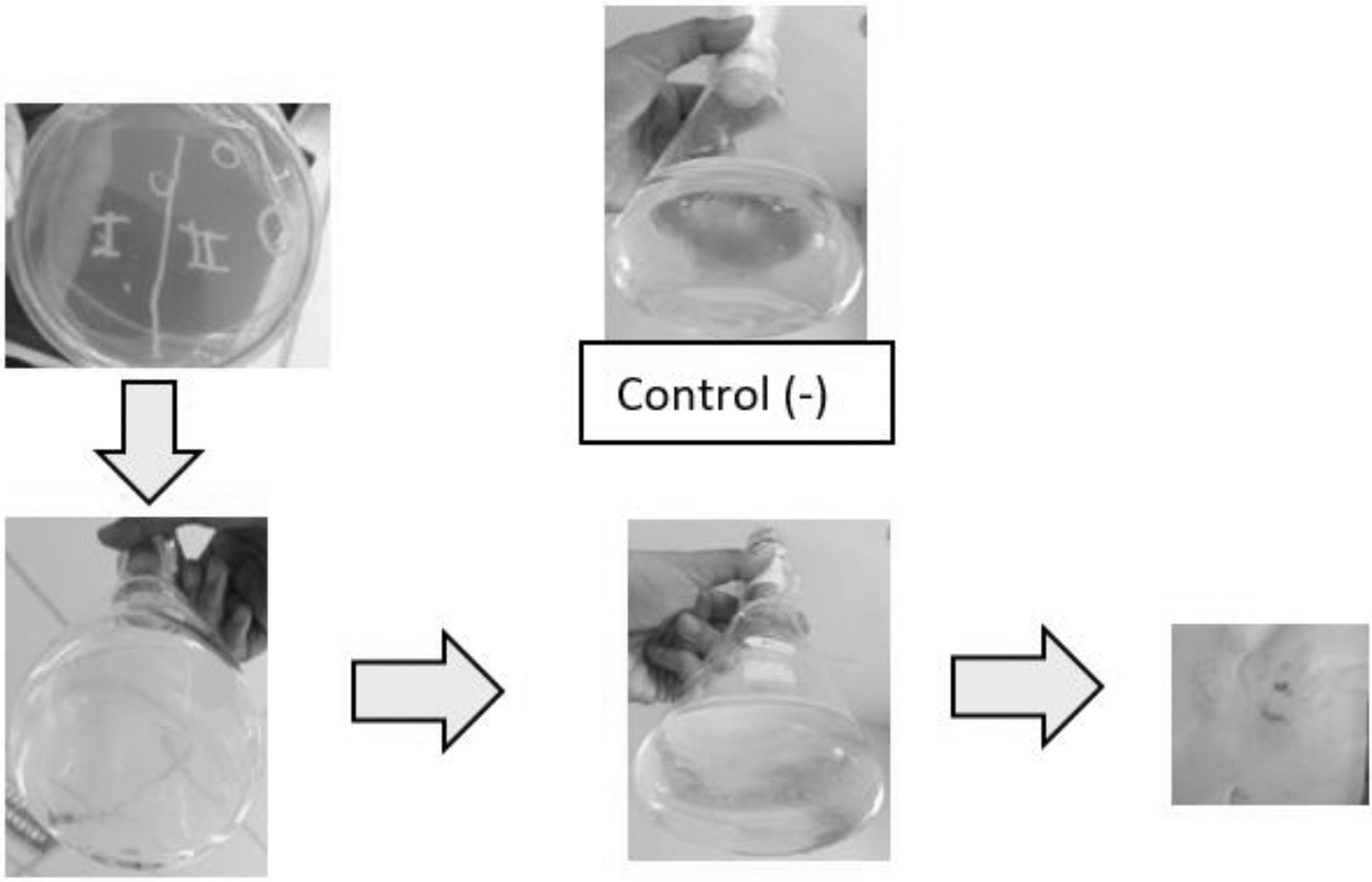
Sludge in microaerobic flask formed by microbes of screened effluent of bioscrubber's POME.
Thiobacillus media inoculated by microalgae with aeration did not produce any deposits, but the pH decreased significantly from about 7 to 3. This confirmed aeration caused oxidation of sulfur and conversion to sulfuric acid.
Further experiments were conducted using microbes screened from effluent POME grown on agar media. The sludge was visually reddish and higher in quantity. Sulfur polarity has properties that can be hydrophobic or hydrophilic, but most of the deposited sulfur was hydrophilic. 14 The microbes were inoculated on modified Thiobacillus media and sodium thiosulphate was added periodically. Negative control—the same media and treatment but not cultivated by microbes—also resulted in sludge formation. After more than 2 weeks, the sludge was separated and analyzed; the composition was about 60% water and 24.995% total sulfur.
Conclusion
This research describes the possibility to reduce sulfur content in simulation media. The microbes, indigenous to Indonesia, have the potential to be applied to bioscrubbers to purify H2S in biogas power plants. Simulation with Thibacillus media proved that the sulfur source, Na2S2O3, was degraded and converted to other sedimented sulfur compounds. The sludge was analyzed and total sulfur was found to be 24.995%. This Thiobacillus family is very important for the effectiveness of bioscrubbers to reduce H2S to levels of at most 200 ppm. Direct use with a biogas in the power generator without desulfurization would result in the engine being quickly damaged due to corrosion. This H2S purification will also automatically reduce CO2 levels related to the solubility of CO2 in water. Furthermore, methane concentration will automatically increase due to reduction of both CO2 and H2S.
The use of a bioscrubber at the biogas power plant would be more effective with a two-step process described in Fig. 5. The first step is to absorb H2S by alkali solution and react to salt formation such as NaHS or MgHS. H2S will be more reactive than CO2. The second step is a microbial process to separate the sulfur to elemental S, S0 or S8, or other, more stable sulfur molecules.

Proposed modification bioscrubber system for biogas power plant.
Footnotes
Acknowledgments
This work was conducted at two laboratories, PTSEIK-BPPT and Chemical Engineering – Pamulang University. During this work, a student from Chemical Engineering, ITB – Indonesia, was involved. Thanks to Mr. Kevin Susilo who gave contribution for re-checking the microbes that grew in effluent of bioscrubber in the field during his internship.
Author Disclosure Statement
No competing financial interests exist.
Funding Information
This work is also supported by research funding from the minister of RISTEK-DIKTI for fundamental research. Moreover, this work started based on the Program of PTSEIK and in line with the activity in 2019: Power Plant of Biogas from POME, especially in the part of biogas purification from H2S. Thanks to all team of Work-Break down Structure (WBS) innovation and developing biogas.