




Abstract
Population growth, an expanding middle-class, and a global shift in dietary preferences have driven an enduring demand for animal products. Since animal products are playing a vital role in human diets, their consumption is predicted to increase further. However, the great dependency of animal husbandry on global staple feed crop soybean; the environmental consequences of soybean production; and barriers for soy cropland expansion cast doubt on food system sustainability. The need to mitigate future demand for soy with other feed sources of similar nutritional profile, and thereby decouple food and feed production from ecological pressures, is compelling. Yet, the literature and science of sustainable agriculture is one of incremental improvements, featuring primarily, crop production intensification. A different, more profound approach to the design of feed systems is required to ensure sustainable food security. The question arises if alternative technologies exist to support such a design. This paper explores a particular novel configuration of four advanced technologies recently deployed in the region of Hengill, Iceland: light-emitting diode systems, advanced indoor photobioreactors, atmospheric carbon capture technology, and geothermal energy technology. In situ system analysis and data triangulation with scientific literature and data from independent sources illustrate the potential of these integrated technologies to produce algal-based animal feed. The analysis suggests that a highly sustainable soybean equivalent is technically attainable for feed purposes. The integrated system requires less than 1% of arable land and fresh water compared with soybean cultivation and is carbon negative. In addition, it provides a pesticide- and herbicide-free cultivation platform. This new configuration provides one pathway for the future of feed.
Introduction
By 2030, 8.5 billion people will occupy the planet. 1 Of them, over 5 billion individuals are projected to live in cities. 2 The share of the middle-class of the total world population is estimated to expand from 1.8 billion people in 2009, to 3.2 billion by 2020, and 4.9 billion people in 2030. 3 Future demographic trends and their associated changes in dietary preferences are set to drive a considerable increase in the demand for animal products. 4 –9
This paper takes interest in the consequences of the demand for animal products, and particularly, with the dependency of animal husbandry on soybean used as animal feed. It seeks to reduce the environmental pressures this dependency creates, especially on the availability of arable lands and potable water. 10,11
While the literature and science of sustainable agriculture continue to propose incremental improvements in food and feed systems, a technological breakthrough is required to achieve sustainable food security.
This paper explores whether a particular novel integration of advanced technologies, recently deployed in a demonstration site in Hellisheiði geothermal park, Hengill area, Iceland, can produce a soybean-equivalent for animal feed, and thereby, reduce the environmental pressures of the livestock sector on natural resources. The study relies on scientific literature and independent measurements taken in situ, triangulated with official calculations of third-parties.
This paper is organized as follows: first, a brief description of the livestock economy illustrates the dependency of animal products in animal feed. Second, a concise presentation of soybean cultivation is used to highlight primary environmental pressures involved in soybean agriculture, which brings the sustainability of the food system into question. The paper then proposes that a radical innovation approach, not incremental, is required to design better performing feed systems decoupled from ecological pressures. The paper proceeds to assess an innovative configuration of advanced technologies, currently employed in the region of Hengill. The paper concludes with a comparison of this cultivation method with US soybean cultivation in two sustainability metrics. A discussion of this pathway for the future of feed summarizes the study.
The Livestock Economy
According to the Food and Agriculture Organization, animal products have played a vital role in global food security and healthy nutritional requirements. 7,12 Since the 1960s, the daily intake of protein from meat, eggs, milk and dairy products has increased in high-income countries by 33%. In low- and middle-income countries, the daily per capita availability of protein from animal products surged by 116% (both figures are expected to rise by 2030). 13
Currently, animal products provide 34% of global protein intake and provide additional essential micro-nutrients. 14,15 Recent predictions determine that animal products will continue to serve as a critical source of proteins in human diets (for clarity, “animal” is defined as “all food products from animal sources, including milk, eggs, cheese, chicken meat, beef, sausages, fish and seafood”). 10 Accordingly, the demand for meat is expected to rise by 76% between 2005 and 2050. 5 Fischer et al. note that a demand increase is expected for other animal products. 16
The livestock economy depends on a constant supply of animal food, referred to as feed, and so, future food and nutritional security hinges on a constant supply of certain staple crops used for animal husbandry.
Staple Feed Crops
Of the primary 100 global cultivated crops by land area, the top four items comprise approximately 50% of the total cropland. 17 These four items–wheat, maize, rice and soybean–are therefore referred to as ‘global staple crops' or ‘the big four'. 16 Together, wheat, maize, rice and soybean command some 7 billion hectares of cultivation area. 7 Of this, soybean consists of 17%, equivalent to roughly 123.5 million hectares (Fig. 1). 17,18
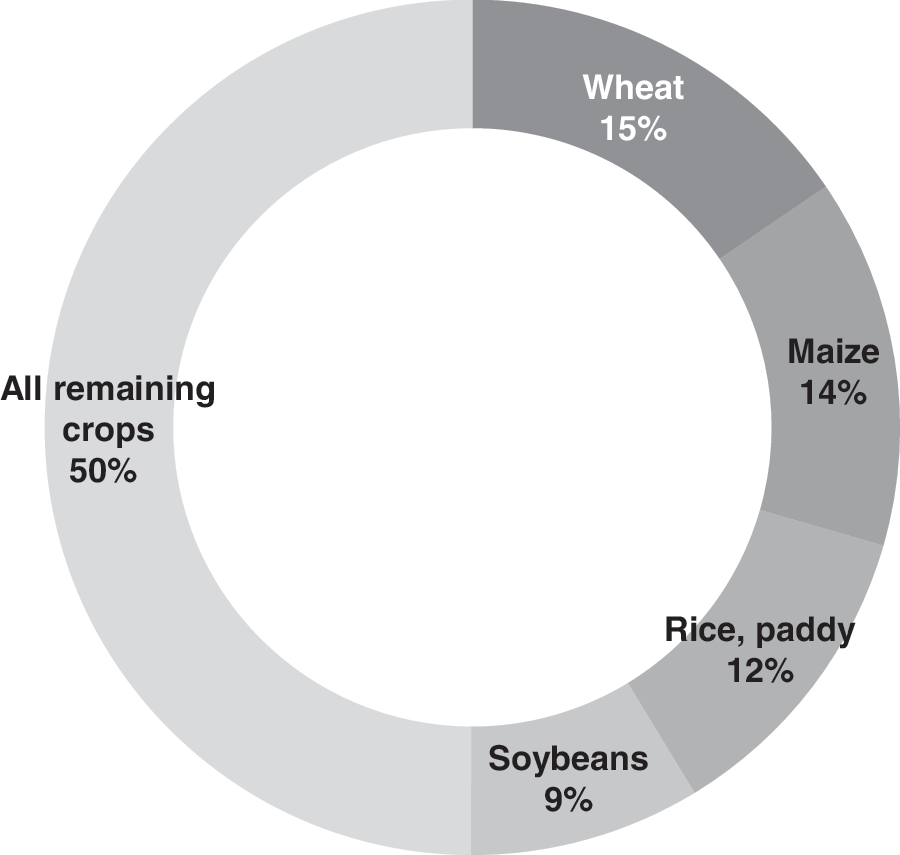
Top one hundred global staple crops by area. 17
SOYBEAN
Soybean (Glycine max) is the world's primary plant protein source, 19 and over the last few decades it went through the greatest cultivation expansion of any global crop. 20 The principal soy-producing countries are the US, Brazil, and Argentina, 16 and the US is the largest single cultivator of soybean, accounting for over 25% of global output. 21
According to World Wildlife Fund estimations, 85% of all soybeans are cultivated for feed purposes, primarily pigs and poultry, and predominantly in China, the EU, the US and Brazil—where the soybean serves as the primary protein source in the livestock economy. 10,22 The WWF noted that every year, the average European consumes over 60 kg of soybean, mostly indirectly, by eating various animal products. 10
According to the Global Forest Atlas, “due to the large international demand… the global soy harvest increased by 10% each year from 1989 to 1998… Consumption in China has doubled from 26.7 million tons in 2000 to 55 million tonnes in 2009… across the whole of South America, production grew by 123% between 1996 and 2004”. 23
The nutritional profile of soybeans underpins this demand. Soybean oil and protein content combined account for 56% of dry soybeans by weight (DM). Protein makes about 36% and fat makes about 20%. 24 The remainder contains 30% carbohydrates, 9% water and 5% ash. Its essential amino acids composition is 3% Leucine, 2.7% Lysine, 3.1% Arginine, 2% Valine, 1.7% Threonine, 2.1% Phenylalanine, 1.9% Isoleucine, 0.5% Methionine and 1% Histidine. The values of nutritional content of soybean are based on US soybean, as soy from this origin present higher content of essential amino acids than Brazilian and Argentinian soybean sources (three major soybean producers). 25 –28
Estimations register a necessary 80% growth in global soybean production between 2005 and 2050 to meet demand for animal products. 16 This will entail an expansion of 32% in harvested areas by 2050, more than any other global staple crop. 16
The Environmental Consequences of Soybean
Soybean is grown both in cold temperate regions (such as the US) and in warm and humid climates, in tropical and subtropical regions (such as Brazil, Argentina, China, India, and Paraguay). It is an open-field, sunlit, fertile-soil, predominantly rainfed, 29 and sometime rotating-crop 30 system, dependent on fresh water, fertilizers, and pesticides. 16
World average soybean production stands at over 350 million tons per year, yielding an average of 28,542 hectograms per hectare. US soybean registers higher productivity levels, yielding 3,274 kilogram per hectare every year. 17 Its cultivation requires an average of 2.5 pesticide spraying cycles every year, applying 8.6 kg of active ingredient per hectare each cycle, and one annual cycle of organic and synthetic fertilizers application (mostly phosphorous and potassium). The total US soybean emissions intensity (including land use change) is 0.94 kg of CO2 equivalent per one kilogram of biomass (DM). 31
The global average water footprint of soybean is 2,144 L/kg (green, blue and grey water combined). 32 The more water-productive US soybean requires 1,664 m3/ton, or 1,664 L/kg of biomass. 33
Cultivation is subject to favorable weather conditions and is vulnerable to alternations in precipitation regimes, 16,34 and therefore, to climate change. 35 An open-field crop, the number of growing degree days, amount of sunshine and light intermittencies affect soy yield.
Using pesticide and fertilizer applications makes this type of cultivation system environmentally harmful, reducing biodiversity and impairing ecosystem services. 36 –38
In the primary soybean basket, the US, soil degradation is a concern. “In the continental US… between 2001 and 2010, 410,000 ha of grassland were converted to soy production” resulting in environmental degradation, according to the Global Forest Atlas, 23 and in soil erosion, according to Nearing et al. 39
Expanding production would require a strategy of yield intensification coupled with expansion of croplands, 16,40 the latter would involve deforestation—a documented practice. 41 –45
Production intensification may prove a difficult task. Although progress has been achieved in improving crop yields, 19 the rate of demand is estimated to outstrip the rate of yield improvement, 21,46 –48 and that of production. 16,49 A 1% annual increase in soy yield, an observable figure, 50 is insufficient to lessen global food security concerns.
Cropland expansion is no less challenging. 12,51 According to the FAO, 7,11 nearly one-third of the world's arable lands are moderately to exceedingly degraded (i.e., suffering erosion and loss of nutrients resulting in reduced soil fertility, due to intensive agriculture and removal of vegetation cover; see also Pimentel et al., 52 Pimentel; 53 and Quinton et al). 54 In addition, the FAO stressed that there are scarce opportunities left for increasing agricultural areas. Bleakley and Hayes 55 noted that “previously utilized methods of intensifying agriculture will soon no longer be an option due to the high impact trade-offs they have on the environment, including fragmenting natural habitats and threatening biodiversity, production of greenhouse gases from land clearing, fertilizers and animal livestock production, and nutrient run-off from fertilizer damaging marine, freshwater and terrestrial ecosystems”. Nelson et al. 56 and Tilman et al. 57 indicated similar barriers for crop land expansion.
Sustainable Agricultural Solutions for Food and Feed Systems
The need to considerably improve agricultural methods and practices is well recognized in literature and in public policy. 11,58,59 Yet, the science of sustainable agriculture is mostly one of incremental improvements, featuring, primarily, crop production intensification. 5,12,16,60 –71 Some of these studies acknowledge that they leave approximately 350 million people in undernourishment conditions in 2050. 16
A different, more profound approach to the design of food and feed systems is desirable to dramatically enhance their sustainability profiles.
This need has not gone unnoticed. The WWF 10 registered technological innovation in feed systems as an area of particular interest, arguing “we need to produce feeds with lower resource requirements”, and highlighting—among other recent developments—new technologies in aquaculture for feed. In a similar vein, the FAO 11 called to devise innovative feed systems, “to protect the natural resource base while boosting productivity”. Recent research 72 underscored several areas of technological innovation that are necessary to meet a growing demand for feed, while decoupling production from environmental impact.
The question arises if alternative technologies are readily available to support a fully sustainable feed-system design.
Integrating Technologies for Resource-Efficient Algae Production
Here, the paper explores an original configuration of four advanced technologies, or platforms, deployed in the region of Hengill, South West Iceland: advanced light-emitting diode systems, indoor closed photobioreactors, atmospheric carbon capture technology (also known as Direct Air Capture) and geothermal energy technology.
Three of the four technologies were not initially developed for feed-farming purposes. Hellisheidi heat and power plant intended to provide Iceland's domestic and industrial sectors with their electricity and direct heating needs. Advanced light-emitting diodes were concocted to efficiently emit light and are integrated in a wide catalogue of devices for various uses. Atmospheric carbon capture, which separates CO2 from ambient atmospheric air, proposes to play a role in climate change mitigation. The integration of the three for feed cultivation was made possible with the fourth technology: advanced, closed, indoor photobioreactor, the heart of the integrated system, made operational in early 2018.
Each platform is proprietary and listed under different entities. Each platform matured, technologically and commercially, in separate. Atmospheric carbon capture is still in relatively early development stages. 73 The integration of all four is currently available only in Hellisheidi geothermal park.
The following sections introduce each technology and describe the overall cultivation system configuration. A review of the microalgae cultured in the system and a comparison of the environmental performance of the feed-system to soybean follows.
The analysis relies on scientific and technical literature, and on measurements taken on-site, triangulated with official calculations of third-parties. The latter is retrieved in the form of personal communication, conducted in the region of Hengill and in Reykjavik, Iceland. Data collection took place between November 2018 and February 2019.
While a comprehensive technical analysis of the four platforms lies outside the scope of this paper, a brief account of their functions on-site is provided.
Closed Indoor Photobioreactors
Photobioreactors (PBRs) are apparatuses devised for the production of phototrophic microorganisms (e.g., microalgae). Closed indoor PBRs are comprised of closed cultivators (e.g., tubes or panels) of different shapes and sizes. To achieve optimum growth in PBRs, light and turbulence are the main factors for success. 74 Closed indoor PBRs use electric light for irradiation 75 and various illumination technologies have been applied for PBRs in recent decades, including fluorescent lights, optical fibers and light emitting diodes. 76 –79
PBR systems are characterized by low pathogen contamination risks, low space requirements, and minimal ecological-footprint (if located on non-productive, non-arable land); almost no water losses, efficient CO2 utilization, high variability in regards to cultivatable species (nearly all microalgal varieties can be cultivated), high degree of control over culture processes, high biomass concentration, high efficiency of downstream processing; and for indoor PBRs, no dependence on weather conditions. 74,75
About half of the microalgal dry weight is carbon, originating from CO2 photosynthetic fixation. To achieve a high photosynthesis rate (photosynthetic efficiency) in high-density microalgae photobioreactors, sufficient dissolved CO2 must be available to match the biological carbon demand. Straka et al. 80 suggested injecting appropriate amounts of pure CO2 into microalgal cultures. This demands a complimentary carbon capture and delivery system. Such a system is discussed in the following.
To maintain optimal photosynthesis conditions and metabolism, a constant nutrient supply for the culture is a prerequisite. 81 Closed photobioreactors offer a high level of control over culture processes so optimum temperature, pH levels, solution salinity, mixing, phosphorus and nitrogen concentrations can be kept in optimum ratios and ranges. 74 According to Janssen et al., 82 the productivity of PBRs is determined by the light regime inside the bioreactors. In a similar fashion, Kirk, 83 Pulz, 74 and Suh and Lee 75 maintained that light for photo-autotrophic life is the principal limiting factor in PBR environments. The next section discusses this aspect of the integrated system.
Light-Emitting Diodes Systems
Light-emitting diodes (LED) are artificial lighting devices, which provide spatial, temporal and spectral control of light. 84 –86 In a recent technical analysis of best available, high efficiency, light-emitting diodes for augmented photosynthesis, Ooms et al. 87 argued that readily available optical engineering technology holds the potential for production intensification of microalgae cultivation in PBRs. 88 With regards to LED uses in PBR systems, Ooms et al. 87 noted that the light regime “directly impacts the rate of photosynthesis and respiration. Controlling the cell density, light path, and mixing rates can result in optimal areal productivity and efficiency”. 89
Based on an energy balance, taking into account energy-to-light LED efficiency and light-to-microalgae-biomass conversion efficiency (including biosynthesis and maintenance), Ooms at al. calculated the energy required per algal biomass to be 140 kWh per 1 kg of biomass. 87 This figure does not consider additional energy requirements of the cultivation system (PBR operations). According to on-site measurements of fluid dynamics, gas and liquid mass transfers demand 10% additional energy, or a total of 154 kWh per 1 kg of biomass.
The controlled-environment agriculture (CEA) system allows 24 hours production for 330 operating days per annum (approximately 90% of the time; 10% is needed for system maintenance), or a total of 7,920 hours annually. Based on these figures, an annual production of 1 ton of biomass requires 19.4 kW per annum. These figures match the performance of the LED-PBR facility in Hellisheidi geothermal park.
Furthermore, as stated by Ooms et al. (2016), 87 best available LED technology converts about 40% of the electrical energy to light. The residual energy (60%) is converted into heat, which needs to be removed from the cultivation system to keep optimal LED performance (avoid LED overheat; extend LED lifespan), and maintain optimal cultivation temperature (algal strain dependent). Assuming 140 kWh per 1 kg of biomass, at 40% conversion rate, 84 kWh per kilogram (60%) is residual energy (residual heat) and needs to be removed. This could be efficiently done by liquid-liquid heat exchange using cooling water (brackish or ocean water). This outlines the cooling requirements of the LED-PBR. While water-cooling assessments are not included in this analysis, cooling demands require a nearby water source.
Atmospheric Carbon Capture
Atmospheric carbon capture, also called Direct Air Capture (DAC) technology, has been an area of scientific and applied interest for some time 90 and was suggested as a technically-feasible climate change mitigation instrument. 91 It made significant progress in novel technical design and prototype systems in the last decade 92,93 and received notable scientific attention more recently. 94 –96 One area of concern is the energy requirements of DAC systems, 97 and if such demonstration technologies are connected to renewable energy sources, then DAC systems can be carbon-negative (for example, see Nikulshina et al.). 98
An atmospheric carbon capture pilot plant (DAC plant), able to run on renewable energy source, was deployed in 2017 and is now operational in Iceland, as part of a Horizon 2020-funded CarbFix2 project. It is the world's first carbon removal solution through direct air capture. The demonstration system is situated in ON Power Geothermal Park in Hengill. It draws ambient air and binds the CO2 within the air to a filter. When the filter is saturated with CO2 it is heated to approximately 100°C, then the CO2 is released and collected as concentrated gas. The system is a net-negative carbon platform. In this facility, the majority of energy required for the process comes from low-grade heat (waste heat). The technology does not require a fresh water source. 99
Based on pilot project reports and third-party assessments, to capture 1 ton of CO2-equivalent, the system requires approximately 2,000 kWh for water heating and 650 kWh of electricity; a total of 2,600 kWh. In the production process, the system produces about 1 ton of water for 1 ton of CO2. In large scale operations, the system would require 1 m2 of land to produce up to 30 tons of CO2-equivalent. In current installed capacity (pilot project), the system uses 1 m2 to capture 1 ton of CO2-equivalent. The pilot plant is connected to the geothermal energy source.
Geothermal Energy Technology
Geothermal energy is heat energy which originates from physical processes occurring in the internal structure of Earth's interior. 100 Access to it depends on geological formations and is therefore unequally distributed on the planet's surface. For instance, the geographical location of Iceland is particularly favorable to harness geothermal energy for various uses. Barbier 100 noted that “Reykjavik is the only capital city of the world heated entirely by geothermal energy… (and) the first municipal district heating system using geothermal water was set up in Reykjavik in 1930.” In 2002 some 90% of the population of Iceland lived in houses heated by geothermal energy.
Geothermal energy is exploited for two primary purposes, electric energy generation and direct uses (e.g., water heating, greenhouses). Geothermal electricity is produced at efficiency rates of 10% to 17% and geothermal kWh is cost-competitive with conventional sources of energy, in the range $0.02–$0.1 USD per kWh. Current geothermal technology enables producers to control its associated environmental impacts. 101
Hellisheidi heat and power plant is Iceland's largest and newest power station and one of the largest geothermal power stations in the world, in terms of installed Megawatt capacity (Mexico and the US also host large systems). Since 2016, when generation expansion works concluded, Hellisheidi production capacity stood at approximately 303 Megawatts of electricity and up to 400 Megawatts of thermal energy. 102
Two impartial Environmental Impact Assessments, based on the best knowledge available, were issued for Hellisheidi power plant. The first was conducted in 2002, and the second in 2005. Both assessments determined that the geothermal project does not have a significant impact on the environment. 103 By the EIB, Hellisheidi Power Plant has negligible effect on water, air, flora, fauna, and biota of hot springs, as well as cultural remains, residential development and transport. The lands in Hengill area are moss-covered (roughly a quarter of the area is lava), has little or no vegetation and animal life is scarce. Land and climate conditions make the area unsuitable for open-air crop cultivation (i.e., non-productive, non-arable land).
Microalgae to Mitigate Future Demand for Soy as Animal Feed, Cultivated in an Integrated LED-PBR-DAC, Based on Geothermal Energy
Since early 2018, the integrated system has been cultivating natural strains of protein-rich high omega-3 marine microalgae for feed purposes (Fig. 2). In situ analysis was based on the cultivation of Nanochloropsis oculata.
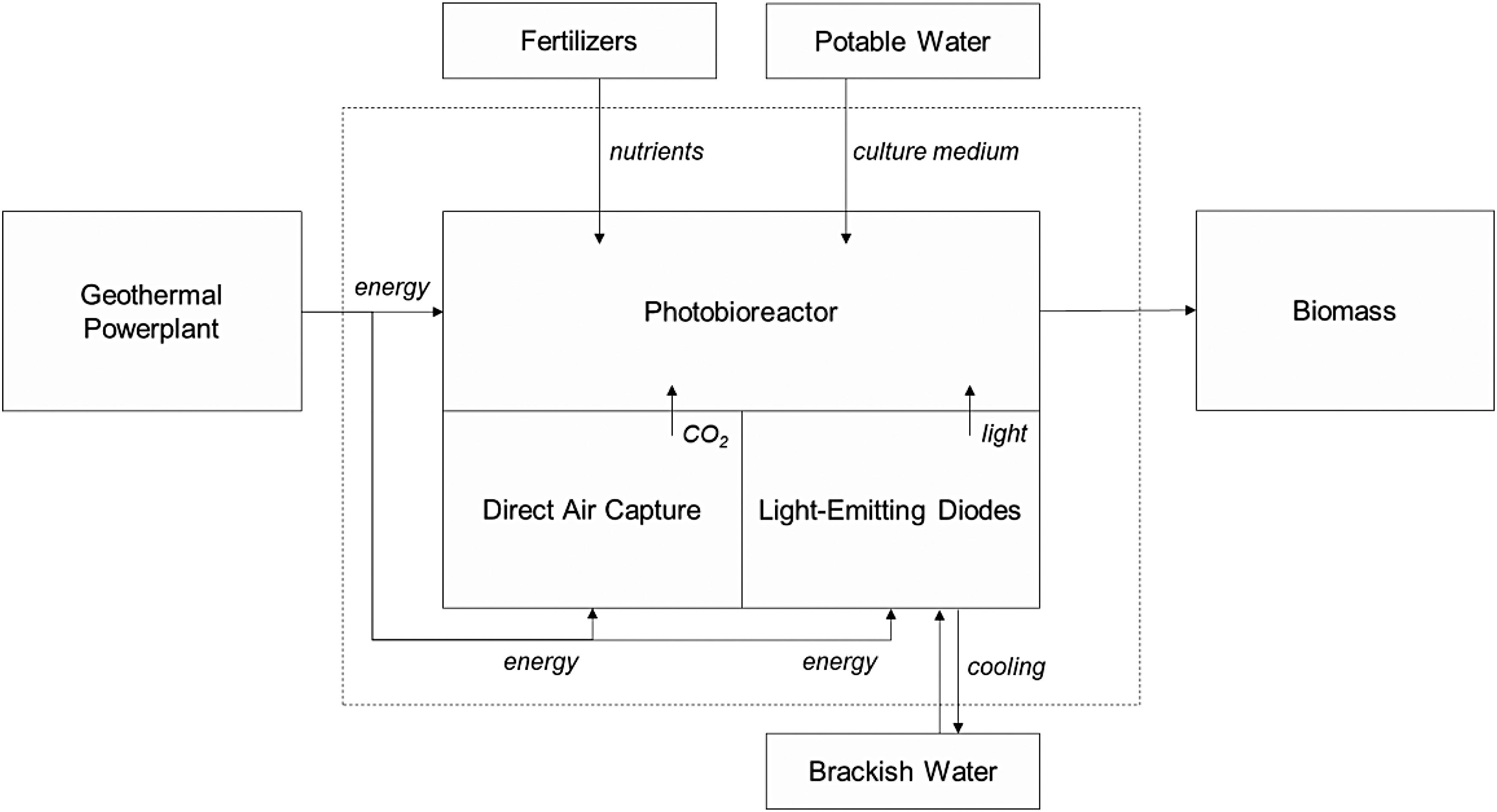
Integrated system outline (in place and operational to produce 10,500 kg of biomass per year; DAC is a pilot project).
Microalgae are commonly used for feed purposes. 84,86 Literature recognizes them as important food and feed source. 104 –112 According to recent nutritional studies, microalgae can partially replace soybean in animal husbandry, and are therefore suitable for direct demand mitigation.
Gatrell et al. (2014) 113 noted that broiler chicks, laying hens and weanling pigs can digest microalgal biomass incorporated into their diets at 7.5%. Gatrell et al. (2015) 114 later demonstrated that 8–16% Nannochloropsis oceanica inclusion in broiler chick diets can produce a n-3 fatty-acid-enriched chicken meat.
Kim et al. 115 indicated that 7.5–15% of soybean meal in pig or broiler chick diets can be replaced with defatted microalgae (Staurospira sp. and Desmodesmus sp.), with no animal health and food safety disturbances. Likewise, Austic et al. 116 indicated that defatted diatom Staurosira could replace 7.5% of soybean meal in broiler chick diets.
Becker 117 claimed that microalgae (Spirulina) up to a level of 10% can be included safely as a substitute for conventional proteins (including soy), in poultry rations. Evans et al. 118 demonstrated that algae inclusion (Spirulina) in bird diet formulations of up to 16% (to replace about 60% of the soybean meal), has no harmful effect on performance.
A more recent study of meat quality (physico-chemical testing) to determine the effects of substituting soybean meal with Spirulina in poultry diets, found that a 50% substitution of soybean with microalgae shows insignificant or no changes in meat quality, and by some parameters, improved meat quality. 119
As early as 1982, Yap et al. 120 showed that a combination of Spirulina maxima, Arthrospira platensis and Chlorella can replace up to 50% of soybean in pig diets, with no harmful effects, while improving weight gain. Becker 117 then argued that an upper limit for microalgae inclusion in pig feed has yet to be identified. In 2011, Isaacs et al. 121 claimed that Staurospira could replace 7.5% of soybean meal in diets for weanling pigs. Making further progress, Manor et al. 122 later established that inclusion of 15% of microalgal-biomass did not change growth performance of non-anemic pigs.
In lactating dairy cows, recent nutritional trials indicated that a cocktail of microalgae species can replace soybean meal as a source of proteins. 123 In particular, the inclusion of Spirulina led to increased milk fat concentration, and the inclusion of Nannochloropsis in cow diets resulted in favorable omega-6:omega-3 ratio for human nutrition “and a fourfold increase in milk EPA [eicosapentaenoic acid] concentration without adverse effects on milk fat production”.
Research suggests that the digestibility of microalgae in animal diets will depend on the resistance of the cell wall (their cell wall structure). Various treatment methods and biorefinery models can be applied in the downstream processing of algal-biomass which would rupture the cell wall for protein release and separation (i.e., increase protein bioavailability), thus allowing the use of microalgae as a “drop-in feed” ingredient (which then feed providers could introduce into the fodder mix). No single method is optimal for all microalgae species. It is beyond the scope of this paper to discuss these methods (see Chronakis et al. 124 and Vermuë et al. 125 ).
Still, microalgae remain an under-exploited “crop.” 55,126,127
Recent research illustrates that the discourse of sustainable feed sources has expanded: the discussion is no longer confined to the nutritional viability of algae as feed, it now also explores sustainable, technically-attainable feed production systems.
The integrated system at the center of this study currently grows a natural strain of the green marine microalgae Nannochloropsis oculata. 128 –130 The system could cultivate all six known Nannochloropsis species (see Ma et al.) 131 as well as any other microalgae strain, marine or fresh-water (including Spirulina).
The nutritional profile of N. oculata bears similarity to that of soybean. 132 The composition of N. oculata is about 40% proteins (against 36% in soybean), 29% carbohydrate (fiber, sugar and polysaccharides), 15% fats (including omega-3 fatty acids), 14% minerals (including trace minerals) and 2% chlorophyll and carotenoids. Its essential amino acids composition is 9% Leucine (3% in soy), 8% Lysine (2.7% in soy), 6% Arginine (3.1% in soy), 6% Valine (2% in soy), 5% Threonine (1.7% in soy), 5% Phenylalanine (2.1% in soy), 4% Isoleucine (1.9% in soy), 2% Methionine (0.5% in soy) and 2% Histidine (1% in soy). 133
N. oculata is cultured in a controlled-environment agriculture (CEA) system: artificially lit, geothermal energy-based, with zero pesticides and herbicides, and fertilizer-efficient. LED technology is used to achieve high photosynthetic photon flux at the wavelengths of photosynthetic interest. The novel configuration shown in Fig. 2 operates in a “no-spill zone” site, and the cultivation facility employs an evaporative oxidization system for sanitation and crop protection, with no harmful environmental consequences.
The photosynthetic photon flux density (PPFD) 134 of the system averages over 750 (μmol per m2 per second). 135 For comparison, hydroponic lettuce (Lactuca sativa L.) achieves good growth results under treatments of high light intensity (LED) of 290 PPFD. 136
Since the microalgae culture grows in a liquid medium, material handling and mechanization costs are anticipated to be low relative to terrestrial crops (for instance, soybean cultivation is labor and machine intensive).
The microalgae LED-PBR cultivation system is modularly divided into Production Units (PUs). Data from in situ measurements, triangulated with third parties, indicate that each PU requires 159.2 kWh (LED, CO2 and operations combined) 137 to cultivate 1 kg of algal biomass (DM). In each PU, culture is grown in liquid medium of 14.4 m3. In local conditions, this volume of water is of a potable water source, and is replaced entirely once every two months (6 times per annum). The closed system presents no opportunity for water loss through evaporation. Each PU uses zero hectares of productive, arable land, and occupies approximately 130 m2 of non-productive land (this figure accounts for PU and Direct Air Capture unit; the calculation excludes energy production area). A PU produces approximately 10,500 kg (DM) of biomass per annum.
In the cultivation process, 0.084 kg of dipotassium phosphate (K2HPO4) and 0.65 kg of sodium nitrate (NaNO3) are consumed per 1 kilogram of biomass. The cultivation of 1 kg of biomass requires approximately 2 kg of CO2-equivalent. The CO2 emissions balance, calculated for each PU by third parties, stands at a net negative of −0.93 ton of CO2-equivalent per ton (DM) of biomass (excluding fertilizers). No pesticides and herbicides are involved in the production process.
Comparison of Land and Water Uses
A Production Unit currently uses about 130 m2 of non-productive lands to cultivate 10,500 kg of biomass per annum (Fig. 3). Fresh water utilization is based on medium replacements. This translates into 8.23 L of fresh water per kg of dry weight, ash-free (6.8% ash), algal biomass (Fig. 4). A large-scale commercial production site is currently under construction in Hellisheiði geothermal park. Figures used for comparison are based on production potential and on data provided above.

Areal yield (land footprint) comparison: LED-PBR-DAC and US soybean (kg/ha). This shows a nearly 250-fold higher output (yield) for microalgae cultured in the novel configuration (geothermal powered LED-PBR-DAC) than for soybean.

Fresh water requirements (water footprint) comparison: LED-PBR-DAC and soybean (L/kg). This shows a nearly 200-fold higher water footprint (fresh water use) soybean than for microalgae cultured in the novel configuration (geothermal powered LED-PBR-DAC).
Discussion
Meeting an expected increase in global demand for animal products requires innovative technological platforms for the culture of fully sustainable animal feed.
Such innovations should part from the common prescription of yield intensification and cropland expansion which draw on an already limited supply of arable lands and fresh water. New platforms should attempt to approach carbon neutrality (net zero carbon footprint), net zero water use, zero net fertile-land degradation, and zero agro-waste by regulating resources life-cycles so that they are optimally used with no harmful disposal.
This paper presented the findings of research into one novel configuration of four technologies employed to cultivate a sustainable soybean equivalent feed ingredient. This configuration is technically feasible and resource-efficient. As nutritional research advances, new data are likely to emerge as to the digestibility of strains of microalgae used for animal-feed. Current research already suggests that a variety of microalgae, used alone or in combination (Spirulina platensis; Chlorella vulgaris; Nannochloropsis gaditana) can complement the use of soy in animal husbandry and thus mitigate some of the future demand.
This innovative configuration sets the land productivity of the LED-PBR-DAC system at a potential 807,692 kg of biomass per hectare per year (Fig. 3). The integrated system's water consumption is 8.23 liters of potable water per kilogram of biomass, at a high cell density of above 10 g (ash-free dry weight; 6.8% ash) per liter of water. 138 These figures represent a reduction of arable land and fresh water footprint of a feed-source cultivated in LED-PBRs by a factor of over 200, compared with the land and water footprint of soybean cultivation (Fig. 4).
With best available technologies, these productivity rates could only be achieved for microorganisms, and microalgae in particular. As Walsh et al. 139 noted, microalgae “grows 10 times more rapidly than terrestrial plants… it doesn't compete with other crops for land… it doesn't require fresh water… it can be fertilized more efficiently than land crops… it avoids wasteful fertilizer runoff, and downstream eutrophication associated with modern agriculture”.
Furthermore, cultivating unicellular “crops” assists in achieving zero agro-waste, as no energy and matter are invested in developing non-edible external plant architecture (e.g. roots, stems, leaves) characterizing multicellular staple crops.
From a techno-operational perspective, LED-PBR-DAC feed production potential is linked primarily to available energy (mainly in the form of light). If cultivation is to be sustainable, then a clean energy source is required. If it is to maintain production at constant rates, then the energy source must not be susceptible to intermittencies. These systems' properties call for further research on the feed production potential of the integrated system utilizing additional energy sources, mainly hydropower.
While the assessments in this paper are focused strictly on environmental considerations, other economic factors play a critical role in developing alternative, scalable and economically-sustainable future food and feed options. Accounting for these factors warrants further techno-economic analyses.
Footnotes
Author Disclosure Statement
The author does not work for, consult, own shares in or receive funding from any organization that would benefit from this article. The author has no relevant affiliations beyond his academic appointment. The author has no other financial and/or non-financial interests in relation to the study described in the article that could undermine the objectivity and integrity of data presentation, analysis and interpretation.
Acknowledgments
Data obtained with the generous assistance of Dagný Hauksdóttir, Verkefnastjóri Jarðhitagarðs ON Power, Iceland; Daniel Egger, Climeworks, Zurich, Switzerland; Sam Couture, Algaennovation, Iceland; Ari Ingimundarson, Mannvit, Iceland; Gunnar Tryggvason, Iceland; and Kevin Dillman, Orkuveita Reykjavíkur (OR, Reykjavík Energy), Iceland, between November 2018 and February 2019.
This paper was made possible through the support of The Centre for the Study of Existential Risk (CSER), an interdisciplinary research centre at CRASSH within the University of Cambridge. This paper is part of the Food Security and Global Catastrophic Risks Project at CSER, Cambridge, dedicated to explore dependencies and distortions in the food system, to understand what shocks might threaten global food security, what the consequences of such shocks may be, and how society can work to mitigate these risks.