




Abstract
An extensive body of evidence demonstrates that patents and other intellectual property (IP) rights are critical to the future of innovation and the development of new treatments and cures. A strong legal regime is essential for a robust innovation-based biopharmaceutical industry, but other targeted incentives can provide further impetus to transform inventions into commercial innovations.
For Canada, the legal context surrounding intellectual property rights protection and the national regulatory regime are influencing the biopharmaceutical industry. These dimensions also have consequences for Canadian patients, Canadian economy, and access to future medical innovations. In the course of trade negotiations, several aspects of the Canadian IP system have been changed and reinforced. This article summarizes the biotech industry context and describes existing IP policy and regulatory initiatives in Canada.
We will also discuss briefly the most recent initiatives of the Québec government to support creation, protection and commercialization of innovations from local businesses.
Introduction
The intellectual property field offers protection for a variety of intangible creations, notably through copyright, trademarks, patents, industrial designs, plants breeders' rights, etc. In the biotechnology world, the acquisition of a title of intellectual property represents a valuable intangible asset that may help a company protect its exclusivity in the market. It also constitutes a reputational advantage to convince investors that the invention is sound and provides a real margin of innovation compared to other existing products.
Biotechnology companies may benefit from several IP tools, whether through the goodwill associated with its protected trademark, the competitive advantage of a trade-secret for a non-reverse engineerable process, or the commercial monopoly conferred by a patent for one of its inventions.
In Canada, the national regulatory regime has powerful influences on the biopharmaceutical industry. The Canadian IP system has evolved and improved considerably over the years.
There are three main areas of recent changes regarding Canadian IP protection for the biopharmaceutical industry: (1) the period of patent term restoration (also called “sui generis protection”), (2) a patent utility standard that was higher than and inconsistent with international norms, (3) the duration and scope of regulatory data protection.
Canada's Intellectual Property Landscape
Patents in Canada
IP protection provides innovative biopharmaceutical firms with an assurance of some return on their investment, thus creating incentives for the development of new technologies that could otherwise be easily replicated and sold by competitors.
For an invention to be patented in Canada, it must meet the requirements set out in the Patent Act (Act). 1 The Act defines “invention” as any new “useful art, process, machine, manufacture or composition of matter, or any new and useful improvement in any art, process, machine, manufacture or composition of matter.” 1 In other words, the invention must be shown to be novel, useful and nonobvious. This section must be read in conjunction with section 27(8) of the same Act, which excludes mere scientific principles or abstract theorems from patentability. Patents are granted a 20-year period from the date of filing. 1
Criteria of Novelty, Non-obviousness and Utility
For an invention to be considered novel under Canadian patent law, it must not have been publicly disclosed by a third party anywhere in the world, as well as not have been previously described or claimed in a third-party patent application in Canada. 1
The test for novelty is whether the entirety of the information required to produce the claimed invention, without the exercise of any inventive skill, is contained in a single, publicly disclosed example of prior art. 2
With regard to non-obviousness (also known as the “inventive step”), “a four-part test was established in Apotex v Sanofi-Synthelabo
Finally, to be patentable, an invention must also satisfy the criterion of utility. The objective behind this requirement is to avoid limiting potentially beneficial research and development by prematurely granting patents. The invention has to “be useful, in the sense that it carries out some useful known objective.” 4 While utility is a condition for patent validity, a patentee is not required to disclose the utility of the invention to fulfill the requirements of the Patent Act—the application needs only to express what is claimed to be invented. 5 However, utility may nonetheless be the basis for contesting patent validity in litigation, during which the impugned invention's usefulness will be assessed according to the information that existed at the time of its filing.
For several years, federal courts have been assessing the utility of a patent through the “Promise of the patent” doctrine, which held that a patent met the required utility only if it fulfilled the promises contained in its application. 6 After identifying the promises contained in both the claims and the disclosure of the patent application, a court would determine whether they were fulfilled through demonstration or “sound prediction,” assessed according to the information available when the application was filed. If any one of the identified promises was not fulfilled, then the requirements of the Patent Act were not met and the patent was invalidated in its entirety. 7 This doctrine only existed in Canadian courts, and at the international level it was considered impractical for pharmaceutical innovations, for which the patent applications were often filed before any trial data was available. Consequently, 24 patents were revoked in the last decade—damages from the premature loss of patent protection were estimated at $766 million for American companies. 8
After much debate, the line was finally drawn, and the promise doctrine was recently abolished by the Supreme Court of Canada (SCC). Its use for the fulfillment of the utility requirement was unanimously rejected in the 2017 decision AstraZeneca Canada Inc. v. Apotex Inc., 7 where the SCC considered the doctrine to pose an excessively onerous burden on patentees. Instead, the Court held that the correct method of evaluation for utility is to first identify the subject matter of the invention, then determine whether it is useful. A subject matter is useful if it is “capable of a practical purpose,” i.e. an actual result. 7 Since the SCC's decision, the Federal Court, Federal Court of Appeal and Ontario Superior Court of Justice have been reapplying the original “scintilla of utility” threshold to determine whether the requirement is met. 9
Filings in Canada
With regard to patents, Canada imports significantly more than it exports. 10 Almost half of the patent applications filed in Canada are from residents of the United States—only 12% of the total applications received in 2017 come from Canadian residents. As demonstrated in Fig. 1, the United States, Germany, Japan, France and Switzerland are the countries which file most applications in Canada.

Top countries filing for patents in Canada in 2017 (reproduced with permission from Department of Innovation, Science and Economic Development, Canada).
Nonetheless, innovation in Canada represents a key economic strength for the country. Canadian patent filings abroad have significantly grown over the last decade. In 2018, Canadians have filed internationally for patents almost five times more than in 2016. As seen in Fig. 2, the top three international destinations for Canadian filings are the United States, the European Patent Office (EPO) and China. The United States' remarkable popularity is justified by the fact that it represents the primary market for most export businesses in Canada.

Top International destinations for Canadian patent applicants in 2016 (reproduced with permission from Department of Innovation, Science and Economic Development, Canada).
The total international filings increased by 13% from 2007 to 2016. 10 Impressive growth can seen noticed in Patent Cooperation Treaty (PCT) filings during that same period, which increased by 31%, as demonstrated by Fig. 3.
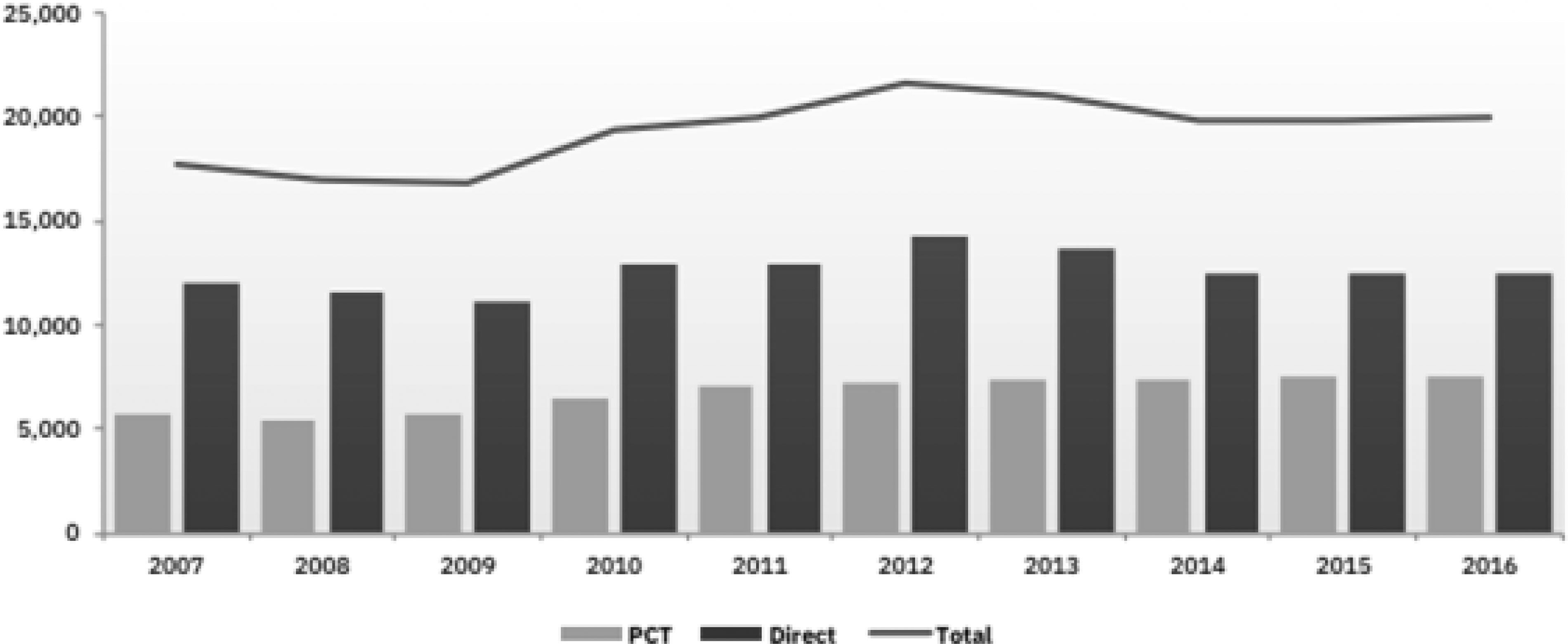
Canadian patent applications abroad by filing route, 2007–2016 (reproduced with permission from Department of Innovation, Science and Economic Development, Canada).
Canada and the pharmaceutical industry
Canada finds itself among the top 10 pharmaceutical markets worldwide, notably justified by its increasingly elderly population and advanced regulatory system. 8 Patented drug sales represent 60% of the total market and are expected to grow at an annual rate of 2.3%. 8 This development is bound to be sustained by innovations in the biopharmaceutical sector.
Patentable Subject Matter in Biotechnology
In the domain of biotechnology, Canada has established that higher life forms, such as genetically modified animals and plants, are not patentable subject matter, while lower life forms may be eligible. This principle was discussed in detail by the country's highest court in the 2002 decision Harvard College v. Canada (Commissioner of Patents), 11 a case involving the validity of a patent application for a genetically modified cancer-prone mouse, the “oncomouse.” The Court found that claims to the mouse itself were not patentable, as mammals do not fall under the categories of “manufacture” or “composition of matter” enumerated in the definition for an “invention” in the Patent Act. However, the Court affirmed that claims to the genetically modified genes in the mouse were patentable. Several other claims concerning higher life forms in Harvard College's patent application could implicitly be understood to be patent-eligible, as they were not contested or rejected, such as: a transgenic cell culture, a somatic cell culture derived from a transgenic mammal, a method of producing a transgenic mammal, a method of testing use of such mammal, and the use of such mammal in a method of testing. 12
The patentability of genetically modified genes and cells was revisited by the SCC in the 2004 decision Monsanto v. Schmeiser, 13 where the Court confirmed the position put forth in aforementioned Harvard College decision. This case involved the validity of a patent for an herbicide-resistant gene and cell, which were found to be patentable. However, the plants containing the gene were themselves unpatentable, as they fell under the definition of a higher life form. Nonetheless, the protected gene and cells were sufficient to protect the plants—meaning that the cultivation of plants that contain a patented gene and cells could result in infringement, even though the plant itself cannot be patented.
The distinction between higher and lower life forms is outlined clearly by the Patent Office in the Manuel of Patent Office Practice (MOPOP), 14 in which a lower life form is defined as unicellular, in contrast to a higher life form, which is multicellular. 14 The MOPOP specifies that higher life forms do not fall within the scope of the Patent Act, and that “animals at any stage of development are not statutory subject matter eligible for patent, and consequently fertilized eggs and totipotent stem cells are included in the higher life form proscription.” 14 A totipotent stem cell is defined as a cell capable of developing into all types of differentiated cells that are found in an organism—stem cells with limited developmental potential are nonetheless patentable. Lower life forms, on the other hand, such as unicellular fungi (including moulds and yeast), bacteria, viruses, pluripotent and multipotent stem cells, etc. are patentable.
Finally, methods of medical treatment are not patentable in Canada—it is well established that professional skills cannot be the subject of exclusive property or privileges. 15 However, courts have clearly stated that this prohibition does not apply to the substances utilized in the methods of medical treatment, nor does it cover the processes used to create such substances. 16 Pharmaceutical compositions are therefore patentable, provided they meet the other requirements for patentability. Thus, new biotechnological inventions can be claimed as “composition of matter” when appropriate and can therefore benefit from broad coverage irrespective of the use, or medical indication of its first commercial embodiment.
Biosimilars
In Canada, biosimilars are regulated as new drugs under the Food and Drugs Act and the Food and Drug Regulations. Health Canada's Biologics and Genetic Therapies Directorate (BGTD) is the body that regulates biosimilars in concert with the Regulatory Operations and Regions Branch (RORB) and the Marketed Health Products Directorate (MHPD). 17
Health Canada requires biosimilar manufacturers to provide information demonstrating that the biosimilar is safe, effective, and highly similar to the reference originator biologic. Given that Health Canada is assessing the similarity of the biosimilar to the originator biologic, the type of data required to support authorization of the biosimilar is different from that of an originator biologic. The structure and function of the biosimilar are assessed, in addition to human clinical studies in patients new to biologic therapy, to confirm that there are no clinically meaningful differences in safety and efficacy between the biosimilar and originator biologic. 18
As such, it is notable that biosimilars are not “generic biologics,” such that the characteristics required for the authorization and marketed use for generic pharmaceutical drugs do not apply. In fact, companies wishing to commercialize a biosimilar must submit a new drug submission (NDS), and authorization for marketing a biosimilar is not a declaration of pharmaceutical equivalence, bioequivalence or clinical equivalence to the reference biologic drug. Although biosimilars play an important role in the future of medicine, this last point may explain the slow progress in the market since there is still some hesitation by some patients and healthcare providers of using these non-equivalent products.
Health Canada does not consider the patent during their regulatory review, but at the same time they will not authorize a biosimilar for the market until the issues related to the reference drug's patents have been addressed. Hence, a biosimilar may still not reach the market for several years if the patent issues are not resolved. 19
Data exclusivity
Data exclusivity (also called data protection) protects an innovative company that first developed a drug and spent a lot of money on clinical trials and regulatory approvals. The exclusivity blocks later drug developers from shortcutting to get market approval by comparing their subsequent drug to the innovative drug's data. The subsequent drug developers are generic drug manufacturers or biosimilar manufacturers. Without data exclusivity, a subsequent developer could potentially get its marketing approval on the heels of the initial drug approval and undercut on price because it didn't have to undergo R&D or significant clinical trial expenses. Data exclusivity allows protection of the innovative company and enables it to recoup R&D investments, and hopefully put part of its profit back into more innovative research. Data exclusivity is time limited and varies between countries.
Canada currently provides eight years of data protection for an innovator drug. This period applies to both biologics and conventional small molecule pharmaceuticals. A manufacturer may not file a drug submission referencing an innovator drug within six years of the initial authorization of the innovator drug. This completely blocks comparisons to the innovator drug. After six years, comparisons may be made in a drug submission. However, there remains an additional two-year period that applies before generic or biosimilar marketing authorization can be granted. In the case of pediatric clinical trials, an additional six months of exclusivity may be added to the eight-year term.
A biosimilar drug or generic drug does not qualify as an “innovator drug” and therefore cannot itself benefit from data protection or other regulatory exclusivity against other subsequent products. There is also no market exclusivity for the first approved generic drug or biologic drug against subsequent drugs. 20
Supplementary Protection Certificates (SPC)
In 2016, Bill C-30 (the “Act to implement CETA”) made important changes to Canada's intellectual property landscape which reflected Canada's obligations under the Comprehensive Economic and Trade Agreement between Canada and the European Union (CETA). Implemented on September 21, 2017, this new Certificate of Supplementary Protection (CSP) Regime now allows patent holders to receive up to 2 years of additional patent protection for approved medicines, such as approved medicinal ingredients or combination of medicinal ingredients. The CSP regime was implemented to compensate patent holders for time spent in research and development for drugs containing patented medicinal ingredients.
The issuance of Canadian CSPs is great news for biopharmaceutical patentees seeking to recover some of the patent term lost to regulatory delays of their biopharmaceutical drugs. There are, however, important eligibility requirements and filing deadlines for a CSP application based on the subject matter of the patent and the timing of its grant and the underlying drug product and the timing of its market approval in Canada and in other jurisdictions. The intricate details of these requirements are not the subject of this article.
The Landscape in Québec
Québec possesses an extensive network of renowned universities, technical and engineering schools, business and administration programs. As well, its regional network of 59 collegial tech transfer centers and Université du Québec network provide an ideal ecosystem to nurture its knowledge-based economy, in urban centers and regionally.
Québec: A Potential Biotechnology Hub
Canada's bio-sourced products market is estimated at an overall worth of 230 billion dollars. 21 The province of Québec is particularly interesting with regard to biotechnology innovation, notably because of the vast proportion of its territory covered by the boreal ecosystem. In fact, over 46% of the Québec territory is covered by forests, with over a third being boreal forests. The timber industry is essential for Québec's economy, generating revenues of over 15 billion dollars and creating more than 60 000 jobs. 22
The boreal forest is known for its biodiversity and the presence of countless therapeutic, cosmetics and nutraceutical agents. Considering over half of the therapeutic agents used today originate from natural sources, the opportunities created by the development of non-timber forest products and by-products are innumerable.
Examples of therapeutic biotechnological innovations stemming from the Québec forest industry involve the extraction of essential oils, the use of different mushrooms found on trees for pharmaceutical purposes (polypores), the elaboration of nutraceutical blueberry powders, etc. 22 For example, amongst other institutions, the University of Québec in Chicoutimi has a laboratory dedicated to research for therapeutic molecules found in the forest. Remarkably, it was recently granted a patent for an antibiotic developed from the buds of the Populus Balsamifera, which could potentially be used against the Methicillin-resistant Staphylococcus aureus (MRSA). The researchers have also found that the Cornus Canadensis, a small leafy plant, could potentially serve for the treatment against herpes. Their findings are advanced enough to start a clinical trial shortly. Another interesting finding concerns the triterpene Betulin, extracted from the bark of the birch tree, which was found to selectively trigger apoptosis in cancerous cells. The Centre de recherche sur les matériaux renouvelables (CRMR), affiliated with Québec City's Laval University, found that the black spruce's high polyphenolic concentration may have dermacosmetic and nutraceutical applications. 23 With over 3,000 species, the exploration of the therapeutic potential found in the boreal forest is only at its beginnings.
Beyond therapeutic applications, the boreal forest also constitutes a key factor for the development of the cosmetics industry in Québec. This industry is mainly constituted of Small and Medium-sized Enterprises (SMEs), and the use of natural products is a crucial ingredient to the products developed. 24 Most of those goods are Québec-specific and are extracted from the boreal forest and biomarine products. 25 Québec is holding an increasingly important role within the Canadian cosmetics landscape—in 2013, 32% of the Canadian cosmetics deliveries originated from Québec, as well as 28.5% of the total Canadian cosmetics exports. 25 As the global cosmetics industry is also on the rise, Québec's biodiversity places it in a privileged position. 25
While the biotechnology landscape in Québec is very promising, the potential is clearly underexploited, from both an economic and an innovation perspective. According to data provided by the U.S. Patent and Trademark Office (USPTO), most inventors in Québec are not the owners of their inventions—meaning that the financial benefits realized are not necessarily invested domestically—and most of the patented inventions relate to information technology. 26 In fact, as shown in Fig. 4, only 5.2% of the granted patents in 2016 were in biotechnology. 26

Number of patented inventions at the USPTO and number of patents granted by the USPTO according to technological field in Québec, 1980–2016. Source: United States Patent and Trademark Office (USPTO) and Observatoire des sciences et des technologies (updated February 2018) (© Gouvernement du Québec, Institut de la Statistique du Québec, 2018, reproduced with permission).
With the exceptional biodiversity contained in its forest and marine ecosystems, Québec should be a global leader in the development of natural extracts, to be used in various industries.
As well, the 2008 crisis of the pharmaceutical industry in Québec resulted in the creation of a constellation of small biotech R&D and services businesses that filled the employment void for highly educated scientists and provides an excellent context for the growth of our knowledge-based society.
Policies Promoting Patenting of Innovations in Québec
Governments around the world are looking at incentive regimes to encourage companies to exploit and commercialize intellectual property protected innovations in their jurisdictions.
Innovation regimes are set up in many countries to encourage companies to locate intellectual property activities and the new high-value jobs associated with the development, manufacture and exploitation of innovation inside their country. When properly designed, it promotes and enhances the innovation capacity of sectors that leverage science and technology innovations. Firms in all sectors have a greater incentive to adopt, commercialize or otherwise exploit the output of the R&D process in their respective countries.
The new “Patent Box” regime for Québec
Québec is the first province to announce the implementation of a “patent box” incentive. The reference to “box” comes from having to tick a box on the tax form that indicates this type of revenue is being claimed. 27 This incentive is also referred more formally as the “Déduction pour les sociétés innovantes” (deduction for innovative businesses).
As of January 1, 2017, Québec businesses that market a product that includes a patent protecting an invention developed in the province will benefit from a lower tax rate on the revenue attributable to that patent. More precisely, the tax rate decreases from 11.8% to 4%. This deduction is added to the existing R&D tax credit offered by the province. According to the government, this initiative supports innovative businesses that want to take the results of their research to the commercialization stage and will eventually allow Québec's businesses to save $135 million dollars over the next five years. The province hopes this new incentive will encourage innovative businesses to choose Québec for their R&D activities. 28
A new innovative context in Québec
Through some of its programs, the provincial government seeks to promote innovation by offering researchers reimbursement for a substantial part of the costs raised by the filing of a patent application. In fact, on August 1st, 2015, the Ministry of Economy, Innovation and Exportation (MEIE) had put in place its Premier Brevet program, which allowed businesses of less than 250 employees to have a maximum of 50% or $25,000 of the fees incurred for the application of their first patent. To be eligible, the company must have put efforts in R&D to arrive at the invention and presented a commercial potential. Also, the company must NOT have submitted a patent application before applying.
The New “INNOVATION” program
On September 19, 2018, the Québec government fused five of its previous innovation incentive programs into a single more comprehensive program called “programme INNOVATION.”
Since then, the Ministry for Economy and Innovation's (MEI) INNOVATION program allows small and medium businesses (SMB) to apply for a reimbursement of up to 50% of their costs involved in the research, development, scale-up, validation and protection of a novel product or process, up to a maximum of $500,000 per company. 28
In contrast to the previous PREMIER BREVET program, the eligible projects need not be the first patenting experience for the company, hence broadening the qualifications for financial help. One main objective of this broader program is to provide financial help to Québec innovative companies to survive the “death-valley,” a critical period between the proof of concept and the large-scale production, often necessary for pre-commercialization.
Under this program, the R&D carried out in Québec can be done collaboratively with foreign partners. This should provide some incentive for foreign companies to build partnerships with Québec's innovative companies alone, or in association with its numerous research centers, to benefit from this program.
Conclusions
Canada and Québec benefit from well-established Universities and colleges with renowned technical, scientific and business programs, as well as a burgeoning entrepreneurial milieu that provide a rich environment for innovation. The strong IP system in Canada, and the provincial programs and incentives established by the government of Québec all constitute a rich ecosystem, well-equipped for harnessing scientific advances and biotechnological inventions into successful commercial innovations.
Footnotes
Acknowledgments
The Author would like to thank Lina Bensaïdane for the help provided in drafting this manuscript.
Author Disclosure Statement
No competing financial interest exist.