




Abstract

US-based sustainable technology company Anellotech (Pearl River, NY) was set up in 2008 to provide everyday products with a lower carbon footprint. Despite petro-based products continuing to dominate, consumers want greener household goods—including packaging for food and drinks—as well as more sustainable ways to power our transport, like biofuels. Anellotech wanted to create a scalable, greener technology to help meet this demand.
Anellotech's proprietary Bio-TCatTM process is an innovative technology to produce cost-competitive renewable aromatics from non-food biomass, creating 100% biobased drop-in aromatic chemicals and fuels with a range of applications for consumer products. Bio-TCat's R&D program has been completed and Anellotech is now planning the design and engineering of its first commercial plant, in collaboration with development and licensing partners IFP Energies nouvelles (IFPEN; Paris, France) and Axens (Rueil Malmaison, France). Engineering design work on the first plant has started and the next phase, leading towards construction, is planned for the second half of 2020.
Anellotech has also launched a development initiative focused on plastics chemical recycling through its new, breakthrough conversion process Plas-TCatTM. By using plastic waste as a feedstock, Anellotech is developing Plas-TCat, a sister technology to the Bio-TCat process platform, allowing waste plastic to be economically converted into commodity chemicals.
Biobased Aromatics Created from Non-Food Feedstocks
Anellotech's Bio-TCat technology produces a mixture of biobased benzene, toluene, and xylene (BTX)—as well as larger aromatics—all of which are chemically identical to their petroleum-derived counterparts. Liquid products created through the Bio-TCat process are called AnelloMateTM and the product slate includes: AnelloMate BTX, a naphtha containing over 90% bio-BTX AnelloMate Distillate, a middle and heavy distillate range hydrocarbon mixture
AnelloMate cellulosic-sourced biofuels, with the same properties as conventional fuels—including fungibility—offer a unique opportunity to foster low-carbon impact biofuels in existing fuel distribution systems.
Bio-TCat's ability to produce ‘drop-in’ products means its technology can serve producer objectives in dual product markets. If renewable chemicals-to-polymers markets are the targets, AnelloMate BTX can be separated to make high-purity aromatic chemicals. If the focus is on biofuels, the product makes a high-octane gasoline/petrol blendstock. In both cases, the AnelloMate Distillate stream can be upgraded to make marine, diesel or jet fuel blendstocks.
The Bio-TCat process breaks down biomass thermally and simultaneously catalytically converts it into BTX in the same reactor. This single-step process uses a proprietary zeolite catalyst, jointly-developed by Anellotech and Johnson Matthey, to produce bio-BTX with commercially-attractive yields.
By going directly from biomass to BTX in one step, Anellotech avoids highly-oxygenated bio-oil intermediate products, often seen in multi-step pyrolysis processes. This also eliminates the need to use significant quantities of costly hydrogen.
Encouraging Progress at TCat-8 Pilot Plant
AnelloMate products are currently created from pulpwood feedstocks at TCat-8, Anellotech's large-scale pilot plant located in Silsbee, Texas (Fig. 1. Bio-TCat has been demonstrated with extensive time onstream, operating for 7,500 hours. In TCat-8, over the past 30 months of on-stream operation, Anellotech has been converting wood into hydrocarbons, performing mass balances, confirming product yields and catalyst performance, collecting data needed for commercial scale design and improving operational performance (Fig. 2).

Silo at Anellotech's TCat-8 pilot plant in Silsbee, TX.

Anellotch's TCat-8 pilot plant in Silsbee, TX.
The results of TCat-8's operation have confirmed attractive product yields and commercially viable catalyst performance. Critical factors for commercial operation and design such as process control and process reliability insights have also been obtained. Anellotech's R&D team has accelerated cost-competitive technology development and commercialization through long-term partnerships, collaborating with industry leaders Suntory (Tokyo, Japan), Toyota Tsusho (Nagoya, Japan), IFPEN, Axens and Johnson Matthey (London, United Kingdom).
MinFreeTM Technology for Biomass Pre-Treatment
Anellotech also has developed MinFree technology, an innovative, biomass pre-treatment process demonstrated to significantly reduce the mineral (ash) content of loblolly pine at a 20-metric tons/day scale. Bio-TCat pilot trials in TCat-8, which converted MinFree-treated, low-mineral pine into bio-BTX, found that the Bio-TCat catalyst life was extended economically thanks to MinFree pre-treatment.
Similar outcomes are projected when using various woody biomass, as well as other agricultural residues such as non-edible sugarcane waste and corn stover. These promising results could enable expanded feedstock flexibility and extend Bio-TCat's commercially-viable performance to many different feedstock applications.
A 100% Biobased PET Bottle
BTX aromatics produced using the Bio-TCat Process (Fig. 3) can be used in a range of chemical applications to make commodity polymers such as polyester (polyethylene terephthalate, PET), polystyrenes, polycarbonates, nylons, acrylonitrile-butadiene-styrene (ABS) and polyurethanes, which are used to manufacture plastic consumer goods such as beverage bottles, food packaging, clothing, footwear, carpeting, automotive and electronic components. BTX component benzene is also used to produce linear alkyl benzene (LAB), a strong surfactant used in laundry detergents.
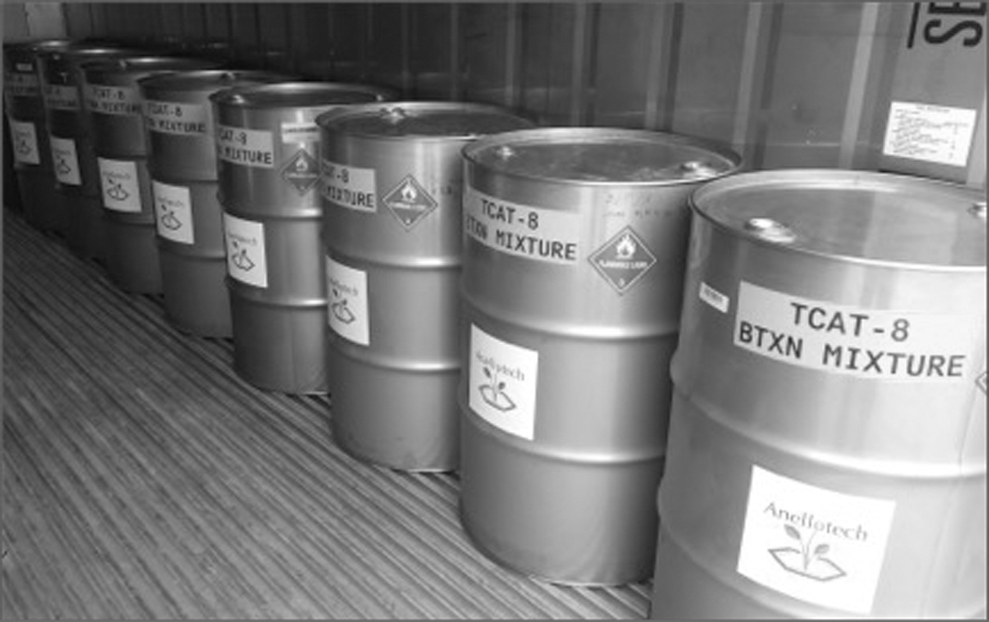
Anellotech's biobased BTX aromatics.
A key focus for Anellotech has been commercializing bio-paraxylene. Anellotech has collaborated with Suntory, one of the world's leading consumer beverage companies, in this effort as bio-paraxylene is the key missing component needed to make 100% biobased PET bottles. Suntory currently uses 30% biobased PET for its Suntory Tennensui brand of mineral water and, by replacing petro-based paraxylene with bio-paraxylene from Bio-TCat, the collaboration aims to make a 100% biobased PET for Tennensui as well as other Suntory brands in the future.
A BTX sample produced at Anellotech's pilot plant has already been converted into high-purity bio-paraxylene (Fig. 4). Larger volumes are now being prepared to make a 100% bio-PET resin for prototype bottle manufacture and product testing. These high-purity bio-paraxylene test samples have met the ASTM international specifications for downstream derivatives including PET conversion. This will be the industry's first production of bio-PET from continuous, cost-effective processing of non-food biomass.
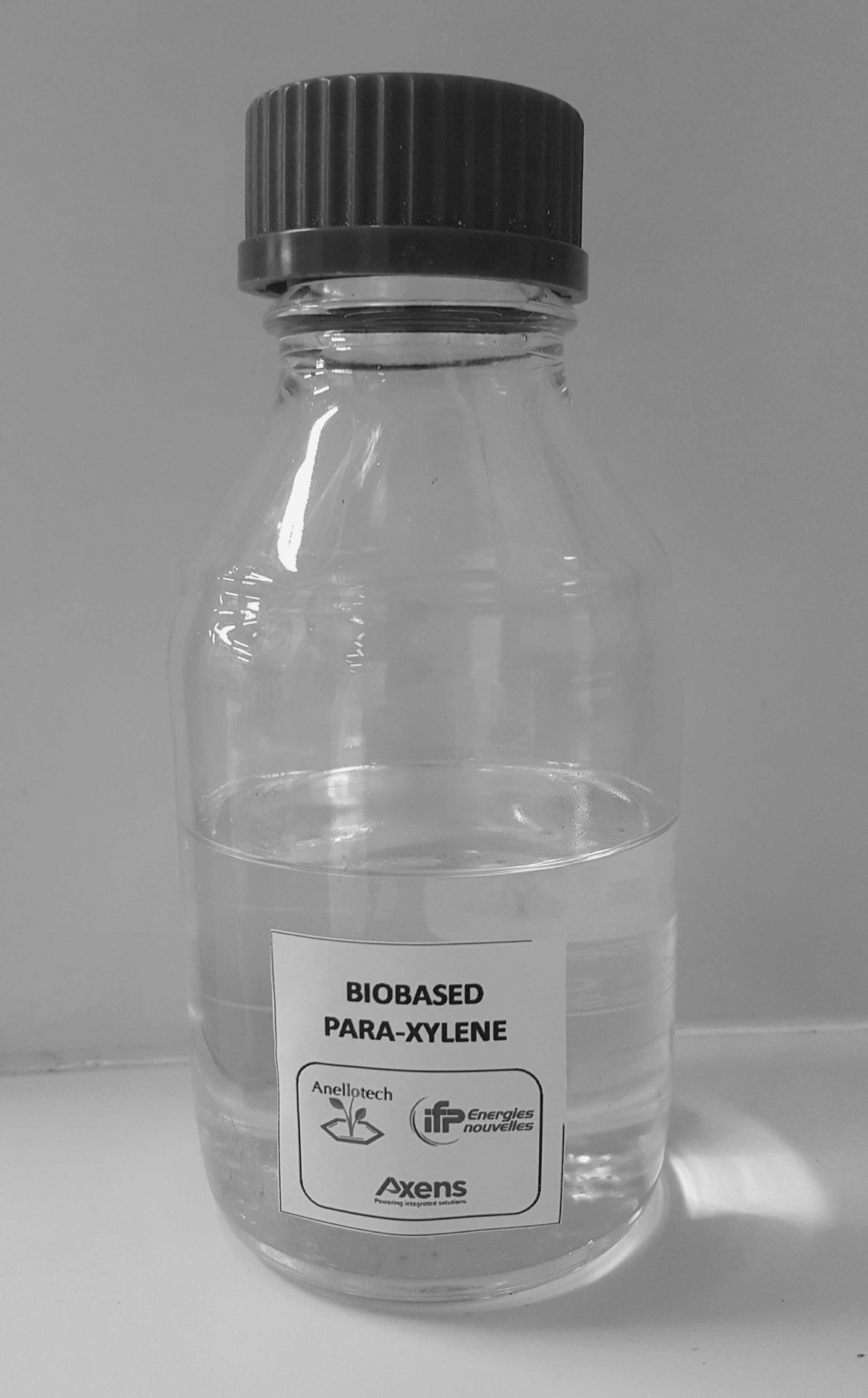
Anellotech's bio-paraxylene.
Alternative Waste Feedstocks
So far, Bio-TCat aromatics have been produced using loblolly pine feedstock from the southern United States. Loblolly pine was selected first due to its abundance and an existing supply chain, providing low cost of supply and efficiency in industrial applications.
However, the MinFree and Bio-TCat processes can be adapted to use alternative non-food biomass inputs. Anellotech is now selecting additional feedstocks and testing for further commercialization.
The recovery and disposal of plastic waste is currently a major societal problem threatening to overwhelm our ecosystem. Anellotech wants to provide solutions to this serious issue by leveraging its technology platform with its core technology, knowhow and development infrastructure to create a plastics chemical recycling solution using plastic waste as a feedstock.
Using Anellotech's new Plas-TCat technology, we will attempt to transform plastic waste into virgin commodity chemicals for further use as ‘drop in’ raw materials, in the production of polymers in a plastics circular economy. With Plas-TCat, single and mixed streams of plastic waste could be converted into the same olefins and aromatics used today to produce the same virgin polymers used to make and package everyday products in a range of industries, such as food and beverage and automotive markets. The use of Plas-TCat to convert mixed plastics streams includes feeding tightly bound multi-plastics such as composite films, as well as the conversion of different plastics routinely found as part of the gathering and preparation steps of the plastics recycling operations.
Only minor modifications are expected at Anellotech's TCat-8 pilot plant to handle plastic feedstock instead of wood. By using Plas-TCat, companies could produce aromatics and olefins directly from plastic waste. This is intended to be more economically attractive than competing technologies which produce lower value products (pyrolysis oils) as they do not use a catalyst. Pyrolysis oils require further processing in steam crackers or other upgrading facilities to create some of the same valuable chemicals as Plas-TCat. The flexibility of Plas-TCat means it could produce valuable products from a variety of mixed plastics with a high yield.
Anellotech is looking to use this process in areas where plastic waste collection is not yet enforced and where proper collection infrastructure to isolate waste plastics streams is currently lacking, such as developing countries in Asia who have a significant amount of ocean plastics pollution. By allowing payment in waste plastic, Plas-TCat provides economic incentives to tackle plastics pollution.
Textiles are another alternative feedstock being explored through new process Tex-TCatTM, which also leverages Anellotech's technology platform. Cotton fabrics, synthetic fabrics (polyester, nylon, Lycra/Spandex, etc.) as well as blends are currently under consideration as feedstock to produce aromatics. They would be used as a ‘drop-in’ replacement for the petroleum-derived aromatics used to make the same virgin synthetic fibers and fabrics, or for monetizing via production of biofuels.
Technology Enabling Sustainability Confirmed by LCA
Made from renewable feedstocks, Bio-TCat products enable significant greenhouse gas (GHG) reductions compared to identical chemicals currently made from crude oil. Jacobs (Jacobs Engineering Group Inc., Dallas, TX) confirmed this claim with an in-depth review of Anellotech's GHG emissions through a Lifecycle Analysis (LCA), using its industry-respected refinery and petrochemical process models.
Jacob's LCA assessment compared Bio-TCat aromatics produced using sustainably-sourced loblolly pine feedstock from the southern United States, to petro-aromatics produced in the US Gulf Coast from three crude oils, representing a range of carbon intensities. Jacobs employed their proprietary models for oil production, transportation and refining to estimate the carbon intensity of producing high-purity paraxylene and benzene products.
The results showed that CO2 emissions for producing paraxylene and benzene from pulpwood using Anellotech's process are around 70-80% lower than emissions for identical petro-based chemicals made from crude oils. If Bio-TCat is configured to make renewable gasoline and distillate fuel blendstocks, the reduction potential exceeds 90% as fuels are burned to make energy.
Commercialization and Other Future Plans
Anellotech wants to extend its strategic collaboration for Bio-TCat to motivated partners who want to capitalize on the improved sustainability and competitiveness of Anellotech's technology to build and operate commercial plants. Biomass suppliers, refiners, chemicals manufacturers, brand owners and others across the value chain are welcome to get in touch if they are interested in joining the Anellotech alliance network.
As well as bio-paraxylene, Anellotech continues to work on the recovery, separation and purification of bio-benzene and toluene from TCat-8® output which will enable sample volumes of a range of important bio-based polymers such as nylons, polycarbonate, polystyrene and ABS.
Additionally, programs for chemical recycling of plastic waste and waste clothing are underway. Strategic partner engagements are sought for development funding and contribution of complimentary expertise in the bio-benzene and in the plastic waste conversion supply chains, as well as future commercial plants.
As Anellotech moves ever-closer to delivering its first commercial Bio-TCat plant, it will continue to work with the Anellotech alliance network to ensure performance and quality as it delivers its sustainable technologies.