




Abstract
Bringing Sustainable Protein to the Feed Market
Over the past decade the animal feed industry has suffered from a growing sense of unease and uncertainty about the future supply of protein. In 2018, the world produced 1.07 billion metric tons of animal feed, driven by the continued expansion of aquaculture and the livestock sector. Yet that expansion relies on the supply of quality protein. However, that supply is not growing and actually declining in some cases. The aquaculture sector in particular suffers from a problematic dependence on fishmeal sourced from declining wild fisheries.
Innovators and academics have increasingly sought to bring alternative products to market, ranging from algae to insects and single cell proteins. Of these alternatives one clear leader has emerged: insect protein. This new industry has grown quickly in the last five years and demonstrated that the quality and consistency of protein that can be produced can rival any conventional protein source. The growth of this industry is inspiring, however, only a few companies manage to produce a product that is price-competitive with high grade fishmeal. Malaysia-based Nutrition Technologies has achieved this goal. While other players in the insect industry have demonstrated the ability to provide high quality, sustainable and price stable products, most are now facing the challenge to make them affordable at scale.
Black Soldier Fly—The Scalable Species
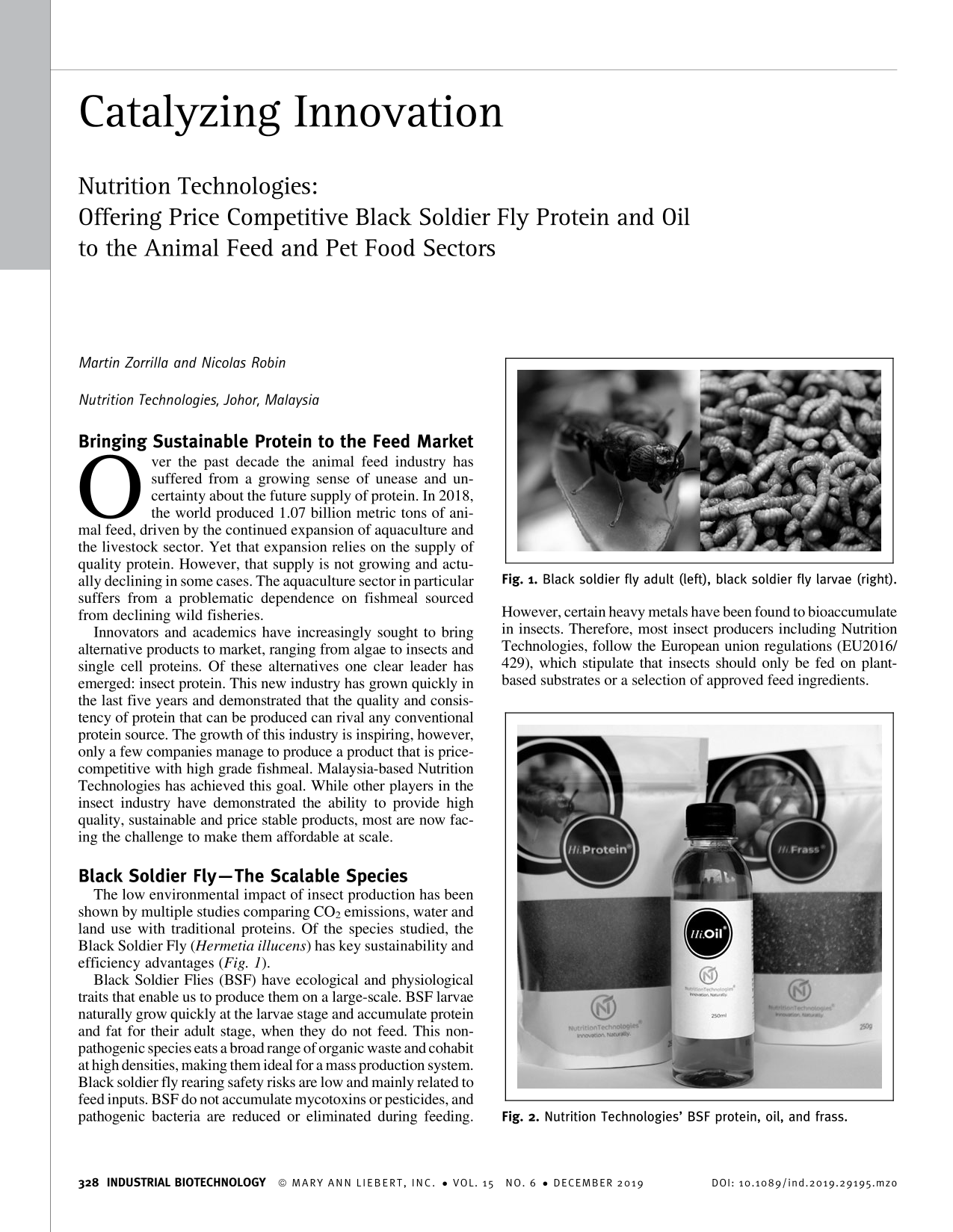
The low environmental impact of insect production has been shown by multiple studies comparing CO2 emissions, water and land use with traditional proteins. Of the species studied, the Black Soldier Fly (Hermetia illucens) has key sustainability and efficiency advantages (Fig. 1).

Black soldier fly adult (left), black soldier fly larvae (right).
Black Soldier Flies (BSF) have ecological and physiological traits that enable us to produce them on a large-scale. BSF larvae naturally grow quickly at the larvae stage and accumulate protein and fat for their adult stage, when they do not feed. This non-pathogenic species eats a broad range of organic waste and cohabit at high densities, making them ideal for a mass production system. Black soldier fly rearing safety risks are low and mainly related to feed inputs. BSF do not accumulate mycotoxins or pesticides, and pathogenic bacteria are reduced or eliminated during feeding. However, certain heavy metals have been found to bioaccumulate in insects. Therefore, most insect producers including Nutrition Technologies, follow the European union regulations (EU2016/429), which stipulate that insects should only be fed on plant-based substrates or a selection of approved feed ingredients.
On average, BSF producers have been able to produce protein meals around 50% protein with a diverse amino acid profile, with lysine level reaching about 3.4%. However, BSF larvae are also rich in oil, which can be extracted from larvae as well. The oil has antibacterial properties, thanks to its high lauric acid content. For this reason, it is used as an animal feed ingredient, particularly in formulations aimed at reducing or eliminating antibiotics (Fig. 2). The BSFL oil fatty acid profile can also be modified by changing BSF diet to express targeted fatty acids. A third product is also made during the rearing process, BSF frass. This is the insect manure and is currently used as a soil conditioner and organic fertilizer by insect producers.
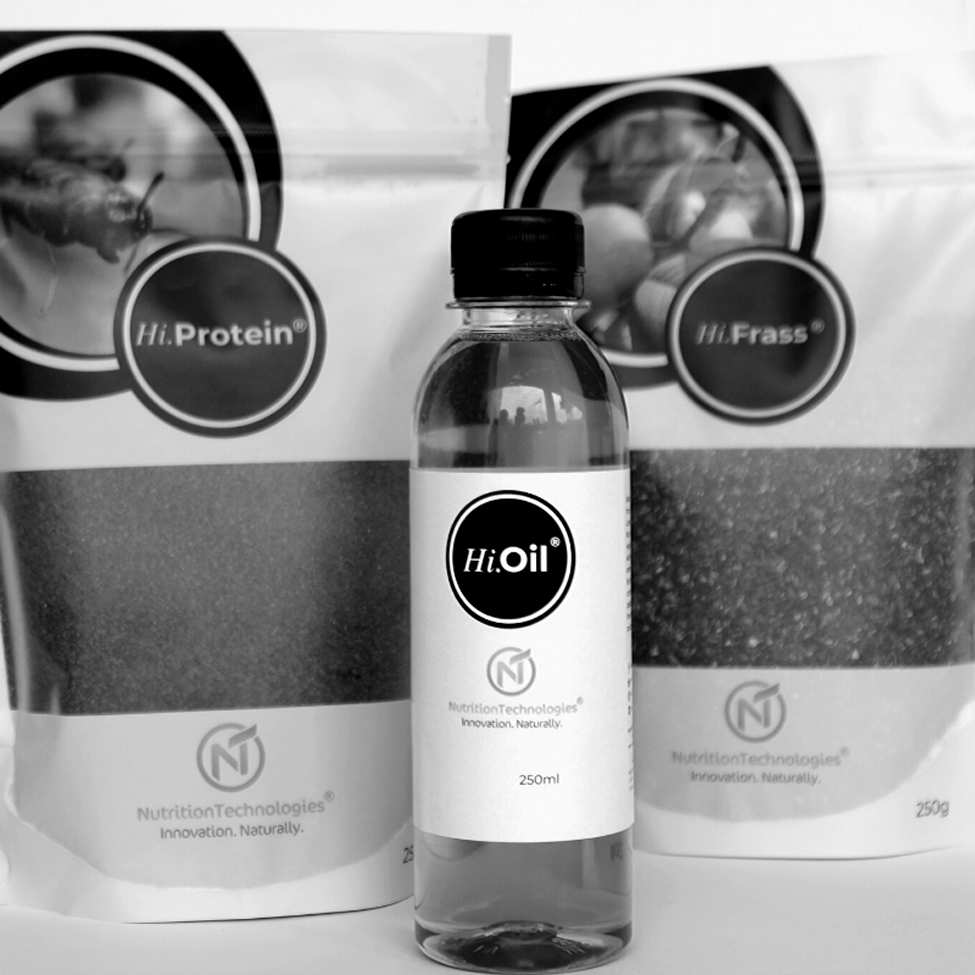
Nutrition Technologies' BSF protein, oil, and frass.
Of these products BSF protein meal has the most potential for disrupting the global feed industry, valued at $430 billion. The protein source has garnered the attention of major feed manufacturers due to a series of peer-reviewed studies that have found that BSF meal can substitute fishmeal. Multiple studies on salmonids species such as Atlantic Salmon have successfully replaced up to 100% of fishmeal without adverse effects. 1 Research has included species of high interest to producers in Asia, such as whiteleg shrimp (Litopenaeus vannamei) showing fishmeal replacement rates up to 25%. 2
Black Soldier Fly larvae-based protein meals are clearly high-quality alternatives, but currently production costs and therefore price remains a major sticking point. Some producers however, such as Nutrition Technologies, mainly based in tropical countries, have managed to lower the cost of production and offer prices lower than equivalent grade fishmeal (Peruvian super prime). Other producers with higher production costs rely on positioning the product in the feed market at a higher price point, but as an environmentally friendly alternative that can improve consumer perception of aquaculture products.
Affordable and Sustainable—Nutrition Technologies' Realistic Approach
At Nutrition Technologies, our main mission is to offer a price competitive sustainable protein and oil to the animal feed market and organic compost to our local agricultural industry. To achieve this, we use both a low capital production system and our own proprietary biotechnology methods to upcycle very low grade and abundant raw materials as feed for the larvae. This key bioprocessing step frees up nutrients from nutritionally poor ingredients, allowing us to formulate our feeds with greater flexibility. Additionally, the ideal climate conditions offered by our tropical location enables us to lower our system's energy inputs. Our insect larvae are reared in a vertical farming system that is highly efficient: in a single year, one square meter of our factory floor space can produce more protein that one a one-hectare soybean field. Nutrition Technologies approach has been to design these efficient low-cost production system so that they replicated in any tropical environment.
Future Outlook
As with all entrepreneurial ventures, every day at Nutrition Technologies has presented us with new challenges. Initiated in 2015 the company's newest challenge is to complete its transition from its pilot facility to its first fully commercial production plant by the end of the year 2020 (Fig. 3). In the meantime, we continue to innovate and improve our production process. In such a new industry this can mean efficiency gains on a weekly basis. Added to the economies of scale that this expansion will bring, we will be able to offer a realistic solution to the aquafeed sectors' fishmeal dependence. Working closely with animal feed manufacturers to define their needs and requirements, our goal is to offer affordable, sustainable and efficient protein and oil to the animal feed and pet food sector.

Nutrition Technologies' second factory in Malaysia (commercial phase).