




Abstract
The present work aimed to immobilize Penicillium brasilianum fungus in situ or by contact in polyurethane foam and assess the production of exo-polygalacturonase with the immobilized fungus while evaluating the reuse, storage stability and kinetic parameters of production. The immobilization/adhesion processes in situ and in contact polyurethane resulted in activities of 2.01 ± 0.02 U/mL for both processes, results that are statistically (p < 0.05) greater than the production by free microorganism (1.70 ± 0.02 U/mL). Continuous reuse, both for contact and in situ techniques, demonstrated the possibility of reuse up to 4 times with up to 50% of the initial enzymatic activity. The evaluation of storage stability demonstrated the possibility of preserving the immobilized microorganism (in situ and by contact) for 30 days under refrigeration, without substantially affecting its productive capacity. Microbial growth rate (rx) and cell-substrate conversion factor (YX/S) were affected by the immobilization/adhesion process, demonstrating that the same it alters cell metabolism with regard to cell growth and substrate consumption.
Introduction
Pectinases were the first enzymes to be used industrially and have numerous commercial applications, especially in the fruit processing industry. 1,2 Among the natural sources of these enzymes, microbial pectinases are usually employed due to their ease of production and high specificity regarding the preferred substrate (pectin, pectic acid or oligogalacturonate) and their action pattern (endo-enzymes and exo-enzymes). 1,3 They represent a 25% share of the world food and beverage enzyme market 4,5 and are expected to generate an estimated $35.5 million in revenue by 2021. 6
However, like many other industrial enzymes, pectinases face low yield and productivity constraints, and the cost of production is a limiting factor. 3 Microbial immobilization is a potential strategy to obtain higher yields at substantially lower costs. 7,8 Among the supports used for microbial immobilization, polyurethane foam offers interesting features such as high resistance to mechanical force, organic solvents, and microbiological attacks, as well as ease of handling. 9 –11
In the literature, immobilization studies in polyurethane foam evaluate aggregation of the microorganism in situ, although this process can lead to inactivation of the microorganism, mainly due to the exothermic polymerization step. 10,12,13 Previous works suggest the species Penicillium brasilianum as an important biotechnological target for production of enzymes, including pectinases, specifically those with polygalacturonase activity. 14,15
To our knowledge, there is no comparative study of kinetic pectinase production in situ and contact immobilization of P. brasilianum in polyurethane foam in relation to free production. The present study aimed to immobilize P. brasilianum for exo-polygalacturonase (exo-PG) production by two immobilization techniques—in situ and by contact in laboratory-synthesized polyurethane foam—while analyzing the reuse and storage stability of immobilized cells and the kinetic parameters of production.
Materials and Methods
MICRORGANISM
The filamentous fungus P. brasilianum was previously isolated by Zeni et al. 15 This fungus was incubated in Potato Dextrose Agar (PDA) medium (Merck, Germany) at 25°C for 5 days, after which spores were counted and concentration was found to be 5x10⁶ spores/mL, according to the methodology of Zeni et al. 15
IMMOBILIZATION OF P. BRASILIANUM IN POLYURETHANE
Contact
The polyurethane support was prepared by mixing 3 mL of isocyanate with 7 mL of polyol. The polymerization was carried out at room temperature (22°C ±2°C). After 24 h of drying, the resulting foam was cut into cubes of approximately 1 cm3, 16 and subjected to autoclaving at 121°C for 20 min. For immobilization/adhesion, 3 cubes previously soaked in Potato Dextrose Broth (Merck, Germany) and 1 mL of spore solution were added to the surface of PDA medium and incubated for 5 days at 30°C.
In Situ
In situ immobilization was developed by adapting the conditions of Nyari et al. 17 where 1 mL of the spore solution (5x10⁶ spores/mL) was added to 7 mL of polyol, homogenized, and kept in ice bath (since the addition of the foaming components causes a heating in the mixture that could cause death of the inoculum). Then, 3 mL of isocyanate was added to the mixture and homogenized. After complete homogenization, the system was removed from the ice bath and maintained for 24 h at room temperature (22°C ± 2°C) for complete polymerization and drying of the foam. The resulting foam was diced to approximately 1 cm3.
PRODUCTION OF EXO-PG WITH P. BRASILIANUM IMMOBILIZED
Polyurethane foam cubes containing in situ or contact immobilized cells were washed with distilled water to remove cells that were poorly adhered to the support. Afterwards, 3 cubes were incubated in 63 mL of medium (32 g/L of citrus pectin, 10 g/L of yeast extract and 0.5 g/L of magnesium sulfate) for 96 h at 30°C and 180 rpm, according to Zeni et al. 15 Samples were collected every 12 h for analytical determinations. Fermentation was also performed with free cells under the same conditions for comparison.
STORAGE STABILITY OF THE IMMOBILIZED CELLS
To assess the storage stability of the immobilized cells, the polyurethane foam cubes containing the immobilized cells were stored in a refrigerator (4°C) until the exo-PG yield was less than 50%. For this, every 7 days the cubes were fermented under the same conditions described above, and exo-PG production and biomass detachment were quantified.
OPERATIONAL STABILITY (REUSE) OF THE IMMOBILIZED CELLS
To evaluate immobilization stability and continuous use capacity of the immobilized cells, polyurethane foam cubes containing P. brasilianum cells were fermented for 96 h, at 30°C and 180 rpm in medium containing 32 g/L of citrus pectin, 10 g/L of yeast extract and 0.5 g/L of magnesium sulfate. The foam cubes were then removed from the medium, washed with sterile distilled water and immediately placed in new fermentation medium. At each fermentation, biomass detachment and exo-PG production analyzes were performed. Reuses were made until yielding less than 50% of the initial value.
KINETIC PARAMETERS OF EXO-PG PRODUCTION
From the total values of biomass, substrate, and product versus culture time, it was possible to use Equations 1–3
18
to determine the speed at which cellular growth (rx), substrate consumption (rs, carbon), and product formation (rp) occurred in both the immobilized culture (in situ or by contact) and free cells.
where X is biomass concentration (g/L), S is substrate concentration, P is product concentration (U/mL) and t is time (h).
In order to calculate the microbial cell speed (rx) for the immobilized culture, it was assumed that (a) cells resulting from cell duplication do not have the ability to remain adhered to the polymeric matrix and (b) cells contained inside the polyurethane matrix present growth speed (rx) similar to those that have diffused in the medium.
The values found with Equations 1–3 were then used to determine substrate (carbon) conversion values, to cells (YX/S) and Exo-PG (YP/S), according to Equations 4 and 5.
18
Productivity (Qp) was determined by Equation 6.
where Qp (U/mL·h) is productivity, Pf is enzyme concentration (U/mL) and t (h) is duration of fermentation where the enzyme showed the highest activity.
ANALYTICAL METHODS
Determination of biomass
The cells were centrifuged at 9,625 g for 30 min at 4°C, washed with distilled water, and dried at 105°C (Fanem SE-320) until a constant mass was obtained. To measure immobilized cells, the biomass released from the polyurethane was quantified by the same method, the entire sample was vacuum filtered and the biomass adhered to the cube was removed with the aid of tweezers, and added to the filter paper for drying in the oven under the conditions described above.
Substrate Consumption
The total organic carbon (TOC) in the medium was determined by the catalytic combustion method, using TOC analyzer (Shimadzu model TOC-VCSH, China). 19
Determination of Exo-PG activity
Exo-PG activity was determined by the DNS (dinitrosalicylic acid) method, initially proposed by Miller, 20 with modifications. 0.5 mL of sodium acetate buffer with 0.5% citric pectin and pH 5.5 were incubated at 37°C for 15 min. Afterwards, 0.5 mL of enzyme extract was added and incubated at 37°C for 5 min (for blank, 0.5 mL of distilled water was added). Then, 1 mL of DNS solution was added and the mixture was kept for 6 min boiling for color formation, cooled in ice bath. 8 mL of 50 mM double sodium-potassium tartrate solution for color stabilization. Absorbance was measured by spectrophotometer (Beckman Coutler, model DU640) at 540 nm. A unit of pectinolytic activity was defined as the amount of galacturonic acid released per mL of enzyme extract per minute (U = μmol/min) under the conditions studied according to a standard curve established with αD-galacturonic acid (Fluka Chemica, molecular weight 212.16) as reducing sugar. Exo-PG activity was expressed in activity unit per mL (U/mL).
STATISTICAL TREATMENT
The results were tabulated with software Statistica version 7.0. All analyses were performed in triplicate.
Results and Discussion
PRODUCTION OF EXO-PG WITH IMMOBILIZED/ADHERED AND FREE P. BRASILIANUM
Figure 1 shows that maximum exo-PG activity occurred within 48 h of production for both free and immobilized/adhered microorganisms under the conditions studied. Free P. brasilianum presented exo-PG activity of 1.70 ± 0.02 U/mL (Fig. 1a) with 42.37% of the available carbon consumed (Fig.1c), resulting in a biomass of 10.63 g/L (Fig. 1b). In situ and contact immobilization/adhesion on polyurethane resulted in exo-PG activity values statistically higher (p < 0.05) than those of the free microorganism with activity of 2.01 ± 0.02 U/mL, an 18% increase in resource efficiency with the techniques used. Biomass production was 1.19 ± 0.11 g/L (Fig. 1b) for in situ fixed cells, with 54.6% carbon consumption in this period, while for contact fixed cells it was 1.72 ± 0.21 g/L, or 40.08% of available carbon consumed, which is statistically different (p < 0.05) from 10.63 ± 0.23 g/L for free cells. The small biomass production for free and in situ-immobilized cells demonstrates that exo-PG production was predominantly performed by previously immobilized microorganisms. These values represent a positive factor in the immobilization/adhesion, since, by decreasing the diffused biomass values in the product, the later steps of separation and purification of the final product are easier. These findings represent a fundamental advance in the final economic calculation of production viability. 21

Production kinetics of
The positive effects of immobilization may be due to immobilization/adhesion occurring with whole viable cells, which can improve cells' tolerance to the substrate and inhibition of the final product, increase the shear stress resistance of sensitive cells, reduce the phase of delaying cell growth, and improve the use of the substrate by advantageous metabolic changes or by channeling the flow of material within the cell through a specific path. In addition, the cellular activities of the immobilized cells can be enhanced by providing a favorable microenvironment, such as cell–cell contact, the increased of substrate concentration near the immobilized cells, nutrient-product gradients, and pH gradients. 22 –24 It has also been reported that immobilized cells have the ability to assimilate products released from lysed cells for growth/maintenance purposes, and this is important for maintaining a constant catalytic activity. 23
Positive effects on the immobilization of microorganisms were also seen by Mesquita, 16 who, while immobilizing Xanthomonas campestris with simultaneous synthesis of polyurethane (in situ immobilization), obtained a 274% increase in xanthan gum production. Wan-Mohtar et al., 11 in contact immobilization of Ganoderma lucidum in polyurethane aiming at the production of exopolysaccharides, obtained high production mainly due to the reduction of mass transfer limitations, which allowed greater access to the substrate by the cells. Nie et al. 10 immobilized Pseudomonas aeruginosa NY3 in polyurethane, obtaining high hydrocarbon-removal rates from high oil effluent. The hydrophobic characteristics of polyurethane allow strong interactions with most microorganism cells, which makes of polyurethane foam a suitable material for the immobilization/adhesion of microorganisms. 10
STORAGE STABILITY OF THE IMMOBILIZED CELLS
Storage stability was evaluated by immobilization/adhesion of P. brasilianum in situ and by contact with laboratory-synthesized polyurethane. After 30 days of storage in the refrigerator, fixed assets in situ had a reduction of 19.4% of its productive capacity, while fixed assets by contact showed a reduction of 30.4%. Figure 2 shows a gradual reduction in the productive capacity of fixed assets, which is related to the increase of released cells (biomass) to the production medium. In addition, those immobilized by contact have visible cells adhered to its surface ( Fig. 3), which during storage easily detach into the medium. This reduction was also observed by Mesquita, 16 who, while storing X. campestris cells immobilized in situ in polyurethane foam for 30 days in a refrigerator (4°C), observed a 20.5% reduction in their ability to produce xanthan gum. After 45 days of storage in the refrigerator, a reduction of 53.7% was observe for fixed assets in situ and 55.2% for fixed assets per contact, demonstrating that the storage of immobilized fungus is viable for exo-PG production up to 30 days under refrigeration. After this period, it loses more than 50% of its exo-PG production capacity. Production behavior for both techniques occurs similarly over the storage period.
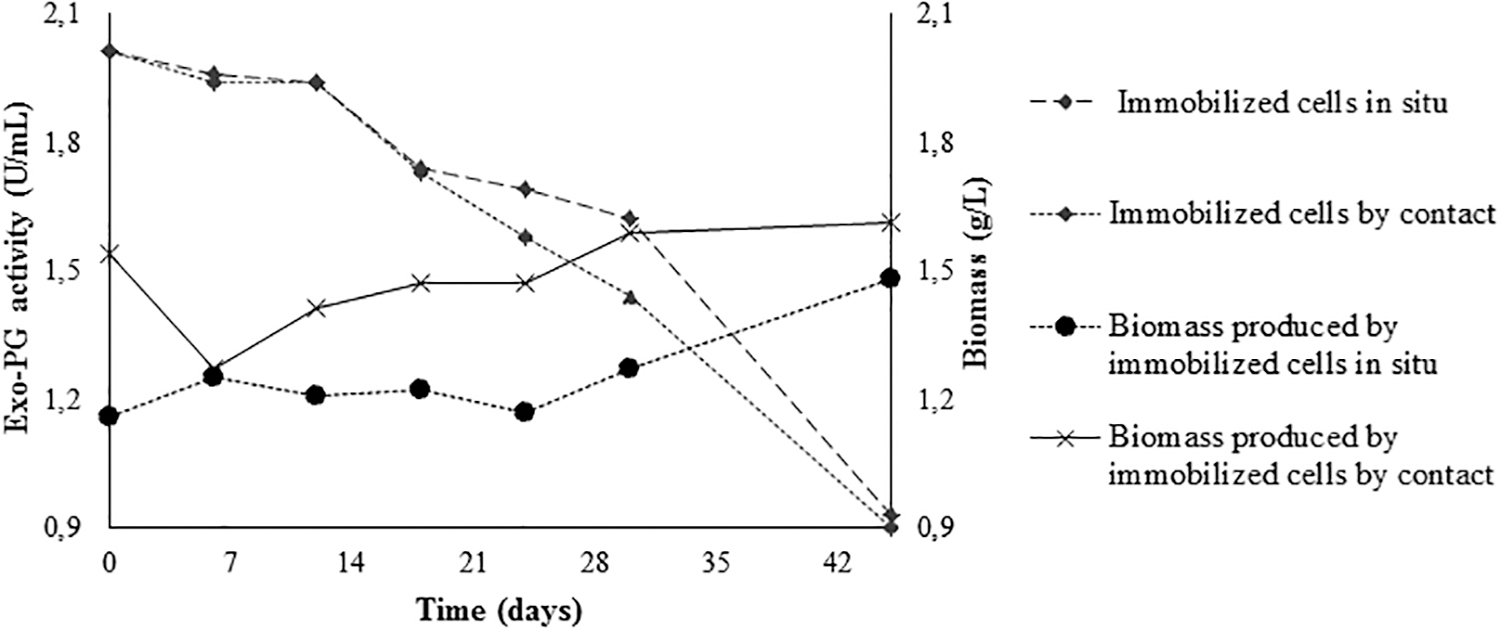
Storage stability (4°C) of P. brasilianum immobilized/adhered in situ and by contact.
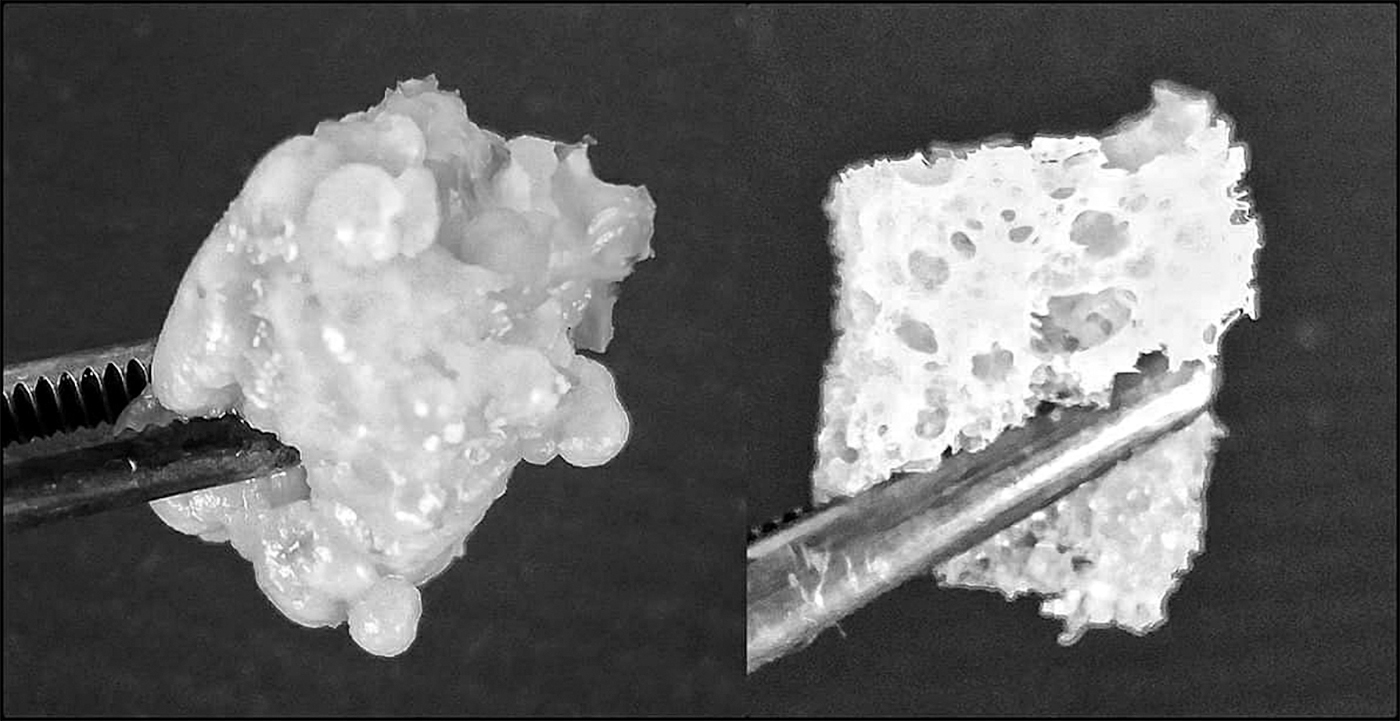
Polyurethane cubes with immobilization of P. brasilianum by (left) contact and (right) in situ.
OPERATIONAL STABILITY (REUSE) OF THE IMMOBILIZED CELLS
In the evaluation of reuse capacity of P. brasilianum immobilized in situ and adhered by contact in laboratory-synthesized polyurethane, it was observed that the exo-PG activity produced by the microorganism decreases to values below 50% of its initial production after 4 reuses (Fig. 4). Biomass values increase with each reuse, possibly because part of the reproducing cells do not adhere to the matrix. 16 With each new fermentation, microorganisms remain metabolically active and produce new cells that are unable to remain attached to the polymer matrix, thus detaching and diffusing into the medium. 25 –27
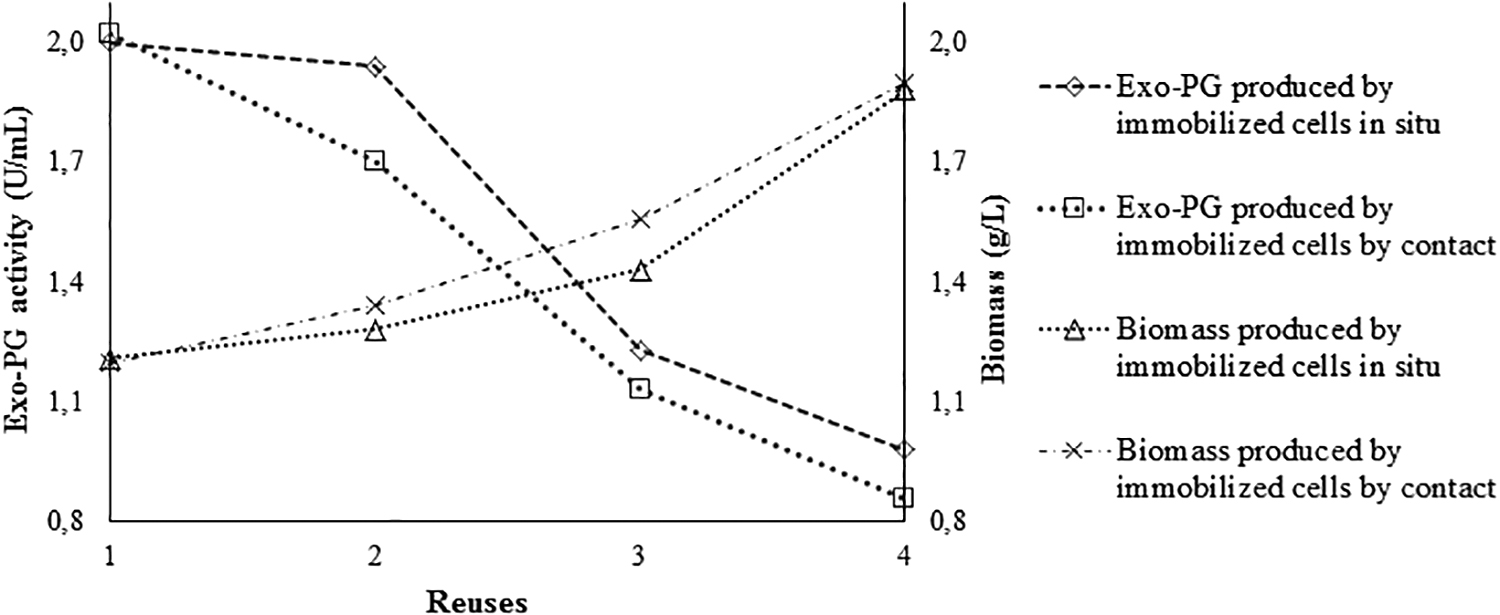
Behavior of immobilized/adhered P. brasilianum when submitted to continuous batch fermentations.
KINETIC PARAMETERS OF EXO-PG PRODUCTION BY IMMOBILIZED AND FREE CELLS
Table 1 presents kinetic parameters of the free and immobilized/adhered P. brasilianum fermentation process (in situ and by contact). The microbial growth rate (rx) of free P. brasilianum was ten times higher than the growth rate of immobilized cells. Mesquita 16 found the same behavior in X. campestris immobilization on the assumption that immobilization reduces cell duplication or makes it occur more slowly, possibly due to physical support restriction. Consequently, cell-substrate conversion factor (YX/S) decreased with immobilization, suggesting that immobilization alters cell metabolism regarding cell growth. 10,11,17 Correlating cell growth (rx) with substrate-to-product (YP/S) and cell-substrate conversion factors (YX/S), we can conclude that the free-form microorganism used the substrate to a large extent for cell growth and maintenance, while the microorganism in immobilized form both in situ and by contact made greater use for the production of the enzyme at issue, which is justified by the productivity values (Qp).
Kinetic Parameters of Fermentation Process by Free and Immobilized/Adhered Cells of P. brasilianum
Conclusion
This study shows that the process of immobilization/adhesion in situ and by contact of P. brasilianum in polyurethane is effective, since the immobilized (in situ and by contact) showed exo-PG activity greater than that of the free microorganism, and that the fixed assets can be reused up to four times (with 50% of residual activity) and stored for a period of 30 days in refrigeration temperature (4°C) without affecting their productive capacity. Microbial growth rate (rx) and cell-substrate conversion factor (YX/S) were affected by the immobilization process, demonstrating that immobilization alters cell metabolism with regard to cell growth and substrate consumption.
Footnotes
Author Disclosure Statement
No competing financial interests exist.
Funding Information
The authors wish to thank the National Council for Scientific and Technological Development (CNPq), Coordination for the Improvement of Higher Education Personnel (CAPES) and Research Support Foundation of the State of Rio Grande do Sul (FAPERGS) for financial support.