




Abstract

More than two billion people scramble to find food. Nations go to war over access to arable land and drinkable water. Political leaders worldwide struggle to keep an unhappy populace from rioting. These are the things that will happen if farmers around the world continue to cultivate crops at the present rate.
This is not a fantasy scenario that relies on dubious computer models or suspect assumptions. It's a simple extrapolation—obvious from a glance at a population chart (Fig. 1). 1 Even with a recent slowdown in birth rates, the number of people on the planet nonetheless is growing fast, as it always has. That sets the stage for a potential nightmare scenario within the next few decades.
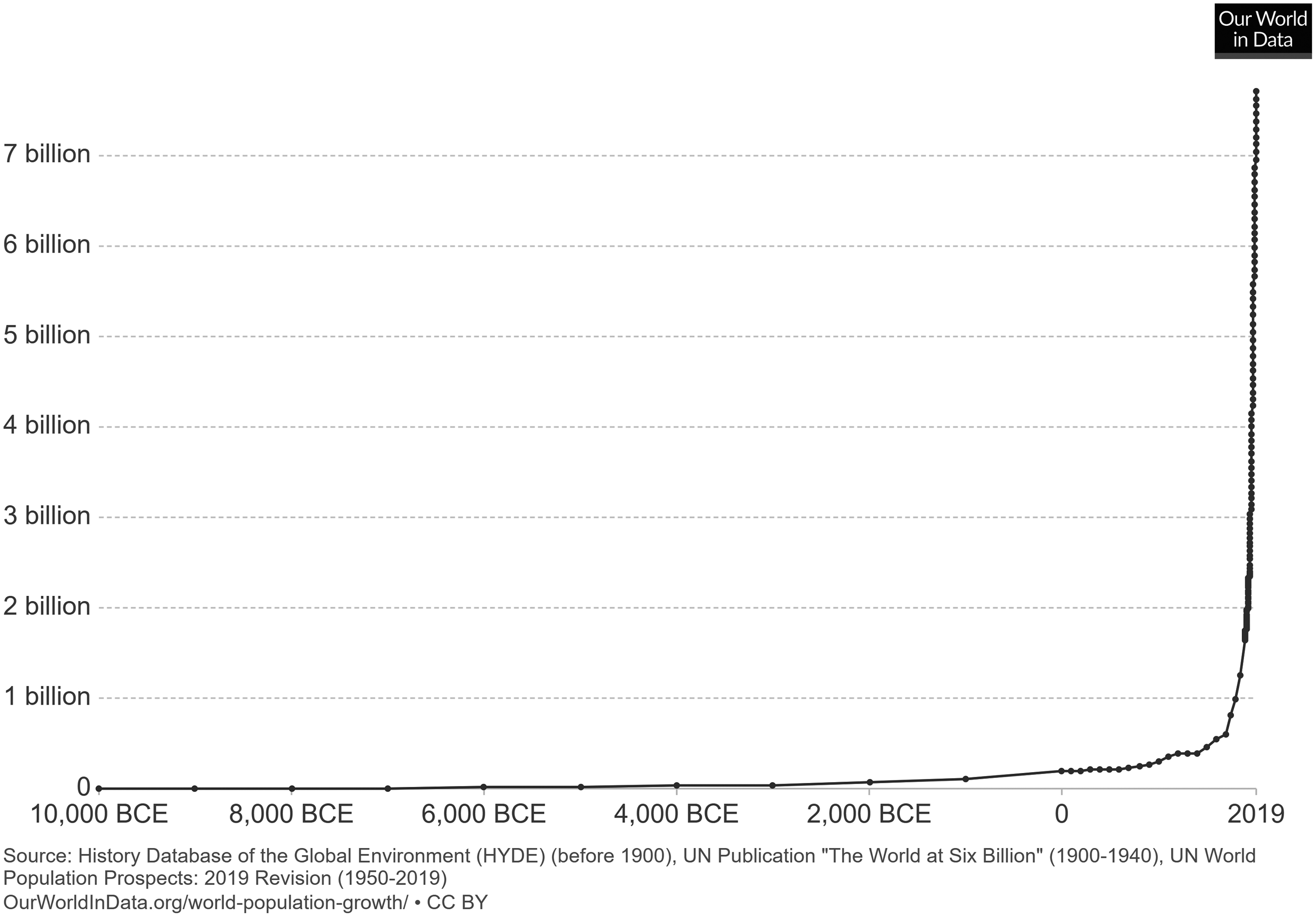
World population since 10,000 BCE.
Statisticians at the United Nations say another one billion people will be living on this planet within the next fifteen years or so, an increase from 7.8 billion to 8.8 billion. 2 Yet another billion people are expected to join by 2050, bringing the total to 9.8 billion. More than half of this growth will happen in Africa, 3 a continent already beset by malnutrition 4,5 and a shortage of clean, drinkable water. 6
There simply aren't enough calories to go around to feed an extra two billion people without positing a fantasy scenario in which no morsel of food is ever wasted, everyone becomes a vegan, all political conflicts end and the weather is always sunny. The most realistic estimates suggest yields must increase 70% to satisfy the expected demand. 7 Even if we sustain the current rate of crop yield growth of around 1–2% a year, it won't be enough. 8
A global “all hands on deck” attitude is needed to deploy the world's available resources in the most efficient manner possible to keep up with the global demand. Technology has demonstrated its ability to overcome population hurdles in the past. In the 1950s and 1960s, the Green Revolution's development of cutting-edge hybrid plant varieties rescued an estimated billion lives from starvation. Dwarf wheat was used to nearly double the yields in India and Pakistan, 9 allowing those countries to become self-sufficient food producers. Genetic scientist Norman Borlaug received the 1970 Nobel Peace Prize for his pioneering work. 10 “More than any other single person of this age,” the Nobel committee's chairman explained, “he has helped to provide bread for a hungry world. We have made this choice in the hope that providing bread will also give the world peace.” 9
What the EU Is Doing Wrong
Nearly half a century later, the European Union has decided to take technology—and the peace it brings—for granted. Instead of allowing a scientific approach to growing food, Europe has withdrawn its technology, dense capital investment and fertile soil from the global effort to achieve a long-term food security solution. As the European Union is the world's top exporter of food 11 –13 products, this is a major setback that the world can't afford.
The retreat from science comes in the form of the “Precautionary Principle,” which states that any technology carrying the potential for harm must be banned, 14 even in cases where a risk is remote or unproven. The principle shifts the burden of proof to innovators, forcing them to establish that their products are not harmful. While that sounds reasonable, in practice the system empowers naysayers who need only raise some doubt and create a bit of a political stir to thwart a promising advance. The precautionary principle ends up giving established incumbents and narrow advocacy groups a veto power over new technology.
The European Commission used the precautionary principle to, in effect, ban genetically modified organisms, 15 even though every reputable scientific organization that has looked at GMOs has found them as safe as conventionally bred crops. 16 Last year, the European Court of Justice went a step further and declared that new plant breeding technologies, such as CRISPR, must be treated as if they were GMOs. 17,18 That is, this novel gene-editing technique is to be outlawed before it has a chance to fully demonstrate its merits.
CRISPR is often described as a pair of molecular scissors that scientists can use to cut out unwanted strands of DNA from an organism, or to insert positive traits. The technique allows for the creation of stronger, higher-yielding plant able to grow in harsh environments. Plants can be tailored to the exact environments in which they will be grown for maximum performance.
That humans are manipulating genes is nothing new. We've been doing that since the dawn of agriculture. Every crop we plant today is the product of an imprecise trial-and-error breeding process that has taken place over millennia. Instead of leaving the mix of plant traits to chance, CRISPR achieves the desired result much more quickly through precision and science.
CRISPR has already shown its usefulness in an early application that could ease the overharvesting of the world's fish. CRISPR has been used to create oilseed plants that produce healthy, omega-3 fatty acids. Growing a hectare of these plants replaces the need for harvesting 10,000 kg of wild fish. 19,20 It's a remarkable achievement, one that the U.S. Department of Agriculture after an extensive review recognized as safe to grow. 21
When a major world market closes its doors to such developments, it has a chilling effect on both investment capital and research and development. Since farmers around the world aren't allowed to export crops grown with advanced seeds to the EU, agricultural R&D suffers in line with the decline in sales of outlawed products. Why invest in something that can only be sold in the United States, when efforts can be directed toward other products than can be sold anywhere in the world? This sets off a downward economic death spiral in which developing new crop technology products becomes cost prohibitive. Exciting new discoveries that could advance food security around the world will never be seen outside the laboratories in which they were created.
We've already seen this happen with many GMOs. Golden Rice, 22 for instance, is a strain of rice genetically infused with vitamin A that was created in 1999 specifically to help African nations tackle debilitating diseases caused by vitamin A deficiency. Almost two decades later, opposition to GMOs continues to keep this potentially life-saving product from being grown where it's needed most.
Farmers are very practical people. Faced with these artificial constraints they will choose to forgo the most effective available technologies in favor of ‘safer’ options—safer politically, that is. From a public health standpoint, high-tech and low-tech crops are indistinguishable. It's just that low-tech crops are grown far less efficiently. To feed the same number of people with low-yielding crops, it takes more land, more clean water, more fertilizer, more pesticides and more energy. Europe's self-indulgent position spreads these added costs far beyond the EU borders.
The Promise of AI
If fears continue to guide the regulatory machinery, the most promising future agricultural technologies may never see the light of day. One of the more exciting undeveloped prospects is the use of artificial intelligence in the breeding of higher-yielding plant varieties.
Right now, highly experienced breeders can use conventional techniques to create new higher-yielding plant varieties. They do so by crossbreeding plants with the most promising qualities in the hopes that the offspring will demonstrate qualities superior to the parent varieties. This is a labor-intensive undertaking. As random genetic variation is at work, ultimate success in this endeavor comes down luck. The way you win the genetic lottery is by growing hundreds of thousands of plants at a time.
Each “ticket” in this genetic lottery involves hand-pollinating a test variety, growing it to maturity, and evaluating the results. This process needs to be repeated several times to isolate whether a promising specimen's genetics were responsible for superior growth, or whether the plant just happened to enjoy better growing conditions.
Science offers an alternative to breeding by luck. The use of advanced data analytics 23 can drastically reduce the number of replications needed to produce the same results. Algorithms absorb data about expected growing conditions and the genetic profile of the plant varieties and then perform simulations to determine which varieties to test, where and how, to maximize the chance of success. This is nothing more than mathematics—highly advanced mathematics, but mathematics nonetheless—driving greater efficiency.
Artificial intelligence (AI) can raise the use of science to a new level across all aspects of agriculture. The term AI often introduces confusion, as it can refer to a number of distinctly different tools. The AI of use to agriculture is not the artificial general intelligence found in science fiction that has machines attempting to mimic the human intellect. Rather, I'm referring to a cognitive engine that serves as a highly specialized tool to process and evaluate information through causal analysis.
Such an AI system can reduce the barrier to entry for growing plants at maximum efficiency by taking the experience of centuries of know-how and putting in the hands of every grower on the planet. The tool would offer customized advice on how best to grow a particular crop in each part of a grower's field, meaning a novice smallholder in Africa could make growing decisions as good, or better, than those being made by multimillion dollar enterprises. Likewise, AI breeders would be a boon to the world's less affluent regions that have a hard time attracting experienced plant breeders.
Ensuring access to next-generation tools and techniques is our best chance at ensuring agriculture keeps up with future global demand. The days when you could just grow more food simply by planting more seeds in a larger field are long gone. The constraints on available land and clean water mean the most realistic long-term solution is to grow better plants—and make no mistake, that is a phenomenally complex undertaking.
A maize plant has around 50,000 genes. 24 Its properties are determined by a near infinite combination of those genes. Think of it as a combination lock with 50,000 numbers. It wouldn't just take you a while to find the exact combination that opens the lock, you probably won't ever open it. And, of course, this is just one plant among hundreds that are commonly grown for food. Picture the produce aisle in the grocery store. Each of those varieties of food has its own set of near-infinite combinations.
Traditional breeding can't hope to crack a code that complex. The best that luck can provide is incremental advances after a tremendous expenditure of R&D resources. Fortunately, there is a scientific alternative. Sorting through complexity on this order is an ideal task for AI. 25 Artificial intelligence cognitive engines could be built to use causal inference to work through the genetic profile of a plant and identify which genes are most likely responsible for producing the desired results and benefits. Knowing which genes to modify is a problem of quantitative genetics—one that cannot be resolved without the sort of causal analysis that AI can perform.
CRISPR comes into the picture once that analysis is performed. That gene editing tool takes the information on positive traits identified by AI and turns it into a product that individual farmers can grow. AI and CRISPR are biotechnology tools that only reach their full potential when used in combination. AI is powerful, but its insight comes to life when combined with gene editing. Likewise, CRISPR only works if you know which genes to modify to get the desired result.
These technologies work together to accelerate development, creating higher yielding crops in far less time than it would take to improve yields with conventional breeding. And time is exactly what the world does not have.
The Clock Is Ticking
Consider what's happening in Africa, where fields have been under siege for the past three years by the Fall Armyworm, a highly destructive moth larva that chews its way through acres of maize, sugarcane, rice and other key crops. 26 After this pestilent caterpillar has feasted on a farmer's livelihood, it grows into an adult moth that can fly up to 60 miles per night in search of the next victim. The 12 most affected countries face the loss of up to half of their annual maize production—a loss of $6 billion. 27 It's a massive setback for the continent.
The invasion is just now making inroads into India, South East Asia and South China. The further it spreads in the developing world, the greater the strain on a world food supply that will soon find itself struggling to keep pace.
It's worth pointing out that, in the United States, the Fall Armyworm is mostly a minor annoyance. Unlike their counterparts in Africa and Europe, U.S. farmers have the luxury of keeping this ravenous insect in check using modern technology. Bt corn is a variety that has been genetically modified to express a naturally occurring protein that kills any insect that bites into the plant. There are now varieties of Bt maize designed specifically to kill the Fall Armyworm and survive in the drought conditions often found in Sub-Saharan Africa, 28 but there must be a will to use it.
The EU's treatment of GMOs like Bt corn is a cautionary tale of what could happen to the promise of as yet undeveloped technologies like AI. It's not beyond the realm of possibility that the EU and Africa could shut down development out of irrational fears and a fundamental misunderstanding of how AI works, lumping it in with other new breeding technologies. After all, bad science fiction always paints AI as the enemy of humanity. Regulators can find all the precautionary “doubt” they need by watching 2001: A Space Odyssey or The Terminator. Would the European regulators actually ban AI? Perhaps not, but they have already diluted AI's full potential by banning CRISPR. When regulatory decisions are not guided by science, there is really no way to know what possibilities are realistic. That's the problem.
The Weight of Scientific Evidence
The choice to go with the precautionary principle has nothing to do with science; it's a self-indulgent choice based on politics and ideology. In 2016, 107 Nobel laureates joined with a number of professional societies to remind world leaders that GMOs are safe. Molecular biologist Richard J. Roberts organized the campaign, explaining that, “All serious scientific studies, i.e., those published in prestigious journals, show that the plant varieties prepared by GM methods are not more dangerous than those available by traditional breeding techniques.” 29
Even the commission's own Group of Chief Scientific Advisors last year 30 pointed out that the EU is alone in believing the precautionary principle is appropriate. “All other countries,” they wrote, “consider the likelihood of the hazard causing harm as part of a risk assessment, based upon one or more use scenarios that might include risk mitigation measures that render the risk acceptable.” 31 Every substance, including water and oxygen, can be fatal to humans in excess. That's why an evaluation of the likelihood that something is harmful allows for a weighing of the risks against the benefits.
Now Imagine a Smarter EU
So how does the rest of the world convince the EU to rejoin the global effort to address the long-term food security crisis? The continent's trade partners can start by using their leverage to convince the EU to drop its counterproductive policies. The United States, China, Switzerland, Russia and Turkey, respectively, are the EU's top trading partners exchanging nearly 2 trillion euros in merchandise annually. 32 The message to the EU regulators is simple: listen to your own scientists.
If the EU allowed agricultural imports using the best available technologies, growers around the world would find their potential market expanded by a half-billion people. There would be a correspondingly greater incentive to devote capital to the new techniques and products. This would have a huge and positive impact.
Africa, and the world, are in need of a second Green Revolution, one led by the best available technologies, from AI and GMOs to new breeding technologies like CRISPR. Convincing the EU to adopt a science-based regulatory policy would go a long way toward enabling such a revolution.