




Abstract
Obtaining biomass is an important step in the cultivation and production of bioproducts from microalgae. Electroflocculation is a separation method that consists of the immersion of two electrodes in the culture medium, where separation occurs through the migration of microalgae cells to the upper region of the container. The method is gaining importance due to low cost, energy efficiency, speed, and lack of need for chemical flocculants. In line with growing demand for low-cost microalgae harvesting methods for production of biomass with biotechnological application, this work aims to gather articles and patents related to microalgae electroflocculation. A total of 28 patents and 79 articles were found. The following trends were analyzed: year of publication and filing; depositing countries and countries of affiliation of the authors; main applicants; microalgae genera most studied; and factors that can influence process efficiency. Microalgae electroflocculation is still an infrequently studied topic that needs to be explored due to its great application potential.
Introduction
Microalgae are microscopic, prokaryotic or eukaryotic, unicellular photosynthesizing organisms. 1 Their rapid growth, diversity of metabolites and ability to adapt to adverse conditions have resulted in significant interest, with many publications and patents. 2 Their biomass composition, with large amounts of proteins, carbohydrates, pigments, lipids, and other biomolecules, makes these microrganisms important biotechnological targets that have been used in various industrial sectors, mainly food, pharmaceutical and cosmetic. 3
Andrade et al. (2019) 4 produced biomass of Spirulina sp. LEB-18 with high content of carbohydrates (58%), phycocyanin (2.47 mg mL−1) and saturated fatty acids (60.13%) through cultivation in reused non-supplemented medium, demonstrating the ability of microalgae and cyanobacteria to adapt to stress conditions, as well as the possibility of reducing microalgal biomass production costs. Silva et al. (2022), 5 in turn, showed that it was possible to cultivate Chlorella vulgaris in wastewater (produced water). The authors produced biomass with a high carbohydrate content (40.19%) and an ideal fatty acid profile for the production of biodiesel (palmitoleic – 5.42 mg g−1, γ-linolenic – 3.02 mg g−1, and linoleadic – 1.94 mg g−1).
Harvesting is a major step for obtaining bioproducts from microalgae. It is estimated that this process is responsible for 20–30% of the total cost of microalgal biomass production. 6 The separation method used must be able to overcome the main challenges of the process, namely small size of cells and low concentration of biomass. 7 In addition, the choice of method should consider microalgae species, the nature and quality of the desired bioproducts, and, in some cases, the absence of toxicity to the microalgae cell, since these methods can affect cell growth and biological activities and can leave residues that can prevent the application of microalgal biomass in certain industrial sectors (such as the food sector). 8
There are several biomass harvesting methods, each with advantages and disadvantages. Centrifugation has been the most used due to its rapid, high recovery rate (superior a 95%) and possibility of application for a large number of microalgae strains. However, it has high cost due to equipment and high energy demand, and can cause damage to cells due to high shear forces. 1 Sedimentation, flotation, filtration, flocculation and electroflocculation are also some of the main methods of separation.
Electroflocculation consists of the immersion of two electrodes (one anode and one cathode) in the culture medium, where separation occurs through the movement of microalgae cells (negatively charged) towards the positive pole (anode), resulting in the neutralization of charges and formation of cell aggregates. 1,9 The material from which the electrodes are made has direct influence on the separation efficiency. Aluminum and iron are the most widely used metals, with aluminum being the most efficient (100% efficiency, against 78.9% of iron), due to its increased current and dissociation capacity. 10
The main factors that affect electroflocculation are current, voltage, time, electrode contact area, density, pH and conductivity of the solution. The increase in electric current allows the separation of biomass more quickly due to greater oxidation of the anode and release of the flocculant cations. 6 The voltage varies depending on the resistance offered by the culture. A larger surface area of the electrodes allows a higher flow of cultivation volume between them, increasing the efficiency of the process. 11 During electroflocculation, the pH of the culture increases rapidly, and this is directly influenced by the metal used in the electrodes. The higher the pH of the medium, the greater the amount of cations required for separation. 6
Few studies have addressed the use of electroflocculation in harvesting microalgal biomass as well as process efficiency. Valero et al. 12 used electroflocculation to separate biomass from microalgae present in reservoirs (Scenedesmus spp., Kirchneriella sp. and Microcystis sp.). They assessed parameters that can influence the process (voltage, time, electrode separation and natural sedimentation). The authors concluded that, using 10 V voltage for 1 minute, the optimal distance between electrodes is 5.5 cm.
Mubarak et al. 13 compared different separation methods (electroflocculation, centrifugation, filtration, and flocculation) to obtain biomass of Chlorella pyrenoidosa and concluded that electroflocculation was the second most efficient method (95%), lower only than flocculation with FeCl3 (98.5%). The authors also concluded that the residual culture medium of electroflocculation supplemented with Basal Bold medium allowed cell growth of the same microalgae species at values close to the fresh medium.
The objective of this work was to determine the state of the art regarding the use of electroflocculation as a method of obtaining microalgae biomass through the search for patents and scientific articles.
Methodology for the Systematic Review of Microalgae Electroflocculation Patents and Articles
The search for patents was carried out in the free Database Espacenet (
The search for scientific articles was carried out on the Science Direct platforms (
Results and Discussion
Figure 1 shows the year of publication and deposit of the articles and patents. The patents attained in this prospecting were published between the years 2011-2018, and no patents on the topic were published from 2019-2021. As shown in Fig. 1A, there was a greater number of deposits in the years 2015 and 2016. Similarly, 2015 presented a greater number of publications of scientific articles related to the theme (6 articles), as well as 2017, also with 6 published articles (Fig. 1B).
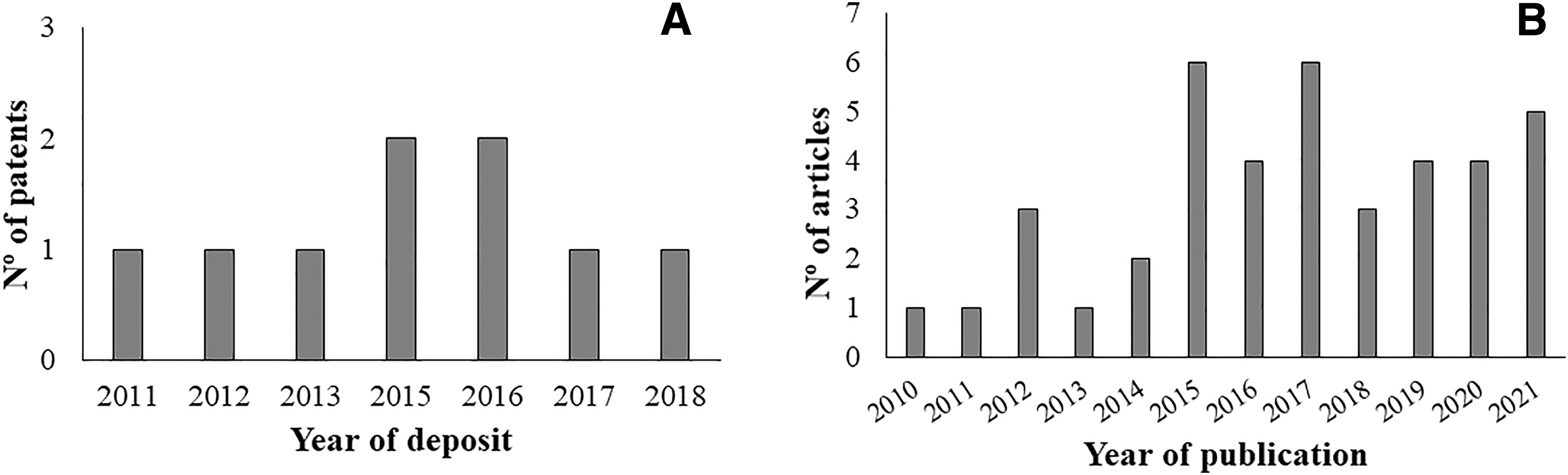
Frequency of
Figure 2 shows the countries where patents were filed and countries of affiliation of the first authors of the studied articles. The main countries depositing patents belong to the Asian continent, being China (6), Korea (1), India (1) and Israel (1) (Fig. 2A). The resulting articles, in turn, were published by authors from different continents (Fig. 2B), with the main countries being India (9), China (8) and Spain (4). In 2019, India ranked 7th when it came to power generation, producing 2.5% of the world's total annual energy. 9
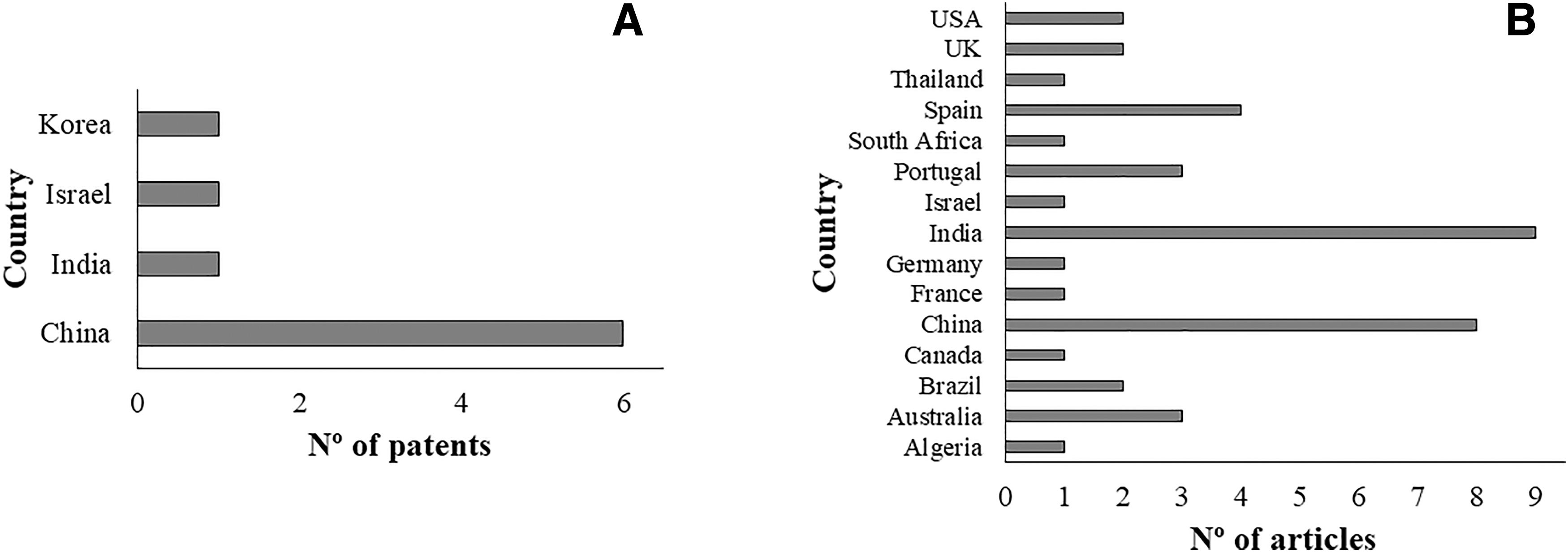
With the growing concern to generate clean energies from renewable sources, the cultivation of microalgae has been one of the main alternatives for reducing pollution in the energy sector, since from them it is possible to obtain fuels such as biodiesel and bioethanol. 15 The use of microalgae for the production of biofuels has several advantages, namely the non-use of arable areas for its cultivation; absorption of CO2, used in cellular metabolism, which contributes to the reduction of the greenhouse effect; potential to be cultivated in salt and wastewater; high content of lipids and carbohydrates in some species; and high growth rate. 16,17 For the production of biodiesel from microalgae, it is necessary, after cultivation, to extract the lipids, which then undergo a transesterification process to finally obtain the fatty acids that make up the biodiesel. 18 The production of bioethanol consists, in short, of the hydrolysis of microalgal biomass so that the carbohydrates are broken down into monosaccharides and then subjected to the fermentation process by the action of yeasts. 19 This growing interest stimulates the development of research and processes that become articles and patents.
Since the 2000s, companies have emerged focusing on the production of biofuels from microalgae. They are TerraVia Holdings Inc. (formerly Solazyme, Inc.), Sapphire Energy, Inc., Cellana, Inc., Solix Algredients, Inc. (formerly Solix Biofuels, Inc.) and Aurora Biofuels, Inc. (afterwards Aurora Algae, Inc.), all American. 20 Other companies can be mentioned, such as Spain's Alga Energy, which also operate in the areas of agriculture, cosmetics, human and animal nutrition and aquaculture and Brazilian firms Syntalgae (also with nutrition, cosmetics, pharmaceutical, green chemistry, biofuels, agriculture) and Algae Biotecnologia (besides effluent treatment, CO2 biofixation, animal nutrition and human health). Among the biofuels produced are biodiesel, bioethanol, biobutanol and biokerosene.
China is the world's second largest oil consumer, acquiring and using approximately 14 million barrels per day in 2019, according to the US Energy Information Administration. Furthermore, China contributed 27% of global CO2 emission in 2019 (equivalent to 3 million tonnes per year), according to the Global Carbon Project 2021. Given this scenario, policies have been created to promote the development of biofuels in the country and since then several studies have been conducted on the feasibility of using microalgae for the development of clean fuels. 14 Considering that the production of microalgae is an expensive process due mainly to the high cost of nutrients, energy consumption and separation of biomass from the culture medium, new technologies are being developed to lower the cost of the process, including electroflocculation, causing the number of scientific articles and patents related to the subject to be increasing.
Technological institutes appear in greater quantity than universities in the list of patent applicants resulting from this search. Although not directly connected to the area of microalgae, research with metallic and non-metallic materials, synthetic and composite, precision conformation, special process, computer application, non-polluting casting technology and premium casting production technology, was performed by the Shenyang Research Institute of Foundry (SRIF) in partnership with a Chinese chemical industry (Chemical Industry Company LTDA) to make the CN105505780A patent filing. The other patents filed by the Harbin Institute of Technology (China), Institute of Process Engineering (China) and National Institute of Ocean Technology (India) technology institutes were not the result of partnerships.
Nanchang University (NCU) is a Chinese University founded in 1993 as the result of the union between Jiangxi University and Jiangxi Industrial University, and is responsible for two of the 9 patents studied in this work (CN104803523A e CN204848533U). Both patents have the same group of inventors (Liu Junying, Liu Yuhuan, Peng Hong, Ruan Rongsheng, Wan Yiqin, Wang Yunpu, Wu Xiaodan, Zheng Hongli and Zou Yawen) who work with research involving, mainly, microalgae and biofuels. Two other patents were also filed by Chonnam National University (KR101801743B1) and China's Hohai University (CN207483512U).
The WO2011040955A1 patent was filed by a group of researchers currently working in two companies, ViAqua Therapeutics and TransAlgae. Israel's ViAqua Therapeutics develops solutions for the prevention and treatment of aquatic diseases. The Israeli company TransAlgae produces genetically modified algae as vehicles of oral medicines, vaccines and insecticides. This group of researchers consists of Shai Einbinder, Doron Eiseinstadt, Jonathan Gressel and Ami Schlesinger.
It is possible to perceive a large difference between the number of patents (9) and articles (40). The fact that there are almost 3-fold higher numbers of journal articles than patents show there is considerable interest in the subject from academic and government laboratories. The number of experimental and review articles was the same (18 articles in each category). Experimental articles show the constant advancement and improvement of technologies developed and disseminated. For this reason it is necessary to compile, compare and update knowledge through review articles.
The most studied genus in the articles were Chlorella (9 articles) and Scenedesmus (5 articles), followed by the Botryococcus, Chlamydomonas, Dunaliella, Kirchneriella, Microcystis, Nannochloropsis and Tetraselmis, each being studied in 2 articles (Fig. 3). The genus Chlorella has attracted a lot of attention from researchers and industries due to its potential for biohydrogen production, its high protein content (greater than 50% DW) and pharmacological potential against cardiovascular diseases, cancer, hypertension, cataracts, and others, 21 beyond already having your genome sequenced. The species of the genus Scenedesmus are known for their high lipid content (up to 50% DW), production of several secondary metabolites of biotechnological interest (α-carotene, β-carotene, lutein) and growth capacity in wastewater. 22
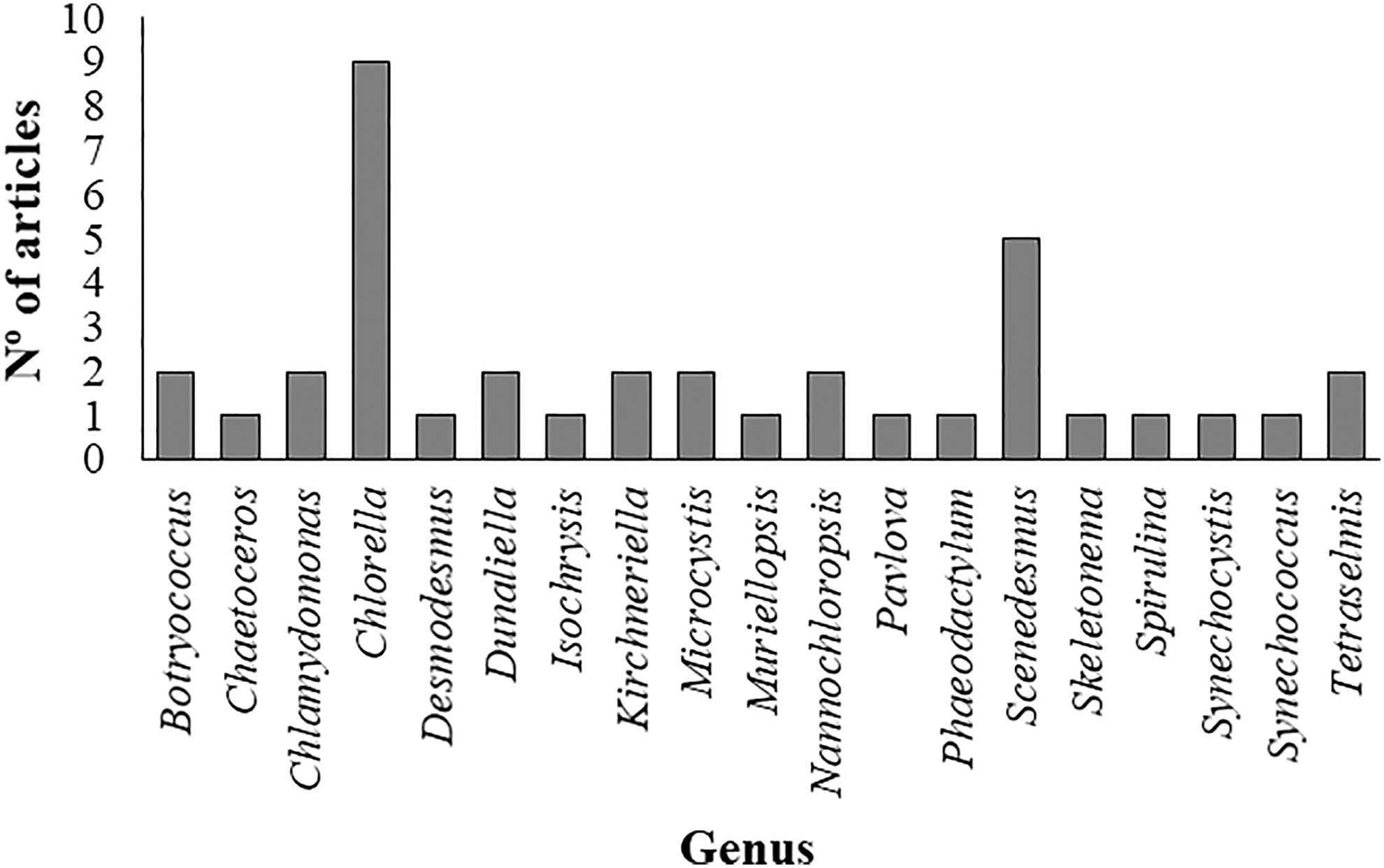
Microalgae genus most studied in articles, according to searches.
Part of the articles describes experiments using chemical, natural, polymeric and physical flocculants, such as nanoparticles and magnetic particles, 23,24 metallic salts, 25,26,13 chitosans, 25,27 tannins, 28 alkaline floccuants, 29 protozoa (biofloculants) 30 and pH. 31
Electroflocculation has been tested in the separation of biomass from different microalgae, both marine and freshwater species (Table 1), 12,13,32 -37 in several variables. The material from which the electrodes are made is one of the main, with aluminum and iron being the foremost metals used. Although aluminum is not the cheapest metal, its high separation efficiency (greater than 95.0% in all studies) makes it a good choice for biomass separation.
Variables Analyzed in Experimental Studies on Microalgae Electroflocculation
During electroflocculation, metal ions are released from the electrodes. These metal ions function as coagulants and interact with microalgae cells, allowing the formation of cell aggregates and, consequently, the separation of biomass from the culture medium. In addition to changing the biomass color, this release of ions results in the loss of mass of the electrodes, which can influence the separation efficiency of the subsequent use of the electroflocculator. Rahmani et al. 37 observed a lower mass loss of aluminum electrodes (17.73 g m−3) when compared to iron electrodes (44.32 g m−3) zinc (84.04 g m−3) and copper (45.03 g m−3).
Most electrodes used in the analyzed articles are plate or plate format, regardless of the type of container used to perform electroflocculation. Meanwhile, Baierle et al. 36 developed and used a spiral electrode. According to the authors, this format increases the contact surface, allows the increase of flake formation and homogeneity of the solution, in addition to reducing the energy consumption of the process and increasing the life of the electrode.
The current and voltage applied in the electroflocculation process are widely studied variables. As can be seen in Table 1, different currents and stresses have been tested, ranging from 0.3–66 A and 5–30 V, respectively. The higher the current and voltage applied, the higher the efficiency of the process. This is because the increase of these variables allows the greater release of metal ions from the electrodes and the greater interaction with the microalgae cells, increasing the flocculation. 32
Lal and Das 33 observed higher separation efficiency (96.0%) when they used the 12 V voltage to electrofloculate Chlorella sp. The 6 V and 9 V voltages provided a separation efficiency of 42.0% and 66.0%, respectively. Misra et al. 35 also observed higher biomass separation efficiency of Scenedesmus obliquus when higher currents were applied (Table 1). However, Xiong et al. (2015) 32 observed a reduction in separation efficiency when using the highest tested current (0.8 A). This reduction may be justified by the excessive formation of Al(OH)n. The authors also observed that the maximum separation efficiency was achieved in less time (3 and 4 min) when the highest currents were applied (0.5 A and 0.8 A), while with the lowest current (0.3 A) it took more time (6 min) to achieve the maximum removal efficiency.
Voltage and time are directly related to removal efficiency. The application of higher voltages and currents allows greater release of ions by the electrodes, as well as greater formation of bubbles, which directly interferes with the size of the formed biomass flakes and results in a greater removal efficiency. However, exposure to long periods of electroflocculation and high voltages and currents can increase the risk of heating of the culture and equipment. 33,35
Although higher currents and stresses allow for greater separation efficiency, a greater amount of energy is needed to carry out the process, which can be challenging when it comes to large-scale application, due to the high cost of electricity. Rahmani et al. 37 tested photovoltaic energy as an energy source for the electroflocculation of C. pyrenoidosa. Despite being an alternative potential, the use of renewable energies such as solar energy in electroflocculation needs to be well evaluated. The climate of the region where the microalgae production plant is located and its availability of sunlight, as well as the costs of installing and maintaining solar panels should be taken into account.
Given the potential of electroflocculation, studies on process toxicity have been conducted. Mubarak et al. 13 used the residual electroflocculation medium to cultivate Chlorella pyrenoidosa, supplementing it with different percentages of the nutrients of bold basal medium (BBM) and without supplementing it. The results indicated the maximum production of 0.88, 0.86, 0.83, 0.78 and 0.76 g L−1 of biomass, respectively, for the residual media supplemented with 80%, 60%, 40% and 20% of nutrients and not supplemented. The cultivation in fresh medium allowed the maximum production of 0.98 g L−1 of biomass. These values were higher than those obtained when the microalgae were cultivated in the residual environment of flocculation with iron chloride (FeCl3).
Ramos et al., 38 in turn, evaluated the effect of electroflocculation on antioxidant activity and toxicity of extracts of the microalgae Isochrysis galbana and Phaeodactylum tricornutum, compared to centrifugation. The authors did not observe cell mortality of Artemia salina when exposed to P. tricornutum extracts, however, the IC50 value of experiments performed with electroflocculated biomass was 63% higher than that of centrifugation, indicating a lower antioxidant potential of electroflocculated extract, as a greater amount of extract was needed to reduce the initial concentration of DPPH by 50%. No antioxidant activity was observed in the biomass of I. galbana obtained by any of the harvesting methods.
According to Baierle et al., the use of lower currents results in higher concentrations of the metals that form the electrode in the residual medium, due to their lower interaction with the microalgal cells. 36 In the study, higher concentrations of aluminum were observed in the residual medium, when compared to iron. On the other hand, higher concentrations of iron were found in the microalgae biomass. The concentration of iron in the residual medium was lower than the maximum limit allowed in water class 1 (according to Brazilian legislation, 15 mg L−1), that is, water designated as suitable for primary contact in recreation, protection of aquatic communities, aquaculture and fishing activities; supplies for human consumption after conventional or advanced treatments; irrigation of vegetables, parks, gardens, sports fields and leisure places, in direct contact with the public. The aluminum concentration, in turn, needs to be strictly controlled, since there are already established relationships between the presence of aluminum and the development of diseases, such as Alzheimer's, encephalopathy, renal osteodystrophy, learning and memorization disabilities.
Although only the abstracts of the patents were made available for consultation, it was possible to notice the diversity of technologies that has been developed to enable harvesting microalgal biomass by electroflocculation. This process can be carried out both in closed and open reactors (raceway). 39,40 Depending on the type of reactor, the location of the electrodes may vary, being possible to find them at the bottom of the reactors (usually in open reactors) or immersed in cultivation (in closed reactors). 41,42 In addition, the power source may also vary, and may be supplied by an electrical source or by the sun. 42 Other associated tools have been described in the patents found, such as a biomass scraping mechanism after separation and the association of reactors to receive cultivation at each separation phase. 40,41
Thus, electroflocculation appears to be a promising separation method, since, despite demanding electrical energy, the time of use is in most cases short (on average 5 minutes). Electroflocculation also has high separation efficiency, reaching values of up to 98%, as shown in Table 1. As with any method, it has some points that need further investigation and improvement, such as the presence of residues in the biomass and in the residual medium—a topic that has not yet been much evaluated in available literature but which is extremely important, as it directly influences the application of microalgal biomass and residual medium.
Conclusion
The number of articles on microalgae electro-flocculation continue to grow as it has grown over the years. China and India, which are major consumers and producers of energy, have been particularly active in developing electroflocculation processes based on searches in databases for patents and papers. In terms of microbial sources of biomass, application of electroflocculation has been actively applied to the genus Chlorella and Scenedesmus, both are of great industrial interest due to their lipid content. The main variables of electroflocculators are the material of the electrodes, applied current and voltage and process time. Despite its great potential, the use of electroflocculation needs to be well evaluated, since it can alter characteristics of the biomass obtained, such as its cytotoxicity due to leaching of metals from electrodes.
Footnotes
Acknowledgments
The authors thank the Coordination for the Improvement of Higher Education Personnel (CAPES) – Brazil, and the Ministry of Science, Technology and Innovations (MCTI).
Author Disclosure Statement
No competing financial interests exist.
Funding Information
This research was financed by Coordenação de Aperfeiçoamento de Pessoal de Nível Superior (CAPES).