




Abstract
CEASAs (wholesaler food supply centers) are strategically located throughout the Brazilian territory. However, food circulation leads to a high generation of fruit and vegetable waste. CEASA-Maracanaú (Ceará state, Brazil) is an example of this, sending around 17 tons of organic waste to the landfill each day without categorization. An environmentally friendly option to reuse fruit and vegetable wasted (FVW) at CEASA-Maracanaú is using it as a substrate in methane production through anaerobic digestion, which requires a detailed quality and quantity characterization. This study aimed to characterize the FVW generated at CEASA-Maracanaú to evaluate its biomethane potential and estimate energy recovery. To characterize the residue, questionnaires were sent to 1,200 permit holders. The results pointed to a residue composed of orange (42.0%), onion (7.7%), corn (5.5%), papaya (5.4%), avocado (4.8%), watermelon (3.4%), banana (3.0%), melon (3.1%), potato (3.0%), pineapple (3.1%), cabbage (2.4%), guava (1.2%), and tomato (1.0%), among others. This composition was crushed and characterized in terms of chemical oxygen demand (138.13 ± 12.4 gCOD/kgFVW). Biomethane potential tests of crushed residue was 275 NmLCH4/gCOD or 313 NmLCH4/gVS, resulting in 79.3% biodegradability. From this potential, it is estimated that FVW from CEASA-Maracanaú yields a methane-based energy recovery of up to 373 KW of thermic power. As a result, it is possible to meet 86% energy demand of CEASA-Maracanaú during the rush-hour (5:30 pm to 8:30 pm) rate by employing the energy recovered from the daily accumulated biogas.
Introduction
In the agro-industrial sector, Brazil is the third-largest producer of fruits and vegetables in the world. 1 As a logistics strategy, Brazil has about 52 Wholesaler Food Supply Centers (CEASAs) responsible for the distribution and marketing of agri-food products throughout its territory. However, due to the loss of market value, transport logistics, and shelf life, around 30% of all marketed fruit and vegetable is wasted (∼10.9 x 10⁶ ton/year), 2 resulting in high disposal costs. 3 For instance, the state of São Paulo has the largest CEASA in Latin America, which reported the production of 70.8 x 10³ ton of solid waste in 2020 of which 95% were sent to landfills. 4 The lack of segregation strategies for waste generated at these food markets results in large food waste, making recycling approaches difficult. 5 Some studies reported that the Brazilian CEASA is the biggest contributor to the generation of fruit and vegetable waste (FVW) in the country. 6,7 Besides, the centralized generation of large quantities of FVW can facilitate the implementation of control and treatment strategies, such as anaerobic digestion.
The high moisture and biodegradable organic material content in FVW encourage the application of anaerobic systems as treatment units aiming at energy recovery. 3,8,9 FVW is mainly composed of soluble sugars (e.g., glucose, fructose, and sucrose), being substrates with high energy content for the biogas generation. 10,11 The prospect of large biogas production from FVW reveals an increase in energy security, 12 –14 since biogas can be converted into electrical energy whose equivalence is approximately 2.1 kWh/m3 using motor generators. 15 Methane (CH4) in biogas can also be used in gas boilers, sludge drying, turbines, and even in cars. 16 Therefore, energy recovery from biological methanization can bring economic return with a reduction in electricity consumption.
This research proposes a case analysis for the improvement of waste management in the largest CEASA in Ceará state (CEASA-Maracanaú). At CEASA-Maracanaú, all solid waste generated is sent to landfill (annual cost of US$137,000.00), including the organic fraction of the fruit and vegetables, which has a great unknown and unexploitable energy potential. Therefore, the central goal of this study is to evaluate the composition of FVW and its energy potential from the production of CH4 in anaerobic systems.
Material and Methods
Standard Composition of FVW
The study area was CEASA-Maracanaú, located in the city of Maracanaú in northeastern Brazil. To characterize the average composition of the FVW, quantitative and qualitative field research was carried out during the first half of 2021, and solid waste management reports provided by the administration. During the on-site visits, interviews were carried out through a structured questionnaire to all fixed or mobile vendors for the average qualitative composition estimation, which was validated based on the total reported amount of all food that entered CEASA and the total reported waste contracted to be disposed of at the landfill. 17 Respondents described losses in terms of the number of boxes of wasted products. Thus, the density per standard box (46 L) of each mentioned product was estimated and descriptive statistics with frequency distribution were used to determine the composition and standard mass of the fruit and vegetable residues characteristic of CEASA-Maracanaú.
FVW Characterization
A sample dilution (50 g of crushed FVW/L) was homogenized at 10,000 rpm for 15 min (Ultra-Turrax T25, IKA-Labortechnik) to improve sample uniformity and reduce analytical errors due to the heterogeneous nature of the residue. The FVW samples were characterized based on chemical oxygen demand (COD), total solids (TS), volatile solids (VS), nitrogen total Kjeldahl, 18 total carbohydrates, 19 and nutrients. 20 Protein content was determined by the DUMAS method in a Nitrogen/Protein Analyzer NDA 701 Dumas equipment (VELP, 2019), using EDTA as standard (AOAC, 2016) and the lipid concentration by method No. Am 5-04 from American Oil Chemists' Society (AOCS, 2005), using the high pressure and high-temperature extraction system in XT-15 Ankom equipment. Storage was in a refrigerated chamber (4.0°C) before feeding the anaerobic experiment.
Biomethane Potential Tests
Anaerobic digestion of crushed FVW was performed in batch assays, which were carried out in 0.330 L flasks (Schott, Germany), with a working volume of 0.200 L. Granular anaerobic brewery sludge was used as inoculum. Each flask was filled with inoculum (5.0 gVS/L of sludge), 2.5 gCOD/L, and 2.5 gNaHCO3/L. The assays were carried out in triplicate, at constant temperature (35°C) and agitation (120 rpm). Three flasks of positive control containing glucose (2.5 gCOD/L) was included to measure the specific methanogenic activity (SMA) of sludge. In addition, two flasks containing only the inoculum were used as negative control for assessing endogenous background CH4 production. All flacks were connected to an anaerobic respirometer (Micro-Oxymax respirometer, Columbus Instruments) that automatically monitored the biogas production (volume in mL and rate in mL/d), from which the composition can be estimated (CH4 and CO2 concentration), during 30 days until anaerobic substrate degradation.
Calculations and Energetic Potential Perspective
The BMP calculation was based on Angelidaki et al.
21
following Strömbeg et al.
22
modifications (Equation 1). In addition, Gompertz-model was applied to acquire the operational variables from BMP average experiment. The maximal SMA (Equation 2) was measured based on cumulative CH4 production rate (Equation 3). The biodegradability (B%) was calculated as a function of the total organic matter (COD mass basis) converted into CH4 (Equation 4).
where, BMP in NmLCH4/gCOD, VMs is the normalized volume of CH4 from the substrate and inoculum (NmLCH4), VMb is the volume of CH4 from the negative control (NmLCH4), Ms is the substrate mass (gCOD), M(t) is the cumulative CH4 production at time (NmLCH4), P is the CH4 potential (NmLCH4), Rm is the cumulative maximum CH4 production rate (NmLCH4/d), ʎ is the lag-phase (d), SMA in gCODCH4/gVS.d, VS is the concentration of volatile suspended solid of sludge (gVS/L), Vm is the cumulative CH4 volume (NmLCH4), F is the conversion factor (350 NmLCH4/gCOD), Vr is the reactor volume (L), and t is the time of operation in day (d).
The bioenergy recovery potential was estimated considering the Equations 5
-8
23
where, PTheo is the theoretical energy power obtained from the produced biogas (kW); mbiogas is the biogas mass flow rate (kg/s); %CH4 is the CH4 concentration in biogas (%); LHVCH4 is the CH4 lower heating value (50016 kJ/kg); Qbiogas is the biogas flow rate (m3/s); vbiogas is the biogas specific volume (m3/kg); Rbiogas is the biogas constant (kJ/kmol.K); Tbiogas is the biogas temperature (K); R is the universal gas constant (8.3144621 kJ/kmol.K); and Mbiogas is the biogas molecular mass, considering biogas composition as %CH4 and %CO2 balance (g/mol).
Results and Discussion
The Standard-FVW
The results were obtained by tabulating the answers to the questionnaires applied to the market sellers and pointed to FVW composed of (as percentage of the total FVW): orange (42.00% ± 2.23%), onion (7.70% ± 0.77%), corn (5.50% ± 3.60%), papaya (5.40% ± 0.22%), avocado (4.80% ± 1.08%), watermelon (3.40% ± 0.37%), melon (3.10% ± 0.26%), pineapple (3.10% ± 0.77%), banana (3.00% ± 0.34%), potato (3.00% ± 0.29%), cabbage (2.40% ± 0.30%), guava (1.20% ± 0.16%), tomato (1.00% ± 0.04%), bell pepper (0.90% ± 0.22%), beet (0.90% ± 0.25%), apple (0.70% ± 0.12%), passion fruit (0.40% ± 0.18%), carrot (0.40% ± 0.21%) and pumpkin (0.20% ± 0.01%). Seasonal products or those with a lower commercial volume accounted for 10.90% of losses.
The administrative reports of CEASA-Maracanaú reveal that 24.5 ton/d of waste is sent to the landfill, estimating 70% of FVW in the composition. The main causes of these losses are in truck unloading, lack of adequate storage, and conservation, leading to accelerated deterioration of fruits and vegetables. 7 However, the geographic distribution of CEASAs in the Brazilian territory implies different FVW composition and quantities, due to weather, food habit, regional crops, etc., which affects the CEASA waste and loss. Therefore, it is impossible to estimate a standard FVW composition of these supply centers. For example, Lima and Oliveira 24 used the interview methodology in CEASA-Campinas (Southeast Region, São Paulo-Brazil) and defined the potato as the item with the greatest loss. Santos et al, 7 report that in CEASA-Salvador (Northeast Region, Bahia-Brazil) banana and papaya are the items with the highest losses.
However, in the present study, the orange waste was by far the main compound of FVW, which may be due to the long transport distance (∼3.000 km) from the producer (Southeast Region, São Paulo-Brazil), causing more damage to the fruits. Additionally, the nutritional composition of the standard FVW was consistent with recent literature involving the same subject of this case study (Table 1). 6,25
Characterization of FVW
Values after ± refers to standard deviation; WW: wet weight; DW: dry weight; DL: detection limit
Biomethane Potential
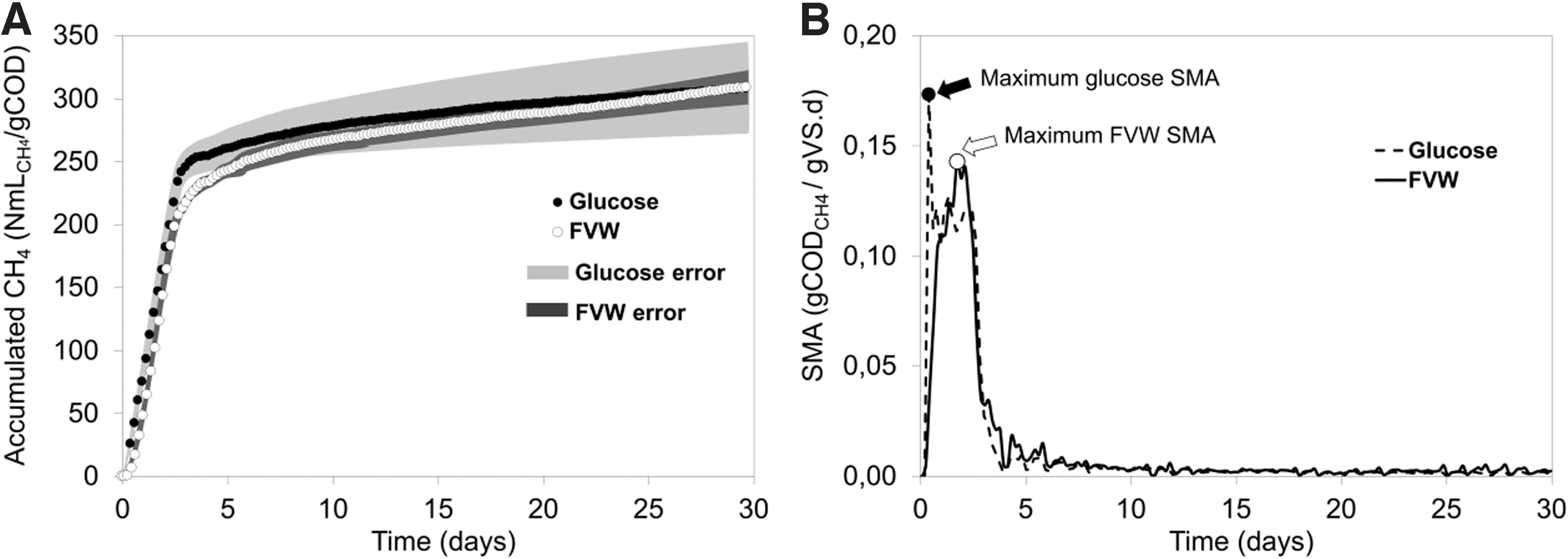
The main BMP results of the FVW processed in batch mode was similar to the CH4 potential acquired through Gompertz-model (Table 2). The SMA measured for both assays revealed a high sludge activity (Fig. 1). 26 In addition, the biodegradability of FVW (∼79%) is equivalent to recent values reported in the literature, 6,13 revealing the suitability of this substrate for methanization.
Operational Variables of the Methanogenic Batch Assays, Including Gompertz Parameters
1.14 gCOD/gVS to convert the unit of FVW
The fast ascension of CH4 production corresponds to the presence of large amounts of short-chain fatty acids and sugars in the FVW, facilitating the acetogenesis process. 13 In addition, the reduction of particles of FVW processing facilitated the hydrolysis processes and consequent acidogenesis. The BMP found in this study (∼313 NmLCH4/gVS) is close to the value reported by Edwiges et al. 6 when they a operating a mesophilic system fed with FVW and reported BMP between 288 to 516 NmLCH4/gVS. However, it is important to report that the CH4 production ratio as a function of the amount of VS varies according to the composition of the substrate, making direct comparison difficult for residues that have varied compositions.
Bioenergy Recovery and Economic Approach
To assess the energy potential through CH4 production from FVW at CEASA-Maracanaú, the following variables were assumed: (1) reactor efficiency in converting the biomass into CH4 is estimated in 82.5%, calculated using the BMP found in batch mode assay; (2) 71% of CH4-percentage in the biogas, calculated from the respirometer results; (3) organic loading rate of 5 kgCOD/m3d (4.39 kgVS/m3d). These parameters resulted in a full-scale reactor, with 480 m3 working volume that produces 936.6 m3/d of biogas. Considering a generator set with an efficiency of around 22% (which is the standard for small generators), 27 it is possible to generate approximately 82 kW (∼59,400 kWh per month). This value represents about 10.8% of the daily consumption of CEASA-Maracanaú (550,000 kWh per month).
Strategically, the biogas can be stored along the day and this accumulated volume used as fuel for motor generator set of approximately 660 kW during the rush hour period (5:30 pm to 8:30 pm), which is 86.4% of CEASA-Maracanaú energy demand during this period. This configuration increases the economic viability of the system, as during peak hours the kWh cost is 3 to 4 times higher than during off-peak hours.
Conclusion
The qualitative and quantitative estimation of FVW-content produced by CEASA-Maracanaú revealed a waste or loss of organic matter of around 17.2 ton per day. This FVW can be used for CH4 production in an anaerobic reactor at a BMP of 275 N-mLCH4/gCOD or 313 N-mLCH4/gVS, generating up to 936,6 m3/day of biogas with 71% CH4. The power conversion for the entire organic fraction generated can supply a demand of up to 660 kW during the rush hour period (5:30 pm to 8:30 pm). That is, the energy recovery of the amount of FVW generated at CEASA-Maracanaú has the potential to supply 86.4% of the energy used during the rush hour period, with the best cost/benefit ratio.
Footnotes
Acknowledgments
The authors would like to thank Laila, Ingrid and all CEASA-Maracanaú and EMBRAPA-Fortaleza employees for their constant support and help in carrying out the application of the questionnaires, collection, and analysis.
Author Disclosure Statement
No competing financial interests exist.
Funding Information
São Paulo Research Foundation (FAPESP) under grant 2015/06246-7 (Dr. Marcelo Zaiat).
Brazilian National Council for Scientific and Technological Development (CNPq) under grants 304340/2021-9 and 308807/2017-0 (Dr. Renato C. Leitão). Ceará State Foundation for the Support of Scientific and Technological Development under grant 09784703/2021 (Dr. Renato C. Leitão).
Author Contributions
The authors confirm contribution to the paper as follows: Study conception and design, F.C. G. Silva-Júnior, C.A. Menezes, W.A. Cavalcante, M. Zaiat, R.C. Leitão. Data collection, C.G. Silva-Júnior, O.P. Aragão, R.C. Leitão. Interpretation of results, F.C.G. Silva-Júnior, C.A. Menezes, W.A. Cavalcante, O.P. Aragão, M. Zaiat, R.C. Leitão. Draft manuscript preparation, F.C.G. Silva-Júnior, C.A. Menezes, W.A. Cavalcante, O.P. Aragão, M. Zaiat, R.C. Leitão. All authors reviewed the results and approved the final version of the manuscript.