




Abstract
The waste generated by cassava starch processing has an ample variety of molecules that can be converted to value-added products. Cassava starch wastewater (CSW) has a high nutritional value and can be used as a substrate in biological processes, in addition to providing microorganisms of biotechnological interest, due to the rich native biota present. Bacteriocins—peptides synthesized by ribosomes—are capable of inactivating or inhibiting the growth of pathogenic bacteria, used to preserve food, and can be isolated from CSW. This study evaluated growth conditions to produce bacteriocins from a lactic acid bacterium Leuconostoc mesenteroides isolated from CSW, using residues from the cassava processing agroindustry as substrate. The experimental planning by Plackett & Burman (PB) was carried out to evaluate the effects of the variable's sucrose, yeast extract, potassium phosphate, magnesium sulfate, and Tween 80, with 15 assays, 36 h of incubation, and agitation at 100 rpm. From these assays, it was verified that only the variables sucrose, yeast extract, and tween 80 were significant at 90%. The results indicated a maximum bacteriocin production of 1990.47 AU/mL (assay 14), COD (chemical oxygen demand) removal efficiency of 59.99% (assay 11), the sugar removal efficiency of 55.89 (assay 14), and production of lactic acid 21.41 g/L (assay 6).
Introduction
Cassava, Manihot esculenta Crantz, is the sixth most important food crop in the world, supporting millions of people in tropical and subtropical Africa, Asia, and Latin America. 1 During the processing of cassava for the production of starch and flour, large amounts of residues are generated that are often not managed properly. 2
When discarded without proper treatment in a body of water, the liquid waste, commonly known as cassava starch wastewater (CSW), can generate serious environmental problems due to its high organic load and toxicity. However, this residue has a high nutritional value, with an autochthonous biota with microorganisms of biotechnological interest, such as lactic acid bacteria. 3
Lactic acid bacteria (LAB) are used in the food industry, being gram-positive microorganisms, without motility, non-spore-forming, non-pathogenic, and generally considered safe, according to the Food and Drug Administration (FDA). 4,5 Furthermore, LAB can produce bacteriocins, which are small antimicrobial peptides with high added value. Bacteriocins are capable of inactivating or inhibiting the growth of pathogenic bacteria, are resistant to high temperatures and low pH, and can be applied in food preservation. 6,7
Leuconostoc mesenteroides is a species of LAB that produces bacteriocins, 8 characterized as microorganisms with coccoid morphology, fastidious, mesophilic, with optimal growth in the range of 20 to 30°C. 9 This species can be found in different environments, for example, in vegetables, cereals, meats, fruits, and dairy products. 10 -14 Some authors have identified the presence of L. mesenteroides in residues used in cassava processing. 15,16
The production of bacteriocins from L. mesenteroides can be influenced by several factors, such as pH, temperature, fermentation time, fermentation agitation, and culture medium, among others. 17 The culture medium can be supplemented with sources of carbon and nutrients to increase the growth of microorganisms; therefore, it is important to evaluate the substrates that influence the medium, aiming at optimizing the medium for high bacteriocin production. 18
Considering the characteristics of waste from the cassava processing industry and bacteriocins, it is relevant to evaluate their products for further application in the food industry, to mitigate losses resulting from food decomposition, and increase the added value. Furthermore, minimize the environmental impact, using the wastewater from the cassava starch industry as a growing medium.
The objective of this study was to evaluate the production of bacteriocins by L. mesenteroides using wastewater from the cassava starch industry as a substrate for a culture medium. Therefore, the Plackett-Burman (PB) experimental design was used to select the variables (sucrose, yeast extract, potassium phosphate, magnesium sulfate, Tween 80) that can directly influence the production of bacteriocins.
Materials and Methods
Characterization of CSW
The cassava starch wastewater (CSW) was used as a culture medium to produce bacteriocins, being collected from a starch plant in the western region of Paraná-Brazil, homogenized, filtered and physical-chemical characterization was performed using pre-established parameters (Table 1). The methods that were used to perform the analyzes are described in the Standard Methods for the Examination of Water and Wastewater, 19 except for total sugars that were determined according to Dubois et al. 20
Legends COD: chemical oxygen demand; CSW: cassava starch wastewater
Inoculum of L. Mesenteroides
The inoculum was prepared from a stock culture of L. mesenteroides reported producing bacteriocin, isolated from wastewater from the production of cassava flour by Vilvert, 22 and preserved in MRS broth (g/L) of the Sigma-Aldrich® (Reference 63016-500G-F), containing 20% (v/v) glycerol and frozen at -4°C. For the activation of the inoculum, 10% of the stock culture (v/v) and 90% of the MRS broth (g/L) were used, and 1 mL of vaseline (ml/L) was added to ensure anaerobic conditions. The inoculum was incubated in a rotational shaker at 100 rpm, at 30°C, for 16 h or until obtaining an optical density (OD) of 1 in a spectrophotometer with a wavelength of 660 nm.
Morphological and Biochemical Characterization of the L. Mesenteroides Strain
The morphological and biochemical characterization of the stock culture was performed using Gram stain and catalase production. The Gram stain technique was performed by treating cells fixed on glass slides with crystal violet, lugol, alcohol, and fuchsin and were visualized under an optical microscope, with a 100x objective and a 10x eyepiece. For the catalase test, a drop of hydrogen peroxide was added to the surface of cultures grown on M17 agar, the immediate bubbling of the culture indicates positive catalase and in the absence of negative catalase. 22
Experimental Design (Plackett & Burman) for the Production of Bacteriocins and Treatment of CSW
Plackett & Burman (PB) experimental design allows the selection of significant factors that influence a given production, being suitable for efficiently and economically studying the effect of factors. 23 In this study, PB was applied to evaluate the production of bacteriocins by L. mesenteroides, being selected five independent variables: sucrose, yeast extract, potassium phosphate, magnesium sulfate, and polysorbate Tween 80.
The variables were selected based on the literature review and identified as factors that influence the production of bacteriocins. 24 -34 In PB, an experimental design composed of 15 trials was applied, being: 12 trials at levels -1 and +1 and three repetitions of the central point (Table 2).
The PB treatments were carried out from fermentations in 120 mL flasks, each flask was composed of 45 mL of cassava starch wastewater enriched with nutrients (Table 2). Initially, the pH was adjusted to 6 with 0.2 mol/L NaOH for all treatments. Afterward, the flasks were autoclaved at 121 atm for 15 min and after cooling the material, 5 mL of inoculum was added (about 10% v/v) to be then incubated at 35°C, at 100 rpm for 36 hours in PB, the design of the experiment can be seen in Fig. 1.

Stages of the processes involved in the production of bacteriocins by Leuconostoc mesenteroides.
After the fermentation period, the pH was corrected to 2.5 with 0.2 mol/L HCL to promote the total excretion of bacteriocins from the cell to the extracellular medium. 35 The acidified medium was centrifuged at 1,824 rcf for 20 min, and the supernatant was removed and filtered through a 0.20 μm filter. In the supernatant, physicochemical analyses of the following parameters were performed: COD (chemical oxygen demand), total sugars, lactic acid, acetic acid, and bacteriocins. The centrifugation precipitate was used to quantify the biomass, which is expressed as total suspended solids (TSS). 36
Analytical Methods
For all tests, the supernatant of the treatments was used to determine the parameters. The pH parameter was measured using the Tec 3MP bench-top pHmeter (Tecnal®). COD and total solids (TS) biomass were determined by the methods described in the Standard Methods for the Examination of Water and Wastewater. 19 Measurements of total sugar concentrations were quantified according to Dubois et al. 20 Lactic acid analysis was performed by high-performance chromatography (HPLC). 37
Determination of Bacteriocin Activity by
L. Mesenteroides
The determination of bacteriocin activity was performed by the agar diffusion method described by Lewis and Montville. 38 The agar chosen to verify the growth of bacteriocins was TSA (Tryptone Soy Agar) supplemented with sheep blood at 5% v/v. Lactobacillus sakei (L. sakei) was used as an indicator microorganism of the activity of bacteriocins, according to Bromberg et al. 39 in the evaluation of the production of the bacteriocin nisin.
The cultivation of L. sakei was carried out by adding 1 mL of cells to 9 mL of MRS broth (100 rpm, 30°C, 24 h), after which the optical density (OD) was read at 660 μm, indicating a value of 0.4. A 100-μL fraction of the L. sakei culture was spread on the petri dish with the aid of a Drigalski spatula, containing the TSA medium supplemented with solidified sheep blood. Afterward, holes of approximately 3 mm in diameter were inserted into the agar surface with the aid of a sterile metal perforator, 20 μL aliquots of the supernatant from the fermented samples were placed in each hole. After the aforementioned procedures, the plates were incubated in the anaerobic jar at 35°C for 24 h. At the end of the incubation period, measurements were taken of the diameters of the halos formed around the holes with the aid of a digital caliper.
For the determination of bacteriocin production, a standard curve was prepared with a commercial solution containing 2.5% nisin (Sigma Aldrich), corresponding to 106 AU/g. The curve was obtained using dilutions of standard nisin in autoclaved cassava wastewater at 121 atm for 15 min, at concentrations of 100 to 105 AU/mL. The diameter of the halo formed, after inhibition of cell growth by bacteriocin, was measured using a four-point digital caliper. The mean measure of halos is related to bacteriocin activity, being expressed in arbitrary units (AU). The relationship of the inhibition halo diameters with the bacteriocin concentration generated a straight line equation, described by Equation 1.

where, BP = bacteriocin production (AU/mL) and x = measurement of the inhibition halo (mm).
Statistical Analysis
Action Stat® software was used initially to verify whether the results obtained in BP were normal. If they were not, the data would be transformed by the box-cox technique into the Statistica® software. Then, with the aid of the Statistica® software, the significant effects of the independent variables (sucrose, yeast extract, potassium phosphate, magnesium sulfate, and tween 80) were evaluated.
Results and Discussion
Characterization of L. Mesenteroides Isolated from Cassava Processing Waste
L. mesenteroides is a Gram-positive lactic acid bacterium. It has a cocci form (Fig. 2a) 40 in an MRS medium and a white, milky color and circular shape (Fig. 2b). It has no sensitivity when tested with the antibiotic vancomycin 41,42 and has negative catalase. 43
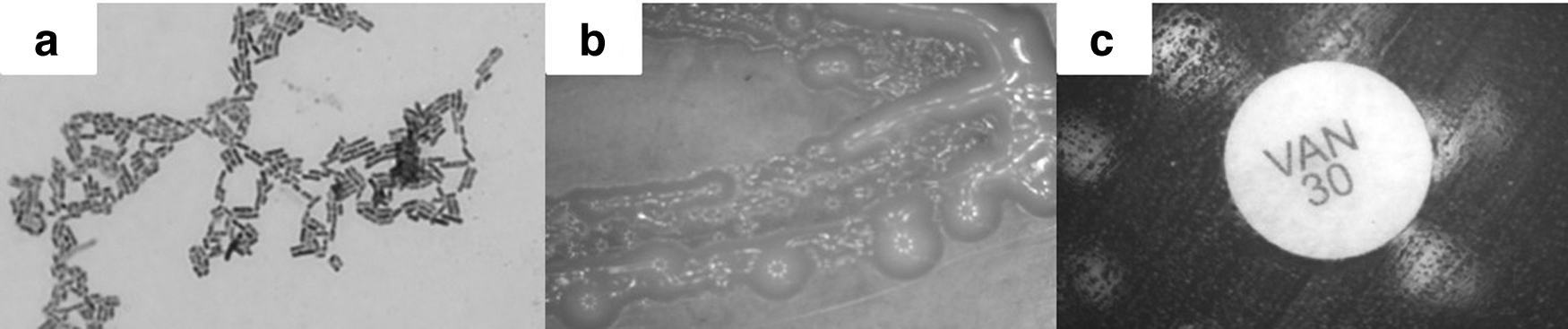
Morphological characterization of Leuconostoc mesenteroides;
The presence of L. mesenteroides in cassava product residues has been reported by several authors. 44 -54 To date, there are not many studies reporting bacteriocin production by L. mesenteroides from cassava starch wastewater, as well as the use of this residue as a substrate for this purpose.
Experimental Design - Plackett-Burman
From the Plackett-Burman (PB) experimental design, the responses of the dependent variables on bacteriocin production, COD and sugar removal efficiency, dry mass, and lactic acid production concerning the independent variables sucrose, yeast extract, potassium phosphate, magnesium sulfate, and Tween 80, are shown in Table 3. The use of real substrates can increase bacteriocin production in the MRS broth by up to two times, under the same conditions. 55 The values for bacteriocin production (AU/ml) were transformed into the Statistica® software by the box-cox method, in order to meet the normality of the data.
Actual values, no transformation; COD: chemical oxygen demand
Analyzing the PB experimental design (Table 3), the lowest production of bacteriocins was in treatment 12 with 140.21 AU/mL. This confirms the expectation for this level, considering that the wastewater was not supplemented with any of the factors. However, from this result, it is inferred that despite the low production, the wastewater from the cassava starch can be considered a substrate for the production of bacteriocins, since there was production.
The highest production of bacteriocins was in treatment 9 with 1990.47 AU/mL, at this level potassium phosphate and Tween 80 were added. From the results, it was found that in all treatments that used Tween 80, the production of bacteriocins increased, so this was the most significant supplement at 90% significance (Fig. 3). The performance of Tween 80 can be explained by its surfactant characteristic, as it accelerates cell growth and interferes with membrane permeability, thus accelerating the diffusion of bacteriocins 56,57 . After Tween 80, the variables that had the greatest influence on the production of bacteriocins were sucrose and yeast extract.
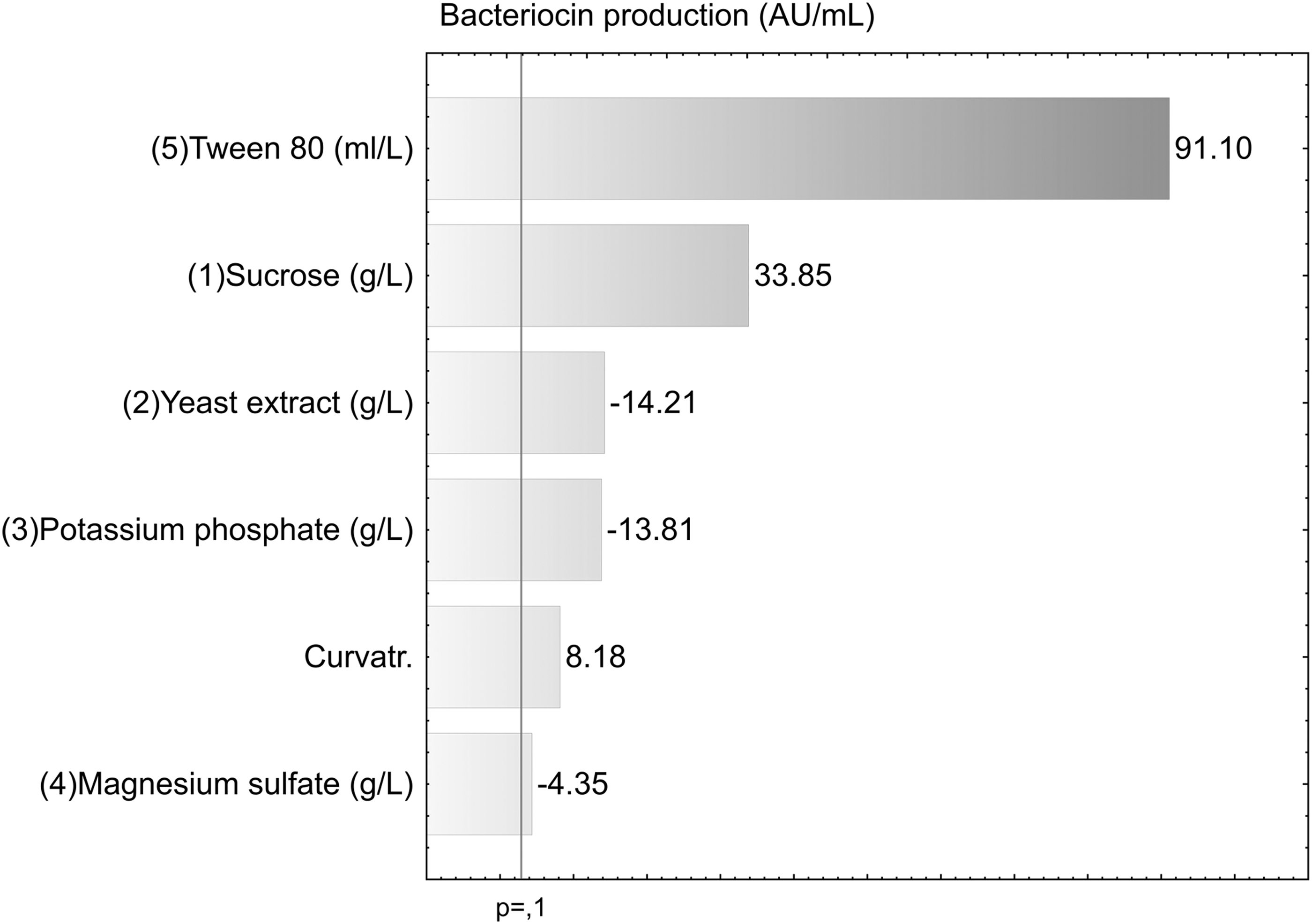
Pareto graph of independent variables for the production of bacteriocins by Leuconostoc mesenteroides.
Yeast extract added to the culture medium is a source of organic nitrogen, widely used for microbial cell growth, which has water solubility for yeast cells that are formed by amino acids, peptides, carbohydrates and salts. 58 The essential amino acids of yeast extract are one of the factors that drive the increase in bacteriocin production. 59
Mataragas et a. 60 evaluated L. mesenteroides by supplementing the culture medium with yeast extract, peptone, and glucose, and bacteriocin production increased from 2,560 AU/mL to 5,120 AU/mL. Sucrose, on the other hand, is used as a carbon source for the growth of microorganisms and its concentration in the medium directly influences the production of bacteriocins. 61 In general, the optimal sugar concentrations to produce the bacteriocin nisin reported were between 3 and 4%. 33
Magnesium sulfate and potassium phosphate had less influence on the production of bacteriocins, as can be seen in Fig. 3. Initially, magnesium sulfate was chosen in PB because it is a source of metal, whereas potassium phosphate was added by its buffering activity to slow down the pH drop. In the study by Furtado et al. 62 evaluating the use of magnesium sulfate and potassium phosphate, the results indicated that these two components are important for the production of the bacteriocin nisin by Lactococcus lactis when used in adequate amounts.
In the central point assays (14, 15, and 16), the bacteriocin productions were 329.02, 341.62, and 342.91 AU/mL, respectively, with no statistical difference between treatments. Close values in the central points indicate that the experimental errors were low. 63 . The low production of bacteriocin in the central points may have been influenced by the concentration of Tween 80, which was lower than that used in treatment 9, which presented the highest production of bacteriocins.
The efficiency of COD removal was in the range of 10 to 60% approximately, being the lowest efficiency in test 7 with 10.34% (Table 3). This low efficiency in assay 7 can be explained by the lack of sucrose and conditions that the bacteria would need to promote COD removal. It is important to emphasize that for cassava starch wastewater to be disposed of in water bodies, it is necessary to treat and reduce the value of the COD in the medium. 64
The efficiency of sugar removal is related to the consumption of sucrose (carbon source), which can be converted into organic acids and metabolites through heterofermentative fermentation of the lactic bacteria L. mesenteroides. 65 The highest removal of sugar was 55.89% in test 14, indicating that a part of the sucrose was consumed and converted to lactic acid, acetic acid, and other metabolites such as bacteriocin. In test 14 (Table 3), one of the highest productions of lactic acid—19 g/L—was achieved.
Cell growth corresponds to the variable dry mass (g/L) and is related to the synthesis of lactic acid in fermentation process of L. mesenteroides. From the PB tests, it is noted that the tests with the highest dry mass concentrations (g/L) also contained the highest concentrations of lactic acid. The production of lactic acid occurs only if the culture medium has nitrogen concentrations and adequate pH and temperature conditions to promote production. 66 In Table 3, we can see that the highest lactic acid production was 21./41 g/L.
Conclusion
The study demonstrates that L. mesenteroides has the potential to produce bacteriocins using cassava starch wastewater as a growing medium. From the analysis of data from the Plackett & Burman experimental design, the factors selected to improve production were sucrose, yeast extract, and Tween 80. The most significant variables affecting bacteriocin production can be used for further studies on the optimization of bacteriocin production. Furthermore, it appears that, although the focus of the study is the production of bacteriocins, the treatment of wastewater from the starch industry takes place, as there was efficiency in removing the chemical demand for oxygen and sugars. The next step for this study will be to evaluate bacteriocin purification and bacteriocin application in the control of food spoilage and food-borne pathogens in food products.
Footnotes
Acknowledgment
The authors would like to thank the Coordenação de Aperfeiçoamento de Pessoal de Nível Superior - Brazil (CAPES) and Western Parana State University (UNIOESTE).
Author Disclosure Statement
No competing financial interests exist.
Funding Information
The Coordination for the Improvement of Higher Education Personnel (CAPES) financed this work.