




Abstract

Introduction
Business, science, politics and society are largely in agreement that climate change is one of the major challenges of our century and that a shift away from fossil fuels is urgently needed. Because biomass represents a fundamentally sustainable alternative source of carbon and energy, numerous nations are embracing biomass and have developed and adopted strategies for transitioning to a bioeconomy based on biomass or biogenic feedstocks derived from biomass.
For the processing of biogenic carbon and energy sources, industrial biotechnology represents a key technology because it is involved in processes of all stages of biomass production, its standardization, processing, and finally recycling. Consequently, this results in a very large business and investment potential for business models based on industrial biotechnology. This commentary deals with which business areas have particular potential and what leads to success in leveraging this potential.
The Size of the Opportunity
Today, the world's carbon demand is supplied from two sources: Two-thirds of it comes from fossil resources (coal, natural gas and mineral oil), and only one-third is of biological origin with agricultural and forest biomass. Common sense alone indicates that, given this ratio, biogenic carbon cannot completely replace fossil carbon. This is not necessary, because the lion's share of more than 90% of fossil carbon goes into the production of heat and cold, electricity and fuels, for which fortunately carbon-free energies such as photovoltaic, solar thermal, wind and water power, geothermal, nuclear energy, etc. are available. In the field of mobility, many sustainability strategies and now also car manufacturers are also focusing on electricity and hydrogen-based mobility. However, especially in heavy-duty transport (airplanes, ships, trucks), the aforementioned alternative fuels still have such serious limitations today that biofuels and synthetic fuels will continue to have market potential for the foreseeable future. How long depends on progress, especially in battery and hydrogen technology and charging infrastructure.
In the long term, another sector is more attractive, namely chemicals. It accounts for only a fraction of fossil carbon consumption today (8%), but unlike the short value chains of energy products, chemistry is characterized by long value chains and is therefore more valuable. Crucially, however, organic chemistry products are fundamentally dependent on carbon and biogenic as well as recycled carbon sources are the only alternatives.
The Importance of Biotechnology
Industrial biotechnology plays a key role in the production and processing of biogenic carbon sources. This starts, for example, with CRISPR in modern plant breeding methods and continues with the enzymatic release of sugars from biogenic polymers such as starch and celluloses. The conversion of biogenic sugars and fatty acids to the diverse products of biobased polymers, lubricants, adhesives, food and feed additives, skin care and pharmaceutical active ingredients, to name just a few examples, is carried out using whole cell or enzymatic catalysis. Today, anaerobic biogas fermentation is mainly used to generate bio-methane as an energy-carrier from residual and waste materials. However, it can also gain in importance for the standardization of complex mixtures of substances to bio-methane as a carbon source for basic chemistry instead of natural gas. Gaseous emissions, especially carbon dioxide, must also be addressed in the utilization of residual materials. In addition to the fixation of carbon dioxide in the natural carbon cycle by photosynthetic algae, biotechnology with gas fermentation of clostridia offers an option to recycle carbon dioxide directly from emission streams to ethanol and other bulk chemicals and thus to keep the carbon in a technical cycle.
Biotechnological methods and products thus offer business potential in all stages of biomass processing, from its production, its transformation and the recycling of residual and waste materials, as well as across all stages of the value chains, from raw materials (sugar, fatty acids) to non-functionalized bulk chemical products, functionalized specialty and fine chemical products, and highly functionalized enzymes and pharmaceutical actives.
For companies and founders, this raises the question of the low-hanging fruit. To this end, the pros and cons of biomass as a raw material and of biotechnological methods will be briefly considered (Fig. 1). 1 Biomass first offers the advantage of being a product of the natural carbon cycle and thus basically climate neutral. As mentioned above, biomass is a raw material that can be processed into an enormous variety of products ranging from energy carriers and basic chemicals to high value-added products for a very wide range of applications. Biomass itself is already rich in functionalized products such as sugars, fatty acids, proteins, polymers, dyes and more. However, this is at the same time a certain handicap—its comparatively high oxygen content is disadvantageous for the production of fuels and basic chemicals, whose products are largely reduced. The lower carbon density compared to fossil carbon sources, the overall complex composition, and costly logistics of biomass also act as competitive disadvantages compared to fossil raw materials.
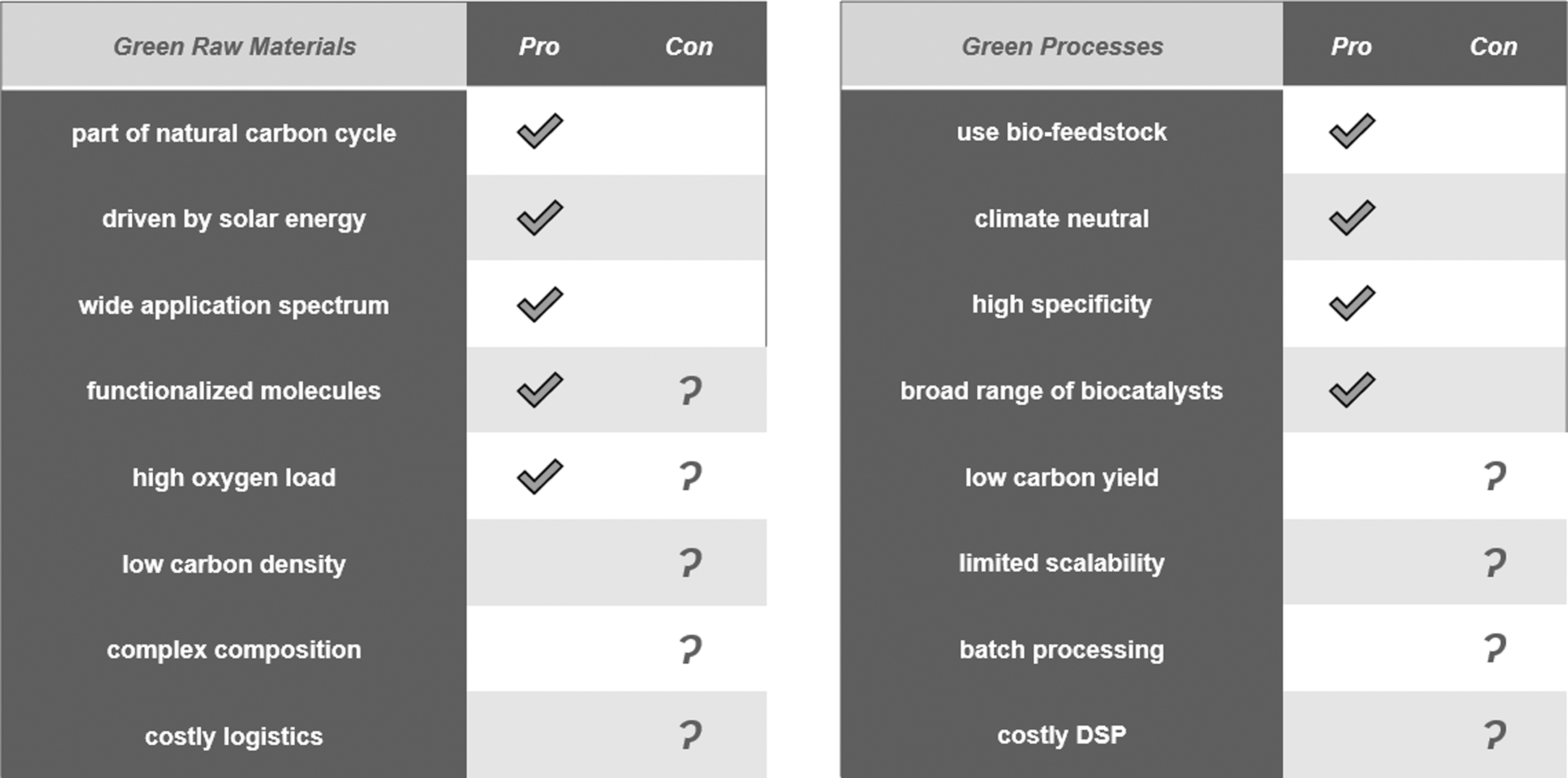
Pros and cons of biomass as raw material and biotechnological processes.
Let us now look at biotechnological processes. Positive aspects are their suitability for processing biogenic raw materials, their climate-neutral emission of carbon dioxide, their high specificity and the enormously broad spectrum of biocatalytic reactions. However, this is offset by lower carbon yield compared to fossil-based processes, limited scalability, lack of continuous processes, and usually complex downstream processing.
It is therefore not surprising that biotechnological processes and products are commercially successful where they can play to their pros. This is especially the supply of functionalized ingredients and their biotechnological transformation into functionalized products of specialty and fine chemicals. It is important to note that these biobased products are successful on the market because they are the only ones with the expected performance spectrum; in other words, they are not directly exposed to competition from fossil-based alternatives. Examples include chiral molecules that are not accessible by synthetic catalysis. Biobased, non-functionalized products of basic chemistry and monomers, on the other hand, have so far only been able to conquer niche markets due to cost disadvantages.
The situation is different for biofuels such as bioethanol and biodiesel. They achieve very large volumes on the market because mandatory quotas create markets in which competition with fossil alternatives is restricted. The same applies if, for example, mandatory ecological purchasing criteria are imposed by regulations on large customers such as the public sector.
Business Models
It is essential to consider these relationships when developing a business plan. If a functionalized product is targeted, its performance must be carefully and convincingly demonstrated. At the same time, the achievement of providing this proof through analytics, testing and the interpretation of data offers additional business potential, as these competencies can also be commercialized as services. However, care must be taken to avoid diluting the capabilities of the business and diverting from the core business. For every business plan it is therefore crucial to work out the unique selling point (USP). Regardless of whether this lies in cost advantages, a defined functionality or a lower ecological footprint, independent proof that can withstand critical scrutiny is necessary.
Young companies rightly focus on these issues, but often tend to underestimate and neglect the equally essential business component of market access and marketing. Rarely is a product so unique that it sells itself. In contrast, it usually encounters a market with similar products, which may be defended by top dogs with defensive measures such as price reductions. In addition, changing conditions may have to be taken into account. The above-mentioned quotas for biofuels are an example of this. The same applies to emissions trading, which may be extended to more and more sectors and regions in the future and may have a positive impact on the competitive position of biobased products. Such a change in the framework conditions will have a fundamental impact on the target markets and must be taken into account in the business plan at an early stage.
Another important criterion for the value of a business plan is the position of the product in the value chain (Fig. 2). 2 The higher the position, the higher the value creation can be expected and a company that can demonstrate in the business plan the potential to cover multiple value chain stages by integrating backwards (towards supply chain) or forwards (towards consumer products) gains attractiveness.
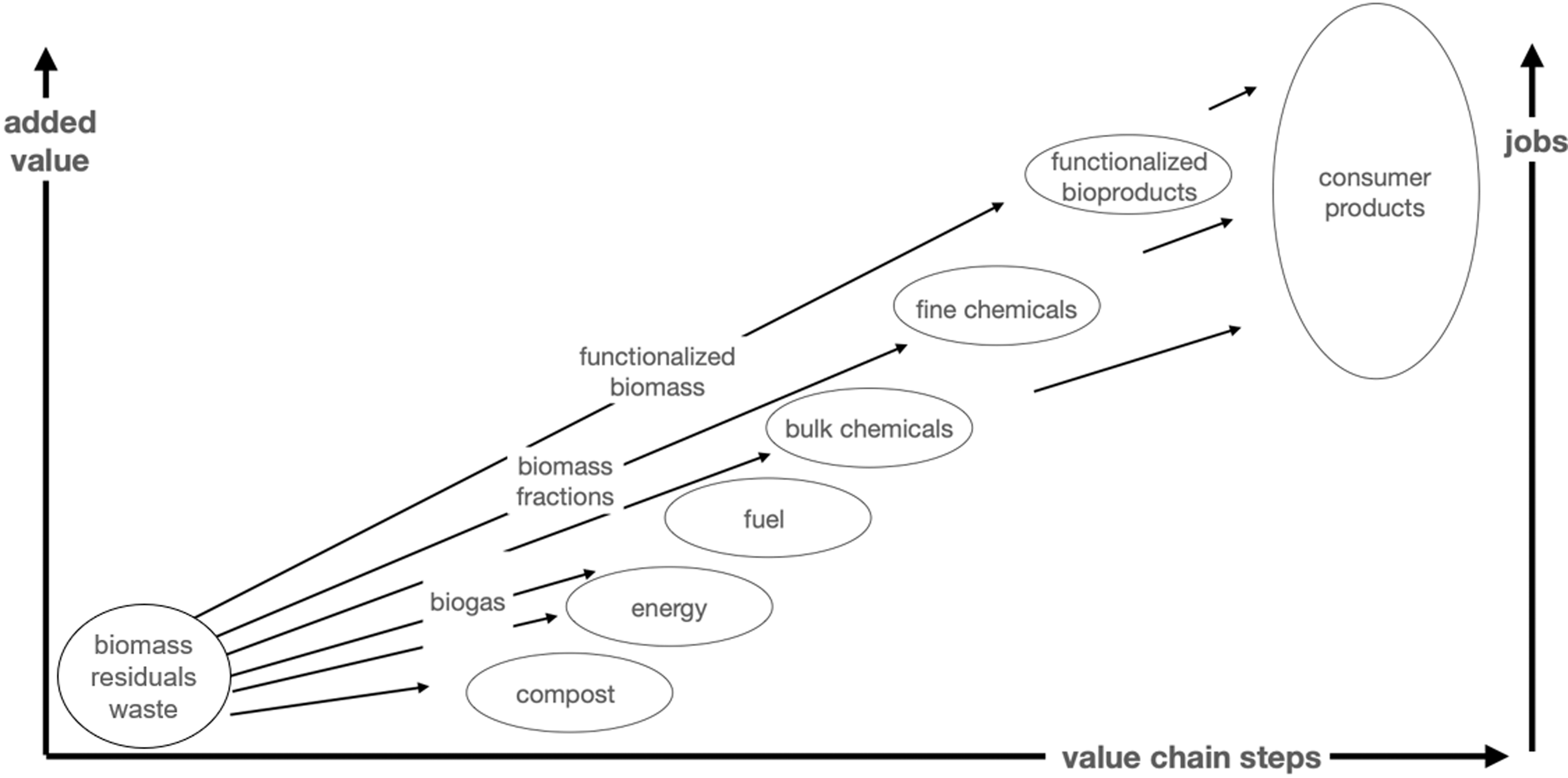
Value chains of biobased products from raw material to consumer product.
As the industrial relevance of closing material cycles increases, recycling of residual and waste materials will also gain business potential in the future. One example is the biogas fermentation mentioned above, which ferments complex waste mixtures into biogas. Today, the bio-methane it contains serves primarily as an energy source, but in the future it may also gain in market value as a carbon source for the chemical industry.
Investment Criteria
A sound business plan is the basis for convincing financiers, be it public funds or private funds. It is important not only to rely on the persuasiveness of the business plan, but also to take into account the different expectations of the funders when presenting it. Public funds always have not only the economic success potential of the business plan in mind, but also social and political goals. Mention should be made here of the employment potential in a particular region, gender policies or environmental criteria such as climate neutrality. Private investors (business angels, venture capital), on the other hand, ask about the value of the company and its potential performance, because their business model is based on buying shares in the company and selling them later after the value has increased. Therefore, in this case, the business plan should plausibly present the current value of the company (funds already raised, sales, buildings and equipment, patents, etc.), the value development potential and the exit strategy.
Conclusion
Business models based on biobased products and biotechnological processes are successful under today's economic policy conditions, especially where technical properties of biogenic raw materials and biotechnological processes lead to competitive advantages. These are, in particular, the functionalized products of specialty and fine chemicals as well as pharmaceuticals. Quotas are prescribed for biofuels, but because political decisions are intended to push back combustion engines, in the long term we have to reckon with declining markets, first for passenger car fuels and later also for heavy-duty fuels.
Nevertheless, investments in biofuels can also be worthwhile in the long term if processes and plants can also be converted to products of basic chemistry. For example, bio-ethanol and bio-methane can be used equally as fuels or base chemicals. Today, large-volume basic chemical and polymer products are only successful in niche markets that are willing to pay a premium price for ecological product properties. This market situation may also change in the future as a result of changes in the framework conditions, because, for example, the European emissions trading system could be further developed in such a way that it is not essentially the energy-related emissions of the chemical industry that are priced, but also the product-related emissions. In this case, biobased carbon sources and the corresponding biotechnological processes will gain competitiveness and open up the very large market of basic chemicals and monomers/polymers to biotechnology. It is therefore important to keep an eye not only on the further technical development of biotechnological processes, but also on the development of framework conditions in equal measure, because it is also important for the success of a business model to recognize and occupy an opening market window at an early stage.