




Abstract
The main motivation of the food industry is to guarantee the sensory and microbiological quality of the products. The development of active packaging through nanotechnology is a promising strategy for extending the shelf life of food products. Bacteriocins are peptides that have antibacterial properties. However, the direct application of bacteriocins in foods with a high protein and lipid content can limit or inactivate their action. Thus, nanotechnology emerges as an alternative to overcome this obstacle. This review addresses nanotechnological innovations to improve antimicrobial properties and the application of bacteriocins through active food packaging systems. In this sense, nanotechnological techniques are described as alternatives for the physicochemical stabilization of bacteriocins and to enhance their antimicrobial properties. The incorporation of nanoencapsulated bacteriocins in active packaging systems needs to be explored to expand the potential in the food industries.
Introduction
Microbiological contamination is a factor that induces food spoilage. In the food industry, contamination can occur during obtaining raw materials, processing, storing, and distributing products. 1 In this context, biopreservatives have been studied as an alternative to chemical preservatives, as they are non-toxic and anti-carcinogenic. Among the biopreservatives produced by microorganisms, bacteriocins are of particular interest for maintaining the chemical structure and sensory properties of foods, as occurs with the application of biopreservatives such as ethanoic acid and sodium nitrites. 2 -4
Bacteriocins are ribosomally synthesized extracellular polypeptides. They may or may not be processed by additional post-translational alteration. These biopreservatives can be produced by several bacteria, such as Lactobacillus salivarius, 5 Escherichia coli, 6 Enterococcus faecium, Enterococcus faecalis 7 and Lactobacillus sakei. 8 Bacteriocins can have a molecular weight of more than 30,000 Da. As they are produced by organisms Recognized as Safe (GRAS), they have the antimicrobial potential to be added to foods. 9,10 As examples of bacteriocins used as commercial preservatives in food, pediocin PA-111 and nisin 10 stand out.
Bacteriocins have antimicrobial properties against Staphylococcus aureus, 12 Bacillus cereus, 13 Listeria monocytogenes, 14 and Clostridium botulinum. 15 The inactivation mechanisms against bacteria can be by (i) action on cell wall synthesis, (ii) inhibition of DNA replication, (iii) interference with protein synthesis, and (iv) disruption of membrane structure. 16 However, the antimicrobial activity of bacteriocins is prejudiced when these compounds come into contact with lipid and protein molecules. This inactivation occurs due to the presence of lipolytic and proteolytic enzymes. 3,10 Therefore, the application of bacteriocin as a biopreservative in the food industry is limited. As an alternative, the encapsulation of bacteriocins for later application as active packaging can favor the stability of antimicrobial activity in foods with high lipid and protein contents. 17
In this context, active packaging comes with encapsulated active compound carriers, contributing to food safety. These systems contribute to the bioavailability and controlled release of antimicrobial agents such as bacteriocins. Moreover, active packaging developed with encapsulated bacteriocins allows extending the shelf life of the food. 18 Active packaging can also be barriers that prevent the exchange of gases between the external environment and the packaged food. 17 In this sense, nanotechnology is a promising alternative to produce active packaging due to the synthesis of nanostructures with a high surface area. Thus, the greatest number of reactive sites is available on the surface of the nanostructure to interact with the food. Consequently, there is the best microbiological control. 19
Different nanotechnological encapsulation approaches have been used for application in foods, such as nanoliposome, 20 nanocapsules, 21 nanofibers, 19 nanoemulsions, 22 and nanospheres. 23 This review paper addresses the potential of applying these techniques in active packaging, using bacteriocins as an active compound, differing from the literature, which addresses the direct application in the food matrix. In this sense, the review addresses nanotechnological innovations with the potential to stabilize the antimicrobial properties of bacteriocins through active food packaging systems.
Bacteriocins as Antimicrobial Agents for Food Products
Some bacteria produce compounds with an inhibitory effect on the growth of other microorganisms. These compounds can be toxins, enzymes, antibiotic substances, and/or bacteriocins. 24 Bacteriocins are considered primary or secondary metabolites, depending on the producing strain. When it originates from the primary metabolite, the production is proportional to the producer's dry mass. If from secondary metabolism, production is relative, and its yield is directly related to growing conditions and strain production. 25 Bacteriocins are produced by various strains of gram-positive and gram-negative bacteria. In this case, the lactic acid bacteria stand out. These peptides are synthesized on ribosomes and released into the extracellular médium. 26
The use of biopreservatives in the food industry has been an alternative to increasing the safety, quality, and replacement of chemical preservatives in food. 27 Bacteriocins are biologically active, having bacteriostatic or bactericidal action, including pathogenic bacteria (Table 1). 27 -34 Commercially bacteriocins permitted by the Food and Drug Administration (FDA) for use as biopreservatives are nisin and pediocin PA-1. 27 These peptides can be added to food by inserting (i) the purified bacteriocin, (ii) the initial culture of the producing microorganism, or (iii) fermentation containing the bacteriocin. 24
Antimicrobial Spectrum and Bacteriocin Stability
Nisin and pediocin have an antimicrobial action spectrum limited to gram-positive bacteria. Besides, they may exhibit instability in acidic and basic mediums and reduce the solubility over a wide pH range. 34 Furthermore, bacteriocins are sensitive to proteolytic enzymes. Because of this, bacteriocins lose their antimicrobial activity due to the breaking of peptide bonds by proteases. 35 Thus, new systems to improve their stability is promising research. The use of nanotechnology becomes an innovative alternative for bacteriocins to enhance their stability when applied to food.
Potential of Nanotechnology for the Application of Bacteriocins in Active Packaging
Active packaging can be developed with antimicrobial compounds which interact with the food and/or with the product's internal atmosphere. There is a reduction in deterioration, improvement in food quality, and promoting an increase in shelf life. Furthermore, active packaging can be applied as a barrier to oxygen, moisture, and others. 36,37 The release of antimicrobial substances controls the growth of unwanted microorganisms in food. Antimicrobial packages can be (a) sachets containing antimicrobial compounds; (b) incorporation of antimicrobial agents into the polymer matrix; or (c) use of antimicrobial polymeric raw materials. 36 Thus, bacteriocin nanoencapsulation for subsequent application as active packaging can expand the food protection property. As nanomaterials present differentiated physicochemical properties, they can contribute to thermal stability, mechanical resistance, biodegradability, and flexibility. Besides, nanoencapsulated bacteriocins can be used as absorbing systems and active release of compounds to promote a barrier to moisture and gas exchange. 36 -38 These properties can be given to packaging through emerging and innovative technologies, such as nanotechnology.
Nanotechnology studies and manipulates materials with dimensions at the nanoscale and, due to this, can produce packaging with different physicochemical properties. The differentiated physicochemical properties are related to the high relation between surface and volume and the increase in the number of reactive sites in the nanomaterial. 39 Due to these properties, the use of nanotechnology methods has shown promising results in the yield and stabilization of bioactive compounds. Nanoencapsulation can protect bacteriocins against the inactivation of proteolytic and lipolytic enzymes, extending the shelf life of foods. Furthermore, nanoencapsulation of bacteriocins can result in the reduction of high dosages of the antimicrobial agent in foods. 10
Nanotechnology is being applied to the development of antimicrobial packaging, containing different encapsulated compounds that are physically and chemically unstable. Examples of encapsulated compounds include metallic silver nanoparticles, 40 zinc oxide, 41 gold, 42 copper 43 and titanium oxide. 44 Compounds obtained from natural sources have also been studied, such as essential garlic oil, 45 biomass of Spirulina sp., 46 phycocyanin, 19 acai extract. 47 However, there are few studies on nanoencapsulation of bacteriocins. Nisin and pediocin belong to classes I and II, respectively. Both are electrostatically attracted by the cell's phospholipid membrane, acting on its permeability, according to the specificity of each class. The high content of anionic lipids present in Gram-positive cells explains the specificity of these bacteriocins. 48 Therefore, nanomaterials with active functions provided by bacteriocins become promising alternatives for the development of food packaging and need to be further explored and presented in the literature.
Nanotechnology Approaches for Encapsulation of Active Compounds
Nanotechnology systems have a controlled release of compounds. Compound nanoencapsulation processes differ for each type of nanostructures, such as nanoemulsions, nanofibers, or nanocapsules. In addition to the food properties, the nanostructured system to be used is related to the properties of the encapsulated antibacterial agent and the materials used. 17 The nanostructures have the potential for application in foods (Table 2). 19,49 -64
Nanostructures and Their Potential for Application in Food
Nanoliposomes
Liposomes are spherical structures that can contain a lipid bilayer or multiple bilayers (Fig. 1), and are classified as unilamellar and multilamellar, respectively. 65,66 The difference between unilamellar and multilamellar liposomes is the vesicle size, which can range from 20 nm to 1 μm. 67 The formation of vesicles occurs spontaneously due to the hydrophilic interaction of the polar portion of the phospholipid with water. 65 Nanoliposomes have the same structure and constituents as liposomes. However, they are not formed spontaneously. 68
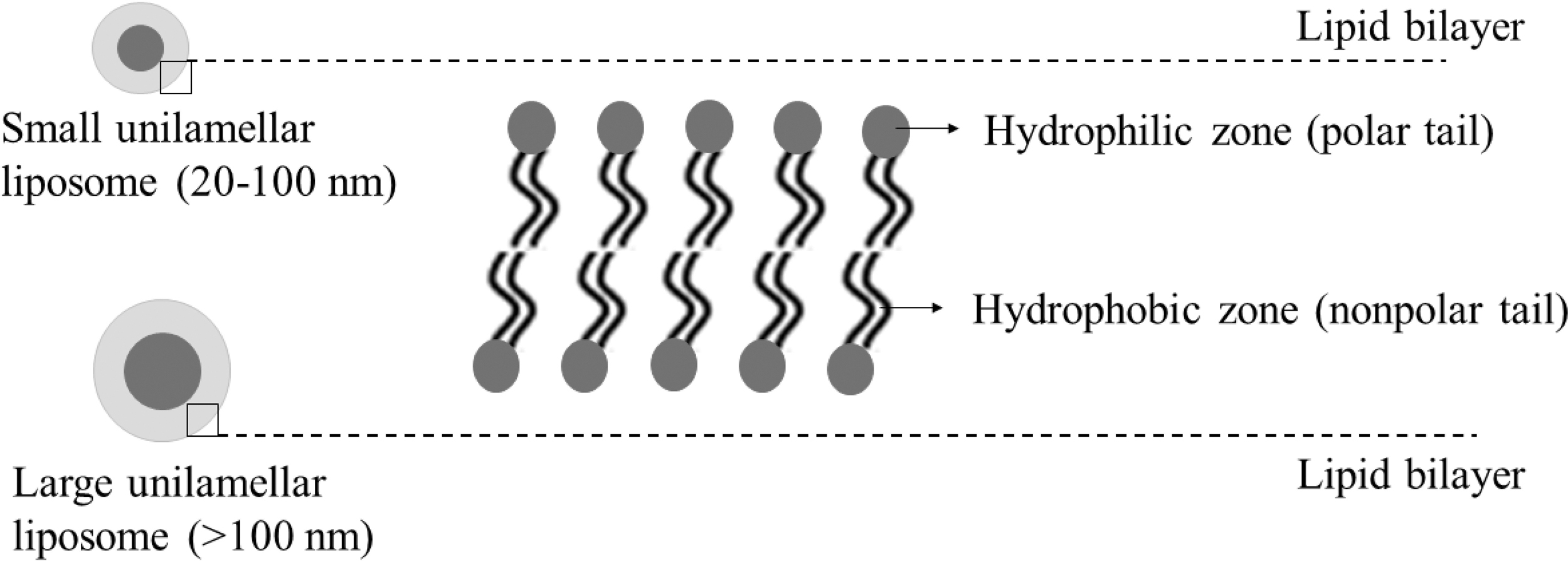
Structural characteristics of nanoliposomes.
Nanoliposomes can be applied as carriers of bioactive substances, such as antimicrobials and antioxidants, promoting the physicochemical stabilization of the molecule. Nanoliposimes can be added directly to the polymeric film forming solution to participate in the packaging manufacturing. In this context, Cui et al. used chitosan and Artemisia annua oil (AAO) liposomes to control the growth of E. coli O157:H7. For the film preparation, agar and chitosan were dissolved in water and acetic acid, respectively. The liposomes were incorporated into this solution at 45°C. The prepared solution was stirred and degassed by ultrasonic to remove air bubbles. The authors concluded that this film presented a potential for use as active packaging since the incorporation of AAO liposomes had a bacteriostatic effect. 69 Thus, nanoliposomes can carry out the controlled release of these compounds into the system (food), extending the shelf life of the product.
Other studies also proved the potential of nanoliposomes for application in active packaging. Sarabandi and Jafari produced betanin nanoliposomes added to isolated films of whey protein and chitosan, with potential application as active packaging. The authors found a reduction in water vapor permeability from 7.38 gPa−1s−1m−1 to 5.46 gPa−1s−1m−1. Furthermore, the films added with nanoliposomes showed antibacterial activity against Staphylococcus aureus (63.45%). 70 Hamadou et al. evaluated the oxidation of β-carotene when encapsulated in lipid nanoliposomes composed of marine phospholipids (MPL) and egg phosphatidylcholine. The greatest inhibition of lipid peroxidation was obtained in MPL nanovesicles with β-carotene (42.9 ± 2.18%). Thus, it was found that MPL nanoliposomes can be used to extend the shelf life of foods. 71
Furthermore, according Lopez-Polo et al., the combined use of nanoliposomes with edible coatings is an innovative approach to improving the physical properties of these coatings. 72 Therefore, this combination contributes to increasing the applicability of nanoliposomes in food packaging systems, improving the shelf life of foods through the gradual and controlled release of the encapsulated compound from the polymer matrix.
Nanoemulsions
Nanoemulsion (Fig. 2) is the dispersion of two immiscible solutions stabilized by surfactants or surfactant systems. The oil-in-water (O/W) nanoemulsion corresponds to the system where the particles have their hydrophobic part facing inwards with the oil and the hydrophilic part facing outwards in contact with water. Water-in-oil (W/O) nanoemulsion has the hydrophobic part of the particles facing outwards with the oil and the hydrophilic part inwards along with the water. 73 High-energy or low-energy processes can be used to produce nanoemulsions. High energy methods include high-pressure homogenization, ultrasonic treatment, and microfluidization. Low energy techniques use chemical energy stored in components such as spontaneous emulsification and phase inversion temperature. 74,75

Microscopic representation of the structure of nanoemulsions.
Nanoemulsions have the potential for application in food production, due to the droplets being stable in gravity separation and in the aggregation of encapsulated components. Nanoencapsulated bioactives have potentiated action due to the large area of contact surface, thus providing greater bioavailability. 76,77 Nanoemulsions can be used in food coating solutions such as fruits. Concerning their application in food packaging, nanoemulsions must be solidified. In this case, the active compounds are dispersed within a continuous phase constituted by a film-forming matrix. This procedure requires adding an emulsifier and introducing energy through homogenization or other processes. Finally, casting the film-forming formulations at a controlled thickness is applied to obtain a uniformly dry layer. 78
Xiong et al. evaluated the effect of oregano essential oil (OEO), encapsulated in resveratrol nanoemulsion (RES) and incorporated in pectin matrix (PEC), in the preservation of fresh pork loin. The results showed that OEO coatings on RES nanoemulsions significantly extended the shelf life of pork. The pH values and color variations were stable. The lipid and protein oxidation were minimized, maintaining the tenderness of the meat and inhibiting microbial growth. The authors found that the edible coating of biopolymer loaded with nanoemulsion had the potential to produce active packaging for fresh meat. 79
Nanofibers
The obtainment of nanofibers can occur by several methods, such as drawing, template synthesis, self-assembly, and phase separation. 80 Nanofibers can be developed with bioactive compounds, producing porous materials with high surface area concerning volume. Compared to materials on a macro-scale, nanofibers have high surface functionality, tensile strength, and stiffness, depending on the polymer matrix. They can be used in the synthesis of multilayer films, favoring the improvement of the mechanical properties of the polymeric film. The diameter on a nanometric scale provides greater flexibility and malleability of the material. 46,81 However, some nanotechnological methods have disadvantages, including: complex and costly preparation steps; complementary techniques for drying the materials; producing particles with a high distribution of diameters; the using extreme temperatures and chemical solvents. In this sense, the electrospinning technique has the potential to encapsulate cells through simple, one-step processing.
The principle of this process is a high-voltage application in the polymer solution resulting in the formation of nanofibers through electrostatic repulsion of charges and solution stretching (Fig. 3). In addition, the technique has advantages, such as (i) the use of organic and inorganic solvents, (ii) it does not use high temperatures, (ii) it has a uniform size distribution of the nanofibers, promoting the stability of bioactive compounds with controlled release, and (iv) produces dry nanofibers without agglomerates. 82
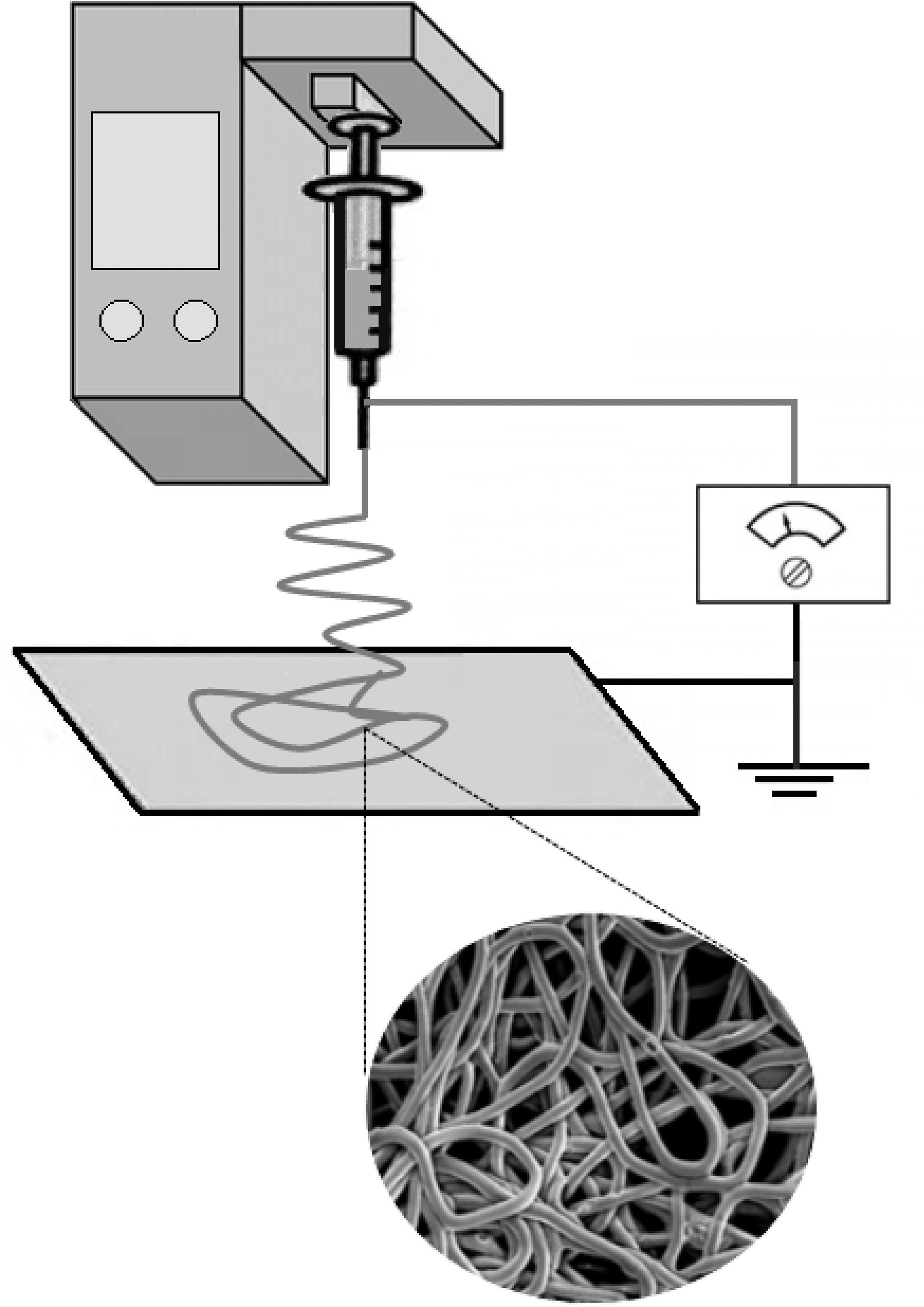
Schematic representation of the production of nanofibers using the electrospinning technique.
Due to these properties, nanofibers are promising materials for applications in food packaging, through the nanoencapsulation of different bioactive compounds. 19,46,83 Nanofibers can be produced to manufacture components for application to the primary packaging, such as a label, sachet, or stickers, to promote improved stability and controlled release of bioactive compounds. The application of nanofibers in active packaging can be carried out internally to preserving food quality. 84 In this sense, Yang et al. have developed nanofiber films loaded with pullulan/ethylcellulose-cinnamaldehyde (CA) with inhibition against gram-negative (Escherichia coli) and gram-positive (Staphylococcus aureus) bacteria. Therefore, the authors suggested the use of films composed of nanofibers with CA as a potential material for application in active (antimicrobial) food packaging. 85
Nanospheres and Nanocapsules
Nanocapsules (Fig. 4a) and nanospheres (Fig. 4b) differ according to composition and structural organization. Nanocapsules are composed of polymers that surround core. Therefore, there is nuclear differentiation. However, nanospheres that do not contain oil in their structure are composed of a polymer matrix, in which there is no differentiation of the nucleus, and are composed of a more uniform matrix. 86 Compounds can be encapsulated, adsorbed, or dispersed in nanoparticles. Nanocapsules and nanospheres can be added directly to the synthesis of the packaging material. Another alternative is to incorporate them into the polymeric solution, adding them into smaller components (sachets, labels, others) for addition to food packaging. 84 Several nanoparticles composed of different materials (including lipids, inorganic materials, natural and synthetic polymers) have been developed. These differentiated nanoparticle systems resulted in delivery systems with different physicochemical properties, providing several applications in the pharmaceutical, biomedical, food, and other industries. 86,87

Structural characteristics of
There are different methods for the development of polymeric microparticles and nanoparticles, such as electrospraying, spray dryer coacervation, and polymerization. The electrospraying technique, known as electrohydrodynamic atomization, is widely used for obtaining nanoparticles. 88 As electrospinning, electrospraying is a procedure based on the application of electrical potential, generating an electric field between the capillary and the collector. Nanospheres' characteristics produced by electrospraying can differ due to parameters such as flow rate, electrostatic potential, distance from capillary to the collector, and solution parameters (viscosity, density, and concentration). Environmental factors, such as temperature and pressure will also affect the nanospheres' properties. 89 In this context, Schmatz et al. developed polymeric nanoparticles to encapsulate phycocyanin through the electrospraying technique. The nanoencapsulation from electrospraying keeps the pigment's antioxidant activity at high temperatures (up to 216 °C). These results showed the potential of this nanoencapsulated phycocyanin for future applications as a component in food formulation. 89
Nanoencapsulated Bacteriocins for Potentiation as Active Component
Bacteriocins have antibacterial activity in their isolated form. However, they have low molecular stability when exposed to foods with high protein and lipid contents, which does not contribute to microbiological stability for a long time. 18 Bacteriocins, when added to a food matrix or polymer matrix, have some disadvantages, such as (i) enzymatic inactivation in the presence of proteolytic enzymes (ii) interaction with food/polymer matrix ingredients, and (iii) neutralization of anionic charges. 35 These disadvantages can be overcome through the nanoencapsulation of bacteriocins, in order to protect them from the other constituents of the medium. 90
Nanoencapsulation allows for the gradual release of the compound, which can be considered a delivery system. 91 At the nanoscale, materials have unique properties. The high surface area, the potential for biological activity, and the controlled release of compounds make nanotechnology a strategy to increase the stability of bacteriocins. 92 Most of these nanoencapsulation systems are used for bioactive agents. 93 However, there are few studies with nano encapsulated bacteriocins applied in food packaging, and this punctual deficit becomes a promising research alternative.
Nisin was encapsulated with microemulsions containing essential oil of dittany. The zone of inhibition formed during the development of Bacillus cereus was superior compared to the free nisin solution. In plates contaminated with Bacillus cereus (6.8 log cfu mL−1), encapsulated nisin promoted total inhibition of the microorganism, while free nisin did not present an inhibition zone. 94 In another study, polysaccharide-coated liposomes were used for nanoencapsulation of lysozyme and nisin. Phosphatidylcholine liposomes were coated with pectin, with an average particle size of 77 nm and encapsulation efficiency of 77–87%. Co-encapsulation of lysozyme and nisin reduced the microbial count of Listeria monocytogenes in the whole milk by 3 log CFU mL−1 and 2 log CFU mL−1 after 4 and 10 hours, respectively. The data proved the controlled release of nisin and lysozyme. 95
Nisin liposomes entrapped in phosphatidylcholine and embedded in gelatin and cellulose films also showed high activity against L. monocytogenes. 96 The phospholipid must have good interaction with the bacteriocin and not reduce its antimicrobial effect. 97 Therefore, liposomes are a promising source for encapsulation of bacteriocins for application in the active material, as they provide stability and protection against molecular degradation.
Nanoencapsulation of bacteriocins can be performed by nanoparticles and promote a controlled release of the antimicrobial agent. In a study developed by Lee et al., chitosan nanoparticles were added with nisin, through ionic interactions between the positively charged amino groups of chitosan and the negatively charged tripolyphosphate ions of nisin. Free nisin reduced 2.73 log CFU mL−1 of Staphylococcus aureus in orange juice, while nisin-encapsulated nanoparticles reduced it by 3.82 log CFU mL−1. 98 In another study, nisin was added to amaranth protein isolate to produce pullulan nanofibers by electrospinning process. The release of nisin encapsulated in pullulan nanofibers occurred faster within 12 hours of analysis, resulting in 81.4% in acetate buffer at pH 3.4 (apple juice simulator). Thus, the release gradually reduced until it reached a constant cumulative. Encapsulated nisin nanofibers showed bactericidal activity against Listeria monocytogenes inoculated in apple juice after 20 h. 99 According to Cui et al., nanofibers containing nisin-loaded nanoparticles present activity against Listeria monocytogenes. Moreover, these nanostructures did not change the sensory characteristics of the product. 100
Thus, studies prove that nanoencapsulation methods contribute to protecting bacteriocins, enhancing their bacteriostatic effects. Furthermore, nanoencapsulation controls the release of the active compound, allowing product stability and consequently improving food preservation.
Conclusions and Future Perspectives
Several studies are carried out to determine different bacteriocin-producing strains with a broad spectrum of antibacterial action. However, the application of bacteriocins in foods is limited due to the low physicochemical stability of the molecule. The use of innovative techniques, such as nanoencapsulation from nanoliposomes, nanoemulsions, nanoparticles, and nanofibers, become an alternative for bacteriocins to have greater physicochemical stability when applied to foods. Research in the literature reports nanotechniques applied to bacteriocins with direct application in the food matrix. This review article presents techniques applicable to bacteriocins with the potential for incorporation into active packaging.
The mentioned techniques are applied to bacteriocins and show high potential for insertion in active packaging. Nanoliposomes and nanofibers stand out due to their low cost and improvements to the mechanical properties of the packaging, respectively. Besides, both contribute so that a single and high dosage of the compound does not occur, ensuring microbiological stability of the food for a long time. However, these technologies are few explored in the literature for the encapsulation of bacteriocin, especially concerning its application in active food packaging. Future perspectives of the application of nanotechnology in the encapsulation of bacteriocins demonstrate several advantages. The nanoencapsulation of bacteriocins can be used to extend the shelf-life of foods, increase the safety of industrialized foods, and produce more efficient nutricosmetics, pharmaceuticals, and biomedical materials. These applications will be a reality soon after more studies addresses the molecular stability and controlled release of encapsulated bacteriocin from nanotechnology.
Footnotes
Author Disclosure Statement
No competing financial interests exist.
Funding Information
This work was supported by the Ministry of Science, Technology and Innovation (MCTI) (Project 01200.005005/2014-49). This study was financed in part by the Coordenação de Aperfeiçoamento de Pessoal de Nível Superior–Brasil (CAPES) Finance Code 001. This study was financed in part by National Council for Scientific and Technological Development (CNPq) (Project 310490/2014–6) (National Council for Scientific and Technological Development) and Research Support Foundation of the State of RS (FAPERGS). The authors also are grateful to the Industrial Technology Laboratory at the Federal University of Rio Grande and CEME-SUL (Center of Electronic Microscopy of the South) for their support of this study.