







Abstract
The development of cosmetics formulated with natural ingredients is on the rise. Solid shampoos are considered a natural and ecological alternative that has been gaining ground in the cosmetics industry. Additionally, biomass of cyanobacteria and C-phycocyanin (C-PC), one of its components, are considered potential ingredients in various industries, including food, renewable energy, and, more recently, cosmetics formulas. The present work aims to develop solid shampoos using natural pigments derived from Spirulina, which provide color and health-promoting properties. In addition, physical-chemical and microbiological characterization, analysis of color stability, and biological activity of the produced bioproducts were carried out. Therefore, four solid shampoos were prepared: control shampoo (A), without the addition of pigments containing 1% (w/w) of C-PC (B), shampoo with 5% (w/w) Spirulina biomass (C) and shampoo with 5% (w/w) of residual Spirulina biomass (D) (obtained after extracting the C-PC). The physical-chemical characterization presented results within the ranges determined by Brazilian Legislation for all evaluated parameters. The results of the microbiological analysis indicated that all samples are considered safe and sanitary. All shampoos produced with the addition of pigments exhibited higher antioxidant activity and phenolic compounds content than the control shampoo. However, the formulation made with Spirulina biomass (C) showed greater stability in its pigmenting action, and the same happened with the antioxidant activity considering the two methods studied in the evaluation of this parameter during the evaluated period.
Introduction
In response to consumer demands, the development of cosmetics formulated with natural ingredients or derived from natural sources that can be labeled as organic, 1 ecological, and sustainable 2 is on the rise. The use of natural pigments found in microalgae and cyanobacteria can offer color but also health-promoting properties such as antioxidant and anti-inflammatory properties. 3,4
Considering the vast diversity of microalgae and cyanobacteria, Spirulina has stood out in recent decades in academic research related to production, 5 scale expansion, 6 use as a source of bioactive compounds, 7 –12 and application to products. 13
Spirulina is a renewable source of pigments and bioactive compounds, with anti-aging, revitalizing, remineralizing, moisturizing, actions in skin and hair. For these reasons, it is gaining interest as a potential ingredient for green cosmetic formulations 14 and the application of natural pigments in these formulations can increase their antioxidant activities. 15
Among daily-use cosmetics, shampoo is one of the most frequently used formulations. 16 Work by Delsin et al. 17 proved the effectiveness of capillary formulations made with 0.1% Spirulina extract in strengthening the capillary fiber, decreasing the combing strength, and increasing the shine of the strands.
In recent years, several brands, driven by consumer demand and environmental issues, have invested in producing products in solid form. 18 Bar shampoos have advantages such as accessible transport, greater durability, microbiological stability, and less need for plastic packaging since they dispense water in their composition, making bar shampoo format one of the natural and ecological alternatives gaining ground in the cosmetics industry.
Such products are usually formulated with clay as a pigment, 18 and despite Spirulina's many benefits in cosmetic formulations, 14 there is still much to be explored. Therefore, the objective of this study was to incorporate the natural pigments derived from these cyanobacteria in cosmetic formulations of the solid shampoo type to evaluate their biological effects.
Material and Methods
SPIRULINA BIOMASS
Spirulina dry biomass powder was provided by Fazenda Tamandúa® and used for the extraction of the C-phycocyanin (C-PC) pigment. Together with the remainder of the extraction, residual biomass of the process, was also applied.
EXTRACTION AND PURIFICATION OF C-PHYCOCYANIN
Spirulina biomass was thawed 1 h before extraction started and processed in an analytical knife mill (IKA A11 Basic) to separate the particles through a 0.106 mm mesh/Tyler. 19 According to Fratelli et al., 8 the residual biomass (RB) was also obtained to extract the C-PC from the biomass. In addition, fractional precipitation with (NH4)2SO4 was performed 9 to purify C-PC, bringing purity >1.0.
ANALYTICAL METHODS
C-PC concentration (mg.mL−1) was calculated as described by Bennet & Bogorad,
20
with wavelength adapted by Moraes & Kalil
21
according to Equation 1. The C-PC extract purity (EP) was calculated according to Equation 2.
22
The absorbance (A) measurements were performed using a UV-visible spectrophotometer (Shimadzu, Kyoto, Japan). The yield (Y) was calculated using Equation 3 and expressed in mg.g−1. C-PC is the concentration of C-PC (mg.mL−1), V corresponds to solvent volume (mL), and DB is the dry biomass (g):
PRODUCTION OF SOLID SHAMPOOS
Four solid shampoos were produced. The control shampoo (A) was elaborated without adding pigments and was used as a base for developing the other products. Another three formulations were produced with the addition of natural pigments: (B) contained 1% (m/m) of C-PC; (C) contained 5% (m/m) standardized Spirulina biomass, and to (D) 5% (m/m) of the lyophilized residual biomass (RB) from Spirulina, obtained through the extraction of C-PC, was added. The list of cosmetic inputs with their function and percentage of pigments is presented in Table 1.
Ingredients Used in the Formulation of Solid Shampoos
A: control shampoo; B: C-PC added shampoo; C: Spirulina biomass shampoo and D: residual biomass (RB) shampoo.
PHYSICOCHEMICAL ANALYSIS
In the present study, the physical-chemical characterization analyses were based on the guidelines of the Quality Control Guide for Cosmetic Products, 23 visual sensory verification for cosmetics and pH analysis using a previously calibrated pHmeter.
MICROBIOLOGICAL ANALYSES
The microbiological quality of the formulated shampoos was determined after production (zero time) and after 91 days, applying the analysis of total coliforms and Escherichia coli, Staphylococcus aureus, total aerobic mesophilic microorganisms and molds, and yeasts. And for that, the Petrifilm® (3M) rapid methodology was used, a method validated by the Association of Analytical Communities. 24 –26
COLOR STABILITY ASSESSMENT
The color stability of the formulated shampoos was monitored for 91 days, weekly, under the absence and exposure to ambient light. For this, a triplicate of each shampoo (A, B, C, and D) was stored in a dark box (absence of light), and another triplicate was stored in a transparent box and exposed to light.
Colorimetric analysis used a colorimeter (Minolta, model CM25D, Japan). And the values of L*, a*, and b* were determined for each formulation at each point (every 7 days). The Hue angle (h), which indicates the color angle (0°- red, 90°- yellow, 180°- green, 270°- blue, and 360°- black), was calculated by Equation 4. L* indicates brightness (0–100), a* indicates the amount of red (positive values) or green (negative values), and b* specifies the amount of yellow (positive values) or blue (negative values) in the samples. The color difference (ΔE, Equations 4–8) was also calculated from the initial (t = 0) and final (t = 182) values of L*, a*, and b* of each formulation:

ANTIOXIDANT ACTIVITY AND TOTAL PHENOLIC COMPOUNDS DETERMINATION
The samples were stirred with 20 mL of methanol for 15 min to extract the antioxidant compounds from the matrices. The filtrate was concentrated using a rotary evaporator at temperatures below 40°C until 5 mL of total volume. 27,28 The samples were filtered using 0.22 μm cellulose acetate membranes before the experiment. For the determination of the antioxidant activity against the peroxyl radical, the ORAC (oxygen radical absorption capacity) method was used, based on peroxyl radical formation by the thermal degradation of AAPH (2,2’-azobis (2-amidinopropane) dihydrochloride) at 37°C. 28
To determine the antioxidant activity against the ABTS●+ radical according to Re et al. 29 Both antioxidant results were expressed in μmol.gsample −1 of Trolox equivalents (TE). The total phenolic compounds were determined by the Folin-Ciocalteu method, according to the procedure of Singleton and Rossi, 30 and expressed in gallic acid equivalent (GAE)/g.
STATISTICAL ANALYSIS
The assays were carried out independently in triplicate and compared by applying analysis of variance (ANOVA), Tukey's post hoc test, and T-test to compare the means, using the degree of significance of 95% (p < 0.05)
Results and Discussion
For the application of C-phycocyanin in solid shampoos, the extraction process was carried out from the commercial biomass of Spirulina, followed by the partial purification stage by saturation and dialysis, to achieve a degree of purity >1.0 for application in food and cosmetics. After extraction, the initial purity of the pigment was 0.41, and after partial purification, the results for the concentration, yield, and purity of C-PC of 6.02 mg.mL−1, 81.91 mg of C-PC/g of Spirulina and 1.14, respectively. Pigments were incorporated into solid shampoos in the following steps, as mentioned in the material and methods section. The coding of the samples was determined, and sample A corresponds to the control shampoo without pigments, sample B the shampoo with 1% (w/w) lyophilized C-phycocyanin, sample C corresponds to the shampoo with 5% (w/w) dry biomass of Spirulina and, finally, sample D with 5% (w/w) of the lyophilized residual biomass after the C-PC extraction, as presented in Fig. 1.
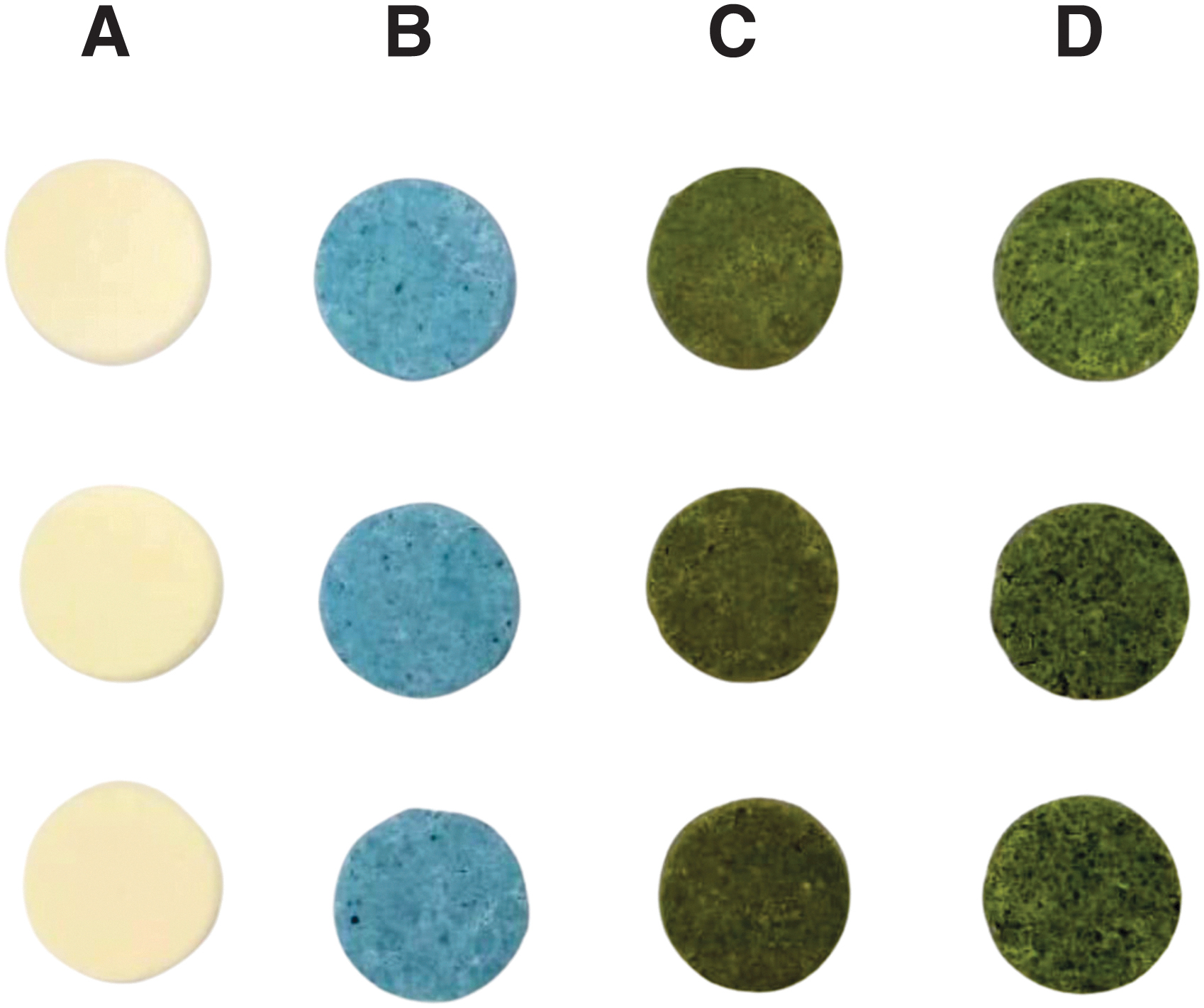
Images of the shampoos formulated;
Regarding the choice of the percentage of 1% (m/m) of C-PC instead of 5%, it was a reference to the concentration of C-PC present in each 1 g of Spirulina biomass. According to our calculations, the amount of C-PC contained in the C samples would proportionally be approximately 0.5% (m/m). So, if this proportion were chosen for the formulation of the shampoo containing C-PC, 5%, this would increase the product cost, making it unfeasible for large-scale production scale due to the high cost of producing C-PC. In an attempt to meet in the middle, we formulated the C-PC shampoo using 1%.
Table 2 presents the results of the physical-chemical analyses. The results obtained from the physical-chemical parameters follow what is recommended by Brazilian Legislation. 31 Regarding pH, there was a slight increase in shampoos with natural pigments derived from Spirulina. According to European (EU) legislation, a cosmetic product is any substance or mixture that is intended to be placed in contact with the external parts of the human body or the teeth and mucous membranes of the oral cavity for the sole or primary purpose of cleaning, perfuming, changing their appearance, protecting, keeping them in good condition, or correcting body odors. Furthermore, a cosmetic product placed on the market must be safe for human health when used under typical or reasonably foreseeable settings, taking into account presentation, labeling, directions for use, and disposal. 32
Results Obtained from the Analysis of the Physical-Chemical Parameters of the Four Elaborated Shampoos
Regarding microbiological quality, EU and USA legislation state that cosmetics used around the eyes, mucous membranes in general, damaged skin, children under three years of age, the elderly, and people with compromised immune responses must be given special consideration. The manufacturing business must carry out the findings of the preservation challenge test. The cosmetic product's qualitative and quantitative composition, including the chemical identity of the ingredients and their intended purpose, must be stated. Furthermore, the stability of the cosmetics product under generally predictable storage circumstances is required. 32,33
Besides, good manufacturing practice is a must in all the Legislation regarding cosmetic production worldwide. EU and EUA Legislation presents a list of prohibited cosmetic products. 32,33
Since the literature does not present studies of cosmetics using Spirulina and its pigments, we found some explanations in other biotechnological products, as in the study by Mohammadi-Gouraji et al., 34 where C-PC-enriched yogurt samples exhibited higher pH levels than the control. In the case of our formulated shampoos, since the pH of Spirulina is around 7.0, 35 the shampoos containing Spirulina or its pigments showed values higher than that of control samples, and possibly, the pH from the biomass is responsible for this slight increase. However, the results are close to the natural pH values of the hair and scalp (5.5–6.0), 18 so they are suitable for the hair product.
The slight characteristic odor of the Spirulina biomass in the shampoo samples added with Spirulina (samples C) and of the residual biomass (samples D) was not relevant. For application in products of this nature, they can be accepted as an aroma referring to the sea. Ideally, and as a suggestion for future work, the sensory evaluation of these formulations would be essential to determine the relevance of this odor concerning the purchase intention of the products. If this attribute is identified as a problem, an exciting alternative to correct this odor would be the addition of essential oils, which is even a common practice in companies that produce and sell solid shampoos.
Essential oils are natural, organic, and vegan compounds that, in addition to providing aroma, are also associated with antioxidant, anti-inflammatory and antimicrobial activities. The demand for these compounds is growing in the cosmetics market, and the effectiveness of these ingredients in hair products stands out, especially in repairing damage to the scalp and hair shaft. 36 As this work aimed to evaluate the incorporation of natural pigments and their effect in terms of antioxidant activity, essential oils could interfere with the evaluation of this capacity; therefore, it was decided not to add this device to the present work.
There was no growth of pathogenic and contaminating microorganisms initially or even after 91 days of production (Table 3). Therefore, according to the results obtained, the products are safe from the point of view of microbiological quality control and were appropriately prepared. The control of microbial contamination of cosmetics is of fundamental importance in Public Health. Many microorganisms with pathogenic potential may be present in cosmetic products. 37 In addition to physical-chemical and microbiological analyses, color stability is an important parameter to consider in cosmetics.
Microbiological Analysis Results of the Shampoos Formulated on the Initial Day and After 91 Days
CFU: Colony Forming Units
In the present work, as previously mentioned, the color stability of the shampoos was monitored for 91 days from production, both in the presence and absence of light. The results obtained are shown in Fig. 2.
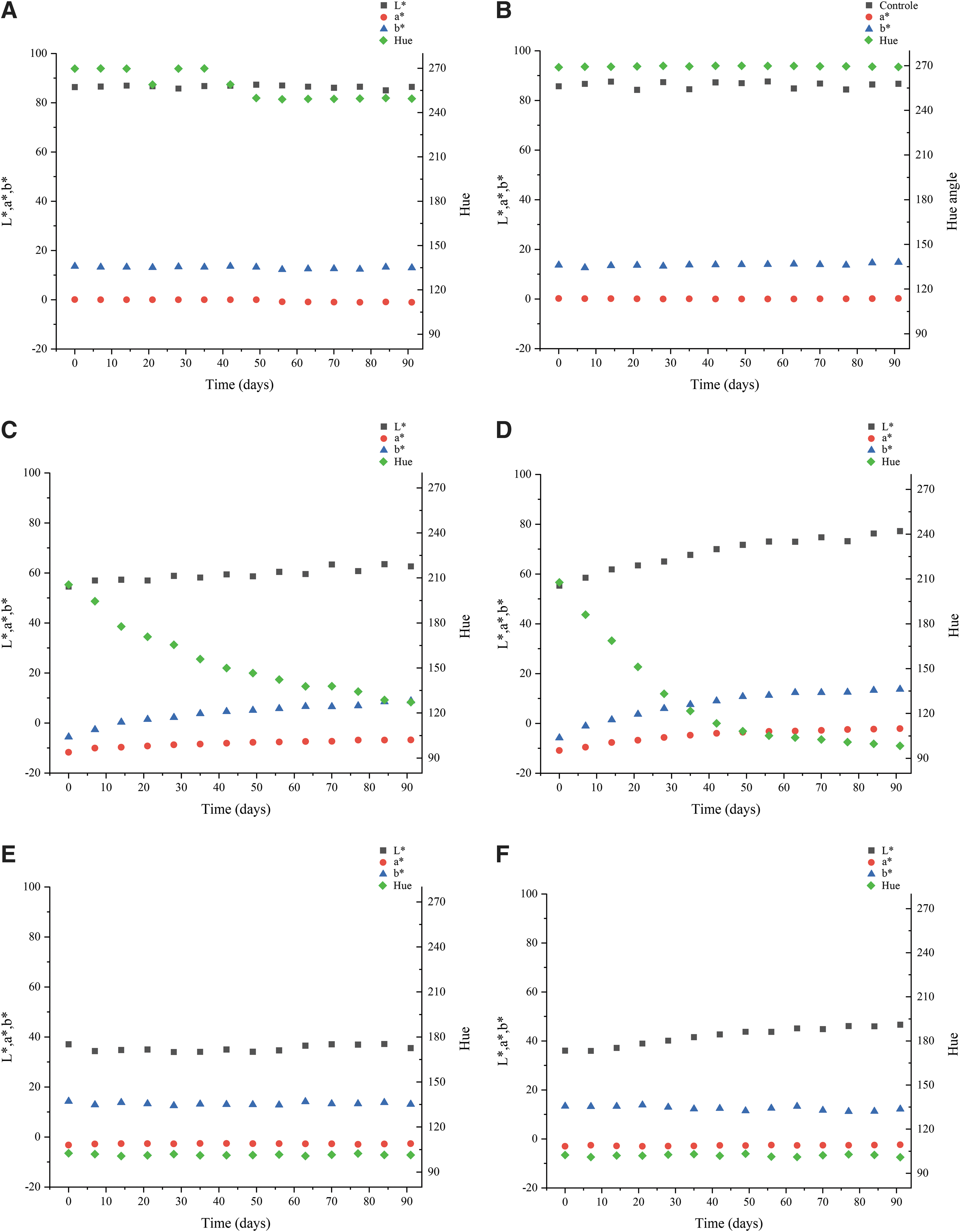
Color stability over time for shampoo samples; control

Observing Figs. 2A-B, which present the results of the color variation of sample A (control), in the absence and in the presence of light, it can be observed that the null value of a* indicates the lack of red or green, but the presence of a small positive value for b* corresponding to a yellowish hue, and the high value of L* expresses the lightness and pallor of the hue of the control sample. As expected, the control shampoo without added pigment showed more excellent stability.
The change in Hue angle values was the most significant difference observed between the control samples under the absence and exposure to light. While the samples kept in the dark obtained values close to 270, the samples exposed to light showed a slightly yellowish hue after the sixth week, corresponding to values close to 90, as shown in Fig. 2B.
Results for shampoo B samples (containing 1% C-PC) are shown in Figs. 2C-2D. In the presence of light (Fig. 2D), the value of b* is initially negative, indicating the blue color, which over time becomes slightly positive, tending to yellow. Furthermore, a* values remain negative, and the increase in ΔL demonstrates that the sample has become paler and lighter in the presence of light.
Comparing the samples of shampoos incorporated with C-PC in the absence (2C) and in the presence of light (2D), in Fig. 2C, the value of L* and the degrees of Hue suffer less variation when compared to Fig. 2D; also, the values of a* and b* remain similar.
This instability is smaller for samples C, containing Spirulina ( Figs. 2E-2F) and D (RB ( Fig. 2G-2H). Both have a negative and relatively stable a* value, indicating a green Hue, and a slightly positive b* value, which confers a yellowish color, confirmed by the Hue value, which remains around 90° for these samples over time rated.
The blue-green hue of the shampoo samples containing Spirulina can be influenced by the presence of C-PC when observing the closest value to the negative of b* ( Figs. 2E-2F). While for shampoos with added residual biomass (sample D), the b* value is more positive ( Figs. 2G-2H), indicating the absence of the blue color.
The most significant difference between shampoo samples C ( Figs. 2E-2F) and D ( Figs. 2G-2H) is in the increase of L*, indicating greater clarity and paleness in samples exposed to light.
With blue, as it is a less common color in nature, 38 and despite the benefits of using natural pigments, presents challenging color preservation. Among all the formulations, the shampoo samples with the natural pigment C-PC showed less stability under exposure to light during the evaluated period (91 days). The estimated use time of a solid shampoo weighing around 60 g (greater than the sample ∼10 g) is 1 to 3 months, equivalent to the samples' shelf life according to the color's duration. However, maintaining the color is a decisive factor in the consumer's purchasing attitude. 4,39
To investigate the sensitivity of natural dyes under exposure to light, pH, and temperature, the study by Jespersen et al. 38 evaluated the color stability of different dyes, one of them being C-PC, for application in food matrices. As expected, C-phycocyanin was unstable to light. Exposure to light at 3 × 10⁵ lux for 24 hours in an aqueous solution at pH 5 and 7 caused about 80% pigment degradation, leading to a color change. As for the pH, over 24 hours, the pH 5 solutions were bluer, while the pH 7 solution was found to be almost discolored. And in both samples, a precipitate was observed to indicate protein denaturation.
It is a known fact that in addition to color, natural pigments also provide biological activities for the products to which they are added, and the antioxidant activity is the most frequently cited in the literature on biological effects related to natural pigments. 7
When exposed to light, C-PC degrades at varying rates depending on the strength and wavelength of the light. A cyclohelical conformation was adopted when exposed to light, resulting in nonfluorescence, deactivation, and photodegradation due to intramolecular energy transfer or radical processes. 40 At the same time, the blue color of C-PC is attributable to phycocyanobilin, a chromophore that binds proteins via thioether linkages. 41
C-PC is made of two homologous subunits, the α-subunit, which has one phycocyanobilin connected at cysteine 84, and the β-subunit, which has two phycocyanobilins attached at cysteines 84 and 155. 42 The phycocyanobilins are open-chain tetrapyrrole chromophores with a unique arrangement of conjugated double bonds that account for the phycocyanin's distinctive radical scavenging and antioxidant activities, as well as its color. 43 The extinction coefficients of the phycobiliproteins drop as the hexamers break down into trimers and monomers. The high-order structure of phycocyanin influences its biological stability. 40 Furthermore, the intensity and location of phycocyanin's absorption maximum are dependent on its aggregation state. Temperature, pH, light, pressure, heavy metal cations, and denaturants all alter phycocyanin aggregation and structure, which may affect its biological activity and color profile. 40 This is maybe the physicochemical explanation for the loss of color stability and biological effect more intensively when the shampoo containing C-PC was exposed to light.
As previously mentioned, antioxidant activity is an indirect measure to assess the ability of a compound to delay or prevent the oxidation of an extract by the presence and/or formation of free radicals. In the present work, taking into account the importance of seeking greater coverage of the action of the pigments under study, the antioxidant activity was analyzed using two methods. Results are shown in Fig. 3.

Results of analysis of antioxidant activity, ORAC
For the results of antioxidant activity using the ORAC method (Fig. 3A), the samples with pigment showed significantly higher antioxidant activity values than the control sample in the absence of light. In the absence of light, the sample with 1% C-phycocyanin (shampoo B) showed statistically higher antioxidant activity than the other samples. In contrast, the samples added with Spirulina (shampoo C) showed antioxidant activity statistically equal to the shampoo containing residual biomass (shampoo D).
In the presence of light, there was a drastic reduction in the antioxidant activity of formulation B, in which the values were statistically equivalent to those of the control samples in the absence and presence of light. In this scenario, we can suggest that the loss of color also indicated a degradation of the bioactive compounds responsible for the antioxidant action against the peroxyl radical.
Still evaluating the data obtained from the ORAC method in the presence of light, there is an indication that sample D had a reduction in its antioxidant action. However, unlike sample B, its values remained higher than the control shampoo's (A) values. And for sample C, although there was a significant loss of antioxidant activity in the presence of light, its antioxidant capacity was greater than that of the other samples, even being statistically equal to the values of sample D in the absence of light.
Pondering the results obtained for antioxidant activity against the ABTS radical (Fig. 3B), the samples with pigment showed significantly higher antioxidant activity values than the control sample. Comparing each sample relating to the absence and presence of light, it can be observed that there was no statistically significant difference considering all the evaluated samples. From these data, it is possible to state that even with a change in the samples' color parameters, the compounds responsible for the antioxidant action, measured by the ABTS method, remain functional.
The antioxidant activity is known to be partially related to the concentration of phenolic compounds. Therefore, the total phenolics (Fig. 3C) of the shampoo samples were also evaluated in the present work. 44 The more accentuated loss of color and antioxidant activity in the presence of light may be explained by the changes in phenolic compounds since values of antioxidant activities of Spirulina extracts are related to the presence of certain individual phenolic compounds and their corresponding structures, with the positions and quantities of hydroxyl groups of particular importance. Determined results generally depend on the selected methodology, including the type of extraction and solvent, reaction conditions within pH values, temperature, number of free radicals, and the time provided for the reaction.
To prolong shelf life regarding the stability of antioxidant activity values and content of phenolic acids and flavonoids, a dark, daylight-impermeable package and storage at room temperature can be recommended to potential manufacturers. 45
Based on the results of the antioxidant activity of the shampoos produced, it can be suggested that the presence of C-phycocyanin significantly contributed to the increase in the antioxidant activity in the shampoos.
Shampoo D, formulated with residual biomass, showed antioxidant action. This result greatly interests the research group because the residual biomass is usually discarded after the C-PC extraction process. Adding value to waste from biotechnological processes is extremely important, meeting the principles of sustainability and circular economy.
Still, the samples of shampoo C containing Spirulina biomass showed greater stability in color maintenance for 91 days and a relevant antioxidant capacity with their maintenance in the presence of light. This fact corroborates the importance of using available raw materials, which are sources of bioactive compounds. Spirulina possesses several components that may be responsible for the greater stability of biological effects. By maintaining these structures, we preserve the natural balance of these compounds, possibly leading to higher stability of the color and antioxidant action of the compounds.
Davis et al. 46 conducted a study evaluating the antioxidant capacity of tea (Camellia sinensis) extracts was assessed using the ORAC method, and the protection of hair from damage induced by ultraviolet irradiation was the primary goal. Even though the authors used the same methodology used in the present study, the calculation was made differently. Hence it is not possible to compare. The same was observed in the study conducted by Panontion, 47 which formulated a new antioxidant lauryl-free herbal shampoo formulation with a Brazilian plant extract. The authors obtained antioxidant activity expressed in Antioxidant Activity (%) (140 μg/mL), showing values from 67.74 to 91.93, unfortunately not comparable with our results.
Nevertheless, antioxidant biomolecules can be used in numerous novel applications (e.g., shampoos, cosmetic creams, body oils, and gelled matrices, among others), indicating these bioactive compounds' technological relevance. Literature evidence shows that there may be a therapeutic role in the use of antioxidants and anti-inflammatories to counteract oxidative stress related to hair loss, 48 the antioxidant activity helps hair cosmetics because it is intimately connected with the protection of the hair fiber. 47 All these confirm the relevance of the present work and the development of new cosmetic products containing bioactive compounds from a sustainable perspective.
Conclusion
The natural pigments derived from Spirulina, as well as its biomass, can be applied in solid shampoos providing color, bioactive compounds, and antioxidant action. In the present work, three formulations were successfully produced and met the quality criteria proposed, indicating that the product is safe for use. Monitoring the color stability of natural pigments as components of shampoos, it is possible to estimate a shelf life of at least 90 days for products protected from light. This shelf life is compatible with the validity of this type of product. The samples made with Spirulina obtained the best result during the analyzed period, preserving the structure and action of the pigments within the matrix and providing greater stability in terms of color and antioxidant activity.
Footnotes
Acknowledgments
The authors wish to thank Fazenda Tamanduá® for donating the organic Spirulina used in the present work.
Author Disclosure Statement
No competing financial interests exist.
Funding Information
This work was supported by “Fundação de Amparo à Pesquisa do Estado de São Paulo - FAPESP” through the grants process n° 2020/06732-7, 2022/06293-9 and 2023/00857-0. The authors also acknowledge CAPES for financial support.