




Abstract
Paper products are omnipresent; however, the high versatility due to different coatings complicates the assessment of their biodegradability. Simple and rapid screening methods are essential and traditionally dependent on time-consuming biodegradation trials, which require the measurement of the tensile strength of buried paper strips over several days. Commercial cellulase formulations were evaluated for correlation to biodegradation in soil as a fast alternative requiring only 1 hour using 3,5-dinitrosalicylic acid. In addition, substances potentially accelerating biodegradation were assessed to demonstrate the suitability of the screening method for evaluation of materials with enhanced recycling properties. The addition of starch and lignosulfonates to the assay resulted in enhanced enzyme activity of up to +24.1% and +44.4%, respectively, whereas gluconolactone inhibited β-glucosidase activity. The same trend was seen for the hydrolysis of coated paper based on the release of reducing sugars and high-performance liquid chromatography quantification of mono- and oligosaccharides. Biodegradation trials were performed in soil to validate the developed screening method. Indeed, enzymatic hydrolysis correlated to biodegradation in soil where a faster decrease of tensile strength of 43.45% and 22.16% was seen after 3 days for polymerized lignosulfonates and starch, respectively. This indicates that the biodegradation in soil is affected by extracellular cellulases of microorganisms. This was further confirmed by measurement of endoglucanase (on derivatized cellopentaose) and β-glucosidase activity in soil which again resulted in increased activity in the presence of starch and lignosulfonates. Hence, time-consuming soil biodegradation trials of cellulosic materials can be replaced by enzyme-based in vitro activity assays and considerably reduce testing times.
Introduction
In a high pace plastic consuming environment, it is absolutely crucial to have an understanding about products that can potentially enter the environment. This is especially important for packaging materials that are often constituted of nonrenewable polymers and accounting for the majority (95%–99%) of the total plastics. In 2018, ∼359 million tons of these polymers were produced. 1 Most of the nonrenewable oil-based plastics, however, show very low biodegradation rates, whereas the risks of formed microplastics have been extensively discussed in the recent years.
Therefore, cellulose or starch-based packaging materials are gaining a lot of attention due to their environmental friendly features and the ability to break down into natural substances. These materials have a broader disposal range as they can be biodegraded in the environment, by composting or in anaerobic digestion plants. Packaging materials are quite demanding in terms of performance, resulting in the addition of additives or material blends. Because of the complexity of the material composition, it is necessary to perform biodegradation experiments to verify the original features such as a natural biodegradability. Several other polymers have been developed over the last decades to enhance biodegradability ranging from renewable polyesters (e.g., polylactic acid) to various blends such as polycaprolactone combined with starch. Biodegradability is a broad term as material degradation depends on environmental conditions. 2 –4 Moreover, it also depends on the chemical structure (e.g., ester bonds that can be hydrolyzed by microbial enzymes) and even the final material properties and additives matter. 5
For paper-based packaging materials, the extent of biodegradation does not only depend on the material composition (e.g., mechanical strength enhancers) but also on the processing parameters (e.g., pulping and bleaching affect the fiber structure and the ratio of cellulose, hemicellulose, and lignin). 3,6 In this study, an enzyme-based procedure was developed for screening the biodegradability of paper-based materials, more specifically the effect of biopolymers used in coating formulations (e.g., starch and lignosulfonates) or that are remaining from the production process (e.g., xylan). Starch is commonly used as binder, bonding agent, or as surfacing-sizing agent for paper products, whereas enzymatically polymerized lignosulfonates have more recently been used to partially replace latex in paper coatings. 7 –9
For paper-based materials, standard biodegradability tests are often quite time-consuming, which can be a bottleneck when developing novel products. Here, we investigated whether susceptibility to cellulolytic enzymes could be a simpler and faster method to correlate biodegradability of modified paper-based materials in soils. Extracellular microbial enzymes play a crucial role in biodegradation of cellulose since they catalyze the hydrolysis to smaller oligomers and monomers, which can then be transported into the cells in order to be metabolized by microorganisms. The main enzymes responsible for the enzymatic decomposition of cellulose are hydrolytic endoglucanases (endo-1,4-glucanases, EC 3.2.1.4), exoglucanases (exo-1,4-cellobiohydrolases, EC 3.2.1.91), and β-glucosidases (EC 3.2.1.21). Endoglucanases randomly cleave β-1,4-glycosidic bonds of cellulose chains internally and act in the amorphous region of cellulose, thereby creating new ends for exoglucanases and releasing cello-oligosaccharides in the process. Cellobiohydrolases attack cellulose chains at their nonreducing or reducing ends, thereby generating cellobiose units, whereas β-glucosidases cleave cello-oligosaccharide chains into glucose. Finally, enzymes such as lytic polysaccharide monooxygenases together with cellobiose dehydrogenases degrade cellulose via an oxidative mechanism. 10 –12
Several bacteria and fungi present in soil are capable of cellulose decomposition (e.g., the well-known cellulase producing fungus Trichoderma reesei). However, the exact composition of the microbial cellulolytic community is always dependent on regional characteristics, and consequently, soil cellulolytic enzyme activities likewise differ. Accordingly, incubation of cellulose-based materials with enzymes from individual soil samples could provide useful information regarding biodegradability in these specific environments. 13 –15
Therefore, in this study, hydrolysis of different cellulose-based sheets by a variety of enzyme formulations was investigated regarding correlation to their biodegradation behavior in soil with the aim of developing a rapid screening method.
Materials and Methods
An uncoated base paper composed of 70% hardwood short fiber and 30% softwood long fiber provided by Sappi was used for the investigation of biodegradation in soil and enzymatic hydrolysis. In addition, base papers coated with polymers such as starch and polymerized lignosulfonates were investigated, whereas gluconolactone was used as negative control. The commercial enzyme formulations EnzC, EnzD, and EnzE were provided by the Austrian pulp and paper industry, which were part of a previous study related to their effect in pulp refining. 16 The cellulase formulations EnzC and EnzD contain different cellulolytic and hemicellulolytic enzymes, whereas the formulation EnzE mainly shows endoglucanase activity. A detailed overview of the β-glucosidase, endoglucanase, xylanase and the activities on Whatman filter paper are detailed in Supplementary Table S1 of the supplementary material. Polymerized lignosulfonates were prepared similarly to a procedure previously described, 17 however, without the use of any mediators. Briefly, industrial liquid magnesium lignosulfonates from Sappi (specification in supplementary material) were diluted to a concentration of 10% with MQ water and polymerized at pH 7 for 5.5 hours using a laccase enzyme from Myceliophthora thermophila (MtL) at a dosage of 166.7 nkat/mL under oxygen supplementation (30 mL/min) and 2.5% glycerol was added as plasticizer. Xylan from beechwood (with 4-O-methyl glucuronoxylan) was obtained from Carl Roth. All other chemicals including starch from potato were obtained from Sigma-Aldrich (Vienna, Austria) in high-performance liquid chromatography (HPLC) grade if not stated otherwise.
COATING OF CELLULOSE BASE PAPER
The paper sheets with an overall weight of 50 g/m2 were provided by Sappi, which performed the coating procedure. Both sides were coated with a desktop RK Multicoater (Litlington, UK) and dried with an infrared dryer afterwards. The application parameters were optimized per coating material with the intention to have a layer that is thick enough to avoid direct contact between the soil and the actual paper substrate thereby giving the actual performance of the coating material. The target coating weight was 8 g/m2 in total (4 g/m2).
ENZYMATIC HYDROLYSIS OF (COATED) PAPER SHEETS
Quantification of released reducing sugars
Cellulase activity was evaluated using uncoated as well as coated papers similar to the standard procedure of the International Union of Pure and Applied Chemistry that uses filter paper for enzyme activity quantification. 18 Strips of (coated) paper with a dimension of 7.5 cm × 0.75 mm (30 mg) were prepared and suspended in 800 µL 50 mM citrate buffer (pH 4.8) in a 15-mL glass tube, which was previously equilibrated at 45°C. The reaction was started by the addition of 200 µL soil enzyme solution or commercial enzyme formulation and stopped using 1000 µL 1M NaOH after 0, 5, 10, 20, 40, and 60 minutes. A volume of 1000 µL 3,5-dinitrosalicylic acid (DNS) was added, and the solution was incubated in the static boiling water bath type 1004 (GFL, Germany) for 5 minutes. The absorbance was measured at 540 nm after transfer of 200 µL to a 96-well plate using an Infinite M200 Pro plate reader (Tecan, Switzerland). For the calculation of the enzyme activity in nkat/mL, the DNS solution was calibrated using glucose standards between 0 and 20 mM. Measurements were performed in duplicates, and error bars indicate the standard deviation. The polymers xylan and starch were measured at concentrations of 1 mg/ml, whereas gluconolactone was evaluated at 30 mg/mL in 50 mM citrate buffer pH 4.8. Polymerized lignosulfonates were used at a concentration of 5% in citrate buffer. To account for potential inaccuracies caused by the color change of the added substances, blank measurements were performed with each sample, whereas the calibration of the DNS solution was always repeated using the respective sample matrix.
HPLC quantification of released molecules
Pieces (1 × 1 cm) of (coated) paper (5 mg) were incubated with enzyme solutions at a dosage of 16.67 nkat for 4 hours in 1250 µL of 50 mM citrate buffer (pH 4.8). Samples were inactivated by incubation at 99°C for 5 minutes using the thermomixer comfort (Eppendorf, Germany), and the supernatant was subsequently diluted 1:5 with MQ water. Any proteins or lipids in the reaction mixture were removed by Carrez precipitation, which was achieved by the addition of 20 µL of 2% potassium hexacyanoferrate(II) trihydrate solution and 20 µL of 2% zinc sulfate heptahydrate solution and centrifugation at 12,500 rpm for 30 minutes using a Eppendorf 5427R centrifuge equipped with an FA-45-48-11 rotor (Hamburg, Germany). The supernatant was finally applied to an Agilent 1260 Infinity LC system (Santa Clara, USA), equipped with an ICSep ION-300 (Transgenomic Inc) column and a refraction index detector after filtration of the sample through a 0.45 µm filter. Analysis of sugars was conducted at a flow rate of 0.325 mL/min for 45 minutes using 0.01M H2SO4 as mobile phase at a temperature of 45°C. Glucose, cellobiose, and xylose standards ranging between 0 and 0.96 mg/mL were used for the calculation of the sugar concentration in mg/mL. Measurements were performed in duplicates, and error bars indicate the standard deviation.
ENZYME ACTIVITY OF SOIL SAMPLES AND MODEL SUBSTRATES
Endoglucanase activity on derivatized cellopentaose (CellG5)
Endoglucanase activity of soil used for traditional biodegradation trials (see respective section below) was determined at 45°C using the endoglucanase-specific CellG5 assay from Megazyme (Bray, Ireland). The assay was modified based on the procedure described in McCleary et al.
19
Soil samples (0.500 g) were diluted in 5 mL 50 mM citrate buffer (pH 4.8), and 100 µL of this solution was added to 100 µL of CellG5 substrate [(4,6-O-(3-ketobutylidene)−4-nitrophenyl-β-
β-glucosidase activity
β-Glucosidase activity of soil used for traditional biodegradation trials (see respective section below) was quantified using 2 mM 4-nitrophenyl β-
Biodegradation tests of (coated) paper strips in soil
Biodegradation of (coated) paper in soil was evaluated using a very airy (no branches or lumps), microorganism rich and fertilizer containing store-bought garden soil for consistency and homogeneity purposes. Around 3 kg of soil was placed in transparent boxes (filled 2/3 of height) with an adjusted humidity of 50% to ensure controlled conditions. Moreover, the boxes were closed and incubated in a conditioned room at 23°C under constant light conditions. The paper samples were prepared by cutting the (coated) paper into 1.5 × 15 cm strips to fit the soil containing boxes. To enable comparison of changes in paper properties, tensile strength was measured after 3 and 6 days of burial time. For each measuring point, five paper strips were used, corresponding to the burial of 15 paper strips per sample type. For the assessment of changes in the tensile strength, a desktop L&W Tensile Tester from ABB (Zurich, Switzerland) was used, for which an average value out of four samples was calculated. The baseline for comparison was made by performing the tensile test on the paper strips that had not been in contact with soil, the so-called day 0 sample. The resulting value is a percentage that corresponds to how much the strength of the materials decreased over 3 and 6 days in relation to day 0 of when buried in a microorganism active soil. This biodegradation test set-up was chosen to minimize the amount of required sample timepoints as more test points did not result in increased information. In addition, a humidity level of 50% was selected to further increase the biodegradation speed and hence the screening throughput time.
Results and Discussion
EFFECT OF VARIOUS SUBSTANCES ON THE ENZYME ACTIVITY OF COMMERCIAL ENZYME FORMULATIONS
Fast, and effective screening methods are important to assess the biodegradability during the development of novel paper-based materials, for example, used in packaging. Hence, the susceptibility of various coated paper sheets toward cellulolytic enzymes is an easy way to screen for biodegradation efficiency in soil. Commercial enzyme formulations are therefore a promising procedure to quickly test coated cellulosic materials, yielding much faster results when compared with conventional biodegradation trials using buried paper strips in soil. Three different commercial enzyme formulations containing cellulase enzymes named EnzA, EnzC, as well as a commercial endoglucanase formulation designated as EnzE were evaluated that are commonly used by the pulp and paper industry in the refining process. 16
In a first step, uncoated cellulose base paper was incubated with commercial enzyme formulations in the presence of various polymers that have been used as paper coatings. This allows for the comparison of the effect of the different enzyme formulations, while investigating the behavior of substances that are already used in the pulp and paper industry. Gluconolactone, a well-known inhibitor of enzymes involved in cellulose hydrolysis, was used as a negative control (Fig. 1).
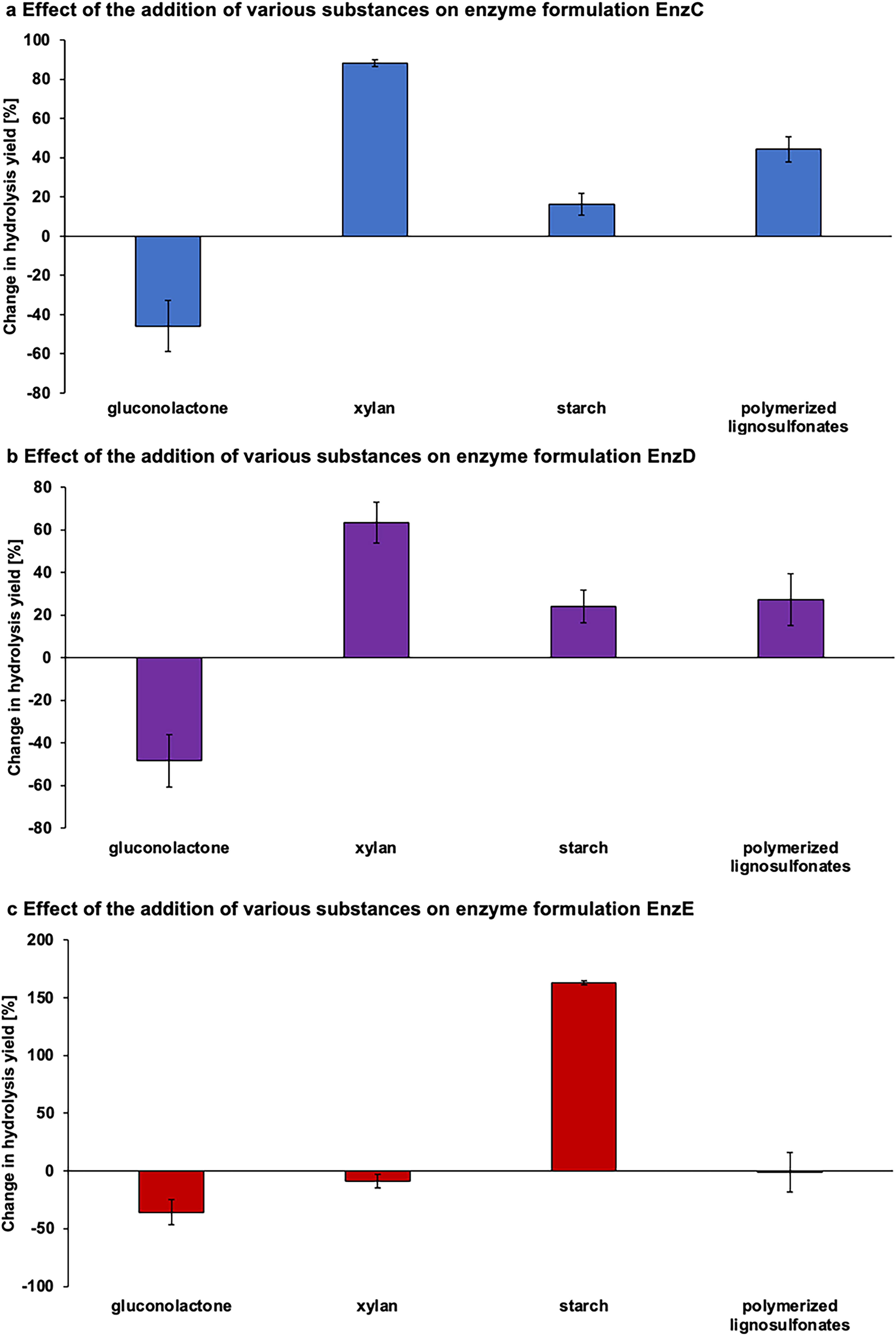
Effect of different substances on the hydrolysis of paper by the commercial cellulolytic enzyme formulations EnzC (
A substance that potentially has an effect on the biodegradation of cellulose-based materials is starch, as it can be degraded by microorganisms and is already part of many biodegradable materials. 21 –23 In addition, starch is often used during papermaking to increase the strength of paper sheets. During this process, starch with a combination of hydrophobic nanoparticles is applied on the surface (“surface sizing”), which contributes to the overall stiffness. 24 Therefore, starch is already present in a variety of cellulose-based materials and might have an impact on biodegradability. Starch is an excellent carbon and energy source for a variety of different microorganisms that use enzymes such as α-amylases or glucoamylases to obtain glucose, which would potentially enhance biodegradation. 25,26 Commercial enzyme formulations often contain starch-degrading enzymes such as amylases and the resulting glucose monomers subsequently contribute to the signal of the DNS assay. Indeed, the enzymatic hydrolysis of the base paper was enhanced after addition of starch to EnzC (+16.4%) and EnzD (+24.1%). Interestingly, also the hydrolysis by the commercial endoglucanase was enhanced (+163%) upon addition of starch, which suggests that this enzyme preparation may contain starch-degrading enzyme activities. However, to further investigate the effect of starch addition, the activity of all formulations on starch was tested in absence of any base paper, which allows the subtraction of the signal increase of cellulase activity caused by the enzymatic degradation of the added starch (see Supplementary Table S2 of the supplementary material). Indeed, the enzyme activities increased for all enzyme formulations in the presence of starch (EnzC: +12.1%, EnzD: + 7.1%, EnzE: + 36.0%), which confirms the enhancing effect of starch on cellulase activity. Moreover, activity measurement with the endoglucanase-specific substrate CellG5 confirmed an increase of endoglucanase activity in the presence of starch (see below). A similar behavior was observed in a study investigating the cellulase activity of white rot fungi on starch, while it is also known that starch induces the production of cellulases in microorganisms. 27,28
Xylan is a representative of hemicelluloses and carries different substituents (e.g., arabinose, glucuronic acid, and acetyl groups). Some amount of xylan remains in paper products after pulping/bleaching, resulting in improved strength properties. In nature, xylans are hydrolyzed by different enzymes including endo-β-1,4-xylanase, β-xylosidase or α-
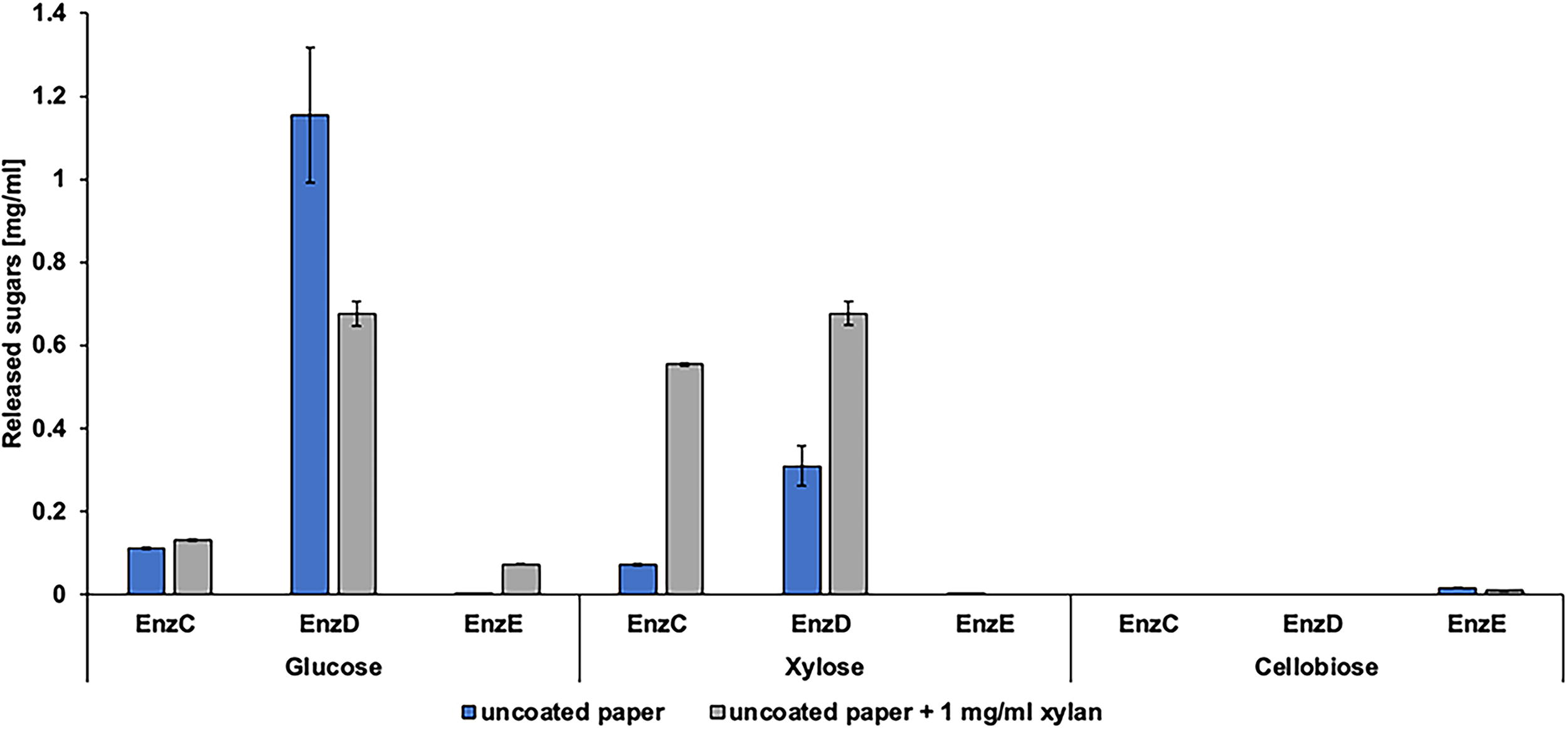
Release of glucose, xylose, and cellobiose from paper in the absence and presence of added xylan using the commercial enzyme formulations EnzC, EnzD, and EnzE in mg/mL as measured by HPLC. HPLC, high-performance liquid chromatography.
To investigate the effect of β-glucosidase enzymes on the hydrolysis of the base paper, gluconolactone was added to suppress the β-glucosidase enzyme activity (Fig. 1). The release of reducing sugars from the base paper was in fact decreased considerably, having the highest effect for the hydrolytic formulation EnzD (−48.33%) and EnzC (−45.85%). Interestingly, also the commercial endoglucanase was inhibited by gluconolactone addition (−35.69%), which could be explained by a small amount of β-glucosidase enzymes that could not entirely removed during the production process for this commercial endoglucanase formulation. The inhibiting effect of gluconolactone proves the importance of β-glucosidase enzymes on enzymatic saccharification.
As next step, the effect of polymerized lignosulfonates was investigated (Fig. 1). Lignosulfonates are the major by-product of sulfite pulping in the pulp and paper industry and make up around 90% of the commercially available lignin. Lignosulfonates are now used as plasticizers or dispersants as an effort to use these waste substances to form new products instead of the environmentally harmful incineration. 37 Lignosulfonates contain sulfonate and carboxylic acid groups, which makes them water soluble. For example, lignosulfonates contain sulfonic acid groups in the range between 0.83 and 1.78 mmol/g. 38 Due to the hydrophilic and hydrophobic groups, lignosulfonates have the ability to influence enzymatic hydrolysis processes. It was shown that lignosulfonates enhance the activity of cellulases by increasing their productive adsorption, whereas nonproductive binding is reduced by electrostatic repulsion forces between cellulase enzymes and lignin. 37,39 –41 On the contrary, it was reported that lignosulfonates can inhibit enzyme activity. However, studies investigating this ambivalent effect concluded that the inhibitory effect of lignosulfonates was present when the concentration was under a certain threshold and was caused by competitive inhibition, which blocks the binding domain of the enzymes. At higher concentration of the lignosulfonates, the enzymes are stabilized by shielding them from air exposure and by reduction of nonproductive binding effects, as electrostatic repulsion and hydrophobic forces are reduced. 42,43 Polymerized lignosulfonates are obtained by enzymatic polymerization using enzymes such as laccases, yielding insoluble polymers that are then applied in coatings, some of which have been used to partially replace latex in paper coatings. 7,44 The addition of polymerized lignosulfonates could therefore lead to the acceleration of the biodegradation in soil in the case enhanced enzyme activity is actually measured, thus improving recyclability of respective products. Indeed, the increase in enzyme activity in the presence of lignosulfonates was also visible in our study. The highest elevation was caused by EnzC (+44.44%) and EnzD (+27.27%), whereas the activity for the commercial endoglucanase was in fact decreased by the addition of lignosulfonates (−1.08%).
EFFECT OF ENZYME FORMULATIONS ON THE HYDROLYSIS OF PAPER SHEETS COATED WITH SELECTED SUBSTANCES
As a next step, those polymers enhancing cellulose hydrolysis in the initial screening, namely starch and polymerized lignosulfonates, were coated onto separate base papers and changes in the enzymatic hydrolysis of the individual coated papers were determined once more (Fig. 3). Gluconolactone was again assessed as an inhibiting control. In agreement with the results obtained for simple addition of these polymers, both starch and polymerized lignosulfonates enhanced enzymatic hydrolysis of the coated paper, whereas the effect was more pronounced for lignosulfonates, except for EnzE, for which lignosulfonates also enhanced hydrolysis but only slightly (+22.0%). To account for reducing sugars potentially released by the coatings themselves, blank measurements were performed, and the DNS solution was calibrated based on the target coating amount. However, for starch only neglectable release was observed; therefore, the correction was mainly applied for polymerized lignosulfonates. The highest increase of almost 50% was seen for the hydrolysis of paper coated with polymerized lignosulfonates by EnzC. Expectedly, coating of the base paper with gluconolactone resulted in decreased enzyme activity for all investigated enzyme formulations with highest decrease seen for the endoglucanase formulation EnzE (−56.2%) (Fig. 3c). The activity of EnzC was decreased by 37.60% and that of EnzD by 25.63%. These results confirm the trend seen in the initial screening.
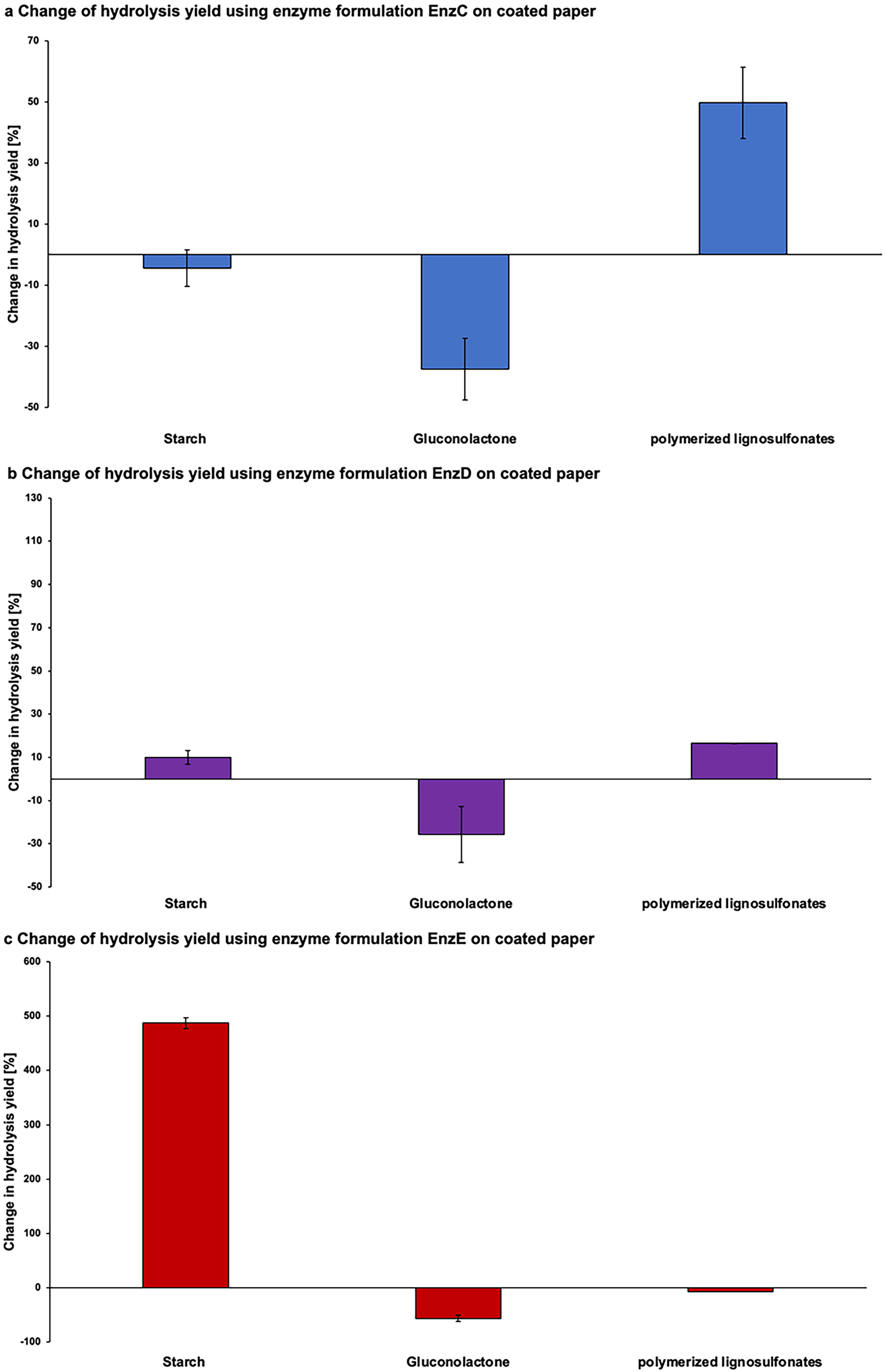
Effect of different substances coated onto paper on hydrolysis by the commercial cellulolytic enzyme formulations (
DETERMINATION OF ENDOGLUCANASE AND β-GLUCOSIDASE ACTIVITY IN SOIL
In order to correlate the biodegradation efficiency of paper-based products in different environments (i.e., soil), the effect of enhancing polymers on enzyme activities from these respective environments was assessed. However, the DNS-based assay cannot provide detailed knowledge about the effect of individual enzymes such as endoglucanase or β-glucosidase enzymes. Hence, more specific assays for individual enzymes involved in cellulose hydrolysis were applied. Endoglucanases are one of the main drivers in cellulose degradation as they cut cellulose chains within amorphous regions. 45 –47 For the determination of endoglucanase activity, the specific derivatized cellopentaose substrate CellG5 was used, as it enables a quick, specific, and simple application, when mixed with soil, excluding matrix effects. The CellG5 substrate was modified to only allow endoglucanases to hydrolyze it, whereas enzymes such as β-glucosidases, cellobiohydrolases, or xylanases are excluded, which makes it especially useful for the determination of enzyme activity in microorganism-rich soil. Indeed, an endoglucanase activity of 0.248 nkat/g soil was measured in 50 mM citrate buffer (pH 4.8).
Another important enzyme contributing to the overall hydrolysis of cellulose is β-glucosidase, which is essential for the conversion of cellobiose to glucose, Glucose is subsequently metabolized by the respective microorganisms. 48 –50 In soil, a β-glucosidase activity of 0.018 nkat/g soil was determined, which is lower than the measured endoglucanase activity (0.25 nkat/g soil). However, the exact enzyme activity ratio is strongly dependent on the composition of the microbial community in soil with a study showing a similar behavior for bacterial clusters while fungal clusters or combined bacterial and fungal clusters exhibited a higher β-glucosidase than endoglucanase activity. 51 Enzyme activities such as from β-glucosidases are often used as soil health indicators to give information about the soil productivity (e.g., for crops), as the activity is influenced by environmental factors such as temperature, moisture content, or soil organic content. Especially β-glucosidases are related to changes in organic matter. For example, β-glucosidase activity is known to be higher in soils from natural vegetation compared with soils used for monocultures. 52 –54
EVALUATION OF THE EFFECT OF SELECTED POLYMERS ON ENDOGLUCANASE AND β-GLUCOSIDASE ACTIVITY
As next step, the effect of starch and polymerized lignosulfonates on the hydrolysis activity of soil endoglucanases was tested (Fig. 4a). Indeed, in agreement with the results obtained for commercial enzyme preparations, both starch and polymerized lignosulfonates significantly enhanced hydrolysis activity of soil endoglucanases. Enhanced enzymatic saccharification in the presence of lignosulfonates has been previously reported for commercial cellulase preparations and is assumed to be caused by lignosulfonates acting as surfactants that reduce nonproductive binding of cellulases. 55 –57 Similarly, cellulose and starch-degrading enzymes are secreted by microorganisms such as the filamentous fungi Streptomyces and Aspergillus, and these enzymes contain carbohydrate-binding modules, which have the task to bring the enzymes in proximity to their target substrates. This could explain the increased endoglucanase activity after starch addition as either the enzymes or the microorganisms as a whole are brought in close proximity to the derivatized cellopentaose CellG5 substrate, which is used for this assay. Similarly, the cellopentaose substrate could have bound to starch, thus facilitating its accessibility to endoglucanases. 58 –60 Gluconolactone was not tested in this case, as excess β-glucosidase enzymes are added for this assay to release nitrophenol from the endoglucanase hydrolyzed cellopentaose chains.
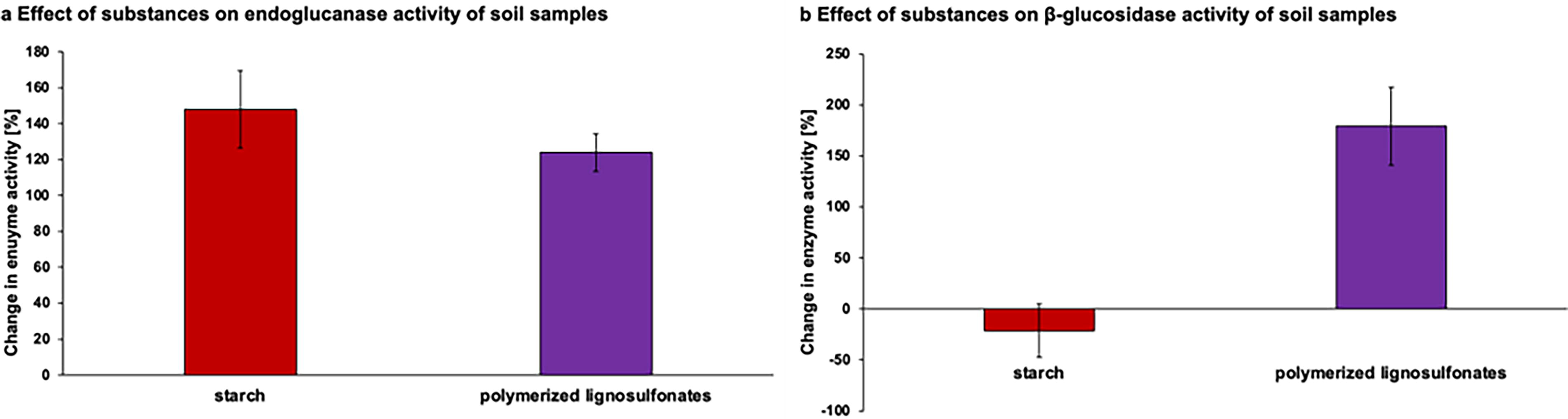
Effect of starch and polymerized lignosulfonates on soil endoglucanase (
Finally, the effect of starch or polymerized lignosulfonates on β-glucosidase activity was investigated. Although the addition of polymerized lignosulfonates increased soil β-glucosidase activity (+179.17%), no significant effect was seen for starch in contrast to endoglucanase activity (Fig. 4b).
TRADITIONAL BIODEGRADATION TRIALS OF COATED BASE PAPER IN SOIL
To confirm the correlation of the enzyme-based screening method with the biodegradation behavior of coated paper, degradation trials in soil were performed (Fig. 5). One efficient way to evaluate the integrity of paper is the measurement of tensile strength, which decreases in an advanced stage of degradation. 6,61 Indeed, the tensile strength of the noncommercial base paper decreased considerably after 3 days (−12.60%) and even more after 6 days (−68.74%). This was even more the case after starch was coated, resulting in a decrease of 22.16% after 3 days and unmeasurable tensile strength due to heavy degradation after 6 days, which is in accordance with the results of the enzyme-based screening. When gluconolactone-coated papers were placed in soil, the degradation was expectedly slowed down (Fig. 5), but this was only seen after 6 days of incubation. Interestingly, there was an increase in tensile strength after 3 days for gluconolactone (+8.1%), which could be explained by different starting values due to contact of the paper strips with water and also because the coating of the paper with gluconolactone itself slightly changes the paper properties. However, after 6 days, gluconolactone-coated paper strips resulted in the lowest decrease of the tensile strength (65.8%), clearly confirming that soil β-glucosidases (obviously inhibited by gluconolactone) influence biodegradation.
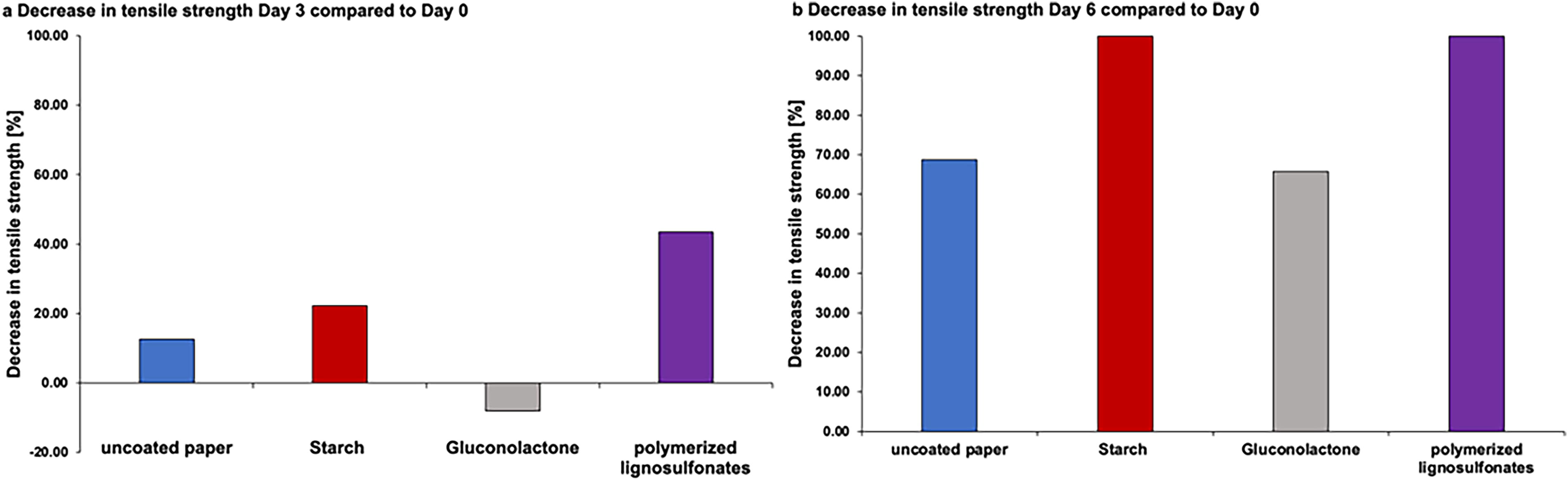
Biodegradation trials of the uncoated base paper as well as papers coated with starch, gluconolactone, or polymerized lignosulfonates in soil. (
For microorganisms, the enzymatic conversion of cello-oligosaccharides to glucose is essential for their survival. This is achieved by the action of β-glucosidase enzymes, which convert the cello-oligosaccharides that were released by endoglucanases to glucose. This confirms the crucial role of β-glucosidase enzymes that are renowned inhibited by gluconolactone.
The coating with polymerized lignosulfonates led to the highest degradation after 3 days (43.45%), while the tensile strength was completely lost after 6 days (Fig. 5). Several studies indicated a promoting effect of lignosulfonates on the growth of the microalga Botryococcus braunii or the fungal mycelium Pisolithus tinctorius, which suggests that these microorganisms can benefit from lignosulfonates through enhanced enzymatic saccharification. Similar behavior was observed for lignolytic bacterial strains such as Streptomyces or Bacillus, which are abundant throughout soil. 62 –64 Overall, the incubation of coated paper sheets with the commercial formulation EnzC most accurately correlated to the outcome of the actual biodegradation in soil.
Conclusions
The screening of novel materials, for example, developed for packaging applications for their biodegradability is still quite time consuming, as it requires long-lasting biodegradation trials in soil. In addition, the specific composition of the microbial communities in different environments may lead to different biodegradation times. In this study, it was shown that cellulase enzyme formulations can indeed be used to screen cellulose-based materials potentially entering the environment for their biodegradability, while results are already obtained within 1 hour instead of several days as it is required for traditional biodegradability trials using buried paper strips in soil. In addition, the effect of several polymers potentially enhancing biodegradability on the activity of commercial cellulase formulations was tested, to demonstrate that the developed method can also be applied to screen novel cellulose-based materials for enhanced recycling capabilities. The addition of starch or polymerized lignosulfonates to the standard enzyme assay indeed considerably enhanced activity. Likewise, hydrolysis of paper coated with starch or polymerized lignosulfonates by these enzyme preparations was enhanced. These results were confirmed by traditional biodegradation trials in soil after which the same polymers led to faster biodegradation. To account for the activity of individual soil microbial populations, β-glucosidase and endoglucanase activities of soil were measured using specific substrates and again the same trend regarding the effect of starch and polymerized lignosulfonates enhancing activity was found. In future experiments, the in vitro screening strategy could be expanded to enzymes from different environments (e.g., marine) as well as to other polymers as useful tool to conduct biodegradation screening during product development.
Footnotes
Acknowledgments
The authors are grateful to the company Sappi for providing their scientific contribution as well as the (coated) paper materials.
Authors’ Contributions
M.N.: Writing—original draft, methodology, investigation, formal analysis, data curation, conceptualization, and project administration. R.P.: Supervision, conceptualization, formal analysis, writing—review and editing, and project administration. N.S.: Supervision, methodology, and formal analysis. M.H-K.: Supervision, methodology, and formal analysis. G.M.G.: Conceptualization, supervision, formal analysis, writing—review and editing, and funding acquisition.
Author Disclosure Statement
R.P., N.S., and M.H.-K. were employed by the company Sappi. The remaining authors declare that the research was conducted in the absence of any commercial or financial relationships that could be construed as a potential conflict of interest.
Funding Information
The
Supplementary Material
Supplementary Table S1
Supplementary Table S2
Supplementary Figure S1
Supplementary Data
References
Supplementary Material
Please find the following supplemental material available below.
For Open Access articles published under a Creative Commons License, all supplemental material carries the same license as the article it is associated with.
For non-Open Access articles published, all supplemental material carries a non-exclusive license, and permission requests for re-use of supplemental material or any part of supplemental material shall be sent directly to the copyright owner as specified in the copyright notice associated with the article.
