




Abstract
The human population has reached 8 billion, which is more than carrying capacity of biosphere. The increasing population produces mammoth amount of waste specifically nutrient rich biodegradable food waste and nondegradable synthetic polymers waste. Plastics and polymers are an inevitable part of our day-to-day existence. However, as they are derived from fossil fuel they are nondegradable, unsustainable and pollute the environment. In contrast biopolymers, which are obtained from plants and microorganisms, can be viable preferences to synthetic polymers. Biopolymers produced by marine bacteria not only are attractive substitutes to unsustainable and nondegradable synthetic polymers but can also be produced through environment friendly microbial bio-factories as part of integrated bioprocesses. These biopolymers produced by marine bacteria are novel with wide and varied applications. However, principle difficulty in bacterial biopolymer production is high cost of production media which mainly due to high carbon requirement of microorganisms for efficient biopolymer production. With increasing population, enormous amount of food and dairy waste are generated globally. These food and dairy wastes have high content of organic matters such as carbohydrates, proteins, and lipids. The disposal of these nutrient rich food and dairy waste is costly and if not disposed appropriately, causes pollution. However, the high carbon content of food and dairy waste make them ideal and cheap alternatives of carbon substrate for exopolysaccharides and polyhydroxyalkanoates production by microorganisms. The utilization of food waste for formulating the production medium for biopolymer production by microorganisms would substantially reduce the production cost of microbial polymers; additionally, it would deal with the complex issue of managing food waste by effectively recycling the food industry waste for production of valuable microbial biopolymers. The use of food and dairy waste for biopolymer production would thus be an excellent model of circular resource utilization.
Synthetic Polymer Waste: An Issue of Concern
Polymers are large class of materials, which consist of many monomers that are linked together to form long chains. Polymers are inevitable part of our daily existence and have wide array of applications in different domains of science, technologies, and industry—from basic uses as polymers for packaging to advanced uses as therapeutic polymers. 1
With escalating human population reaching 8 billion the demand for polymers is also substantially increasing. Every year worldwide production of synthetic polymers is around 140 million tons. A large part of these synthetic polymers end up as plastic waste in environment. More than 10 million metric tons of plastic ended up into the oceans during 2018 alone, and it is estimated that 13 billion tons of plastic waste will reach the environment by 2050. These synthetic polymers and plastics are very stable in biosphere, and their bio degradation cycles in the environment are indefinite. Degradation of environment and pollution of biosphere by recalcitrant synthetic polymers and plastics has been recognized as a major global problem. Due to their extreme stability and nondegradable nature, synthetic polymers are known to accumulate in our biosphere, at the rate of around 8% by weight and approximately 20% by volume of the landfills. 2
The conservative technology to deal with the management of polymer waste includes recycling, landfilling, and incineration of synthetic polymer waste. However current trends for dealing with plastic and polymer waste include their use in Polymer Blended Bitumen Road, Co-processing of polymer waste as alternative fuel or raw material, plasma pyrolysis technology and conversion of plastic waste to liquid fuel. 3
Apart from their role as recalcitrant pollutants in environment another point of concern is that majority of synthetic polymers are derived from fossil fuels. Due to extensive consumption of fossil fuel, the concentrations of CO2 and CH4 in the atmosphere have significantly increased to the level of causing catastrophe of climate change. The accelerated depletion of fossil fuel reserves and their mounting adverse effects on the environment are the key driving forces to replace petroleum and fossil fuel-based synthetic polymers by natural biopolymers. 4
Microbial Biopolymers: A Sustainable Option
Biopolymers are polymeric biomolecules made from monomeric units that are covalently bonded to form larger molecules. The term biopolymer is used to designate an extensive array of materials obtained from biological sources like microorganisms, plants, or animals.”
5
Biopolymers are produced by living organisms with the help of diverse enzymes which link the basic building blocks such as amino acids, sugars, and hydroxyl fatty acids to generate biomolecules with high molecular weight. Biopolymers are biodegradable, biocompatible, and can be engineered or modified, and hence biopolymers procured from animals, plants, and microorganisms are sustainable, viable and appealing options instead of synthetic, fossil fuel-derived polymers. But in the current global scenario of climate change, the use of plant and animal sources for providing biopolymers for industrial use is non-sustainable. The low crop yields, increased land cost, increasing energy and transport costs, uncertainty in climate, etc. hinder the use of plant and animal sources for biopolymer supply. Hence there is massive interest for alternative and more reliable sources of biopolymers.
6
In this context, bacterial biopolymers are the best option in present times. Biopolymers produced by bacteria are attractive alternatives to synthetic and nondegradable polymers and can be manufactured through environment-friendly bio-factories and refineries as part of integrated bioprocesses.
4
Biopolymers produced by bacteria are advantageous over synthetic polymers, as they are biodegradable, nontoxic, biocompatible, and have no adverse or hostile effects in the environment and biological systems. Bacteria are known to synthesize a diverse array of biopolymers, namely, Polyamides—which are polymers of amino acids linked to each other via peptide bonds, Polysaccharides—which are polymers of sugars or sugar acids linked to each other via glycosidic bonds, Polyphosphates—which are polymers of inorganic phosphates linked to each other via anhydride bonds, and Polyesters—which are polymers of hydroxyl fatty acids linked to each other via ester bonds.
7
These polymeric substances produced by bacteria have many important biological functions, such as attachment and adhesion, storage of energy, protection in adverse conditions, and are major components of biofilm matrix. The physicochemical properties of these biopolymers are crucial for bacterial behaviors, like adhesion and attachment onto biotic or abiotic surfaces, invasion, defense, persistence, and translocation. 4 The synthesis of these biopolymers is also synchronized in response to several environmental stimuli. 8 Among the different biopolymers produced by bacteria exopolysaccharides (EPS) and polyhydroxyalkanoates (PHA) have wide range of applications in diverse sectors.
The complex biopolymers produced by microorganisms are described by the term Microbial EPSs. They accumulate and mount in the surrounding environment of the producing cells. The microbial EPS has distinct physical–chemical properties of polysaccharides, such as increased water retention capacity, unique rheology, film-forming capacity, and good mechanical and tensile strength. The microbial EPS also has a wide range of functional groups which allow their modifications, feature modulation, and provide strong biocompatibility. Due to their unique structural and physical properties, microbial EPSs have wide applications in various sectors, such as agricultural biotechnology, beverages, cosmetics, detergents, food, textiles, paper, paint, petroleum, pharmaceutical, and in medical industries for drug delivery and cancer therapy. Some of the applications of microbial EPS include their use as binding agents, coagulating agents, emulsifying agents, film formers, gelling agents, lubricating agents, stabilizing agents, suspending and thickening agents, and also as support or scaffolds in tissue engineering, drug delivery, and wound dressings. 9 –11 The various applications and properties of EPS are depicted in Figure 1.
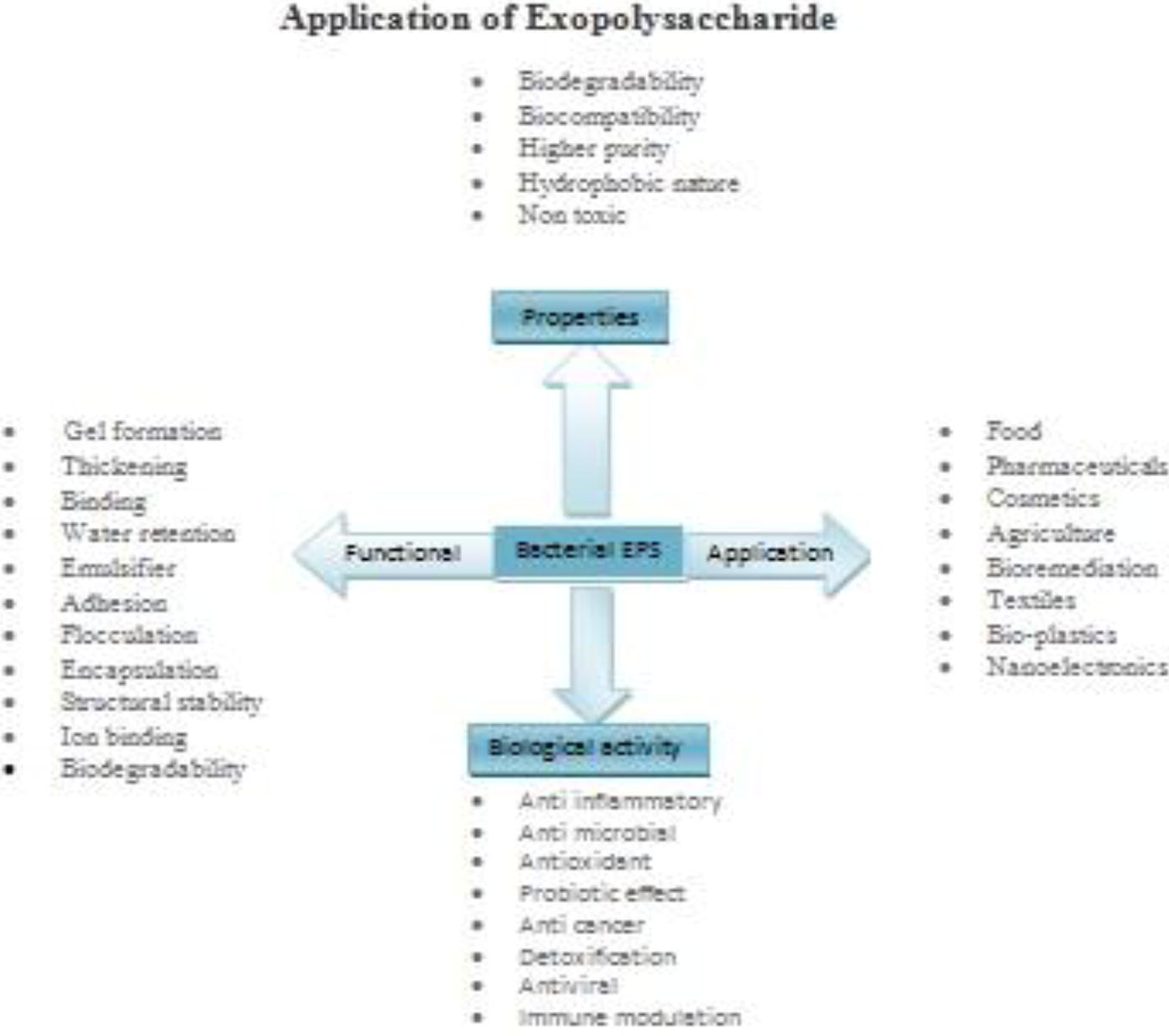
EPS Applications.
EPS are promising alternatives to chemical polymers due to their bioactive role. Additionally, their ease of extraction and purification, biocompatibility, biodegradable nature, enhanced efficiency, better and improved physical properties, reproducible physicochemical properties, edibility, and non-toxicity to both humans and environment along with a plethora of applications in various sectors make these biopolymers very attractive targets for mass production. Thus mass production of these biomolecules is gaining a lot of interest and momentum. 12
PHAs, such as poly((R)3-hydroxybutyrate), are biodegradable polymers synthesized by bacteria. They are essentially bioplastics or biological polyesters synthesized by microorganisms. They are intracellular, non-branched linear polyesters which are synthesized and assembled into hydrophobic globular inclusions. Many bacteria and archaea accumulate PHA’s as intracellular inclusion bodies to levels as high as 90% of the cell dry weight when carbon source is in excess but other nutrient such as oxygen, phosphate, nitrogen, and sulfur supply are in limiting condition. The PHAs serve as carbon and energy storages for the producing cells. The accumulation of PHAs helps bacteria maintain their structural integrity and function in stressful conditions. 13,14 The PHAs have properties similar to petrochemical thermoplastics combined with environmental friendly properties such as biodegradability, biocompatibility, and nontoxicity. 15 This unique blend of properties makes them innovative biopolymers with diverse and novel applications in many sectors. They have been considered as unique and distinctive biologically produced plastics which can be bioengineered, modified chemically, and transformed into high-value commodities which have applications in medical fields such as sutures, scaffolds for tissue engineering, drug delivery, drug carriers, and particulate vaccines. Additionally PHA can also be processed to generate low-value commodities such as bioplastics in food packaging as well as packaging and coating material for other sectors. The various applications of PHA are depicted in Figure 2. 16
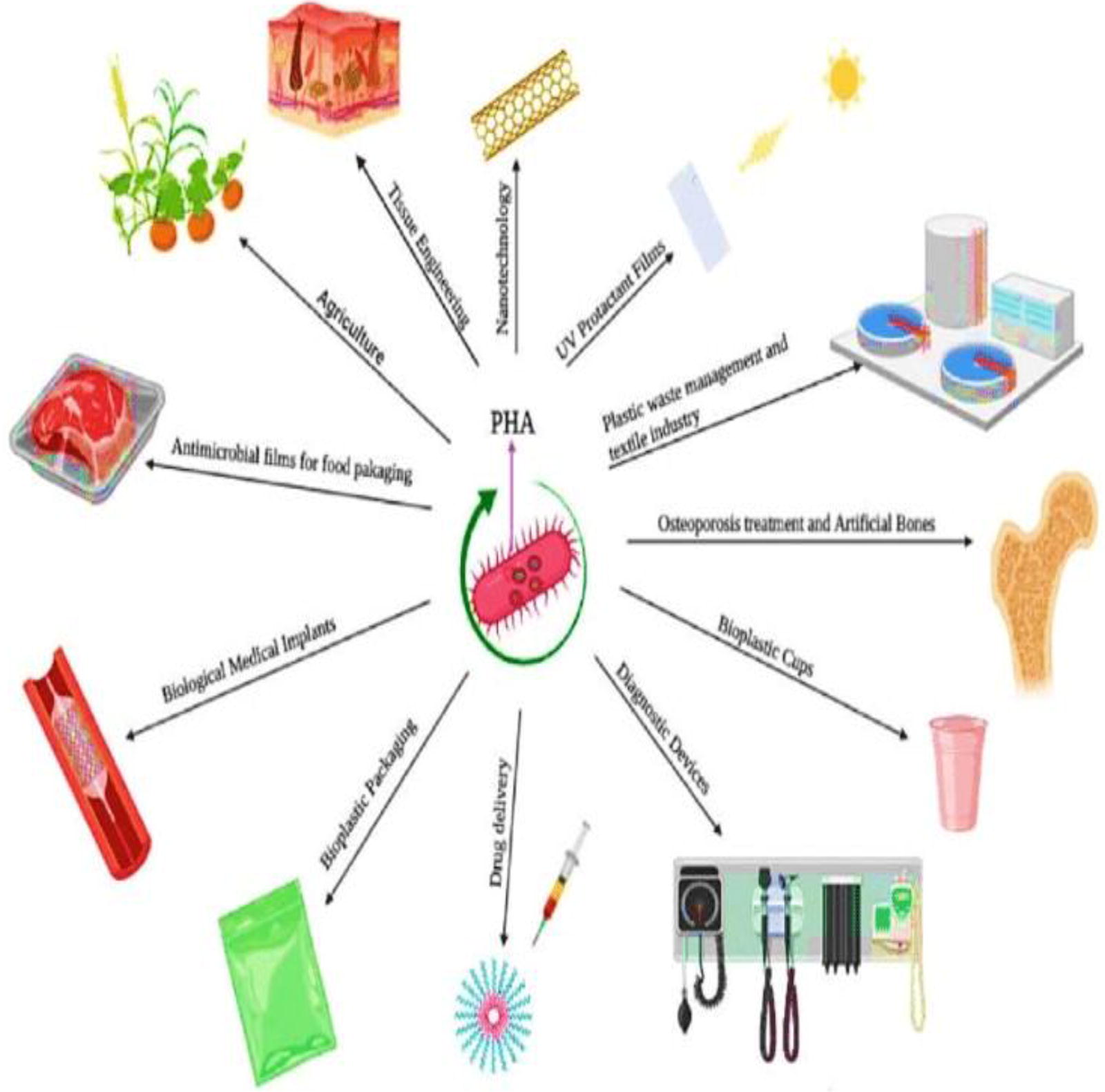
PHA applications.
Thus microbial EPS and PHA have wide applications in many sectors. The current thrust area in biopolymer sector is large-scale, economical, and cost-effective production of bacterial EPS and PHA. In this context, the conversion of carbon-rich food and agricultural waste to biopolymers is a viable, eco-friendly alternative to petropolymers and is currently gaining a lot of interest in the field of industrial applications and waste management.
Halophiles and Halotolerant Microorganisms: Abundance and Survival Strategies
The biosphere comprises of three major habitats, out of which seas and oceans account for as much as 70% of the Earth’s surface. Oceans with a coastline of 312,000 km (193,000 miles) and a volume of 137 × 106 km3 are the largest ecosystems on the earth and have been used for a variety of purposes by mankind since millennia. 17 In marine benthic sediments, microbial life substantially contributes to the global biomass and is a vital component of the Earth’s systems. Presently the estimated number of microbial cells in marine benthic sediments is around 2.9 × 1029 to 5.4 × 1029 cells, which corresponds to 0.18 to 3.6% of Earth’s total living biomass. 18
Halotolerant and halophilic microorganisms inhabit marine sediments. The microorganisms which have a requirement or need of salt for their survival and growth are termed as halophiles, whereas microorganisms that are able to grow in the absence as well as in the presence of salt are non-halophilic microorganisms but are designated as Halotolerant. In accordance to the most frequently used definition,
19
one can differentiate between Slight halophiles as organisms which grow best in medium having 1–3% w/v NaCl. Moderate halophiles organisms which grow best in medium having 3–15% w/v NaCl. Extreme halophiles organisms whose optimal growth is in medium having 15–30% w/v NaCl.
19
Similarly there are several categories of halotolerant microorganisms as well, Non-halotolerant, organisms which can tolerant or withstand only small concentration of about 1% w/v NaCl w/v. Slightly halotolerant, organisms which can tolerate or withstand 6–8% w/v NaCl w/v. Moderately halotolerant, organisms which can tolerate or withstand 18–20% NaCl w/v. Extremely halotolerant, which can grow and tolerate a wide range of salt concentrations from zero to saturation.
11,20
The organisms thriving at extremely high salt concentrations have adapted two fundamentally different strategies for their survival, and they use either of two mechanisms for maintaining osmotic balance.viz.: (i) salt-in-cytoplasm strategy—These organisms are obligate halophilic; they accumulate high molar concentrations of potassium and chloride in their cytoplasm. The strategy of accumulating high intracellular concentrations of potassium and chloride requires extensive adaptation of the intracellular enzymatic machinery to the presence of high salt concentrations, as all the proteins would be required to sustain their proper conformation as well as activity at near-saturating salt concentrations. The proteome of these organisms would be highly acidic and would be denatured if exposed to low salt concentration.
(ii) organic-solute-in strategy—These organisms are halotolerant, and intracellular accumulation of high salt concentration in the cytoplasm of organisms is prevented either by biosynthesis and/or accumulation of highly non-charged, water-soluble osmotic organic solutes. The proteome of these organisms remains largely unmodified, and they can grow and survive over a broad range of salt concentration from zero to near saturation. 19
The diverse approaches evolved by halophilic and halotolerant organisms for growth and survival in highly saline environments have led to the production of many novel enzymes and metabolites, which can be explored and exploited for variety of biotechnological applications.
Halophiles and Halotolerant Microorganisms: Source of Novel Biopolymers
The marine microorganisms also produce many novel biopolymers. The crucial property of marine polymers that are synthesized by the variety of halophilic and halotolerant microorganisms is their net negative charge, which is attributed to the number of anionic groups (e.g., COO−, C–O−, SO4
2−). Additionally, EPS produced by marine bacteria typically contains higher levels of uronic acids,
The EPS produced by marine bacteria has many applications and uses. They can be used for metal bioremediation and microbial enhanced oil recovery (MEOR). EPSs from marine bacteria have promising applications in the pharmaceutical industries and medical sector. Additionally, EPS from marine organisms are used to prepare composites which improve their biomedical applications such as drug delivery, scaffolding, surgical sealants, tissue engineering, and repair. The sulfated acidic heteropolysaccharide produced by archaeon Haloferax mediterranei has a high viscosity at low concentrations, has excellent rheological properties, it is resistant to extremes of pH, and temperature and has application to enhance oil recovery from low-productivity oil wells. 21 The Halomonas maura produces Mauran which is polyanionic and sulfated EPS which has several intriguing properties such as antioxidant, antihemolytic, and antithrombogenic activities. The EPS Mauran produced by Halomonas maura also exhibits emulsifying properties and has pseudoplastic behavior and can be used for bioremediation and MEOR. The EPS produced by a marine Vibrio strain has antitumor, antiviral, and immunostimulant activities and has the potential to be developed into a therapeutic agent against cancer. The Alteromonas infernus-derived EPS is oversulfated and can augment the proliferation of human umbilical vein endothelial cells and can be useful for speeding vascular wound healing. 22 The Aphanothece halophytica a halophilic unicellular cyanobacterium found in a hypersaline environment produces sulfated polysaccharide with immunomodulating properties which when administered orally in mice, significantly inhibited pneumonia induced by influenza virus H1N118.The EPS produced by Planococcus maitriensis Anita I isolated from the coastal sea water area of Bhavnagar (India) had oil spreading potential comparable to Triton X100 and Tween 80, which would make it suitable for bioremediation, enhanced oil recovery, and cosmetic applications.
Many halophilic bacteria are known to produce PHA. The ability of halophilic organisms to thrive and produce PHA at high salinity is very advantageous, as there is reduced risk of contamination allowing the process to be carried out in open non-sterile condition. 23 Additionally, at high salinity, the recovery cost of PHA would be reduced, as cells can be easily lysed in normal water due to high intracellular osmotic pressure. There are many reports on PHA production by halophilic organisms. The Haloferax mediterranei synthesizes PHBV and poly (3-hydroxybutyrate-co-3-hydroxyvalerate-co-4-hydroxybutyrate). 24 It grows in simple media at high salt concentration with sugars or starch as cheap carbon sources and produces 38% of the cell dry weight as PHA. Halomonas boliviensis can accumulate PHA up to 88% of its dry weight when grown on Acetate, Butyrate or Sucrose as carbon sources. 21 H. alkaliantarctica and H. desertis G11 produce PHA utilizing crude glycerol. 13,25 More than 150 different types of PHA have been identified, and different types of PHA can be produced by varying the fermentation conditions. The PHAs are bioplastics having properties comparable to thermoplastics along with being biodegradable and biocompatible. Depending on their composition and properties, applications of PHA range from their use in biodegradable packaging, to use as chemical additives, to usage in the fields of medicine, agriculture, wastewater treatment, and cosmetics. 25
Although there are many reports regarding novel properties and applications of marine biopolymers, their potential is yet underexploited. The marine bacteria from coastal regions can be isolated and screened to develop microbial cell factories producing biopolymers of interest at competitive and economical costs.
Challenges in Microbial Biopolymer Production
However, the commercial production of biopolymers requires huge amount of energy in the form of a carbon source, which makes the production process very expensive and costly. Much of the total production cost for biopolymers is for the carbon source in the nutrient media. The principal carbon substrates used for the commercial production of biopolymers are carbohydrates such as sucrose and glucose. However, alternative cheaper substrates with high carbon content can be exploited for enhanced biopolymer production which would significantly reduce the production cost of microbial biopolymers. 26 The food wastes from fruit, vegetable, and dairy have high organic matter content and are rich sources of carbon and can be explored as a cheap alternative for biopolymer production.
Food Waste: An Environmental Concern
A huge volume of waste is generated by the food industry round the globe every year. The unceasing rise in world human population has prominently increased the demand for food supply and subsequently has increased food wastage through food supply chain. Food losses ultimately include wasting of critical resources such as land, water, fertilizers, chemicals, energy, and labor. 27 Food losses culminate in environmental pollution and dire scarcity of natural resources. Recycling and reuse of resources are the major pillars of circular economy which focuses on the retrieval of energy and resources from food waste for sustainable environment. 28
Food wastes have abundant amount of organic matters such as carbohydrates, proteins and lipids. Management of such waste, rich in organic matter is a crucial matter for food industries. Since the food waste have very high organic matter content, disposal of such waste is a complex problem in terms of costs as well as in terms of environmental pollution. Usually, the disposal of waste generated from food industries is done by conventional methods, such as land filling, spreading, composting, incineration. It is also a customary practice to use food waste as a low quality animal feed. But dumping and abandoning of these food wastes in open environment can have several adverse environmental effects: It emits a filthy odor, it is a source of greenhouse gases, and also creates a big nuisance and problem by attracting birds, rats pigs and vectors of numerous diseases. 12
Food Waste as Substrate for Biopolymer Production: A Viable Option
The fruits and vegetables processing industry, cafeteria, and fruit juice vendors produce huge quantities of waste in form of fruit pulps, fruit peels and seeds. 29 These waste peels, pulp, and have high content of simple sugars of in range of 69–93 g L−1 which mainly include glucose (17–23 g L−1) and fructose (29–53 g L−1). Due to their high sugar and organic matter content these waste require extensive treatment for reducing their BOD to acceptable limits. Clearing of such food waste is an environmental problem and economically costly and due to their characteristics high organic matter content these wastes have constrained applications, such as bio fertilizer and fodder. However, such sugar rich waste can be an excellent, ideal and cheap source of carbon for biopolymer production. 30 The microorganisms can easily utilize such carbon rich fruits waste as a carbon and energy source to produce biopolymers and range of secondary metabolites. 26 The utility of fruits waste as an alternative substrate for biopolymer production has several distinctive advantages like its non-toxicity, biocompatibility, cheap and easy availability. The transformation rate of carbon rich food waste by microorganisms is as high as 70%. Bacteria can easily metabolize constituents like carbon, nitrogen, cellulose, hemicellulose, lignin, pectin, vitamins, moisture, minerals, ash content existing in fruit wastes and can produce industrially important products like EPS and PHA. Exploring and exploiting such carbon rich food waste in designing production medium for biopolymer production not only makes the production medium simpler, nutritive and cheaper but also makes the recovery and purification of biopolymer simpler. 30
Whey is a major by-product of the dairy industry, which is obtained during cheese production. It is also an attractive preference for developing media for biopolymer production, as it accounts for around 80% to 90% of the processed milk and comprises about 55% of milk nutrients. Cheese whey is an abundant source of nutrients and constitutes of lactose (4.5%–5%), soluble proteins (0.6–0.8%), lipids (0.4–0.5%), and mineral salts (0.5–0.7%) as well as many other minor constituents such as lactic and citric acids and vitamins of B group. Yearly the global dairy sector produces tonnes of whey as waste which is approximately more than 140 million tonnes. This whey has extremely high biological oxygen demand (BOD) and chemical oxygen demand (COD) levels. The BOD values range from 27 to 60 kg/m3, and COD value is around 50 to 102 kg/m3. The whey from the dairy industry is thus very problematic to dispose of, and its treatment/disposal is a matter of concern for the dairy industry as well as the environment. However, since whey has high carbon content and is the rich source of amino acids too, it can be exploited for EPS and PHA production. The utilization of whey for biopolymer production would substantially reduce the expense of microbial nutrient media which is mandatory for the overall economic efficiency of commercial biopolymer prodction. 9 The use of whey can also to a certain extent recycle the waste of dairy industry.
The agro-waste such as milk whey, citrus fruits, olive mill wastewater, pineapple waste, beet molasses, potato starch waste, sugarcane vinasse, date syrup, and rotting tropical fruits has been widely used as cheap carbon sources for enhanced production of EPS by marine microrganisms. 31 Instead of using pure sugars in production media for biopolymer production, the utilization of food and dairy industry waste as carbon substrate would considerably reduce the cost of biopolymer production, as waste from the food industry can be procured at much less cost or zero cost as compared to pure sugars, it would also be of interest to food industry as for food industry it would save the complexities of waste treatment and disposal. The yield of different EPS is depicted in Table 1 and is reported to be in the range of 0.2–60 g/L, depending on the carbon substrate and producing organism. 33 The production cost of EPS has been reported around $0.95/L. 35 Gudiña et al. have reported a 30% decrease in the cost of Exopolysaccharide Production by Rhizobium viscosum CECT908 using medium developed from Corn Steep Liquor and Sugarcane Molasses as sole substrates. The cost of pure glucose in the study was 0.8 €, which can be completely nullified by using waste from food and dairy industry. The cost of synthetic medium for production of 1 kg EPS was reported to be 86.37 €, which was reduced to 2.82 € if sugar cane molasses and corn steep liquor was used to formulate the medium for EPS production by Rhizobium viscosum. 36,37 Veerapandian et al. have reported a 20% reduction in the cost of microbial levan production using sugarcane (Saccharum spp.) juice and chicken feather peptone as a low-cost alternate medium. The cost of sucrose was considered as 45 Rs/Kg. The cost of synthetic medium for production of 1 kg levan was reported to be 122.43, which was reduced to 97.39 if sugar cane juice was used to formulate the medium. The xanthan gum is EPS produced by Xanthomonas, which has diverse applications in many industrial sectors. The commercial production of Xanthan is being done by Deosen Biochemical (Ordos) Ltd., which uses corn starch as a carbon source, fish meal and soybean meal powder as a nitrogen source for xanthan production by fermentation.
The EPS Yield from Microorganisms
EPS, exopolysaccharide.
Similarly, waste from the food industry such as whey, cassava starch, palm oil, tallow, wheat bran, rice straw, sugar cane molasses, sugarcane bagasse, and date palm syrup has been extensively used for PHA production by marine microorganisms. 38,39 The yield of PHA from different microorganisms is depicted in Table 2 .The yield of PHA in terms of cell dry weight is reported to range from 50 to 90% and the average production cost of PHA has been reported to range from $8–11.6/kg. 41 The production cost of PHA/PHB can also be significantly reduced by using food waste as a carbon source instead of pure sugars or nutrients. The production cost of PHA and PHB when using pure glycerol and glucose as carbon substrates was reported to be $6.72/kg and $7.87/kg, respectively. The cost of glycerol and glucose in the study was estimated to be at $0.53/kg and $0.77/kg, respectively. This production was significantly reduced from $6–7 to $1.77 when using food industry waste for production of PHB31. The commercial production of PHA from Halomonas spp. is being done by the Chinese company Bluepha, which uses agricultural feed stocks such as starch, sugar cane waste, and vegetable oil for PHA production.
The PHA Yield from Microorganisms
PHA, polyhydroxyalkanoate.
The production cost of biopolymers can be substantially reduced, and the carbon conversion rate to biopolymers can be improved by expanding the variety of valuable products obtained from a single batch of fermentation. Simultaneous production of two or more microbial products through the same process is desirable due to the potential reduction in production cost and simplicity of operation. 4 Since the EPS is extracellular and PHA is intracellular, there is good potential for the coproduction of EPA and PHA from same process. The dual production of EPS and PHA has been reported for Azotobacter chrococcum and Azotobacter beijerinkii. 4 The halophilic Halomonas smyrnensis has also been reported for the coproduction of PHB and levan. 34 Although coproduction and dual production of EPS and PHA/PHB are reported for many organisms, the production medium for dual production of biopolymers generally uses pure and expensive carbon sources and nitrogen sources which increases the production cost of biopolymers. The use of carbon-rich food waste has not been attempted for coproduction of EPS and PHA/PHB. In this context, there is promising prospective for developing the production media for the coproduction of EPS and PHA, utilizing cheap and easily available food waste as carbon source. The coproduction of two polymers from medium-developed food waste can significantly improve the carbon conversion ratio and profitability of process.
The marine bacteria are known to produce novel EPS and PHA, but their potential is underexploited due to the bottleneck of high production cost, mainly the cost of carbon in production medium. However, the waste from fruit, vegetable, and dairy industry has ideal characteristics for EPS and PHA production. The use of such waste can serve dual purpose of significantly reducing the production cost of these biopolymers and solving the issue of waste disposal by effectively recycling the waste into valuable by-products. Additionally, the use of food waste in the production medium for the coproduction of two biopolymers would make the process economically more profitable.
Conclusion
The human population, which has reached 8 billion, generates a mammoth amount of Synthetic polymer waste, which is nonbiodegradable and pollutes the environment. Food waste which has high organic and carbon content is biodegradable and can be recycled/reused for the production of value-added components.
Microbial biopolymers are the need of time. They have extensive applications and can completely replace synthetic polymers, but their production is not economically viable because of the high production cost of media, mainly due to the high carbon requirement.
The production cost of microbial polymers can be substantially reduced by the use of medium developed from food waste, which will benefit at multiple levels by: Significantly reducing the production cost of biopolymer. Solving the issue of food waste disposal by effectively recycling the waste into valuable by-products. Reducing pollution by replacing synthetic polymers with microbial biopolymers. Being an excellent model of circular resource utilization.
Footnotes
Acknowledgments
The authors are thankful to the
Author Disclosure Statement
The authors would hereby like to declare that there is no conflict of interests that could possibly arise.
Funding Information
The authors are thankful to the Gujarat State Biotechnology Mission (GSBTM) for providing funds for the research work Rs 3567356.