




Abstract
Lipopeptides are key elements in the formation of monolayer and bilayer phospholipid membranes, by which the dynamic strength, balance of acting forces, interaction modes, and arrangement patterns are maintained within phospholipid and epithelial cells. This review focuses on the production, structural characterization, and application of lipopeptides produced by various species of bacteria, which are grouped into three classes: surfactin, iturin, and fengycin. These compounds have tremendous potential in biomedicine. A cyclic lipopeptide correlated with peptides with heuristic structures of a functional spectrum, such as surfactin, the cyclic heptapeptide iturin, and the antifungal lipopeptide fengycin. Structural elucidation will be performed via advanced high-performance liquid chromatography, mass spectrometry, nuclear magnetic resonance, and Fourier transform infrared spectroscopy techniques to elucidate the peptide and fatty acid compositions of the lipopeptides in detail. This review has also considered the high-throughput screening methods thus far applied in identifying microorganisms that produce lipopeptides and the role of genetic manipulation in improving the productivity of lipopeptides. The elucidation of their structure and complex composition via chromatographic and spectroscopic techniques highlights the complexity of lipopeptide analysis. These biomolecules find applications as antibacterial, antiviral, and antifungal therapies in drug delivery systems and as bioactive agents in various industrial processes. Owing to their advantages in the encapsulation and transportation of bioactive substances, their prospective application in medicine and pharmaceuticals has increased.
Introduction
Lipopeptides are a class of compounds that are amphiphilic in nature and participate in the formation of monolayer and bilayer phospholipid membranes. 1 They play a very important role in the dynamic strength, balance of forces, forms of interaction, and patterns of arrangements within the phospholipid membrane and epithelial cells. 2 The presence of free radical conjugating groups makes phospholipid membranes capable of undergoing continuous-phase transitions. This feature allows them to encapsulate bioactive molecules in liposomes and deliver drugs and prodrugs. 3 Fluorescent dyes and radioactive compounds are used to map the pathways of biomaterials in living organisms, and by linking ligands to copolymer structures, their self-assembly can be labeled. 4 It can be exploited in the study of structure formation via the use of copolymer molecules in the formation of liposomes or micelles, which are then detected via colorimetry or fluorescence. Micelles generally work in circumstances involving the immune response to optimize localized activity and, therefore, the sensitivity of drugs or prodrugs while reducing systemic cytotoxicity through their release above a critical concentration. The oxidoreduction of transgenic acids, peroxidants, oxidants, and high concentrations of metabolic wastes, including nitric oxide, sulfur oxide, and oxidized heme, is among the reversible consequences of inducible growth factors that cause cytotoxicity in cells.
Lipopeptides are very effective chemicals that play crucial roles in preventing cellular and nuclear damage.
5
They achieve this through the interaction effects between chains and the development of functional molecular assemblies. It is a specialized type of molecule that can exist as a dimer, trimer, or oligomer. This molecule can selectively target and bind to certain regions of viral or microbial gene segments, such as virility histones, microbial DNA polymerases, and RNAases. The conjugated lipopeptides organized in structured micelles display three unique characteristics. They can induce the transformation of cis isomerization to trans isomerization and trigger the d or l configuration. They can exert a lytic effect similar to that of peptidyl-peptidase enzymes or act through multiple carboxyl groups, such as decarboxylase enzymes. They are capable of signaling other entities or biomolecules.
Signal lipopeptides can be detected via several chromatographic techniques, including gel chromatography and high-performance liquid chromatography (HPLC), which have been proven to be successful. Designing lipopeptides that mimic the structure of cerebrospinal fluid can effectively induce neuron responses, including lymph transduction signals. Their ability to form amphiphilic barriers prevents the attachment of cofactors and reduces the adhesion of apoptotic effects caused by mutant estrogen steroids. This effect is more noticeable at higher levels of lipophilicity in micelles. 3
TYPES OF LIPOPEPTIDES
There are three main categories of lipopeptides: surfactin, iturin, and fengycin. These lipopeptides are synthesized by different species of bacteria. 6
Surfactin
Surfactin, a kind of cyclic lipoheptapeptide, is with a molecular weight of approximately 1.36 kDa. The primary structure of the enzyme is composed of Glu-Leu-Leu-Val-Asp-Leu-Leu amino acids and is amphipathic in nature. The sequence is connected through the β-hydroxy fatty acid chain of 12–16 carbon atoms, forming a special kind of cyclic lactone ring structure as indicated in Figure 1. While the identical amino acid sequence is present in the Bacillus sp. strain and is named AMS-H2O-1, the type of surfactin is governed by the sequence of amino acids and the size of the lipid portion. 8 Hydrophobic amino acids in this surfactin molecule are located at positions 2, 3, 4, 6, and 7, while Glu and Asp residues are found at positions 1 and 5, respectively. In most instances, surfactin isoforms will be found in cells as a mixture of many peptidic variants that have different lengths of aliphatic chains. There is thus variation in the concentration of amino acids and β-hydroxy fatty acids in the surfactin molecule dependent on the bacterial strain and specific growth conditions. Commonly, the formation of β-turn happens via the intramolecular hydrogen link, while the β-sheet formation relies on the intermolecular hydrogen bond. 9 –12

Cyclic structure of surfactin. 7
Iturin
Iturin is distinguished from the other two lipopeptide classes by having a comparatively low molecular mass of approximately 1.1 kDa. Iturin A primarily comprises two parts: a hydrophobic tail with 11–12 carbon atoms and a peptide section with seven amino acid residues (Fig. 2). The structure of this molecule indicates that it is amphiphilic, meaning that cell membranes are more prone to being its site of action. 13 The iturin lipopeptide is a cyclic heptapeptide linked to a chain of β-amino fatty acids; this chain can have carbon atoms in the chain ranging from C-14 to C-17. A class of compounds possessing great biological and physicochemical properties is of particular interest for their application in the food, oil, and pharmaceutical industries. All strains of the species Bacillus subtilis synthesize this class of lipopeptides. Specifically, the 38–40 kilobases iturin operon contains four open-reading frames: ituA, ituB, ituC, and ituD. 14 –17
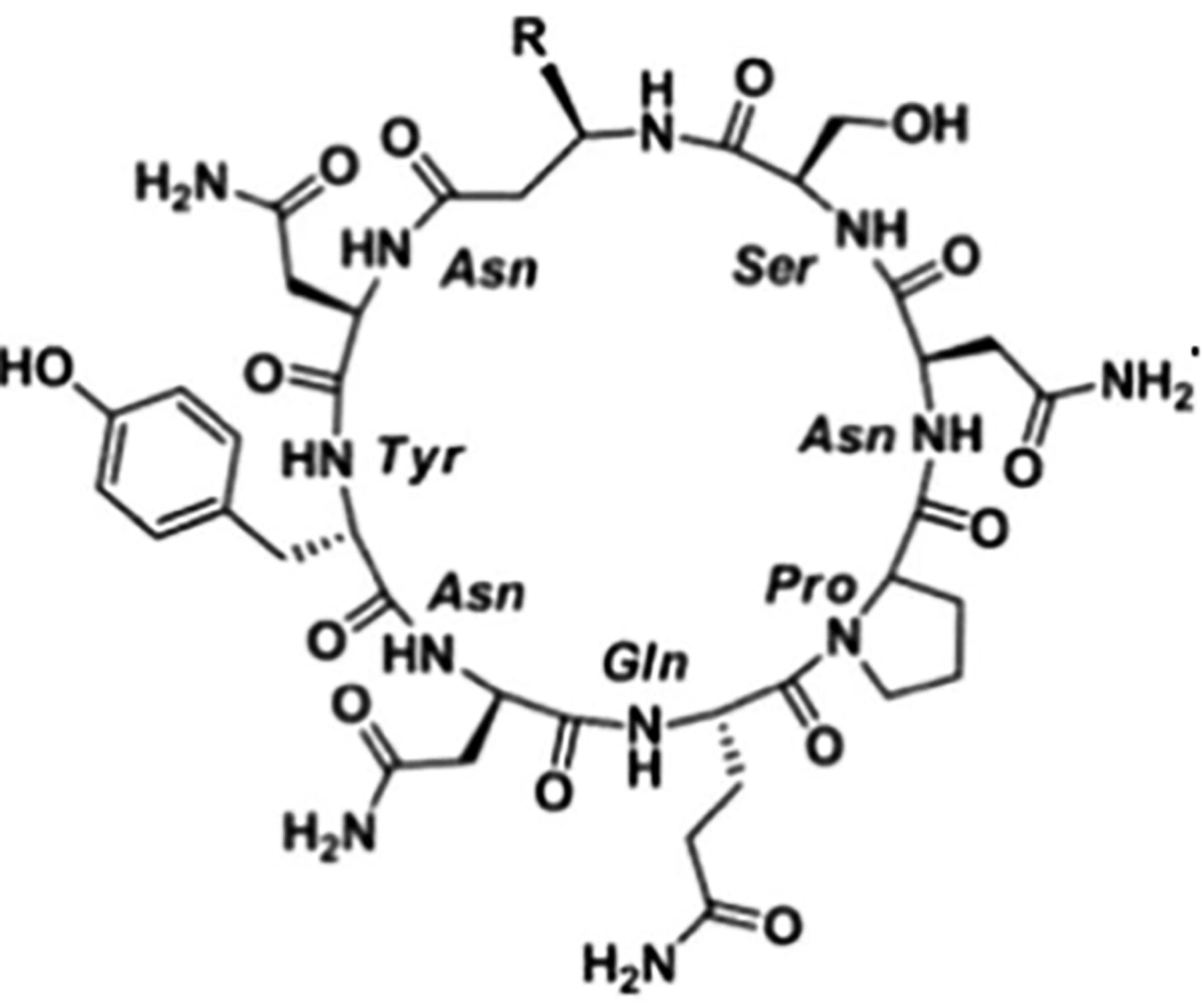
Cyclic structure of iturin. 13
Fengycin
Fengycin is a biologically active lipopeptide synthesized by many strains of B. subtilis. 18 It has antifungal properties against filamentous fungi. It is referred to as plumastatin and is classified into the third family of lipopeptides, following surfactin and iturin (Fig. 3). The bioactive compounds mentioned are lipodecapeptides that consist of a lactone ring in the β-hydroxy fatty acid chain. 20 The fatty acid chain can be either saturated or unsaturated. Fengycin is composed of a peptide chain consisting of 10 amino acids connected to a fatty acid chain. 21 Fengycins can have fatty acid chains ranging from C-14 to C-17 carbon atoms, resulting in the formation of several homologous molecules and isomers. Fengycins are cyclic decapeptides that are generated through lactonization. The peptide component of the fengycin lipopeptide is composed of a chain of 10 amino acids. 22 Within this chain, eight specific amino acids (Tyr, Thr, Glu, Ala, Pro, Gln, Tyr, and Ile) participate in the creation of a peptide ring. The phenolic-OH group of Tyr3 and the C-terminal-COOH group of Ile10 create a lactone bond that results in the creation of this ring. The fengycin family members show variation in the length of the β-hydroxy fatty acid chain, which may range from C-14 to C-17 carbons, as well as in the sixth position of the peptide component. A single amino acid alteration at the sixth position in the peptide ring divides fencing into two classes: fencing A and fencing B. Position 6 in fencing A contains alanine, whereas position 6 in fencing B has valine. 23

Cyclic structure of fengycin. 19
Isolation of Biosurfactant-Producing Microorganisms
Many different approaches have been developed to isolate and screen microorganisms that produce biosurfactants (BSs). Some of these approaches are more prevalent than others. While some of these techniques are often used, others have not been subjected to as much scrutiny. 24 Hence, this review primarily concentrates on innovative high-throughput technologies and avoids discussing these techniques. 25 Figure 4 shows the typical steps in the BS research workflow, which include microbial isolation, screening, and identification of BS-producing strains. All around the globe, people have been collecting soil and water samples to isolate various microorganisms, including bacteria, archaea, and fungi. 26 While some environmental isolates may cause BS, it is usually a small fraction. Interestingly, the utilization of enriched hydrocarbon cultures can significantly increase this percentage, reaching 80%. 27 In samples obtained from locations contaminated with hydrocarbons or heavy metals, the percentage can even reach 25%. 28,29 Numerous microbiological methods have been developed to isolate BS-producing microorganisms from ambient samples (A) and achieve pristine colonies (C). The next step is to test certain microbes for BS production via one or more high-throughput screening (HTS) methods (D). D1 follows the identification of BS-positive strains (e.g., by 16S rDNA sequencing). Additional BS production confirmation is needed. BS/lipopeptide (LP) production is feasible in a conventional laboratory Erlenmeyer flask (F). A variety of isolation and purification procedures can be used to obtain a compound (G) that is free of contaminants and suitable for use in various tests. The regular procedure for finding and studying BS/LP is shown in Figure 4. 30

A regular procedure for finding and studying BS/LP. BS/LP, biosurfactant/lipopeptide.
All methods used to screen BS producers can isolate and analyze only microbes that can be grown artificially. It is also possible that the preliminary cultivation conditions and media of the isolates affect their metabolism and BS production. 31 Nothing has been extensively used in metagenomics screening for bacteria that produce BS. Owing to the high homology of nonribosomal peptide synthetases (NRPS) operons across species, the abundance of primers in the literature and the ability to utilize tools and databases such as NRPS prediction, anti-SMASH, and Basic Local Alignment Search Tool (BLAST), LP manufacturers may find it advantageous to employ such a strategy. This might be the most economical and successful way to examine LP/BS generated by microorganisms in various settings. 32
The isolation and growth of pure microbiological cultures are necessary before screening and further analysis. Microbes are cultured and isolated via standard microbiology methods. For example, diluted samples of water or soil are plated on several agar plates. After a few days of incubation, single colonies are moved to liquid media to develop bacteria independently. 33 A well-liked substitute for this customary procedure is enjoyment culturing. 34 Microbes that break down hydrocarbons flourish in settings where the primary carbon source is a liquid medium. The samples used for enrichment culture were diluted and then plated on agar. Although there are always exceptions to the norm, the synthesis of BS has been connected to microbial growth on hydrophobic carbon substrates.
Although documented, high-throughput isolation procedures could yet be developed. It is possible to cultivate these uncultivable BS-producing bacteria via high-throughput isolation techniques. 35 These techniques may be used to determine the distribution of BS producers across various niches and identify unknowns involved in BS production.
Screening of BS-Producing Microorganisms
Several very efficient direct and indirect approaches (Table 1) may be used to test for BS production by growing isolates and isolating single, pure colonies. The screening procedures have changed in recent years. Below is a summary of these updated indirect (Table 1) and direct (Table 2) techniques.
Indirect, Novel Screening Methods Are Used for Revealing Biosurfactant-Producing Microbes
BS, biosurfactant.
Direct, High-Throughput Screening and Emerging Methods Designed for the Fast and Accurate Detection of Lipopeptide or Lipopeptide-Producing Microorganisms
ACN, acetonitrile; HPLC, high-performance liquid chromatography; LC–MS, liquid chromatography–mass spectrometry; LP, lipopeptide; LP/BS, lipopeptide/biosurfactant; MALDI-TOF, matrix-assisted laser desorption ionization time-of-flight; MS, mass spectrometry; NRPS, nonribosomal peptide synthetases; PrISM, proteomic investigation of secondary metabolism; RP-HPLC, reversed-phase high-performance liquid chromatography.
Indirect screening methods are employed to detect all categories of surfactants simultaneously, whereas direct methods are limited to detecting only one category at a time. 38,45 These methods offer initial data on the kinetics and yield of bacterial production, but they can produce inaccurate qualitative results, either indicating the presence of bacteria when there are none (false positive) or failing to detect bacteria when they are present (false negative). 34,37 Additionally, these methods may underestimate or overestimate bacterial yields. Additionally, these methods vary in their sensitivity and are not appropriate for HTS. 44
Indirect screening methods may detect changes in microbial culture surface characteristics or emulsification or antimicrobial/hemolytic activity in culture supernatants for preliminary bacterial screening. 46 Nevertheless, indirect screening techniques have numerous drawbacks and are being replaced by direct approaches, which can address diverse inquiries and reveal supplementary characteristics, such as structural information. When determining the most appropriate method, it is important to consider a specific scientific question. 41
The screening process is crucial for optimizing bacterial research, and each method has advantages and disadvantages. 47 Using a two-part screening approach is advised as a very effective and efficient strategy. Initially, a HTS technique was employed to evaluate a substantial number of isolates with heightened sensitivity and minimal likelihood of encountering erroneous positive or negative outcomes. 48 Drop collapse, microplate assays, PCR, and mass spectrometry (MS) provide the ability to screen isolates on a large scale. The method selected should consider the researcher’s proficiency in a microbiological laboratory, the availability of the required tools, and the number of isolated bacteria that need to be accurately and sensitively examined.
Subsequent processing is required for the isolated and selected BS-positive isolates in the secondary screening phase to confirm BS production, identify the type of BS produced, and quantify and/or measure BS activity. Assessing the surface tension or emulsification activity of clarified microbial cultures is a frequently used assay for confirming BS production and estimating BS yield and/or activity. However, BS extraction followed by thin-layer chromatography (TLC) is a method that is frequently employed to clarify broad details regarding the composition of active substances. 49 Recent developments in the field, such as HPLC/UPLC, LC–MS, or MS, show great promise because of their exceptional sensitivity, excellent precision, and strong automation capabilities. The use of absorbance or MS data will make it possible to identify and measure bacterial synthesis (LP). Additionally, the structure of active compounds can be resolved by adapting MS/MS spectra. MS-based procedures necessitate advanced equipment, a proficient workforce, and the capacity to analyze substantial volumes of data produced. 50
In situ genome analysis allows for the identification of certain microbes, an advantage over the traditional API-testing method, which is time-consuming and laborious. Recently, novel automated high-throughput MS-based methods have been developed that can potentially identify hundreds of microorganisms in a single experiment. 33 One can compare the results with databases to accurately identify bacteria at the subspecies level.
Cultivation of Microbes for the Production of LP
To study new LPs/BSs for their structure and function, the development of effective methods for the production and purification of LPs/BSs by microorganisms is necessary. Optimal growth conditions and culture media are necessary for efficient LP production. For this reason, optimizing culture conditions and nutrients is crucial, resulting in an extremely fascinating field of study. 34 Numerous microorganisms, including those belonging to the genera Bacillus and Pseudomonas, are used for the production of LPs. 14,35,36 pH, culture oxygenation, fermentation temperature, and nutrient composition are a few of the variables that appear to be important in the biosynthesis of LPs. The pH should be between 6.0 and 7.0, or neutral, to support the culture’s maximum productivity and efficiency. Furthermore, none of the nutrient sources should prevent bacteria from growing. 37 It is also important to choose media carefully because it has been suggested that complex and rich media can impede the production of long players. Finally, 30°C was the ideal cultivation temperature for most LP producers. 38,39
Choosing the appropriate culture media is a crucial step in effectively producing a sufficient quantity of LP/BS for analysis. 51 Minimal mineral salt media (MSM) are frequently employed for the synthesis of BS, typically comprising buffered salts, a carbonaceous substrate, and a nitrogenous substrate. Supplementing MSM with trace elements has been shown to increase LP production. Additionally, the addition of small quantities of complex additives can also increase bacterial growth and LP production. 52 –54
To achieve maximum productivity, carefully choosing the most suitable medium and cultivation conditions for each LP/BS producer is necessary. The process of determining the most suitable medium is typically conducted in standard laboratory Erlenmeyer flasks by altering one factor (such as the type or concentration of the carbon source) at a time. Oxygenation can be regulated by modifying the agitation speed or by employing baffled flasks. 46,55,56
The optimization process for the production of BS involves evaluating the LP/BS production to identify the most favorable conditions. 57,58 The quantitative techniques used for LP/BS screening can be effectively modified to measure BS accurately. Nevertheless, it is prudent to consider less complex and more cost-effective techniques, such as microplate meniscus shape or atomized oil HTS tests, especially when there are constraints in obtaining laboratory equipment. 13
Fermentation Processes of Lipopeptides
SUBMERGED FERMENTATION
Submerged fermentation is a widely used method for the production of lipopeptides, in which microbial growth takes place in a liquid nutritional solution. It is possible to maintain and manage environmental conditions, such as pH, temperature, and oxygen, which are crucial for maximizing production and quality. 59 The submerged fermentation method offers significant advantages because of its ability to provide efficient scaling-up and seamless integration with automated systems, enabling large-scale production. 60
SOLID-STATE FERMENTATION
Solid-state fermentation is the method of cultivating microorganisms on solid surfaces without any assistance from the liquid phase. This technique showed very good results in the synthesis of lipopeptides. Specific lipopeptides are generally produced in traces under submerged conditions. 61 Agro-industrial wastes can serve as substrates for solid-state fermentation, making the process both environmentally sustainable and cost-effective. 62 On the contrary, if parameters like moisture level and availability of air are uniform throughout, it could raise some issues. 63
LAB-SCALE PRODUCTION
Small-scale fermentation setup
A small-scale fermentation system is important in preliminary studies toward optimization. This will often include a setup with shake flasks or small-scale bioreactors, which enables measurement and manipulation of key parameters. 64 It is rather a vital step toward the realization of the microbial growth pattern and preliminary capacity for the production of lipopeptides under different conditions. 65
Process parameters and monitoring
Regulation and monitoring of pH, temperature, dissolved oxygen levels, and nutrient levels are required for the effective synthesis of lipopeptides. Precise measurement of and control over process parameters guarantee the most optimal development of microbial cultures and the highest amount of desired lipopeptides. 66 Advanced sensors and data acquisition systems have consistently been utilized at the laboratory level to ensure precise process control. 67
Yield analysis
Yield analysis quantifies the amount of produced lipopeptide under different cultivation conditions. This is an important process in fermentation processing since it deals with the assessment of process efficiency and adjusting process parameters. 68 The concentration and purity of the generated lipopeptides are ascertained using analytical techniques such as HPLC and MS. 69
LARGE-SCALE PRODUCTION
Scale-Up strategies
Transitioning from the laboratory scale to the industrial scale necessitates careful attention to specific parameters, including maintaining similar environmental conditions, optimizing mixers, and enhancing aeration. 70 Typically, strategies for scale-up involve gradually increasing the amount of fermentation medium and utilizing pilot-scale bioreactors. These measures help identify potential issues before moving on to full-scale production. 49
Industrial bioreactor design
Industrial bioreactors have been designed to efficiently handle substantial amounts of fermentation media while maintaining precise control over the surrounding conditions. In terms of design, factors such as the type of mixing system, the method of aeration, and the choice of materials used to achieve durability and efficiency are important. 71 Advanced monitoring and control devices are necessary to maintain optimal conditions during fermentation in bioreactors. 65
Process control and optimization
The implementation of sophisticated control systems is an integral part of large-scale production, enabling real-time monitoring of parameters and facilitating necessary adjustments for process control and optimization. 72 Several techniques were used to improve the effectiveness and dependability of lipopeptide synthesis including model-based control, feedback, and process analytical technology. 73
DOWNSTREAM PROCESSING
Extraction techniques
The extraction methods refer to the specific techniques employed to extract lipopeptides from fermentation broth. The techniques include solvent extraction, precipitation, and membrane filtration. 74 Hence, the extraction method can be selected on the basis of the properties of the extracted lipopeptide and the composition of the fermentation medium. Ensuring high purity of recovered lipopeptides is crucial, and this requires efficient extraction. 50
Purification methods
While alternative purification methods exist, their importance lies in effectively isolating lipopeptides from other biological constituents and impurities. Chromatography can be performed via various techniques, including HPLC, ion-exchange chromatography, and electrophoresis. 49 The objective remains to achieve a high level of purity and adequately prepare the lipopeptides for subsequent utilization. 50
Gene Cloning and Expression
IDENTIFICATION OF KEY GENES
The initial stage of genetic engineering for increased production involves the identification of the primary genes responsible for lipopeptide biosynthesis. The methods used to identify the specific genes responsible for the production of lipopeptides involve genome sequencing techniques, gene knockout, and transcriptome analysis. 39
CLONING VECTORS AND HOST STRAINS
Each of these genes is separately inserted into appropriate host strains via a cloning vector. Plasmids, bacteriophages, and artificial chromosomes are all examples of vectors. To maximize the production of lipopeptide genes, it is imperative to meticulously choose a host strain that is highly suitable for overexpression. 51
EXPRESSION AND PRODUCTION ENHANCEMENT
The production of lipopeptides has been significantly enhanced through the application of synthetic biology and genetic engineering techniques. The initial step in this process involves the identification of key genes responsible for lipopeptide biosynthesis. 75 Advances in genome sequencing, transcriptome analysis, and gene knockout studies have enabled researchers to pinpoint these genes. For example, in B. subtilis, the itu operon, comprising ituA, ituB, ituC, and ituD, is responsible for iturin production, while the srf operon encodes enzymes for surfactin biosynthesis. 76 Bioinformatics tools such as Anti-SMASH and BLAST have further facilitated the identification of NRPS genes, which are critical for lipopeptide synthesis. 77 –79 Once the key genes are identified, they are cloned into suitable vectors, such as plasmids, bacteriophages, or artificial chromosomes, and introduced into host strains for overexpression. The choice of host strain is crucial, as it must support high levels of gene expression and be amenable to genetic manipulation. Commonly used hosts include B. subtilis, Escherichia coli, and Pseudomonas putida. Recent advancements in synthetic biology, such as modular cloning systems like Golden Gate and Gibson assembly, have streamlined the construction of complex genetic circuits for lipopeptide production. 80,81
To further enhance lipopeptide production, several genetic engineering strategies have been employed. Promoter engineering involves the use of strong, inducible promoters (e.g., P_veg, P_spac) to drive the expression of lipopeptide biosynthetic genes. Synthetic promoters with tunable strength have also been developed to optimize gene expression levels. 82 Codon optimization is another strategy, where the codon usage in target genes is adjusted to match the host strain’s tRNA pool, improving translation efficiency and protein yield. Metabolic engineering has been used to modify host strain pathways to increase the availability of precursors, such as fatty acids and amino acids, required for lipopeptide biosynthesis. 83 For instance, overexpression of acetyl-CoA carboxylase in B. subtilis has been shown to enhance fatty acid precursor production, leading to higher lipopeptide yields. The CRISPR-Cas9 genome editing system has also been employed to knock out competing pathways or introduce beneficial mutations in host strains. For example, knocking out the rocR gene in B. subtilis has been shown to increase surfactin production by redirecting metabolic flux toward lipopeptide biosynthesis. 84 Heterologous expression is another approach, where lipopeptide biosynthetic genes from one organism are expressed in a non-native host. This has been successfully demonstrated by expressing the srf operon from B. subtilis in E. coli, resulting in surfactin production. Directed evolution techniques, such as error-prone PCR and DNA shuffling, have been used to generate mutant libraries of lipopeptide biosynthetic genes, leading to the identification of hyperproducing strains.
Synthetic biology has further revolutionized lipopeptide production by enabling the design and construction of synthetic gene clusters. These synthetic clusters can be tailored to produce novel lipopeptides with enhanced bioactivity or improved physicochemical properties. For example, combinatorial biosynthesis has been used to generate hybrid lipopeptides by combining modules from different NRPS gene clusters. 85 Additionally, synthetic regulatory elements, such as riboswitches and small regulatory RNAs, have allowed for the fine-tuning of gene expression in response to environmental cues. Despite these advancements, challenges remain in the field. The complexity of lipopeptide biosynthetic pathways, the need for efficient host strains, and the difficulty in scaling-up production are significant hurdles. Future research should focus on developing robust host strains, optimizing fermentation conditions, and integrating omics technologies (e.g., genomics, transcriptomics, and metabolomics) to gain a deeper understanding of lipopeptide biosynthesis. 86 The application of machine learning and artificial intelligence in strain design and pathway optimization also holds great promise for the future of lipopeptide production. 52
Isolation and Purification of LP
Following a successful production process, efficient purification is necessary to obtain pure compounds that can be used for structural or physical analyses. Therefore, it is necessary to employ effective isolation techniques to obtain pure forms of the LP produced from the culture broth. 53 When evaluating the feasibility of large-scale production processes, it is crucial to consider whether there are suitable and economically viable methods for recovering and processing the materials. Efficient and high-capacity processing techniques are required to recover the optimal LP/BS. Over the past few years, researchers have reported a range of both conventional and unconventional techniques for LP retrieval. 53 One of the main advantages of isolation and purification techniques is their ability to operate continuously while achieving high levels of purity in the recovery of LP.
Typically, the recovery and purification of LP/BS necessitate the use of multiple downstream processing techniques. In this scenario, implementing a multistep recovery strategy that incorporates a sequence of concentration and purification steps can be highly effective. Owing to the complex and multistep nature of the recovery process, it is possible to achieve LP/BS with the desired level of purity. 87 The predominant methods for purifying microbial LPs include solvent extraction, ammonium sulfate precipitation, ultrafiltration, and dialysis. An effective technique for restoring LP is acid precipitation. 55
In the process of acid precipitation, it is essential to add concentrated hydrochloric acid to reduce the pH to 2.0. This effectively neutralizes certain negative charges on LP, which likely refers to a compound or group of compounds, thereby reducing their solubility in the liquid phase. Following the process of separation, the LP can subsequently be gathered for analysis. This technique is straightforward and efficient for recovering crude LPs from the liquid fraction of a cell-free sample. It is also cost-effective and easy to develop. 56 Additional commonly employed methods include foam fractionation and adsorption—desorption on polystyrene resins. Furthermore, ion-exchange chromatography has also been utilized. All of these processes utilize specific properties of the BS. They are particularly useful for efficiently recovering extracellular biological substances from culture broth on a large scale. Furthermore, these techniques can be consistently utilized to extract a substantial amount of exceptionally pure BS, making it suitable for large-scale commercial production. 57 The frequently utilized methods involve organic solvent extractions employing n-hexane, methanol, petroleum ether, ethyl acetate, and chloroform. 58 Recently, ethyl acetate has demonstrated promise in extracting LPs from Bacillus and Pseudomonas. The use of this natural solvent can effectively minimize environmental hazards and significantly reduce recovery costs. 59
Identification, Characterization, and Quantification of LP by Various Chromatographic and Spectroscopic Techniques
Characterization and quantification are performed via various chromatographic methods, such as column chromatography, preparative/semipreparative HPLC, TLC, and preparative TLC. Every methodology has unique benefits and drawbacks. The optimal methodology should be selected according to the characteristics of the target material, such as its molecular size, stability, charge, and solubility. This is a comprehensive analysis of all aspects related to the design of the purification system, including the selection of the stationary phase and the application of chromatographic techniques.
Various spectroscopic techniques have been employed to investigate the chemical and biological characteristics of LP. The analysis incorporates various techniques, such as MS, Fourier transform infrared spectroscopy (FTIR) spectroscopy, and nuclear magnetic resonance (NMR) spectroscopy, with a specific focus on the 1H and 13C isotopes. 88 The combination of liquid chromatography and MS has become widely popular. 89
RAMAN SPECTROMETRY
Raman spectroscopy is a key tool for the diagnosis and examination of the structural features of the lipopeptides. This method uses the inelastic scattering process by using monochromatic light, usually from the laser source. 39 The analysis of the intricate molecular vibrations exhibited by lipopeptide molecules determines the molecular structure of this compound. Due to its nondamaging nature and lack of extensive preparation, this technique is highly suitable for reviewing delicate biological molecules such as lipopeptides. The developed Raman spectra can provide information about the peptide backbone, lipid chains, and functional groups of the lipopeptides. Additionally, this approach is responsive to the structural alterations and intermolecular associations of molecules with one another, a critical aspect in comprehending the functional attributes of lipopeptides in varying circumstances. Hence, Raman spectroscopy proves to be highly valuable for conducting complete investigations into the composition and dynamics of lipopeptides, with potential applications spanning various domains including environmental management, biomedicine, and industrial processes. 39,52,61
FOURIER TRANSFORM INFRARED SPECTROSCOPY
The development of FTIR technology originated in 1972, and subsequent enhancements have been made to its implementation. This technique is used to determine the characteristics of chemical bonds and functional groups in compounds. FTIR spectroscopy has been utilized for the examination of different lipopeptide compounds, such as surfactin and iturin. The intensity and position of the different IR bands are used to characterize functional groups or their different protonation states. When examining the FTIR spectra of lipopeptides, different characteristics of the spectrum are utilized to identify peaks corresponding to distinct compounds. 90 These methods are valuable for identifying the functional groups and chemical characteristics of compounds. 56 An FTIR system typically consists of a light source, an interferometer, a sensor, a computer, an amplifier, and a sample chamber. The radiation source traverses the sample and arrives at the sensor via an interferometer. Next, the radiation source produces a signal, which is then amplified and converted into a digital format via a digital converter. The signal is subsequently conveyed to a computer that executes the Fourier transform. One of the many benefits of this method is that it involves nondestructive analysis, preserving the structure of the compounds. Furthermore, this method can be effortlessly executed and is straightforward and cost-effective. Nevertheless, the outcomes could be impacted by specific environmental variables. This process entails repetitive scanning of the same sample and background. The appropriate selection of the purification steps for analysis is vital. 31,91
NUCLEAR MAGNETIC RESONANCE
NMR involves studying the absorption of radiofrequency radiation by nuclei. NMR can generate valuable information about the structure of molecules in solution with high resolution. Structural characterization via this method involves (i) creating suitable conditions for recording spectra; (ii) estimating a series of one-dimensional (1D) (1H and 13C) or 2D (e.g., correlation spectroscopy, total correlations spectroscopy, and rotating frame overhauser enhancement spectroscopy) NMR spectra; and (iii) merging across peaks and conversion to upper distance ranges; and finally, the quality of the molecular structure is estimated. 92 The samples are mixed with a reference compound mixture, such as tetra methylsilane dissolved in DMSO-d6 for 1H NMR, added to an NMR probe (generally <2 mL), inserted into the instrument, and the NMR spectrum is generated for analysis. This technique is useful for characterizing the lipopeptide structure of both the fatty acid and peptide components, along with providing information about the position of the linkage between these moieties. In this case, purified lipopeptides were first dissolved in deuterated chloroform, and a series of 1D and 2D NMR experiments were conducted. The obtained data are drawn from the NMR spectrum, which relies on the impact of shielding by electrons orbiting the nucleus. Chemical shifts in the spectrum represent components of the molecular structure. The chemical shift for 1H NMR is determined as the difference (in ppm) between the resonance frequency of the observed proton and that of the reference proton present in a reference compound set at 0 ppm. 93,94
HIGH-PERFORMANCE LIQUID CHROMATOGRAPHY
HPLC is a commonly employed method for analyzing peptides. Lipophilic compounds, such as lipopeptides, can be effectively separated, quantified, and analyzed via reversed-phase HPLC (RP-HPLC). The RP-HPLC columns feature a hydrophobic stationary phase coated with an aliphatic carbon chain. 95 This coating allows the stationary phase to interact with the hydrophobic regions of solute molecules. Bound compounds are separated sequentially from the RP-HPLC column via a gradient of organic solvents. This method is highly efficient in separating compounds based on variations in hydrophobicity. Ultraviolet (UV) absorbance can be used to detect the highest points of components, and these components can be gathered in fractions for additional analysis. A frequently employed mobile phase for the separation of lipopeptides, such as fengicins and iturins, is a mixture of methanol and water at a ratio of 80:20. The surfactants used different mobile phases, namely, acetonitrile:water. Traditionally, lipopeptide fractionation has been performed via the use of RP-HPLC columns coated with C-18 aliphatic carbon chains. These columns are usually 150–250 mm long and have a stationary phase particle size of 5 µm. 96,97
LIQUID CHROMATOGRAPHY
HPLC–MS analysis was carried out by comparing the molecular weights of the molecules produced in different amounts with those in the MS database. The identification of lipopeptides/peptides solely by UV detection is difficult since most of the compounds may coelute because of their similar chemical natures. 98 Coupling of HPLC with a mass spectrometer allows preliminary information to be obtained about the molecular mass of every component. In this respect, HPLC–MS has a considerable advantage in determining the occurrence of coelution. 66
Together, liquid chromatography and MS can rapidly, cost-effectively, and quantitatively measure organic molecules in a wide range of applications. Combining LC and MS allows complex mixture analysis by characterizing the LP/BS retention time and mass spectral signature. Typically, the process involves dividing the HPLC eluent to introduce a part into the mass spectrometer. LC–MS can be used to assess LP/BS in fermentation broths directly. However, prior purification is necessary to eliminate the most problematic interferences and increase the concentration of the sample when BS levels are very low. RP separation is the most common quantitative LC–MS separation method. 99 This process utilizes “nonspecific hydrophobic interactions” to separate an apolar stationary phase and a polar mobile phase. The mobile phases typically consist of water and a polar organic solvent, such as acetonitrile (ACN) or methanol, that is miscible with water. LC–MS is capable of effectively separating and purifying different types of LPs. Thus, an efficient high-resolution LC–MS method is needed to purify microbial LPs and commercialize LP isoforms as therapeutic agents. LC–MS is best for discovery-based approaches to unknown LPs because many BSs are easily analyzed. 99,100
Matrix-assisted laser desorption/ionization time-of-flight MS was used to identify a diverse array of lipopeptides. The sample was combined with a matrix and then dried on a stainless-steel target plate. Subsequently, a laser is focused on the target, causing the compounds to desorb and transform into gaseous ions. These ions can then be separated on the basis of the time of flight in a magnetic field and detected. The matrix-assisted laser desorption ionization time-of-flight mass spectrometry (MALDI-TOFMS) technique has been previously used to detect and identify the lipopeptides surfactin, fengycin, and bacillomycin, which were purified from Bacillus amyloliquefaciens An6. 24,67 An identical technique was utilized to identify surfactin that had been purified from B. mojavensis. Surfactin and iturin, which are lipopeptides derived from B, belong to the class of BSs. Two enzymes, KP7 and I0-1a, from B. subtilis have been analyzed via MALDI-TOFMS and liquid chromatography MS/MS. 101
MATRIX-ASSISTED LASER DESORPTION IONIZATION TIME-OF-FLIGHT MASS SPECTROMETRY
MALDI-TOFMS has been employed for the identification of various lipopeptides. The samples are combined with a matrix and subsequently dehydrated on a stainless-steel target plate. A laser beam is subsequently directed toward the target, resulting in the vaporization of the compounds and the formation of gaseous ions. These ions can subsequently be separated according to their time of flight in a magnetic field and then detected. 102 The lipopeptides surfactin, fengycin, and bacillomycin were successfully detected and identified via MALDI-TOFMS. 103 Surfactin was also discovered and extracted from the bacterium B. mojavensis. The BSs were obtained from the lipopeptides surfactin and iturin, which are derived from B. The strains KP7 and I0-1a of B. subtilis were analyzed via MALDI-TOFMS and LC–MS/MS techniques. 39,68,69
THIN-LAYER CHROMATOGRAPHY
Thin-layer chromatography, also known as TLC, is a technique used to partition mixtures into individual compounds. It is primarily used to qualitatively analyze solutions, determine the number of components present, identify these compounds, and assess their purity. BS production can be detected via TLC, which involves separating cell-free culture supernatants on silica gel plates and analyzing their chemical composition. 104 BS can be preliminarily identified as LP by employing TLC along with selectively developing reagents. LP, when exposed to ninhydrin, appears as red spots. In addition, LPs exhibit varying Rf values when exposed to different solvents or solvent mixtures. Rf values are employed to identify compounds by comparing an unknown compound with the Rf values of known reference compounds. Several TLC systems have been specifically developed to investigate LP, as indicated in Table 2.
TLC is a highly adaptable technique used to identify naturally produced surface-active compounds made by microorganisms. In addition, it could also be utilized for monitoring the quality and authenticity of crude BS extracts. 73
Separating BS extracts, which are typically mixtures of different surface-active compounds, remains a significant challenge. This is because the identification and characterization procedure can only be applied to pure substances. A common method used to isolate LPs involves employing multiple separation techniques, such as TLC and preparative thin-layer chromatography, to obtain compounds in their pure form. 13,105
GAS CHROMATOGRAPHY–MS
Gas chromatography–MS (GC–MS) is a commonly employed technique for examining the structure of fatty acids, with a specific focus on the quantitative and qualitative analysis of their structures. When combined with MS, it offers supplementary details regarding molecular weight, elemental composition, functional groups, molecular structure, and spatial isomerism. GC–MS methods typically necessitate a fairly pure LP sample, and the majority of LPs analyzed by GC–MS require chemical derivatization, which involves breaking the bonds between the peptide and lipid components of LPs through hydrolytic cleavage. This process enhances volatility and thermal stability. 33 Compared with LC–MS, GC–MS is more sensitive for analyzing free fatty acids. This is because the high resolution of GC enables the separation of structurally similar fatty acids that would be challenging to separate via HPLC. 106 GC is not frequently employed for the analysis of biomolecules because of the thermal destruction of samples following hydrolysis. Nevertheless, it is possible to examine smaller molecules, such as amino acids, fatty acids, and specific carbohydrates, by subjecting them to chemical modifications that increase their volatility. Compared with other methods, LC–MS is more adaptable because it can analyze samples that are not just volatile or heat stable. The LP produced by B. thuringiensis was restructured via GC–MS, which involved identifying the fatty acid components in the purified LP and detecting specific peaks that indicate β-hydroxy fatty acid methyl derivatives. 77
Statistical Optimization of Lipopeptides
DESIGN OF EXPERIMENTS
It is a methodical approach that links process variables to the finished product via the design of experiments (DOE). Through experimental design, it is possible to identify pertinent factors—mainly those associated with yield and quality—and their interplay in the lipopeptide production process. The range of parameters can then be thoroughly studied through experimental design, allowing researchers to optimize production conditions. The chosen strategy minimizes the number of necessary experimental trials, saving time and money while also optimizing the amount of information gained from each experiment. 78
RESPONSE SURFACE METHODOLOGY
Response surface methodology (RSM) comprises a range of statistical and mathematical techniques that are highly valuable in the stages of process development, improvement, and optimization. RSM is used to create a model and investigate how different independent variables affect one or more response variables in the context of lipopeptide production. RSM analyses the relationship between variables and determines the ideal circumstances to obtain the maximum lipopeptide yield via quadratic surface fitting. When there is a complex and nonlinear interaction between the variables, this method works better. 79
OPTIMIZATION OF KEY PARAMETERS
To increase productivity, proper manipulation of parameters such as pH, temperature, nutrient concentration, and agitation speed during the lipopeptide production process is necessary. The DOE and RSM are primarily responsible for applying statistical tools in this optimization process. It was possible to identify a combination of these parameters that would allow for the highest production and quality of lipopeptides by methodically varying these factors and carefully examining the outcomes. This will improve the production process’s efficiency as well as its repeatability and scalability for the production of lipopeptides. 80
Applications of Lipopeptides
Among the three lipopeptides, surfactin has predominantly been chosen for a wide range of commercial uses. Surfactin has a long history and was initially studied for its pharmaceutical properties, specifically its ability to fight bacteria, combat tumors, and reduce cholesterol levels. 92 The identification of its antimycoplasma and antiviral properties in the late 1990s prompted the suggestion of its use to certify biotechnological or pharmaceutical products. Furthermore, the food industry has considered the utilization of lipopeptides due to their occurrence in fermented food products. Additionally, their capacity to stimulate systemic resistance in plants and their role in the dissemination of bacterial cells, which results in colonization of the rhizosphere, may present new possibilities for their utilization as effective phytopharmaceutical products. 81,82
LIPOPEPTIDES IN THE FOOD INDUSTRY
Lipopeptides, which are cyclic peptides, are employed in the food industry for their antimicrobial, antiviral, and antitumor characteristics. In the baking industry, emulsifiers are utilized in the processing of raw materials to preserve texture, stability, and volume. Recently, lipopeptides derived from the Enterobacteriaceae bacterial group have been discovered for their exceptional emulsifying abilities under acidic conditions. 14 Food manufacturers frequently employ a range of food preservatives to prevent rapid spoilage, utilizing multiple antimicrobial compounds that have been recognized for their efficacy in managing foodborne pathogens. The sales figures for food additives are increasing at an annual growth rate of 2%–3%, with emulsifiers and hydrocolloids showing the highest rates of growth. 107 Lipopeptides are expected to constitute a substantial portion of food additives on the market.
BIOMEDICAL AND THERAPEUTIC APPLICATIONS OF SURFACTINS AND ITURINS
Lipopeptides are a type of biosurfactant that stands out for their strong ability to reduce surface tension and their potential to act as antibiotics against various plant pathogens. Surfactins can function as antiviral agents, antibiotics, antitumor agents, immunomodulators, or inhibitors of specific toxins (Table 3). Surfactin was discovered to be more effective than iturin A in altering the hydrophobic nature of the B. subtilis surface. 115 The combination of lipopeptide and T-cell epitopes serves as an effective adjuvant for in vitro immunization of human mononuclear cells or mouse B cells, leading to increased production of antibody-secreting hybridomas. As per a recent study, iturin has the property of wound healing because of its anti-inflammatory and antibacterial characteristics. 116 Iturin has the potential to stimulate angiogenesis, due to which it can accelerate the creation of blood vessels, this can help in tissue repair and regeneration due to the availability of essential resources. 117 Recently, there has been a lot of investigation on turn-based lipopeptides as drug delivery vehicles. Due to its amphiphilic properties, iturin has the capacity to form vesicles or micelles, which will empower them to transport hydrophobic medications. 118 The appropriateness of iturin for integration into medication delivery systems is demonstrated by its diminished tendency to provoke adverse reactions or cause long-term accumulation within the human body. 119 There have been studies to prove iturin’s capabilities in skin conditioning and the maintenance of skin elasticity 120
Applications of Lipopeptides in the Medical Field
Bacteria employ surface adhesion and biofilm formation as mechanisms for their survival, safeguarding their inhabitants in harsh environmental circumstances. Surfactins, which possess antibacterial and antiviral properties, have demonstrated efficacy in preventing the attachment of microorganisms and the formation of biofilms. One example of this phenomenon is the use of surfactin derived from B. subtilis on vinyl urethral catheters, which led to a reduction in the production of biofilms. An antiadhesive effect against multiple bacterial species was observed when a lipopeptide biosurfactant derived from Bacillus circulans was used. 121 Surfactin significantly suppressed the formation of biofilms by 97% and 90% for S. aureus and E. coli, respectively, on polystyrene surfaces. The anionic nature of surfactin enables electrostatic repulsion between bacteria and surfactin molecules, which makes it a promising antiadhesive compound for safeguarding surfaces against microbial contamination. 122 Surfactin has shown inhibition activity of MCF-7 breast cancer cell line 123 and stops the progression of cancer by cell cycle arrest and apoptosis. 124 Surfactin has been shown to assist the intestinal health improvement of freshwater fish tilapia. 125 It is also reported that surfactin can eradicate Staphylococcus aureus colonies in the human intestine. 126
ANTIFUNGAL AND ANTIBACTERIAL ACTIVITIES OF THE LIPOPEPTIDES
Fungal and bacterial species are responsible for plant diseases, which result in decreased crop yields and financial losses for farmers. Iturin and fengycin are lipopeptides that exhibit potent antifungal properties, whereas surfactin possesses antibacterial activity. 13,127 These lipopeptides demonstrate biocontrol efficacy against Bacillus strains and diverse plant pathogens. Surfactins are potent surface-active compounds that exhibit antibacterial properties but do not have significant fungicidal effects. Iturin family lipopeptides exhibit strong antifungal properties and can be employed as biopesticides to safeguard plants. A novel lipopeptide, named “Kinnurin,” derived from Bacillus cereus has demonstrated significant antifungal efficacy. The surfactins produced by Bacillus circulans exhibit activity against bacteria that are resistant to multiple drugs, including Alcaligenes faecalis, Proteus vulgaris, Pseudomonas aeruginosa, E. coli, and methicillin-resistant S. aureus. Compared with conventional antibiotics, surfactants exhibit lower inhibitory and bactericidal concentrations. 128 –130
ANTIPARASITIC ACTIVITY OF SURFACTIN
Microsporidia are classified as fungi that exhibit a high degree of specialization. Nosema ceranae is a causative agent of nosemosis, which is a disease that occurs globally. Surfactin is recognized as a molecule with the ability to decrease the development of parasitosis. 131 This can be achieved by either directly exposing spores to them or by incorporating them into the lumina of the bee midgut. Surfactin acts as a competitive inhibitor of NAD+ and an uncompetitive inhibitor of the acetylated peptide. Surfactin was discovered to be a highly effective inhibitor of the growth of P. falciparum within red blood cells in a laboratory setting. Surfactin can serve as an alternative remedy for nosemosis. Exposure to surfactin resulted in a notable decrease in the infectivity of Nosema ceranae spores, the pathogen responsible for parasitic infection in Apis mellifera. Furthermore, the administration of surfactin in the bee digestive tract also results in a decrease in the development of parasitoids. 132,133
ANTIVIRAL ACTIVITY OF SURFACTIN
Surfactin is a highly effective antiviral agent that has demonstrated efficacy against a range of viruses, such as Semliki Forest virus, Herpes simplex virus, simian immunodeficiency virus, vesicular stomatitis virus, feline calicivirus, and murine encephalomyocarditis virus. 134 The carbon chain length of cyclic surfactin lipopeptide directly affects its ability to deactivate viruses. 135 Compared with nonenveloped viruses, surfactin is more effective at deactivating enveloped viruses, specifically herpes viruses and retroviruses. The primary mechanism by which surfactin exhibits antiviral activity is through the physicochemical interaction between its surfactant, which affects the membrane, and the lipid membrane of the virus. The quantity of carbon atoms in the acyl chain of surfactin plays a crucial role in its deactivation. The absence of surfactin leads to the loss of viral infectivity. Cell-free viruses are inactivated by antimicrobial lipopeptides containing surfactin. 136,137
ANTITUMOR ACTIVITY OF SURFACTIN
The anticancer lipopeptide surfactin is very effective against Ehrlich’s ascites carcinoma cells. It also inhibits survival-regulating signals, including ERK and PI3K/Akt, arresting and killing HCT15 and HT29 human colon cancer cells. 138 The T47D and MDA-MB-231 breast cancer cell lines exhibit the cytostatic/cytotoxic action of surfactin. Further research revealed that surfactin, in a dose-dependent manner, suppresses growth and triggers apoptosis in human breast MCF-7 cancer cells via the reactive oxygen species (ROS)/JNK-mediated mitochondrial/caspase pathway. ROS are produced by surfactin, which activates the survival mediators JNK and ERK1/2, which are important apoptosis regulators. 139
THROMBOLYTIC ACTIVITY OF SURFACTIN
Through several proteolysis-requiring mechanisms, the plasminogen—plasmin system aids in the breakdown of blood clots. The activators of tissue and urokinase types of plasminogen are essential for fibrinolytic action because they activate the zymogen plasminogen. At doses ranging from 3 to 20 μmol/L, surfactin amplifies the activation of prourokinase and modifies the structure of plasminogen, hence increasing fibrinolysis both in vitro and in vivo. 140 When prourokinase and surfactin C were administered together, the rat pulmonary embolism model presented an increase in plasma clot lysis. In addition, it stops new fibrin clot formation, stops platelet aggregation, and promotes fibrinolysis by facilitating the diffusion of fibrinolytic drugs. Because surfactin acts on downstream signaling pathways, it has detergent properties. It may be used as a long-term clot-bursting agent because of its reduced adverse effects. 141,142
Future Directions and Conclusions
Rapid progress in biotechnology and genetic engineering, along with the growing emphasis on environmental conservation, has led to a quest for novel microorganisms that may produce biomolecules with desirable traits that can be applied across several domains. Biosynthetic compounds have the potential to become highly versatile in the future. In recent years, both BSs and LPs have gained widespread interest across multiple industries, making them viable and significant alternatives to synthetic surfactants. Nevertheless, it is crucial to assess the primary uses of LP and ascertain the feasibility of producing high-quality LP on a wide scale.
Lipopeptides are amphipathic molecules that function as phospholipid membrane builders and stabilizers. They play crucial roles in facilitating the healing of damaged cells and regulating cellular trafficking. These compounds are synthesized by different types of bacteria and can be categorized into three classes: surfactin, iturin, and fengycin. Surfactin is a cyclic lipoheptapeptide, iturin is a low-molecular-mass peptide with a cyclic structure linked to a β-amino fatty acid chain, and fengycin is an antifungal drug synthesized by B. subtilis. The manufacturing process involves the isolation, screening, and optimization of growing conditions for microorganisms. Efforts are underway to create advanced methods for growing and identifying bacteria that produce lipopeptides. However, effective procedures for manufacturing and purifying these lipopeptides are essential to facilitate medication development and structural research. Chromatographic techniques, spectroscopic techniques, and current screening methods are used to characterize and quantify the structure of lipopeptides. Optimal culture conditions, current screening technologies, and advanced analytical techniques are necessary to achieve high yields in terms of production, isolation, and characterization.
Footnotes
Authors’ Contributions
D.A.Y. has critically reviewed and written the whole manuscript. Prasanth DSNBK has critically reviewed the manuscript. S.G.H. has collected the required data for the review article.
Author Disclosure Statement
No competing financial interests exist.
Funding Information
No funding was received for this article.