




Abstract
Co-contamination of the environment with organic and inorganic pollutants (mainly heavy metals) is on the rise due to rapid urbanization and industrial growth. Bioremediation of co-contaminated systems is difficult as microbes must survive or perform efficiently under the combined toxicity of organics and metals. Additionally, the presence of one type of contaminant often hinders the removal of others, and vice versa. Hence, for bioremediation of such systems, microbial strains are required not only to tolerate the simultaneous presence of these toxicants but also to have the capability for their co-removal. Microbial strains endowed with adaptive and detoxification mechanisms toward both heavy metals and organics are of particular interest for the remediation of such co-contaminated matrices. Among the organic and heavy metal pollutants, phenol and hexavalent chromium (Cr) are noteworthy. Both are considered extremely toxic and highly mobile pollutants, and their co-presence is prevalent in various industrial effluents and natural contaminated systems. In the present review, recent approaches for using microorganisms in the co-remediation of phenol and Cr (VI) are presented. A broad perspective on toxicity and adaptive measures used by microorganisms to cope with individual toxicants and the effect of metal contaminants on the removal of organics and vice versa are also highlighted.
Keywords
Introduction
Bioremediation is one of the sustainable technologies that not only plays a pivotal role in controlling environmental pollution but also paves the path toward achieving the maximum number of Sustainable development goals.1,2 However, bioremediation of co-contaminated systems laden with heavy metals and organic compounds is somewhat more complicated compared to bioremediation of individual contaminants.3,4
Heavy metals and organic pollutants are recognized as two major chemical families that often coexist and cause water and soil co-contamination.5,6 Despite their individual toxicities, their copresence exerts more deleterious effects on the environment due to their interactions.7,8 Co-contamination is characteristic of many industrial effluents, spill areas, dumping sites, and hazardous waste sites.9–15 Many hazardous waste sites are co-contaminated with organic and metal pollutants.14–17 Industrial effluents from dye-printing, leather tanning, pharmaceuticals, cotton textile mills, petroleum refining, metal finishing industries, wood processing factories, and cocking plants contain both organic and heavy metal components.5,7,18–21
Typical organic pollutants in co-contaminated soil and water environments include various phenolic compounds, hydrocarbons, halogenated hydrocarbons, solvents, nitrogen, and phosphorus compounds. Whereas, inorganic pollutants are mainly represented by toxic heavy metals such as chromium (Cr), silver (Ag), lead (Pb), mercury (Hg), cadmium (Cd), Zinc (Zn), Copper (Cu), nickel (Ni), and arsenic (As), other than nutrients such as nitrogen and phosphorus. Remediation of such co-contaminated sites is a complex problem because of the presence of different chemical entities, which often require different treatment strategies.7,16,22,23
Metal inactivation or reducing bioavailable metal concentration is generally used as the first step to detoxify co-contaminated sites. 16 Metals exert their effects either by producing toxic effects on microorganisms or through interactions with enzymes directly involved in the biodegradation of organic compounds.7,15,16,24 Thus, most of the studies on the remediation of co-contaminated environments focus on increasing organic biodegradation by reducing metal toxicity through metal sequestration and precipitation.15,25 Metal detoxification using various physico-chemical methods (chelating agents, surfactants, changes in pH) followed by biodegradation using microorganism(s) has been reported by various authors for the restoration of the co-contaminated environment.26–28 However, this approach for remediation of co-contaminated systems is mainly concerned with increasing organic compound biodegradation by reducing the toxicity of metals. In other words, these methods primarily focus on degrading organic compounds without consideration of metal extraction/removal from the co-contaminated systems.25,29 This generally leads to incomplete remediation of contaminated sites. In view of the issues associated with the partial treatment of a co-contaminated environment, there is a requirement for the development of suitable strategies that can take care of both the partners, i.e., removal of toxic metals along with the organic contaminants, and thus presenting a sustainable remediation approach.
Potential natural microorganism(s) that can co-remediate both types of pollutants are therefore of particular interest for the bioremediation of a co-contaminated environment.22,23,30 However, to use these microorganisms for the remediation of complex or mixed/co-contaminated systems, they must be harbored with proficient tolerance and detoxification abilities toward different types of pollutants. These properties help them to sustain and perform efficiently in complex co-polluted systems. Microbes possessing such specialized novel properties can either be isolated from natural co-contaminated sources or obtained through various modifications or engineered processes. Usage of such microorganisms in bioremediation can be presented as one of the most economically, industrially, and environmentally favorable approaches to alleviate co-contamination problems.
The present review focuses on using microorganism(s) for the remediation of organic-metal mixtures from co-contaminated systems. The toxicity, adaptive features of microorganisms, and effects of metals on the biodegradation of organic compounds and vice versa are also discussed in the study. In the latter part of the review, organic compounds and heavy metals are exemplified using phenol and Cr (VI), respectively, to present the case-specific studies. Phenol is a recalcitrant aromatic pollutant mainly originating from industrial wastewater. Owing to its toxicity and solubility in water, it has drastic effects on aquatic life and poses a threat to the aquatic ecosystem. Similarly, Cr (VI) is one of the toxic heavy metals with strong oxidizing and carcinogenic properties is also a global environmental and health concern.
Use of Microorganisms in Remediation of Co-Contaminated System
Both heavy metals and organic compounds have their toxicities; thus, it is difficult for a single microbe to adapt and thrive in this extreme environment. Indeed, the energy requirement to survive and the concurrent remediation of both pollutants by a single microbe is too high. 31 Hence, the use of co-culture and microbial consortium has been reported or practiced for bioremediation of co-contaminated situations.6,9,21,32,33 On the contrary, authors like Tripathi et al. 21 and Bhattacharya et al. 34 have reported in their studies that bioremediation using a single potent strain is more convenient as its nutritional requirement, growth, and maintenance are more easily managed than co-culture or consortium of cultures.
Either used as a single or mixed culture, unique microbes are required to perform this function. The co-contaminated environment sometimes works as a source for isolating such potential microbial strains. 21 The native microbes isolated from these polluted sites may provide information on microbial adaptability to heavy metals and organic compounds. 30 However, along with microbial strain, other factors like pH, temperature, nutrients, oxygen content, competition with native microbes, and the presence of other contaminants should also be considered for bioremediation to be effective in such co-contaminated environments in the form of soil or water. The applied microbes not only need to tolerate and remove the toxicants but also have to grow and compete with native microbes at these co-contaminated sites. 35 Thus, only those microbes that can withstand these toxicities and can survive or compete with the indigenous/native microbes have the potential for remediation of such a co-contaminated environment, as mentioned in the preceding section.
The next section highlights the major toxic effects exerted by these contaminants on microbes.
TOXICITY OF ORGANIC COMPOUNDS ON MICROORGANISMS
The major toxic effects of organic compounds on microorganisms are generally believed to be disruption of biological membranes and the production of toxic metabolites.36,37 The lipophillic character of organic compounds, particularly aromatic hydrocarbons, can alter membrane fluidity, increase membrane permeability, and cause swelling of the lipid bilayer, which disrupts energy transduction and the activity of membrane-associated proteins. 38 The above alterations can also lead to the leakage of important metabolites of cells like ATP, potassium ions, RNA, and proteins.36–38
TOXICITY OF HEAVY METALS ON MICROORGANISMS
The toxicity of heavy metals to microorganisms mainly depends on metal type, dose, microbial species, and bioavailability of metals. General toxicity of heavy metals includes blockage of functional groups of enzymes and transport channels, damaging cell membrane and DNA structure, and altering enzyme specificity.39,40 All these toxic effects lead to the disruption of cellular functions. Heavy metals like Hg, Cu, and Cd are reported to inhibit protein synthesis, 39 while Cr, Ni, Zn, Pb, and Cu are known to generate reactive oxygen species (ROS), resulting in the development of oxidative stress in the cell.39–41
Despite their toxicity, microorganisms possess one or the other below-mentioned adaptive features which help them to sustain organic and heavy metal co-contaminated extreme environments.
GENERAL ADAPTIVE FEATURES OF MICROORGANISMS TOWARD ORGANIC COMPOUNDS AND HEAVY METALS
Microbes adapt themselves to the toxicity of organic compounds and heavy metals by the following mechanisms-
Organic compounds.
The main effect of organic compounds is the increase in membrane fluidity, and cells adapt to changes in their membrane fluidity using the following mechanisms, as reported by Gupta & Khare
38
and Nowak et al.
42
Shifting in the ratio of saturated to unsaturated fatty acids in the cell membrane. Isomerization of the naturally synthesized cis-isomer of an unsaturated fatty acid to the trans-isomer using the isomerase enzyme. Increased synthesis of cyclopropane and branched fatty acids.
These alterations in the membrane structure provide rigidity through the tight packing of membrane phospholipids.
Besides the aforementioned adaptations, biotransformation or degradation of organic compounds and an increase in cell size have also been reported to play a role in circumventing the toxic effects of organic compounds.38,43,44 An increase in microbial cell size helps in combating the toxic effects of organic compounds by providing a smaller surface area, which consequently reduces the attachable surface for toxic organic compounds. Moreover, regulation of efflux pumps, production of oxidative stress-response proteins and metabolites, especially related to scavenging of ROS, have also been detected in bacteria in response to organic compounds. 42
Heavy metals. The following mechanisms are used by microbial cells to cope with heavy metal-induced stress
Increased synthesis of efflux pumps for lowering the intracellular concentration of heavy metals.15,40,41 Enzymatic transformation of heavy metal from a toxic oxidation state to a less toxic oxidation state.41,45,46 Production of metal-chelating and metal-precipitating agents inside and outside cells to reduce the bioavailable concentration of heavy metals.45,46,48 For instance, the production of metallothionein, a low-molecular-weight thiol- and cysteine-rich protein, is meant for the sequestration of heavy metals. Similarly, the production of exopolysaccharides and siderophores also results in the sequestration of heavy metals.
41
Increased synthesis of oxidative stress-alleviating enzymes (superoxide dismutase, peroxidases, and catalase) and metabolites (glutathione, thioredoxin).
The co-presence of heavy metals and organic compounds also affects their individual remediation properties.
EFFECT OF CO-PRESENCE OF HEAVY METALS ON BIODEGRADATION OF ORGANIC COMPOUNDS
The major effects of heavy metals on the biodegradation of organic contaminants are extended acclimatization periods, reduced biodegradation rates, and failure of target compound degradation. 15 Heavy metals may inhibit pollutant biodegradation either by interfering with enzymes directly involved in biodegradation or in general metabolism or by exerting toxicity on microbes.11,15,16 Indeed, the extent of organic compound biodegradation inhibition increases with the rise in the concentration of heavy metals. In contrast, sometimes heavy metals at low concentrations are reported to stimulate the biodegradation of organic compounds.15,49 This enhancement might be due to their role in the catalytic properties of certain enzymes involved in biodegradation. The presence of heavy metals is also reported to lower the ATPase activity, thereby affecting the biodegradation of organic pollutants. 50
EFFECT OF CO-PRESENCE OF ORGANIC COMPOUNDS ON MICROBIAL REDUCTION OF HEAVY METALS
The presence of organic compounds may also affect microbial metal removal from co-contaminated systems. This effect might be due to alteration in the structure and physiology of the microorganism as discussed in subsection “GENERAL ADAPTIVE FEATURES OF MICROORGANISMS TOWARD ORGANIC COMPOUNDS AND HEAVY METALS”. Adaptive measures like structural changes in membrane/cell envelope affect the biosorption properties of cells toward heavy metals.51,52 For instance, modification of cell components to counteract the toxicity of cyclohexane decreases the sorptive property of Pseudomonas fluorescens TEM08 to Ni (II). 51 On the other hand, increased membrane saturation due to the presence of organic compound toluene helps Bacillus sp. ORAs2 in combating arsenic toxicity. 53
Occasionally, the organic compound itself or its intermediate degrading products might work as an electron donor for the reduction of some toxic heavy metals to a less toxic state. For instance, Song et al. 18 and Zhou & Chen 54 suggested intermediate phenol degradation products as electron donors for the reduction of toxic Cr (VI) to less toxic Cr (III) during their studies on bioremediation of phenol and Cr (VI). Sun et al. 52 observed a shift from the meta (catechol 2,3 dioxygenase) to ortho-cleavage (catechol 1,2 dioxygenase) pathway of chlorocatechol in the co-presence of Cr (VI). This shift in ring cleavage of catechol is due to the wider substrate specificity of catechol 1,2 dioxygenase than the other enzyme, and this selection thus provides better growth of bacteria and conditions for Cr (VI) reduction.
For simplification, phenol and Cr (VI) are selected as model organic compound and heavy metal, respectively to exemplify the cases of remediation of organic-metal mixtures in the present review. Selection of phenol and Cr (VI) is based on their vast prevalence (natural system and industrial effluents), toxicity, easy solubility, and co-presence in the environment.11,55 In further sections, the sources and combined toxicity of these two pollutants, along with their simultaneous remediation, are discussed.
Phenol
Among major toxic organic pollutants, phenol and its derivatives are noteworthy because of their common presence in a wide range of industrial effluents. Indeed, the high solubility and mobility of phenol in water make it one of the widespread pollutants in most of the contaminated water bodies. 56
Majorly effluents from coal processing, petrochemicals, refineries, and agro-food industries viz. wineries, and olive mills are loaded with high phenol concentrations.56–58 Moreover, industrial effluents from pulp and paper, tannery, pharmaceutical and plastic, and polymeric resin manufacturing industries also release phenol into the environment.56,59 Phenol is one of the major environmental pollutants and is toxic to living organisms, including microbes. Its exposure can result in eye, skin, and mucous membrane irritation and is also known to have mutagenic and teratogenic properties. 60 Considering this, the US-EPA and European Union have listed phenol as a pollutant of priority concern. 61 Moreover, the World Health Organization identified phenol as a Group 2B carcinogen, and its concentration in drinking water is set to be <1 µg L−1. 62
Chromium
Amid various heavy metals, Cr is a common pollutant with high concentrations in the environment due to the discharge of Cr-contaminated effluents from a variety of industries viz., electroplating, metal finishing, textile dyeing, and leather tanning.63,64 Among the various species or oxidation states of Cr, Cr (VI) and Cr (III) are the stable ones, and Cr in the environment is found in these two states only.65,66 Cr (VI) is more toxic than Cr (III), and considering this, every regulatory body lists Cr (VI) as one of the chemical entities whose level needs to be monitored and controlled. It is known to have strong oxidizing, carcinogenic, and mutagenic properties, and its exposure may induce lung cancer and alter the normal liver, lung, and reproductive functions. 67 The detailed toxicity of Cr (VI) on microbes and other life forms is presented in the reviews of Bhattacharya et al. 66 and Pushkar et al. 68 Considering its toxicity, US-EPA has listed Cr (VI) as a priority pollutant and set the non-enforceable health-based advisory level of 0.02 ppb for Cr (VI) in drinking water. 69
Sources of Phenol and Cr (VI)
Despite the fact that both toxicants often coexist either in a single industrial effluent or in effluent receiving discharges from different industrial processes, it is still a challenge to simultaneously remediate both contaminants from the effluents. 70 Industrial sources such as leather tanning, photographic film and printing ink manufacturing units, wood preservation, car manufacturing, petroleum refining, and agricultural activities, along with dumpsite discharge, result in the production of hexavalent Cr and its associated organic co-pollutants like phenol.11,71 Easy solubility and mobility of both phenol and Cr (VI) in aqueous systems make them as commonly found contaminants in natural water bodies, including groundwater. Both phenol and Cr (VI) are highly toxic and pose a serious threat to living beings and the environment.65,72–74 Their co-presence further enhances the toxicity and also affects the bioremediation of individual components. Therefore, US-EPA has set a permissible limit of 0.1 mg L−1 for phenol and 0.05 mg L−1 for Cr (VI), which needs to be attained before release of phenol and/or chromate-containing effluent to the environment and thus necessitates its treatment before discharge.6,34
Co-Remediation of Phenol and Cr (VI) by Microorganism(s)
From the literature, it can be found that most of the research has been carried out on the bioremediation of single species of organic compounds or metal ions by microorganisms. Very little attention has been given to bioremediation of organic-metal mixtures. There are reports for bioremediation of single pollutants from heterogeneous industrial effluents or contaminated soil, but studies on simultaneous remediation of two or more pollutants from such type of complex systems are limited. The first study on simultaneous removal of organic and metal pollutants [phenol and Cr (VI)] by microorganism(s) was reported by Shen & Wang. 75 They have used a defined co-culture of Cr (VI) reducer, Escherichia coli ATCC 33456, and a phenol degrader, Pseudomonas putida DMP-1 for simultaneous reduction of Cr (VI), and degradation of phenol from the co-contaminated system. Afterward, several researchers used various microbial species either in the form of pure or binary/mixed culture for simultaneous remediation of phenol and Cr (VI).6,11,33,34,61,70,76
Compared to other remediation technologies, bioremediation using microorganisms is considered one of the sustainable methods of treatment, but simultaneous bioremediation of phenol and Cr (VI) from the co-contaminated system is still a challenge. The microbes here not only need energy to tolerate the combined toxicity but also must remediate or treat the system. Ontanon et al. 77 studied the combined toxicity of phenol and Cr (VI) on Acinetobacter guillouiae SFC500-1A using a proteomics study and postulated the adaptive responses of the bacterium toward the combined toxicity of both contaminants. In this study, the author observed lower expressions of phenol degradation enzymes and more expression of enzymes for assimilatory pathways. Enhanced expression of assimilatory pathways resulted in more diversion of metabolite flux toward mitigating oxidative stress caused by the toxicants rather than remediating the pollutants. No expression of chromate reductase was observed, while expressions of several flavoproteins were enhanced, which resulted in the alleviation of Cr (VI) toxicity through the transformation of Cr (VI) to Cr (III). Phenol is majorly responsible for disrupting the plasma membrane which ultimately leads to leakage of intracellular metabolites and finally resulting the cell death. On the other hand, Cr (VI) toxicity majorly lies in the cell’s transport through the sulfate transporter and generation of oxidative stress. The individual toxicity of phenol and Cr (VI) on microbes is well described by various authors.42,56,66,78 Hence, it could be highlighted that in the co-presence of both phenol and Cr (VI), a major portion of microbial energy (in case of single microbe) is spent in adapting to the situation of co-contamination. 31
In the next section, various bioremediation-based approaches have been discussed for the simultaneous removal of phenol and Cr (VI).
STRATEGIES FOR SIMULTANEOUS MICROBIAL REMOVAL OF PHENOL AND Cr (VI) FROM CO-CONTAMINATED SYSTEM
Using single microorganism or pure culture.
Simultaneous removal of phenol and Cr (VI) using a single microbial isolate has been reported by Song et al., 18 Gunasundari & Muthukumar, 17 and Bhattacharya et al. 34 using Pseudomonas aeruginosa CCTCC AB91095, Stenotrophomonas sp., and Acinetobacter sp. B9, respectively. On the other hand, Ontanon et al., 9 Gupta & Balomajumder, 76 and Zhou & Chen, 54 have used A. guillouiae SFC, Bacillus sp. (MTCC3166), and Pseudomonas sp. JF122, respectively, for co-remediation of phenol and Cr (VI). In most of the aforementioned cases, phenol biodegradation products work as an electron donor for the reduction of toxic Cr (VI) to less toxic Cr (III). Studies on simultaneous remediation of Cr (VI) and phenolics (other than phenol)/biphenyl using a single potent isolate have also been reported by Yasir et al. 7 Chen et al. 20 Verma et al., 79 and Garg et al. 32
Removal of a binary mixture of phenol and Cr (VI) using sorption by microbial biomass has been reported by many researchers. For instance, the sorption of phenol and Cr (VI) using biofilm of Arthrobacter viscosus supported on granular activated carbon has been used by Quintelas et al. 80 for the removal of Cr (VI) and organic compounds (chlorophenol, phenol, and o-cresol) from aqueous solutions. Whereas, activated sludge has also been reported for bioabsorbtion of a binary mixture of phenol and Cr (VI) from the co-contaminated system.81–83 Similarly, Bhattacharya et al. 34 used Acinetobacter sp. B9 for simultaneous remediation of phenol and Cr (VI), where phenol was remediated through biodegradation, while sorption was thought to be responsible for the remediation of Cr (VI) from the media.
The aforementioned studies are mainly based on laboratory studies; in actual situations, bioaugmentation with these microbes could be used. However, the growth inhibition of augmented species by the indigenous microbes of the contaminated system needs to be considered. For this, an excess inoculum of extraneous or bio-augmented microbes may be added to the system, so that even after inhibition, the functional population of augmented microbes persists for effective remediation.
Successive remediation of pollutants using Cr (VI) reducing microbes followed by phenol-degrading microorganisms or vice-versa could be used for treatment of the phenol-Cr (VI) complex system. Srivastava et al. 84 have reported simultaneous bio-removal of pentachlorophenol and Cr (VI) from tannery effluents by sequential treatment by first using a consortium of seven bacterial strains followed by treatment using Aspergillus niger FK1. The combined action of bioaccumulation and biodegradation by the bacterial isolates and the fungus resulted in the removal of pollutants from the effluent. Indeed, whatever microbes may be used in this approach, they must be tolerant to both the contaminants, especially the microbes used first in the sequence. The microbe first in the sequence will act profusely only when it is tolerant to other co-contaminant, which will be removed by the microbe next in the sequence. Similarly, the sequential combination of adsorption (on agro residues) and biodegradation has also been reported for the removal of Cr (VI) and phenol. Cobas et al. 28 used citric acid-treated Chestnut shells for the adsorption of Cr (VI) followed by the treatment of phenolic effluent with the laccase-producing fungus, Phlebia radiate.
Consortia or mixed culture.
Consortia of phenol degrading microbe(s) and Cr (VI) reducing microbe(s) has been a choice of interest for many researchers for the removal of both pollutants from co-contaminated system.6,10,11,33,75,84–88 For instance, Chirwa & Wang 85 reported consortia of microbes containing E. coli and phenol degraders for simultaneous removal of phenol and Cr (VI) under batch studies. In this case, phenol was degraded by phenol degraders and metabolites of phenol degradation were used by E. coli as energy source/electron donors for chromate reduction [Cr (VI) to Cr (III)].
Similarly, Liu et al. 87 have used consortia of microbes containing Bacillus sp. and P. putida Migula for bioremediation of phenol and Cr (VI) from a co-contaminated system. P. putida Migula utilized phenol as the sole carbon source and Bacillus sp. utilized metabolites formed from phenol degradation as electron donors and energy sources for Cr (VI) reduction. On the same note, Gupta & Balomajumder 89 reported the simultaneous removal of contaminants in a continuous column reactor packed with Bacillus sp. and E. coli immobilized on tea waste. In this study, metabolites of phenol degradation generated by Bacillus sp. were used by E. coli for Cr (VI) reduction. Bacterial consortia SFC500-1 (A. guillouiae SFC500-1A and Bacillus sp. SFC500-1E) immobilized on Ca-alginate beads was used by Ontanon et al. 11 and observed enhanced removal of phenol and Cr (VI) compared to free cells. Recently, Bing et al. 70 studied phenol degradation in the presence of Cr (VI) stress using co-culture of Bacillus cereus 2WBE (responsible for phenol degradation) and B. licheniformis (alleviating Cr stress).
Immobilization of mixed cultures or consortia of phenol and Cr (VI) remediating microbes in a suitable immobilization matrix viz. chitosan, collagen, agarose, agar-agar also aids in enhanced remediation of co-pollutants. The immobilization matrix provides a protective environment by minimizing the direct exposure of the microbes to the pollutant(s) but also sometimes acts as a sorbent for the pollutant. Ontanon et al. 11 improved the simultaneous remediation efficiency of phenol and Cr (VI) from the contaminated system using calcium alginate immobilized bacterial consortia containing A. guillouiae SFC5001A and Bacillus sp. SFC5001E). Pereira et al. 61 immobilized A. guillouiae SFC5001A and Bacillus toyonensis SFC500-1E mixed culture on polyvinyl alcohol-based polymeric nanomembrane and applied the system for simultaneous remediation of Cr (VI) and phenol for tannery wastewater.
The use of microbial consortia seems promising, but it has some challenges, like different microbial species in a consortium have different optimal growth conditions, such as pH, temperature, oxygen, and nutritional requirements. Therefore, it is difficult to maintain the specific or optimum conditions specific to each microbe. This may result in a change in the relative abundance of different microbes of consortia, thus affecting the removal process. On the other hand, in case of a pure or single culture, these conditions can conveniently be maintained specific to the requirement of the microbe used. Moreover, quantifying individual species and identifying their functional role in the treatment process is more complex compared to determining the mechanisms of treatment using pure culture. Indeed, intermediate metabolites or byproducts generated during the degradation of pollutants may be inhibitory to some microbes of the consortia, thus affecting the total remediation rate.
Use of enzymes/nano adsorbents.
Metallic nano adsorbents, viz. ZnO, CuO, and FeO nanoparticles or polymeric nanoparticles (polystyrene) have also been reported for the removal of pollutants in a mixed system.90,91 These nano adsorbents could be used sequentially or in combination with phenol or metal-removing microbes. However, the microbial system used here should be tolerant to the nano adsorbents, especially the metallic nano adsorbents. Moreover, these metallic adsorbents have also been reported to mimic phenol-catabolizing enzymes like peroxidases and catalase and thus find applicability in the removal of phenol besides the adsorption of metals.92,93 Pretreatment of effluents with phenol-degrading/transforming enzymes such as peroxidases, laccases, tyrosinase, and catalase could also be used for removing phenol from wastewater. The dephenolized effluent thus obtained may then be treated with Cr (VI) reducing microbes or their enzyme viz., Cr reductase, for removal of Cr (VI). In this regard, immobilization of enzymes (peroxidases/laccases/Cr reductase) offers several advantages, viz, improved catalytic efficiency, operational stability, enzyme recovery, and reusability compared to the use of free enzymes.
Combination of bio and phytoremediation.
The use of plants in combination with microbial consortia in the form of floating wetlands has also been reported for efficient coupled remediation of phenol and Cr (VI). Recently, Rashid et al. 6 used plant-Phragmites australis and bacterial consortia and detected 86% and 80% removal of initial 500 and 25 mg L−1 of phenol and Cr (VI), respectively, from contaminated water within 50 days of treatment. Whereas, treatment with only bacterial consortia resulted in the removal of only 51% phenol and 36% Cr (VI) of the same concentrations. Plants produce certain chemicals and nutrients resulting in chemotaxis, while bacteria produce phenol-degrading enzymes, resulting in removal of phenol from the co-contaminated environment. Both plants and bacteria also help in the sorption/uptake of Cr (VI).
Use of genetically modified microbes.
As mentioned earlier, co-remediation of both phenol and Cr (VI) by a single microorganism is a challenge, as single microbes are usually not competent enough to remediate both pollutants. For microbes to be effective in co-remediation of both pollutants, they must harbor multifunctional genes, which not only provide tolerance to microbes against both toxicants but also help in remediating the same. In this reference, genetically modified microbes could be used created by the introduction of two or more multifunctional genes responsible for the simultaneous remediation of both phenol and Cr (VI).
For instance, inserting the Cr (VI) reductase gene into a phenol-degrading microbe will result in genetically engineered microbes (GEM) that can remediate both phenol and Cr (VI). Similarly, genes encoding metal binding proteins may be cloned in the phenol-metabolizing microbe, which can also potentially be used for removing both pollutants. The other approach could also be used in which phenol degrading enzymes may be introduced in Cr (VI) reducing microbes. However, here whole operons or cassettes of genes need to be introduced, as phenol degradation requires multiple enzymes, and its mineralization is a sequential enzymatic process. In view of this requirement, the first approach seems to be more feasible and convenient. These studies show that applying GEM as a bio-augmented microbe may also aid in the simultaneous remediation of both contaminants, however, more investigations are required in this regard.
Use of biochar and biochar-based composites.
Recently the use of biochar—a product usually formed by pyrolysis of biomass viz. agricultural, and forest residues in the absence of oxygen in the temperature range of 300–900°C. 94 This carbon-rich pyrogenic charcoal-based product is widely used for the adsorption of a range of organic and inorganic contaminants from soil. 95 The porous structure and abundance of charged functional groups in biochar make it an ideal adsorbent for both hydrophobic and hydrophilic contaminants. Major mechanisms involved in biochar-based removal of contaminants include ion exchange, precipitation, complexation, and free oxygen radicals (present in biochar) mediated degradation of organic pollutants. 95 The adsorptive efficiency of the biochar greatly depends upon the feedstock used and pyrolysis conditions, thus biochar obtained from different feedstock showed varied absorptive behavior. Indeed, the use of biochar as a soil amendment is widely recognized, it not only removes soil contaminants but also improves soil quality and nutrient availability by providing inorganic nutrients (formed or released during pyrolysis of feedstock) to the soil.94,95 Moreover, it also helps in the sequestration of excess carbon and hence reduces greenhouse gas emissions and facilitates increasing soil carbon sink. 95
In total, its use as a soil conditioner or amendment not only increases soil structural and nutritional properties but also helps in removing free contaminants present in the soil. The adsorptive efficiency of the biochar could further be enhanced through surface modification or functionalization using acid (H3PO4) or alkali treatment or by making composites with CaCO3, SiO2, iron oxides, and oxidizing agents like TiO2 or sulfate radical.8,96,97 Dong et al. 98 demonstrated the simultaneous removal of phenol and Cr (VI) from an aqueous system using Pomelo peel biochar-iron oxide composites. Similarly, soybean straw biochar coupled with TiO2 photocatalyst was used by Hou et al. 8 for enhanced removal of phenol and Cr (VI) from the co-contaminated system. A recent review by Guo et al. 94 and Haider et al. 95 very well documented the application of biochar and its composites for the removal of various organic and inorganic contaminants. The efficiency of simultaneous remediation of phenol and Cr (VI) using microorganisms could further be enhanced using biochar-based or post/pre-treatment.
Figure 1 shows a schematic representation of all the above-discussed approaches for the remediation of phenol and Cr (VI) from a complex contaminated system. Detailed resistance mechanisms adopted by microbes for individual phenol and Cr (VI) are substantially discussed in the reviews of Bhattacharya et al. 56 and Zha et al., 99 respectively. Figure 2 schematically illustrates probable simultaneous phenol and Cr (VI) removal mechanisms adopted by a single bacterial cell. A list of microbial strain(s) capable of co-remediation of phenol and Cr (VI) both as pure culture and as a consortium, including their isolation source, phenol and Cr (VI) removal efficiency, and optimum culture conditions, is presented in Table 1. The search for pure microbial strains or consortia of microbes continues to find potential microbes that will be competent in the efficient simultaneous removal of not only phenol and Cr, but also different kinds of pollutants to increase their applicability in environmental remediation.
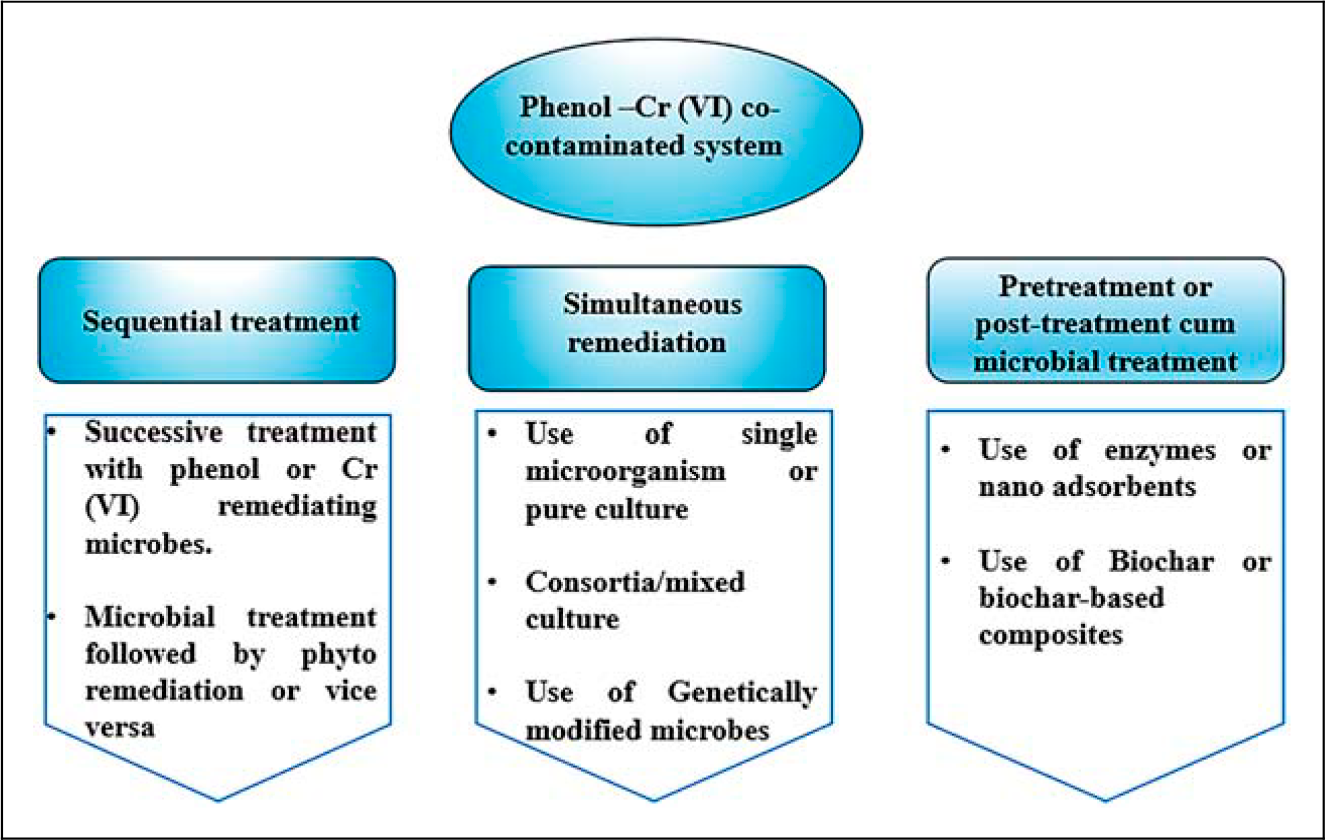
Different approaches for co-remediation of phenol and Cr (VI) using microorganisms. Cr, Chromium.

Co-removal mechanisms of phenol and Cr (VI) by single bacterial cell. 1. Biodegradation/mineralization of phenol using TCA cycle. 2. Intracellular Cr (VI) reduction to Cr (III) using phenol/metabolites of phenol as e− donors (Shown by dash arrows). 3. Intracellular enzymatic Cr (VI) reduction to Cr (III). 4. Accumulation/complexation of Cr (VI). 5. Accumulation/precipitation of Cr (III). 6. Extracellular reduction of Cr (VI) to Cr (III) using enzyme or various e− donors. 7. Periplasmic absorption of Cr (VI)/Cr (III). 8. Adsorption of Cr (VI) on the cell surface.
Simultaneous Removal of Phenol and Chromium (VI) Using Microorganisms

Conclusions and Future Perspectives
Concurrent bioremediation of co-contaminants viz., heavy metals and organic pollutants, is a serious challenge, as microorganisms not only have to resist the toxicity of both contaminants but also have to remove them from the system. Indeed, the presence of heavy metals is known to inhibit the biodegradation/bioremoval process of organic pollutants and vice versa. Looking into the current industrial development scenario and realizing the future load of environmental pollution, there is an urgent need for the development of sustainable methods to mitigate combined pollution of organic compounds and heavy metals, particularly phenol and Cr (VI). Bioremediation can be looked upon as one such option that has the potential to resolve this vast problem of mixed contamination. The use of microbial consortia showing remediating properties toward different target pollutants is one of the effective approaches for the treatment of contaminants. Moreover, immobilization of microbe(s), enzymatic pretreatment, the use of nanoadsorbents, biochar, GEM, and a combination of both plants and microbial systems in the form of constructed/floating wetlands also seems promising. Considering limited reports on this aspect, it is emphasized that studies on the role of environmental factors, nutrient supply, and application in industrial wastewater systems also need to be incorporated into the experimental design to explore the real application of microorganisms in the co-remediation of pollutants.
Moreover, more research is needed concerning removing high concentrations of phenol and hexavalent Cr that prevail in tannery wastewater, chemical manufacturing, and metal-finishing wastewater using biologically safe, robust microorganisms. Some of the areas that need to be explored further in the area of co-remediation of phenol and Cr (VI) are as follows:
In many studies, Cr (VI) is being reduced to lesser toxic form of Cr (III) using microbes or their enzymes; however, the fate of Cr (III) is overlooked or unexplored. So, studies should be focused more on the complete removal of Cr (VI) and also Cr (III). This could be done with sequential treatment or using microbial consortia. More pilot- and field-scale studies are required to evaluate how fluctuating environmental parameters affect simultaneous bioremediation. Detailed mechanistic studies are needed to elucidate metabolic pathways and potential synergistic or antagonistic effects between phenol degradation and Cr reduction. Research into safe disposal or recovery methods for residual heavy metals in biomass is limited. More studies need to be done on elucidating the stress response and resistance mechanisms to toxic phenol and Cr in microbes using proteomics or metabolomics. This will help in identifying the adaptation strategies and novel enzymes used by the microbe(s) to cope with the toxicity of both pollutants. Indeed, more studies on field trials and scaled-up conditions need to be done, with real wastewater.
Authors’ Contributions
A.B. conceptualized and prepared the original draft, and A.G. provided valuable inputs to the article and edited the content.
Footnotes
Author Disclosure Statement
The authors declare that they have no conflict of interest.
Funding Statement
This work received no funding from any organization, agency, or individual.